
|
시장보고서
상품코드
2122742
AI 칩셋 : 시장 점유율 분석, 업계 동향 및 통계, 성장 예측(2026-2031년)AI Chipsets - Market Share Analysis, Industry Trends & Statistics, Growth Forecasts (2026 - 2031) |
||||||
 Mordor Intelligence
Mordor Intelligence에 의하면, 2026년 AI 칩셋 시장 규모는 702억 5,000만 달러로 추정되고 2025년 530억 6,000만 달러에서 확대해, 2031년에는 2,859억 달러에 이를 것으로 예측됩니다.
2026-2031년 동안의 연평균 성장률(CAGR)은 32.41%를 나타낼 것으로 전망됩니다.

본 보고서는 구성 요소별(CPU, GPU, 기타), 처리 유형별(훈련, 추론), 도입 장소별(클라우드·하이퍼스케일 데이터센터, 기업 On-Premise 데이터센터, 기타), 용도별(가전제품, 자동차, 기타), 기술 노드별, 지역별로 분류되어 있습니다. 시장 예측은 금액(달러) 기준으로 제시되어 있습니다.
세계의 AI 칩셋 시장 동향 및 인사이트
최첨단 모델 개발자에 의한 훈련용 연산 수요의 폭발적 증가
대규모 언어 모델의 연간 연산 수요는 18개월마다 10배씩 증가하고 있으며, 이는 멀티다이 GPU 및 첨단 패키징 솔루션에 대한 지속적인 수주를 견인하고 있습니다. NVIDIA 데이터센터 부문의 매출은 Blackwell 슈퍼컴퓨터 출하를 배경으로 2025년 4분기에 356억 달러에 달했으며, 이는 하이퍼스케일 고객들이 AI 전용으로 막대한 재고를 축적하고 있음을 여실히 보여줍니다. 현재 멀티모달 모델 개발자들은 상호 연결된 수천 대의 가속기를 필요로 하고 있으며, 이로 인해 CoWoS 기판 및 차세대 HBM 스택에 대한 수요가 증가하고 있습니다. 그 결과, 주요 AI 기업들은 2027년까지 전 세계 AI 연산 능력의 15-20%를 장악할 것으로 예상되며, 3nm급 반도체의 지속적인 조달이 확보될 전망입니다. 이러한 수요 집중은 단기적인 공급 부족을 심화시키는 한편, 첨단 노드에서 제조가 가능한 공급업체들에게는 수년에 걸친 수익 파이프라인을 확립하게 될 것입니다. 그 결과, AI 칩셋 시장은 예측 기간 동안 훈련용 구매가 구조적으로 높은 수준을 유지할 것으로 예상되어 그 혜택을 누릴 것으로 보입니다.
자동차 부문의 ‘소프트웨어 정의 차량(SDV)’용 실리콘 설계 수주
각 자동차 제조업체들은 다수의 전자 제어 장치를 AI 지원 중앙 집중형 연산 도메인으로 통합하고 있습니다. 산업 분석가들은 2035년까지 신차의 80%가 AI 기능을 탑재할 것으로 예측하고 있으며, 이로 인해 추론용 가속기의 거대한 도입 기반이 형성될 것입니다. 5nm 공정 기술을 기반으로 제조된 NXP의 S32N 프로세서는 엄격한 ASIL D 요건을 충족하면서도 34TOPS의 성능을 발휘하고 있으며, 자동차 등급의 안전성과 AI 처리 능력이 단일 디바이스 내에서 공존할 수 있음을 보여줍니다. 각 설계 주기는 7년에서 10년에 달하기 때문에 현재 모델에 채택된 반도체는 공급업체에게 연금과 같은 안정적인 매출을 가져다줍니다. 따라서 현재 레벨 3 자율 주행, 센서 퓨전, 무선(OTA) 업그레이드 기능을 위해 확보된 설계 수주는 예측 기간 동안 수요를 더욱 확대할 것으로 보입니다.
3nm 이하 공급망의 리소그래피 병목 현상
2nm 공정 제조에 필요한 고NA EUV 장비는 1대당 3억 달러 이상이 들며, 그 수량은 여전히 제한적입니다. TSMC의 첫 번째 2nm 파일럿 라인은 2025년 하반기에 양산을 시작하지만, 주요 고객들의 대량의 사전 배정 주문에 직면해 있습니다. 생산 능력 부족으로 인해 웨이퍼 가격이 상승하고 있으며, 이러한 공정 노드에서 제조되는 AI 가속기의 납기 기간이 길어지고 있습니다. 중국이 고 NA 리소그래피 시장에서 배제됨에 따라 세계 공급망은 더욱 분절화되고 있으며, 기술 기준의 양극화가 우려되고 있습니다. 그 결과, 2027년 이후 추가 팹이 가동을 시작할 때까지 단기적으로는 공급량이 감소함과 동시에 AI 칩셋 시장의 성장률이 둔화될 것입니다.
부문별 분석
NPU와 ASIC이 2031년까지 연평균 성장률(CAGR) 44.2%를 나타낼 것으로 예측되는 반면, GPU는 훈련 과정에서 타의 추종을 불허하는 병렬 처리 능력을 제공함으로써 2025년 AI 칩셋 시장 점유율 51.40%를 유지했습니다. 최첨단 모델이 연산 자원 수요를 확대함에 따라 GPU 출하에 할당되는 시장 규모는 절대값으로 계속 증가하겠지만, 특정 부문용 실리콘으로의 점유율 이동은 부인할 수 없는 사실입니다. 메모리 및 스토리지 공급업체들은 비할 데 없는 호재를 누리고 있습니다. 삼성의 HBM3E 스택은 현재 다이당 36GB에 달하며, 더 큰 컨텍스트 윈도우에 대한 수요를 충족시키는 동시에 평균 판매 가격을 끌어올리고 있습니다. 2024년 이후 HBM 가격이 500% 상승한 것은 시장이 순수한 주파수보다 대역폭을 더 중요시하고 있음을 뒷받침합니다. 치플릿(chiplet)을 활용한 이종 설계에서는 CPU, NPU, HBM을 공통 인터포저 위에 통합하여 엣지 추론을 위한 전력 소비 한도를 최적화하고 있습니다. 고급 2.5D 패키징, 다이 간 상호 연결, 메모리 콜로케이션을 숙달한 벤더는 지속적으로 진화하는 AI 칩셋 시장에서 높은 수익률을 달성할 것으로 예측됩니다.
CPU 부문은 온다이 AI 가속기 및 새로운 명령어 세트의 도입을 통해 적응을 추진하며, 제어 로직과 추론이 혼재된 기존 워크로드에서 그 중요성을 유지하고 있습니다. FPGA는 특히 산업용 로봇 및 통신 게이트웨이 분야에서 절대적인 처리량보다 결정론적 지연 시간 및 현장 업그레이드 가능성이 중시되는 부문에서 다시 한 번 탄력을 받고 있습니다. 아키텍처의 다양성은 각 워크로드가 가장 효율적인 실리콘 블록에 할당되므로, 궁극적으로 총 잠재 시장 규모(TAM)를 확대시킵니다. 따라서 시스템 통합사업자들이 개별 부품이 아닌 턴키형 서브시스템을 요구하는 가운데, 멀티-칩렛 솔루션을 통합할 수 있는 공급업체는 시장 점유율을 대폭 확대할 수 있는 위치에 있습니다.
2025년에는 랙당 수백 페타플롭스를 처리하는 하이퍼스케일 데이터센터 클러스터를 핵심으로 하여, 훈련이 AI 칩셋 시장 점유율의 60.30%를 차지했습니다. 다중 모드 모델의 매개변수 수가 기하급수적으로 증가하고 있기 때문에 훈련과 관련된 시장 규모는 계속 확대될 전망이며, 2030년까지 1억 개의 H100급 GPU가 필요할 것이라는 예측도 있습니다. 그럼에도 불구하고, 기업들이 각 산업 분야에서 생성형 AI 서비스를 전개하고 네트워크 에지에 소형 모델을 통합함에 따라, 추론용 출하량은 연평균 성장률(CAGR) 36.9%로 성장할 전망입니다. Cerebras Systems와 Qualcomm은 공동으로 기존 솔루션에 비해 10배 향상된 가격 대비 성능 비율을 입증하며, 새로운 아키텍처가 기존의 비용 곡선을 뒤집을 가능성을 뒷받침했습니다.
엣지 추론 가속기는 FLOPS보다 에너지 효율을 우선시하고 있으며, 이에 따라 벤더들은 어텐션이나 컨볼루션과 같은 커널을 위해 저전압 SRAM, 니어 메모리 컴퓨팅, 아날로그 처리를 채택하고 있습니다. 이러한 이분법으로 인해, 훈련용 초고밀도 수냉식 다이와 추론용 슬림한 밀리와트급 ASIC이라는 두 가지 병행된 제품 로드맵이 탄생하고 있습니다. 두 범주에 걸쳐 사업을 영위하는 벤더는 소프트웨어 툴체인의 교차 판매가 가능하지만, 반면 전문 벤더는 지연 시간, 보안 또는 가격에 민감한 엔드포인트와 같은 틈새 시장을 공략할 가능성이 있습니다. 그 결과 발생하는 경쟁적 긴장감이 AI 칩셋 시장 전반에 걸친 혁신을 뒷받침하고 있습니다.
지역별 분석
2025년, 아시아태평양은 AI 칩셋 시장 점유율의 41.10%를 차지하며 계속해서 주도적인 위치를 유지했습니다. 중국의 1,430억 달러 규모의 AI 자급자족 프로그램, 대만의 첨단 AI 제조 분야에서 90%가 넘는 점유율, 한국의 HBM 부문에서의 패권이 이 지역의 우위를 더욱 공고히 하고 있습니다. 일본의 슈퍼컴퓨터 ‘후가쿠(Fugaku)’의 업그레이드는 훈련용 가속기에 대한 국내 수요를 더욱 공고히 하고 있습니다. 그 결과, 단기적인 수출 규제를 둘러싼 마찰이 있음에도 불구하고, 아시아태평양 관련 시장 규모는 꾸준히 확대될 전망입니다.
북미는 탄탄한 연구개발(R&D) 생태계, 하이퍼스케일 규모의 설비 투자, ‘CHIPS and Science Act’에 따른 정부 보조금 등의 혜택을 누리고 있습니다. NVIDIA 플랫폼의 지배적 지위와 인텔의 파운드리 사업 리쇼어링 전략은 최첨단 생산 능력에 대한 접근성을 유지하면서 지역 내 공급망 관리를 강화하고 있습니다. 이러한 요인들로 인해 북미는 특히 트레이닝 클러스터 및 클라우드 공급업체용 맞춤형 가속기 분야에서 2위 소비 거점으로서의 지위를 유지하고 있습니다.
중동 및 아프리카는 절대값으로는 작지만 연평균 성장률(CAGR) 34.1%를 나타낼 것으로 예측되어, AI 칩셋 시장에서 가장 빠르게 성장하는 지역이 될 전망입니다. NVIDIA의 GPU를 핵심으로 하는 아랍에미리트의 ‘스타게이트 캠퍼스’와 사우디아라비아의 ‘비전 2030’에 따른 400억 달러 규모의 AI 펀드는 유럽과 미국의 기술 기업들로부터 직접 투자를 유치하고 있습니다. 사막 기후에 대응한 열 설계와 아랍어 지원 LLM(대규모 언어 모델)을 위한 맞춤화를 통해 응용 범위가 확대되고 있으며, 현지 조건이 어떻게 맞춤형 실리콘 솔루션을 만들어내는지 여실히 보여주고 있습니다. 유럽은 계속해서 데이터 주권과 에너지 효율에 중점을 두고 있으며, 저전력 AI 칩셋의 사양 선정을 촉진하는 GAIA-X 클라우드 표준을 추진하고 있습니다. 남미는 신흥 도입 지역으로, 농업 및 천연 자원 모니터링에 엣지 AI를 활용하고 있지만, 선진 노드에 대한 접근성 면에서는 여전히 뒤처져 있습니다.
기타 혜택
- 엑셀 형식 시장 예측(ME) 시트
- 3개월간의 애널리스트 지원
자주 묻는 질문
목차
제1장 서론
제2장 조사 방법
제3장 주요 요약
제4장 시장 인사이트
제5장 시장 역학
제6장 시장 세분화
제7장 경쟁 구도
제8장 투자 분석
제9장 시장 전망
KTH 26.09.08According to Mordor Intelligence, AI chipsets market size in 2026 is estimated at USD 70.25 billion, growing from 2025 value of USD 53.06 billion with 2031 projections showing USD 285.9 billion, growing at 32.41% CAGR over 2026-2031.
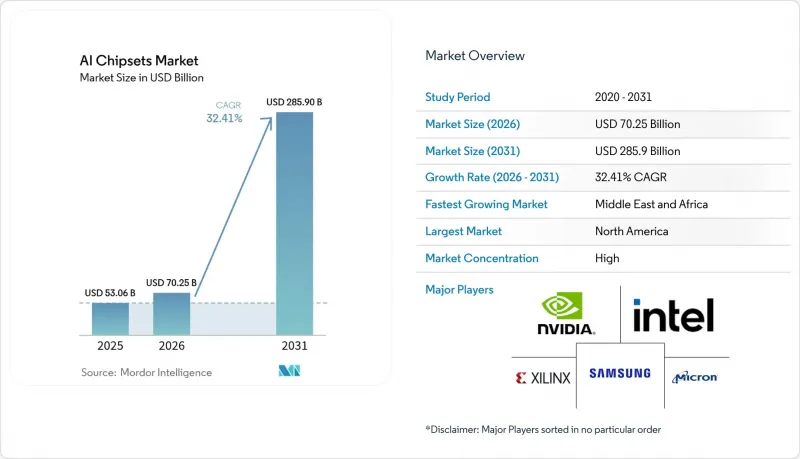
This report is Segmented by Component (CPU, GPU, and More), Processing Type (Training, Inference), Deployment Location (Cloud/Hyperscale Data Center, Enterprise On-Prem Data Center and More), Application (Consumer Electronics, Automotive & Transportation, and More), Technology Node and Geography. The Market Forecasts are Provided in Terms of Value (USD).
Global AI Chipsets Market Trends and Insights
Exploding Training-Compute Demand from Frontier-Model Developers
Annual compute needs for large-scale language models are increasing ten-foldev ery 18 months, driving sustained orders for multi-die GPUs and advanced packaging solutions. NVIDIA's data-center revenue rose to USD 35.6 billion in Q4 2025 on the back of Blackwell supercomputer shipments, underscoring how hyperscale customers are accumulating vast AI-specific inventories. Multimodal model builders now require thousands of interconnected accelerators, pushing demand for CoWoS substrates and next-generation HBM stacks. As a result, leading AI companies are expected to control 15-20% of global AI-compute capacity by 2027, ensuring continuous procurement of 3 nm-class silicon. This volume concentration intensifies near-term shortages but establishes a multi-year revenue pipeline for suppliers that can execute at advanced nodes. Consequently, the AI chipsets market will benefit from a structurally higher baseline of training-oriented purchases through the forecast horizon.
Automotive "Software-Defined Vehicle" Silicon Design Wins
Automakers are consolidating scores of electronic control units into centralized AI-enabled compute domains. Industry analysts project that 80% of new vehicles will embed AI functionality by 2035, creating a large installed base for inference-class accelerators. NXP's S32N processors built on 5 nm technology deliver 34 TOPS while meeting rigorous ASIL D requirements, signalling that automotive-grade safety and AI horsepower can coexist in a single device. With each design cycle spanning seven to ten years, silicon selected for today's models generates annuity-like volume for their suppliers. Design wins now being awarded for Level 3 autonomy, sensor fusion, and over-the-air upgradability will therefore compound demand during the forecast period.
Supply-Chain Lithography Bottlenecks Below 3 nm
High-NA EUV machines required for 2 nm production cost more than USD 300 million each and remain limited in quantity. TSMC's first 2 nm pilot line enters mass production in late 2025 but faces heavy pre-allocations from flagship customers. Capacity scarcity drives higher wafer pricing and lengthens delivery lead times for AI accelerators fabricated on these nodes. China's exclusion from High-NA lithography further fragments global supply chains, raising the prospect of dual technology standards. The net effect lowers near-term unit availability and tempers the AI chipsets market growth rate until additional fabs come online after 2027.
Other drivers and restraints analyzed in the detailed report include:
- Ultra-Low-Power Edge AI ASIC Breakthroughs
- National AI-Infrastructure Stimulus Programs
- AI-Model Compression Reducing Silicon Requirements
For complete list of drivers and restraints, kindly check the Table Of Contents.
Segment Analysis
GPUs retained 51.40% AI chipsets market share in 2025 by delivering unmatched parallelism for training, even as NPUs and ASICs are forecast to grow at a 44.2% CAGR by 2031. The market size allocated to GPU shipments will continue rising in absolute terms as frontier models swell compute budgets, yet the share shift toward domain-specific silicon is unmistakable. Memory and storage suppliers enjoy extraordinary tailwinds: HBM3E stacks from Samsung now reach 36 GB per die, meeting larger context window demands while raising average selling prices. A 500% increase in HBM pricing since 2024 confirms the market's appetite for bandwidth over raw frequency. Heterogeneous designs based on chiplets are integrating CPUs, NPUs, and HBM on a common interposer to optimize power envelopes for edge inference. Vendors that master advanced 2.5D packaging, die-to-die interconnects, and memory co-location will capture premium margins within the evolving AI chipsets market.
The CPU segment adapts through on-die AI accelerators and new instruction sets, preserving relevance in traditional workloads that intermingle control logic and inference. FPGAs regain momentum where deterministic latency or in-field upgradability outweighs absolute throughput, especially inside industrial robots and telecom gateways. Architectural diversity ultimately raises the total addressable market because each workload maps to the most efficient silicon block. Suppliers capable of orchestrating multi-chiplet solutions are thus positioned for outsized share gains as system integrators demand turnkey subsystems rather than discrete parts.
Training commanded 60.30% of AI chipsets market share in 2025, anchored by hyperscale data-center clusters running hundreds of petaflops per rack. The market size linked to training will keep growing because parameter counts in multimodal models expand geometrically; scenarios point to 100 million H100-class GPUs required by 2030. Still, inference shipments will scale at a 36.9% CAGR as enterprises roll out generative AI services across verticals and embed smaller models at the network edge. Cerebras Systems and Qualcomm jointly demonstrated 10X price-performance gains versus incumbent solutions, confirming that fresh architectures can disrupt historical cost curves.
Edge inference accelerators place energy efficiency above FLOPS, spurring chip vendors to adopt low-voltage SRAM, near-memory compute, and analog processing for kernels such as attention or convolution. This dichotomy creates two parallel product roadmaps: ultra-dense, liquid-cooled dies for training, and svelte, milliwatt-class ASICs for inference. Vendors that straddle both categories can cross-sell software toolchains, while specialists may seize niches around latency, security, or price-sensitive endpoints. The resulting competitive tension sustains innovation across the AI chipsets market.
Complete Report Scope:
- By Component
- Central Processing Unit (CPU)
- Graphics Processing Unit (GPU)
- Neural Network Processor (NNP)
- Other Components
- By Application
- Consumer Electronics
- Automotive
- Healthcare
- Automation and Robotics
- Other Applications
- By Geography
- North America
- Europe
- Asia-Pacific
- Latin America
- Middle-East
Geography Analysis
Asia-Pacific maintained leadership with 41.10% AI chipsets market share in 2025. China's USD 143 billion AI-self-reliance program, Taiwan's >90% share in advanced AI manufacturing, and South Korea's hegemony in HBM reinforce the region's advantage. Japan's Fugaku supercomputer upgrade further cements local demand for training-class accelerators. As a result, the market size tied to Asia-Pacific will expand steadily despite near-term export-control friction.
North America benefits from a deep R&D ecosystem, hyperscale capex, and government subsidies under the CHIPS and Science Act. NVIDIA's platform dominance and Intel's foundry reshore strategy tighten regional supply-chain control while preserving access to bleeding-edge capacity. These factors keep North America as the second-largest consumption base, especially for training clusters and custom accelerators for cloud providers.
The Middle East and Africa region, although smaller in absolute terms, is projected to post a 34.1% CAGR, making it the fastest-growing territory in the AI chipsets market. The UAE's Stargate campus anchored by NVIDIA GPUs and Saudi Arabia's Vision 2030 USD 40 billion AI fund draw direct investment from Western tech firms. Customizations for desert-climate thermals and Arabic-language LLMs broaden the application spectrum, underscoring how local conditions can trigger tailored silicon solutions. Europe remains focused on data sovereignty and energy efficiency, championing GAIA-X cloud standards that influence spec selection toward lower-power AI chipsets. South America is an emerging adopter, leveraging edge AI for agriculture and natural-resource monitoring, yet still trails on advanced-node access.
- Advanced Micro Devices Inc. (AMD)
- Xilinx Inc.
- Graphcore Ltd
- Huawei Technologies Co. Ltd
- IBM Corporation
- Intel Corporation
- NVIDIA Corporation
- Micron Technology Inc.
- Samsung Semiconductor (Samsung Electronics Co. Ltd)
Additional Benefits:
- The market estimate (ME) sheet in Excel format
- 3 months of analyst support
TABLE OF CONTENTS
1 INTRODUCTION
- 1.1 Study Assumptions and Market Definition
- 1.2 Scope of the Study
2 RESEARCH METHODOLOGY
3 EXECUTIVE SUMMARY
4 MARKET INSIGHTS
- 4.1 Market Overview
- 4.2 Industry Attractiveness - Porter's Five Forces Analysis
- 4.2.1 Threat of New Entrants
- 4.2.2 Bargaining Power of Buyers
- 4.2.3 Bargaining Power of Suppliers
- 4.2.4 Threat of Substitute Products
- 4.2.5 Intensity of Competitive Rivalry
- 4.3 Industry Value Chain Analysis
- 4.4 Assessment of the Impact of COVID-19 on the AI Chipsets Market
5 MARKET DYNAMICS
- 5.1 Market Drivers
- 5.1.1 Increase in Demand for Autonomous Driving Technology
- 5.1.2 Growth in Edge Analytics for IoT Application
- 5.2 Market Restraints
- 5.2.1 Complexity in Design and AI Interface
6 MARKET SEGMENTATION
- 6.1 By Component
- 6.1.1 Central Processing Unit (CPU)
- 6.1.2 Graphics Processing Unit (GPU)
- 6.1.3 Neural Network Processor (NNP)
- 6.1.4 Other Components
- 6.2 By Application
- 6.2.1 Consumer Electronics
- 6.2.2 Automotive
- 6.2.3 Healthcare
- 6.2.4 Automation and Robotics
- 6.2.5 Other Applications
- 6.3 By Geography
- 6.3.1 North America
- 6.3.2 Europe
- 6.3.3 Asia-Pacific
- 6.3.4 Latin America
- 6.3.5 Middle-East
7 COMPETITIVE LANDSCAPE
- 7.1 Company Profiles
- 7.1.1 Advanced Micro Devices Inc. (AMD)
- 7.1.2 Xilinx Inc.
- 7.1.3 Graphcore Ltd
- 7.1.4 Huawei Technologies Co. Ltd
- 7.1.5 IBM Corporation
- 7.1.6 Intel Corporation
- 7.1.7 NVIDIA Corporation
- 7.1.8 Micron Technology Inc.
- 7.1.9 Samsung Semiconductor (Samsung Electronics Co. Ltd)