

|
시장보고서
상품코드
2099236
미국의 HBM 시장 : 점유율 분석, 업계 동향 및 통계, 성장 예측(2026-2031년)United States HBM - Market Share Analysis, Industry Trends & Statistics, Growth Forecasts (2026 - 2031) |
||||||
 Mordor Intelligence
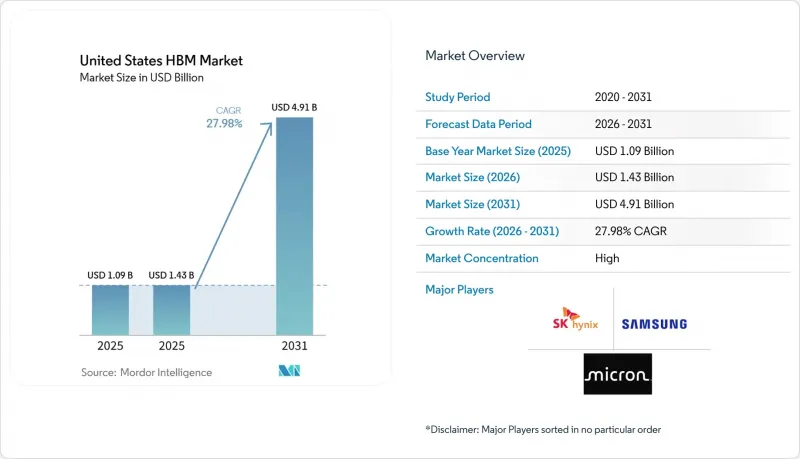
Mordor Intelligence에 의하면, 미국 HBM 시장 규모는 2025년에 10억 9,000만 달러로 평가되었고 2026년 14억 3,000만 달러에서 2031년까지 49억 1,000만 달러에 이를 것으로 예측되며, 예측 기간(2026-2031년) CAGR은 27.98%를 나타낼 전망입니다.
본 보고서는 HBM 유형(HBM2E 및 그 이전, HBM3, HBM3E 등), 기술 분야(1X 이상, 1Y, 1Z 및 1Z 미만), 최종 이용 산업(CSP 및 하이퍼스케일러, 인터넷 플랫폼, 엔터프라이즈, 통신 등), 용도(AI 훈련, 추론, HPC, 그래픽스), 패키징 유형(2.5D 인터포저, 3D 스태킹, 팬아웃)별로 분류되어 있습니다. 시장 전망은 금액(달러) 기준으로 제시되어 있습니다.
미국 HBM 시장 동향 및 인사이트
AI 훈련 및 추론에서의 메모리 집약도 가속화
새로운 플랫폼이 등장할 때마다 더 많은 스택이 사용되고, 스택당 대역폭도 높아짐에 따라 가속기 1대당 HBM 수요는 가속기 대수 증가율을 상회하는 속도로 증가하고 있습니다. NVIDIA는 Vera Rubin이 2026년 5월에 본격 양산에 들어갔다고 발표하며, 이 플랫폼을 ‘에이전트형 AI 팩토리’용으로 포지셔닝했습니다. 이에 따라 메모리 대역폭은 시스템 설계 및 도입 계획에서 계속해서 핵심적인 역할을 수행하고 있습니다. Samsung Electronics는 자사의 상용 HBM4가 11.7 Gbps의 전송 속도와 스택당 최대 3.3 TB/s를 달성했다고 발표했는데, 이는 더욱 까다로운 AI 워크로드를 처리하기 위해 메모리 로드맵이 어떻게 추진되고 있는지를 보여줍니다. 마이크론은 Vera Rubin을 위해 HBM4의 대량 생산을 시작했으며, AMD는 2025년 데이터센터 매출이 166억 달러에 달했다고 보고하여, HBM을 탑재한 컴퓨팅 플랫폼에 대한 수요가 지속되고 있음을 시사하고 있습니다. 훈련 클러스터는 여전히 대량의 메모리를 소비하지만, 추론 플리트는 실제 사용자 트래픽 및 서비스의 성장에 따라 확대됨에 따라 보다 안정적인 수요층을 형성하고 있습니다. 이러한 추세는 신규 도입과 지속적인 플랫폼 갱신 주기 모두에서 메모리 탑재량이 증가하고 있기 때문에 미국 HBM 시장을 뒷받침하고 있습니다.
미국 데이터센터 내 하이퍼스케일 GPU 클러스터의 확대
대규모 AI 데이터센터의 확장은 가속기 도입 일정이 메모리 공급 상황과 밀접하게 연관되어 있기 때문에 HBM 출하량을 지속적으로 끌어올리고 있습니다. NVIDIA에 따르면, 'Vera Rubin'은 30개국 이상의 350개 이상공급망 파트너를 통해 7종의 새로운 칩으로 본격적인 양산에 들어갔다고 합니다. 이는 도입을 위해 움직이기 시작한 시스템의 규모를 시사합니다. 마이크론은 2026년 3월에 'Vera Rubin'용 HBM4의 대량 생산을 시작했으며, 삼성도 2026년 2월에 상용 HBM4의 양산을 시작했습니다. 이 모든 것은 주요 고객의 전개 계획과 발맞추고 있습니다. AMD의 2025년 데이터센터 매출 성장세 또한 가속기 수요 기반의 확대를 시사하고 있습니다. HBM 수요는 개별 메모리 구매가 아닌 플랫폼 채택과 연동되기 때문에 이 점은 중요합니다. 파일럿 클러스터에서 실제 운영 환경으로 전환하는 구매자가 늘어남에 따라 공급 여유가 줄어들고 있으며, 리드타임은 여전히 민감한 문제로 남아 있습니다. 이러한 변화로 인해 미국의 HBM 시장은 단일 조달 주기가 시사하는 것보다 더 광범위하고 지속적인 수요 기반을 확보하게 될 것입니다.
CoWoS 및 유사 공정에서의 첨단 패키징 생산 능력 제약
첨단 패키징은 여전히 제약 요인으로 작용하고 있습니다. 이는 미국 수요가 최첨단 AI 가속기를 위한 제한된 수의 인증된 통합 공정에 계속 의존하고 있기 때문입니다. NIST에 따르면, SK하이닉스의 인디애나주 시설은 2028년 하반기가 되어서야 비로소 양산을 시작할 전망이며, 국내 공급 완화는 현재 수요 급증이 지나간 후에야 이루어질 것입니다. 마이크론의 아이다호, 뉴욕, 버지니아 계획은 대규모이지만, 이는 패키징 생산 능력을 즉시 투입하기보다는 수년 단위의 확장 계획의 일부에 불과합니다. 이 때문에 패키징 공급 상황과 가속기 출시 계획이 어긋날 때마다, 단기적인 미국 HBM 시장은 일정상의 압박에 직면하게 될 것입니다. 이 문제는 구조적인 것입니다. 왜냐하면 차세대 HBM에는 단순히 웨이퍼 생산량을 늘리는 것뿐만 아니라 패키징 검증과 공정 조정도 필요하기 때문입니다. 인증된 생산 능력이 충분히 갖춰질 때까지는 최종 수요가 견조하더라도 도입 시기는 불안정한 상태를 유지할 것입니다.
부문 분석
2025년 시점에서 HBM3E는 미국 HBM 시장 점유율의 71.32%를 차지했으나, HBM4E 및 그 이후 세대의 HBM은 2031년까지 연평균 성장률(CAGR) 28.94%로 확대될 것으로 예측됩니다. 이러한 우위는 Blackwell 기반 시스템과 관련된 대규모 조달 주기에 기인하며, 이를 통해 HBM3E는 대량 도입되는 AI 가속기에서 핵심 메모리 옵션으로 자리 잡았습니다. 이 세대의 HBM은 미국 HBM 시장의 최근 국면을 특징지은 훈련을 많이 활용하는 인프라 구축에 필요한 대역폭을 제공했습니다. HBM2E 및 HBM3을 포함한 이전 세대는 인증 주기나 이미 도입된 플랫폼의 제약으로 인해 즉각적인 전환이 어려운 레거시 HPC 및 전문가용 시각화 환경에서 여전히 활용되고 있습니다. HBM4는 공급업체들이 개발 단계에서 고객 출하 단계로 넘어감에 따라 2026년 초 본격적인 상용화를 시작했습니다.
이 카테고리에서 가장 빠르게 성장하고 있는 분야는 HBM4E 및 그 이후 세대의 HBM입니다. 이는 고객들이 현재 동일한 패키지 실적 내에서 더 높은 처리량, 스택당 대용량화, 그리고 더 뛰어난 전력 효율을 요구하고 있기 때문입니다. Samsung Electronics는 자사의 상용 HBM4가 최대 3.3 TB/s를 달성하고 HBM3E 대비 전력 효율을 40% 향상시켰다고 발표하며, 이 부문의 향후 성장을 뒷받침할 명확한 성능 근거를 제시했습니다. 또한 삼성은 2026년 5월, 최대 3.6 TB/s의 대역폭과 48 GB의 용량을 갖춘 HBM4E의 샘플 출하를 시작하며, 해당 연도의 로드맵을 한층 더 앞당겼습니다. SK하이닉스는 2025년 9월에 HBM4개발을 완료했고, 마이크론은 2026년 3월에 ‘Vera Rubin’용 HBM4의 양산을 시작했습니다. 이를 통해 다음 주기가 계획 단계에서 실행 단계로 전환되었음이 확인되었습니다. 미국 HBM 업계에서 이러한 변화는 중요한 의미를 지닙니다. 왜냐하면 수요 증가는 더 이상 HBM4의 출시 여부에 좌우되는 것이 아니라, 공급업체가 고객의 전체 프로그램에 HBM4를 얼마나 신속하게 적용할 수 있는지에 달려 있게 되었기 때문입니다.
2025년, 1Z 이하의 첨단 노드는 미국 HBM 시장 규모의 49.94%를 차지하고 있으며, 2031년까지 연평균 성장률(CAGR) 28.69%를 나타낼 것으로 예측됩니다. 이는 주목할 만한 점입니다. 왜냐하면 동일한 노드 클래스가 현재의 수익과 미래의 성장을 모두 견인하고 있으며, 첨단 공정 기술이 더 이상 미래의 선택지가 아니라 이미 현재의 필수 요건이 되었음을 보여주기 때문입니다. 1Z 노드는 1차 HBM3E 물결을 뒷받침했지만, 현재는 1Z 이하 노드가 HBM4 및 HBM4E 제품으로의 전환을 뒷받침하고 있습니다. SK하이닉스는 자사의 HBM4가 1b nm 공정과 Advanced MR-MUF 공정을 채택하고 있으며, 차세대 HBM의 성능이 더욱 진보된 제조 기술과 직접적으로 연결되어 있다고 밝혔습니다. Samsung Electronics는 자사의 상용 HBM4가 4nm 로직 기반 다이와 1c DRAM 공정을 결합하고 있다고 밝히며, 다른 주요 공급업체에서 나타나는 ‘동일 노드’ 추세를 뒷받침하고 있습니다.
고도화된 노드가 중요한 이유는 코패키징된 메모리가 시스템 수준에서 고속화되는 AI 가속기, 스택 수 증가, 그리고 더욱 엄격해진 전력 소비 제한에 지속적으로 대응해야 하기 때문입니다. 마이크론이 ‘Vera Rubin’을 위해 HBM4 양산에 착수한 것은 1Z 이하 공정 기술이 더 이상 단순한 개발상의 벤치마크가 아니라 실제 상용 공급의 일부가 되었음을 보여줍니다. 1X, 1Y, 1Z를 포함한 기존 노드 제품군에 대해서는 피크 성능과 마찬가지로 지속성이 중시되는 국방, 연구 및 인증 절차가 완만한 환경에서 여전히 수요가 있습니다. 이러한 구형 노드는 프로그램의 수명 주기가 길고 플랫폼 전환이 신중하게 이루어지는 경우에도 여전히 유용합니다. 하지만 2025년 미국 HBM 시장에서는 1Z 이하의 첨단 노드가 시장의 49.94%를 차지했습니다. 이는 미국 HBM 시장에서 다른 기술적 절충안보다 와트당 대역폭과 집적 효율이 더 중요시되기 시작했기 때문입니다.
기타 혜택:
- 엑셀 형식 시장 예측(ME) 시트
- 3개월간의 애널리스트 지원
자주 묻는 질문
목차
제1장 서론
제2장 조사 방법
제3장 주요 요약
제4장 시장 구도
제5장 시장 규모와 성장 예측
제6장 경쟁 구도
제7장 시장 기회와 향후 전망
JHS 26.08.07According to Mordor Intelligence, the United States HBM market size was valued at USD 1.09 billion in 2025 and estimated to grow from USD 1.43 billion in 2026 to reach USD 4.91 billion by 2031, at a CAGR of 27.98% during the forecast period (2026-2031).
This report is Segmented by HBM Type (HBM2E and Earlier, HBM3, HBM3E, and More), Technology Node (1X and Above, 1Y, 1Z, and Below 1Z), End Use Industry (CSPs and Hyperscalers, Internet Platforms, Enterprise, Telecom, and More), Application (AI Training, Inference, HPC, and Graphics), and Packaging Type (2. 5D Interposer, 3D Stacking, and Fan-Out). The Market Forecasts are Provided in Terms of Value (USD).
United States HBM Market Trends and Insights
Accelerating AI Training and Inference Memory Intensity
Per-accelerator HBM demand is rising faster than accelerator unit growth because each new platform uses more stacks and higher bandwidth per stack. NVIDIA stated that Vera Rubin ramped into full production in May 2026 and positioned the platform for agentic AI factories, which keeps memory bandwidth central to system design and deployment planning. Samsung said its commercial HBM4 reached 11.7 Gbps transfer speed and up to 3.3 TB/s per stack, which shows how memory roadmaps are being pushed to match more demanding AI workloads. Micron entered high-volume HBM4 production for Vera Rubin, and AMD reported USD 16.6 billion in 2025 data center revenue, pointing to sustained demand for HBM-equipped compute platforms. Training clusters still consume large amounts of memory, but inference fleets add a steadier demand layer as they expand with live user traffic and service growth. That pattern supports the United States HBM market because memory content now rises with both new installations and ongoing platform refresh cycles.
Hyperscale GPU Cluster Expansion in United States Data Centers
Large AI data center build-outs keep pulling HBM volumes forward because accelerator deployment schedules are closely tied to memory availability. NVIDIA said Vera Rubin entered full production with 7 new chips across more than 350 supply chain partners in 30 countries, which signals the scale of systems moving toward deployment. Micron moved into high-volume HBM4 production for Vera Rubin in March 2026, and Samsung began mass production of commercial HBM4 in February 2026, both aligned with large customer rollouts. AMD's 2025 data center revenue growth also points to a broader accelerator demand base, which matters because HBM demand follows platform adoption rather than stand-alone memory purchasing. As more buyers move from pilot clusters to production environments, supply allocations become harder to loosen and lead times remain sensitive. That shift gives the United States HBM market a broader and more durable demand base than a single procurement cycle would suggest.
Advanced Packaging Capacity Constraints Across CoWoS And Similar Flows
Advanced packaging remains a restraint because the United States demand still depends on a narrow set of qualified integration flows for frontier AI accelerators. NIST said SK hynix's Indiana facility is expected to begin mass production only in the second half of 2028, meaning domestic relief will arrive after the current demand wave. Micron's Idaho, New York, and Virginia plans are large, but they are part of a multi-year build-out rather than an immediate release of packaging capacity. This leaves the near-term United States HBM market exposed to schedule pressure whenever packaging availability and accelerator launch plans fall out of sync. The problem is structural because each new HBM generation also requires packaging validation and process tuning, not just more wafer output. Until more qualified capacity is in place, deployment timing will remain vulnerable even when end demand stays strong.
Other drivers and restraints analyzed in the detailed report include:
- HBM Adoption in Advanced Packaging and Chiplet Architectures
- Domestic Memory Supply Chain Reshoring Incentives and CHIPS Act Support
- High Yield Loss Risk In Multi-Die, High-Stack HBM Manufacturing
For complete list of drivers and restraints, kindly check the Table Of Contents.
Segment Analysis
HBM3E held 71.32% of the United States HBM market share in 2025, while HBM4E and later-generation HBM are projected to expand at a 28.94% CAGR through 2031. That lead came from the large procurement cycle tied to Blackwell-based systems, which made HBM3E the core memory choice for high-volume AI accelerator deployments. The generation delivered the bandwidth needed for the training-heavy build-out that defined the recent phase of the United States HBM market. Earlier generations, including HBM2E and HBM3, still served legacy HPC and professional visualization deployments where qualification cycles and installed platforms limited immediate migration. HBM4 entered meaningful commercial activity in early 2026 as suppliers shifted from development milestones to customer shipments.
The fastest-growing part of this category is HBM4E and later-generation HBM, as customers now want higher throughput, greater capacity per stack, and stronger power efficiency within the same package footprint. Samsung said its commercial HBM4 reached up to 3.3 TB/s and improved power efficiency by 40% compared with HBM3E, giving the segment a clear performance case for future growth. Samsung also began shipping HBM4E samples in May 2026, with up to 3.6 TB/s bandwidth and 48 GB capacity, pushing the roadmap forward further that year. SK Hynix completed HBM4 development in September 2025, and Micron began high-volume HBM4 production for Vera Rubin in March 2026, confirming that the next cycle has moved from planning to execution. In the United States HBM industry, that change matters because demand growth now depends less on whether HBM4 arrives and more on how quickly suppliers can scale it across customer programs.
Advanced nodes below 1Z commanded 49.94% of the United States HBM market size in 2025 and are projected to grow at a 28.69% CAGR through 2031. This is notable because the same node class is driving both current revenue and future growth, indicating that advanced process technology has already become a current requirement rather than a future option. The 1Z node underpinned the first HBM3E wave, while nodes below 1Z now support the shift to HBM4 and HBM4E products. SK hynix said its HBM4 uses the 1b nm process and the Advanced MR-MUF process, which ties next-generation HBM performance directly to more advanced manufacturing execution. Samsung said its commercial HBM4 combines a 4 nm logic base die with a 1c DRAM process, reinforcing the same-node trend seen with another leading supplier.
Advanced nodes matter because co-packaged memory must keep pace with faster AI accelerators, larger stack counts, and tighter power envelopes at the system level. Micron's move into high-volume HBM4 production for Vera Rubin shows that below 1Z execution is now part of live commercial supply, not just a development benchmark. Legacy node families, including 1X, 1Y, and 1Z, still have demand in defense, research, and slower-qualification environments where continuity matters as much as peak performance. Those older nodes remain relevant when program lifecycles are long, and platform migration is managed cautiously. Even so, advanced nodes below 1Z accounted for 49.94% of the United States HBM market in 2025, as the United States HBM market now rewards bandwidth per watt and integration efficiency over other technical trade-offs.
Complete Report Scope:
- By HBM Type
- HBM2E and Earlier Generations
- HBM3
- HBM3E
- HBM4
- HBM4E and Later-Generation HBM
- By Technology Node
- 1X And Above Legacy Nodes
- 1Y Node
- 1Z Node
- Advanced Nodes Below 1Z
- By Packaging Type
- 2.5D Interposer-Based Packaging
- 3D Stacking
- Fan-Out Advanced Packaging
- By End Use Industry
- Cloud Service Providers and Hyperscalers
- Internet Platforms and AI Model Developers
- Government, Defense, Research, and Academic Institutions
- Enterprise Data Centers
- Telecommunications Operators and Network Equipment Providers
- Other Enterprise Verticals
- By Application
- AI Model Training
- AI Model Inference
- HPC and Scientific Computing
- Professional Graphics, Rendering, and Visualization
- Network and Telecom Processing
- Other High-Bandwidth Compute Workloads
List of Companies Covered in this Report:
- SK Hynix Inc.
- Samsung Electronics Co., Ltd.
- Micron Technology, Inc.
Additional Benefits:
- The market estimate (ME) sheet in Excel format
- 3 months of analyst support
TABLE OF CONTENTS
1 INTRODUCTION
- 1.1 Study Assumptions and Market Definition
- 1.2 Scope of the Study
2 RESEARCH METHODOLOGY
3 EXECUTIVE SUMMARY
4 MARKET LANDSCAPE
- 4.1 Market Overview
- 4.2 Market Drivers
- 4.2.1 Accelerating AI Training and Inference Memory Intensity
- 4.2.2 Hyperscale GPU Cluster Expansion in United States Data Centers
- 4.2.3 HBM Adoption in Advanced Packaging and Chiplet Architectures
- 4.2.4 Domestic Memory Supply Chain Reshoring Incentives and CHIPS Act Support
- 4.2.5 HBM Demand Pull From Sovereign AI, Defense, and Secure Compute Programs
- 4.2.6 HBM Qualification for Next-Generation Accelerators and Custom Silicon
- 4.3 Market Restraints
- 4.3.1 Advanced Packaging Capacity Constraints Across CoWoS and Similar Flows
- 4.3.2 High Yield Loss Risk in Multi-Die, High-Stack HBM Manufacturing
- 4.3.3 Thermal Management Limits in High Power Density AI Systems
- 4.3.4 Heavy Concentration of Qualified Supply and Long Qualification Cycles
- 4.4 Supply Chain Analysis
- 4.5 Regulatory Landscape
- 4.6 Technological Outlook
- 4.7 Porter's Five Forces Analysis
- 4.7.1 Bargaining Power of Suppliers
- 4.7.2 Bargaining Power of Buyers
- 4.7.3 Threat of New Entrants
- 4.7.4 Threat of Substitutes
- 4.7.5 Intensity of Competitive Rivalry
5 MARKET SIZE AND GROWTH FORECASTS (VALUE)
- 5.1 By HBM Type
- 5.1.1 HBM2E and Earlier Generations
- 5.1.2 HBM3
- 5.1.3 HBM3E
- 5.1.4 HBM4
- 5.1.5 HBM4E and Later-Generation HBM
- 5.2 By Technology Node
- 5.2.1 1X And Above Legacy Nodes
- 5.2.2 1Y Node
- 5.2.3 1Z Node
- 5.2.4 Advanced Nodes Below 1Z
- 5.3 By Packaging Type
- 5.3.1 2.5D Interposer-Based Packaging
- 5.3.2 3D Stacking
- 5.3.3 Fan-Out Advanced Packaging
- 5.4 By End Use Industry
- 5.4.1 Cloud Service Providers and Hyperscalers
- 5.4.2 Internet Platforms and AI Model Developers
- 5.4.3 Government, Defense, Research, and Academic Institutions
- 5.4.4 Enterprise Data Centers
- 5.4.5 Telecommunications Operators and Network Equipment Providers
- 5.4.6 Other Enterprise Verticals
- 5.5 By Application
- 5.5.1 AI Model Training
- 5.5.2 AI Model Inference
- 5.5.3 HPC and Scientific Computing
- 5.5.4 Professional Graphics, Rendering, and Visualization
- 5.5.5 Network and Telecom Processing
- 5.5.6 Other High-Bandwidth Compute Workloads
6 COMPETITIVE LANDSCAPE
- 6.1 Market Concentration
- 6.2 Strategic Moves
- 6.3 Market Share Analysis
- 6.4 Company Profiles (includes Global Level Overview, Market Level Overview, Core Segments, Financials as available, Strategic Information, Products and Services, Recent Developments)
- 6.4.1 SK Hynix Inc.
- 6.4.2 Samsung Electronics Co., Ltd.
- 6.4.3 Micron Technology, Inc.
- 6.5 Other Ecosystem Players
- 6.5.1 NVIDIA Corporation
- 6.5.2 Advanced Micro Devices, Inc.
- 6.5.3 Intel Corporation
- 6.5.4 Broadcom Inc.
- 6.5.5 Marvell Technology, Inc.
- 6.5.6 Taiwan Semiconductor Manufacturing Company Limited
- 6.5.7 Amkor Technology, Inc.
- 6.5.8 ASE Technology Holding Co., Ltd.
- 6.5.9 Powertech Technology Inc.
- 6.5.10 Siliconware Precision Industries Co., Ltd.
- 6.5.11 GlobalFoundries Inc.
- 6.5.12 Applied Materials, Inc.
- 6.5.13 Cadence Design Systems, Inc.
- 6.5.14 Synopsys, Inc.
- 6.5.15 Rambus Inc.
- 6.5.16 Qualcomm Incorporated
- 6.5.17 Texas Instruments Incorporated
7 MARKET OPPORTUNITIES AND FUTURE OUTLOOK
- 7.1 White-Space and Unmet-Need Assessment


