

|
시장보고서
상품코드
2099767
HBM CoWoS 패키징 생산 능력 및 수급 : 시장 점유율 분석, 업계 동향 및 통계, 성장 예측(2026-2031년)HBM CoWoS Packaging Capacity and Supply-Demand - Market Share Analysis, Industry Trends & Statistics, Growth Forecasts (2026 - 2031) |
||||||
 Mordor Intelligence
Mordor Intelligence에 의하면, HBM CoWoS 패키징 생산 능력 및 수급 시장 규모는 2025년 17억 1,000만 달러로 평가되었습니다. 2026년에는 23억 1,000만 달러로 확대되어 2031년까지 84억 2,000만 달러에 이를 것으로 예상되고 2026년부터 2031년에 걸쳐 CAGR 29.53%로 성장할 전망입니다.
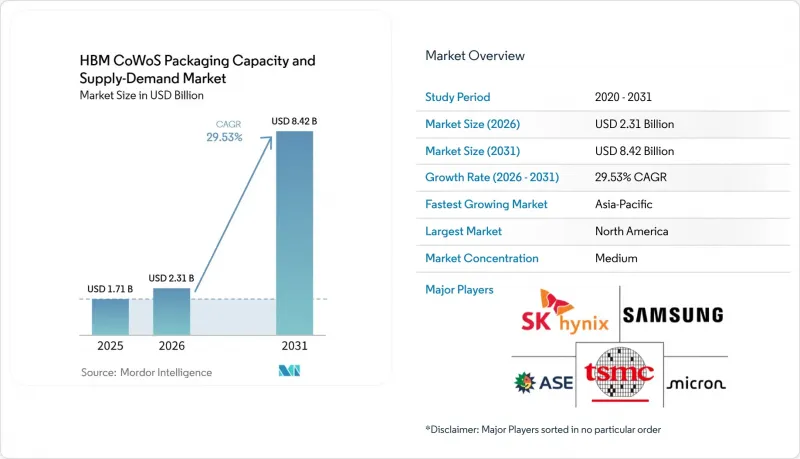
본 보고서는 패키징 기술별(CoWoS-S, CoWoS-R, CoWoS-L 등), HBM 세대별(HBM3, HBM3E, HBM4 등), 패키징 용량 티어별(월간 5만 웨이퍼 미만 등), 최종 사용자별(GPU 및 AI 칩 벤더 등), 용도별(애플리케이션 프로세서, GPU, FPGA 등), 그리고 지역별로 분류되어 있습니다. 시장 전망은 금액(달러) 기준으로 제시되어 있습니다.
세계의 HBM CoWoS 패키징 생산 능력 및 수급 시장 동향과 인사이트
AI 가속기 수요가 첨단 패키징 생산 능력을 상회
HBM CoWoS 패키징 생산 능력 및 수급 시장은 여전히 AI 시스템 수요와 이를 충족하기 위해 이용 가능한 인증된 CoWoS 생산량 간의 격차로 특징지어집니다. IEEE 보고서에 따르면, TSMC는 2025년에 CoWoS 생산 능력을 106% 확대했으나, 그 증산분은 고객 수요에 의해 급속히 흡수되어 공급망은 여전히 타이트한 상태를 유지했습니다. 또한 TSMC는 2026년 연례 주주총회에서 CoWoS 생산 능력이 2026년 말까지 완전히 예약되었다고 밝혔습니다. 이는 대규모 확장 노력을 거쳤음에도 불구하고, 현물 시장공급 여력이 여전히 제한적임을 보여줍니다. 이 점이 중요한 이유는 병목 현상이 웨이퍼 수에만 국한되지 않기 때문입니다. 차세대 가속기는 각 디바이스 내에서 더 큰 패키지와 더 많은 HBM을 채택하는 경향이 있기 때문입니다. 이러한 추세로 인해 출하량 증가와 패키지 복잡성 증가라는 두 가지 측면에서 패키징 수요가 높아지기 때문에 명목상 생산 능력이 확대되고 있음에도 불구하고 HBM CoWoS 패키징 생산 능력 및 수급 시장은 계속해서 타이트한 상태를 유지하고 있습니다. 그 결과, 조기에 발주한 고객은 공급을 확보할 수 있는 반면, 뒤늦게 진입한 고객은 리드타임 장기화, 출시 지연, 제품 일정 유연성 저하와 같은 과제에 직면하게 됩니다.
HBM4의 채택 확대가 인터포저의 복잡화와 웨이퍼 수요를 증가시키고 있습니다.
새로운 세대의 HBM으로의 전환에 따라, HBM CoWoS 패키징 생산 능력 및 수급 시장 전체에서 인터포저, 메모리 인터페이스, 그리고 열 관리에 대한 기술적 부담이 커지고 있습니다. SK하이닉스는 2026년 5월, 냉각 요소를 패키지 구조 내에 직접 내장하여 열 저항을 30% 저감하는 ‘iHBM’ 열 솔루션을 발표했습니다. 이는 메모리의 미세화가 패키지 설계에 그 어느 때보다 까다로운 과제를 안겨주고 있음을 여실히 보여줍니다. HBM4E를 둘러싼 고객사의 인증 작업에서도 유사한 방향성이 확인되고 있으며, 각 공급업체들은 단순한 메모리 밀도 향상뿐만 아니라 방열, 스택의 신뢰성, 그리고 고도의 패키지 통합에 주력하고 있습니다. 메모리 서브시스템이 대형화되고 발열량이 증가함에 따라, 인터포저 및 주변 패키지는 동일한 실적 내에서 더 높은 배선 밀도와 더 까다로운 전기적 조건을 충족해야 합니다. 이는 실질적으로 웨이퍼 수요 증가로 이어집니다. 더 복잡한 패키지는 인증에 시간이 더 오래 걸리고, 알려진 양품 수율에 대한 압박을 높이며, 신규 제품이 양산에 투입되기까지의 속도를 늦추기 때문입니다. 따라서 HBM CoWoS 패키징 생산 능력 및 수급 시장은 HBM4로의 전환에 따른 가치 상승의 혜택을 받고 있지만, 그 전환 자체가 엔지니어링상의 마찰을 야기하여 공급 부족 상태를 장기화시키는 요인이 되고 있습니다.
TSMC의 CoWoS 생산 능력이 여전히 제약 요인으로 작용하고 있습니다.
HBM CoWoS 패키징 생산 능력 및 수급 시장에서 단기적으로 가장 큰 제약 요인은 부가가치가 가장 높은 패키징 공정이 여전히 한 곳공급업체와 제한된 인증 라인에 크게 의존하고 있다는 점입니다. IEEE에 따르면, TSMC는 2026년에 연간 약 24만-27만 장의 웨이퍼를 OSAT 파트너사에 외주할 예정이며, 그 잉여분의 대부분은 복잡도가 낮은 CoWoS 공정을 담당하는 Amkor 및 Siliconware Precision Industries에 배분될 전망입니다. 이러한 합의는 압박을 완화하는 데 도움이 되겠지만, 가장 정교한 공정 경험과 최고 수준의 인증 신뢰성을 필요로 하는 최첨단 패키지 유형의 부족을 완전히 해결하는 것은 아닙니다. HBM CoWoS 패키징 생산 능력 및 수급 시장은 여전히 제약을 받고 있습니다. 새로운 생산 라인이 공급에 실질적으로 기여하기 위해서는 설비 도입, 공정 조정, 고객 인증, 그리고 안정적인 수율 확보가 필요하기 때문입니다. 설비 리드타임과 인증 주기로 인해 이 과정은 수 분기에 걸쳐 장기화되므로, 발표된 생산 능력은 수요 증가 속도와 동일한 속도로 실질적인 생산량으로 이어지지 않습니다. 이러한 상황으로 인해 시장은 집중된 상태가 지속되고, 공급업체의 강력한 우위가 유지되며, 공급 상황이 ‘할당 주도형’에서 보다 균형 잡힌 상태로 전환되는 시기가 지연되고 있습니다.
부문 분석
2025년, CoWoS-S는 패키징 기술 부문의 68.31%를 차지했으며, 이는 기준 연도에 HBM CoWoS 패키징 생산 능력 및 수급 시장이 여전히 검증된 실리콘 인터포저 형식에 얼마나 크게 의존하고 있었는지를 보여줍니다. 이러한 주도적 지위는 오랜 인증 실적, AI 훈련 시스템에서의 광범위한 도입, 그리고 패키지 개념 전체를 재설계하지 않고도 고대역폭을 필요로 하는 고객에게 친숙한 생산 흐름에 기인했습니다. 또한 CoWoS-S는 진행 중인 많은 프로그램이 이미 확립된 인터포저 지오메트리에 고정되어 있었습니다는 사실로부터도 혜택을 받았으며, 이를 통해 조달 및 생산량의 연속성이 뒷받침되었습니다. 실용적인 관점에서 볼 때, HBM CoWoS 패키징 생산 능력 및 수급 업계가 예측 기간 동안 더욱 까다로운 패키지 구성에 대비하는 가운데, CoWoS-S는 여전히 주력 포맷으로서의 지위를 유지하고 있었습니다. AI 하드웨어 사이클 전체가 이미 할당 부족과 긴 주문 기간에 직면해 있었기 때문에 고객들은 실행 위험이 낮은 대안을 선호했고, 이러한 상황에서 CoWoS-S의 입지는 매우 중요했습니다.
현재 성장 방향은 CoWoS-L로 이동하고 있으며, 2031년까지 연평균 성장률(CAGR) 30.33%로 확대되어 HBM CoWoS 패키징 생산 능력 및 수급 시장에서 더 대형 가속기를 위한 주요 확장 플랫폼이 될 것으로 예측됩니다. 그 매력은 물리적 확장성에 있으며, 패키지의 실적가 커지고 HBM 탑재량이 증가함에 따라 모놀리식 인터포저 방식에는 한계가 생기고 있기 때문입니다. 이러한 전환이 중요한 이유는 패키지 크기가 더 이상 단순한 제조상의 세부 사항이 아니라 직접적인 경쟁 요인이 되고 있기 때문입니다. 연산 다이와 메모리 스택이 모두 확대되는 가운데, 공급업체들은 대량 생산에서 용납할 수 없는 수준의 수율 저하를 초래하지 않으면서도 더 까다로운 레이아웃을 수용할 수 있는 패키지 형식을 필요로 하고 있습니다. CoWoS-R은 완전한 실리콘 밀도가 필수적이지 않은 비용 중심의 설계에서 여전히 유용하며, 이를 통해 시장에는 프리미엄 흐름과 복잡도가 낮은 흐름 사이의 중간적인 선택지가 제공됩니다. 다른 신흥 포맷들은 아직 상용화의 초기 단계에 있지만, 고객들이 향후 단일 첨단 패키지 아키텍처에 대한 의존도를 낮출 수 있는 대안을 모색하고 있기 때문에 이미 설계 계획에 영향을 미치고 있습니다. 따라서 HBM CoWoS 패키징 생산 능력 및 수급 시장은 하룻밤 사이에 CoWoS-S에서 벗어나지는 않겠지만, 가치 구성 비율은 더 크고 발열량이 높으며 메모리 밀도가 높은 AI 시스템을 지원할 수 있는 솔루션으로 점차 이동하고 있습니다. 이러한 변화로 인해 디바이스 1대당 패키지 면적 수요도 증가할 것입니다. 즉, 디바이스 출하량 증가세가 둔화되더라도 패키징 수익은 계속 상승할 가능성이 있다는 뜻입니다. 이 부문은 HBM CoWoS 패키징 생산 능력 및 수급 시장에서 기술 선택이 단순한 비용 차이뿐만 아니라 패키지의 규모적 한계에 의해 점점 더 결정되고 있음을 보여줍니다.
2025년, HBM3E는 HBM 세대별 부문에서 금액 기준 55.73%의 점유율을 차지하며, 기준 연도에 HBM CoWoS 패키징 생산 능력 및 수급 시장에서 매출 1위의 위치를 확립했습니다. 이 결과는 진행 중인 AI 가속기 프로그램에서 HBM3E의 광범위한 채택과, 도입 시작 후에도 고객이 선택한 메모리·패키지 구성을 계속 사용하도록 유도하는 긴 인증 주기를 반영한 것입니다. 인터포저, 열 경로 및 HBM 스택의 배치가 일체형으로 검증되면, 고객은 일반적으로 즉각적인 변경을 주저하게 됩니다. 이로 인해 공급업체가 개발 초점을 차세대 제품으로 전환했음에도 불구하고, HBM3E에 대한 수요는 2026년까지 유지되었습니다. 따라서 HBM2, HBM2E 및 HBM3는 새로운 전략적 모멘텀에 의한 것이 아니라, 주로 잔여 도입을 통해 시장에 계속 남아 있었습니다.
HBM4는 가장 빠르게 성장하는 하위 부문으로, 2031년까지 연평균 성장률(CAGR) 30.42%로 확대될 것으로 예측되며, HBM CoWoS 패키징 시장에서 주요 가치 창출 요인으로 자리 잡고 있습니다. 그 이유는 메모리 속도 향상뿐만 아니라, 패키지, 열 시스템, 인증 로드맵 전반에 걸쳐 발생하는 광범위한 재설계 노력에도 있습니다. 새로운 세대의 HBM은 공급업체로 하여금 냉각, 신뢰성 및 패키지 통합을 제품 차별화의 더 중요한 요소로 다루도록 촉구하고 있으며, 이는 SK하이닉스의 2026년 iHBM 열 설계 발표에서도 분명히 드러났습니다. 따라서 HBM4로의 전환은 패키지 설계 방식과 양산 인증 속도를 변화시키기 때문에 일반적인 메모리 업그레이드보다 더 큰 경제적 영향을 미칩니다. 차세대 메모리 연동 설계에서 HBM CoWoS 패키징 생산 능력 및 수급 시장 규모는 확대되고 있습니다. 이는 각 프로그램에서 보다 고도화된 엔지니어링, 메모리와 파운드리 간의 긴밀한 협력, 그리고 조립 공정 전반에 걸친 보다 엄격한 공정 관리가 요구되기 때문입니다. 동시에, HBM3E 프로그램의 도입 기반이 이미 존재함으로써 신구 세대가 중첩되는 전환 기간이 생겨, 수요의 급격한 전환을 방지하고 있습니다. 이러한 중복은 계획 수립 및 생산 능력 확보에 복잡성을 더하는 한편, 전환 기간 동안의 수익 회복력을 뒷받침하고 있습니다. 따라서 HBM CoWoS 패키징 생산 능력 및 수급 시장은 지속성과 업그레이드 압력이라는 두 가지 이점을 모두 누리고 있습니다. 이는 성숙한 프로그램의 출하가 지속되는 한편, 보다 진보된 프로그램이 패키지의 평균 단가를 끌어올리고 있기 때문입니다. 이 부문은 메모리 세대의 전환이 단순한 배경적인 기술 변화가 아니라, HBM CoWoS 패키징 생산 능력 및 수급 시장 전체에서 가격 책정 및 할당의 주요 요인이 되고 있음을 보여줍니다.
지역별 분석
2025년, 아시아태평양은 HBM CoWoS 패키징 생산 능력 및 수급 시장의 79.84%를 차지하며, 현재 공급, 제조 깊이, 그리고 생태계 연계 측면에서 중심지로서의 입지를 확고히 다졌습니다. 이러한 지위는 대만의 패키징 라인, 한국의 HBM 생산 거점, 그리고 중요한 기판, 화학 약품, 설비 공급에서 일본이 수행하는 역할에 힘입은 것이었습니다. 아시아태평양의 HBM CoWoS 패키징 생산 능력 및 수급 시장 규모가 다른 지역을 크게 앞지르는 추세를 이어온 것은 현재의 AI 붐이 가속화되기 전부터 메모리에서 패키징에 이르는 전체 공급망이 이미 해당 지역에 집중되어 있었기 때문입니다. 이러한 집중은 구조적인 제조상의 우위를 가져왔지만, 경쟁 지역에서는 정책이나 새로운 투자 프로그램을 통해 이제야 대응을 시작했을 뿐입니다.
대만은 가장 높은 부가가치를 지닌 CoWoS 흐름이 TSMC의 가장 성숙한 패키징 인프라와 고객 관계에 가장 가까운 곳에 머물러 있었기 때문에 아시아태평양 내 핵심으로서의 지위를 유지했습니다. 또한 메모리 패키징이 DRAM 생산량뿐만 아니라 최종 시스템의 성능 측면에서도 중요성이 커짐에 따라 한국도 그 존재감을 강화했습니다. 2026년 7월, Samsung Electronics(Samsung Electronics)와 SK하이닉스(SK hynix)는 업계 전체에서 392조 원(252억 5,000만 달러 상당)에 달하는 투자 계획의 일환으로, 한국 충청 지역에 HBM 패키징 제조 시설을 건설할 계획을 발표했습니다. 이를 통해 해당 지역의 패키징 규모 확대를 위한 노력이 한층 더 강화되었습니다. 이는 HBM CoWoS 패키징 생산 능력 및 수급 시장에 중요한 의미를 지닙니다. 왜냐하면 경쟁 우위의 균형이 프런트엔드 공정 리더십에서 메모리 및 백엔드 통합과의 보다 긴밀한 연계로 이동하고 있기 때문입니다. 중국은 여전히 막대한 잠재 수요의 중심지였으나, 수출 규제와 패키징 제조업체의 인가 요건으로 인해 그 수요 중 어느 정도가 실제로 이용 가능한 최첨단 패키징 프로그램으로 이어질 수 있는지가 계속해서 제한되어 왔습니다. 그 결과, 아시아태평양은 우위를 유지하고 있지만, 그 우위는 대만의 파운드리 주도형 패키징의 깊이와 한국의 확대되는 메모리 관련 패키징에 대한 야망 사이에서 점점 더 양분되는 양상을 보이고 있습니다.
북미는 가장 빠르게 성장하는 지역으로, HBM CoWoS 패키징 시장에서 2031년까지 연평균 성장률(CAGR) 30.44%로 확대될 것으로 예측됩니다. 이 지역의 성장은 직접적인 공공 자금, 전략적인 국내 프로젝트, 그리고 제휴 공급망 및 하이퍼스케일 수요 거점과 가까운 패키징 거점에 대한 고객의 선호에 힘입고 있습니다. 2025년 1월의 NAPMP 보조금과 2024년 12월 SK하이닉스와 Amkor에 대한 CHIPS 인센티브로 인해, 첨단 패키징 규모 확대를 위한 국내 로드맵이 더욱 명확해졌습니다. 2026년 6월 애리조나주에서 체결된 TSMC와 Amkor의 제휴는 파운드리 수요와 현지 패키징 및 테스트 업무를 연결하는 장기적인 운영 체계를 확립했습니다. 본 보고 기간 동안 유럽은 여전히 패키징 분야에서 일정한 직접적인 입지를 유지했으나, 남미 및 중동 및 아프리카는 이에 상응하는 반도체 제조 인프라가 부족하여 시장 규모는 여전히 소규모에 그쳤습니다.
기타 혜택 :
- 엑셀 형식 시장 예측(ME) 시트
- 3개월간의 애널리스트 지원
자주 묻는 질문
목차
제1장 서론
제2장 조사 방법
제3장 주요 요약
제4장 시장 구도
제5장 시장 규모 및 성장 예측
제6장 경쟁 구도
제7장 시장 기회 및 향후 전망
KTH 26.08.10According to Mordor Intelligence, the HBM coWoS packaging capacity and supply-demand market size is expected to increase from USD 1.71 billion in 2025 to USD 2.31 billion in 2026 and reach USD 8.42 billion by 2031, growing at a CAGR of 29.53% over 2026-2031.
This report is Segmented by Packaging Technology (CoWoS-S, CoWoS-R, CoWoS-L, and More), HBM Generation (HBM3, HBM3E, HBM4, and More), Packaging Capacity Tier (Below 50, 000 Wafers Per Month, and More), End User (GPU and AI Chip Vendors, and More), Application (Application Processors, Gpus, Fpgas, and More), and Geography. The Market Forecasts are Provided in Terms of Value (USD).
Global HBM CoWoS Packaging Capacity and Supply-Demand Market Trends and Insights
AI Accelerator Demand Outpacing Advanced Packaging Capacity
The HBM CoWoS packaging capacity and supply-demand market is still being defined by the gap between AI system demand and the amount of qualified CoWoS output available to serve it. IEEE reported that TSMC expanded CoWoS capacity by 106% in 2025, yet the supply chain remained tight because those additions were absorbed quickly by customer demand. TSMC also stated at its 2026 annual shareholder meeting that CoWoS capacity was fully booked through the end of 2026, which shows that spot availability remained limited even after large expansion efforts. This matters because the bottleneck is not limited to wafer count alone, since each new accelerator generation tends to use larger packages and more HBM content within each device. That pattern means packaging demand rises through both shipment growth and package complexity, so the HBM CoWoS packaging capacity and supply-demand market keeps tightening even while nominal capacity grows. The result is a market where customers with early commitments secure supply, while later entrants face longer lead times, delayed launches, and less flexibility in product timing.
HBM4 Adoption Increasing Interposer Complexity and Wafer Demand
The move toward newer HBM generations is raising the technical burden placed on interposers, memory interfaces, and thermal control across the HBM CoWoS packaging capacity and supply-demand market. SK hynix introduced its iHBM thermal solution in May 2026, embedding cooling elements directly within the package structure to reduce thermal resistance by 30%, which highlights how memory scaling is now pushing packaging design into a more demanding role. The same direction is visible in customer qualification work around HBM4E, where suppliers are focusing on heat removal, stack reliability, and advanced package integration rather than simple memory density gains. As the memory subsystem becomes larger and hotter, the interposer and surrounding package have to handle more routing density and stricter electrical conditions across the same footprint. That raises wafer demand in practical terms because more complex packages take longer to qualify, place more pressure on known good yield, and slow how quickly new output becomes usable in production. The HBM CoWoS packaging capacity and supply-demand market therefore benefits from the value uplift tied to HBM4 migration, even though that same transition adds engineering friction and keeps supply tight for longer.
TSMC CoWoS Capacity Remains the Binding Constraint
The largest near-term limit on the HBM CoWoS packaging capacity and supply-demand market is that the highest-value packaging flows still depend heavily on one supplier and a narrow set of qualified lines. IEEE noted that TSMC was outsourcing an estimated 240,000 to 270,000 wafers annually to OSAT partners in 2026, with most of that overflow directed to Amkor and Siliconware Precision Industries for less complex CoWoS flows. That arrangement helps relieve pressure, but it does not fully solve the shortage for the most advanced package types that need the deepest process experience and the highest qualification confidence. The HBM CoWoS packaging capacity and supply-demand market remains constrained because every new line also needs tools, process tuning, customer certification, and stable yield before it contributes meaningfully to supply. Equipment lead times and qualification cycles stretch this process over many quarters, so announced capacity does not convert into practical output as quickly as demand is rising. This keeps the market concentrated, preserves strong supplier leverage, and delays the point at which supply conditions move from allocation-driven to more balanced.
Other drivers and restraints analyzed in the detailed report include:
- Hyperscaler Co-Design and Long-Term Capacity Reservation Behavior
- Government Incentives for Memory and Advanced Packaging Expansion
- TSV Yield Losses Rise at Higher Stack Heights
For complete list of drivers and restraints, kindly check the Table Of Contents.
Segment Analysis
CoWoS-S accounted for 68.31% of the packaging technology segment in 2025, which shows how strongly the HBM CoWoS packaging capacity and supply-demand market still relied on a proven silicon interposer format during the base year. Its leadership came from long qualification history, wide deployment in AI training systems, and a familiar production flow for customers that needed high bandwidth without redesigning the entire package concept. CoWoS-S also benefited from the fact that many active programs were already locked to established interposer geometries, which supported continuity in procurement and output. In practical terms, it remained the workhorse format while the HBM CoWoS packaging capacity and supply-demand industry prepared for a more demanding package mix over the forecast period. That position was important because customers preferred lower execution risk while the broader AI hardware cycle was already facing allocation pressure and long booking windows.
The growth direction is now shifting toward CoWoS-L, which is forecast to expand at a 30.33% CAGR through 2031 and become the main scale platform for larger accelerators in the HBM CoWoS packaging capacity and supply-demand market. Its appeal is tied to physical scalability, since larger package footprints and heavier HBM content place pressure on monolithic interposer approaches. This transition matters because package size is now becoming a direct competitive factor rather than only a manufacturing detail. As compute dies and memory stacks expand together, suppliers need packaging formats that can support more demanding layouts without making yield losses unacceptable at scale. CoWoS-R remains relevant for cost-sensitive designs where full silicon density is not essential, which gives the market an intermediate option between premium and lower-complexity flows. Other emerging formats remain earlier in their commercialization path, but they are already influencing design planning because customers want alternatives that could reduce future dependence on a single advanced package architecture. The HBM CoWoS packaging capacity and supply-demand market therefore is not moving away from CoWoS-S overnight, but the value mix is gradually shifting toward solutions that can support larger, hotter, and more memory-dense AI systems. That shift also raises package area demand per device, which means packaging revenue can keep climbing even when device unit growth slows. The segment shows how technology choice in the HBM CoWoS packaging capacity and supply-demand market is increasingly being set by package scale limits rather than by simple cost differences alone.
HBM3E held 55.73% of the HBM generation segment by value in 2025, which gave it the leading revenue position in the HBM CoWoS packaging capacity and supply-demand market during the base year. That outcome reflected its broad use in active AI accelerator programs and the long qualification cycles that keep customers on a chosen memory-package configuration after deployment begins. Once an interposer, thermal path, and HBM stack arrangement are validated together, customers are usually cautious about making immediate changes. This preserved HBM3E demand into 2026 even as suppliers moved their development attention toward later generations. HBM2, HBM2E, and HBM3 therefore remained in the mix mostly through residual deployments rather than through new strategic momentum.
HBM4 is the fastest-growing sub-segment and is projected to advance at a 30.42% CAGR through 2031, which makes it a major value driver for the HBM CoWoS packaging market. The reason is not only a memory speed increase, but also the broader redesign effort it triggers across the package, thermal system, and qualification roadmap. Newer HBM generations are pushing suppliers to treat cooling, reliability, and package integration as a larger part of product differentiation, which was clear in SK hynix's 2026 iHBM thermal launch. This is why the transition to HBM4 carries larger economic implications than a normal memory upgrade, since it changes how the package is engineered and how quickly volume can be certified. The HBM CoWoS packaging capacity and supply-demand market size for next-generation memory-linked designs rises because each program requires more engineering depth, closer memory-foundry coordination, and stronger process control across assembly stages. At the same time, the installed base of HBM3E programs creates a bridge period where old and new generations overlap, which prevents a sudden demand handoff. That overlap supports revenue resilience during the transition window, even though it also adds complexity to planning and capacity reservation. The HBM CoWoS packaging capacity and supply-demand industry therefore gains from both continuity and upgrade pressure, since mature programs keep shipping while more advanced ones raise average package value. This segment shows that memory generation shifts are becoming a central pricing and allocation force across the HBM CoWoS packaging capacity and supply-demand market rather than a background technology change.
Complete Report Scope:
- By Packaging Technology
- CoWoS-S
- CoWoS-R
- CoWoS-L
- Other Packaging Technology
- By HBM Generation
- HBM2 and HBM2E
- HBM3
- HBM3E
- HBM4
- HBM4E and Beyond
- By Packaging Capacity Tier
- Below 50,000 Wafers Per Month
- 50,000 to 99,999 Wafers Per Month
- 100,000 to 149,999 Wafers Per Month
- 150,000 Wafers Per Month and Above
- By End User
- GPU and AI Chip Vendors
- Hyperscalers / Cloud Providers
- Semiconductor Companies (Fabless & IDMs)
- Networking and Telecom Equipment Vendors
- Automotive Semiconductor Suppliers
- Aerospace and Defense Electronics
- By Application
- AI Accelerators
- High-Performance Computing
- GPUs
- FPGAs
- Networking and Data Center Processors
- Application Processors
- By Geography
- North America
- United States
- Canada
- Mexico
- Europe
- Germany
- United Kingdom
- France
- Italy
- Rest of Europe
- Asia-Pacific
- China
- Japan
- South Korea
- Taiwan
- India
- Rest of Asia-Pacific
- South America
- Middle East and Africa
- North America
Geography Analysis
Asia-Pacific held 79.84% of the HBM CoWoS packaging capacity and supply-demand market in 2025, which clearly established it as the center of present-day supply, manufacturing depth, and ecosystem coordination. This position rested on Taiwan's packaging lines, South Korea's HBM production base, and Japan's role in supplying critical substrate, chemical, and equipment inputs. The HBM CoWoS packaging capacity and supply-demand market size in Asia-Pacific remained far ahead of other regions because the full chain from memory through packaging was already concentrated there before the current AI upcycle accelerated. That concentration created a structural manufacturing advantage that competing regions are only beginning to address through policy and new investment programs.
Taiwan remained the anchor within Asia-Pacific because the highest-value CoWoS flows stayed closest to TSMC's most mature packaging infrastructure and customer relationships. South Korea also strengthened its relevance as memory packaging became more important to final system performance and not only to DRAM output. In July 2026, Samsung Electronics and SK hynix announced plans for HBM packaging fabrication facilities in South Korea's Chungcheong region as part of an industrywide KRW 392 trillion investment plan, equal to USD 252.5 billion, which reinforced the region's push into packaging scale. This matters for the HBM CoWoS packaging capacity and supply-demand market because the balance of advantage is shifting from front-end process leadership alone toward tighter coordination between memory and back-end integration. China remained a large potential demand center, but export controls and packager approval requirements continued to limit how much of that demand could translate into accessible leading-edge packaging programs. The result was that Asia-Pacific kept its dominance, but that dominance was increasingly split between Taiwan's foundry-led packaging depth and South Korea's expanding memory-linked packaging ambitions.
North America is the fastest-growing region and is projected to expand at a 30.44% CAGR through 2031 in the HBM CoWoS packaging market. The region's growth is being supported by direct public funding, strategic domestic projects, and customer preference for packaging locations closer to allied supply chains and hyperscale demand centers. The January 2025 NAPMP awards and the December 2024 CHIPS incentives for SK hynix and Amkor created a clearer domestic path for advanced packaging scale-up. The June 2026 TSMC-Amkor partnership in Arizona added a long-term operating framework that linked foundry demand with local packaging and test execution. Europe still held a modest direct packaging position in this report period, while South America and the Middle East and Africa remained small because they lacked comparable semiconductor manufacturing infrastructure.
- Taiwan Semiconductor Manufacturing Company Limited
- SK hynix Inc.
- Samsung Electronics Co., Ltd.
- Micron Technology, Inc.
- ASE Technology Holding Co., Ltd.
- Amkor Technology, Inc.
- Intel Corporation
- JCET Group Co., Ltd.
- Powertech Technology Inc.
- Siliconware Precision Industries Co., Ltd.
- Tongfu Microelectronics Co., Ltd.
- Nepes Corporation
- Hana Micron Inc.
- GlobalFoundries Inc.
- UMC
- Applied Materials, Inc.
- Tokyo Electron Limited
- Cadence Design Systems, Inc.
- Synopsys, Inc.
- Broadcom Inc.
Additional Benefits:
- The market estimate (ME) sheet in Excel format
- 3 months of analyst support
TABLE OF CONTENTS
1 INTRODUCTION
- 1.1 Study Assumptions and Market Definition
- 1.2 Scope of the Study
2 RESEARCH METHODOLOGY
3 EXECUTIVE SUMMARY
4 MARKET LANDSCAPE
- 4.1 Market Overview
- 4.2 Impact of Macroeconomic Factors on the Market
- 4.3 Market Drivers
- 4.3.1 AI Accelerator Demand Outpacing Advanced Packaging Capacity
- 4.3.2 HBM4 Adoption Increasing Interposer Complexity and Wafer Demand
- 4.3.3 Hyperscaler Co-Design and Long-Term Capacity Reservation Behavior
- 4.3.4 Government Incentives for Memory and Advanced Packaging Expansion
- 4.3.5 Multi-Sourcing of Packaging and Memory Across Regions
- 4.3.6 CoWoS-L Migration Raising Packaged Bit Output per Wafer
- 4.4 Market Restraints
- 4.4.1 TSMC CoWoS Capacity Remains the Binding Constraint
- 4.4.2 TSV Yield Losses Rise at Higher Stack Heights
- 4.4.3 Thermal Density Limits at Higher Bandwidth and Stack Count
- 4.4.4 Export Controls and Qualification Delays Slow China-Led Demand Conversion
- 4.5 Supply Chain Analysis
- 4.6 Regulatory Landscape
- 4.7 Technological Outlook
- 4.8 Porter's Five Forces Analysis
- 4.8.1 Threat of New Entrants
- 4.8.2 Bargaining Power of Suppliers
- 4.8.3 Bargaining Power of Buyers
- 4.8.4 Threat of Substitutes
- 4.8.5 Intensity of Competitive Rivalry
5 MARKET SIZE AND GROWTH FORECASTS
- 5.1 By Packaging Technology
- 5.1.1 CoWoS-S
- 5.1.2 CoWoS-R
- 5.1.3 CoWoS-L
- 5.1.4 Other Packaging Technology
- 5.2 By HBM Generation
- 5.2.1 HBM2 and HBM2E
- 5.2.2 HBM3
- 5.2.3 HBM3E
- 5.2.4 HBM4
- 5.2.5 HBM4E and Beyond
- 5.3 By Packaging Capacity Tier
- 5.3.1 Below 50,000 Wafers Per Month
- 5.3.2 50,000 to 99,999 Wafers Per Month
- 5.3.3 100,000 to 149,999 Wafers Per Month
- 5.3.4 150,000 Wafers Per Month and Above
- 5.4 By End User
- 5.4.1 GPU and AI Chip Vendors
- 5.4.2 Hyperscalers / Cloud Providers
- 5.4.3 Semiconductor Companies (Fabless & IDMs)
- 5.4.4 Networking and Telecom Equipment Vendors
- 5.4.5 Automotive Semiconductor Suppliers
- 5.4.6 Aerospace and Defense Electronics
- 5.5 By Application
- 5.5.1 AI Accelerators
- 5.5.2 High-Performance Computing
- 5.5.3 GPUs
- 5.5.4 FPGAs
- 5.5.5 Networking and Data Center Processors
- 5.5.6 Application Processors
- 5.6 By Geography
- 5.6.1 North America
- 5.6.1.1 United States
- 5.6.1.2 Canada
- 5.6.1.3 Mexico
- 5.6.2 Europe
- 5.6.2.1 Germany
- 5.6.2.2 United Kingdom
- 5.6.2.3 France
- 5.6.2.4 Italy
- 5.6.2.5 Rest of Europe
- 5.6.3 Asia-Pacific
- 5.6.3.1 China
- 5.6.3.2 Japan
- 5.6.3.3 South Korea
- 5.6.3.4 Taiwan
- 5.6.3.5 India
- 5.6.3.6 Rest of Asia-Pacific
- 5.6.4 South America
- 5.6.5 Middle East and Africa
- 5.6.1 North America
6 COMPETITIVE LANDSCAPE
- 6.1 Market Concentration
- 6.2 Strategic Moves
- 6.3 Market Share Analysis
- 6.4 Company Profiles (includes Global Level Overview, Market Level Overview, Core Segments, Financials as available, Strategic Information, Market Rank/Share, Products and Services, Recent Developments)
- 6.4.1 Taiwan Semiconductor Manufacturing Company Limited
- 6.4.2 SK hynix Inc.
- 6.4.3 Samsung Electronics Co., Ltd.
- 6.4.4 Micron Technology, Inc.
- 6.4.5 ASE Technology Holding Co., Ltd.
- 6.4.6 Amkor Technology, Inc.
- 6.4.7 Intel Corporation
- 6.4.8 JCET Group Co., Ltd.
- 6.4.9 Powertech Technology Inc.
- 6.4.10 Siliconware Precision Industries Co., Ltd.
- 6.4.11 Tongfu Microelectronics Co., Ltd.
- 6.4.12 Nepes Corporation
- 6.4.13 Hana Micron Inc.
- 6.4.14 GlobalFoundries Inc.
- 6.4.15 UMC
- 6.4.16 Applied Materials, Inc.
- 6.4.17 Tokyo Electron Limited
- 6.4.18 Cadence Design Systems, Inc.
- 6.4.19 Synopsys, Inc.
- 6.4.20 Broadcom Inc.
7 MARKET OPPORTUNITIES AND FUTURE OUTLOOK
- 7.1 White-Space and Unmet-Need Assessment


