

|
시장보고서
상품코드
2099239
유럽의 HBM 시장 : 점유율 분석, 업계 동향 및 통계, 성장 예측(2026-2031년)Europe HBM - Market Share Analysis, Industry Trends & Statistics, Growth Forecasts (2026 - 2031) |
||||||
 Mordor Intelligence
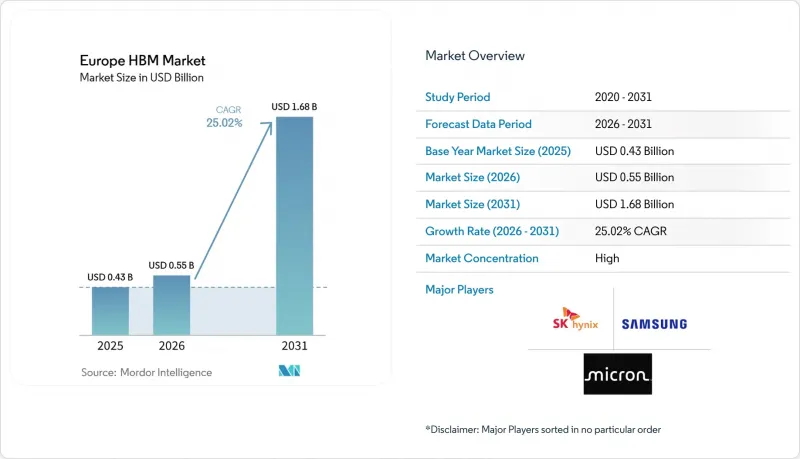
Mordor Intelligence에 의하면, 유럽 HBM 시장 규모는 2025년에 4억 3,000만 달러, 2026년에 5억 5,000만 달러가 되고, 2031년까지 16억 8,000만 달러에 이를 것으로 예측되며, 2026년부터 2031년까지 CAGR 25.02%로 성장할 전망입니다.
본 보고서는 HBM 유형(HBM2E, HBM3, HBM3E, HBM4, HBM4E), 기술 분야(1X, 1Y, 1Z, Sub-1Z), 최종 이용 산업(클라우드, AI 개발자, 기업, 정부, 통신 등), 용도(AI 모델 훈련, AI 모델 추론, 네트워크 및 통신 처리 등), 패키징 유형(2.5D 인터포저, 3D 스태킹, 팬아웃), 지역별로 분류되어 있습니다. 시장 전망은 금액(달러) 기준으로 제시되어 있습니다.
유럽 HBM 시장 동향 및 인사이트
유럽 데이터센터의 AI 주도 가속기 밀도
GPU를 다량으로 사용하는 인프라의 급속한 확충은 유럽 HBM 시장에 있어 계속해서 가장 강력한 단기적 호재로 작용하고 있습니다. 이는 새로운 AI 클러스터가 추가될 때마다 시스템 규모에서 고대역폭 메모리에 대한 수요가 증가하기 때문입니다. NVIDIA는 2026년 6월, 유럽 23개국에서 35기의 새로운 AI 슈퍼컴퓨터가 개발 중이며, 2025년 이후 유럽에서는 800 AI 엑사플롭스 이상이 도입되거나 발표되었다고 밝혔습니다. 이러한 AI 팩토리 도입의 90% 이상이 HBM을 메모리 기반으로 사용하는 Blackwell 및 Hopper 시스템과 관련되어 있으므로, 이러한 확장은 유럽 HBM 시장에 있어 중요합니다. 모델 학습에서 실시간 추론으로의 전환도 수요를 확대시키고 있습니다. 이는 프로덕션 환경의 워크로드에서는 간헐적인 버스트가 아닌, 여러 동시 세션에 걸쳐 일관된 메모리 처리량이 요구되기 때문입니다. 이러한 추세가 더 많은 국가 및 기업 차원의 도입으로 확산됨에 따라, 유럽의 HBM 시장은 하이퍼스케일러에 의한 제한적인 구매 주기에서 더 광범위하고 지속적인 조달 기반으로 전환되고 있습니다.
EuroHPC의 주권 컴퓨팅 구축
EuroHPC 네트워크는 일반적인 상용 클라우드 지출 주기와는 달리, 정책에 뒷받침된 유럽 HBM 시장 수요 하한선을 형성하고 있습니다. EuroHPC는 고립된 플래그십 시스템에서 보다 광범위한 AI 팩토리 네트워크로 전환되고 있으며, 이러한 변화로 인해 고대역폭 컴퓨팅 수요가 여러 회원국으로 확산되고 있습니다. 2026년 4월에 체결된 IT4LIA AI 팩토리 계약은 이러한 수요의 규모를 여실히 보여줍니다. 이 시스템은 NVIDIA GB200 NVL4 아키텍처를 기반으로 하며, 8,000대 이상의 GPU와 160 엑사플롭스를 넘는 피크 추론 성능을 갖추고 있기 때문입니다. SiPearl사의 ‘Rhea1’은 2026년 5월에 가동을 완료했으며, 4개의 HBM 스택을 통합한 설계 덕분에 HBM 지원 자율 컴퓨팅을 향한 유럽의 직접적인 경로가 추가되었습니다. 이러한 프로그램들은 수년에 걸친 체계적인 로드맵과 연계되어 있어, 상업적 지출을 예측하기 어려워진 상황에서도 유럽 HBM 시장에 안정적인 수요원을 제공합니다.
유럽 내 HBM 현지 공급 기반의 부족
유럽 HBM 시장의 가장 큰 구조적 제약은 해당 지역에서 여전히 상업적 규모의 현지 HBM 제조가 이루어지지 않고 있다는 점입니다. 이러한 격차로 인해 공급이 여전히 지역 외 제조업체에 의존하고 있으므로, 유럽 내 수요 증가가 자동으로 현지 부가가치 창출로 이어지지는 않습니다. 따라서 유럽 HBM 시장은 유럽 구매자가 직접 통제할 수 없는 외부 할당 우선순위, 공급업체 인증 주기, 그리고 패키징 병목 현상의 영향을 계속 받게 될 것입니다. EU의 ‘칩법’은 반도체 분야의 광범위한 노력을 강화했으나, 현재 진행 중인 프로젝트에서 주목받고 있는 부분은 HBM 생산 능력 그 자체보다는 로직 반도체 및 파워 반도체에 중점을 두고 있습니다. 이 격차가 좁혀질 때까지는 현지 AI 인프라 수요가 견조함에도 불구하고, 유럽의 HBM 시장은 타 지역의 업스트림 공정 결정에 계속해서 좌우될 것입니다.
부문 분석
2025년, HBM3E는 매출 기준 유럽 HBM 시장의 51.95%를 차지하고 있으며, 이는 해당 지역에서 가장 널리 도입된 AI 가속기 플랫폼의 표준 메모리 구성으로서의 역할을 반영합니다. Hopper 및 초기 Blackwell 시스템을 중심으로 구축된 도입 기반을 통해, HBM3E는 현재 조달에서 여전히 중심적인 위치를 차지하고 있습니다. 이는 이러한 플랫폼들이 많은 클라우드, 연구 및 정부 기관에서의 도입 기반이 되고 있기 때문입니다. 또한, 유럽의 HBM 시장은 플랫폼의 지속성이 중요함을 보여줍니다. 차세대 제품이 본격적으로 보급되기 시작하더라도 기존의 HBM3E 기반 시스템은 계속 가동될 것이기 때문입니다. 삼성은 2026년 5월, HBM4E 샘플을 예정보다 빨리 NVIDIA에 출하했다고 발표했습니다. 이 제품의 사양은 핀당 최대 16Gbps, 용량 48 GB, 스택당 최대 3.6 TB/s입니다. 엔비디아가 2026년 6월 베라 루빈(Vera Rubin) 플랫폼의 양산 개시를 확인한 것은 시장이 이미 HBM4로의 전환을 위해 준비를 진행하고 있음을 뒷받침합니다.
HBM4E 및 그 이후의 변형 제품은 2031년까지 25.94%라는 가장 높은 연평균 성장률(CAGR)을 보일 것으로 예측되며, 이는 수요 구성이 다음 성능 수준으로 얼마나 빠르게 이동하고 있는지를 보여줍니다. 유럽 HBM 시장의 이러한 움직임은 단순한 속도 향상에 그치지 않습니다. 새로운 베이스 다이 및 패키징에 대한 기대감으로 인해 통합 요구 사항도 변화하게 될 것입니다. 삼성의 HBM4E 조기 샘플 제공과 NVIDIA의 로드맵 모두에서 인증 시기가 공급업체 시장 내 입지를 결정하는 데 중요한 역할을 할 것임을 시사하고 있습니다. HBM2E나 HBM3와 같은 구세대 제품 및 레거시 도입 사례는 학술 기관, 공공 기관, 초기 단계의 AI 클러스터에서 여전히 일정한 역할을 하고 있지만, 더 이상 유럽 HBM 시장의 방향성을 결정짓는 요소는 아닙니다. 따라서 이 부문은 점진적인 도입 곡선을 반영하고 있으며, 현재 출하량은 HBM3E에 집중되어 있는 반면, 미래의 성장은 이미 HBM4E에 대한 대응 준비에 의해 결정되고 있습니다.
2025년, 1Z 이하의 첨단 노드는 유럽 HBM 시장의 59.13%를 차지했으며, 이 부문은 새로운 HBM 도입의 최전선이기도 했습니다. 이러한 집중 현상은 유럽의 조달 활동이 현대 AI 시스템의 대역폭 밀도 및 전력 효율 목표를 달성하는 데 필요한 최첨단 메모리 공정과 밀접하게 연동되어 있음을 보여줍니다. 따라서 유럽의 HBM 시장은 공정 세대 간에 고르게 분포되어 있지 않습니다. 이는 수요 추세가 최신 가속기 플랫폼을 위해 설계된 메모리를 강력하게 선호하기 때문입니다. 삼성, SK하이닉스 등 공급업체의 로드맵에 따르면, HBM3E에서 HBM4로의 전환은 더욱 선진적인 공정 등급으로의 지속적인 전환과 밀접하게 연관되어 있습니다. 그 결과, 차세대 AI 시스템이 양산 단계에 접어들면서 유럽 HBM 시장에서 첨단 노드의 점유율은 계속 상승할 것으로 보입니다.
1Z 노드는 아직 HBM3E나 HBM4 기반 구성으로 업데이트하지 않은 기관 및 사업자를 대상으로 계속해서 제공되는 HBM3 도입에서 여전히 중요한 위치를 차지하고 있습니다. 1Y나 1X와 같은 이전 노드는 새로운 주류 도입 주기라기보다는 레거시 HBM 프로그램이나 구형 HPC(고성능 컴퓨팅) 설비와 점점 더 밀접하게 연결되고 있습니다. 이로 인해 유럽 HBM 시장에서는 공정 계층에서 ‘승자 독식’ 패턴이 나타나고 있습니다. 왜냐하면 노드 전환이 성공할 때마다 이전 세대와의 상업적 격차가 확대되기 때문입니다. HBM 상호 운용성에 관한 표준화 노력은 시스템 통합사업자가 완전히 락인(lock-in)될 위험을 완화하는 데 도움이 되지만, 상업적 수요가 최첨단 제조 노드에 집중되어 있다는 사실을 바꾸지는 못합니다. 따라서 이 부문은 공정 분야의 리더십이 유럽 HBM 시장 진입에 있어 가장 명확한 구조적 필터 중 하나로 자리 잡고 있음을 보여줍니다.
기타 혜택:
- 엑셀 형식 시장 예측(ME) 시트
- 3개월간의 애널리스트 지원
자주 묻는 질문
목차
제1장 서론
제2장 조사 방법
제3장 주요 요약
제4장 시장 구도
제5장 시장 규모와 성장 예측
제6장 경쟁 구도
제7장 시장 기회와 향후 전망
JHS 26.08.07According to Mordor Intelligence, the Europe HBM market size is projected to be USD 0.43 billion in 2025, USD 0.55 billion in 2026, and reach USD 1.68 billion by 2031, growing at a CAGR of 25.02% from 2026 to 2031.
This report is Segmented by HBM Type (HBM2E, HBM3, HBM3E, HBM4, and HBM4E), Technology Node (1X, 1Y, 1Z, and Sub-1Z), End Use Industry (Cloud, AI Developers, Enterprise, Government, Telecom, and More), Application (AI Model Training, AI Model Inference, Network and Telecom Processing, and More), Packaging (2. 5D Interposer, 3D Stacking, and Fan-Out), and Geography. The Market Forecasts are Provided in Terms of Value (USD).
Europe HBM Market Trends and Insights
AI-Driven Accelerator Density in European Data Centers
The rapid buildout of GPU-heavy infrastructure remains the strongest near-term support for the Europe HBM market because each new AI cluster adds high-bandwidth memory requirements at system scale. NVIDIA said in June 2026 that 35 new AI supercomputers were in development across 23 European countries, with more than 800 AI exaflops deployed or announced in Europe since 2025. That buildout matters for the Europe HBM market because more than 90% of those AI factory deployments were tied to Blackwell and Hopper systems that use HBM as their memory base. The shift from model training to live inference is also widening demand, as production workloads require consistent memory throughput across multiple simultaneous sessions rather than periodic bursts. As that pattern spreads into more national and enterprise deployments, the Europe HBM market is moving from a narrow hyperscaler buying cycle toward a broader and more repeatable procurement base.
EuroHPC Sovereign Compute Buildout
The EuroHPC network is creating a policy-backed demand floor for the Europe HBM market that sits outside the usual commercial cloud spending cycle. EuroHPC moved from isolated flagship systems toward a wider network of AI factories, and that shift is spreading high-bandwidth compute demand across multiple member states. The IT4LIA AI Factory contract signed in April 2026 showed the scale of this demand because the system was built on NVIDIA GB200 NVL4 architecture with more than 8,000 GPUs and over 160 exaflops of peak inference performance. SiPearl's Rhea1 completed power-on in May 2026, and its design with 4 integrated HBM stacks added a direct European pathway for HBM-enabled sovereign compute. Because these programs are tied to multiyear institutional roadmaps, they give the Europe HBM market a steadier source of demand even when commercial spending becomes less predictable
Limited Indigenous HBM Supply Base in Europe
The biggest structural limit on the Europe HBM market is that the region still lacks local HBM fabrication at a commercial scale. That gap means European demand growth does not automatically translate into local value capture, because supply still depends on producers outside the region. The Europe HBM market, therefore, remains exposed to external allocation priorities, supplier qualification cycles, and packaging bottlenecks that European buyers do not directly control. The EU Chips Act has strengthened the broader semiconductor agenda, but the projects highlighted in the current pipeline are focused more on logic and power semiconductors than on HBM capacity itself. Until that gap narrows, the Europe HBM market will remain sensitive to upstream decisions in other regions, even as local AI infrastructure demand remains strong.
Other drivers and restraints analyzed in the detailed report include:
- Specialized Inference Platforms Using On-Package Memory
- Automotive ADAS and In-Vehicle AI Memory Intensity
- Advanced Packaging Capacity Concentration Outside Europe
For complete list of drivers and restraints, kindly check the Table Of Contents.
Segment Analysis
HBM3E held 51.95% of the Europe HBM market by revenue in 2025, reflecting its role as the standard memory configuration on the AI accelerator platforms most widely deployed across the region. The installed base built around Hopper and early Blackwell systems keeps HBM3E central to current procurement because these platforms continue to anchor many cloud, research, and sovereign deployments. The Europe HBM market also shows that platform continuity matters, because existing HBM3E-based systems will remain active even as the next generation starts to scale. Samsung said in May 2026 that it shipped HBM4E samples to NVIDIA ahead of schedule, with specifications of up to 16 Gbps per pin, 48 GB capacity, and up to 3.6 TB/s per stack. NVIDIA's confirmation of the Vera Rubin platform's production start in June 2026 reinforces that the market is already preparing for the HBM4 transition.
HBM4E and later variants are projected to record the fastest CAGR of 25.94% through 2031, indicating how quickly the demand mix is shifting toward the next performance tier. This part of the Europe HBM market is not only about a speed upgrade; the move also changes integration requirements due to new base-die and packaging expectations. Samsung's early HBM4E sampling and the NVIDIA roadmap both suggest that qualification timing will play a major role in supplier positioning. Older generations such as HBM2E and HBM3, as well as legacy deployments, still have a place in academic, institutional, and earlier AI clusters, but they are no longer setting the direction of the Europe HBM market. The segment, therefore, reflects a layered adoption curve where current volume remains concentrated in HBM3E, while future growth is already defined by HBM4E readiness.
Advanced nodes below 1Z held 59.13% of the Europe HBM market in 2025, and this tier also represented the leading edge of new HBM deployment. That concentration shows that European procurement is closely aligned with the most advanced memory processes required to meet bandwidth density and power efficiency targets in modern AI systems. The Europe HBM market is therefore not spreading evenly across process generations, because the demand profile strongly favors memory built for the newest accelerator platforms. Supplier roadmaps from Samsung and SK Hynix indicate that the transition from HBM3E toward HBM4 is tied to continued migration into more advanced process classes. As a result, the share of advanced nodes within the Europe HBM market is likely to keep rising as new AI system generations move into production.
The 1Z tier remains relevant for HBM3 deployments that continue to serve institutions and operators that are not yet refreshing to HBM3E or HBM4-based configurations. Earlier nodes, such as 1Y and 1X, are increasingly tied to legacy HBM programs and older HPC installations rather than new mainstream deployment cycles. This creates a process-layer winner-takes-most pattern in the Europe HBM market, because each successful node migration increases the commercial gap with prior generations. Standards work around HBM interoperability helps reduce the risk of complete lock-in for system integrators, yet it does not change the fact that commercial demand is clustering around the most advanced manufacturing nodes. The segment therefore shows that process leadership is becoming one of the clearest structural filters for participation in the Europe HBM market.
Complete Report Scope:
- By HBM Type
- HBM2E and Earlier Generations
- HBM3
- HBM3E
- HBM4
- HBM4E
- By Technology Node
- 1X And Above Legacy Nodes
- 1Y Node
- 1Z Node
- Advanced Nodes Below 1Z
- By Packaging Type
- 2.5D Interposer-Based Packaging
- 3D Stacking
- Fan-Out Advanced Packaging
- By End Use Industry
- Cloud Service Providers and Hyperscalers
- Internet Platforms and AI Model Developers
- Government, Defense, Research, and Academic Institutions
- Enterprise Data Centers
- Telecommunications Operators and Network Equipment Providers
- Other Enterprise Verticals
- By Application
- AI Model Training
- AI Model Inference
- HPC and Scientific Computing
- Professional Graphics, Rendering, and Visualization
- Network and Telecom Processing
- Other High-Bandwidth Compute Workloads
- By Geography
- Germany
- United Kingdom
- France
- Italy
- Spain
- Nordics
- Rest of Europe
List of Companies Covered in this Report:
- Samsung Electronics Co., Ltd.
- SK hynix Inc.
- Micron Technology, Inc.
Additional Benefits:
- The market estimate (ME) sheet in Excel format
- 3 months of analyst support
TABLE OF CONTENTS
1 INTRODUCTION
- 1.1 Study Assumptions and Market Definition
- 1.2 Scope of the Study
2 RESEARCH METHODOLOGY
3 EXECUTIVE SUMMARY
4 MARKET LANDSCAPE
- 4.1 Market Overview
- 4.2 Market Drivers
- 4.2.1 AI-Driven Accelerator Density in European Data Centers
- 4.2.2 EuroHPC Sovereign Compute Buildout
- 4.2.3 Automotive ADAS and In-Vehicle AI Memory Intensity
- 4.2.4 HBM Adoption in Memory-Bound Scientific Workloads
- 4.2.5 Advanced Packaging Pull-Through from European System Integrators
- 4.2.6 Specialized Inference Platforms Using On-Package Memory
- 4.3 Market Restraints
- 4.3.1 Limited Indigenous HBM Supply Base in Europe
- 4.3.2 Advanced Packaging Capacity Concentration Outside Europe
- 4.3.3 High Thermal and Power-Delivery Complexity at Scale
- 4.3.4 Long Qualification Cycles for Automotive and Industrial Platforms
- 4.4 Industry Supply Chain Analysis
- 4.5 Regulatory Landscape
- 4.6 Technological Outlook
- 4.7 Porter's Five Forces Analysis
- 4.7.1 Bargaining Power of Suppliers
- 4.7.2 Bargaining Power of Buyers
- 4.7.3 Threat of New Entrants
- 4.7.4 Threat of Substitutes
- 4.7.5 Intensity of Competitive Rivalry
5 MARKET SIZE AND GROWTH FORECASTS (VALUE)
- 5.1 By HBM Type
- 5.1.1 HBM2E and Earlier Generations
- 5.1.2 HBM3
- 5.1.3 HBM3E
- 5.1.4 HBM4
- 5.1.5 HBM4E
- 5.2 By Technology Node
- 5.2.1 1X And Above Legacy Nodes
- 5.2.2 1Y Node
- 5.2.3 1Z Node
- 5.2.4 Advanced Nodes Below 1Z
- 5.3 By Packaging Type
- 5.3.1 2.5D Interposer-Based Packaging
- 5.3.2 3D Stacking
- 5.3.3 Fan-Out Advanced Packaging
- 5.4 By End Use Industry
- 5.4.1 Cloud Service Providers and Hyperscalers
- 5.4.2 Internet Platforms and AI Model Developers
- 5.4.3 Government, Defense, Research, and Academic Institutions
- 5.4.4 Enterprise Data Centers
- 5.4.5 Telecommunications Operators and Network Equipment Providers
- 5.4.6 Other Enterprise Verticals
- 5.5 By Application
- 5.5.1 AI Model Training
- 5.5.2 AI Model Inference
- 5.5.3 HPC and Scientific Computing
- 5.5.4 Professional Graphics, Rendering, and Visualization
- 5.5.5 Network and Telecom Processing
- 5.5.6 Other High-Bandwidth Compute Workloads
- 5.6 By Geography
- 5.6.1 Germany
- 5.6.2 United Kingdom
- 5.6.3 France
- 5.6.4 Italy
- 5.6.5 Spain
- 5.6.6 Nordics
- 5.6.7 Rest of Europe
6 COMPETITIVE LANDSCAPE
- 6.1 Market Concentration
- 6.2 Strategic Moves
- 6.3 Market Share Analysis
- 6.4 Company Profiles (includes Global Level Overview, Market Level Overview, Core Segments, Financials as available, Strategic Information, Products and Services, Recent Developments)
- 6.4.1 Samsung Electronics Co., Ltd.
- 6.4.2 SK hynix Inc.
- 6.4.3 Micron Technology, Inc.
- 6.5 Other Ecosystem Players
- 6.5.1 NVIDIA Corporation
- 6.5.2 Advanced Micro Devices, Inc.
- 6.5.3 Intel Corporation
- 6.5.4 Broadcom Inc.
- 6.5.5 Hewlett Packard Enterprise Company
- 6.5.6 Lenovo Group Limited
- 6.5.7 ASML Holding N.V.
- 6.5.8 STMicroelectronics N.V.
- 6.5.9 Infineon Technologies AG
- 6.5.10 Robert Bosch GmbH
- 6.5.11 SiPearl SAS
- 6.5.12 Eviden
- 6.5.13 Atos SE
- 6.5.14 imec vzw
- 6.5.15 Fraunhofer-Gesellschaft zur Forderung der angewandten Forschung e.V.
- 6.5.16 Cadence Design Systems, Inc.
- 6.5.17 Synopsys, Inc.
- 6.5.18 Marvell Technology, Inc.
- 6.5.19 Applied Materials, Inc.
- 6.5.20 Renault Group
- 6.5.21 BMW AG
- 6.5.22 Mercedes-Benz Group AG
- 6.5.23 Volkswagen AG
7 MARKET OPPORTUNITIES AND FUTURE OUTLOOK
- 7.1 White-Space and Unmet-Need Assessment


