

|
시장보고서
상품코드
2099758
HPC 및 슈퍼컴퓨팅용 HBM : 시장 점유율 분석, 업계 동향 및 통계, 성장 예측(2026-2031년)HBM For HPC and Supercomputing - Market Share Analysis, Industry Trends & Statistics, Growth Forecasts (2026 - 2031) |
||||||
 Mordor Intelligence
Mordor Intelligence에 의하면, HPC 및 슈퍼컴퓨팅용 HBM 시장 규모는 2025년 6억 달러로 평가되었습니다. 2026년에는 7억 6,000만 달러로 확대되어 2031년까지 20억 1,000만 달러에 이를 것으로 예상되고 2026년부터 2031년에 걸쳐 CAGR 21.47%로 성장할 전망입니다.
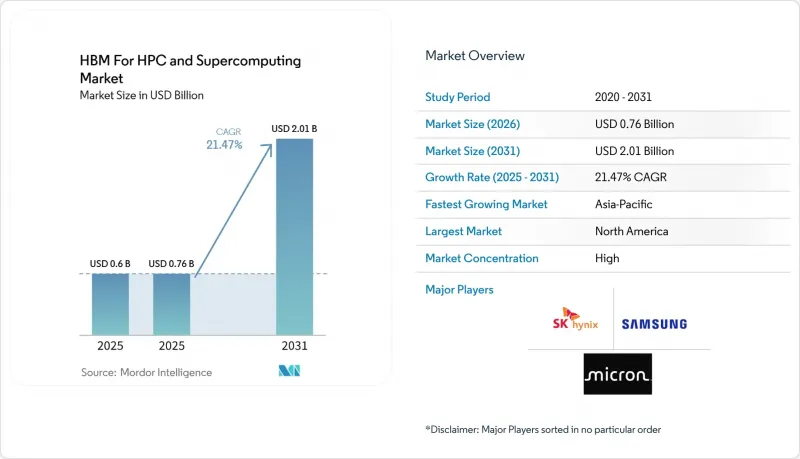
본 보고서는 HBM 세대별(HBM3, HBM3E, HBM4 등), 메모리 용량별(최대 8 GB, 8-16GB 등), 프로세서 인터페이스별(GPU 기반 HPC 프로세서, CPU 기반 HPC 프로세서 등), 용도별(과학 계산, 기상·기후 모델링 등), 지역별(북미, 아시아태평양 등)로 분류되어 있습니다. 시장 전망은 금액(달러) 기준으로 제시되어 있습니다.
세계의 HPC 및 슈퍼컴퓨팅용 HBM 시장 동향 및 인사이트
AI 훈련 및 슈퍼컴퓨팅 수요의 가속화
HPC 및 슈퍼컴퓨팅용 HBM 시장은 생성형 AI 훈련과 기존 시뮬레이션 간의 중복 영역이 확대되고 있는 혜택을 받고 있습니다. 이는 두 워크로드가 현재 동일한 메모리 집약형 컴퓨팅 클러스터를 경쟁적으로 사용하고 있기 때문입니다. SK 하이닉스는 현재의 메모리 사이클이 HBM 수요에 의해 주도되고 있으며, 그 기세는 HBM3E 및 HBM4를 대규모로 채택하는 플랫폼의 양산 확대와 밀접하게 관련되어 있다고 밝혔습니다. NVIDIA는 현재 Vera Rubin을 AI뿐만 아니라 과학 계산용으로도 포지셔닝하고 있으며, 로스앨러모스 국립연구소의 ‘Mission’, ‘Vision’, ‘Veritas’와 같은 시스템에서는 공개 워크로드 및 기밀 워크로드를 위해 Rubin GPU와 Vera CPU를 조합할 예정입니다. 이를 통해 HPC 및 슈퍼컴퓨팅용 시장에서의 HBM 고객 기반은 상용 클라우드를 넘어 국립 연구소 및 국가 차원의 계산 프로그램까지 확대될 것입니다. 또한 공급업체 입장에서는 모델 학습 규모의 확대와 시뮬레이션 워크플로우 내 AI 모델 활용 확대라는 두 가지 요인에 의해 뒷받침되는 수요층에 대응하게 될 것입니다.
차세대 가속기에서 HBM3E 및 HBM4 채택
HPC 및 슈퍼컴퓨팅용 HBM 시장은 HBM3에서 HBM3E 및 HBM4로의 전환에 의해서도 견인되고 있습니다. 이러한 전환으로 인해 플랫폼 수준의 대역폭과 용량 모두 변화하기 때문입니다. 삼성은 2026년 2월 HBM4 양산을 시작하며, 자사의 새로운 스택이 스택당 11.7 Gbps 및 3.3 TB/s에 달한다고 발표했습니다. 이는 이전 세대에 비해 뚜렷한 성능 향상을 보여줍니다. NVIDIA에 따르면, 각 Vera Rubin R200 GPU는 288 GB의 HBM4를 탑재하여 22 TB/s의 메모리 대역폭을 실현하고 있으며, 시스템 설계자들은 소규모 업그레이드 경로가 아닌 새로운 메모리 세대에 묶이게 될 것입니다. HPC 및 슈퍼컴퓨팅용 HBM 시장에서 이는 조달 시기가 단순히 프로세서의 가용성뿐만 아니라 HBM 할당 일정에 점점 더 좌우된다는 것을 의미합니다. 또한, 고도의 HBM 성능 기준과 연계된 수출 규제로 인해 최첨단 구성을 이용할 수 있는 인증된 최종 사용자의 범위가 좁아지면서, 승인된 구매자 및 공급 경로의 집중화가 더욱 심화되고 있습니다.
HBM 공급 부족과 긴 인증 주기
HPC 및 슈퍼컴퓨팅용 HBM 시장은 특히 스택 높이가 증가함에 따라, 표준 DRAM의 양산보다 훨씬 긴 인증 주기로 인해 여전히 제약을 받고 있습니다. 미래의 하이 스택 설계를 위한 더미 다이 구조에 관한 삼성의 자체 특허 출원은 16층 설계에서 심각한 수율 압박이 발생하고 있음을 보여주며, 8층 설계와 비교해 40%-60%의 손실이 보고되고 있습니다. 마이크론에 따르면, 2026 회계연도의 설비 투자액은 250억 달러를 넘어설 것으로 예상되며, 이는 공급 상황이 실질적으로 개선되기까지 얼마나 많은 투자가 필요한지를 보여줍니다. HPC 및 슈퍼컴퓨팅용 분야의 HBM 시장에서 이러한 긴 주기는 구성의 락인(lock-in) 위험으로 이어집니다. 특정 메모리 로드맵에 따라 발주된 시스템이라도 납품 전에 타이밍이나 사양 변경에 직면할 가능성이 있기 때문입니다.
부문 분석
2025년, HPC 및 슈퍼컴퓨팅용 시장 내 HBM의 53.18%를 HBM3가 차지했으며, 이는 2024년 및 2025년에 걸쳐 구매된 ‘Hopper’ 세대 시스템의 도입 대수를 반영한 것입니다. HBM2 및 HBM2E는 레거시 클러스터에서 계속 사용되고 있지만, 운영자들이 플래그십 시스템 전반의 성능 향상에 나서면서 그 역할은 지속적으로 축소되고 있습니다. HBM3E는 HPC 및 슈퍼컴퓨팅용 시장에서 HBM의 과도기적 단계로 부상하며, 현재의 도입 주기와 향후 예정된 HBM4로의 전환을 연결하는 가교 역할을 수행하고 있습니다. SK 하이닉스는 2026년 내내 HBM3E가 HBM 총 출하량에서 큰 비중을 차지할 것이라고 밝혔으며, 이는 이러한 견해를 뒷받침합니다.
HBM4는 2026년부터 2031년에 걸쳐 연평균 성장률(CAGR) 22.29%를 나타낼 것으로 예측되는 가장 빠르게 성장하는 세대이며, 이러한 성장은 NVIDIA의 Vera Rubin 및 AMD의 Instinct MI455X 구성과 직접적으로 연결되어 있습니다. Samsung Electronics에 따르면, 자사의 HBM4 양산 제품은 6세대 1c DRAM 다이를 채택하고 있으며, 11.7 Gbps에서 13 Gbps까지 확장할 수 있다고 합니다. 이는 제품 라인이 이미 추가적인 속도 향상을 염두에 두고 설계되었음을 시사합니다. 따라서 HPC 및 슈퍼컴퓨팅용 HBM의 로드맵은 단축되고 있습니다. 16층·48 GB 구성을 상정한 HBM4E 샘플이 2026년 중반에는 이미 고객에게 샘플을 제공하는 단계에 들어섰기 때문입니다. HPC 및 슈퍼컴퓨팅용 HBM 시장에서는 이러한 로드맵 단축으로 인해 시스템 통합사업자의 자본 계획에 대한 압박이 커지고 있습니다. 이는 각 세대마다 다음 세대가 인증 단계에 진입하기까지의 안정적 기간이 단축되고 있기 때문입니다.
2025년 HPC 및 슈퍼컴퓨팅용 HBM 시장 점유율 중 16GB-32GB 구간이 48.63%를 차지했습니다. 이는 주요 가속기 플랫폼 전반에서 8-high HBM3 및 HBM3E 스택이 여전히 주요 양산 구성이었기 때문입니다. Blackwell Ultra 및 동급 시스템의 양산이 아직 확대 단계에 있기 때문에 이 대역은 당분간 전환 기간 동안에도 주요 출하 기반이 될 것으로 예측됩니다. 동시에, HPC 및 슈퍼컴퓨팅용 HBM 시장은 성능과 패키지당 총 메모리 용량이 모두 향상됨에 따라 고밀도 스택으로 전환되고 있습니다. 이에 따라 구매자들의 관심이 더 높은 밀도의 제품으로 이동하고 있음에도 불구하고, 현재 사이클에서는 중용량 대역의 중요성이 유지될 전망입니다.
32GB를 초과하는 대역폭은 GPU 1대당 메모리 풀을 대폭 확대해야 하는 NVIDIA Vera Rubin R200이나 AMD MI455X 등의 설계에 힘입어, 2026년부터 2031년에 걸쳐 연평균 성장률(CAGR) 22.21%로 성장할 전망입니다. 2025년 동료 심사를 거친 연구에 따르면, 3D 적층형 HBM의 하이브리드 본딩에서 12층 이상이 되면 열적 및 기계적 스트레스가 증가하는 것으로 밝혀졌습니다. 이는 HPC 및 슈퍼컴퓨팅용 HBM 시장에서 이 분야가 강력한 수요와 중대한 공정 위험에 동시에 직면해 있는 이유를 설명해 줍니다. HPC 및 슈퍼컴퓨팅용 HBM 시장에서는 엣지 HPC, FPGA 도입, 임베디드 시뮬레이션 시스템 등 절대적인 용량보다 전력 제한이 더 중요시되는 분야에서 저용량 티어도 여전히 중요한 역할을 수행하고 있습니다. 또한 상호 운용성 결정은 공식적인 HBM 인터페이스 사양 및 패키징 규정을 준수해야 하므로, 모든 티어에서 규격 준수는 계속해서 중요할 것입니다.
지역별 분석
2025년, 북미는 HPC 및 슈퍼컴퓨팅용 HBM 시장 점유율 43.39%를 차지했으며, 현재 도입 측면에서 가장 규모가 큰 지역 거점이 되고 있습니다. 이 지역의 우위는 이미 대규모 메모리 집약형 아키텍처를 구매하고 있는 국립 연구소, 하이퍼스케일러 및 첨단 컴퓨팅 조달 프로그램이 집중되어 있음을 반영합니다. 아르곤 국립연구소의 'Aurora'나 NERSC에서 계획 중인 'Doudna' 시스템은 북미의 HPC 및 슈퍼컴퓨팅용 HBM 시장이 구매 주기가 긴 초대형 공공 컴퓨팅 프로그램과 밀접하게 연결되어 있음을 보여줍니다. 또한, ECCN 3A090.c에 기반한 수출 관리 규정도 이 지역의 HPC 및 슈퍼컴퓨팅용 HBM 시장에 영향을 미치고 있습니다. 이는 최첨단 구성이 규정 준수 및 동맹국에 대한 접근과 밀접하게 관련되어 있기 때문입니다. DARPA나 NNSA와 같은 기관들이 수년에 걸친 컴퓨팅 프로그램에 대한 지원을 지속하고 있기 때문에 북미에서는 다른 많은 지역에 비해 수요 전망이 더 명확합니다.
2025년에도 유럽 시장 규모는 작았지만, 새로운 EuroHPC에 대한 투자에 따라 HPC 및 슈퍼컴퓨팅 시장에서 HBM의 역할은 커지고 있습니다. 독일의 ‘JUPITER’와 프랑스의 ‘Alice Recoque’는 특히 기후 연구, AI 훈련, 양자 지향 시뮬레이션 워크로드 분야에서 유럽 내 HBM 활용이 뚜렷이 확대되고 있음을 보여줍니다. 슈투트가르트의 HLRS가 추진하는 'HammerHAI'와 NVIDIA의 EuroHPC 관련 광범위한 계획은 유럽의 HPC 및 슈퍼컴퓨팅용 HBM 시장이 선택적 도입에서 보다 광범위한 기관 차원의 전개로 전환되고 있음을 보여줍니다. 또한, 이 지역에서는 데이터 주권 및 인증 요건의 중요성도 높아지고 있어, 메모리 조달 및 시스템 설계에 규정 준수 측면이 추가되고 있습니다.
아시아태평양은 2026년부터 2031년까지 연평균 성장률(CAGR) 22.34%를 나타낼 것으로 예측되며, HPC 및 슈퍼컴퓨팅용 HBM 시장에서 가장 두드러진 성장을 보일 지역이 될 것입니다. 이 지역은 HBM의 주요 생산 거점인 동시에, 주권 AI 및 HPC 프로그램에 대한 수요가 확대되고 있는 중심지이기도 하여 이중의 역할을 담당하고 있습니다. 삼성과 SK하이닉스는 2026년 7월, 지역 전체에 걸쳐 총 240조 원(168억 8,000만 달러) 규모의 투자를 발표했습니다. 여기에는 삼성의 56조 원(394억 달러)과 SK하이닉스의 20조 원(141억 달러)이 포함되어 있어, 공급 측에 얼마나 많은 신규 생산 능력과 패키징 고도화가 투입되고 있는지를 보여줍니다. 또한 일본도 마이크론의 히로시마 공장 확장에 대해 5,000억 엔(33억 달러)을 지원했습니다. 시설 투자액 자체는 93억 달러로 발표되었으며, 2028년경 UPI를 통한 향후 HBM 출하를 목표로 하고 있습니다. 중국의 현재 HBM 소비량은 여전히 소규모이지만, 기술 격차가 좁혀지고 수출 규제 회피책을 둘러싼 경쟁이 지속될 경우, 국내 HBM 개발 노력은 향후 3-4년 동안 더 큰 변수가 될 가능성이 있습니다.
기타 혜택 :
- 엑셀 형식 시장 예측(ME) 시트
- 3개월간의 애널리스트 지원
자주 묻는 질문
목차
제1장 서론
제2장 조사 방법
제3장 주요 요약
제4장 시장 구도
제5장 시장 규모 및 성장 예측
제6장 경쟁 구도
제7장 시장 기회 및 향후 전망
KTH 26.08.10According to Mordor Intelligence, the HBM for HPC and supercomputing market size is expected to increase from USD 0.60 billion in 2025 to USD 0.76 billion in 2026 and reach USD 2.01 billion by 2031, growing at a CAGR of 21.47% over 2026-2031.
This report is Segmented by HBM Generation (HBM3, HBM3E, and HBM4, and More), Memory Capacity (Up To 8 GB, 8-16 GB, and More), Processor Interface (GPU-Based HPC Processors, CPU-Based HPC Processors, and More), Application (Scientific Computing, Weather and Climate Modeling, and More), and Geography (North America, Asia-Pacific, and More). The Market Forecasts are Provided in Terms of Value (USD).
Global HBM For HPC and Supercomputing Market Trends and Insights
Accelerating AI Training And Supercomputing Demand
The HBM for HPC and supercomputing market is benefiting from the growing overlap between generative AI training and classical simulation, as both workloads now compete for the same memory-intensive compute clusters. SK hynix says the current memory cycle is being led by HBM demand, tying that momentum to the production ramp of platforms that use HBM3E and HBM4 at scale. NVIDIA now positions Vera Rubin for scientific computing as well as AI, with Los Alamos systems such as Mission, Vision, and Veritas set to combine Rubin GPUs with Vera CPUs for open and classified workloads. This broadens the HBM's buyer base in the HPC and supercomputing market beyond commercial cloud into national laboratory and sovereign compute programs. It also means suppliers are serving a demand pool supported by both model training scale and the growing use of AI models in simulation workflows.
HBM3E And HBM4 Adoption In Next-Gen Accelerators
The HBM for HPC and supercomputing market is also being driven by the move from HBM3 to HBM3E and HBM4, as the shift changes both bandwidth and capacity at the platform level. Samsung began HBM4 mass production in February 2026 and said its new stack reaches 11.7 Gbps and 3.3 TB/s per stack, marking a clear performance step over prior generations. NVIDIA says each Vera Rubin R200 GPU features 288 GB of HBM4 and delivers 22 TB/s of memory bandwidth, locking system designers into a new memory generation rather than a minor upgrade path. In the HBM market for HPC and supercomputing, this means procurement timing is increasingly tied to HBM allocation schedules rather than just processor availability. Export rules tied to advanced HBM performance thresholds also narrow the qualified end-user base for the most advanced configurations, reinforcing concentration among approved buyers and supply routes.
Limited HBM Supply And Long Qualification Cycles
The HBM for HPC and supercomputing market remains constrained by qualification cycles that are much longer than standard DRAM ramps, especially as stack heights rise. Samsung's own patent work on dummy die structures for future high-stack designs indicates severe yield pressure in 16-layer designs, with reported losses of 40%-60% compared to 8-layer designs. Micron says fiscal 2026 capital expenditure is expected to exceed USD 25 billion, indicating how much spending remains before supply relief becomes meaningful. For the HBM market in HPC and supercomputing, these long cycles translate into configuration lock-in risk, as systems ordered under one memory roadmap may face timing or specification changes before delivery.
Other drivers and restraints analyzed in the detailed report include:
- Memory-Bound Workloads In HPC Clusters
- Co-Packaged Memory Architectures In Exascale Systems
- Extreme Dependence On A Few Qualified Memory Suppliers
For complete list of drivers and restraints, kindly check the Table Of Contents.
Segment Analysis
HBM3 held 53.18% of the HBM for the HPC and supercomputing market in 2025, reflecting the installed base of Hopper-era systems purchased through 2024 and 2025. HBM2 and HBM2E remained present in legacy clusters, but their roles continued to shrink as operators began upgrading capabilities across flagship systems. HBM3E emerged as the transition layer for HBM in the HPC and supercomputing markets, bridging current deployment cycles with the upcoming move to HBM4. SK hynix says HBM3E will continue to account for a large share of total HBM shipments through 2026, which supports that transition view.
HBM4 is the fastest-growing generation with a 22.29% CAGR from 2026 to 2031, and that rise is tied directly to NVIDIA Vera Rubin and AMD Instinct MI455X configurations. Samsung says its HBM4 mass production uses a 6th-generation 1c DRAM die and can scale from 11.7 Gbps to 13 Gbps, indicating the product line is already being designed for a further speed step. The HBM for HPC and supercomputing industry is therefore moving through a compressed roadmap, because HBM4E samples aimed at 16-layer and 48 GB configurations had already entered customer sampling by mid-2026. In the HBM for HPC and supercomputing market, that compression raises capital planning pressure on integrators, because each generation now has a shorter stable window before the next one enters qualification.
The 16 GB to 32 GB tier accounted for 48.63% of the HBM market share in the HPC and supercomputing market in 2025, as 8-high HBM3 and HBM3E stacks remained the main volume configuration across leading accelerator platforms. That tier should remain the primary shipment base in the near-term transition, as Blackwell Ultra and comparable systems are still ramping in volume. At the same time, the HBM for the HPC and supercomputing market is shifting toward denser stacks as both performance and total memory per package rise. This keeps the middle tier important in the current cycle, even as buyer attention shifts toward higher densities.
The Above 32 GB band is set to grow at a 22.21% CAGR from 2026 to 2031, driven by designs such as NVIDIA Vera Rubin R200 and AMD MI455X that require much larger per-GPU memory pools. A 2025 peer-reviewed study found that hybrid bonding in 3D-stacked HBM creates increasing thermal and mechanical stress at 12+ layers, which explains why this part of the HBM for the HPC and supercomputing market faces both strong demand and significant process risk. Lower-capacity tiers still matter in the HBM for HPC and supercomputing markets, including edge HPC, FPGA deployments, and embedded simulation systems, where power limits matter more than absolute capacity. Standards compliance also remains important across all tiers, as interoperability decisions must still align with formal HBM interface specifications and packaging rules.
Complete Report Scope:
- By HBM Generation
- HBM2 and HBM2E
- HBM3
- HBM3E
- HBM4
- By Memory Capacity Per Stack
- Up to 8 GB
- 8 GB to 16 GB
- 16 GB to 32 GB
- Above 32 GB
- By Processor Interface
- GPU-based HPC Processors
- CPU-based HPC Processors
- AI Accelerators and Custom ASICs
- FPGA-based Accelerators
- By Application
- Scientific Computing
- Weather and Climate Modeling
- Defense and National Security Computing
- Engineering Simulation and Digital Twins
- AI-enabled HPC Workloads
- By Geography
- North America
- United States
- Canada
- Mexico
- Europe
- Germany
- United Kingdom
- France
- Italy
- Rest of Europe
- Asia-Pacific
- China
- Japan
- South Korea
- Taiwan
- India
- Rest of Asia-Pacific
- South America
- Middle East and Africa
- North America
Geography Analysis
North America held 43.39% of the HBM market share for the HPC and supercomputing market in 2025, making it the largest regional base for current deployments. The region's lead reflects the concentration of national laboratories, hyperscalers, and advanced computing procurement programs that already buy memory-rich architectures at scale. Aurora at Argonne and the planned Doudna system at NERSC show how the HBM for the HPC and supercomputing market in North America is tied to very large public computing programs with long buying cycles. Export control rules under ECCN 3A090.c also shape the HBM for the HPC and supercomputing markets in this region, because the most advanced configurations are closely tied to compliance and allied-country access. Demand visibility is therefore stronger in North America than in many other regions, since agencies such as DARPA and NNSA continue to support multiyear compute programs.
Europe remained smaller in 2025, but its role in the HBM for HPC and supercomputing market is rising with new EuroHPC spending. JUPITER in Germany and Alice Recoque in France reflect a clear scale-up in European HBM use, especially for climate research, AI training, and quantum-oriented simulation workloads. HLRS Stuttgart's HammerHAI and NVIDIA's broader EuroHPC-linked plans show that the HBM for HPC and supercomputing market in Europe is moving from selective adoption to wider institutional rollout. Data sovereignty and certification requirements also matter more here, which adds a compliance layer to memory sourcing and system design.
Asia-Pacific is projected to grow at a 22.34% CAGR from 2026 to 2031, which makes it the fastest-growing regional part of the HBM for HPC and supercomputing market. The region has a dual role, because it is both the main production base for HBM and a growing demand center for sovereign AI and HPC programs. Samsung and SK hynix announced combined regional investment of KRW 240 trillion (USD 168.8 billion) in July 2026, including Samsung's KRW 56 trillion (USD 39.4 billion) and SK hynix's KRW 20 trillion (USD 14.1 billion), which shows how much new capacity and packaging depth are being directed into the supply side. Japan also backed Micron's Hiroshima expansion with JPY 500 billion (USD 3.3 billion) in support, while the facility investment itself was stated at USD 9.3 billion and is aimed at future HBM shipments around 2028 UPI. China remains smaller by current HBM consumption, but domestic HBM efforts could become a stronger variable over the next 3-4 years if technology gaps narrow and export control workarounds remain contested.
- SK hynix Inc.
- Samsung Electronics Co., Ltd.
- Micron Technology, Inc.
Additional Benefits:
- The market estimate (ME) sheet in Excel format
- 3 months of analyst support
TABLE OF CONTENTS
1 INTRODUCTION
- 1.1 Study Assumptions and Market Definition
- 1.2 Scope of the Study
2 RESEARCH METHODOLOGY
3 EXECUTIVE SUMMARY
4 MARKET LANDSCAPE
- 4.1 Market Overview
- 4.2 Market Drivers
- 4.2.1 Accelerating AI Training and Supercomputing Demand
- 4.2.2 HBM3E and HBM4 Adoption in Next-Gen Accelerators
- 4.2.3 Memory-Bound Workloads in HPC Clusters
- 4.2.4 Co-Packaged Memory Architectures in Exascale Systems
- 4.2.5 Export-Control-Driven Localization of Advanced Memory Supply Chains
- 4.2.6 Yield Improvement Through TSV and Advanced Packaging Automation
- 4.3 Market Restraints
- 4.3.1 Limited HBM Supply and Long Qualification Cycles
- 4.3.2 Extreme Dependence on A Few Qualified Memory Suppliers
- 4.3.3 Thermal Density and Power Integrity Constraints in Dense Stacks
- 4.3.4 High Cost Per Bit Versus Alternative Memory Architectures
- 4.4 Industry Supply Chain Analysis
- 4.5 Impact of Macroeconomic Factors on the Market
- 4.6 Regulatory Landscape
- 4.7 Technological Outlook
- 4.8 Porter's Five Forces Analysis
- 4.8.1 Bargaining Power of Suppliers
- 4.8.2 Bargaining Power of Buyers
- 4.8.3 Threat of New Entrants
- 4.8.4 Threat of Substitutes
- 4.8.5 Intensity of Competitive Rivalry
5 MARKET SIZE AND GROWTH FORECASTS (VALUE)
- 5.1 By HBM Generation
- 5.1.1 HBM2 and HBM2E
- 5.1.2 HBM3
- 5.1.3 HBM3E
- 5.1.4 HBM4
- 5.2 By Memory Capacity Per Stack
- 5.2.1 Up to 8 GB
- 5.2.2 8 GB to 16 GB
- 5.2.3 16 GB to 32 GB
- 5.2.4 Above 32 GB
- 5.3 By Processor Interface
- 5.3.1 GPU-based HPC Processors
- 5.3.2 CPU-based HPC Processors
- 5.3.3 AI Accelerators and Custom ASICs
- 5.3.4 FPGA-based Accelerators
- 5.4 By Application
- 5.4.1 Scientific Computing
- 5.4.2 Weather and Climate Modeling
- 5.4.3 Defense and National Security Computing
- 5.4.4 Engineering Simulation and Digital Twins
- 5.4.5 AI-enabled HPC Workloads
- 5.5 By Geography
- 5.5.1 North America
- 5.5.1.1 United States
- 5.5.1.2 Canada
- 5.5.1.3 Mexico
- 5.5.2 Europe
- 5.5.2.1 Germany
- 5.5.2.2 United Kingdom
- 5.5.2.3 France
- 5.5.2.4 Italy
- 5.5.2.5 Rest of Europe
- 5.5.3 Asia-Pacific
- 5.5.3.1 China
- 5.5.3.2 Japan
- 5.5.3.3 South Korea
- 5.5.3.4 Taiwan
- 5.5.3.5 India
- 5.5.3.6 Rest of Asia-Pacific
- 5.5.4 South America
- 5.5.5 Middle East and Africa
- 5.5.1 North America
6 COMPETITIVE LANDSCAPE
- 6.1 Market Concentration
- 6.2 Strategic Moves
- 6.3 Market Share Analysis
- 6.4 Company Profiles (includes Global Level Overview, Market Level Overview, Core Segments, Financials as available, Strategic Information, Products and Services, Recent Developments)
- 6.4.1 SK hynix Inc.
- 6.4.2 Samsung Electronics Co., Ltd.
- 6.4.3 Micron Technology, Inc.
- 6.5 Other Ecosystem Players
- 6.5.1 NVIDIA Corporation
- 6.5.2 Advanced Micro Devices, Inc.
- 6.5.3 Intel Corporation
- 6.5.4 Fujitsu Limited
- 6.5.5 IBM Corporation
- 6.5.6 Broadcom Inc.
- 6.5.7 Marvell Technology, Inc.
- 6.5.8 Qualcomm Incorporated
- 6.5.9 Rambus Inc.
- 6.5.10 Kioxia Corporation
- 6.5.11 ASML Holding N.V.
- 6.5.12 Lam Research Corporation
- 6.5.13 Applied Materials, Inc.
- 6.5.14 Tokyo Electron Limited
- 6.5.15 ASE Technology Holding Co., Ltd.
- 6.5.16 TSMC
- 6.5.17 Amkor Technology, Inc.
7 MARKET OPPORTUNITIES AND FUTURE OUTLOOK
- 7.1 White-Space and Unmet-Need Assessment


