
|
시장보고서
상품코드
2099245
유럽의 현장 근로자 기술 시장 : 점유율 분석, 업계 동향 및 통계, 성장 예측(2026-2031년)Europe Frontline Worker Technology - Market Share Analysis, Industry Trends & Statistics, Growth Forecasts (2026 - 2031) |
||||||
 Mordor Intelligence
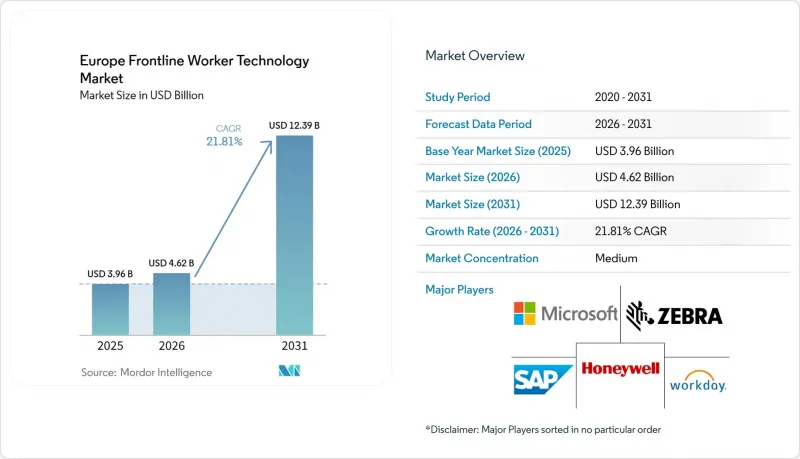
Mordor Intelligence에 의하면, 유럽 현장 근로자 기술 시장 규모는 2025년에 39억 6,000만 달러, 2026년에 46억 2,000만 달러가 되고, 2031년까지 123억 9,000만 달러에 이를 것으로 예측되며, 2026년부터 2031년까지 CAGR 21.81%로 성장할 전망입니다.
본 보고서는 구성 요소(소프트웨어 및 서비스), 배포 방식(클라우드 기반, 하이브리드형, On-Premise형), 조직 규모(대기업 및 중소기업), 용도(직원 커뮤니케이션 및 참여도 등), 최종 사용 산업(소매 및 전자상거래 등), 지역별로 분류되어 있습니다. 시장 전망은 금액(달러)으로 표시되어 있습니다.
유럽 현장 근로자 기술 시장 동향 및 인사이트
소매, 의료, 제조, 물류 각 업계에서의 ‘모바일 퍼스트’ 업무용 소프트웨어로의 전환
유럽 현장 근로자 기술 시장은 고정 단말기를 통한 워크플로우에서 지시나 최신 정보를 근로자의 손끝에 직접 전달하는 모바일 도구로의 전환을 통해 성장을 이루고 있습니다. 마이크로소프트는 2026년, Frontline Hub, Shifts의 스마트 스케줄링, Communicator 앱, 그리고 Frontline Agent의 음성 제어 기능을 통해 현장용 솔루션을 확충했습니다. 이는 현장 워크플로가 더 이상 제품 로드맵의 주변부가 아니라 중심에 가까운 위치를 차지하게 되었음을 보여줍니다. 하네웰 역시 마찬가지로 ‘Performance+ for Guided Work’를 도입했습니다. 이는 창고, 소매, 물류 환경 전반에 걸쳐 음성 기반 작업 안내와 분석 기능을 결합한 것으로, 48개 언어를 지원합니다. 이러한 변화가 중요한 이유는 모바일 우선 시스템이 지시, 실행, 확인 사이의 지연을 줄여주기 때문입니다. 이는 임시 직원이나 여러 교대조가 존재하는 바쁜 시설에서 특히 가치가 있습니다. TeamViewer의 보고서에 따르면, Vandemoortele사는 6곳의 창고 거점에 비전 피킹 워크플로를 도입한 후, 임시 직원의 교육 시간을 25% 단축했습니다. 이는 유럽 현장 근로자 기술 시장에서 모바일 및 지원형 워크플로가 노동 생산성을 직접 향상시키는 도구로 자리 잡고 있음을 보여줍니다.
데스크리스 팀의 실시간 커뮤니케이션 및 업무 조정에 대한 수요 증가
많은 현장 직원들은 사무직 직원들이 일상적으로 이용하는 디지털 채널을 이용할 수 없는 상태에서 여전히 업무를 수행하고 있기 때문에 실시간 커뮤니케이션은 여전히 기본적인 요구 사항으로 남아 있습니다. 따라서 유럽의 현장 근로자 기술 시장에서는 메시징, 업무 할당, 확인, 에스컬레이션을 하나의 모바일 인터페이스에 통합한 플랫폼에 대한 수요가 증가하고 있습니다. LumApps는 2025년, 자사의 'LumApps AI Employee Hub'와 'Beekeeper' 플랫폼을 결합한 서비스가 2,000개 이상의 조직에 걸쳐 700만 명 이상의 사용자에게 이용되며, 200개 이상의 언어를 지원한다고 발표했습니다. 이는 유럽 내 다국어 현장 커뮤니케이션 수요의 규모를 여실히 보여줍니다. UKG가 2026년 3월에 실시한 조사에 따르면, 현장 종사자의 75%가 ‘기술 덕분에 근무 일정 관리가 쉬워졌습니다’고 응답한 반면, 64%는 여전히 자발적으로 초과 근무를 하고 있다고 답했습니다. 이는 인력 배치에 대한 압박이 남아 있는 상황에서도, 더 우수한 커뮤니케이션 도구가 업무 흐름의 명확화에 기여할 수 있음을 시사합니다. 업무의 분산화 추세가 가속화되는 가운데, 커뮤니케이션과 실시간 실행을 연계하는 벤더들이 유럽 현장 근로자 기술 시장에서 입지를 다지고 있습니다. 이는 구매자들이 현장 수준의 업무 인계 간극을 줄이고 책임 소재를 더욱 명확히 하고자 하기 때문입니다.
GDPR(EU 개인정보보호규정) 및 직원 개인정보 보호 관련 제약: 위치 정보, 행동, 성과 모니터링
개인정보 보호 규제로 인해 직원의 행동, 위치 정보 또는 성과에 관한 상세한 데이터를 수집하는 플랫폼의 도입은 여전히 더딘 상태입니다. 이에 대응하여 유럽 현장 근로자 기술 시장에서는 데이터 발자국을 축소하고, 권한 구조를 더욱 명확히 하며, 감사 관리를 강화하는 방향으로 제품 설계를 전환하고 있습니다. 이러한 광범위한 규제 환경은 알고리즘 기반 관리 및 근로자 보호를 둘러싼 유럽 내 논의로 인해 더욱 강화되고 있으며, 유럽의회 조사국은 이를 직장 전반으로 확대되고 있는 문제로 지적하고 있습니다. 이는 구매자가 감시 기능을 현지 법규 및 노동 관련 기대치에 부합하도록 설정할 수 있는지 여부를 따지게 되었기 때문에 공급업체가 기능의 충실도에만 의존할 수 없게 되었음을 의미합니다. 그 결과, 유럽 현장 근로자 기술 시장의 일부에서는 조달에 시간이 걸리는 경향이 있지만, 도입 시 규정 준수 관련 불확실성을 줄일 수 있는 ‘프라이버시 바이 디자인(Privacy by Design)’을 채택한 제품도 우위를 점하고 있습니다.
부문 분석
2025년에는 소프트웨어가 시장의 81.11%를 차지하며, 유럽 현장 근로자 기술 시장에서 가장 큰 구성 요소가 되었습니다. 이러한 위상은 클라우드 도입이 용이해짐에 따라 급속히 확대된 워크플로우 관리 플랫폼, 커뮤니케이션 도구 및 SaaS형 스케줄링 시스템의 강력한 보급을 반영한 것입니다. 한편, 서비스 부문은 2031년까지 연평균 성장률(CAGR) 22.41%를 나타낼 것으로 예측되며, 구매자들이 시범 도입에서 본격적인 확대로 전환함에 따라 도입 작업의 중요성이 점점 더 커지고 있음을 보여줍니다. 2025년 유럽 현장 근로자 기술 시장에서 소프트웨어 시장 규모는 서비스 부문을 크게 앞질렀으나, 이용 사례가 복잡해짐에 따라 도입 지원, 현지화, 변경 관리와 같은 분야에서도 새로운 수익 성장이 나타나고 있습니다. 이러한 추세는 소프트웨어가 여전히 핵심적인 상업적 요소인 반면, 대규모 구매자가 구매 후 얼마나 많은 가치를 창출할 수 있는지는 많은 경우 서비스의 깊이에 따라 결정된다는 점을 보여줍니다.
ATOSS Software SE는 2025 회계연도 매출이 1억 8,930만 유로(2억 440만 달러)였다고 보고했으며, 클라우드 및 구독 수익은 전년 대비 28% 증가했습니다. 이는 지속 가능한 수익 모델을 갖춘 플랫폼 중심의 인력 관리 솔루션에 대한 수요를 반영합니다. 이 회사의 고객 기반에는 독일 철도(Deutsche Bahn), 루프트한자(Lufthansa), 데카트론(Decathlon) 등 주요 기업들이 이름을 올리고 있으며, 이는 여러 국가에 걸친 일정 관리 및 인력 배치 규칙이 도입에 있어 전문 지식의 역할을 얼마나 크게 하고 있는지를 보여줍니다. 유럽의 현장 근로자 기술 업계에서는 서비스 팀이 고객 확보 채널의 역할도 수행하고 있습니다. 이는 서비스 팀이 공급업체가 워크플로우의 격차를 파악하도록 돕고, 이것이 향후 분석 및 자동화 확대로 이어지기 때문입니다. 이를 통해 구매자가 국가별 일정 수립 논리, 다국어 도입 지원, 현지 운영 관행과의 정합성을 필요로 하는 상황에서 현지 전문가가 우위를 점하게 됩니다. 따라서 유럽 현장 근로자 기술 시장에서는 시장 점유율 측면에서 소프트웨어가 우세하지만, 고객 확보 및 유지 측면에서는 서비스 역량이 여전히 중요한 요소로 작용하고 있습니다.
2025년에는 클라우드 기반 도입이 시장 점유율의 76.61%를 차지하며, 유럽 현장 근로자 기술 시장에서 하이브리드형이나 On-Premise형 접근 방식을 확실히 앞질렀습니다. 이는 소유 비용 절감, 원격 관리, 그리고 분산된 거점 전반에 걸친 규정 준수 업데이트의 용이성에 대한 구매자의 선호도를 반영한 것입니다. 또한, 클라우드는 2031년까지 연평균 성장률(CAGR) 23.16%를 나타낼 것으로 예측되며, 가장 큰 도입 모델인 동시에 가장 빠르게 성장하는 도입 모델로 남을 전망입니다. 2025년, 클라우드 기반 시스템은 유럽 현장 근로자 기술 시장의 76.61%를 차지하며, 하드웨어에 얽매이거나 특정 거점에 국한되었던 기존 소프트웨어 환경에서 명확한 전환을 보여주고 있습니다. 이러한 높은 점유율은 데스크리스 근로자에게 도구를 배포할 때, 많은 구매자가 더 신속한 도입 주기와 사내 인프라 부담 경감을 원하고 있음을 시사합니다.
그렇지만 보안에 대한 기대, 데이터 거주지 요건, 혹은 업무상의 기밀성 등의 이유로 완전한 클라우드 활용이 현실적이지 않은 환경에서는 하이브리드 도입이 여전히 전략적 가치를 지니고 있습니다. 독일이나 프랑스의 일부 지역에서는 도입 주기가 장기화된 결과, 신속하게 교체하기에는 비용이 많이 드는 맞춤형 환경이 구축되어 있어 On-Premise 시스템의 도입 비중이 여전히 큰 비율을 차지하고 있습니다. 따라서 EU 내에 인프라를 보유하고 지역별 지원 팀을 갖춘 벤더는 운영 데이터의 저장 위치에 대한 관리권을 잃지 않으면서 클라우드의 유연성을 추구하는 기업 고객 대상으로 조달 심사를 통과할 가능성이 높아집니다. 유럽의 현장 근로자 기술 업계에서는 이로 인해 신속하게 클라우드로 전환할 수 있는 구매자와 여전히 단계적인 전환 모델이 필요한 구매자 간에 양극화가 발생하고 있습니다. 따라서 유럽 현장 근로자 기술 시장은 클라우드 제공을 중심으로 통합이 진행되고 있는 반면, 규제가 엄격하고 보안 의식이 높은 환경에서는 하이브리드형 옵션이 여전히 중요한 위치를 차지하고 있습니다.
기타 혜택:
- 엑셀 형식 시장 예측(ME) 시트
- 3개월간의 애널리스트 지원
자주 묻는 질문
목차
제1장 서론
제2장 조사 방법
제3장 주요 요약
제4장 시장 구도
제5장 시장 규모와 성장 예측
제6장 경쟁 구도
제7장 시장 기회와 향후 전망
JHSAccording to Mordor Intelligence, the Europe frontline worker technology market size is projected to be USD 3.96 billion in 2025, USD 4.62 billion in 2026, and reach USD 12.39 billion by 2031, growing at a CAGR of 21.81% from 2026 to 2031.
This report is Segmented by Component (Software and Services), Deployment (Cloud-Based, Hybrid, and On-Premises), Organization Size (Large Enterprises and Small and Medium Enterprises), Application (Employee Communication and Engagement, and More), End-User Industry (Retail and E-Commerce, and More), and Geography. The Market Forecasts are Provided in Terms of Value (USD).
Europe Frontline Worker Technology Market Trends and Insights
Shift Toward Mobile-First Operational Software Across Retail, Healthcare, Manufacturing, and Logistics
The Europe frontline worker technology market is gaining from the replacement of fixed-terminal workflows with mobile tools that put instructions and updates directly in workers' hands. Microsoft expanded its frontline offering in 2026 with Frontline Hub, Smart Scheduling in Shifts, the Communicator App, and voice-driven capabilities in Frontline Agent, showing that frontline workflows now sit closer to the center of product roadmaps rather than at the edge. Honeywell also moved in the same direction with Performance+ for Guided Work, which combined voice-driven task guidance with analytics across warehousing, retail, and logistics environments and supported 48 languages. This shift matters because mobile-first systems reduce delays between instruction, execution, and confirmation, which is especially valuable in busy facilities with temporary staff and multiple shifts. TeamViewer reported that Vandemoortele reduced temporary worker training time by 25% after deploying vision-picking workflows across 6 warehouse sites, demonstrating how mobile and assisted workflows are becoming direct labor productivity tools in the Europe frontline worker technology market.
Rising Demand For Real-Time Communication and Task Orchestration Among Deskless Teams
Real-time communication remains a basic need because many frontline employees still work without the digital channels that office staff use every day. The Europe frontline worker technology market is therefore seeing stronger demand for platforms that combine messaging, task assignment, acknowledgment, and escalation in one mobile interface. LumApps stated in 2025 that the combined LumApps AI Employee Hub and Beekeeper platform served more than 7 million users across more than 2,000 organizations and supported more than 200 languages, underscoring the scale of multilingual frontline communication demand in Europe. UKG found in March 2026 that 75% of frontline workers said technology had made it easier to manage their work schedules, but 64% still worked voluntary overtime, suggesting that better communication tools improve workflow clarity even when staffing pressure remains. As operations become more distributed, vendors that tie communication to real-time execution are gaining ground in the Europe frontline worker technology market because buyers want fewer handoff gaps and clearer accountability at the site level.
GDPR and Worker Privacy Constraints on Location, Behavior, and Performance Monitoring
Privacy rules continue to slow deployments that involve platforms collecting detailed data on worker behavior, location, or output. The Europe frontline worker technology market is responding by shifting product design toward smaller data footprints, clearer permission structures, and stronger audit controls. The broader regulatory setting is reinforced by European debate around algorithmic management and worker protections, which the European Parliament Research Service highlighted as an expanding issue across the workplace. This means vendors cannot rely solely on feature depth, because buyers now ask whether monitoring functions can be configured to meet local legal and labor expectations. Procurement, therefore, takes longer in parts of the Europe frontline worker technology market, but privacy-by-design products are also gaining an advantage because they reduce compliance uncertainty during rollout.
Other drivers and restraints analyzed in the detailed report include:
- Expansion of AI-Assisted Scheduling, Task Prioritization, and Exception Management
- Compliance Pressure Around Worker Safety, Traceability, And Audit-Ready Workflows
- Fragmented Legacy IT Environments Increase Integration Time And Deployment Cos
For complete list of drivers and restraints, kindly check the Table Of Contents.
Segment Analysis
Software accounted for 81.11% of the market in 2025, making it the largest component of the Europe frontline worker technology market. That position reflected strong adoption of workflow management platforms, communication tools, and software-as-a-service scheduling systems that scaled quickly as cloud deployment became easier. At the same time, services are projected to grow at a 22.41% CAGR through 2031, indicating that implementation work is becoming increasingly important as buyers move from pilots to broader rollouts. The Europe frontline worker technology market size for software remained well ahead of services in 2025, but new revenue growth is spreading into deployment support, localization, and change management as use cases become more complex. This pattern shows that software is still the core commercial layer, while service depth often determines how much value large buyers can unlock after purchase.
ATOSS Software SE reported FY2025 revenue of EUR 189.3 million (USD 204.4 million), with cloud and subscription revenue up 28% year over year, which reflects demand for platform-led workforce solutions with recurring commercial models. Its customer base included large employers such as Deutsche Bahn, Lufthansa, and Decathlon, which illustrates how multi-country scheduling and staffing rules create a bigger role for implementation expertise. In the Europe frontline worker technology industry, service teams also act as account entry channels because they help vendors identify workflow gaps that can later support analytics or automation expansion. This gives local specialists an advantage where buyers need country-specific scheduling logic, multilingual rollout support, and alignment with local operating practices. The Europe frontline worker technology market therefore shows software dominance in terms of share, but service capability remains a major factor in account growth and retention.
Cloud-based deployment captured 76.61% of the market share in 2025, placing it clearly ahead of hybrid and on-premises approaches in the Europe frontline worker technology market. This reflected buyer preference for lower ownership cost, remote administration, and easier compliance updates across distributed sites. Cloud is also projected to grow at a 23.16% CAGR through 2031, keeping it both the largest and fastest-growing deployment model. Cloud-based systems accounted for 76.61% of the Europe frontline worker technology market in 2025, indicating a clear shift away from hardware-tied or site-bound software estates. The strong share position also suggests that many buyers now want faster rollout cycles and lower internal infrastructure burdens when extending tools to deskless workers.
Even so, hybrid deployment still holds strategic value in settings where security expectations, data residency needs, or operational sensitivity make full cloud use less practical. The installed base of on-premises systems remains meaningful in parts of Germany and France because long implementation cycles have created customized environments that are costly to replace quickly. Vendors with EU-hosted infrastructure and regional support teams are therefore more likely to pass procurement reviews in enterprise accounts seeking cloud flexibility without losing control over where operational data resides. In the Europe frontline worker technology industry, this creates a split between buyers that can move quickly to cloud and buyers that still need staged migration models. The Europe frontline worker technology market is thus consolidating around cloud delivery, while hybrid options remain important in regulated and security-conscious environments.
Complete Report Scope:
- By Component
- Software
- Services
- By Deployment
- Cloud-Based
- Hybrid
- On-Premises
- By Organization Size
- Large Enterprises
- Small and Medium Enterprises
- By Application
- Employee Communication and Engagement
- Workforce Execution and Task Management
- Workforce Scheduling and Coordination
- Learning and Knowledge Enablement
- Workforce Analytics and Performance Management
- Safety and Compliance Management
- Other Applications
- By End-User Industry
- Retail and E-Commerce
- Industrial Manufacturing
- Healthcare and Life Sciences
- Transportation and Logistics
- Hospitality
- Construction
- Government and Public Administration
- Other Industries
- By Geography
- Germany
- United Kingdom
- France
- Russia
- Spain
- Rest of Europe
List of Companies Covered in this Report:
- Zebra Technologies Corporation
- Honeywell International Inc.
- RealWear, Inc.
- Vuzix Corporation
- ATOSS Software SE
- SAP SE
- Microsoft Corporation
- Oracle Corporation
- Workday, Inc.
- UKG Inc.
- ADP, Inc.
- ServiceNow, Inc.
- Beekeeper AG
- YOOBIC Ltd.
- PTC Inc.
- IBM Corporation
- Panasonic Holdings Corporation
- Siemens Aktiengesellschaft
- Mitie Group plc
- Frontline AI, Inc.
- Eletive AB
Additional Benefits:
- The market estimate (ME) sheet in Excel format
- 3 months of analyst support
TABLE OF CONTENTS
1 INTRODUCTION
- 1.1 Study Assumptions and Market Definition
- 1.2 Scope of the Study
2 RESEARCH METHODOLOGY
3 EXECUTIVE SUMMARY
4 MARKET LANDSCAPE
- 4.1 Market Overview
- 4.2 Market Drivers
- 4.2.1 Rising Demand For Real-Time Communication And Task Orchestration Among Deskless Teams
- 4.2.2 Compliance Pressure Around Worker Safety, Traceability, And Audit-Ready Workflows
- 4.2.3 Shift Toward Mobile-First Operational Software Across Retail, Healthcare, Manufacturing, And Logistics
- 4.2.4 Expansion Of AI-Assisted Scheduling, Task Prioritization, And Exception Management
- 4.2.5 Growth Of Rugged Devices, Wearables, And Connected PPE In High-Risk Work Environments
- 4.2.6 Multisite Labor Shortages Driving Productivity Tools For Frontline Workforce Retention
- 4.3 Market Restraints
- 4.3.1 GDPR And Worker Privacy Constraints On Location, Behavior, And Performance Monitoring
- 4.3.2 Fragmented Legacy IT Environments Increase Integration Time And Deployment Cost
- 4.3.3 Union And Works Council Resistance To Continuous Digital Oversight
- 4.3.4 Interoperability Gaps Across Devices, Apps, And Enterprise Systems
- 4.4 Impact of Macroeconomic Factors on the Market
- 4.5 Industry Value Chain Analysis
- 4.6 Technology Outlook
- 4.7 Regulatory Landscape
- 4.8 Porter's Five Forces Analysis
- 4.8.1 Threat of New Entrants
- 4.8.2 Bargaining Power of Suppliers
- 4.8.3 Bargaining Power of Buyers
- 4.8.4 Threat of Substitutes
- 4.8.5 Intensity of Competitive Rivalry
5 MARKET SIZE AND GROWTH FORECASTS (VALUE)
- 5.1 By Component
- 5.1.1 Software
- 5.1.2 Services
- 5.2 By Deployment
- 5.2.1 Cloud-Based
- 5.2.2 Hybrid
- 5.2.3 On-Premises
- 5.3 By Organization Size
- 5.3.1 Large Enterprises
- 5.3.2 Small and Medium Enterprises
- 5.4 By Application
- 5.4.1 Employee Communication and Engagement
- 5.4.2 Workforce Execution and Task Management
- 5.4.3 Workforce Scheduling and Coordination
- 5.4.4 Learning and Knowledge Enablement
- 5.4.5 Workforce Analytics and Performance Management
- 5.4.6 Safety and Compliance Management
- 5.4.7 Other Applications
- 5.5 By End-User Industry
- 5.5.1 Retail and E-Commerce
- 5.5.2 Industrial Manufacturing
- 5.5.3 Healthcare and Life Sciences
- 5.5.4 Transportation and Logistics
- 5.5.5 Hospitality
- 5.5.6 Construction
- 5.5.7 Government and Public Administration
- 5.5.8 Other Industries
- 5.6 By Geography
- 5.6.1 Germany
- 5.6.2 United Kingdom
- 5.6.3 France
- 5.6.4 Russia
- 5.6.5 Spain
- 5.6.6 Rest of Europe
6 COMPETITIVE LANDSCAPE
- 6.1 Market Concentration
- 6.2 Strategic Moves
- 6.3 Market Share Analysis
- 6.4 Company Profiles (includes Global Level Overview, Market Level Overview, Core Segments, Financials as available, Strategic Information, Market Rank/Share, Products and Services, Recent Developments)
- 6.4.1 Zebra Technologies Corporation
- 6.4.2 Honeywell International Inc.
- 6.4.3 RealWear, Inc.
- 6.4.4 Vuzix Corporation
- 6.4.5 ATOSS Software SE
- 6.4.6 SAP SE
- 6.4.7 Microsoft Corporation
- 6.4.8 Oracle Corporation
- 6.4.9 Workday, Inc.
- 6.4.10 UKG Inc.
- 6.4.11 ADP, Inc.
- 6.4.12 ServiceNow, Inc.
- 6.4.13 Beekeeper AG
- 6.4.14 YOOBIC Ltd.
- 6.4.15 PTC Inc.
- 6.4.16 IBM Corporation
- 6.4.17 Panasonic Holdings Corporation
- 6.4.18 Siemens Aktiengesellschaft
- 6.4.19 Mitie Group plc
- 6.4.20 Frontline AI, Inc.
- 6.4.21 Eletive AB
7 MARKET OPPORTUNITIES AND FUTURE OUTLOOK
- 7.1 White-Space and Unmet-Need Assessment