

|
시장보고서
상품코드
2099269
미국의 현장 근로자 기술 시장 : 점유율 분석, 업계 동향 및 통계, 성장 예측(2026-2031년)United States Frontline Worker Technology - Market Share Analysis, Industry Trends & Statistics, Growth Forecasts (2026 - 2031) |
||||||
 Mordor Intelligence
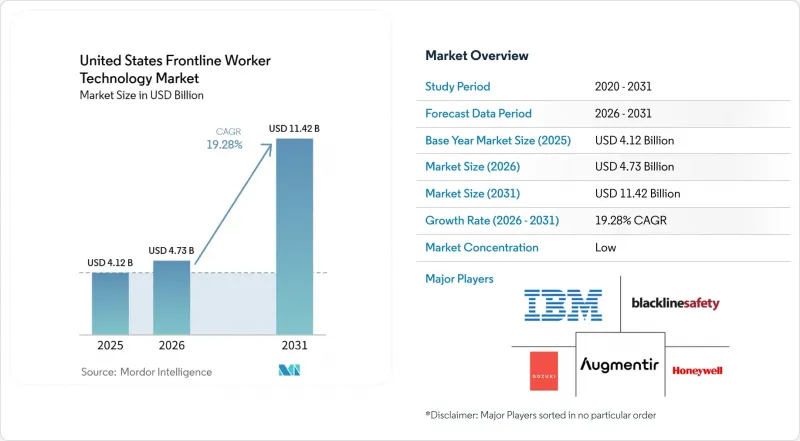
Mordor Intelligence에 의하면, 미국 현장 근로자 기술 시장 규모는 2025년에 41억 2,000만 달러로 평가되었고 2026년 47억 3,000만 달러에서 2031년까지 114억 2,000만 달러에 이를 것으로 예측되며, 예측 기간(2026-2031년) CAGR은 19.28%를 나타낼 전망입니다.
본 보고서는 구성 요소(소프트웨어 및 서비스), 배포 방식(클라우드 기반 등), 조직 규모(대기업 및 중소기업), 용도(직원 커뮤니케이션 및 참여도 등), 최종 사용 산업(소매 및 전자상거래, 산업 제조 등)별로 분류되어 있습니다. 시장 전망은 금액(달러)으로 표시되어 있습니다.
미국 현장 근로자 기술 시장 동향 및 인사이트
실시간 현장 가시화에 대한 수요 증가
현장 작업 환경과 기업의 보고 시스템 사이에 존재하는 업무상의 ‘사각지대’는 여전히 큰 비용 문제로 대두되고 있으며, 이는 기업들이 가시화 도구를 고립된 시범 도입 단계에서 보다 광범위한 운영 단계로 전환하도록 촉진하고 있습니다. Zebra Technologies는 2026년 6월, 미국 소매업체의 51%가 재고 최적화를 위해 AI를 시범 도입하고 있으며, 45%가 비용 최적화를 위해 시범 도입하고 있다고 보고했습니다. 이 모든 것은 현장에서 관리 시스템으로 유입되는 실시간 데이터에 의존하고 있습니다. 이러한 변화로 인해 경영 실무도 변화하고 있습니다. 왜냐하면 실적을 뒤늦게 전달되는 주간 또는 월간 요약 보고서에 의존하는 대신, 특정 거점, 근무 교대, 업무, 혹은 이벤트와 연계할 수 있게 되었기 때문입니다. 하네웰은 2026년 3월, 셰브론 및 토탈에너지스와 진행한 시범 운영을 통해 ‘Experion Operations Assistant’가 사고 발생 5-10분 전에 경보 예측을 생성했다고 발표했습니다. 이는 조기 가시화가 가동 중단 시간을 방지하고 운영자의 신속한 대응을 얼마나 지원할 수 있는지를 보여줍니다. 따라서 구매자들은 가시화 소프트웨어를 프로세스 장애 발생 후에 사용되는 단순한 보고서 작성용 애드온이 아니라, 직접적인 투자 회수가 기대되는 운영 관리 계층으로 인식하고 있습니다. 미국 현장 근로자 기술 시장에서 이러한 변화는 사소한 지연이라도 서비스 수준, 근로자의 생산성, 재고 정확도 또는 안전 성능에 영향을 미칠 수 있는 환경에서 평가 주기의 단축에 기여하고 있습니다.
모바일 우선 업무 수행의 확산
미국 전역의 현장 근로자들에게 모바일 기기는 종이 양식, 고정식 체크리스트, 무선을 통한 지시를 대체하며 주요 워크플로 인터페이스로 자리 잡아가고 있습니다. 최신 모바일 애플리케이션이 보급되고 있는 이유는 오프라인 사용, 음성 입력, 안내형 작업 라우팅, 그리고 책상에서 보내는 시간이 적은 직원의 부담을 줄여주는 간단한 일상 업무 워크플로우를 지원하기 때문입니다. 하네웰은 2026년 1월, 보다 신속한 업무 수행과 현장 가시성 향상이 요구되는 소매, 운송, 물류, 의료 분야의 사업자를 대상으로, 음성 유도형 워크플로우 도구와 분석 기능을 결합한 'Performance+ for Guided Work'를 출시했습니다. 마이크로소프트는 2026년 ‘Work Trend Index’에서 Microsoft 365 생태계 내 활성 AI 에이전트 수가 2025년 3월부터 2026년 3월까지 15배 증가했다고 보고했으며, 조사 대상인 다른 부문과 비교했을 때 제조업에서 조직당 도입률이 더 높은 것으로 나타났습니다. 동 조사에 따르면, 관리자의 도입 태도, 실험을 용인하는 기업 문화, 인센티브와 같은 조직적 요인은 개별 도구의 사용 현황만 고려했을 때보다 보고된 AI의 영향력을 2배 이상 설명한다고 합니다. 미국 현장 근로자 기술 시장에서 이는 ‘모바일 퍼스트’의 우위가 용도 자체뿐만 아니라 도입 설계 및 운영 규율에도 크게 좌우된다는 것을 의미합니다.
레거시 시스템과의 고도화된 통합의 복잡성
통합의 복잡성이 높다는 점은 여전히 도입에 있어 가장 명백한 제약 요소 중 하나입니다. 그 이유는 많은 기업이 실시간 데이터 교환을 전제로 구축되지 않은 ERP, 창고 관리, 제조 및 운영 시스템을 여전히 운용하고 있기 때문입니다. 새로운 현장용 도구를 맞춤형 미들웨어를 통해 연결해야 하는 경우, 프로젝트 일정이 장기화되거나 사내 IT 부서의 부담이 증가하거나 총 소유 비용(TCO)의 타당성을 설명하기 어려워지는 경우가 종종 있습니다. 이 문제는 중견 기업 시장에서 더욱 심각합니다. 많은 기업에는 전담 통합 엔지니어가 없어, 기본적인 시스템 연결조차 벤더의 서비스에 의존할 수밖에 없기 때문입니다. 이러한 부담이 미국 내 현장 근로자 기술 시장에서 ‘서비스’가 가장 빠르게 성장하는 분야인 이유 중 하나입니다. 구매자는 소프트웨어 라이선스 외에도 도입, 교육, 워크플로우 설계 및 관리형 지원을 종합적으로 필요로 하는 경우가 많기 때문입니다. 이러한 이유로 하이브리드 배포도 여전히 중요합니다. 많은 기업이 핵심 시스템을 On-Premise로 유지하면서, 그 주변에 클라우드 기반의 통신, 분석 또는 안내 용도를 통합하고 있기 때문입니다. 제품 자체 내에서 통합 부담을 줄일 수 있는 벤더는 대규모 멀티사이트 계약을 수주하고, 장기적으로 계약 갱신을 확보하는 데 유리한 입장에 있습니다.
부문 분석
2025년, 소프트웨어는 매출의 83.47%를 차지하며 미국 현장 근로자 기술 시장에서 가장 큰 점유율을 기록했습니다. 이러한 선두 위상은 분산된 단일 기능 도구가 아닌, 커뮤니케이션, 작업 실행, 분석, 안전 관리를 하나의 운영 계층으로 통합한 통합 제품군으로의 꾸준한 전환을 반영합니다. 구매자들은 직원용 용도 수를 줄이기를 점점 더 요구하고 있습니다. 앱이 너무 많으면 혼란을 초래하고, 도입이 지연되며, 지점 간 데이터의 일관성이 훼손되기 때문입니다. Zebra는 2026년 6월에 개최된 ZONE 컨퍼런스에서 이 문제를 ‘앱 과다’로 제기하며, 업무상의 마찰을 줄이고 더 단순한 현장 디지털 환경을 원하는 고객의 요구를 지적했습니다. 실용적인 관점에서 볼 때, 소프트웨어의 강점은 직원, 기기, 현장 활동, 그리고 기업의 의사결정을 연결하는 제어 계층으로서의 역할에 있습니다.
서비스 분야는 2026년부터 2031년까지 연평균 성장률(CAGR) 22.36%로 확대될 것으로 예측되며, 미국 현장 근로자 기술 시장에서 가장 성장세가 두드러질 분야가 될 전망입니다. 서비스 분야의 강점은 워크플로우 설정, 시스템 연동, 사용자 교육, 그리고 도입 후 운영 지원에 필요한 구현 작업에서 비롯됩니다. 많은 고용주는 소프트웨어를 단독 제품으로 구매하지 않습니다. 이는 도입의 성패가 프로세스 설계, 사용자 지원, 정책의 일관성, 그리고 계약 체결 후의 지속적인 최적화에 좌우되는 경우가 많기 때문입니다. 이는 특히 여러 거점에 걸쳐 전개됨에 따라 거점별로 직원의 업무 절차, 하드웨어 상태, 언어 요구 사항, 시스템 준비 상황에 편차가 발생하는 대규모 도입에서 두드러집니다. 그 결과, 고객 유지율 향상, 계정에 대한 침투 심화, 그리고 더 나은 도입 성과를 목표로 하는 벤더에게 지속적인 서비스 수익의 중요성이 높아지고 있습니다. 따라서 현재의 수익 구성은 소프트웨어가 주도하고 있지만, 향후 가치 점유율에서는 해당 소프트웨어를 대규모로 운영하기 위해 필요한 서비스에서 얻어지는 비중이 점차 증가할 것입니다.
클라우드 기반 도입은 2025년에 수익의 82.63%를 차지하고, 2031년까지 연평균 성장률(CAGR) 19.84%로 성장할 것으로 전망되어, 미국 현장 근로자 기술 시장 규모에서 중심적인 위치를 계속 차지하고 있습니다. 이러한 위상은 다수의 거점을 관리하고 이들 모두에서 데이터를 공유해야 하는 소매업체, 물류 사업자, 의료 네트워크 및 현장 업무 중심 조직의 요구를 반영합니다. 클라우드 기반 제공은 창고, 매장, 진료소, 공장, 서비스 거점별로 개별적인 로컬 환경을 유지하는 데 따르는 인프라 중복을 줄여줍니다. 또한 구독형 지출 모델에도 부합하여 플랫폼 진입을 용이하게 하고, 장기적인 소프트웨어 업데이트 관리도 수월하게 합니다. 많은 구매자에게 있어 클라우드 도입은 현재 각 거점에서 로컬 IT 지원을 재구축하지 않고도 광범위한 사업 거점 전반에 걸쳐 현장용 도구를 확장할 수 있는 가장 실용적인 방법이 되고 있습니다.
많은 대기업이 MES, EHR, POS, ERP 환경 등의 핵심 시스템을 On-Premise로 유지하면서, 그 주변에 클라우드를 통한 통신 및 분석 계층을 지속적으로 추가하고 있기 때문에 하이브리드 배포는 여전히 중요한 역할을 하고 있습니다. 이러한 계층적 접근 방식을 통해 기업은 깊이 정착된 업무 시스템을 즉시 교체하지 않고도 직원을 위한 워크플로를 현대화할 수 있습니다. On-Premise 배포는 전반적으로 점유율이 감소하고 있습니다. 그러나 직원의 활동 데이터, 조달 규칙 또는 보안 요구 사항으로 인해 보다 엄격한 On-Premise 관리가 필요한 환경에서는 여전히 중요한 위치를 차지하고 있습니다. 마이크로소프트는 ‘2026년 업무 동향 지수’에서 Microsoft 365 생태계 내 활성 AI 에이전트 수가 2025년 3월부터 2026년 3월까지 15배 증가했다고 보고하며, 다음 자동화 물결이 클라우드 기반 인프라에 얼마나 크게 의존하고 있는지를 뒷받침하고 있습니다. 미국 현장 근로자 기술 업계에서 도입 선택은 더 이상 단순한 ‘클라우드인가 On-Premise인가’라는 판단이 아니라, 기존 업무를 중단시키지 않으면서 기업이 사용자, 거점, 워크플로를 얼마나 신속하게 연계할 수 있는지에 중점을 두고 있습니다. 구매자들은 중요한 레거시 시스템에 대한 접근성을 유지하면서, 도입 시 발생하는 마찰을 최소화하는 모델을 점점 더 많이 선택하고 있습니다.
기타 혜택:
- 엑셀 형식 시장 예측(ME) 시트
- 3개월간의 애널리스트 지원
자주 묻는 질문
목차
제1장 서론
제2장 조사 방법
제3장 주요 요약
제4장 시장 구도
제5장 시장 규모와 성장 예측
제6장 경쟁 구도
제7장 시장 기회와 향후 전망
JHS 26.08.07According to Mordor Intelligence, the United States frontline worker technology market size was valued at USD 4.12 billion in 2025 and estimated to grow from USD 4.73 billion in 2026 to reach USD 11.42 billion by 2031, at a CAGR of 19.28% during the forecast period (2026-2031).
This report is Segmented by Component (Software, and Services), Deployment Mode (Cloud-Based, and More), Organization Size (Large Enterprises, and Small and Medium Enterprises), Application (Employee Communication and Engagement, and More), and End-User Industry (Retail and E-Commerce, Industrial Manufacturing, and More). The Market Forecasts are Provided in Terms of Value (USD).
United States Frontline Worker Technology Market Trends and Insights
Rising Demand for Real-Time Frontline Visibility
Operational blind spots between frontline work settings and enterprise reporting systems remain a major cost issue, which is pushing companies to move visibility tools from isolated pilots into broader operating use. Zebra Technologies reported in June 2026 that 51% of U.S. retailers were piloting AI for inventory optimization and 45% were piloting it for cost optimization, both of which depend on live data flowing from frontline settings into management systems. This shift is changing management practice because performance can now be linked to a specific site, shift, task, or event instead of relying on delayed weekly or monthly summaries. Honeywell said in March 2026 that Experion Operations Assistant generated alarm predictions 5-10 minutes before incidents during pilot work with Chevron and TotalEnergies, showing how earlier visibility can support avoided downtime and faster operator response. Buyers, therefore, view visibility software as an operating control layer with direct payback rather than as a reporting add-on used after a process failure. In the United States frontline worker technology market, that change is helping compress evaluation cycles in settings where a short delay can affect service levels, worker output, inventory accuracy, or safety performance.
Increasing Adoption of Mobile-First Task Execution
The mobile device is replacing paper forms, static checklists, and radio-based instructions as the main workflow interface for many frontline workers across U.S. operations. Modern mobile applications are gaining traction because they support offline use, voice input, guided task routing, and simple daily workflows that reduce friction for workers who spend little time at a desk. Honeywell launched Performance+ for Guided Work in January 2026, combining voice-directed workflow tools with analytics for retail, transportation, logistics, and healthcare operators that need faster execution and better frontline visibility. Microsoft reported in its 2026 Work Trend Index that active AI agents in the Microsoft 365 ecosystem grew 15x from March 2025 to March 2026, with manufacturing showing deeper deployment per organization than other sectors in the study. The same study said organizational factors such as manager adoption, cultural permission to experiment, and incentives explained more than 2x the reported AI impact compared with individual tool usage alone. For the United States frontline worker technology market, this means the mobile-first advantage depends as much on rollout design and operating discipline as it does on the application itself.
High Integration Complexity with Legacy Systems
High integration complexity remains one of the clearest limits on adoption because many employers still run ERP, warehouse, manufacturing, and operational systems that were not built for real-time exchange. When new frontline tools must connect through custom middleware, project timelines often get longer, internal IT pressure rises, and the total cost of ownership becomes harder to defend. This issue is sharper in the mid-market because many companies do not have dedicated integration engineers and must depend on vendor services for even basic system connectivity. That burden helps explain why services is the fastest-growing component in the United States frontline worker technology market, since buyers often need implementation, training, workflow design, and managed support together with software licenses. Hybrid deployment also remains important for this reason, because many firms keep core systems on-site while layering cloud communication, analytics, or guidance applications around them. Vendors that reduce the integration load inside the product itself are better positioned to secure larger multi-site contracts and renewals over time.
Other drivers and restraints analyzed in the detailed report include:
- AI-Enabled Workforce Guidance and Knowledge Capture
- Expansion of Wearables in Safety-Critical Workflows
- Frontline User Adoption and Change Resistance
For complete list of drivers and restraints, kindly check the Table Of Contents.
Segment Analysis
Software held 83.47% of revenue in 2025, which gave it the largest position in the United States frontline worker technology market share. That lead reflects a steady shift toward unified suites that combine communication, task execution, analytics, and safety management in one operating layer instead of scattered point tools. Buyers increasingly want fewer worker-facing applications because too many apps add confusion, slow adoption, and weaken data consistency across sites. Zebra highlighted this issue as app overload at its June 2026 ZONE conference, pointing to customer demand for simpler frontline digital environments that reduce operating friction. In practical terms, the strength of software comes from its role as the control layer that links workers, devices, site activity, and enterprise decision-making.
Services is projected to expand at 22.36% CAGR from 2026 to 2031, making it the fastest-growing component in the United States frontline worker technology market. The strength of services follows from the implementation work required to configure workflows, connect systems, train users, and support live operations after launch. Many employers are not buying software as a standalone product, because deployment success often depends on process design, user support, policy alignment, and continuing optimization after the contract is signed. This is especially true in large deployments where multi-site rollout creates variation in worker routines, hardware conditions, language needs, and system readiness across locations. As a result, recurring services revenue is becoming more important to vendors that want stronger retention, deeper account penetration, and better deployment outcomes. The component mix is therefore led by software today, but a growing share of future value will come from the services needed to make that software work at scale.
Cloud-based deployment held 82.63% of revenue in 2025 and is projected to grow at 19.84% CAGR through 2031, which keeps it central to the United States frontline worker technology market size. That position reflects the needs of retailers, logistics operators, healthcare networks, and field-intensive organizations that manage many locations and need shared data across all of them. Cloud delivery reduces the infrastructure duplication that would come with maintaining separate local setups for each warehouse, store, clinic, plant, or service branch. It also fits subscription spending models that make platform entry easier and software updates more manageable over time. For many buyers, cloud deployment now represents the most practical way to scale frontline tools across a broad operating footprint without rebuilding local IT support at every site.
Hybrid deployment still has a meaningful role because many large organizations continue to keep core systems such as MES, EHR, POS, or ERP environments on-site while adding cloud communication or analytics layers around them. This layered approach allows companies to modernize worker-facing workflows without forcing immediate replacement of deeply embedded operational systems. On-premises deployment is losing share overall, but it still matters in settings where worker activity data, procurement rules, or security requirements support tighter local control. Microsoft reported in its 2026 Work Trend Index that active AI agents in the Microsoft 365 ecosystem grew 15x from March 2025 to March 2026, reinforcing how strongly the next wave of automation depends on cloud-based infrastructure. Within the United States frontline worker technology industry, deployment choice is now less about a simple cloud versus on-site decision and more about how quickly companies can connect users, sites, and workflows without disrupting existing operations. Buyers are increasingly selecting the model that minimizes rollout friction while preserving access to critical legacy systems.
Complete Report Scope:
- By Component
- Software
- Services
- By Deployment
- Cloud-Based
- Hybrid
- On-Premises
- By Organization Size
- Large Enterprises
- Small and Medium Enterprises
- By Application
- Employee Communication and Engagement
- Workforce Execution and Task Management
- Workforce Scheduling and Coordination
- Learning and Knowledge Enablement
- Workforce Analytics and Performance Management
- Safety and Compliance Management
- Other Applications
- By End-User Industry
- Retail and E-Commerce
- Industrial Manufacturing
- Healthcare and Life Sciences
- Transportation and Logistics
- Hospitality
- Construction
- Government and Public Administration
- Other Industries
List of Companies Covered in this Report:
- Augmentir, Inc.
- IBM Corporation
- Blackline Safety Corp.
- Dozuki, Inc.
- Honeywell International Inc.
- LumApps
- Tulip Interfaces
- L2L, Inc.
- Microsoft Corporation
- Parsable, Inc.
- Poka Inc.
- PTC Inc.
- QAD Inc.
- RealWear, Inc.
- Salesforce, Inc.
- ServiceNow, Inc.
- Zebra Technologies Corporation
- SAP SE
- Samsara
- WorkJam, Inc.
- Voxware, Inc.
Additional Benefits:
- The market estimate (ME) sheet in Excel format
- 3 months of analyst support
TABLE OF CONTENTS
1 INTRODUCTION
- 1.1 Study Assumptions and Market Definition
- 1.2 Scope of the Study
2 RESEARCH METHODOLOGY
3 EXECUTIVE SUMMARY
4 MARKET LANDSCAPE
- 4.1 Market Overview
- 4.2 Market Drivers
- 4.2.1 Rising Demand for Real-Time Frontline Visibility
- 4.2.2 Increasing Adoption of Mobile-First Task Execution
- 4.2.3 Expansion of Wearables in Safety-Critical Workflows
- 4.2.4 AI-Enabled Workforce Guidance and Knowledge Capture
- 4.2.5 Compliance Pressure in Multi-Site Operations
- 4.2.6 Labor Productivity Gap Across Deskless Workforces
- 4.3 Market Restraints
- 4.3.1 High Integration Complexity with Legacy Systems
- 4.3.2 Frontline User Adoption and Change Resistance
- 4.3.3 Data Privacy and Continuous Monitoring Concerns
- 4.3.4 Device Durability, Battery Life, and Support Cost Constraints
- 4.4 Industry Value Chain Analysis
- 4.5 Impact of Macroeconomic Factors on the Market
- 4.6 Regulatory Landscape
- 4.7 Technological Outlook
- 4.8 Porter's Five Forces Analysis
- 4.8.1 Bargaining Power of Buyers
- 4.8.2 Bargaining Power of Suppliers
- 4.8.3 Threat of New Entrants
- 4.8.4 Threat of Substitutes
- 4.8.5 Intensity of Competitive Rivalry
5 MARKET SIZE AND GROWTH FORECASTS (VALUE)
- 5.1 By Component
- 5.1.1 Software
- 5.1.2 Services
- 5.2 By Deployment
- 5.2.1 Cloud-Based
- 5.2.2 Hybrid
- 5.2.3 On-Premises
- 5.3 By Organization Size
- 5.3.1 Large Enterprises
- 5.3.2 Small and Medium Enterprises
- 5.4 By Application
- 5.4.1 Employee Communication and Engagement
- 5.4.2 Workforce Execution and Task Management
- 5.4.3 Workforce Scheduling and Coordination
- 5.4.4 Learning and Knowledge Enablement
- 5.4.5 Workforce Analytics and Performance Management
- 5.4.6 Safety and Compliance Management
- 5.4.7 Other Applications
- 5.5 By End-User Industry
- 5.5.1 Retail and E-Commerce
- 5.5.2 Industrial Manufacturing
- 5.5.3 Healthcare and Life Sciences
- 5.5.4 Transportation and Logistics
- 5.5.5 Hospitality
- 5.5.6 Construction
- 5.5.7 Government and Public Administration
- 5.5.8 Other Industries
6 COMPETITIVE LANDSCAPE
- 6.1 Market Concentration
- 6.2 Strategic Moves
- 6.3 Market Share Analysis
- 6.4 Company Profiles (includes Global Level Overview, Market Level Overview, Core Segments, Financials as available, Strategic Information, Market Rank/Share, Products and Services, Recent Developments)
- 6.4.1 Augmentir, Inc.
- 6.4.2 IBM Corporation
- 6.4.3 Blackline Safety Corp.
- 6.4.4 Dozuki, Inc.
- 6.4.5 Honeywell International Inc.
- 6.4.6 LumApps
- 6.4.7 Tulip Interfaces
- 6.4.8 L2L, Inc.
- 6.4.9 Microsoft Corporation
- 6.4.10 Parsable, Inc.
- 6.4.11 Poka Inc.
- 6.4.12 PTC Inc.
- 6.4.13 QAD Inc.
- 6.4.14 RealWear, Inc.
- 6.4.15 Salesforce, Inc.
- 6.4.16 ServiceNow, Inc.
- 6.4.17 Zebra Technologies Corporation
- 6.4.18 SAP SE
- 6.4.19 Samsara
- 6.4.20 WorkJam, Inc.
- 6.4.21 Voxware, Inc.
7 MARKET OPPORTUNITIES AND FUTURE OUTLOOK
- 7.1 White-Space and Unmet-Need Assessment


