

|
시장보고서
상품코드
2099396
남미의 현장 근로자 기술 : 시장 점유율 분석, 업계 동향 및 통계, 성장 예측(2026-2031년)South America Frontline Worker Technology - Market Share Analysis, Industry Trends & Statistics, Growth Forecasts (2026 - 2031) |
||||||
 Mordor Intelligence
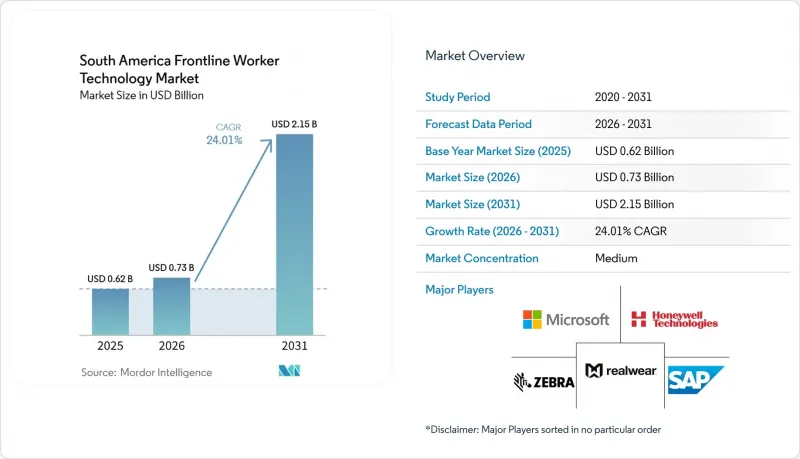
Mordor Intelligence에 의하면, 남미의 현장 근로자 기술 시장 규모는 2025년에 6억 2,000만 달러로 평가되었습니다. 2026년 7억 3,000만 달러에서 2031년까지 21억 5,000만 달러에 이를 것으로 예상되며, 예측 기간(2026-2031년) CAGR은 24.01%를 나타낼 전망입니다.
본 보고서는 구성 요소(소프트웨어 및 서비스), 배포 방식(클라우드 기반, 하이브리드형, On-Premise형), 조직 규모(대기업 및 중소기업), 용도(인력 분석 및 성과 관리 등), 최종 사용자 산업(소매 및 전자상거래 등), 지역별로 분류되어 있습니다. 시장 전망은 금액(달러) 기준으로 제시되어 있습니다.
남미의 현장 근로자 기술 시장 동향 및 인사이트
위험한 작업 현장에서의 핸즈프리 작업 지침에 대한 수요 증가
남미의 현장 근로자 기술 시장은 작업자가 수작업을 중단하거나 보호 장비를 벗지 않고도 디지털 지시를 따를 수 있도록 요구하는 고용주들의 지지를 얻고 있습니다. 이러한 요구는 광업, 금속, 에너지, 공정 산업에서 가장 두드러지는데, 이는 해당 산업에서 작업자가 동일한 작업 주기 내에서 이동, 점검, 의사소통 및 절차 확인을 빈번하게 수행해야 하기 때문입니다. 음성 제어 방식의 스마트 글라스나 헤드마운트형 도구는 종이 지침서, 휴대용 단말기, 또는 반복되는 무선 통신에 대한 의존도를 줄여주며, 소음이 심하고 위험이 높은 환경에서 업무 흐름을 보다 실용적으로 만듭니다. 또한, 이러한 기술의 도입을 통해 작업 완료 현황, 타임스탬프, 작업 상황에 대한 지속적인 기록이 생성되어 안전, 품질, 유지보수 팀에 아날로그 방식으로는 일관되게 수집할 수 없었던 데이터 레이어를 제공합니다. 기업이 이 기록을 사고 검증이나 교육에 활용하기 시작하면, 이와 유사한 도입 사례는 남미의 현장 근로자 기술 시장에서 더 광범위한 규정 준수 및 성과 요구 사항에도 부응하게 될 것입니다. 또한, 소음이 심한 현장에서의 사용을 상정한 본질 안전형 스마트 글라스나, 브라질의 데이터 개인정보 보호 요건을 준수한 스마트 배지 시스템에서 볼 수 있듯이, 위험한 환경이나 개인정보 보호에 대한 기대에 부응하는 제품 설계도 현지화가 더욱 진전되고 있습니다.
산업 현장에서의 프라이빗 5G 및 Wi-Fi 6 네트워크 확대
남미의 현장 근로자 기술 시장은 광산, 공장, 항만 및 현장 자산에서 공유되고 불안정한 통신 계층이 전용 연결로 대체됨에 따라 혜택을 보고 있습니다. 복잡한 작업 환경에서 공용 네트워크에서 흔히 발생하는 지연 없이 작업자가 실시간 지시를 받고, 동영상을 전송하며, 작업을 확인하고, 상태 데이터를 공유할 수 있게 된다면 현장용 도구의 유용성은 비약적으로 높아집니다. 이는 원격 지도, 안전 경보, 위치 추적, 디지털 점검 등 많은 현장 이용 사례에서 근무 중 통신 범위가 불안정하거나 지연이 변동하면 그 가치의 상당 부분이 상실되기 때문에 중요한 의미를 지닙니다. 현장의 연결성이 향상되면, 고용주는 개별 시범 운영 도구를 단일하고 광범위한 운영 플랫폼으로 통합할 수 있게 되어, 도입의 경제성이 향상되고 장기적인 구독 비용의 정당성도 높아집니다. 네트워크가 더욱 전용화되고 관리하기 쉬워짐에 따라, 플랫폼 공급업체는 남미의 현장 근로자 기술 시장 전체에서 보다 안정적인 사용자 경험과 높은 가동률을 보장할 수 있게 될 것입니다. 브라질 연방 기관을 대상으로 한 미션 크리티컬 통신 시스템의 도입은 전용 광대역 및 통합 통신 인프라가 장기적인 운영 아키텍처로 전환되고 있으며, 이 지역에서 고신뢰성 인력 연결의 광범위한 정착을 뒷받침하고 있음을 보여줍니다.
견고한 기기와 플랫폼 통합에 드는 높은 초기 비용
남미의 현장 근로자 기술 시장은 여전히 뚜렷한 도입 장벽에 직면해 있습니다. 이는 견고한 기기가 일반 소비자용 하드웨어보다 훨씬 비싸며, 대개 별도의 투자 결정이 필요하기 때문입니다. 이 문제는 대기업을 제외한 부문에서 특히 두드러집니다. 대기업의 경우, 기업이 현장용 소프트웨어의 가치를 인정하더라도 초기 도입에 기기, 액세서리, 설정, 교육, 지원이 포함되기 때문에 구매를 미루는 사례가 있습니다. 게다가 통합도 또 다른 부담이 됩니다. 많은 구매자는 플랫폼을 일상 업무에 도입하기 전에 ERP, 유지보수, 노무 또는 안전 시스템과의 연동이 필요하기 때문입니다. 이러한 통합 프로젝트는 간단하지 않으며, 사용자가 충분한 성과를 체감하기까지 전문가의 작업에 수개월이 소요되는 경우가 흔합니다. 따라서 남미의 현장 근로자 기술 시장의 중소규모 고용주들은 하드웨어나 시스템과 관련된 부담의 일부를 피할 수 있는 ‘모바일 퍼스트’나 ‘노코드’ 옵션을 선호하는 경향이 있습니다. 자금 조달 모델, 기기 리스, 혹은 부담이 덜한 도입 방식이 보편화되기 전까지는 비용 문제로 인해 수요의 일부는 본격적인 도입 단계에 이르지 못하고 검토 단계에 머물러 있을 것입니다.
부문 분석
2025년, 남미의 현장 근로자 기술 시장에서 소프트웨어는 76.25%의 점유율을 차지했습니다. 이는 구매자들이 커뮤니케이션, 업무, 분석, 규정 준수 기록을 연결하는 제어 계층을 우선시하고 있음을 보여줍니다. 이러한 변화는 중요한 의미를 지닙니다. 왜냐하면 진정한 업무상의 가치는 작업자, 기기, 기업 시스템을 연결하는 단일 인터페이스에 있음에도 불구하고, 고용주는 더 이상 현장의 각 기능마다 개별 도구를 요구하지 않게 되었기 때문입니다. 또한, 플랫폼 주도형 아키텍처는 하드웨어 선택의 폭도 넓혀줍니다. 기업은 핵심 워크플로우 로직을 매번 재설계할 필요 없이 웨어러블 기기, 스마트폰, 태블릿, 스캐너 등을 추가하거나 변경할 수 있기 때문입니다. 이를 통해 플랫폼이 일회성 용도이 아닌 실행 프레임워크가 되므로, 소프트웨어 투자에 대한 지속성이 높아집니다. 따라서 남미의 현장 근로자 기술 시장에서는 소프트웨어 벤더가 여러 워크플로우를 통합하여 대기업의 현지 보고 및 관리 요구를 충족시킬 수 있다면, 예산 점유율을 더욱 확대할 수 있게 됩니다.
서비스 분야는 2031년까지 연평균 성장률(CAGR) 27.02%로 확대될 것으로 예측되며, 이는 소프트웨어의 부상이 서비스 수요를 감소시키는 것이 아니라 오히려 증가시키고 있음을 보여줍니다. 현장용 플랫폼이 기본적인 메시징 기능을 넘어 워크플로우 설계, 분석, 규정 준수 문서 작성 단계로 발전함에 따라, 구매자는 일반적으로 도입 지원, 통합 작업, 프로세스 매핑 및 사용자 교육을 필요로 합니다. 이는 도입 시 기업 내 시스템 스택에 이미 존재하는 ERP, MES, CMMS, ID 관리 시스템 또는 안전 기록과 통합해야 하는 경우에 특히 해당됩니다. 남미의 현장 근로자 기술 시장에서 AI 지원 기능이 더욱 늘어남에 따라, 전문가에 의한 설정 및 지속적인 최적화 작업량은 더욱 증가하는 추세입니다. TeamViewer가 2026년 6월에 실시한 ‘Assist AR’ 업데이트에서는 통신 환경이 불안정한 상황에서도 선명한 원격 영상을 구현하기 위해 Microsoft Windows AI API 지원이 추가되었습니다. 이는 현장용 플랫폼이 점점 더 고도화되고 있으며, 그 결과 숙련된 도입 및 지원 서비스에 대한 의존도가 높아지고 있음을 보여줍니다.
2025년에는 클라우드 기반 도입이 66.45%의 점유율을 차지하고 있으며, 남미의 현장 근로자 기술 시장의 이 분야는 고용주가 인프라를 반복적으로 구매하지 않고도 사용자 수 확대, 워크플로우 업데이트, 기능 추가를 수행할 수 있는 운영 모델의 혜택을 받고 있습니다. 또한, 클라우드 기반 제공 방식은 여러 거점을 운영하는 조직에도 적합합니다. 신규 사용자, 거점, 프로세스 업데이트를 거점별 로컬 설치보다 신속하게 적용할 수 있기 때문입니다. 많은 고용주에게 이 모델은 비용이 비정기적인 자본 프로젝트가 아닌 구독료로 분산되므로 예산 계획과의 일관성이 더욱 높아집니다. 또한, 부족한 현지 IT 인력에 대한 의존도를 낮출 수 있어, 고도의 인프라 지원이 여전히 소수의 도시 지역에 집중되어 있는 지역에서 특히 유용합니다. 따라서 남미의 현장 근로자 기술 시장에서는 구매자가 특정 워크로드에 대해 여전히 현지에서 제어하기를 원하더라도, 많은 주류 현장용 용도에서 클라우드가 기본 아키텍처로 취급되어 왔습니다.
일부 중공업 분야에서는 클라우드를 통한 분석 기능이나 통합 관리를 원하면서도, 네트워크 장애 시의 로컬 내결함성, 저지연 또는 비즈니스 연속성이 요구되기 때문에 하이브리드 배포는 여전히 중요한 위치를 차지하고 있습니다. 정부 기관이나 규제 대상인 공공 서비스 환경에서는 관리 권한, 주권, 또는 기존 조달 구조의 관점에서 여전히 On-Premise 인프라가 우선시되므로, On-Premise 환경의 중요성은 지속되고 있습니다. 그렇지만 클라우드 기반 도입은 가장 빠르게 성장하는 부문이기도 하며, 2031년까지 연평균 성장률(CAGR)이 26.34%를 나타낼 것으로 예측되고 있는데, 이는 중앙 집중식 소프트웨어 관리의 경제성이 지속적으로 향상되고 있음을 보여줍니다. 남미의 현장 근로자 기술 시장의 방향성을 고려할 때, 장기적인 구조는 ‘클라우드 전용’이 아닌 ‘클라우드 주도’ 형태가 될 것이며, 현장 상황에 따라 엣지 기능이 통합되는 형태가 될 것으로 보입니다. TeamViewer가 ‘Assist AR’에서 영상 품질 향상을 위해 기기 내 AI를 활용하고 있는 점은 이러한 추세를 뒷받침하며, 낮은 대역폭 환경에서도 사용 편의성을 유지하기 위해 클라우드 플랫폼과 로컬 처리가 점점 더 결합되고 있음을 보여줍니다.
기타 혜택 :
- 엑셀 형식 시장 예측(ME) 시트
- 3개월간의 애널리스트 지원
자주 묻는 질문
목차
제1장 서론
제2장 조사 방법
제3장 주요 요약
제4장 시장 구도
제5장 시장 규모 및 성장 예측
제6장 경쟁 구도
제7장 시장 기회 및 향후 전망
KTH 26.08.10According to Mordor Intelligence, the South America frontline worker technology market size was valued at USD 0.62 billion in 2025 and estimated to grow from USD 0.73 billion in 2026 to reach USD 2.15 billion by 2031, at a CAGR of 24.01% during the forecast period (2026-2031).
This report is Segmented by Component (Software, and Services), Deployment (Cloud-Based, Hybrid, and On-Premises), Organization Size (Large Enterprises, and Small and Medium Enterprises), Application (Workforce Analytics and Performance Management, and More), End-User Industry (Retail and E-Commerce, and More), and Geography. The Market Forecasts are Provided in Terms of Value (USD).
South America Frontline Worker Technology Market Trends and Insights
Rising Demand for Hands-Free Task Guidance in Hazardous Operations
The South America frontline worker technology market is gaining support from employers that need workers to follow digital instructions without pausing manual tasks or removing protective equipment. This need is strongest in mining, metals, energy, and process industries, where a worker often must move, inspect, communicate, and confirm steps in the same operating cycle. Voice-controlled smart glasses and head-mounted tools reduce reliance on paper sheets, handheld devices, or repeated radio calls, making the workflow more practical in high-noise, high-risk settings. These deployments also create a continuous record of task completion, timestamps, and operating context, which gives safety, quality, and maintenance teams a data layer they could not consistently capture with analog methods. Once companies begin using this record for incident review and training, the same deployment starts supporting broader compliance and performance needs inside the South America frontline worker technology market. Product design is also becoming more localized for hazardous environments and privacy expectations, as shown by intrinsically safe smart glasses for noisy field use and smart badge systems aligned with Brazilian data privacy needs.
Expansion of Private 5G and Wi-Fi 6 Networks in Industrial Sites
The South America frontline worker technology market benefits when dedicated connectivity replaces shared and unstable communication layers in mines, plants, ports, and field assets. Frontline tools become far more useful when workers can receive live instructions, send video, confirm tasks, and share status data without the delays that often affect public networks in complex operating environments. This matters because many frontline use cases, including remote guidance, safety alerts, location tracking, and digital inspections, lose much of their value if coverage is inconsistent or latency varies during a shift. Better site connectivity also helps employers consolidate separate pilot tools into a single, broader operating platform, improving the economics of rollout and strengthening the case for long-term subscription spending. As networks become more dedicated and easier to govern, platform vendors can promise a more stable user experience and higher uptime across the South America frontline worker technology market. Brazil's mission-critical communications rollout for federal agencies shows that dedicated broadband and unified communications infrastructure are moving into a long-term operational architecture, supporting the broader normalization of high-reliability workforce connectivity in the region.
High Upfront Cost of Rugged Devices and Platform Integration
The South America frontline worker technology market still faces a clear adoption barrier because rugged devices cost far more than consumer hardware and usually require a separate investment case. This issue is most visible outside the large-enterprise tier, where a company may accept the value of frontline software but still delay purchases because the first deployment includes devices, accessories, configuration, training, and support. Integration adds another burden, since many buyers need the platform to connect with ERP, maintenance, workforce, or safety systems before it can become part of daily operations. Those integration projects are not simple, and they often consume months of specialist work before users see a full return. Smaller employers in the South America frontline worker technology market, therefore, tend to favor mobile-first or no-code options that can avoid part of the hardware and systems burden. Until financing models, device leasing, or lighter implementation methods become more common, cost will continue to keep a portion of demand in evaluation mode rather than full deployment.
Other drivers and restraints analyzed in the detailed report include:
- Increasing Adoption of Rugged Wearables for Worker Safety Compliance
- Need for Real-Time Workforce Visibility and Traceability
- Limited Battery Life in Field-Deployed Wearables
For complete list of drivers and restraints, kindly check the Table Of Contents.
Segment Analysis
Software held a 76.25% share of the South America frontline worker technology market in 2025, indicating that buyers are prioritizing the control layer that connects communication, tasks, analytics, and compliance records. The shift is important because employers no longer want separate tools for each frontline function when the real operational value lies in a single interface that links workers, devices, and enterprise systems. A platform-led architecture also supports hardware choice, since companies can add or change wearables, phones, tablets, or scanners without redesigning the core workflow logic each time. This makes software spending more durable because the platform becomes the execution framework rather than a single-use application. The South America frontline worker technology market, therefore, gives software vendors a stronger share of the budget when they can unify multiple workflows and support the local reporting and control needs of large employers.
The services segment is projected to expand at a 27.02% CAGR through 2031, indicating that software dominance is increasing service demand rather than reducing it. Once a frontline platform moves beyond basic messaging into workflow design, analytics, and compliance documentation, the buyer usually needs implementation support, integration work, process mapping, and user training. This is especially true when deployments must integrate with ERP, MES, CMMS, identity systems, or safety records that already reside within the enterprise stack. As the South America frontline worker technology market adds more AI-assisted features, the amount of specialist setup and ongoing optimization tends to rise further. TeamViewer's June 2026 update to Assist AR, which added Microsoft Windows AI API support for clearer remote video under weak connectivity, shows how frontline platforms are becoming more advanced and, as a result, more dependent on skilled deployment and support services.
Cloud-based deployment held 66.45% share in 2025, and this part of the South America frontline worker technology market benefits from the operating model that lets employers scale users, update workflows, and add features without repeated infrastructure purchases. Cloud delivery also suits organizations that run multiple sites because new users, locations, and process updates can be activated faster than they could through site-by-site local installations. For many employers, this model better aligns with budget planning because costs are spread across subscriptions rather than irregular capital projects. It also reduces dependence on scarce local IT talent, which is particularly useful in regions where advanced infrastructure support remains concentrated in a few urban centers. The South America frontline worker technology market has therefore treated cloud as the default architecture for many mainstream frontline applications, even where buyers still want local control over selected workloads.
Hybrid deployment remains relevant because some heavy industrial operations need local resilience, low latency, or continuity during network interruptions while still wanting cloud analytics and centralized administration. On-premises setups continue to matter in government and regulated utility environments where control, sovereignty, or legacy procurement structures still favor local infrastructure. Even so, cloud-based deployment is also the fastest-growing segment, with a 26.34% CAGR through 2031, indicating that the economics of centralized software management continue to improve. The direction of the South America frontline worker technology market suggests that the long-term structure will not be cloud-only, but cloud-led with edge capabilities layered in where field conditions require them. TeamViewer's use of on-device AI for video enhancement in Assist AR supports this pattern by showing that cloud platforms are increasingly paired with local processing to preserve usability in low-bandwidth environments.
Complete Report Scope:
- By Component
- Software
- Services
- By Deployment
- Cloud-Based
- Hybrid
- On-Premises
- By Organization Size
- Large Enterprises
- Small and Medium Enterprises
- By Application
- Employee Communication and Engagement
- Workforce Execution and Task Management
- Workforce Scheduling and Coordination
- Learning and Knowledge Enablement
- Workforce Analytics and Performance Management
- Safety and Compliance Management
- Other Applications
- By End-User Industry
- Retail and E-Commerce
- Industrial Manufacturing
- Healthcare and Life Sciences
- Transportation and Logistics
- Hospitality
- Construction
- Government and Public Administration
- Other End-User Industries
- By Geography
- Brazil
- Argentina
- Chile
- Rest of South America
List of Companies Covered in this Report:
- RealWear, Inc.
- Vuzix Corporation
- Zebra Technologies Corporation
- Honeywell International Inc.
- Datalogic S.p.A.
- ProGlove Holding GmbH
- Motorola Solutions, Inc.
- TrueContext Corporation
- TeamViewer SE
- PTC Inc.
- Ubimax GmbH
- Microsoft Corporation
- SAP SE
- Qualcomm Technologies, Inc.
- Augmedics Ltd.
- Atheer, Inc.
- Lenovo Group Limited
- Aegex Technologies, LLC
- KORE Wireless Group, Inc.
- Ecom Instruments GmbH
Additional Benefits:
- The market estimate (ME) sheet in Excel format
- 3 months of analyst support
TABLE OF CONTENTS
1 INTRODUCTION
- 1.1 Study Assumptions and Market Definition
- 1.2 Scope of the Study
2 RESEARCH METHODOLOGY
3 EXECUTIVE SUMMARY
4 MARKET LANDSCAPE
- 4.1 Market Overview
- 4.2 Market Drivers
- 4.2.1 Rising Demand for Hands-Free Task Guidance in Hazardous Operations
- 4.2.2 Expansion of Private 5G and Wi-Fi 6 Networks in Industrial Sites
- 4.2.3 Increasing Adoption of Rugged Wearables for Worker Safety Compliance
- 4.2.4 Need for Real-Time Workforce Visibility and Traceability
- 4.2.5 Growth of Remote Expert Assistance in Mining and Oilfield Operations
- 4.2.6 Digitalization of Maintenance, Inspection, and Training Workflows
- 4.3 Market Restraints
- 4.3.1 High Upfront Cost of Rugged Devices and Platform Integration
- 4.3.2 Limited Battery Life in Field-Deployed Wearables
- 4.3.3 Data Privacy Concerns From Persistent Worker Monitoring
- 4.3.4 Weak Interoperability With Legacy OT and Enterprise Systems
- 4.4 Industry Value Chain Analysis
- 4.5 Regulatory Landscape
- 4.6 Technological Outlook
- 4.7 Impact of Macroeconomic Factors on the Market
- 4.8 Porter's Five Forces Analysis
- 4.8.1 Threat of New Entrants
- 4.8.2 Bargaining Power of Suppliers
- 4.8.3 Bargaining Power of Buyers
- 4.8.4 Threat of Substitutes
- 4.8.5 Competitive Rivalry
5 MARKET SIZE AND GROWTH FORECASTS (VALUE)
- 5.1 By Component
- 5.1.1 Software
- 5.1.2 Services
- 5.2 By Deployment
- 5.2.1 Cloud-Based
- 5.2.2 Hybrid
- 5.2.3 On-Premises
- 5.3 By Organization Size
- 5.3.1 Large Enterprises
- 5.3.2 Small and Medium Enterprises
- 5.4 By Application
- 5.4.1 Employee Communication and Engagement
- 5.4.2 Workforce Execution and Task Management
- 5.4.3 Workforce Scheduling and Coordination
- 5.4.4 Learning and Knowledge Enablement
- 5.4.5 Workforce Analytics and Performance Management
- 5.4.6 Safety and Compliance Management
- 5.4.7 Other Applications
- 5.5 By End-User Industry
- 5.5.1 Retail and E-Commerce
- 5.5.2 Industrial Manufacturing
- 5.5.3 Healthcare and Life Sciences
- 5.5.4 Transportation and Logistics
- 5.5.5 Hospitality
- 5.5.6 Construction
- 5.5.7 Government and Public Administration
- 5.5.8 Other End-User Industries
- 5.6 By Geography
- 5.6.1 Brazil
- 5.6.2 Argentina
- 5.6.3 Chile
- 5.6.4 Rest of South America
6 COMPETITIVE LANDSCAPE
- 6.1 Market Concentration
- 6.2 Strategic Moves
- 6.3 Market Share Analysis
- 6.4 Company Profiles (includes Global Level Overview, Market Level Overview, Core Segments, Financials as available, Strategic Information, Market Rank/Share, Products and Services, Recent Developments)
- 6.4.1 RealWear, Inc.
- 6.4.2 Vuzix Corporation
- 6.4.3 Zebra Technologies Corporation
- 6.4.4 Honeywell International Inc.
- 6.4.5 Datalogic S.p.A.
- 6.4.6 ProGlove Holding GmbH
- 6.4.7 Motorola Solutions, Inc.
- 6.4.8 TrueContext Corporation
- 6.4.9 TeamViewer SE
- 6.4.10 PTC Inc.
- 6.4.11 Ubimax GmbH
- 6.4.12 Microsoft Corporation
- 6.4.13 SAP SE
- 6.4.14 Qualcomm Technologies, Inc.
- 6.4.15 Augmedics Ltd.
- 6.4.16 Atheer, Inc.
- 6.4.17 Lenovo Group Limited
- 6.4.18 Aegex Technologies, LLC
- 6.4.19 KORE Wireless Group, Inc.
- 6.4.20 Ecom Instruments GmbH
7 MARKET OPPORTUNITIES AND FUTURE OUTLOOK
- 7.1 White-Space and Unmet-Need Assessment


