

|
시장보고서
상품코드
2099344
독일의 현장 근로자 기술 : 시장 점유율 분석, 업계 동향 및 통계, 성장 예측(2026-2031년)Germany Frontline Worker Technology - Market Share Analysis, Industry Trends & Statistics, Growth Forecasts (2026 - 2031) |
||||||
 Mordor Intelligence
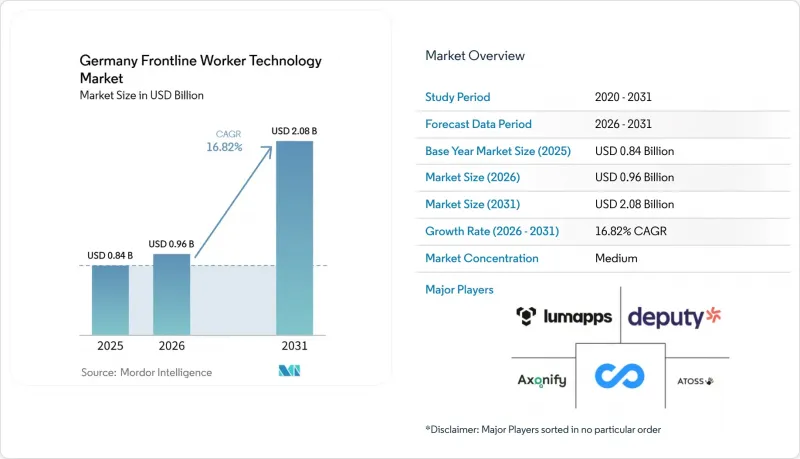
Mordor Intelligence에 의하면, 독일의 현장 근로자 기술 시장 규모는 2025년 8억 4,000만 달러로 평가되었습니다. 2026년에는 9억 6,000만 달러로 확대되어 2031년까지 20억 8,000만 달러에 이를 것으로 예측되며, 2026년부터 2031년에 걸쳐 CAGR 16.82%로 성장할 전망입니다.
본 보고서는 구성 요소(소프트웨어 및 서비스), 도입 형태(클라우드 기반 등), 조직 규모(대기업 및 중소기업), 용도(직원 간 커뮤니케이션 및 참여도 향상 등), 최종 사용자 산업(소매 및 전자상거래, 산업 제조 등)별로 분류되어 있습니다. 시장 전망은 금액(달러)으로 표시되어 있습니다.
독일의 현장 근로자 기술 시장 동향 및 인사이트
데스크리스 업무 흐름의 ‘모바일 퍼스트’를 통한 디지털화
2025년 시점에서도 많은 현장 근로자가 회사에서 제공한 모바일 애플리케이션를 보유하고 있지 않았기 때문에 독일의 현장 근로자 기술 시장의 상당 부분은 여전히 단순한 접근 격차에서 기인하고 있습니다. 이 격차가 중요한 이유는 모바일 퍼스트 플랫폼을 통해 직원들이 PC나 공용 단말기, 회사 이메일 주소 없이도 일정, 업무, 학습 컨텐츠, 커뮤니케이션에 접근할 수 있기 때문입니다. 이를 통해 보다 본격적인 워크플로우 재설계에 착수하기 전에 협업 개선을 도모하고자 하는 고용주에게 모바일 접근은 실용적인 첫걸음이 되고 있습니다. 독일을 거점으로 72개국 이상으로 사업을 확장한 Flip의 성장은 모바일 우선 현장용 소프트웨어가 초기 이용 사례를 훨씬 뛰어넘어 확장 가능함을 보여주었습니다. 또한 보쉬, 로스만, 맥도날드 독일, 포르쉐 등의 고객 사례를 통해 대기업들이 이미 까다로운 업무 환경에서 이 모델을 활용하고 있음이 밝혀졌습니다. 2025년 4월 Nagel-Group이 독일 내 9개 거점과 직원 600명을 대상으로 실시한 파일럿 프로젝트에서는 유서 깊은 물류 사업자조차도 광범위한 프로세스 자동화에 앞서 이 기본적인 연결 계층을 우선시하고 있음이 밝혀졌습니다.
여러 거점에 걸친 교대 근무 운영 시 발생하는 노동 규정의 복잡성
독일의 노동법 제도에서는 연방 차원의 근로시간 규제와 거점별 협약이 모두 현장의 근무 일정 수립 및 기록 방법을 규정하고 있어 막대한 행정적 부담이 발생하고 있습니다. 고용주가 다수의 거점을 운영하며, 노동 협약 규정, 휴식 시간, 일요일 근무 규정, 공휴일 수당 등을 실시간으로 조정해야 하는 경우, 이러한 부담을 관리하는 것은 더욱 어려워집니다. 연정 협정 및 2026년 시행이 예정된 ‘근로시간 기록법(Zeiterfassungsgesetz)’에 따라, 독일 전역에서 전자적 근로시간 기록과 법규 준수를 갖춘 인력 관리 도구의 필요성이 높아지고 있습니다. 이러한 규제적 압박이야말로 독일의 현장 근로자 기술 시장이 단순한 ‘선택적 디지털화’에서 더 시급한 업무로의 도입으로 전환되고 있는 이유 중 하나입니다. 여러 거점을 보유한 제조업체, 소매업체, 물류 사업자에게 있어 인력 관리 플랫폼의 가치는 업무 효율성과 마찬가지로 법규 준수의 일관성에 크게 좌우되고 있습니다. ATOSS의 2025 회계연도 매출액 1억 8,930만 유로(2억 480만 달러)는 규정 준수를 주도하는 수요가 기업의 시스템 갱신 및 확장 활동으로 계속 이어지고 있음을 반영합니다.
인사, 급여, POS, EHR에 걸친 레거시 시스템 통합의 복잡성
독일의 현장 근로자 기술 시장에서 레거시 시스템과의 통합은 여전히 가장 직접적인 운영상의 제약 요인으로 남아 있습니다. 이는 현장용 도구가 SAP, 급여 계산 시스템, 소매 플랫폼 및 산업별 인프라와 연동되어야 하는 경우가 많기 때문입니다. 많은 고용주가 현장용 용도의 신속한 도입을 염두에 두고 설계되지 않은 혼합 기업 환경을 운영하고 있기 때문에 이 문제는 독일에서 특히 심각합니다. 그 결과, 사전 판매 조사, 워크플로우 매핑 및 도입 계획 수립에는 소프트웨어 평가 자체보다 훨씬 더 많은 시간이 소요될 수 있습니다. 이로 인해 공급업체의 계약 체결 속도가 둔화되고, 도입 작업에 착수하기 전에 명확한 투자 회수 전망을 요구하는 중소규모 고용주의 도입도 지연됩니다. 따라서 완전한 전환을 강요하지 않고 기존 인사·노무 시스템을 기반으로 구축할 수 있는 공급업체는 기업 고객을 확보하고 유지하는 데 있어 더 유리한 입장에 있습니다. 상호 운용성이 향상될 때까지는 이러한 마찰이 비용에 민감한 독일의 현장 근로자 기술 시장에서 더 신속한 확장을 계속 방해할 것입니다.
부문 분석
2025년, 소프트웨어는 독일의 현장 근로자 기술 시장 점유율의 82.41%를 차지했으며, 도입 초기 단계가 스케줄링, 커뮤니케이션, 학습과 같은 핵심 용도에 집중되었기 때문에 계속해서 주요 수익 기반을 유지했습니다. 이러한 위상은 SaaS를 통한 제공이 수행한 중요한 역할도 반영하고 있으며, 이를 통해 고용주는 인프라 오버헤드를 줄이면서 대규모 직원 그룹 전체에 표준화된 현장용 도구를 배포할 수 있게 되었습니다. 소프트웨어가 주도적인 위치를 차지하고 있다는 사실은 많은 구매자가 더 복잡한 업무 지원으로 지출을 확대하기 전에 여전히 용도 도입부터 시작하고 있음을 보여줍니다. 한편, 서비스 부문은 2031년까지 연평균 성장률(CAGR) 19.34%로 확대될 것으로 예상되며, 독일의 현장 근로자 기술 시장의 구성 요소 중 가장 빠르게 성장하는 분야입니다.
이 서비스 부문의 강력한 성장은 고용주들이 급여 계산, 인사, 커뮤니케이션, 분석에 이르는 광범위한 현장용 플랫폼을 도입함에 따라, 도입, 맞춤화, 교육 및 관리형 지원에 대한 수요가 증가하고 있음을 반영합니다. ATOSS의 컨설팅 서비스 매출은 2025 회계연도에 3,960만 유로(4,280만 달러)에 달했으며, 이는 소프트웨어 중심공급업체 기반 내에서도 서비스의 비중이 높아지고 있음을 보여줍니다. 또한, Flip사가 2026년 6월에 발표한 ‘AI Flow Builder’ 역시 서비스 부문의 변화를 시사하고 있습니다. AI를 활용한 워크플로우 생성 속도 향상으로 인해 표준 이용 사례에서 정형화된 설정 작업을 줄일 수 있기 때문입니다. 즉, 독일의 현장 근로자 기술 산업에서는 절대적인 규모 면에서 소프트웨어가 여전히 지배적인 반면, 서비스는 규정 준수 설계, 거버넌스 지원, AI 교육으로 더욱 전환될 가능성이 높다고 할 수 있습니다.
클라우드 기반 도입은 2025년에 78.63%의 점유율을 차지했으며, 2031년까지 연평균 성장률(CAGR) 17.42%로 확대될 것으로 전망되어, 독일의 현장 근로자 기술 시장에서 가장 크고 가장 빠르게 성장하는 도입 모델이 되고 있습니다. 이러한 이중적 지위는 독일 시장이 포화 상태에 가까워지고 있는 것이 아니라, 여전히 광범위한 클라우드 도입 주기를 진행 중임을 보여줍니다. 클라우드 기반 제공이 선호되는 모델이 된 이유는 신속한 도입, 손쉬운 업데이트, 그리고 책상이나 고정 단말기 이외의 장소에서 업무를 수행하는 직원의 접근성을 향상시킬 수 있기 때문입니다. 또한, 현장 용도마다 로컬 인프라를 유지하기를 원하지 않는 중견 기업을 대상으로 벤더가 진입할 수 있는 경로를 더욱 명확하게 해줍니다.
하이브리드 배포는 규제가 엄격한 환경에서 여전히 중요한 위치를 차지하고 있습니다. 이러한 환경에서 기업들은 기밀성이 높은 직원 정보를 기존 사내 시스템과 더욱 긴밀하게 연동하는 한편, 더 광범위한 접근 및 분석을 위해 클라우드 오케스트레이션을 활용하고자 합니다. On-Premise 시스템은 엄격한 사내 IT 규정이나 대규모 레거시 투자를 안고 있는 일부 산업 사업자에게는 여전히 중요하지만, 독일의 현장 근로자 기술 시장에서 그 역할은 점차 줄어들고 있습니다. 독일에서의 클라우드 전환은 직원 대표 위원회가 전환을 승인하기 전에 직원 데이터의 저장 위치 및 접근 제어에 대한 명확한 설명을 요구하는 경우가 많기 때문에 더욱 신중하게 진행되어 왔습니다. 2026년 6월 Flip이 출시한 ‘Frontline Identity’는 회사 이메일 주소가 없어도 QR 코드, 패스키 또는 초대 코드를 통한 인증을 가능하게 함으로써 가장 큰 접근 장벽 중 하나를 해소하고, 클라우드의 보다 광범위한 도입을 직접적으로 뒷받침했습니다.
기타 혜택 :
- 엑셀 형식 시장 예측(ME) 시트
- 3개월간의 애널리스트 지원
자주 묻는 질문
목차
제1장 서론
제2장 조사 방법
제3장 주요 요약
제4장 시장 구도
제5장 시장 규모 및 성장 예측
제6장 경쟁 구도
제7장 시장 기회 및 향후 전망
KTH 26.08.10According to Mordor Intelligence, the Germany frontline worker technology market size is projected to expand from USD 0.84 billion in 2025 to USD 0.96 billion in 2026, and reach USD 2.08 billion by 2031, growing at a CAGR of 16.82% from 2026 to 2031.
This report is Segmented by Component (Software, and Services), Deployment Mode (Cloud-Based, and More), Organization Size (Large Enterprises, and Small and Medium Enterprises), Application (Employee Communication and Engagement, and More), and End-User Industry (Retail and E-Commerce, Industrial Manufacturing, and More). The Market Forecasts are Provided in Terms of Value (USD).
Germany Frontline Worker Technology Market Trends and Insights
Mobile-First Digitization of Deskless Workflows
A large part of the Germany frontline worker technology market still rests on a simple access gap, because many frontline workers lacked a company-provided mobile application in 2025. That gap matters because mobile-first platforms give workers access to schedules, tasks, learning content, and communication without requiring a PC, a shared terminal, or a company email address. This has made mobile access the practical first step for employers that want to improve coordination before they move into deeper workflow redesign. Flip's growth from a German base into deployments that span more than 72 countries also showed that mobile-first frontline software can scale well beyond early communication use cases. Its customer examples, including Bosch, Rossmann, McDonald's Germany, and Porsche, also showed that large enterprises were already using this model in demanding operating environments. Nagel-Group's April 2025 pilot across 9 German sites and 600 employees showed that even established logistics operators were prioritizing this basic connectivity layer before broader process automation.
Labor-Rule Complexity Across Multi-Site Shift Operations
Germany's labor framework creates a heavy administrative burden because federal working-time rules and site-level agreements both shape how frontline schedules must be built and recorded. This burden becomes much harder to manage when employers operate many sites and must reconcile tariff rules, rest periods, Sunday work rules, and public holiday premiums in real time. The coalition agreement and the expected Zeiterfassungsgesetz for 2026 are increasing the need for electronic time recording and compliant workforce tools across Germany. This regulatory pressure is one reason the Germany frontline worker technology market is moving from optional digitization toward more urgent operational adoption. For multi-site manufacturers, retailers, and logistics operators, the value of workforce platforms now lies as much in legal consistency as in labor efficiency. ATOSS's FY2025 revenue of EUR 189.3 million (USD 204.8 million) reflected how compliance-driven demand continued to translate into enterprise renewal and expansion activity.
Legacy Integration Complexity Across HR, Payroll, POS, and EHR
Legacy integration remains the most direct operating restraint on the Germany frontline worker technology market because frontline tools often need to connect with SAP, payroll systems, retail platforms, and sector-specific infrastructure. This issue is especially significant in Germany because many employers run mixed enterprise environments that were not designed for fast frontline application rollouts. As a result, pre-sales discovery, workflow mapping, and deployment planning can take much longer than the software evaluation itself. That slows deal velocity for vendors and also delays adoption among smaller employers that need clearer payback before they commit to implementation work. Vendors that can build around existing HR and workforce systems without forcing a full migration are therefore in a stronger position to win and retain enterprise accounts. Until interoperability becomes easier, this friction will continue to limit faster rollout across cost-sensitive parts of the Germany frontline worker technology market.
Other drivers and restraints analyzed in the detailed report include:
- AI-Led Labor Forecasting and Schedule Optimization
- Unified HR, Payroll, Scheduling, and Communication Stacks
- Workforce Data Privacy and Mobile Cybersecurity Exposure
For complete list of drivers and restraints, kindly check the Table Of Contents.
Segment Analysis
Software held 82.41% of Germany frontline worker technology market share in 2025, which kept it as the main revenue base because the earlier phase of adoption centered on core applications such as scheduling, communication, and learning. This position also reflected the strong role of SaaS delivery, which helped employers roll out standardized frontline tools across large employee groups with less infrastructure overhead. The software lead shows that most buyers still begin with application ownership before they widen spending into more complex operating support. At the same time, services are projected to expand at a 19.34% CAGR through 2031, which makes them the faster-growing side of the component mix in the Germany frontline worker technology market.
This stronger services growth reflects the greater need for implementation, customization, training, and managed support as employers adopt broader frontline platforms that touch payroll, HR, communication, and analytics. ATOSS's consulting services revenue reached EUR 39.6 million (USD 42.8 million) in FY2025, which showed that service intensity was rising even inside a software-led supplier base. Flip's June 2026 AI Flow Builder also pointed to a shift inside the services layer, because faster AI-assisted workflow creation can reduce routine configuration effort for standard use cases. That means the Germany frontline worker technology industry is likely to keep software dominant in absolute terms, while services move further toward compliance design, governance support, and AI training.
Cloud-based deployment held 78.63% share in 2025 and is projected to expand at a 17.42% CAGR through 2031, which made it both the largest and the fastest-growing deployment model in the Germany frontline worker technology market. This dual position shows that the country is still moving through a broad cloud adoption cycle rather than nearing saturation. Cloud delivery has become the preferred model because it supports quicker deployment, easier updates, and better access for workers who do not operate from desks or fixed terminals. It also gives vendors a clearer route into mid-sized employers that do not want to maintain local infrastructure for every frontline application.
Hybrid deployment still remains relevant in regulated environments where employers want sensitive workforce information tied more closely to existing internal systems while using cloud orchestration for broader access and analytics. On-premises systems continue to matter for a narrower group of industrial operators with strict internal IT rules and large legacy investments, but their role is gradually receding in the Germany frontline worker technology market. Germany's cloud transition has moved more carefully because works councils often require clarity on employee data location and access controls before approving migration. Flip's Frontline Identity launch in June 2026 addressed one of the biggest access barriers by allowing authentication through QR code, passkey, or invite code without a company email, which directly supported broader cloud adoption.
Complete Report Scope:
- By Component
- Software
- Services
- By Deployment
- Cloud-Based
- Hybrid
- On-Premises
- By Organization Size
- Large Enterprises
- Small and Medium Enterprises
- By Application
- Employee Communication and Engagement
- Workforce Execution and Task Management
- Workforce Scheduling and Coordination
- Learning and Knowledge Enablement
- Workforce Analytics and Performance Management
- Safety and Compliance Management
- Other Applications
- By End-User Industry
- Retail and E-Commerce
- Industrial Manufacturing
- Healthcare and Life Sciences
- Transportation and Logistics
- Hospitality
- Construction
- Government and Public Administration
- Other Industries
List of Companies Covered in this Report:
- ATOSS Software SE
- Axonify Inc.
- LumApps
- Connecteam Ltd.
- Deputy Corporation
- Dozuki, Inc.
- Flip GmbH
- Fountain, Inc.
- ISGUS GmbH
- Legion Technologies, Inc.
- Ordio GmbH
- Poka Inc. by IFS AB
- Quinyx AB
- SISQUAL WFM
- Teambridge, Inc.
- ADP, Inc.
- WorkJam Inc.
- Workforce.com
- YOOBIC Inc.
- Staffbase GmbH
Additional Benefits:
- The market estimate (ME) sheet in Excel format
- 3 months of analyst support
TABLE OF CONTENTS
1 INTRODUCTION
- 1.1 Study Assumptions and Market Definition
- 1.2 Scope of the Study
2 RESEARCH METHODOLOGY
3 EXECUTIVE SUMMARY
4 MARKET LANDSCAPE
- 4.1 Market Overview
- 4.2 Market Drivers
- 4.2.1 Labor-Rule Complexity Across Multi-Site Shift Operations
- 4.2.2 Mobile-First Digitization of Deskless Workflows
- 4.2.3 AI-Led Labor Forecasting and Schedule Optimization
- 4.2.4 Unified HR, Payroll, Scheduling, and Communication Stacks
- 4.2.5 Explainable AI and Audit-Ready Scheduling Demand
- 4.2.6 Worker Control Expectations Around Shifts, Pay, and Flexibility
- 4.3 Market Restraints
- 4.3.1 Legacy Integration Complexity Across HR, Payroll, POS, and EHR
- 4.3.2 Workforce Data Privacy and Mobile Cybersecurity Exposure
- 4.3.3 Shared-Device Identity and Digital Access Gaps
- 4.3.4 Manager and Worker Distrust of Opaque Scheduling AI
- 4.4 Industry Value Chain Analysis
- 4.5 Impact of Macroeconomic Factors on the Market
- 4.6 Regulatory Landscape
- 4.7 Technological Outlook
- 4.8 Porter's Five Forces Analysis
- 4.8.1 Bargaining Power of Buyers
- 4.8.2 Bargaining Power of Suppliers
- 4.8.3 Threat of New Entrants
- 4.8.4 Threat of Substitutes
- 4.8.5 Intensity of Competitive Rivalry
5 MARKET SIZE AND GROWTH FORECASTS (VALUE)
- 5.1 By Component
- 5.1.1 Software
- 5.1.2 Services
- 5.2 By Deployment
- 5.2.1 Cloud-Based
- 5.2.2 Hybrid
- 5.2.3 On-Premises
- 5.3 By Organization Size
- 5.3.1 Large Enterprises
- 5.3.2 Small and Medium Enterprises
- 5.4 By Application
- 5.4.1 Employee Communication and Engagement
- 5.4.2 Workforce Execution and Task Management
- 5.4.3 Workforce Scheduling and Coordination
- 5.4.4 Learning and Knowledge Enablement
- 5.4.5 Workforce Analytics and Performance Management
- 5.4.6 Safety and Compliance Management
- 5.4.7 Other Applications
- 5.5 By End-User Industry
- 5.5.1 Retail and E-Commerce
- 5.5.2 Industrial Manufacturing
- 5.5.3 Healthcare and Life Sciences
- 5.5.4 Transportation and Logistics
- 5.5.5 Hospitality
- 5.5.6 Construction
- 5.5.7 Government and Public Administration
- 5.5.8 Other Industries
6 COMPETITIVE LANDSCAPE
- 6.1 Market Concentration
- 6.2 Strategic Moves
- 6.3 Market Share Analysis
- 6.4 Company Profiles (includes Global Level Overview, Market Level Overview, Core Segments, Financials as available, Strategic Information, Market Rank/Share, Products and Services, Recent Developments)
- 6.4.1 ATOSS Software SE
- 6.4.2 Axonify Inc.
- 6.4.3 LumApps
- 6.4.4 Connecteam Ltd.
- 6.4.5 Deputy Corporation
- 6.4.6 Dozuki, Inc.
- 6.4.7 Flip GmbH
- 6.4.8 Fountain, Inc.
- 6.4.9 ISGUS GmbH
- 6.4.10 Legion Technologies, Inc.
- 6.4.11 Ordio GmbH
- 6.4.12 Poka Inc. by IFS AB
- 6.4.13 Quinyx AB
- 6.4.14 SISQUAL WFM
- 6.4.15 Teambridge, Inc.
- 6.4.16 ADP, Inc.
- 6.4.17 WorkJam Inc.
- 6.4.18 Workforce.com
- 6.4.19 YOOBIC Inc.
- 6.4.20 Staffbase GmbH
7 MARKET OPPORTUNITIES AND FUTURE OUTLOOK
- 7.1 White-Space and Unmet-Need Assessment


