

|
시장보고서
상품코드
2099330
지역사회 상처 관리 : 시장 점유율 분석, 업계 동향 및 통계, 성장 예측(2026-2031년)Community Wound Care - Market Share Analysis, Industry Trends & Statistics, Growth Forecasts (2026 - 2031) |
||||||
 Mordor Intelligence
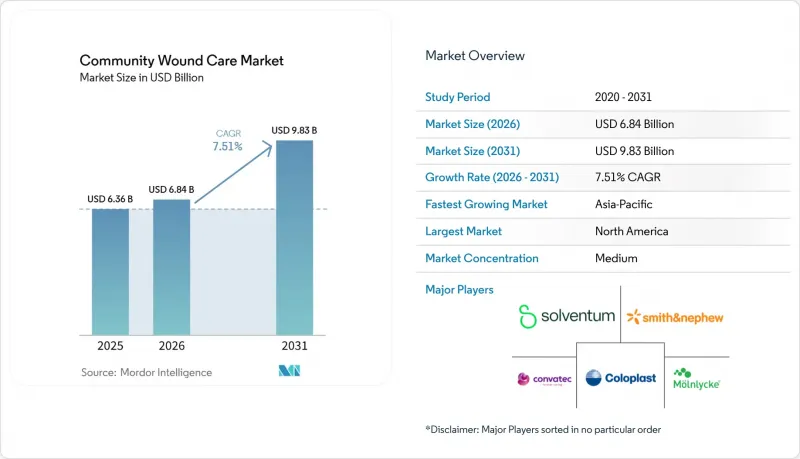
Mordor Intelligence에 의하면, 지역사회 상처 관리 시장 규모는 2025년에 63억 6,000만 달러로 평가되었습니다. 2026년 68억 4,000만 달러에서 2031년까지 98억 3,000만 달러에 이를 것으로 예상되며, 예측 기간(2026-2031년) CAGR은 7.51%를 나타낼 전망입니다.
본 보고서는 서비스 유형별(재택치료, 지역사회 간호 등), 제품 유형별(첨단 상처 피복재, 기존 제품 등), 상처 유형별(만성, 급성), 최종 사용자(재택 간호 기관, 병원 등), 유통 채널(직접 입찰, 소매/약국, 온라인/전자상거래, 도매업체, 기타), 지역(북미, 유럽, 아시아태평양 등)별로 분류되어 있습니다. 예측치는 금액(달러)으로 표시되어 있습니다.
세계의 지역사회 상처 관리 시장 동향 및 인사이트
재택 및 급성기 후 환경에서 만성 상처의 부담 증가
당뇨병 및 혈관 질환으로 인해 병원 외 환경에서 상처 관리가 필요한 환자층이 확대되고 있습니다. 2025년에는 5,310만 명의 미국인이 당뇨병을 앓았으며, 당뇨병 환자의 15.00%-34.00%가 생애 동안 당뇨병성 족부 궤양을 발병할 것으로 예상되므로, 지역사회 상처 관리 시장에는 안정적인 환자 유입이 유지되고 있습니다. 선진국에서는 인구의 최대 2.50%가 만성 상처로 고통받고 있으며, 이는 지역사회 상처 관리 시장에서 드레싱 재료, 전문가 방문, 원격 의료를 활용한 모니터링에 대한 지속적인 수요를 뒷받침하고 있습니다.
욕창은 지역사회 간호 서비스를 받는 환자의 5.00%에게 영향을 미치며, 체위 변경을 위한 자원이 제한적인 장기 요양 시설에서는 그 비율이 더욱 높아집니다. 만성 상처에 대한 수요는 치유 과정에서 일련의 평가, 소모품의 반복 사용, 장기간에 걸친 경과 관찰이 필요하기 때문에 단기적인 경제 변동의 영향을 덜 받는 경향이 있습니다. 따라서 지역사회 상처 관리 시장은 고령화 및 당뇨병 환자층에 뿌리내린 질환 패턴에 의해 뒷받침되고 있습니다.
병원에서 지역사회 시설로의 상처 관리 제공 전환
지불 제도 개혁과 병원의 수용 능력에 대한 압박으로 인해, 상처 관리는 재택 및 지역사회 의료 현장으로 전환되고 있습니다. CMS(미국 의료보험의료서비스센터)는 2026 회계연도(CY 2026)의 재택의료 선지급 제도(Home Health Prospective Payment System)를 개정하여, 재택에서 관리되는 복잡한 상처 상황을 보다 적절히 반영할 수 있도록 30일 에피소드 요금 및 사례 혼합 가중치를 변경했습니다. 『British Journal of Community Nursing』지의 2026년 연구에 따르면, 지역사회 간호사들은 과거에는 전문 외래 진료 시설에서 이루어지던 상처 중재가 필요한 다중 질환을 동반한 환자의 비율을 점점 더 많이 담당하고 있는 것으로 보고되었습니다. 이러한 변화로 인해 지역사회 상처 관리 시장에서 상처 관리 에피소드의 임상적 부담이 증가하고 있으며, 이에 따라 체계화된 프로토콜과 일관된 평가 도구의 가치도 높아지고 있습니다. 체계화되지 않은 임상적 판단에만 의존하는 기관은 치유 진행 상황이나 업무 부담의 편동에 더 취약해집니다. 반면, 워크플로우를 표준화한 기관은 이러한 치료의 변화를 지역사회 상처 관리 시장의 강점으로 전환하는 데 있어 더 유리한 입장에 있습니다.
첨단 드레싱 재료 및 생체 재료로 인한 1건당 높은 비용
첨단 드레싱 재료 및 생물학적 제제의 비용은 지역 의료 현장에서 고품질 상처 관리가 어느 정도까지 보급될 수 있는지에 있어 여전히 현실적인 제약으로 작용하고 있습니다. 2026년 1월 1일부터 발효된 새로 확정된 ‘지역별 급여 결정(LCD)’에서 메디케어 급여 대상으로 확인된 피부 대체재 제품이 불과 18개 품목에 그침에 따라, 환급 압력이 강화되었습니다. 이로 인해 지역사회 상처 관리 시장에서 메디케어 지원 제품을 둘러싼 상업적 보호 영역이 좁아졌습니다. 그 후, 콜로플라스트(Coloplast)는 30억 덴마크 크로네(4억 5,000만 달러)의 감가상각 손실을 보고하며, 미국 외래 상처 치료 시장의 회복 둔화를 피부 대체재에 영향을 미친 메디케어 환급 제도 재검토와 연관 지었습니다. 이러한 변화로 인해 지역 의료 제공업체가 더욱 엄격한 에피소드별 지불 제도 하에서 업무를 수행하게 될 경우, 프리미엄 제품에 대해서는 더욱 강력한 경제적 정당성이 요구될 것입니다. 보험 적용이 제한적이고 의료 제공업체의 이익률이 압박받는 상황에서는 제조업체들이 더 이상 광범위한 프리미엄 제품으로서의 입지에만 의존할 수 없게 되었습니다. 이에 따라 지역사회 상처 관리 시장의 카테고리 구성 및 제품 채택에 있어 단기적으로는 신중한 자세가 요구되고 있습니다.
부문 분석
2025년, 재택 상처 관리 시장은 매출의 34.22%를 차지하며 지역사회 상처 관리 시장에서 가장 큰 서비스 부문이 되었습니다. 이러한 선두 위상은 반복적인 드레싱 교체와 치밀한 상처 경과 관찰이 필요한 환자에게 있어, 임상의가 주도하는 재택 방문이 지닌 실용적인 가치를 반영합니다. 또한, 이 서비스는 상태가 더 복잡한 환자가 조기에 퇴원하여 체계적인 재택 치료로 전환하는 병원 중심의 치료에서 벗어나는 광범위한 변화와도 부합합니다. CMS(미국 의료보험의료서비스센터)의 정책 개정은 재택 상처 관리에 대한 지급 투명성을 높임으로써 이러한 방향성을 뒷받침하고 있습니다. 외래 상처 클리닉은 상처의 복잡성으로 인해 1회의 재택 방문만으로는 안전하게 관리할 수 없는 환자에게 여전히 다음 단계의 선택지로 남아 있습니다.
지역 간호 및 지구 간호는 2031년까지 연평균 성장률(CAGR) 8.53%를 나타낼 것으로 예측되며, 지역사회 상처 관리 시장에서 가장 빠르게 성장하는 서비스 범주로 자리 잡고 있습니다. 독일에서는 2025년 12월, G-BA가 HKP-RL을 개정하여 전문 의료진이 가정 환경에서 만성 및 난치성 상처 관리를 우선적으로 수행하도록 규정함으로써 이 경로가 강화되었습니다. 이러한 변경으로 인해 지역사회 간호 서비스의 대상 범위가 확대되어, 병원 주도의 치료 경로에서 환자를 조기에 이관할 수 있게 되었습니다. 장기 요양 시설 및 전문 요양 시설은 이동 능력의 제한이나 만성 상처의 위험으로 인해 지속적인 간호가 필요한 고령자에게 계속해서 서비스를 제공합니다. 따라서 지역사회 상처 관리 업계는 특히 간호 인프라와 보상 규정이 이미 ‘재택 우선’ 치료 제공을 지원하고 있는 지역에서 보다 체계화된 지역사회 치료 경로로 전환되고 있습니다.
2025년, 첨단 상처 피복재는 지역사회 상처 치료 시장 규모의 52.19%를 차지하며 제품 카테고리 내에서 확고한 선두 자리를 유지했습니다. 이러한 위상은 오랜 기간에 걸친 임상 실적, 보험사의 폭넓은 수용, 그리고 대리점 및 유통업체공급망에 대한 손쉬운 통합을 반영한 것입니다. 폼, 하이드로콜로이드, 항균성 드레싱은 정기적인 지역 방문 시 다양한 만성 상처 관리 요구를 충족시킬 수 있어 여전히 처방 목록의 핵심 품목을 차지하고 있습니다. 스미스 앤 네퓨(Smith & Nephew)는 2026년 5월, 재택 및 지역 의료 현장에서의 만성 상처 치료를 목적으로 한 5층 구조의 폼 드레싱 ‘ALLEVYN COMPLETE CARE’를 출시하며 이 카테고리를 강화했습니다. 기존의 상처 관리 제품은 비용과 사용 편의성이 여전히 중요한 구매 요인으로 작용하는 복잡도가 낮은 급성 상처 치료에 계속해서 활용되고 있습니다.
생물학적 제제 및 피부 대체재는 2031년까지 연평균 성장률(CAGR) 9.17%를 나타낼 것으로 예측되며, 이는 지역사회 상처 관리 시장의 다른 모든 제품 부문을 능가하는 속도입니다. 이러한 성장은 치료가 어려운 당뇨병성 족부 궤양 및 기타 치유가 더딘 상처에 대해 태반 동종 이식편, 어피 이식편 및 관련 조직 유래 치료법에 대한 임상적 관심이 높아지고 있음을 반영합니다. 상처 치료용 기기 또한 중요한 프리미엄 위치를 차지하고 있으며, 특히 휴대용 음압 요법 시스템 덕분에 가정에서의 복잡한 상처 관리가 더욱 현실화되고 있습니다. 2026년 1월 보험 환급 기준 재검토에 따라, 프리미엄 바이오의약품은 보험 적용 범위 및 가치에 대해 보다 직접적인 심사를 받게 될 것입니다. 따라서 지역사회 상처 치료 시장에서는 우수한 치유 성과와 더 설득력 있는 경제적 입지를 동시에 확보할 수 있는 공급업체가 우대를 받게 될 것입니다.
지역별 분석
2025년, 북미는 지역사회 상처 관리 시장 점유율의 33.50%를 차지하며 최대 지역 시장이 되었습니다. 미국이 이러한 위치를 주도하고 있는 이유는 메디케어의 재택치료 정책에 따라 의료 제공업체에게 지역사회 상처 관리 에피소드에 대한 명확한 지급 구조가 정해져 있기 때문입니다. 2026 회계연도 보상률 개정에 따라 일회용 음압상처치료(NPWT) 지급액은 대상 기기 1대당 282.10달러로 설정되었으며, 재택치료 에피소드의 보상률은 2% 인상되었습니다. 이에 따라 더 복잡한 상처 사례를 관리하는 기관의 전망이 개선되었습니다. 이러한 명확화는 재택 환경에서의 고도화된 상처 관리 보급을 촉진하고, 지역사회 상처 치료 시장에서 급성기 이후의 연속성을 강화할 것입니다. 2026년 1월 메디케어 피부 대체재 제도의 대대적인 개편 또한, 상환 근거가 명확한 범주나 제품을 우대함으로써 경쟁 환경에 변화를 가져왔습니다.
유럽은 지역사회 간호가 이미 여러 의료 제도에 통합되어 있어, 지역사회 상처 관리 시장의 주요 축으로 자리 잡고 있습니다. 독일에서는 2025년 12월, G-BA가 HKP-RL을 개정하여 전문 의료 제공업체를 통해 가정 환경에서 만성 상처 및 치유가 어려운 상처를 우선적으로 치료하도록 규정함으로써 이 모델이 강화되었습니다. 이 규정에 따라 법정 건강보험에 기반한 재택 상처 방문의 보상 대상이 직접 확대되었으며, 지역사회 의료 제공업체는 치료 경로에서 더욱 확고한 입지를 확보하게 되었습니다. 영국에서는 지역 간호사의 부담이 계속해서 증가하고 있으며, 최근 간호학 문헌에서는 인력 배치 수준과 상처에 관한 전문 지식이 상처 관리의 일관성과 치료 성과에 직접적으로 연결되어 있다고 지적되고 있습니다. 이러한 상황은 프로토콜 간소화, 문서화 표준화, 그리고 지역사회 상처 관리 시장 내의 편차를 줄일 수 있는 공급업체 및 케어 파트너에게 유리하게 작용합니다.
아시아태평양은 2031년까지 연평균 성장률(CAGR) 7.21%를 나타낼 것으로 예측되며, 지역별로는 지역사회 상처 관리 시장 규모가 가장 빠르게 성장하는 지역이 될 것입니다. 중국과 인도는 대규모 당뇨병 환자 인구와 지역사회 및 1차 진료의 확대가 맞물려 수요의 주요 견인차 역할을 하고 있습니다. 또한, 이 지역은 만성 질환 관리 및 지역사회 의료 체계를 지원하는 정책 방향으로부터도 혜택을 받고 있으며, 이를 통해 상처 관리 서비스는 규모 확대를 위한 더 광범위한 기반을 확보하고 있습니다. 일본에서는 고령화가 진행되는 인구 구조로 인해 장기 요양 및 방문 간호 수요, 특히 욕창 관리 수요가 지속되고 있어 안정적인 수요가 예상됩니다. 중동 및 아프리카 시장 규모는 여전히 작지만, 걸프 국가들의 의료 시스템에서는 의료 제공의 다양화 일환으로 재택치료 프로그램을 확대되고 있습니다. 남미에서는 브라질이 주도적인 역할을 하고 있으며, 공적 지역 돌봄 체계가 상처 관리를 지원하고 있지만, 제품에 대한 접근성 및 전문가 양성에 있어 여전히 격차가 존재하여 선진적인 상처 관리의 보급을 저해하고 있습니다.
기타 혜택 :
- 엑셀 형식 시장 예측(ME) 시트
- 3개월간의 애널리스트 지원
자주 묻는 질문
목차
제1장 서론
제2장 조사 방법
제3장 주요 요약
제4장 시장 구도
제5장 시장 규모 및 성장 예측
제6장 경쟁 구도
제7장 시장 기회 및 향후 전망
KTH 26.08.10According to Mordor Intelligence, the community wound care market size was valued at USD 6.36 billion in 2025 and is estimated to grow from USD 6.84 billion in 2026 to reach USD 9.83 billion by 2031, at a CAGR of 7.51% during the forecast period (2026-2031).
This report is Segmented by Service Type (Home Health, Community Nursing, and More), Product Type (Advanced Dressings, Traditional Products, and More), Wound Type (Chronic, Acute), End User (Home Care Agencies, Hospitals, and More), Distribution (Direct Tenders, Retail/Pharmacy, Online/ECommerce, Distributors, Others), and Geography (North America, Europe, Asia-Pacific, and More). Forecasts are in Value (USD).
Global Community Wound Care Market Trends and Insights
Rising Chronic Wound Burden in Home and Post-Acute Settings
Diabetes and vascular disease are expanding the patient base that needs wound care outside hospital settings. In 2025, 53.1 million Americans had diabetes, and 15.00%-34.00% of people with diabetes develop a diabetic foot ulcer over their lifetime, which keeps a steady flow of patients moving into the community wound care market. Chronic wounds affect up to 2.50% of the population in developed countries, which supports recurring demand for dressings, professional visits, and telehealth-enabled monitoring in the community wound care market.
Pressure injuries affect 5.00% of patients receiving community nursing care, and that share rises in long-term care settings where repositioning resources are limited. Chronic wound demand is less exposed to short-term economic swings because healing often requires serial assessment, repeated consumable use, and extended follow-up. This leaves the community wound care market supported by disease patterns that remain embedded across aging and diabetic populations.
Shift of Wound Care Delivery from Hospitals to Community Sites
Payment reform and hospital capacity pressure are moving more wound care into home and community settings. CMS updated the Home Health Prospective Payment System for CY 2026, including changes to 30-day episode rates and case-mix weights that better reflect complex wound presentations managed at home. A 2026 study in the British Journal of Community Nursing reported that community nurses are handling a growing share of patients with multimorbidities whose wounds need interventions once associated with specialist outpatient settings. The shift is raising the clinical intensity of wound care episodes that sit within the community wound care market, which also raises the value of structured protocols and consistent assessment tools. Agencies that rely on unstructured clinical judgment alone are more exposed to variability in healing progression and workload. Agencies that standardize workflows are better placed to turn this care transfer into an advantage within the community wound care market.
High Per-Episode Cost of Advanced Dressings and Biologics
The cost of advanced dressings and biologics remains a practical limit on how far premium wound care can spread in community settings. Reimbursement pressure increased when only 18 skin substitute products were confirmed as covered under newly finalized Local Coverage Determinations effective January 1, 2026, which narrowed the commercially protected field around Medicare-supported products in the community wound care market. Coloplast later reported a DKK 3.00 billion (USD 0.45 billion) impairment loss, and linked a weaker recovery in U.S. outpatient wound care to the Medicare reimbursement overhaul affecting skin substitutes. These changes mean premium products need stronger economic justification when community providers operate inside tighter episode payments. Manufacturers can no longer depend on broad premium positioning if coverage is selective and provider margins are compressed. This creates near-term caution around category mix and product adoption in the community wound care market.
Other drivers and restraints analyzed in the detailed report include:
- Greater Use of Portable Advanced Wound Therapy in Home Care
- AI-Assisted Wound Documentation Improving Nurse Productivity
- Community Workforce Shortages and Variable Wound Expertise
For complete list of drivers and restraints, kindly check the Table Of Contents.
Segment Analysis
Home Health Wound Care held 34.22% of revenue in 2025, which made it the largest service segment in the community wound care market. That lead reflects the practical value of clinician-led in-home visits for patients who need repeated dressing changes and close wound follow-up. The service also fits the broader shift away from hospital-centered care, as more complex patients are discharged earlier into structured home episodes. CMS policy updates are reinforcing that direction by improving the payment visibility around home-based wound episodes. Outpatient Wound Clinics remain the next layer for patients whose wound complexity exceeds what one visit at home can safely support.
Community Nursing and District Nursing are projected to grow at 8.53% CAGR through 2031, which makes it the fastest-growing service category within the community wound care market. Germany strengthened this pathway in December 2025 when the G-BA amended the HKP-RL to prioritize chronic and hard-to-heal wound care in home settings using specialized providers. That change expands the addressable base for local nursing services and supports earlier referral away from hospital-led pathways. Long-Term Care and Skilled Nursing Facilities continue to serve older adults whose mobility limits and chronic wound exposure create recurring care demand. The community wound care industry is therefore moving toward more formalized local care pathways, especially where nursing infrastructure and reimbursement rules already support home-first delivery.
Advanced Wound Dressings accounted for 52.19% of the community wound care market size in 2025, which kept them firmly in the lead among product categories. Their position reflects long clinical familiarity, broad payer acceptance, and easy integration into agency and distributor supply chains. Foam, hydrocolloid, and antimicrobial dressings remain core formulary items because they fit a wide range of chronic wound needs during routine community visits. Smith+Nephew reinforced this category in May 2026 with ALLEVYN COMPLETE CARE, a 5-layer foam dressing positioned for chronic wound use in home and community settings. Traditional Wound Care Products still serve lower-complexity acute wounds where cost and ease of use remain important buying factors.
Biologics and Skin Substitutes are projected to grow at 9.17% CAGR through 2031, which places them ahead of every other product segment in the community wound care market. The growth reflects a stronger clinical focus on placental allografts, fish-skin grafts, and related tissue-based options for difficult diabetic foot ulcers and other slow-healing wounds. Wound Therapy Devices also hold an important premium position, especially as portable negative pressure systems make complex wound management more practical at home. The January 2026 reimbursement reset means premium biologics now face more direct scrutiny around coverage and value. That leaves the community wound care market favoring suppliers that can pair strong healing outcomes with more defensible economic positioning.
Complete Report Scope:
- By Service Type
- Home Health Wound Care
- Community Nursing and District Nursing
- Outpatient Wound Clinics
- Long-Term Care and Skilled Nursing Facilities
- Others
- By Product Type
- Advanced Wound Dressings
- Traditional Wound Care Products
- Wound Therapy Devices
- Biologics and Skin Substitutes
- Others
- By Wound Type
- Chronic Wounds
- Diabetic Foot Ulcers
- Venous Leg Ulcers
- Pressure Injuries
- Other Chronic Wounds
- Acute Wounds
- Surgical Wounds
- Traumatic Wounds
- Other Acute Wounds
- Chronic Wounds
- By End User
- Home Care Agencies
- Hospitals and Clinics
- Long-Term Care Facilities
- Ambulatory and Specialized Wound Centers
- Others
- By Distribution Channel
- Direct Tenders and Institutional Supply
- Retail and Pharmacy Channels
- Online and eCommerce
- Medical Supply Distributors
- Others
- By Geography
- North America
- United States
- Canada
- Mexico
- Europe
- Germany
- United Kingdom
- France
- Italy
- Spain
- Rest of Europe
- Asia-Pacific
- China
- Japan
- India
- Australia
- South Korea
- Rest of Asia-Pacific
- Middle East and Africa
- GCC
- South Africa
- Rest of Middle East and Africa
- South America
- Brazil
- Argentina
- Rest of South America
- North America
Geography Analysis
North America held 33.50% of the community wound care market share in 2025, which made it the largest regional base. The United States anchors that position because Medicare home health policy gives providers a defined payment structure for community wound episodes. The CY 2026 rate update set disposable NPWT payment at USD 282.10 per applicable device and updated home health episode rates by 2%, which improves visibility for agencies managing more complex wound caseloads. That clarity supports broader use of advanced wound management in the home and strengthens post-acute continuity within the community wound care market. The January 2026 Medicare skin substitute overhaul also changed competitive conditions by favoring categories and products with clearer reimbursement footing.
Europe remains a major pillar of the community wound care market because district nursing is already built into several health systems. Germany reinforced this model in December 2025 when the G-BA amended the HKP-RL to prioritize chronic and hard-to-heal wounds in home settings through specialized providers. That rule directly expands the reimbursable base for home wound visits under statutory health insurance and gives community providers a stronger position in the care pathway. The United Kingdom continues to face district nurse pressure, and recent nursing literature linked staffing levels and wound expertise directly to wound management consistency and outcomes. These conditions favor suppliers and care partners that can simplify protocols, standardize documentation, and reduce variability within the community wound care market.
Asia-Pacific is projected to grow at 7.21% CAGR through 2031, which makes it the fastest-growing regional part of the community wound care market size. China and India are the primary volume drivers because both combine large diabetic populations with wider community and primary care expansion. The region also benefits from policy direction that supports chronic disease management and community health capacity, which gives wound services a broader base for scale. Japan adds steady demand because its older population structure sustains long-term care and district nursing needs, especially for pressure injury management. The Middle East and Africa remain smaller in scale, but Gulf health systems are widening home health programs as part of broader care delivery diversification. South America is led by Brazil, where public community care structures support wound management, although product access and specialist training gaps still limit faster adoption of advanced wound care.
- Advanced Medical Solutions Group
- B. Braun
- Cardinal Health
- Coloplast
- Convatec
- Essity
- Hollister
- Integra LifeSciences
- Integra LifeSciences
- Kerecis
- Medline Industries
- Medtronic
- MIMEDX Group
- Molnlycke Health Care
- Organogenesis
- Hartmann Group
- Smiths Group
- Solventum
- URGO Medical
Additional Benefits:
- The market estimate (ME) sheet in Excel format
- 3 months of analyst support
TABLE OF CONTENTS
1 Introduction
- 1.1 Study Assumptions & Market Definition
- 1.2 Scope of the Study
2 Research Methodology
3 Executive Summary
4 Market Landscape
- 4.1 Market Overview
- 4.2 Market Drivers
- 4.2.1 Rising chronic wound burden in home and post-acute settings
- 4.2.2 Shift of wound care delivery from hospitals to community sites
- 4.2.3 Greater use of portable advanced wound therapy in home care
- 4.2.4 Better reimbursement visibility for outpatient and home health wound episodes
- 4.2.5 AI-assisted wound documentation improving nurse productivity
- 4.2.6 Care pathway standardization in community nursing networks
- 4.3 Market Restraints
- 4.3.1 High per-episode cost of advanced dressings and biologics
- 4.3.2 Uneven coverage rules across payers and care settings
- 4.3.3 Community workforce shortages and variable wound expertise
- 4.3.4 Documentation and coding burden for home-based wound claims
- 4.4 Value Chain Analysis
- 4.5 Regulatory Landscape
- 4.6 Technological Outlook
- 4.7 Porter's Five Forces Analysis
- 4.7.1 Threat of New Entrants
- 4.7.2 Bargaining Power of Suppliers
- 4.7.3 Bargaining Power of Buyers
- 4.7.4 Threat of Substitutes
- 4.7.5 Intensity of Competitive Rivalry
5 Market Size & Growth Forecasts (Value, USD)
- 5.1 By Service Type
- 5.1.1 Home Health Wound Care
- 5.1.2 Community Nursing and District Nursing
- 5.1.3 Outpatient Wound Clinics
- 5.1.4 Long-Term Care and Skilled Nursing Facilities
- 5.1.5 Others
- 5.2 By Product Type
- 5.2.1 Advanced Wound Dressings
- 5.2.2 Traditional Wound Care Products
- 5.2.3 Wound Therapy Devices
- 5.2.4 Biologics and Skin Substitutes
- 5.2.5 Others
- 5.3 By Wound Type
- 5.3.1 Chronic Wounds
- 5.3.1.1 Diabetic Foot Ulcers
- 5.3.1.2 Venous Leg Ulcers
- 5.3.1.3 Pressure Injuries
- 5.3.1.4 Other Chronic Wounds
- 5.3.2 Acute Wounds
- 5.3.2.1 Surgical Wounds
- 5.3.2.2 Traumatic Wounds
- 5.3.2.3 Other Acute Wounds
- 5.3.1 Chronic Wounds
- 5.4 By End User
- 5.4.1 Home Care Agencies
- 5.4.2 Hospitals and Clinics
- 5.4.3 Long-Term Care Facilities
- 5.4.4 Ambulatory and Specialized Wound Centers
- 5.4.5 Others
- 5.5 By Distribution Channel
- 5.5.1 Direct Tenders and Institutional Supply
- 5.5.2 Retail and Pharmacy Channels
- 5.5.3 Online and eCommerce
- 5.5.4 Medical Supply Distributors
- 5.5.5 Others
- 5.6 By Geography
- 5.6.1 North America
- 5.6.1.1 United States
- 5.6.1.2 Canada
- 5.6.1.3 Mexico
- 5.6.2 Europe
- 5.6.2.1 Germany
- 5.6.2.2 United Kingdom
- 5.6.2.3 France
- 5.6.2.4 Italy
- 5.6.2.5 Spain
- 5.6.2.6 Rest of Europe
- 5.6.3 Asia-Pacific
- 5.6.3.1 China
- 5.6.3.2 Japan
- 5.6.3.3 India
- 5.6.3.4 Australia
- 5.6.3.5 South Korea
- 5.6.3.6 Rest of Asia-Pacific
- 5.6.4 Middle East and Africa
- 5.6.4.1 GCC
- 5.6.4.2 South Africa
- 5.6.4.3 Rest of Middle East and Africa
- 5.6.5 South America
- 5.6.5.1 Brazil
- 5.6.5.2 Argentina
- 5.6.5.3 Rest of South America
- 5.6.1 North America
6 Competitive Landscape
- 6.1 Market Concentration
- 6.2 Market Share Analysis
- 6.3 Company Profiles (includes Global Level Overview, Market Level Overview, Core Segments, Financials as available, Strategic Information, Market Rank/Share, Products and Services, Recent Developments)
- 6.3.1 Advanced Medical Solutions Group plc
- 6.3.2 B. Braun SE
- 6.3.3 Cardinal Health, Inc.
- 6.3.4 Coloplast A/S
- 6.3.5 ConvaTec Group PLC
- 6.3.6 Essity AB
- 6.3.7 Hollister Incorporated
- 6.3.8 Integra LifeSciences Corporation
- 6.3.9 Integra LifeSciences Holdings Corporation
- 6.3.10 Kerecis
- 6.3.11 Medline Industries, LP
- 6.3.12 Medtronic plc
- 6.3.13 MiMedx Group, Inc.
- 6.3.14 Molnlycke Health Care AB
- 6.3.15 Organogenesis Holdings Inc.
- 6.3.16 Paul Hartmann AG
- 6.3.17 Smith+Nephew
- 6.3.18 Solventum
- 6.3.19 URGO Medical
7 Market Opportunities & Future Outlook
- 7.1 White-Space and Unmet-Need Assessment


