

|
시장보고서
상품코드
2113708
미국의 상처 관리 기기 : 시장 점유율 분석, 업계 동향 및 통계, 성장 예측(2026-2031년)US Wound Care Management Devices - Market Share Analysis, Industry Trends & Statistics, Growth Forecasts (2026 - 2031) |
||||||
 Mordor Intelligence
Mordor Intelligence에 의하면, 미국의 상처 관리 기기 시장 규모는 2025년에 75억 9,000만 달러로 평가되었습니다. 2026년 79억 8,000만 달러에서 성장하여 2031년까지 102억 8,000만 달러에 이를 것으로 예측됩니다.
예측 기간(2026-2031년)의 연평균 성장률(CAGR)은 5.18%가 될 것으로 전망됩니다.
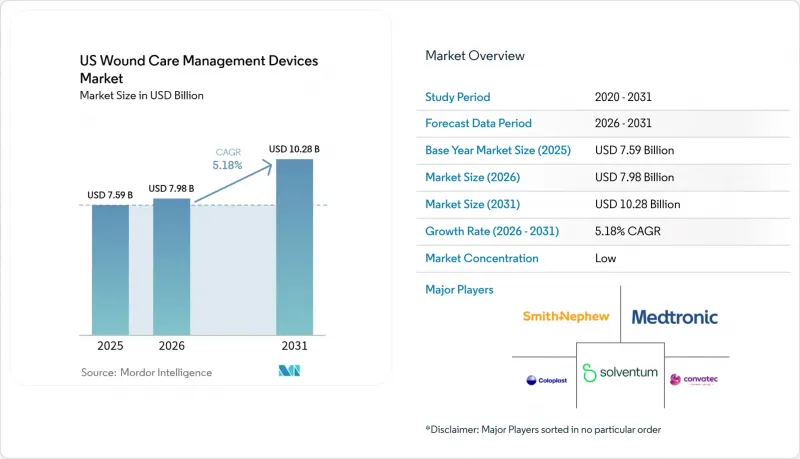
본 보고서는 제품별(상처 관리(드레싱, 상처 관리 기기 등) 및 상처 봉합(봉합사, 외과용 스테이플러 등)), 상처 유형별(만성 상처 및 급성 상처), 최종 사용자별(병원·전문 상처 클리닉 등),구매 형태별(기관 조달 및 소매/OTC 채널)로 분류되어 있습니다. 시장 규모 및 전망은 금액(달러)으로 표시되어 있습니다.
미국의 상처 관리 기기 시장 동향 및 인사이트
만성 상처 및 당뇨병성 상처 발생률 증가
메디케어 수급자 중 만성 상처의 유병률은 상승하고 있으며, 지속적인 관리가 필요한 환자 수는 약 820만 명에 달할 전망입니다. 당뇨병성 족부 궤양만 해도 메디케어의 연간 지출에서 막대한 비용을 차지하고 있으며, 1년 이내 재발률도 높은 경향을 보이고 있습니다. 텍사스주, 플로리다주, 캘리포니아주에서의 지리적 집중은 당뇨병 유병률이 높기 때문이며, 이로 인해 첨단 드레싱 재료, 음압상처치료(NPWT) 시스템 및 보조 요법에 대한 지역적 수요가 증가하고 있습니다.
외과 수술 건수 증가
연간 수술 절개 건수는 1억 건 가까이 회복되었으며, 각각에 봉합용 기기나 드레싱이 필요합니다. 외래 수술로의 전환에 따라, 재택 회복에 적합한 휴대용 NPWT 펌프와 생체활성 조직 접착제에 대한 수요가 증가하고 있습니다. 존슨앤드존슨의 상처 밀봉 패치 ‘Ethizia’는 지혈 작용에 더해 항균 보호 기능도 갖추고 있어 이러한 추세를 상징하는 제품입니다. 병원 측에서는 재입원 1건당 2만 달러를 초과하기도 하는 수술 부위 감염 비용을 절감할 수 있는 기술을 중요하게 여기고 있습니다.
FDA의 엄격한 규제와 CMS의 코딩상의 장벽
FDA는 항균 드레싱의 재분류를 제안하고 있어, 많은 제품이 510(k) 절차를 거쳐 클래스 III PMA(사전 승인 신청)로 전환될 예정입니다. 또한 제조업체는 2026년까지 ISO 13485 규격에 부합하는 품질 시스템 규정(QSR) 개정안을 준수해야 합니다. 이와 병행하여, CMS의 방침에 따라 피부 대체재에 대해서는 동료 심사를 거친 증거가 요구되고 있으며, 이로 인해 임상시험 프로그램의 기간이 장기화되고 비용도 증가하고 있습니다.
부문 분석
2025년 미국의 상처 관리 기기 시장에서 상처 관리 제품 시장 점유율은 66.70%를 차지했습니다. 폼 드레싱과 하이드로콜로이드 드레싱은 뛰어난 수분 관리, 착용 기간 연장, 간호 업무 부담 경감 덕분에 기존의 거즈를 대체했습니다. 드레싱에 내장된 항균제는 잦은 교체가 필요 없이 바이오필름 형성을 억제하는 한편, 플렉서블 프린트 센서는 pH, 온도, 삼출액량을 측정하여 실시간 피드백을 제공합니다.
상처 봉합용 의료기기는 기초 매출 규모는 작지만 연평균 성장률(CAGR) 5.74%로 확대되고 있습니다. 조직용 접착제, 흡수성 스트립, 스프레이형 실란트는 신속한 적용과 심미성 향상을 중시하는 외과의들 사이에서 지지를 얻고 있습니다. 압축 센서가 탑재된 스마트 스테이플러는 수술 중 가이드를 제공하며 삼출률을 감소시킵니다. 비만 수술 및 정형외과 사례 수가 증가하고 있어, 지혈과 감염 억제를 겸비한 생체활성 패치에 대한 수요가 뒷받침되고 있습니다.
2025년, 만성 상처는 미국의 상처 관리 기기 시장 점유율의 59.05%를 차지했습니다. 당뇨병성 족부 궤양 및 욕창은 메디케어 지출에서 가장 큰 비중을 차지하고 있으며, 이는 상처 치유를 촉진하는 하중 경감 기기, 음압상처치료(NPWT) 및 피부 대체재의 채택을 뒷받침하고 있습니다. AI를 활용한 영상 진단 도구는 치유 경과 예측에서 전문가 수준의 정확도를 달성하여, 보다 조기적인 치료 강화를 가능하게 하고 있습니다.
급성 상처 시장은 선택적 수술 후 회복 및 외상 치료 프로토콜 내 감염 관리 강화에 힘입어 연평균 성장률(CAGR) 5.93%로 확대되고 있습니다. 미국의 급성 상처용 상처 관리 기기 시장 규모는 입원 기간을 단축하는 생체 흡수성 실란트 및 음압 드레싱의 보급으로 인해 추가적인 성장이 예상됩니다. 화상은 틈새 시장이지만, AVITA사의 ‘Cohealyx’와 같은 첨단 진피 매트릭스가 흉터 최소화와 신속한 재상피화를 지원하고 있습니다.
기타 혜택 :
- 엑셀 형식 시장 예측(ME) 시트
- 3개월간의 애널리스트 지원
자주 묻는 질문
목차
제1장 서론
제2장 조사 방법
제3장 주요 요약
제4장 시장 구도
제5장 시장 규모 및 성장 예측
제6장 경쟁 구도
제7장 시장 기회 및 향후 전망
KTH 26.08.26According to Mordor Intelligence, the US wound care management devices market size was valued at USD 7.59 billion in 2025 and estimated to grow from USD 7.98 billion in 2026 to reach USD 10.28 billion by 2031, at a CAGR of 5.18% during the forecast period (2026-2031).
This report is Segmented by Product (Wound Care [Dressings, Wound-Care Devices, and More] and Wound Closure [Sutures, Surgical Staplers, and More]), Wound Type (Chronic Wounds and Acute Wounds), End User (Hospitals & Specialty Wound Clinics and More), and Mode of Purchase (Institutional Procurement and Retail / OTC Channel). The Market and Forecasts are Provided in Terms of Value (USD).
US Wound Care Management Devices Market Trends and Insights
Increasing incidence of chronic and diabetic wounds
Chronic wound prevalence among Medicare beneficiaries rose, equating to roughly 8.2 million patients requiring ongoing management. Diabetic foot ulcers alone incur a large sum in annual Medicare spending and show a high recurrence rate within one year. Geographic clustering in Texas, Florida, and California stems from elevated diabetes prevalence, reinforcing regional demand for advanced dressings, NPWT systems, and adjunctive therapies.
Growing volume of surgical procedures
Annual surgical incisions have rebounded to nearly 100 million, each requiring closure devices or dressings. The outpatient migration of procedures fuels demand for portable NPWT pumps and bio-active tissue adhesives suited to home recovery. Johnson & Johnson's Ethizia wound-sealing patch exemplifies this trend, offering hemostasis plus antimicrobial protection. Hospitals emphasize technologies that lower surgical site infection costs, which can exceed USD 20,000 per readmission.
Stringent FDA regulations and CMS coding hurdles
The FDA has proposed reclassifying antimicrobial dressings, pushing many products from the 510(k) pathway to Class III PMA. Manufacturers must also comply with updated Quality System Regulation amendments aligning with ISO 13485 standards by 2026. Parallel CMS policy demands peer-reviewed evidence for skin substitutes, prompting longer and costlier clinical programs.
Other drivers and restraints analyzed in the detailed report include:
- Rising geriatric population base
- Rapid adoption of advanced therapies such as NPWT and skin substitutes
- High total cost of care and device pricing
For complete list of drivers and restraints, kindly check the Table Of Contents.
Segment Analysis
The United States wound care management devices market share favored wound care products at 66.70% in 2025. Foam and hydrocolloid dressings have displaced traditional gauze due to better moisture control, extended wear, and decreased nursing workload. Antimicrobial agents embedded in dressings target biofilm formation without frequent changes, while flexible printed sensors capture pH, temperature, and exudate volume for real-time feedback.
Wound closure devices, though smaller in base revenue, are advancing at 5.74% CAGR. Tissue adhesives, absorbable strips, and sprayable sealants are gaining traction among surgeons who value faster application and improved cosmesis. Smart staplers equipped with compression sensors provide intraoperative guidance that lowers leak rates. Increasing bariatric and orthopedic volumes support demand for bio-active patches that combine hemostasis with infection suppression.
Chronic wounds retained 59.05% of the United States wound care management devices market share in 2025. Diabetic foot ulcers and pressure ulcers consume the largest share of Medicare spending, driving adoption of off-loading devices, NPWT, and skin substitutes that expedite closure. AI-driven imaging tools achieve expert-level accuracy in predicting healing trajectories, enabling earlier therapy escalation .
Acute wounds are expanding at a 5.93% CAGR as elective surgeries rebound and trauma care protocols intensify infection control. The United States wound care management devices market size for acute applications is poised to benefit from bio-resorbable sealants and negative-pressure dressings that shorten hospital stays. Burns constitute a niche segment where advanced dermal matrices like AVITA's Cohealyx support scar minimization and rapid re-epithelialization.
Complete Report Scope:
- By Product
- Wound Care
- Dressings
- Traditional Gauze & Tape Dressings
- Advanced Dressings
- Wound-Care Devices
- Negative Pressure Wound Therapy (NPWT)
- Oxygen & Hyperbaric Systems
- Electrical Stimulation Devices
- Other Wound Care Devices
- Other Wound Care Products
- Dressings
- Wound Closure
- Sutures
- Surgical Staplers
- Tissue Adhesives, Strips, Sealants & Glues
- Wound Care
- By Wound Type
- Chronic Wounds
- Diabetic Foot Ulcer
- Pressure Ulcer
- Venous Leg Ulcer
- Other Chronic Wounds
- Acute Wounds
- Surgical/Traumatic Wounds
- Burns
- Other Acute Wounds
- Chronic Wounds
- By End User
- Hospitals & Specialty Wound Clinics
- Long-term Care Facilities
- Home-Healthcare Settings
- By Mode of Purchase
- Institutional Procurement
- Retail / OTC Channel
List of Companies Covered in this Report:
- Solventum
- Smiths Group
- Johnson & Johnson
- Convatec
- Medtronic
- B. Braun
- Cardinal Health
- Coloplast
- Molnlycke Health Care
- Integra LifeSciences
- Organogenesis
- Teleflex
- Urgo Medical
- Hollister
- Medline Industries
- Zimmer Biomet
- MiMedx Group
- Essity Medical
- AVITA Medical, Inc.
- Hartmann Group
Additional Benefits:
- The market estimate (ME) sheet in Excel format
- 3 months of analyst support
TABLE OF CONTENTS
1 Introduction
- 1.1 Study Assumptions & Market Definition
- 1.2 Scope of the Study
2 Research Methodology
3 Executive Summary
4 Market Landscape
- 4.1 Market Overview
- 4.2 Market Drivers
- 4.2.1 Increasing incidence of chronic & diabetic wounds
- 4.2.2 Growing volume of surgical procedures
- 4.2.3 Rising geriatric population base
- 4.2.4 Rapid adoption of advanced therapies such as NPWT and skin substitutes
- 4.2.5 Reimbursement-linked telehealth & smart dressing deployment
- 4.2.6 Rising hospital-acquired wound cases and infection control mandates
- 4.3 Market Restraints
- 4.3.1 Stringent FDA regulations & CMS coding hurdles
- 4.3.2 High total cost of care and device pricing
- 4.3.3 Heightened payer scrutiny of skin substitutes
- 4.3.4 Shortage of certified wound-care specialists
- 4.4 Regulatory Landscape
- 4.5 Technological Outlook
- 4.6 Porters Five Forces Analysis
- 4.6.1 Bargaining Power of Buyers
- 4.6.2 Bargaining Power of Suppliers
- 4.6.3 Threat of New Entrants
- 4.6.4 Threat of Substitute Products
- 4.6.5 Intensity of Competitive Rivalry
5 Market Size & Growth Forecasts (Value, USD)
- 5.1 By Product
- 5.1.1 Wound Care
- 5.1.1.1 Dressings
- 5.1.1.1.1 Traditional Gauze & Tape Dressings
- 5.1.1.1.2 Advanced Dressings
- 5.1.1.2 Wound-Care Devices
- 5.1.1.2.1 Negative Pressure Wound Therapy (NPWT)
- 5.1.1.2.2 Oxygen & Hyperbaric Systems
- 5.1.1.2.3 Electrical Stimulation Devices
- 5.1.1.2.4 Other Wound Care Devices
- 5.1.1.3 Other Wound Care Products
- 5.1.1.1 Dressings
- 5.1.2 Wound Closure
- 5.1.2.1 Sutures
- 5.1.2.2 Surgical Staplers
- 5.1.2.3 Tissue Adhesives, Strips, Sealants & Glues
- 5.1.1 Wound Care
- 5.2 By Wound Type
- 5.2.1 Chronic Wounds
- 5.2.1.1 Diabetic Foot Ulcer
- 5.2.1.2 Pressure Ulcer
- 5.2.1.3 Venous Leg Ulcer
- 5.2.1.4 Other Chronic Wounds
- 5.2.2 Acute Wounds
- 5.2.2.1 Surgical/Traumatic Wounds
- 5.2.2.2 Burns
- 5.2.2.3 Other Acute Wounds
- 5.2.1 Chronic Wounds
- 5.3 By End User
- 5.3.1 Hospitals & Specialty Wound Clinics
- 5.3.2 Long-term Care Facilities
- 5.3.3 Home-Healthcare Settings
- 5.4 By Mode of Purchase
- 5.4.1 Institutional Procurement
- 5.4.2 Retail / OTC Channel
6 Competitive Landscape
- 6.1 Market Concentration Analysis
- 6.2 Market Share Analysis
- 6.3 Company Profiles (includes Global level Overview, Market level overview, Core Segments, Financials as available, Strategic Information, Market Rank/Share for key companies, Products & Services, and Recent Developments)
- 6.3.1 Solventum
- 6.3.2 Smith & Nephew
- 6.3.3 Johnson & Johnson
- 6.3.4 ConvaTec Group
- 6.3.5 Medtronic
- 6.3.6 B. Braun SE
- 6.3.7 Cardinal Health
- 6.3.8 Coloplast
- 6.3.9 Molnlycke Health Care
- 6.3.10 Integra LifeSciences
- 6.3.11 Organogenesis
- 6.3.12 Teleflex
- 6.3.13 Urgo Medical
- 6.3.14 Hollister Incorporated
- 6.3.15 Medline Industries
- 6.3.16 Zimmer Biomet
- 6.3.17 MiMedx Group
- 6.3.18 Essity Medical
- 6.3.19 AVITA Medical, Inc.
- 6.3.20 Hartmann Group
7 Market Opportunities & Future Outlook
- 7.1 White-space & Unmet-need Assessment


