

|
시장보고서
상품코드
2113543
중국의 창상 관리 기기 : 시장 점유율 분석, 업계 동향 및 통계, 성장 예측(2026-2031년)China Wound Care Management Devices - Market Share Analysis, Industry Trends & Statistics, Growth Forecasts (2026 - 2031) |
||||||
 Mordor Intelligence
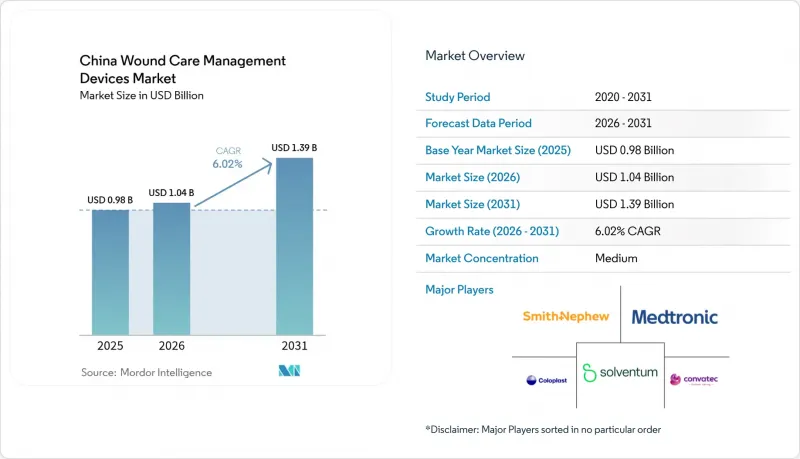
Mordor Intelligence에 의하면, 중국의 창상 관리 기기 시장 규모는 2025년에 9억 8,000만 달러, 2026년 10억 4,000만 달러에서 2031년까지 13억 9,000만 달러에 이를 것으로 예측되며, 예측 기간(2026년-2031년) CAGR은 6.02%를 기록할 전망입니다.
본 보고서는 제품별(상처 관리(드레싱, 상처 관리 기기 등) 및 상처 봉합(봉합사, 외과용 스테이플러 등)),상처 유형별(만성 상처 및 급성 상처), 최종 사용자별(병원 및 전문 상처 클리닉 등), 구매 형태별(기관 조달 및 소매/OTC 채널)로 분류되어 있습니다. 시장 규모 및 예측은 금액(달러) 기준으로 제시되어 있습니다.
중국 상처 관리 기기 시장 동향 및 인사이트
당뇨병 및 만성 상처 유병률 증가
당뇨병 유병률은 2005년 7.53%에서 2023년 13.67%로 증가하여, 중국 상처 관리 기기 시장 수요를 끌어올리고 있습니다. 환자 1인당 당뇨병성 족부 병변의 치료비가 급증하고 절단률이 거의 3배로 증가함에 따라, 병원들은 예방적 드레싱 및 음압 치료 시스템으로의 전환을 강요받고 있습니다. 중국에서는 매년 1억 명 가량이 만성 상처로 고통받고 있으며, 그 주요 원인으로 외상을 제치고 당뇨병성 궤양이 1위를 차지하고 있습니다. 남부 지방에서 치료 효과의 우월성이 입증됨에 따라, 지역별 맞춤형 도입 전략이 추진되고 있습니다. 이러한 동향들이 맞물려 중국 상처 관리 기기 시장의 지속적인 성장을 뒷받침하고 있습니다.
회복 가속화 및 입원 기간 단축에 대한 수요
복잡한 상처를 가진 입원 환자의 평균 입원 일수는 12일로, 일반 입원 환자의 7일보다 길며, 의료비 중앙값은 6,500위안을 초과합니다. 이에 따라 병원들은 회복 기간을 단축하는 기술에 대한 투자를 확대되고 있습니다. 개량형 음압 요법을 통해 치유 기간이 약 3일 단축되었고, 치료비는 절반으로 줄었습니다. iCares 시스템과 같은 스마트 붕대는 임상 관찰보다 며칠 더 빨리 합병증을 감지합니다. 이러한 솔루션은 치료 성과에 따라 보상을 지급하는 ‘진단 관련 그룹(DRG)’ 기반의 지불 제도 개혁과 부합하며, 중국 대도시권의 상처 관리 기기 시장 확대에 기여하고 있습니다.
엄격한 등록(NMPA 클래스 III) 및 보험 환급의 장벽
클래스 III로 분류되는 첨단 드레싱은 광범위한 임상시험을 거쳐야 하며, 승인까지 최대 2년이 걸리는 경우도 드물지 않습니다. 2024년에 시행된 새로운 조달 규정에서는 현지 특허 취득 및 제조가 의무화되어, 많은 다국적 기업이 사실상 배제되고 있습니다. 국가의료보장국이 주도한 가격 협상의 결과, 신규 치료법의 가격이 평균 63% 인하되어 이익률이 압박받고 있습니다. 민간 보험이 혁신적인 의료기기의 비용을 보장하는 비율은 고작 7.7%에 불과하여, 환자는 비용의 거의 절반을 본인 부담해야만 합니다. 이러한 장벽들로 인해, 특히 중국 상처 관리 기기 시장에서 고급 수입 제품의 성장세가 둔화되고 있습니다.
부문 분석
2025년, 중국의 상처 관리 기기 시장에서 첨단 상처 관리 부문은 62.65%의 점유율을 유지했습니다. 연구에 따르면, 음압 요법은 99.75%의 상처 폐쇄율을 달성하는 반면, 기존 방법은 94%에 그쳐 임상 현장에서의 선호도가 높아지고 있음을 뒷받침하고 있습니다. 또한, 병원 측에서는 만성 궤양에 대해 ‘Aquacel Ag+’와 같은 항균성 하이드로파이버를, 육아 조직 형성이 빠르다는 이유로 선호하여 채택하고 있습니다. 첨단 드레싱의 높은 초기 비용은 DRG 지급 제도 개혁에 따른 입원 일수 단축이라는 인센티브로 상쇄되고 있으며, 이것이 3차 의료기관에서의 보급을 뒷받침하고 있습니다.
상처 폐쇄 부문은 규모는 작지만 연평균 성장률(CAGR) 6.75%로 확대될 것으로 예측됩니다. 조직 접착제나 흡수성 실란트는 저침습 수술에서 보급이 확대되고 있으며, 자동 스테이플러는 수술실의 효율 향상에 기여하고 있습니다. 삼출액을 한 방향으로 배출시키면서 pH 값을 측정하는 액체 다이오드식 스마트 붕대는 다음 도약을 상징하는 제품입니다. 이를 종합해 보면, 제품 혁신이 중국 상처 관리 기기 시장의 지속적인 확장을 뒷받침하고 있습니다.
2025년 중국 상처 관리 기기 시장 규모 중 만성 질환이 58.74%를 차지하며, 그중에서도 당뇨병 환자의 연간 발병률이 8.1%에 달하는 당뇨병성 족부 궤양이 가장 큰 비중을 차지합니다. 전문센터 및 도시 차원의 보험 환급 시범 사업을 통해 첨단 드레싱 재료의 보급이 진행되고 있지만, 북부 지방에서는 여전히 치유 속도가 느리다는 보고가 있습니다. 욕창은 여전히 입원 환자에게 비용이 많이 드는 문제이며, 통기성 실리콘 폼에 대한 수요를 높이고 있습니다.
급성 상처 시장은 선택적 수술 증가와 응급 외상 치료의 개선을 반영하여 연평균 성장률(CAGR) 6.83%로 확대될 것으로 예측됩니다. 예방적 음압 시스템은 수술 부위 감염을 74% 감소시켜 병원 내 도입을 촉진하고 있습니다. 충격을 받으면 경화되지만 조직 재건에 맞추어 부드러워지는 동적 단계 적응형 하이드로겔은 화상 치료 부문에서 상처 치유 시간을 단축시킵니다. 이러한 성능상의 이점으로 인해, 중국 상처 관리 기기 시장 증가분 성장에 있어 급성기 부문이 계속해서 큰 기여를 하고 있습니다.
기타 혜택:
- 엑셀 형식 시장 예측(ME) 시트
- 3개월간의 애널리스트 지원
자주 묻는 질문
목차
제1장 서론
제2장 조사 방법
제3장 주요 요약
제4장 시장 구도
제5장 시장 규모와 성장 예측
제6장 경쟁 구도
제7장 시장 기회와 향후 전망
LSH 26.08.25According to Mordor Intelligence, the China wound care management devices market size was valued at USD 0.98 billion in 2025 and estimated to grow from USD 1.04 billion in 2026 to reach USD 1.39 billion by 2031, at a CAGR of 6.02% during the forecast period (2026-2031).
This report is Segmented by Product (Wound Care [Dressings, Wound-Care Devices, and More] and Wound Closure [Sutures, Surgical Staplers, and More]), Wound Type (Chronic Wounds and Acute Wounds), End User (Hospitals & Specialty Wound Clinics and More), and Mode of Purchase (Institutional Procurement and Retail / OTC Channel). The Market and Forecasts are Provided in Terms of Value (USD).
China Wound Care Management Devices Market Trends and Insights
Rising Incidence of Diabetes & Chronic Wounds
Diabetes prevalence increased from 7.53% in 2005 to 13.67% in 2023, inflating demand for the China wound care management devices market. Diabetic-foot treatment cost per patient jumped, while amputation rates almost tripled, prompting hospitals to shift toward preventive dressings and negative-pressure systems. Close to 100 million Chinese suffer chronic wounds every year, and diabetic ulcers have overtaken trauma as the primary cause. Evidence of superior healing in southern provinces drives region-specific adoption strategies. Collectively, these dynamics underpin sustained growth for the China wound care management devices market.
Demand for Faster Recovery & Reduced Hospital Stay
Complex-wound inpatients average 12 days of hospitalization versus seven for ordinary admissions, with median medical costs exceeding RMB 6,500. Hospitals therefore invest in technologies that shorten recovery. Modified negative-pressure therapy has trimmed healing time by almost three days and halved treatment expenses. Smart bandages such as the iCares system detect complications several days earlier than clinical observation. These solutions align with Diagnosis-Related Group (DRG) payment reforms that reward outcomes, helping expand the China wound care management devices market in metropolitan hubs.
Stringent Registration (NMPA Class III) & Reimbursement Hurdles
Advanced dressings classified as Class III must undergo extensive trials, often extending approval by up to two years. New 2024 procurement rules require local patents and manufacturing, effectively sidelining many multinationals. Price negotiations led by the National Healthcare Security Administration resulted in average 63% cuts for novel therapies, squeezing margins. Commercial insurance covers just 7.7% of innovative-device costs, forcing patients to pay nearly half out-of-pocket. These hurdles temper growth, especially for premium imports within the China wound care management devices market.
Other drivers and restraints analyzed in the detailed report include:
- Ageing Population & Higher Elective Surgeries
- Growing Technological Advancements in Wound Care Devices
- High Price Sensitivity in Public Tenders
For complete list of drivers and restraints, kindly check the Table Of Contents.
Segment Analysis
Advanced wound care retained a 62.65% share of the China wound care management devices market in 2025. Studies show negative-pressure therapy achieves 99.75% closure versus 94% for conventional methods, reinforcing clinical preference. Hospitals also favor antimicrobial hydrofibers such as Aquacel Ag+ for chronic ulcers, citing faster granulation. Advanced dressings' higher upfront cost is offset by shorter length-of-stay incentives under DRG payment reform, supporting wider adoption in tertiary centers.
The wound-closure segment, though smaller, is forecast to rise at a 6.75% CAGR. Tissue adhesives and absorbable sealants gain traction for minimally invasive surgery, and automated staplers improve operating-room efficiency. Liquid-diode smart bandages that channel exudate one way while reading pH levels represent the next leap. Taken together, product innovation underpins enduring expansion of the China wound care management devices market.
Chronic conditions accounted for 58.74% of the China wound care management devices market size in 2025, led by diabetic foot ulcers with an 8.1% annual incidence among diabetics. Specialized centers and city-level reimbursement pilots are scaling advanced dressings, although northern provinces still report slower healing. Pressure ulcers remain a costly inpatient problem, elevating demand for breathable silicone foams.
Acute wounds are projected to expand at 6.83% CAGR, reflecting increased elective surgery and improved emergency trauma care. Prophylactic negative-pressure systems reduce surgical-site infection by 74%, reinforcing hospital adoption. Dynamically phase-adaptive hydrogels that harden on impact but soften for remodeling shorten closure times in burn units. Such performance advantages sustain the acute segment's outsized contribution to incremental growth within the China wound care management devices market.
Complete Report Scope:
- By Product
- Wound Care
- Dressings
- Traditional Gauze & Tape Dressings
- Advanced Dressings
- Wound-Care Devices
- Negative Pressure Wound Therapy (NPWT)
- Oxygen & Hyperbaric Systems
- Electrical Stimulation Devices
- Other Wound Care Devices
- Other Wound Care Products
- Dressings
- Wound Closure
- Sutures
- Surgical Staplers
- Tissue Adhesives, Strips, Sealants & Glues
- Wound Care
- By Wound Type
- Chronic Wounds
- Diabetic Foot Ulcer
- Pressure Ulcer
- Venous Leg Ulcer
- Other Chronic Wounds
- Acute Wounds
- Surgical/Traumatic Wounds
- Burns
- Other Acute Wounds
- Chronic Wounds
- By End User
- Hospitals & Specialty Wound Clinics
- Long-term Care Facilities
- Home-Healthcare Settings
- By Mode of Purchase
- Institutional Procurement
- Retail / OTC Channel
List of Companies Covered in this Report:
- Johnson & Johnson
- Solventum
- Smiths Group
- Medtronic
- Coloplast
- Molnlycke Health Care
- Convatec
- Beiersdorf
- Winner Medical
- Zhende Medical
- Mindray (Negative-Pressure Therapy)
- SunMed Medical
- Acelity/KCI
- B. Braun
- Baxter
- DermaSci
- Kang Li Medical
- Lohmann & Rauscher
- Hartmann
- United-DS Medical
Additional Benefits:
- The market estimate (ME) sheet in Excel format
- 3 months of analyst support
TABLE OF CONTENTS
1 Introduction
- 1.1 Study Assumptions & Market Definition
- 1.2 Scope of the Study
2 Research Methodology
3 Executive Summary
4 Market Landscape
- 4.1 Market Overview
- 4.2 Market Drivers
- 4.2.1 Rising incidence of diabetes & chronic wounds
- 4.2.2 Demand for faster recovery & reduced hospital stay
- 4.2.3 Ageing population & higher elective surgeries
- 4.2.4 Growing technological advancements in Wound care devices
- 4.2.5 Government DRG payment reform accelerating adoption of advanced dressings
- 4.2.6 Rising e-commerce penetration of wound supplies in tier-3/4 cities
- 4.3 Market Restraints
- 4.3.1 Stringent registration (NMPA Class III) & reimbursement hurdles
- 4.3.2 High price sensitivity in public tenders
- 4.3.3 Emerging domestic OEMs triggering price wars in negative-pressure devices
- 4.3.4 Shortage of wound care specialists
- 4.4 Regulatory Landscape
- 4.5 Technological Outlook
- 4.6 Porters Five Forces Analysis
- 4.6.1 Threat of New Entrants
- 4.6.2 Bargaining Power of Buyers
- 4.6.3 Bargaining Power of Suppliers
- 4.6.4 Threat of Substitutes
- 4.6.5 Competitive Rivalry
5 Market Size & Growth Forecasts (Value, USD)
- 5.1 By Product
- 5.1.1 Wound Care
- 5.1.1.1 Dressings
- 5.1.1.1.1 Traditional Gauze & Tape Dressings
- 5.1.1.1.2 Advanced Dressings
- 5.1.1.2 Wound-Care Devices
- 5.1.1.2.1 Negative Pressure Wound Therapy (NPWT)
- 5.1.1.2.2 Oxygen & Hyperbaric Systems
- 5.1.1.2.3 Electrical Stimulation Devices
- 5.1.1.2.4 Other Wound Care Devices
- 5.1.1.3 Other Wound Care Products
- 5.1.1.1 Dressings
- 5.1.2 Wound Closure
- 5.1.2.1 Sutures
- 5.1.2.2 Surgical Staplers
- 5.1.2.3 Tissue Adhesives, Strips, Sealants & Glues
- 5.1.1 Wound Care
- 5.2 By Wound Type
- 5.2.1 Chronic Wounds
- 5.2.1.1 Diabetic Foot Ulcer
- 5.2.1.2 Pressure Ulcer
- 5.2.1.3 Venous Leg Ulcer
- 5.2.1.4 Other Chronic Wounds
- 5.2.2 Acute Wounds
- 5.2.2.1 Surgical/Traumatic Wounds
- 5.2.2.2 Burns
- 5.2.2.3 Other Acute Wounds
- 5.2.1 Chronic Wounds
- 5.3 By End User
- 5.3.1 Hospitals & Specialty Wound Clinics
- 5.3.2 Long-term Care Facilities
- 5.3.3 Home-Healthcare Settings
- 5.4 By Mode of Purchase
- 5.4.1 Institutional Procurement
- 5.4.2 Retail / OTC Channel
6 Competitive Landscape
- 6.1 Market Concentration
- 6.2 Market Share Analysis
- 6.3 Company Profiles (includes Global level Overview, Market level overview, Core Segments, Financials as available, Strategic Information, Market Rank/Share, Products & Services, Recent Developments)
- 6.3.1 Johnson & Johnson (Ethicon)
- 6.3.2 Solventum
- 6.3.3 Smith & Nephew
- 6.3.4 Medtronic
- 6.3.5 Coloplast
- 6.3.6 Molnlycke Health Care
- 6.3.7 Convatec
- 6.3.8 Beiersdorf
- 6.3.9 Winner Medical
- 6.3.10 Zhende Medical
- 6.3.11 Mindray (Negative-Pressure Therapy)
- 6.3.12 SunMed Medical
- 6.3.13 Acelity/KCI
- 6.3.14 B. Braun
- 6.3.15 Baxter
- 6.3.16 DermaSci
- 6.3.17 Kang Li Medical
- 6.3.18 Lohmann & Rauscher
- 6.3.19 Hartmann
- 6.3.20 United-DS Medical
7 Market Opportunities & Future Outlook
- 7.1 White-space & Unmet-Need Assessment


