|
시장보고서
상품코드
2099338
독일의 터닝 센터 : 시장 점유율 분석, 업계 동향 및 통계, 성장 예측(2026-2031년)Germany Turning Centers - Market Share Analysis, Industry Trends & Statistics, Growth Forecasts (2026 - 2031) |
||||||
 Mordor Intelligence
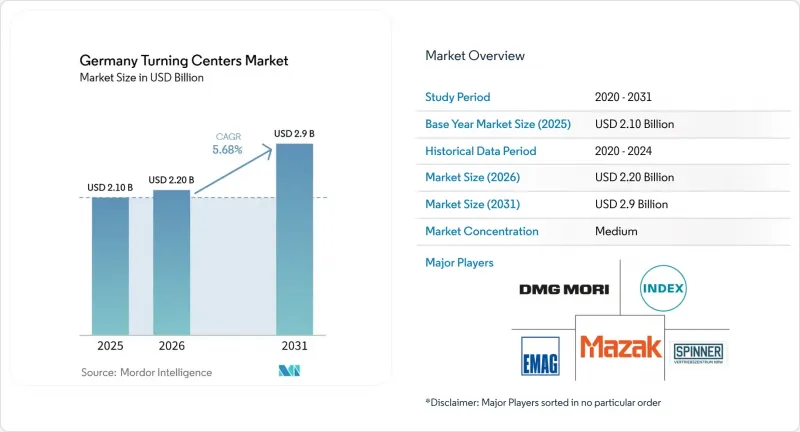
Mordor Intelligence에 의하면, 독일의 터닝 센터 시장 규모는 2025년 21억 달러로 평가되었습니다. 2026년에는 22억 달러로 확대되어 2026년부터 2031년에 걸쳐 CAGR 5.68%로 성장을 지속하여, 2031년에는 29억 달러에 이를 것으로 예측됩니다.
본 보고서는 제품 유형(수평형 터닝 센터, 수직형 터닝 센터 등), 축 구성(3축, 4축, 5축 이상), 자동화 유형(수동, 반자동, 전자동 CNC), 최종 사용자 산업(자동차·상용차, 항공우주 및 방위 등)별로 분류되어 있습니다. 시장 전망은 금액(달러) 및 수량(대)으로 제시되어 있습니다.
독일의 터닝 센터 시장 동향 및 인사이트
전기차(EV)로의 전환이 구동계용 터닝 센터의 설비 갱신을 촉진
전기 구동계 부품은 많은 내연기관용 부품보다 더 엄격한 내경, 원통도 및 표면 공차가 요구되기 때문에 독일의 터닝 센터 시장의 조달 우선순위에 변화가 생기고 있습니다. 이러한 변화로 인해 4축 및 5축 선삭·밀링 가공 플랫폼이 유리한 위치를 차지하고 있습니다. 이는 독일의 터닝 센터 시장에서 전기 구동용 하우징 및 관련 정밀 부품에 대해 단일 세팅으로 가공하는 것이 점점 더 중요해지고 있기 때문입니다. BMW 그룹이 2027년 말까지 뮌헨 공장을 ‘노이에 클라세’의 완전 전기 모델 생산으로 전환하려는 움직임은 이러한 설비 갱신 주기가 이미 공장 차원의 투자 결정에 영향을 미치고 있음을 보여줍니다. 또한, 해당 기업이 란트슈트 공장에서 전동 구동 유닛의 중앙 하우징을 위해 2억 유로(2억 3,530만 달러)를 추가 투자한 것도, 이러한 수요가 장기적인 계획이 아니라 실제 가공 능력과 직결되어 있음을 보여줍니다. VDW의 고객 구성 데이터도 이러한 전환을 뒷받침하고 있으며, 독일 공작기계 생산액에서 자동차 산업이 차지하는 비중은 27.2%로 하락했습니다. 반면, 엔지니어링 분야의 점유율은 30.1%로 상승했으며, 이는 독일의 터닝 센터 시장에서 기존의 파워트레인 관련 수요를 대신해 보다 새로운 정밀 가공 용도가 부상하고 있음을 시사합니다. 그 결과, 단순히 자동차 관련 수요가 감소한 것뿐만 아니라, 독일의 터닝 센터 시장에서 더 뛰어난 축 성능과 강력한 공정 제어가 필요한, 보다 복잡한 가공 업무로 수요가 재분배되고 있는 것입니다.
NATO의 GDP 대비 2% 목표에 따른 국방비 증가
많은 군사 시스템에는 경화 합금, 티타늄, 특수강으로 제작된 정밀 선반 가공 부품이 필요하기 때문에 국방 조달은 이제 지속적인 수요원이 되고 있습니다. 2025년 독일의 군사 지출은 1,140억 달러에 달할 것으로 예상되며, 이는 전년 대비 24% 증가한 수치이자 GDP의 2.3%에 해당하여, 독일의 터닝 센터 시장에 자동차 분야 이외의 더욱 견고한 수요 기반을 제공합니다. 2026년도 국방 예산은 일반 예산과 ‘존더페르모겐(Sondervermogen)’ 특별 기금을 합산하면 1,082억 유로(1,273억 달러)에 달했습니다. 2025년 6월 NATO 정상회의에서 2035년까지 국방·안보 지출 총액을 GDP의 5.0%로 끌어올리겠다는 공약이 발표됨에 따라, 조달 활동의 활성화는 단일 예산 주기를 넘어 지속될 가능성이 높다고 볼 수 있습니다. 2025년 독일의 국가 장비 투자는 47.7% 증가했으며, 이는 공공 부문 수요에 연동된 유형 자본 형성이 이미 시스템 전체로 파급되고 있다는 관점을 뒷받침합니다. 이로 인해 독일의 터닝 센터 시장에는 승용차 설비 투자에 대한 의존도가 낮고, 장기 주기의 산업 및 안보 요건과 밀접하게 연관된 제2의 성장 축이 생겨나고 있습니다.
국내 터닝 센터 수요 감소
공작기계 총 수주량은 2026년 1분기에 회복세를 보이기 시작했으나, 2025년의 급격한 위축으로 인해 국내 수요는 여전히 과거 수준에 미치지 못하고 있습니다. 독일 공작기계 국내 신규 수주는 2025년 연간 기준으로 16% 감소한 반면, 2025년 1분기는 전년의 높은 수준에 비해 30% 감소세를 기록했습니다. 수출 수요는 개선되고 있으나, 특히 자동차 제조업체를 중심으로 국내 투자는 여전히 신중한 태도를 유지하고 있습니다. 2025년 독일 공작기계 업계의 설비 가동률은 평균 76%로, 전년보다 6.1포인트 하락하여 장기 평균을 크게 밑돌았습니다. VDW는 또한 독일의 주요 공작기계 제조업체 12곳이 해외에 생산 거점을 보유하고 있으며, 생산량의 32%가 중국, 20%가 미국에서 차지하고 있다고 지적했습니다. 이는 내수 수요가 부진한 가운데 투자가 해외로 이동하고 있음을 보여줍니다. 독일의 터닝 센터 시장은 2025년에 저점을 찍은 후 2026년에는 회복세를 보일 전망이지만, 2021년 및 2022년에 보였던 수주 환경으로의 완전한 회복에는 여전히 중기적인 시간이 필요할 것으로 보입니다.
부문 분석
2025년, 수평형 터닝 센터는 부문 매출의 47.8%를 차지하며 독일의 터닝 센터 시장에서 가장 큰 제품 카테고리가 되었습니다. 이러한 주도적인 위상은 샤프트 선삭, 일반 산업 생산, 그리고 독일 내 공장에 정착된 자동화 레이아웃에서의 폭넓은 활용을 반영하고 있습니다. 기존의 공작물 고정 시스템, 작업자의 숙련도, 그리고 생산 라인 수준의 연속성이 동급 제품의 교체 수요를 뒷받침하고 있으며, 최종 사용자가 보다 복잡한 플랫폼으로 작업을 전환하는 상황에서도 수평형 시스템이 시장 규모를 유지하는 데 기여하고 있습니다. 많은 독일 공장에서는 새로운 기능 요구 사항과 검증된 공정 안정성 간의 균형을 맞추고 있기 때문에 이미 도입된 설비의 중요성은 여전히 높습니다.
멀티태스크 터닝 센터는 2026년부터 2031년까지 연평균 성장률(CAGR) 6.5%를 나타낼 것으로 예측되며, 독일의 터닝 센터 시장에서 가장 빠르게 성장하는 제품 유형이 될 전망입니다. 이러한 성장은 항공우주, 의료 및 자동차 정밀 부품 분야에서 한 번의 세팅으로 완료되는 완전 가공에 대한 수요를 반영합니다. 수직형 터닝 센터는 에너지, 중장비 및 방위 산업 분야의 대구경 부품 가공에서 여전히 중요한 역할을 수행하고 있습니다. 한편, 스위스형 및 갱 슬라이드식 기계는 임플란트, 전자 및 관련 용도의 소형 정밀 부품 가공에서 계속해서 중요한 역할을 하고 있습니다. INDEX-Werke사의 G160 5축 터닝 센터·밀링 머신은 3만 2,000 rpm의 스핀들과 60개 또는 90개의 공구 위치를 갖추고 있으며, 소형 고복잡도 부품을 위해 설계되었고, 또한 DMG 모리의 'CTX 450 4A' 는 듀얼 스핀들 기능을 갖추고 있어, 2개의 캐리어에 최대 36개의 공구 위치를 배치하여 6면 완전 가공이 가능하며, 제품 개발이 콤팩트하고 공정을 통합한 플랫폼으로 전환되고 있음을 보여줍니다. 이를 통해 구형 수평형 설비가 계속해서 생산성을 유지하는 단계적인 전환 패턴이 뒷받침되고 있습니다. 동시에, 새로운 멀티태스크 시스템이 새로운 가공 프로젝트를 수주함에 따라 독일의 터닝 센터 시장은 성숙한 제품군과 빠르게 성장하는 선삭·밀링 복합 플랫폼을 동시에 지원할 수 있게 되었습니다.
2025년에는 4축 터닝 센터가 매출의 49.2%를 차지하며, 독일의 터닝 센터 시장에서 가장 큰 축 수 등급이 되었습니다. 자동차 부품 공급업체, 일반 산업기계 제조업체, 라디에이터 링을 필요로 하는 업체, 그리고 완전한 동시 5축 동작이 필요하지 않은 부품군 사이에서 그 도입은 계속해서 견조한 추세를 보이고 있습니다. 많은 독일 공장에서 이미 4축 워크플로우를 중심으로 가동되고 있기 때문에 대대적인 공정 재설계보다 가동 시간을 중시하는 경우, 동급 기종으로의 교체가 매력적인 선택지가 됩니다. 비용 측면에서의 합리성도 이 구성을 뒷받침하고 있습니다. 더 고도화된 시스템과 같이 대폭적인 가격 상승을 수반하지 않으면서도 폭넓은 기능을 제공할 수 있기 때문입니다. 이에 따라 4축 플랫폼은 광범위한 산업용도에서의 유용성, 대규모 도입 실적, 그리고 3축 시스템으로부터의 관리하기 쉬운 전환이 가능하다는 점으로 인해 대량 수요의 중심에 계속 자리 잡고 있습니다.
5축 이상의 구성은 2026년부터 2031년에 걸쳐 연평균 성장률(CAGR) 7.8%를 나타낼 것으로 예측되며, 이는 독일의 터닝 센터 시장에서 축 구성별 성장률 중 가장 높은 수치입니다. 항공우주, 방위, 의료 분야 수요 증가가 이러한 성장을 주도하고 있으며, 이러한 용도에서는 셋업 횟수 감소와 더욱 엄격한 기하학적 정밀도가 요구되기 때문입니다. 동기식 선삭·밀링 가공 소프트웨어 및 B축 통합 분야에서 독일 OEM 업체들의 강점은 고도의 용도 엔지니어링이 필요하기 때문에 여전히 타사가 따라잡기 어렵습니다. 한편, 3축 가공기는 추가 축을 도입해도 충분한 투자 대비 효과를 얻을 수 없는 비교적 단순한 원형 부품의 배치 생산에 계속해서 활용되고 있습니다. WFL사의 ‘M70 MILLTURN’은 최대 길이 8,000 mm, 스윙 직경 850 mm의 공작물 처리 능력을 갖추고 있어, 다축 플랫폼이 특수하고 고부가가치의 대형 부품 가공에 어떻게 대응할 수 있는지를 보여주고 있습니다. 정책 방향성도 이러한 추세를 뒷받침하고 있습니다. OECD의 ‘2025년 독일 조사’에 따르면, 제조 경쟁력이 국가의 우선 과제로 강조될 것으로 예상되며, 1회 세팅당 가공 공정 수를 늘려 장기적인 생산성을 높이는 공작기계가 지원될 전망입니다. 4축 설비가 여전히 최대 수익원이지만, 시장 구성비는 더욱 고성능인 시스템으로 이동할 것으로 예측됩니다.
기타 혜택 :
- 엑셀 형식 시장 예측(ME) 시트
- 3개월간의 애널리스트 지원
자주 묻는 질문
목차
제1장 서론
제2장 조사 방법
제3장 주요 요약
제4장 시장 구도
제5장 시장 규모 및 성장 예측
제6장 경쟁 구도
제7장 시장 기회 및 향후 전망
KTH 26.08.10According to Mordor Intelligence, the Germany turning centers market size is expected to grow from USD 2.10 billion in 2025 to USD 2.20 billion in 2026 and is forecast to reach USD 2.9 billion by 2031 at 5.68% CAGR over 2026-2031.
This report is Segmented by Product Type (Horizontal Turning Centers, Vertical Turning Centers, and More), by Axis Configuration (3-Axis, 4-Axis, 5-Axis & Above), by Automation Type (Manual, Semi-Automatic, Fully Automatic CNC), and by End-User Industry (Automotive and Commercial Vehicles, Aerospace & Defense, and More). The Market Forecasts are Provided in Terms of Value (USD) and Volume (Units).
Germany Turning Centers Market Trends and Insights
EV Transition Driving Drivetrain Turning Center Retooling
Electric drivetrain parts require tighter bore, cylindricity, and surface tolerances than many internal combustion components, which is changing procurement priorities in the Germany turning centers market. This shift favors 4-axis and 5-axis turn-mill platforms because single-setup machining is becoming increasingly important for electric-drive housings and related precision parts in the Germany turning centers market. BMW Group's move to convert its Munich plant to all-electric Neue Klasse production by the end of 2027 shows that this retooling cycle is already shaping plant-level investment decisions. The company's additional EUR 200 million (USD 235.3 million) investment at Plant Landshut for electric-drive-unit central housings also shows that this demand is tied to real machining capacity rather than long-term planning. VDW's customer structure data supports this transition because the automotive industry's share of German machine tool output fell to 27.2%. In comparison, engineering rose to 30.1%, suggesting that newer precision applications in the Germany turning centers market are supplanting older powertrain demand. The result is not a simple loss of automotive demand, but a reallocation toward more complex machining work that needs better axis capability and stronger process control in the Germany turning centers market.
Increased Defense Spending Following NATO's 2% GDP Commitment
Defense procurement is becoming a durable source of demand because many military systems require precision turned parts made from hardened alloys, titanium, and specialty steels. Germany's military spending reached USD 114 billion in 2025, which was 24% higher than the prior year and equal to 2.3% of GDP, giving Germany's turning centers market a stronger non-automotive demand base. The 2026 defense budget reached EUR 108.2 billion (USD 127.3 billion) when the regular budget and the Sondervermogen special fund are combined. NATO's June 2025 summit commitment to raise total defense and security spending to 5.0% of GDP by 2035 shows that elevated procurement activity is likely to persist beyond a single budget cycle. Germany's state equipment investments rose 47.7% in 2025, reinforcing the view that physical capital formation tied to public-sector demand is already moving through the system. This gives the Germany turning centers market a second growth pillar, less tied to passenger vehicle capital expenditure and more tied to long-cycle industrial and security requirements.
Decline in Domestic Turning Center Demand
Although overall machine tool orders began recovering in Q1 2026, domestic demand remains below historical levels following the sharp contraction in 2025. German machine tool domestic new orders fell 16% in full-year 2025, while Q1 2025 recorded a 30% decline from a high prior-year base. Although export demand has improved, domestic investment remains cautious, particularly among automotive manufacturers. Capacity utilization in the German machine tool industry averaged 76% in 2025, which was 6.1 percentage points below the prior year and well below the long-run norm. VDW also noted that 12 of the largest German machine tool OEMs have foreign production sites, with 32% of output in China and 20% in the United States, indicating that investment has shifted outward when local demand is weak. The Germany turning centers market should improve from the 2025 trough in 2026, but a full return to the order environment seen in 2021 and 2022 still appears to be a medium-term event.
Other drivers and restraints analyzed in the detailed report include:
- United States Export Growth Boosting Demand for German Turning Center OEMs
- Industry 4.0 Investments Supporting Premium Turning Center Upgrades
- High Manufacturing Costs, Energy, Labor, and Regulatory Compliance
For complete list of drivers and restraints, kindly check the Table Of Contents.
Segment Analysis
Horizontal turning centers accounted for 47.8% of segment revenue in 2025, making them the largest product category in the Germany turning centers market. Their leadership reflects broad use in shaft turning, general industrial production, and established automation layouts across German plants. Existing workholding systems, operator familiarity, and line-level continuity support same-class replacement purchases, helping horizontal systems retain scale as end users shift more work to higher-complexity platforms. The installed base remains important, as many German shops balance new capability needs with proven process stability.
Multi-tasking turning centers are projected to grow at a CAGR of 6.5% from 2026 to 2031, making them the fastest-growing product type in the Germany turning centers market. This growth reflects demand for single-setup, complete machining in aerospace, medical, and precision automotive applications. Vertical turning centers remain important for large-diameter parts in the energy, heavy machinery, and defense industries. At the same time, Swiss-type and gang-slide machines continue to serve small precision parts for implants, electronics, and related applications. INDEX-Werke's G160 5-axis turn-mill, designed for small, high-complexity parts with a 32,000 rpm spindle and 60 or 90 tool positions, and DMG Mori's CTX 450 4A, with dual-spindle capability and up to 36 tool positions across two carriers for six-sided complete machining, show product development shifting toward compact, process-combining platforms. This supports a gradual migration pattern in which older horizontal assets remain productive. At the same time, new multitasking systems take on incremental jobs, allowing the Germany turning centers market to support both mature product classes and faster-growing turn-mill platforms simultaneously.
4-axis turning centers accounted for 49.2% of revenue in 2025, making them the largest axis class in the Germany turning centers market. Their adoption remains strong among automotive suppliers, general industrial machinery manufacturers, and part families that require radial milling but not full simultaneous 5-axis motion. Many German shops already operate around 4-axis workflows, making like-for-like replacement attractive when uptime matters more than major process redesign. Cost discipline also supports this configuration, as it offers broader capabilities without the full price increase of more advanced systems. This keeps 4-axis platforms at the center of volume demand, supported by their relevance across a wide range of industrial applications, a large installed base, and manageable customer migration from 3-axis systems.
5-axis and above configurations are forecast to grow at a 7.8% CAGR from 2026 to 2031, the fastest rate among axis configurations in the Germany turning centers market. Rising demand from aerospace, defense, and medical applications is driving this growth, as these applications require fewer setups and tighter geometric accuracy. German OEM strengths in synchronized turn-mill software and B-axis integration remain difficult to replicate because they require deep application engineering. At the same time, 3-axis machines continue to serve batch production of simpler round parts where additional axes do not generate sufficient returns. WFL's M70 MILLTURN, presented with workpiece handling capabilities of up to 8,000 mm in length and an 850 mm swing diameter, shows how axis-rich platforms address specialized, high-value large-component machining. Policy direction reinforces this trend, as the OECD's 2025 Germany survey is expected to highlight manufacturing competitiveness as a national priority, supporting machines that deliver more operations per setup and stronger long-term productivity. The market mix is expected to shift toward higher-capability systems, even as 4-axis equipment remains the largest revenue pool.
Complete Report Scope:
- By Product Type
- Horizontal Turning Centers
- Vertical Turning Centers
- Multi-Tasking Turning Centers
- Others
- By Axis Configuration
- 3-Axis
- 4-Axis
- 5-Axis and Above
- By Automation Type
- Manual
- Semi-Automatic
- Fully Automatic CNC
- By End-User Industry
- Automotive and Commercial Vehicles
- Aerospace & Defense
- Medical Devices and Surgical Instruments
- Oil, Gas, and Energy
- Electrical, Electronics and Semiconductor Equipment
- General Industrial Machinery
- Others
List of Companies Covered in this Report:
- DMG Mori
- INDEX-Werke GmbH
- EMAG GmbH & Co. KG
- Spinner AG
- Yamazaki Mazak
- Okuma Corporation
- DN Solutions
- Hyundai WIA
- Nakamura-Tome Precision Industry Co., Ltd
- Hwacheon Machinery
- Haas Automation
- Biglia S.p.A.
- Murata Machinery
- CMZ Machine Tool
- Nidec Machine Tool
- WFL Millturn Technologies
- Tsugami Corporation
- SMEC Co., Ltd.
- Citizen Machinery Co., Ltd.
- Star Micronics Co., Ltd.
Additional Benefits:
- The market estimate (ME) sheet in Excel format
- 3 months of analyst support
TABLE OF CONTENTS
1 Introduction
- 1.1 Study Assumptions & Market Definition
- 1.2 Scope of the Study
2 Research Methodology
3 Executive Summary
4 Market Landscape
- 4.1 Market Overview
- 4.2 Market Drivers
- 4.2.1 EV Transition Driving Drivetrain Turning Center Retooling
- 4.2.2 Increased Defense Spending Following NATO's 2% GDP Commitment
- 4.2.3 United States Export Growth Boosting Demand for German Turning Center OEMs
- 4.2.4 Industry 4.0 Investments Supporting Premium Turning Center Upgrades
- 4.2.5 Aerospace Recovery and Airbus Ramp-Up Sustaining 5-Axis Turn-Mill Demand
- 4.2.6 Strong Domestic OEM Ecosystem Enabling Short Lead-Time Machine Procurement
- 4.3 Market Restraints
- 4.3.1 Decline in Domestic Turning Center Demand
- 4.3.2 High Manufacturing Costs: Energy, Labor, and Regulatory Compliance
- 4.3.3 Intensifying Chinese Competition in Mid-Market and Emerging Export Channels
- 4.3.4 Skilled Worker Shortage Impacting Capacity Utilization
- 4.4 Value / Supply-Chain Analysis
- 4.4.1 Raw Material & Critical Component Ecosystem
- 4.4.2 Manufacturing & Assembly Value Chain
- 4.4.3 Distribution & Go-to-Market Channels
- 4.4.4 Aftermarket Services & Lifecycle Support
- 4.5 Regulatory Landscape
- 4.6 Technological Outlook & Innovation Investment Landscape
- 4.6.1 AI-driven adaptive control and chatter suppression
- 4.6.2 High-speed spindle and HSK-T interface evolution
- 4.7 Pricing Analysis
- 4.7.1 Average Selling Price (ASP) Benchmarking of Key Market Participants
- 4.7.2 Average Selling Price (ASP) Analysis, by Product Type
- 4.7.3 Average Selling Price (ASP) Analysis, by Axis Configuration
- 4.7.4 Average Selling Price (ASP) Analysis, by Automation
- 4.8 Buying Criteria & Procurement Analysis
- 4.9 Porter's Five Forces Analysis - Industry Attractiveness Scoring
- 4.9.1 Threat of New Entrants
- 4.9.2 Bargaining Power of Suppliers
- 4.9.3 Bargaining Power of Buyers
- 4.9.4 Threat of Substitutes
- 4.9.5 Industry Rivalry
- 4.10 Impact of Geopolitical Events on the Market
5 Market Size & Growth Forecasts
- 5.1 By Product Type
- 5.1.1 Horizontal Turning Centers
- 5.1.2 Vertical Turning Centers
- 5.1.3 Multi-Tasking Turning Centers
- 5.1.4 Others
- 5.2 By Axis Configuration
- 5.2.1 3-Axis
- 5.2.2 4-Axis
- 5.2.3 5-Axis and Above
- 5.3 By Automation Type
- 5.3.1 Manual
- 5.3.2 Semi-Automatic
- 5.3.3 Fully Automatic CNC
- 5.4 By End-User Industry
- 5.4.1 Automotive and Commercial Vehicles
- 5.4.2 Aerospace & Defense
- 5.4.3 Medical Devices and Surgical Instruments
- 5.4.4 Oil, Gas, and Energy
- 5.4.5 Electrical, Electronics and Semiconductor Equipment
- 5.4.6 General Industrial Machinery
- 5.4.7 Others
6 Competitive Landscape
- 6.1 Market Concentration
- 6.2 Strategic Moves
- 6.3 Market Share Analysis
- 6.4 Competitive Benchmarking Analysis
- 6.5 Company Profiles (Includes Global Level Overview, Market Level Overview, Core Segments, Financials as Available, Strategic Information, Products & Services, and Recent Developments)
- 6.5.1 DMG Mori
- 6.5.2 INDEX-Werke GmbH
- 6.5.3 EMAG GmbH & Co. KG
- 6.5.4 Spinner AG
- 6.5.5 Yamazaki Mazak
- 6.5.6 Okuma Corporation
- 6.5.7 DN Solutions
- 6.5.8 Hyundai WIA
- 6.5.9 Nakamura-Tome Precision Industry Co., Ltd
- 6.5.10 Hwacheon Machinery
- 6.5.11 Haas Automation
- 6.5.12 Biglia S.p.A.
- 6.5.13 Murata Machinery
- 6.5.14 CMZ Machine Tool
- 6.5.15 Nidec Machine Tool
- 6.5.16 WFL Millturn Technologies
- 6.5.17 Tsugami Corporation
- 6.5.18 SMEC Co., Ltd.
- 6.5.19 Citizen Machinery Co., Ltd.
- 6.5.20 Star Micronics Co., Ltd.
7 Market Opportunities & Future Outlook
- 7.1 White-Space & Unmet-Need Assessment