|
시장보고서
상품코드
2099408
인도의 터닝 센터 : 시장 점유율 분석, 업계 동향 및 통계, 성장 예측(2026-2031년)India Turning Centers - Market Share Analysis, Industry Trends & Statistics, Growth Forecasts (2026 - 2031) |
||||||
 Mordor Intelligence
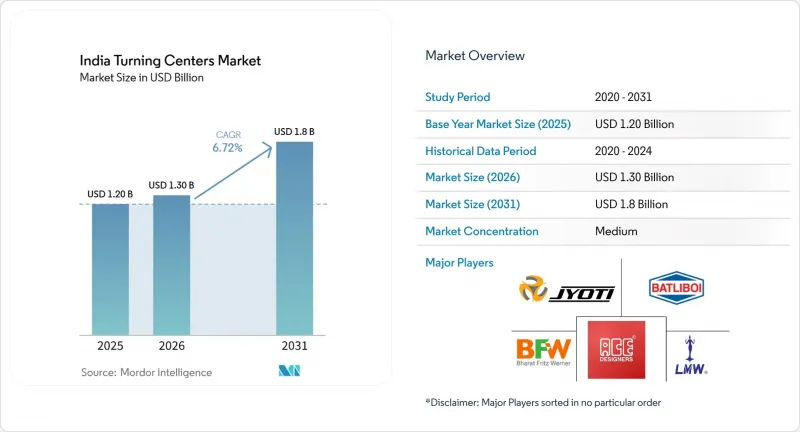
Mordor Intelligence에 의하면, 인도의 터닝 센터 시장 규모는 2025년에 12억 달러로 평가되었습니다. 2026년 13억 달러에서 2031년까지 18억 달러에 이를 것으로 예상되며, 예측 기간(2026-2031년) CAGR은 6.72%를 나타낼 전망입니다.
본 보고서는 제품 유형(수평형 터닝 센터, 수직형 터닝 센터 등), 축 구성(3축, 4축, 5축 이상), 자동화 유형(수동, 반자동, 전자동 CNC), 최종 사용자 산업(자동차·상용차, 항공우주 및 방위 등)별로 분류되어 있습니다. 시장 전망은 금액(달러) 및 수량(대)으로 제시되어 있습니다.
인도의 터닝 센터 시장 동향 및 인사이트
주요 부문의 생산 연계형 인센티브(PLI) 제도
PLI 제도는 단순한 조립 생산량뿐만 아니라 제조 확대에 인센티브를 연계하고 있기 때문에 인도가 제조 거점이 되기 위한 가장 강력한 정책 지원으로 자리 잡고 있습니다. 2025년 12월 기준으로, 해당 제도 하에서 836건의 신청이 승인되었으며, 누적 투자액은 254억 달러에 달했고, 관련 생태계는 144만 명 이상의 직·간접 고용을 창출했습니다. 2025-26 회계연도 자동차 분야의 PLI 예산은 수정 추정치 당시 4,080만 달러에서 3억 3,200만 달러로 증액된 반면, 전자 및 IT 하드웨어 분야에 대한 배정액은 10억 6,000만 미달러로 증가했으며, 이 두 부문 모두에서 설비 수요가 더욱 높아지고 있습니다. 이러한 우대 조치를 희망하는 기업은 국내 부가가치 요건을 충족해야 합니다. 이 요건으로 인해 신규 설비 투자는 수입된 완제품이 아닌, 기계 가공 능력, 부품 생산 라인 및 공장 수준의 자동화 쪽으로 방향을 잡고 있습니다. 이로 인해 인도의 터닝 센터 시장은 광범위하고 다방면에 걸쳐 향후 수년 동안 설비 수요를 지속시킬 가능성이 높은 정책에 뒷받침된 제조 주기와 밀접하게 연결되어 있습니다.
인도 자동차 부문이 터닝 센터 수요를 견인
인도의 자동차 및 자동차 부품 산업은 여전히 인도의 터닝 센터 시장의 최대 수요원이며, 2025년에는 승용차 및 상용차가 수요의 38.5%를 차지했습니다. 인도의 자동차 부품 업계는 2026 회계연도 상반기에 419억 달러의 매출을 기록하여 전년 동기 대비 6.8% 증가했으며, 이는 공급망 전반에 걸쳐 수요가 지속되고 있음을 확인시켜 주었습니다. 1차 자동차 부품 공급업체의 70% 이상이 정밀 가공에 CNC 기술을 채택하고 있으며, 자동차 공급망은 인도에서 터닝 센터에 있어 가장 안정적인 시장 중 하나가 되고 있습니다. 내연기관(ICE)과 전기차(EV) 생산에 대한 병행 투자 사이클이 수요를 뒷받침하고 있습니다. 이는 각 제조업체가 한 플랫폼을 다른 플랫폼으로 대체하는 것이 아니라, 모터 하우징, 배터리 구조 부품, 경량 커넥터, 크랭크샤프트, 캠샤프트를 위한 개별 가공 능력을 추가하고 있기 때문입니다. 이로 인해 인도의 터닝 센터 시장에서는 기존 자동차 부품 카테고리와 새로운 자동차 부품 카테고리 모두에 걸쳐 더 광범위한 설비 수요가 발생하고 있습니다.
고성능 터닝 센터에 대한 높은 수입 의존도
수입 의존도는 여전히 인도의 터닝 센터 시장의 성장을 제한하는 요인으로 작용하고 있으며, 특히 국내 생산 능력이 여전히 제한적인 고급 5축 가공기 및 멀티태스크 시스템 분야에서 두드러집니다. 2025년 공작기계 수입액은 전년 대비 23% 증가한 25억 달러에 달했으며, 이 중 중국, 일본, 독일 3개국이 수입 총액의 62%를 차지했습니다. 제조기술협회(AMT)에 따르면, 2025년 공작기계 수입 총액에서 터닝 센터가 차지하는 비중은 9%로, 이는 인도가 일부 고사양 제품에 대해 여전히 해외 공급에 의존하고 있음을 여실히 보여줍니다. 또한, 수입 장비는 ‘기계·전기기기 안전령’에 따른 추가적인 안전 및 인증 요건을 충족해야 하므로, 구매자는 규정 준수 부담이 가중되고 있습니다. 이로 인해 실사 요건이 엄격해지고 조달 주기가 장기화될 가능성이 있습니다. 현지 공급업체들이 하이엔드 CNC 기술 분야에서 더 큰 진전을 이룰 때까지, 인도의 터닝 센터 시장은 비용 변동, 리드타임 리스크, 수입 시스템에 대한 공급업체 집중과 같은 과제에 계속 직면할 것입니다.
부문 분석
2025년, 인도의 터닝 센터 시장에서 수평형 터닝 센터는 52.5%의 점유율을 차지했습니다. 이는 스핀들의 강성, 안정적인 칩 배출, 그리고 재현성이 높은 사이클 타임이 요구되는 대량 생산형 자동차 및 엔지니어링 용도에서 해당 기종이 확고한 입지를 다지고 있음을 반영합니다. 이러한 기계는 크랭크샤프트, 실린더 라이너, 변속기 샤프트 가공에 있어 여전히 표준적인 선택지로 자리 잡고 있습니다. 이는 이러한 부품의 경우 유연한 다중 공정 레이아웃보다 처리 능력과 치수 일관성이 더 중요하게 요구되기 때문입니다. 이러한 기반을 바탕으로, 대형 자동차 공장이나 파워트레인 및 드라이브라인 프로그램을 담당하는 공급업체의 시설에서 수평형 터닝 센터는 계속해서 조달의 핵심을 차지하고 있습니다. 또한 제조업체들은 기존 공구, 작업자의 숙련도, 유지보수 절차에 적합한 기계 시리즈로 설비를 확장하는 경우가 많기 때문에 이미 도입된 수평형 터닝 센터는 재주문의 기반이 되기도 합니다. 인도의 터닝 센터 시장에서 이러한 갱신 및 확장 주기에 힘입어, 수평형 터닝 센터는 현재 수요가 가장 광범위한 분야와 계속해서 밀접한 관계를 맺고 있습니다.
수직형 터닝 센터는 풍력 발전, 중공업용 장비, 그리고 중력을 이용한 클램핑이 공작물 고정 안정성을 높이는 대구경 항공우주 부품 등의 용도에 힘입어 2031년까지 연평균 성장률(CAGR) 7.8%를 나타낼 것으로 예측됩니다. 이 장비의 매력은 라인 속도보다 진원도 관리, 지그의 복잡성 감소, 그리고 대형 공작물의 안전한 취급이 중시되는 분야에서 더욱 부각되고 있습니다. 또한, 멀티태스크 터닝 센터도 항공우주 및 방위 분야의 하도급 업무에서 진전을 보이고 있습니다. 이는 선삭, 밀링, 드릴링을 한 번의 셋업으로 결합함으로써 다품종 생산 프로그램에서 발생하는 셋업 손실을 줄일 수 있기 때문입니다. LMW사가 IMTEX 2025에서 발표한 신제품에는 LR30T L30, LR40TM L25, LTV 30 Plus, LTV 40 Plus 등 각 모델이 포함되어 있으며, 국내 공급업체들이 수직형 및 중부하 용도 수요를 모두 포착하기 위해 제품 라인업을 확대하고 있음을 보여줍니다. 특수 용도 및 파이프 터닝 센터 시스템은 여전히 틈새 시장이지만, 철도, 압력 용기, 방위 관련 제조 분야에서 표준 양산보다 맞춤화가 중시되는 분야에서 견조한 수요를 유지하고 있습니다.
2025년 인도의 터닝 센터 시장에서 3축 터닝 센터는 65%의 점유율을 차지했습니다. 이는 비용이 저렴하고 표준 공차 환경에서 가동되는 일반 기계 및 자동차 부품 공급업체에 폭넓게 적합하기 때문입니다. 많은 공장에서는 복잡한 부품의 통합보다 신뢰성 높은 생산을 여전히 우선시하고 있기 때문에 이 부문은 방대한 도입 기반을 바탕으로 핵심적인 위치를 유지하고 있습니다. 펌프 하우징, 샤프트, 플랜지 및 기존 기계 가공 부품의 경우, 3축 시스템이 여전히 일반적인 생산량과 예산 제약에 적합합니다. 이 카테고리의 강점은 투자 결정 시 여전히 회수 기간 단축과 프로그래밍의 간편성이 중시되는 인도의 MSME(중소·영세 기업) 제조거점의 구조도 반영하고 있습니다. 따라서 인도의 터닝 센터 시장에서 성능 구성이 상위 기종으로 이동하고 있는 상황에서도 3축 기계에 대한 수요는 계속해서 유지되고 있습니다.
4축 부문은 2031년까지 연평균 성장률(CAGR) 8.5%로 확대될 것으로 예측되며, 제조업체들이 변속기 케이싱, 펌프 본체, 항공우주용 브래킷의 셋업 시간을 단축하기 위해 Y축 기능을 채택함에 따라 가장 빠르게 성장하는 축 등급이 될 전망입니다. 5축 이상 수요는 단일 세팅에서의 정밀도가 중요하고, 스크랩 비용이 높은 항공우주, 방위, 의료기기 가공 분야에 여전히 집중되어 있습니다. Jyoti CNC의 2026 회계연도 4분기 수주 잔고에 따르면, 5억 5,300만 달러 규모의 수주 파이프라인 중 항공우주 및 방위 분야가 38%를 차지하고 있으며, 이는 생산 대수가 적더라도 하이엔드 다축 가공기에 대한 수요가 가치에 얼마나 큰 영향을 미치는지를 보여줍니다. 또한 인도에서는 국내에서 생산되는 절삭 기계의 93%가 현재 CNC 제어 방식인 것으로 보고되고 있으며, 축 수 증설은 일부 초기 도입자에 국한되지 않고 보다 광범위한 디지털화 추세에 따라 진행되고 있습니다. Jyoti CNC사의 ‘BTM 100’ 트윈 스핀들 터닝 센터나 ACE Designers사의 4축 플랫폼과 같은 국내 제품의 출시는 과거 거의 전적으로 수입에 의존하던 수요를 현지 OEM 제조업체들이 흡수하기 시작했음을 보여줍니다.
기타 혜택 :
- 엑셀 형식 시장 예측(ME) 시트
- 3개월간의 애널리스트 지원
자주 묻는 질문
목차
제1장 서론
제2장 조사 방법
제3장 주요 요약
제4장 시장 구도
제5장 시장 규모 및 성장 예측
제6장 경쟁 구도
제7장 시장 기회 및 향후 전망
KTH 26.08.10According to Mordor Intelligence, the India turning centers market size was valued at USD 1.20 billion in 2025 and is estimated to grow from USD 1.30 billion in 2026 to reach USD 1.8 billion by 2031, at a CAGR of 6.72% during the forecast period (2026-2031).
This report is Segmented by Product Type (Horizontal Turning Centers, Vertical Turning Centers, and More), by Axis Configuration (3-Axis, 4-Axis, 5-Axis & Above), by Automation Type (Manual, Semi-Automatic, Fully Automatic CNC), by End-User Industry (Automotive and Commercial Vehicles, Aerospace & Defense, and More). The Market Forecasts are Provided in Terms of Value (USD) and Volume (Units).
India Turning Centers Market Trends and Insights
Production Linked Incentive (PLI) Scheme Across Key Sectors
The PLI scheme remains the strongest policy support for India becoming a manufacturing hub because it ties incentives to manufacturing expansion rather than only to assembly output. As of December 2025, 836 applications had been approved under the scheme, cumulative investment had reached USD 25.4 billion, and the linked ecosystem had generated more than 1.44 million direct and indirect jobs. The automotive PLI budget for 2025-26 rose from USD 40.8 million in the revised estimate to USD 332 million, while electronics and IT hardware allocation increased to USD 1.06 billion, which is building deeper equipment demand across both sectors. Companies seeking these incentives must meet domestic value-addition conditions. That requirement is pushing fresh capital spending into machining capacity, component lines, and plant-level automation rather than into imported finished assemblies. This is keeping the India turning centers market tied to a policy-backed manufacturing cycle that is broad, multi-sector, and likely to sustain equipment demand over several years.
India's Automotive Sector Driving Turning Center Demand
India's automotive and auto components base remains the largest consumption engine for the India turning centers market, with automotive and commercial vehicles accounting for 38.5% of demand in 2025. The Indian auto component industry recorded turnover of USD 41.9 billion in H1 FY26, up 6.8% year on year, confirming continued demand across the supplier network. More than 70% of tier-1 auto component suppliers use CNC technology for precision machining, making the automotive supply chain one of the most stable markets for turning centers in the country. Demand is being reinforced by the parallel investment cycle in ICE and EV production, as manufacturers add separate machining capability for motor housings, battery structural parts, lightweight connectors, crankshafts, and camshafts rather than replacing one platform with another. This is giving the India turning centers market a wider equipment requirement across both traditional and new automotive component categories.
Heavy Import Dependency on Advanced Turning Centers
Import dependence continues to limit the upside of the India turning centers market, especially in premium 5-axis and multi-tasking systems, where domestic capability remains narrower. Machine tool imports rose 23% year on year to USD 2.5 billion in CY2025, and China, Japan, and Germany together accounted for 62% of those imports. Turning centers accounted for 9% of total machine tool imports by type in CY2025, according to the Association for Manufacturing Technology, underscoring the country's continued reliance on overseas supply for several advanced configurations. Buyers also face greater compliance efforts because imported equipment must navigate additional safety and certification requirements under the Machinery and Electrical Equipment Safety Order, which increases due diligence requirements and can lengthen procurement cycles. Until local suppliers move further into premium CNC capability, the India turning centers market will remain exposed to cost shifts, lead-time risk, and supplier concentration in imported systems.
Other drivers and restraints analyzed in the detailed report include:
- MSME (Micro, Small & Medium Enterprises) Modernization and SAMARTH Udyog Initiative
- Growing Domestic Turning Center OEM Capabilities
- Fragmented Aftermarket and Long OEM Service Response Times Outside Major Cities
For complete list of drivers and restraints, kindly check the Table Of Contents.
Segment Analysis
Horizontal turning centers commanded 52.5% of the India turning centers market share in 2025, which reflects their entrenched role in high-volume automotive and engineering applications that depend on spindle rigidity, stable chip evacuation, and repeatable cycle times. These machines remain the default choice for crankshafts, cylinder liners, and transmission shafts because those parts require throughput and dimensional consistency more than flexible multi-process layouts. This base keeps horizontal machines at the center of procurement in large automotive plants and in supplier facilities that serve powertrain and driveline programs. Their installed base also supports repeat orders because manufacturers often expand with machine families that match existing tooling, operator familiarity, and maintenance routines. In the India turning centers market, that replacement and expansion cycle keeps horizontals tied to the broadest part of current demand.
Vertical turning centers are projected to grow at 7.8% CAGR through 2031, driven by applications in wind energy, heavy industrial equipment, and large-diameter aerospace parts where gravity-assisted clamping improves workholding stability. Their appeal is increasing where out-of-roundness control, reduced fixturing complexity, and safer handling of larger workpieces matter more than line speed. Multi-tasking turning centers are also advancing in aerospace and defense subcontracting because they combine turning, milling, and drilling in a single setup, reducing setup losses on high-mix programs. LMW's IMTEX 2025 launches included LR30T L30, LR40TM L25, LTV 30 Plus, and LTV 40 Plus configurations, demonstrating that domestic suppliers are widening their portfolios to capture both vertical and heavy-duty demand. Special-purpose and pipe-turning systems remain niche but steady, serving railways, pressure vessels, and defense fabrication where customization matters more than standard volume.
3-axis turning centers held a 65% share of the India turning centers market in 2025, supported by their lower cost and wide fit with general engineering and automotive suppliers operating in standard-tolerance environments. This segment remains the baseline across a large installed base because many workshops still prioritize dependable production over complex part consolidation. For pump housings, shafts, flanges, and conventional machined parts, 3-axis systems remain aligned with prevailing volume and budget constraints. The strength of this category also reflects the structure of India's MSME manufacturing base, where investment decisions still favor faster payback and simpler programming. That keeps 3-axis machines relevant even as the performance mix in the India turning centers market shifts upward.
The 4-axis segment is forecast to expand at a 8.5% CAGR through 2031, making it the fastest-growing axis class as manufacturers adopt Y-axis capability to reduce setup time for transmission casings, pump bodies, and aerospace brackets. Demand for 5-axis and above remains concentrated in aerospace, defense, and medical device machining, where single-setup accuracy matters and scrap costs are high. Jyoti CNC's Q4 FY2026 order book showed aerospace and defense accounting for 38% of its USD 553 million pipeline, signaling how strongly premium multi-axis demand influences value even when unit volumes remain smaller. India also reported that 93% of cutting machines produced domestically are now CNC-operated, so axis upgrades are increasingly moving with the wider digitalization trend rather than remaining limited to a few early adopters. Domestic launches such as Jyoti CNC's BTM 100 twin-spindle turning center and ACE Designers' 4-axis platform indicate that local OEMs are starting to absorb demand that once moved almost entirely to imports.
Complete Report Scope:
- By Product Type
- Horizontal Turning Centers
- Vertical Turning Centers
- Multi-Tasking Turning Centers
- Others
- By Axis Configuration
- 3-Axis
- 4-Axis
- 5-Axis and Above
- By Automation Type
- Manual
- Semi-Automatic
- Fully Automatic CNC
- By End-User Industry
- Automotive and Commercial Vehicles
- Aerospace & Defense
- Medical Devices and Surgical Instruments
- Oil, Gas, and Energy
- Electrical, Electronics and Semiconductor Equipment
- General Industrial Machinery
- Others
List of Companies Covered in this Report:
- Jyoti CNC Automation
- Bharat Fritz Werner (BFW)
- Lakshmi Machine Works (LMW)
- ACE Designers Ltd.
- Batliboi Ltd.
- Yamazaki Mazak
- DMG MORI
- DN Solutions
- Hyundai WIA
- Okuma Corporation
- Hwacheon Machinery
- Haas Automation
- INDEX-Werke
- EMAG GmbH
- Nakamura-Tome Precision Industry Co., Ltd.
- Goodway Machine Corporation
- Tongtai Machine Tool
- Tsugami Corporation
- Nidec Machine Tool
- Citizen Machinery Co., Ltd.
Additional Benefits:
- The market estimate (ME) sheet in Excel format
- 3 months of analyst support
TABLE OF CONTENTS
1 Introduction
- 1.1 Study Assumptions & Market Definition
- 1.2 Scope of the Study
2 Research Methodology
3 Executive Summary
4 Market Landscape
- 4.1 Market Overview
- 4.2 Market Drivers
- 4.2.1 Production Linked Incentive (PLI) Scheme Across Key Sectors
- 4.2.2 India's Automotive Sector Driving Turning Center Demand
- 4.2.3 MSME Modernization and SAMARTH Udyog Initiative
- 4.2.4 Growing Domestic Turning Center OEM Capabilities
- 4.2.5 Semiconductor and Electronics Manufacturing Investments
- 4.2.6 HAL (Hindustan Aeronautics Limited) and Defense Aerospace Expansion Under Aatmanirbhar Bharat
- 4.3 Market Restraints
- 4.3.1 Heavy Import Dependency on Advanced Turning Centers
- 4.3.2 Fragmented Aftermarket and Long OEM Service Response Times Outside Major Cities
- 4.3.3 Shortage of Skilled CNC Operators and Programmers in Manufacturing Clusters
- 4.3.4 Price Sensitivity Limiting Premium Turning Center Adoption in India
- 4.4 Value / Supply-Chain Analysis
- 4.4.1 Raw Material & Critical Component Ecosystem
- 4.4.2 Manufacturing & Assembly Value Chain
- 4.4.3 Distribution & Go-to-Market Channels
- 4.4.4 Aftermarket Services & Lifecycle Support
- 4.5 Technological Outlook & Innovation Investment Landscape
- 4.5.1 AI-Driven Adaptive Control and Chatter Suppression
- 4.5.2 High-Speed Spindle And HSK-T Interface Evolution
- 4.6 Pricing Analysis
- 4.6.1 Average Selling Price (ASP) Benchmarking of Key Market Participants
- 4.6.2 Average Selling Price (ASP) Analysis, by Product Type
- 4.6.3 Average Selling Price (ASP) Analysis, by Axis Configuration
- 4.6.4 Average Selling Price (ASP) Analysis, by Automation
- 4.7 Buying Criteria & Procurement Analysis
- 4.8 Porter's Five Forces Analysis - Industry Attractiveness Scoring
- 4.8.1 Threat of New Entrants
- 4.8.2 Bargaining Power of Suppliers
- 4.8.3 Bargaining Power of Buyers
- 4.8.4 Threat of Substitutes
- 4.8.5 Industry Rivalry
- 4.9 Impact of Geopolitical Events on the Market
5 Market Size & Growth Forecasts
- 5.1 By Product Type
- 5.1.1 Horizontal Turning Centers
- 5.1.2 Vertical Turning Centers
- 5.1.3 Multi-Tasking Turning Centers
- 5.1.4 Others
- 5.2 By Axis Configuration
- 5.2.1 3-Axis
- 5.2.2 4-Axis
- 5.2.3 5-Axis and Above
- 5.3 By Automation Type
- 5.3.1 Manual
- 5.3.2 Semi-Automatic
- 5.3.3 Fully Automatic CNC
- 5.4 By End-User Industry
- 5.4.1 Automotive and Commercial Vehicles
- 5.4.2 Aerospace & Defense
- 5.4.3 Medical Devices and Surgical Instruments
- 5.4.4 Oil, Gas, and Energy
- 5.4.5 Electrical, Electronics and Semiconductor Equipment
- 5.4.6 General Industrial Machinery
- 5.4.7 Others
6 Competitive Landscape
- 6.1 Market Concentration
- 6.2 Strategic Moves
- 6.3 Market Share Analysis
- 6.4 Competitive Benchmarking Analysis
- 6.5 Company Profiles (Includes Global Level Overview, Market Level Overview, Core Segments, Financials as Available, Strategic Information, Products & Services, and Recent Developments)
- 6.5.1 Jyoti CNC Automation
- 6.5.2 Bharat Fritz Werner (BFW)
- 6.5.3 Lakshmi Machine Works (LMW)
- 6.5.4 ACE Designers Ltd.
- 6.5.5 Batliboi Ltd.
- 6.5.6 Yamazaki Mazak
- 6.5.7 DMG MORI
- 6.5.8 DN Solutions
- 6.5.9 Hyundai WIA
- 6.5.10 Okuma Corporation
- 6.5.11 Hwacheon Machinery
- 6.5.12 Haas Automation
- 6.5.13 INDEX-Werke
- 6.5.14 EMAG GmbH
- 6.5.15 Nakamura-Tome Precision Industry Co., Ltd.
- 6.5.16 Goodway Machine Corporation
- 6.5.17 Tongtai Machine Tool
- 6.5.18 Tsugami Corporation
- 6.5.19 Nidec Machine Tool
- 6.5.20 Citizen Machinery Co., Ltd.
7 Market Opportunities & Future Outlook
- 7.1 White-Space & Unmet-Need Assessment