|
시장보고서
상품코드
2099463
중공 코어 광섬유 백본 네트워크 : 시장 점유율 분석, 업계 동향 및 통계, 성장 예측(2026-2031년)Hollow-Core Fiber Backbone Network - Market Share Analysis, Industry Trends & Statistics, Growth Forecasts (2026 - 2031) |
||||||
 Mordor Intelligence
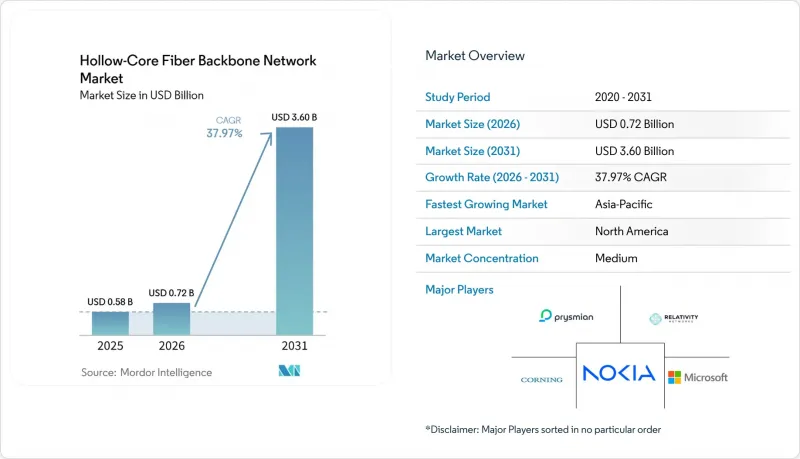
Mordor Intelligence에 의하면, 중공 코어 광섬유 백본 네트워크 시장 규모는 2025년 5억 8,000만 달러로 평가되었습니다. 2026년에는 7억 2,000만 달러로 확대되어 2031년까지 36억 달러에 이를 것으로 예상되고 2026년부터 2031년에 걸쳐 CAGR 37.97%로 성장할 전망입니다.
본 보고서는 광섬유 유형(반공진 중공 코어 광섬유, 포토닉 밴드갭 중공 코어 광섬유 등), 용도(통신 백본 네트워크, 데이터센터 간 상호 연결 등), 최종 사용자 산업(통신 사업자, 하이퍼스케일러 및 클라우드 제공업체 등), 그리고 지역별로 분류되어 있습니다. 시장 전망은 금액(달러)으로 표시되어 있습니다.
세계의 중공 코어 광섬유 백본 네트워크 시장 동향 및 인사이트
백본 및 데이터센터 간 링크에서의 초저지연에 대한 수요
초저지연은 중공 코어 광섬유 백본 네트워크 시장의 채택을 촉진하는 가장 명확한 단기적 요인으로 계속 남아 있습니다. 중공 코어 광섬유는 고체 유리가 아닌 공기를 통해 빛이 전파되므로, 표준 단일 모드 광섬유에 비해 전파 지연을 줄이고 타이밍 성능을 향상시킵니다. 2025년에 발표된 동료 심사 논문에 따르면, 현대 광네트워크와 관련된 전송 조건 하에서 기존 광섬유에 비해 28-33% 범위 내에서 지연이 감소하는 것으로 확인되었습니다. 또한, 마이크로소프트가 실제 운영 환경에서의 도입을 확대하여 이미 메트로 데이터센터 간 1,280km 이상에 걸쳐 고객 트래픽을 전송하고 있는 데 이어, 15,000km에 달하는 Azure 확장 계획을 밝힘에 따라 이 기술의 상용화를 향한 움직임은 더 이상 무시할 수 없게 되었습니다. 지연이 단순한 네트워크 배경 지표가 아니라 가격 책정의 대상이 되는 서비스 속성이 됨에 따라, 미세한 타이밍 개선만으로도 프리미엄 워크로드를 지원할 수 있는 백본 경로에서 중공 코어 광섬유 백본 시장은 탄력을 받고 있습니다.
AI 훈련 클러스터에는 결정론적 광섬유 지연이 필요합니다.
중공 코어 광섬유 백본 네트워크 시장은 분산형 AI 훈련이 대규모 가속기 클러스터 전체에서 극도로 안정적인 지연에 의존하고 있다는 점에서도 뒷받침되고 있습니다. 2025년에 발표된 학술 논문에 따르면, 중공 코어 전송은 실리카 광섬유에서 고출력·다파장 전송에 영향을 미치는 비선형적 제약 사항의 상당 부분을 회피할 수 있으며, 가혹한 작동 조건에서도 보다 예측 가능한 신호 거동을 실현할 수 있는 것으로 나타났습니다. 두 번째 획기적인 진전은 마이크로소프트가 기록적인 광대역폭에서 0.1 dB/km 미만의 감쇠를 입증한 것입니다. 이를 통해 광 증폭을 반복하지 않고도 더 긴 스팬을 구현할 가능성이 높아졌습니다. 이 성능이 중요하게 여겨지는 이유는 AI 네트워크 사업자들이 단순한 대역폭 확대가 아닌 동기화 효율 최적화에 주력하고 있기 때문입니다. 중공 코어 광섬유 백본 네트워크 시장에서 이러한 동향은 구매자들이 광섬유의 설계, 제조 접근성 및 도입 시기를 단순한 일상적인 배선 결정이 아닌, 보다 광범위한 AI 인프라 전략의 일부로 인식하도록 유도하고 있습니다.
중공 코어 광섬유의 제조 및 배선에 드는 높은 비용
높은 제조 비용은 중공 코어 광섬유 백본 네트워크 시장의 보급 확대에 있어 여전히 가장 두드러진 장벽으로 남아 있습니다. 최근의 과학적 검토에 따르면, 중공 코어 광섬유 제조에는 정밀한 형상 요구 사항, 결함에 대한 민감도, 수율 변동성과 같은 어려운 과제가 여전히 존재하며, 이 모든 요인이 복합적으로 작용하여 실용적인 생산량이 주류 광섬유 제조에서 경제성이 요구하는 수준에 미치지 못하고 있습니다. 이 리뷰에서는 저감쇠도에 관한 진전이 의미 있는 것이긴 하지만, 상용 인출 공정 전반에 걸친 일관성이 최상의 기록적인 성능만큼이나 중요하다고 지적하고 있습니다. 이러한 비용 부담으로 인해, 도입은 AI 상호 연결, 특정 백본 경로, 우선순위가 높은 연구 네트워크 등, 낮은 지연 시간이나 신호 품질이 직접적인 경제적 가치를 가져다주는 링크로 제한되고 있습니다. 제조 수율이 향상되고 대규모 생산이 더욱 일상화되기 전까지는 중공 코어 광섬유 백본 네트워크 시장은 표준 통신 사업자의 네트워크 구축에 고르게 확산되기보다는 프리미엄 용도에 집중된 상태가 지속될 가능성이 높습니다.
부문 분석
2025년, 반공진형 중공 코어 광섬유는 중공 코어 광섬유 백본 네트워크 시장 점유율의 48.61%를 차지했습니다. 이는 해당 제조 기술의 성숙도가 높고 시판 제품으로서의 접근성이 넓다는 점을 반영합니다. 구매자들이 성능 향상과 공급 신뢰성, 설치 확실성 간의 균형을 고려하고 있기 때문에 많은 초기 도입 사례에서 이것이 기본 선택지가 되고 있습니다. 이 설계의 위상은 마이크로소프트에 의해 입증되었으며, 보다 광범위한 공급망 전반에 걸친 상업적 진전으로 뒷받침된 0.1 dB/km 미만의 감쇠율이라는 이정표를 통해 더욱 공고해졌습니다. 중공 코어 광섬유 백본 네트워크 업계에서 이로 인해 검증된 성능과 안정적인 조달이 필요한 데이터센터 간 연결 및 통신 백본 프로그램에서 반공진형 광섬유가 실용적인 첫 번째 선택지가 되었습니다.
네스트형 반공진 중공 코어 광섬유는 모드 간 간섭에 대한 제어 능력이 뛰어나, 2031년까지 연평균 성장률(CAGR)이 42.31%에 달하며, 중공 코어 광섬유 백본 네트워크 시장에서 가장 빠른 성장을 이룰 것으로 예측됩니다. 이러한 특성은 신호의 순도가 극히 중요하며, 혼합 트래픽 환경의 확대가 예상되는 경로에서 가장 중요한 요소가 됩니다. 『npj Quantum Information』지에 게재된 연구에 따르면, 중첩형 반공진 중공 코어 광섬유는 200 Gbps의 고전적 DWDM 트래픽과 병행하여 3개의 동시 얽힘 기반 양자 채널을 지원할 수 있는 것으로 나타났습니다. 이는 이 설계가 첨단 네트워크 이용 사례에서 주목을 받고 있는 이유를 여실히 보여줍니다. 포토닉 밴드갭 중공 코어 광섬유는 여전히 틈새 시장 제품이었으나, 게이오기주쿠 대학이 2025년 학회에서 발표한 바에 따르면 지하 캠퍼스 환경에서 1년 동안 안정적인 성능이 확인되어, 제약이 많은 도입 환경에서의 그 역할이 입증되었습니다. 다른 설계들은 여전히 개발 초기 단계에 있으며, 전 세계적으로 통일된 기술 사양이 부재한 점이 중공 코어 광섬유 백본 네트워크 시장에서 통신 사업자들의 광범위한 조달을 계속해서 저해하고 있었습니다.
지역별 분석
2025년, 북미는 중공 코어 광섬유 백본 네트워크 시장의 35.50%를 차지하며 지역별 최대 점유율을 기록했습니다. 2026년에도 마이크로소프트의 Lumenisity 기반 플랫폼, 대규모 하이퍼스케일러의 캠퍼스 밀도, 코닝사의 노스캐롤라이나주 제조 거점이 모두 이 지역에 집중되어 있었기 때문에 이 지역은 계속해서 상업적 중심지로서의 지위를 유지했습니다. 또한, 마이크로소프트의 실제 트래픽 도입과 1만 5,000km에 달하는 확장 계획에서도 알 수 있듯이, 이 지역은 테스트 환경 단계에서 네트워크로 전환되고 있는 것으로 나타났습니다. 캐나다와 멕시코는 해당 지역 내에서 여전히 2차적인 위치를 차지하고 있으며, 독자적인 광섬유 플랫폼에서 주도적인 역할을 하기보다는 국경을 넘는 트래픽 지원에 있어 더 큰 역할을 수행하고 있습니다.
아시아태평양은 2031년까지 연평균 성장률(CAGR) 38.43%를 기록하며, 중공 코어 광섬유 백본 네트워크 시장 점유율에서 가장 빠른 성장세를 보일 것으로 예측됩니다. 이 지역의 성장 속도는 정부 주도의 연구, 국내 광섬유 생산 능력, 그리고 통신 인프라 업그레이드 프로그램이 결합되어 뒷받침되고 있습니다. YOFC는 0.1 dB/km 미만의 상용 규모 생산을 달성했다고 보고했으며, MWC 바르셀로나 2026에서 아시아, 유럽, 북미 및 남미 전역에 걸쳐 10건 이상의 중공 코어 광섬유 실제 운영 프로젝트를 소개했습니다. 이는 해당 지역의 강력한 실행 능력을 입증하는 것입니다. 2026년 5월, Lightera Japan, OKI 전기공업, 게이오기주쿠 대학이 중공 코어 광섬유를 이용한 세계 최초의 단일 광섬유 양방향 광대역 WDM 전송 실증 실험에 성공함으로써 일본도 추가적인 강점을 확보했습니다. 이를 통해 아시아태평양은 중공 코어 광섬유 백본 네트워크 시장의 주요 성장 동력으로서의 위상을 확립했으며, 중국과 일본이 상용화 및 연구 양면에서 주도적인 역할을 수행하고 있습니다.
유럽은 2025년 시장 점유율에서 1위를 차지하지는 못했으나, 주요 생산 및 연구 자산을 보유하고 있었기 때문에 중공 코어 광섬유 백본 네트워크 시장에서 전략적으로 중요한 위치를 계속 차지했습니다. 프리즈미안(Prismian)이 아인트호벤에서 렐라티비티 네트웍스(Relativity Networks)와 체결한 합의 및 그에 따른 투자로 인해, 이 지역은 하이퍼스케일러의 독점 구조 외부에서 오픈 마켓 공급 체계를 구축하는 데 중요한 역할을 맡게 되었습니다. 남미에서는 도입이 앞서 진행되고 있었으나, 2025년에 Lightera, Scala Data Centers, 노키아가 브라질에서 최초의 중공 코어 광섬유 실증 실험을 완료함으로써, 도입 사례가 새로운 하이퍼스케일 지역으로 확대되고 있음을 보여주었습니다. 중동 시장에서는 정부 주도의 AI 및 첨단 인프라 프로그램을 통해 이 기술의 도입이 시작되었으나, 공식적인 정보 공개는 여전히 제한적이었습니다. 아프리카는 하이퍼스케일러의 밀도와 비용 수용도가 여전히 낮아 뒤처져 있었으나, 주요 지상 백홀 회선 주변에서의 틈새 활용이 예측 기간 후반에 나타날 가능성이 있습니다.
기타 혜택 :
- 엑셀 형식 시장 예측(ME) 시트
- 3개월간의 애널리스트 지원
자주 묻는 질문
목차
제1장 서론
제2장 조사 방법
제3장 주요 요약
제4장 시장 구도
제5장 시장 규모 및 성장 예측
제6장 경쟁 구도
제7장 시장 기회 및 향후 전망
KTH 26.08.10According to Mordor Intelligence, the hollow-Core fiber backbone network market size is expected to increase from USD 0.58 billion in 2025 to USD 0.72 billion in 2026 and reach USD 3.60 billion by 2031, growing at a CAGR of 37.97% over 2026-2031.
This report is Segmented by Fiber Type (Anti-Resonant Hollow-Core Fiber, Photonic Bandgap Hollow-Core Fiber, and More), Application (Telecom Backbone Networks, Data Center Interconnect, and More), End User Industry (Telecom Operators, Hyperscalers and Cloud Providers, and More), and Geography. The Market Forecasts are Provided in Value (USD).
Global Hollow-Core Fiber Backbone Network Market Trends and Insights
Ultra-Low Latency Demand in Backbone and Inter-Data-Center Links
Ultra-low latency remains the clearest near-term trigger for adoption in the hollow-core fiber backbone network market. Hollow-core fiber guides light through air rather than solid glass, reducing propagation delay and improving timing performance compared to standard single-mode fiber. Peer-reviewed work published in 2025 confirmed delay reductions in the 28-33% range relative to conventional fiber under transmission conditions relevant to modern optical networks. Commercial intent also became harder to ignore after Microsoft scaled live deployments and outlined a 15,000-km Azure expansion, following more than 1,280 km already carrying customer traffic between metro data center pairs. As latency becomes a priced service attribute rather than a background network metric, the hollow-core fiber backbone market is gaining traction on backbone routes, where even small timing gains can support premium workloads.
AI Training Clusters Need Deterministic Fiber Delay
The hollow-core fiber backbone network market is also being pulled forward by the way distributed AI training depends on highly stable delay across large accelerator clusters. Journal work published in 2025 showed that hollow-core transmission avoids many of the nonlinear limits that affect high-power, multi-wavelength transport in silica fiber, which supports more predictable signal behavior under demanding operating conditions. A second milestone came when Microsoft documented attenuation below 0.1 dB/km across record-wide bandwidth, which improves the case for longer spans without repeated optical amplification. That performance matters because AI network operators are now optimizing for synchronization efficiency rather than just raw bandwidth growth. In the hollow-core fiber backbone network market, this is pushing buyers to treat fiber design, manufacturing access, and deployment timing as part of a broader AI infrastructure strategy rather than as a routine cabling decision.
High Cost of Hollow-Core Fiber Manufacturing and Cabling
High manufacturing cost remains the most visible barrier to broader adoption in the hollow-core fiber backbone network market. Recent scientific reviews showed that hollow-core production still faces a difficult mix of precision-geometry requirements, defect sensitivity, and yield variability, all of which keep usable output below what mainstream fiber-manufacturing economics would require. The same review noted that progress on low attenuation has been meaningful, but consistency across commercial draw runs still matters as much as best-case record performance. This cost burden limits adoption to links where low latency or signal quality carries direct economic value, such as AI interconnects, select backbone routes, and high-priority research networks. Until manufacturing yields improve and scale becomes more routine, the hollow-core fiber backbone network market is likely to remain concentrated in premium applications rather than spread evenly across standard carrier builds.
Other drivers and restraints analyzed in the detailed report include:
- 5G and 6G Transport Upgrade Cycles
- Carrier and Hyperscaler Move to Vertical Integration
- Limited Splicing, Connectorization, and Field-Service Ecosystem
For complete list of drivers and restraints, kindly check the Table Of Contents.
Segment Analysis
Anti-resonant hollow-core fiber held 48.61% of the hollow-core fiber backbone network market share in 2025, reflecting its greater manufacturing maturity and wider commercial availability. It has become the default option for many early deployments because buyers are balancing performance gains with supply reliability and installation confidence. The design's position was reinforced by sub-0.1 dB/km attenuation milestones that were documented by Microsoft and echoed by commercial progress across the broader supply chain. In the hollow-core fiber backbone network industry, this has made anti-resonant fiber the practical first choice for data center interconnect and telecom backbone programs that need proven performance and stable sourcing.
The nested anti-resonant hollow-core fiber is projected to post the fastest growth in the hollow-core fiber backbone network market, with a 42.31% CAGR through 2031, supported by its stronger control of intermodal interference. That feature matters most in routes where signal purity is critical and mixed-traffic environments are expected to grow. Research published in npj Quantum Information showed that a nested anti-resonant hollow-core fiber supported three simultaneous entanglement-based quantum channels alongside 200 Gbps classical DWDM traffic, highlighting why this design is attracting attention in advanced network use cases. The photonic bandgap hollow-core fiber remained a niche, but 2025 conference work from Keio University confirmed stable underground campus performance over a full year, supporting its role in constrained deployments. Other designs were still in early development, and the lack of globally harmonized technical specifications continued to slow broader carrier procurement in the hollow-core fiber backbone network market.
Complete Report Scope:
- By Fiber Type
- Anti-Resonant Hollow-Core Fiber
- Photonic Bandgap Hollow-Core Fiber
- Nested Anti-Resonant Hollow-Core Fiber
- Other Hollow-Core Fiber Types
- By Application
- Telecom Backbone Networks
- Data Center Interconnect
- 5G and 6G Transport Networks
- Quantum Networks
- Other Applications
- By End User Industry
- Telecom Operators
- Hyperscalers and Cloud Providers
- Research and Defense Organizations
- Enterprises and Financial Institutions
- Other End User Industries
- By Geography
- North America
- United States
- Canada
- Mexico
- South America
- Brazil
- Argentina
- Rest of South America
- Europe
- Germany
- United Kingdom
- France
- Rest of Europe
- Asia-Pacific
- China
- Japan
- India
- South Korea
- Rest of Asia-Pacific
- Middle East
- Saudi Arabia
- United Arab Emirates
- Rest of the Middle East
- Africa
- South Africa
- Nigeria
- Rest of Africa
- North America
Geography Analysis
North America held 35.50% of the hollow-core fiber backbone network market in 2025, making it the leading regional contributor. The region remained the commercial center in 2026 because Microsoft's Lumenisity-based platform, large hyperscaler campus density, and Corning's North Carolina manufacturing support were all concentrated there. Microsoft's live traffic deployment and its 15,000-km expansion plan also showed that the region was moving beyond test environments into production networks. Canada and Mexico remained secondary within the region, with a larger role in cross-border traffic support than in independent fiber platform leadership.
Asia-Pacific is projected to record the fastest growth in hollow-core fiber backbone network market share, at a 38.43% CAGR through 2031. The region's pace is being supported by a combination of state-backed research, domestic fiber manufacturing capability, and telecom upgrade programs. YOFC reported commercial-scale production below 0.1 dB/km and described more than 10 live hollow-core fiber projects across Asia, Europe, and the Americas at MWC Barcelona 2026, which underlined the region's strong execution capacity. Japan added another layer of strength when Lightera Japan, OKI Electric Industry, and Keio University completed the first single-fiber bidirectional wideband WDM transmission demonstration on hollow-core fiber in May 2026. This left Asia-Pacific positioned as the main growth engine of the hollow-core fiber backbone network market, with China and Japan setting the tone for both commercial and research progress.
Europe remained strategically important in the hollow-core fiber backbone network market because it hosted major production and research assets, even though it did not lead in the 2025 share. Prysmian's Eindhoven agreement with Relativity Networks, followed by its equity investment, gave the region a critical role in building open-market supply outside captive hyperscaler structures. South America was earlier in adoption, but Lightera, Scala Data Centers, and Nokia completed the first hollow-core fiber proof of concept in Brazil in 2025, demonstrating that the deployment case is extending into new hyperscale regions. Middle East markets were beginning to absorb the technology through sovereign AI and advanced infrastructure programs, although public disclosure remained limited. Africa still lagged because hyperscaler density and cost tolerance remained lower, but niche use around key terrestrial backhaul routes could emerge later in the forecast period.
- Microsoft Corporation
- Corning Incorporated
- Prysmian S.p.A.
- Nokia Corporation
- Relativity Networks, Inc.
- Lightera LLC
- Furukawa Electric Co., Ltd.
- Fujikura Ltd.
- Sumitomo Electric Industries, Ltd.
- Yangtze Optical Fibre and Cable Joint Stock Limited Company
- Jiangsu Hengtong Optic-Electric Co., Ltd.
- Sterlite Technologies Limited
- OFS Fitel, LLC
- Coherent Corp.
- BT Group plc
- AFL Telecommunications LLC
- Heraeus Covantics
- Amazon Web Services, Inc.
- Google LLC
- Meta Platforms, Inc.
Additional Benefits:
- The market estimate (ME) sheet in Excel format
- 3 months of analyst support
TABLE OF CONTENTS
1 INTRODUCTION
- 1.1 Study Assumptions and Market Definition
- 1.2 Scope of the Study
2 RESEARCH METHODOLOGY
3 EXECUTIVE SUMMARY
4 MARKET LANDSCAPE
- 4.1 Market Overview
- 4.2 Market Drivers
- 4.2.1 Ultra-Low Latency Demand in Backbone and Inter-Data-Center Links
- 4.2.2 AI Training Clusters Need Deterministic Fiber Delay
- 4.2.3 5G and 6G Transport Upgrade Cycles
- 4.2.4 Carrier and Hyperscaler Move to Vertical Integration
- 4.2.5 Quantum Networking Readiness for Metro and Backbone Trials
- 4.2.6 Rising Demand for Deterministic Network Performance in Industrial Automation and Edge Computing
- 4.3 Market Restraints
- 4.3.1 High Cost of Hollow-Core Fiber Manufacturing and Cabling
- 4.3.2 Limited Splicing, Connectorization, and Field-Service Ecosystem
- 4.3.3 Low Installed Base, Slower Standards Convergence, and Procurement Caution
- 4.3.4 Lack of Standardized Interoperability Between Hollow-Core Fiber, Optical Transceivers, and Existing Backbone Equipment Slows Multi-Vendor Adoption
- 4.4 Industry Value-Chain Analysis
- 4.5 Regulatory Landscape
- 4.6 Technological Outlook
- 4.7 Porter's Five Forces Analysis
- 4.7.1 Threat of New Entrants
- 4.7.2 Bargaining Power of Suppliers
- 4.7.3 Bargaining Power of Buyers
- 4.7.4 Threat of Substitutes
- 4.7.5 Competitive Rivalry
- 4.8 Impact of Macroeconomic Factors on the Market
5 MARKET SIZE AND GROWTH FORECASTS (VALUE)
- 5.1 By Fiber Type
- 5.1.1 Anti-Resonant Hollow-Core Fiber
- 5.1.2 Photonic Bandgap Hollow-Core Fiber
- 5.1.3 Nested Anti-Resonant Hollow-Core Fiber
- 5.1.4 Other Hollow-Core Fiber Types
- 5.2 By Application
- 5.2.1 Telecom Backbone Networks
- 5.2.2 Data Center Interconnect
- 5.2.3 5G and 6G Transport Networks
- 5.2.4 Quantum Networks
- 5.2.5 Other Applications
- 5.3 By End User Industry
- 5.3.1 Telecom Operators
- 5.3.2 Hyperscalers and Cloud Providers
- 5.3.3 Research and Defense Organizations
- 5.3.4 Enterprises and Financial Institutions
- 5.3.5 Other End User Industries
- 5.4 By Geography
- 5.4.1 North America
- 5.4.1.1 United States
- 5.4.1.2 Canada
- 5.4.1.3 Mexico
- 5.4.2 South America
- 5.4.2.1 Brazil
- 5.4.2.2 Argentina
- 5.4.2.3 Rest of South America
- 5.4.3 Europe
- 5.4.3.1 Germany
- 5.4.3.2 United Kingdom
- 5.4.3.3 France
- 5.4.3.4 Rest of Europe
- 5.4.4 Asia-Pacific
- 5.4.4.1 China
- 5.4.4.2 Japan
- 5.4.4.3 India
- 5.4.4.4 South Korea
- 5.4.4.5 Rest of Asia-Pacific
- 5.4.5 Middle East
- 5.4.5.1 Saudi Arabia
- 5.4.5.2 United Arab Emirates
- 5.4.5.3 Rest of the Middle East
- 5.4.6 Africa
- 5.4.6.1 South Africa
- 5.4.6.2 Nigeria
- 5.4.6.3 Rest of Africa
- 5.4.1 North America
6 COMPETITIVE LANDSCAPE
- 6.1 Market Concentration
- 6.2 Strategic Moves
- 6.3 Market Share Analysis
- 6.4 Company Profiles (includes Global Level Overview, Market Level Overview, Core Segments, Financials as available, Strategic Information, Market Rank/Share, Products and Services, Recent Developments)
- 6.4.1 Microsoft Corporation
- 6.4.2 Corning Incorporated
- 6.4.3 Prysmian S.p.A.
- 6.4.4 Nokia Corporation
- 6.4.5 Relativity Networks, Inc.
- 6.4.6 Lightera LLC
- 6.4.7 Furukawa Electric Co., Ltd.
- 6.4.8 Fujikura Ltd.
- 6.4.9 Sumitomo Electric Industries, Ltd.
- 6.4.10 Yangtze Optical Fibre and Cable Joint Stock Limited Company
- 6.4.11 Jiangsu Hengtong Optic-Electric Co., Ltd.
- 6.4.12 Sterlite Technologies Limited
- 6.4.13 OFS Fitel, LLC
- 6.4.14 Coherent Corp.
- 6.4.15 BT Group plc
- 6.4.16 AFL Telecommunications LLC
- 6.4.17 Heraeus Covantics
- 6.4.18 Amazon Web Services, Inc.
- 6.4.19 Google LLC
- 6.4.20 Meta Platforms, Inc.
7 MARKET OPPORTUNITIES AND FUTURE OUTLOOK
- 7.1 White-Space and Unmet-Need Assessment