|
시장보고서
상품코드
2099838
방위 및 전장 통신 네트워크용 광섬유 시장 : 시장 점유율 분석, 업계 동향 및 통계, 성장 예측(2026-2031년)Fiber Optic For Defense and Battlefield Communication Networks - Market Share Analysis, Industry Trends & Statistics, Growth Forecasts (2026 - 2031) |
||||||
 Mordor Intelligence
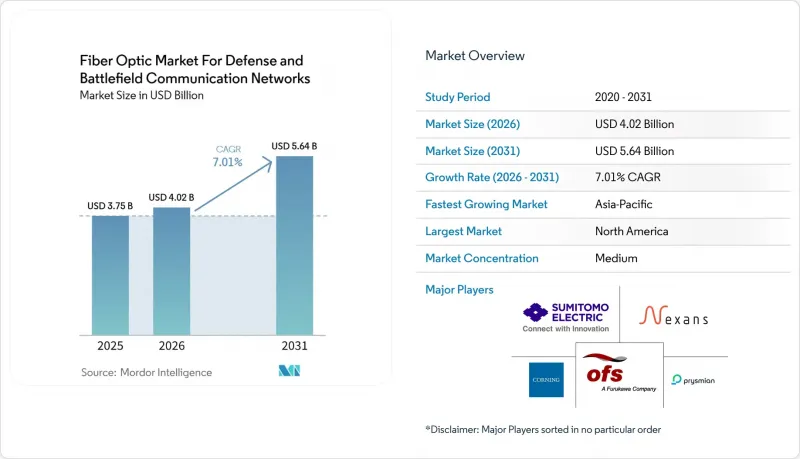
Mordor Intelligence에 의하면, 방위 및 전장 통신 네트워크용 광섬유 시장은 2025년 37억 5,000만 달러로 평가되었고, 2026년에는 40억 2,000만 달러로 확대될 것으로 추정되고, 2031년까지 56억 4,000만 달러에 이를 것으로 예상되며, 2026-2031년 CAGR 7.01%로 성장할 전망입니다.
본 보고서는 광섬유 유형별(단일 모드 광섬유 등), 제품 아키텍처별(장갑 광섬유 케이블 등), 용도별(전장 통신 네트워크 등), 플랫폼별(지상 플랫폼 등), 최종 사용자별(군 등), 지역(북미 등)별로 분류되어 있습니다. 시장 전망은 금액(달러) 기준으로 제시되어 있습니다.
방위 및 전장 통신 네트워크용 광섬유 시장 인사이트 및 동향
방위 네트워크에서 안전하고 지연 시간이 짧은 통신에 대한 수요 증가
지휘 시스템은 현재 분쟁 지역에서 더 빠르고 깨끗한 데이터 전송에 의존하고 있기 때문에 보안이 보장된 광전송이 핵심 요건으로 자리 잡고 있습니다. 암호화된 전송, 저지연, 물리 계층 모니터링이 더 이상 선택적 업그레이드가 아닌 임무 요건으로 간주됨에 따라, 방위 및 전장 통신 네트워크용 광섬유 시장은 이러한 변화의 혜택을 받고 있습니다. 최신 광섬유 시스템은 고밀도 파장 분할 다중화(DWDM) 기술을 통해 단일 광섬유 상에서 여러 개의 암호화된 데이터 스트림을 전송할 수 있으며, 분산형 감지 기능은 회선상의 물리적 간섭을 감지하는 데에도 도움이 됩니다. 출처 자료에 기재된 인도-태평양 지역의 전송망 구축 현황을 보아도, 단순한 정기적인 네트워크 갱신 주기뿐만 아니라 전략적인 지역적 요인이 백본 조달을 주도하고 있음을 알 수 있습니다. 이는 중요한 점입니다. 센서에서 사수까지의 루프에서는 표준 기업 트래픽보다 더 엄격한 지연 성능이 요구되기 때문에 군사 프로그램에는 상용 사양으로는 완전히 대응할 수 없는 견고한 물리 계층이 필요하기 때문입니다. 이러한 격차로 인해 방위 및 전장 통신 네트워크용 광섬유 시장은 진입 장벽이 높고 인증 주기가 긴 독자적인 조달 채널에 얽매여 있는 상태입니다.
C4ISR 백본 인프라의 현대화
C4ISR의 현대화는 강력한 수요의 원동력이 되고 있습니다. 이는 기존의 전술 아키텍처가 현재의 군사 데이터 교환량과 속도에 대응할 수 있도록 설계되지 않았기 때문입니다. 미국 육군의 2027 회계연도 ‘차세대 지휘통제(Next Generation Command and Control)’ 및 ‘C2NOW’ 프로그램에 대한 요구 사항은 구리선이나 위성 백홀에 대한 의존도가 높았던 기존의 WIN-T 구조에서 명확히 탈피하고 있음을 보여줍니다. 자료에 따르면, 이 프로그램이 중요한 이유는 광배선이 사후 조치로 추가되는 것이 아니라, 처음부터 전송 계층에 통합되어 설계되었습니다는 점에 있습니다. 방위 및 전장 통신 네트워크용 광섬유 시장은 더욱 광범위한 규정 준수 요건에 의해서도 뒷받침되고 있습니다. 이는 사이버 보안 및 공급 보장 기준에 따라 물리적 전송 경로에 대한 감시가 더욱 엄격해지고 있기 때문입니다. 이에 따라 인증된 어셈블리, 커넥터, 케이블 시스템의 적용 범위가 기존의 '프로그램 오브 레코드(Program of Record)' 목록을 넘어 확대되고 있습니다. 또한, 인증의 깊이와 여러 프로그램 연도에 걸친 장기적인 생산 일관성을 모두 갖춘 공급업체가 유리합니다.
높은 견고성, 인증 및 수명 주기 비용
방위용 광섬유 어셈블리는 상용 케이블 시스템보다 더 엄격한 환경 및 성능 기준을 충족해야 하므로, 인증 및 수명 주기 비용은 여전히 큰 제약 요인으로 작용하고 있습니다. 자료에 따르면, MIL-STD-810H 인증에는 12-24개월이 소요되며, 케이블 구성 하나당 수백만 달러의 비용이 들 수 있어, 이로 인해 승인된 방위 채널에 진입하거나 활동을 지속할 수 있는 공급업체의 수가 제한되고 있습니다. 이러한 비용 부담은 초기 승인 후에도 지속되는데, 이는 자재나 제조 공정의 변경으로 인해 새로운 검증 절차가 요구될 가능성이 있기 때문입니다. 그 결과, 더 광범위한 경쟁을 통해 비용 절감이나 리드타임 단축이 가능하더라도 구매자는 대개 이미 인증을 받은 공급업체를 고수하게 됩니다. 따라서 방위 및 전장 통신 네트워크용 광섬유 시장은 기술적 승인에 시간이 걸리고, 장기 운영 플랫폼을 위한 가격이 여전히 높은 수준을 유지하는 공급 구조 속에서 성장하고 있습니다. 또한, 인증의 깊이가 제조 규모와 동등한 중요성을 차지하기 때문에 시장이 완전히 개방되지 않고 중간 정도의 통합 상태에 머무르는 이유도 여기에 있습니다.
부문 분석
2025년 시점에서 단일 모드 광섬유 솔루션은 65.43%의 점유율을 차지하며 방위 및 전장 통신 네트워크용 광섬유 시장에서 가장 큰 입지를 확립했습니다. 이러한 우위는 기지 간 백본 회선, 함정 트렁크 회선, 지휘 노드 간 상호 연결과 같은 장거리 요구 사항을 반영한 것이며, 이러한 분야에서는 거리에 따른 감쇠가 여전히 핵심적인 성능 요인으로 작용하고 있습니다. 기존 인프라 역시 중요한 요소입니다. NATO 표준을 따르는 군용 광통신 규격은 역사적으로 단일 모드 사양에 치우쳐 왔기 때문에 교체나 업그레이드 수요는 기존의 기술적 선택에 얽매이게 됩니다. 이러한 기존 인프라의 영향으로 인해 단일 모드에 대한 수요는 단순한 비용 비교를 통해 예상되는 것보다 더 견조한 추세를 보이고 있습니다. 또한 구매자가 코어 네트워크의 전송 계층을 갱신할 때 호환성, 인증 실적, 장기적인 신뢰성을 계속해서 우선시하는 이유도 이러한 관점에서 설명할 수 있습니다.
멀티모드 솔루션은 2026-2031년 연평균 성장률(CAGR) 7.34%를 나타낼 것으로 예측되며, 광섬유 유형 중 가장 빠르게 성장하는 하위 부문이 될 것입니다. 이 솔루션이 가장 큰 역할을 하는 분야는 거리 제약을 관리할 수 있고 대역폭 수요가 높은 장갑차, 해군 전투 시스템, 레이더 환경에서의 단거리 플랫폼 내 배선입니다. 2025년 IEEE에서 발표된 조사에서는 무인 항공기 시스템의 방해 대책으로서 내성을 높이는 하이브리드 광섬유·RF 통신 프로토콜이 설명되어 있으며, 중복된 RF 링크가 광범위한 상황 인식을 유지하는 한편, 광섬유가 중요한 지휘 경로를 이어받는 구조가 제시되어 있습니다. 이러한 아키텍처 덕분에 멀티모드 광섬유의 적용 범위는 고정 플랫폼에 그치지 않고, 기존에는 무선 주파수나 구리선 하네스에 크게 의존하던 항공기 및 로봇 시스템으로 확대되고 있습니다. 군사 규격이 더 많은 단거리 광통신 이용 사례에 대응하도록 진화함에 따라, 멀티모드 광섬유의 채택은 단순한 상업적 선호에 의존하는 것이 아니라 조직적인 지지를 얻고 있습니다. 이러한 조합을 통해 방위 및 전장 통신 네트워크용 광섬유 시장은 단일 모드를 기반으로 하면서도, 빠르게 성장하는 플랫폼 내 이용 사례에 새로운 가능성을 열어가고 있습니다.
2025년에는 장갑 광섬유 케이블이 54.67%의 점유율을 차지했으며, 방위 분야의 기존 설비 전반에서 여전히 지배적인 제품 아키텍처로 자리 잡았습니다. 이러한 지위는 국방 수송을 특징짓는 가혹한 환경과 밀접한 관련이 있습니다. 여기에는 트랙 차량, 함정용 케이블 트레이, 지하의 견고한 시설, 그리고 압착, 열, 마모, 파편 위험이 모두 현실적인 설계상의 우려 사항이 되는 노출된 전술 경로 등이 포함됩니다. 따라서 제품 차원에서 장갑 제품은 방위 및 전장 통신 네트워크용 광섬유 시장에서 중요한 부분을 차지하고 있습니다. 이는 생존성 요건이 단가와 인증 요건을 모두 높이기 때문입니다. 또한, 군사 인증을 받은 국내 인증 공급업체가 상용 케이블 시장에 비해 적다는 사실도 장갑 제품의 가격 프리미엄을 뒷받침하고 있습니다. 가혹한 사용 조건과 인증 공급업체공급 제약이 맞물리면서, 장갑 케이블은 현재 배치와 향후 교체 주기 모두에서 계속해서 중심적인 위치를 차지하고 있습니다.
전술용 필드 파이버 어셈블리는 2031년까지 연평균 성장률(CAGR) 7.12%를 나타낼 것으로 예측되며, 제품 아키텍처 하위 부문 중 가장 빠르게 성장하는 분야가 될 것입니다. 이러한 성장 추세는 장갑 케이블 수요와는 다릅니다. 이는 전장의 최전선에서 사용되기 때문에 장거리 전송 시의 감쇠보다는 신속한 커넥터 연결, 경량화, 그리고 현장에서의 교체 용이성이 더 중요하게 여겨지기 때문입니다. 또한, 해당 자료에서는 커넥터, 스플라이스 및 종단 처리가 제3의 제품군을 형성하고 있으며, 고밀도 패칭 및 고정식 대용량 환경에서 군용 커넥터 규격에 기반한 사양이 점점 더 늘어나고 있다고 지적하고 있습니다. 이는 설치 위험을 현장에서 관리되는 생산 환경으로 이전하는 사전 종단 처리되고 공장에서 인증된 어셈블리 솔루션으로의 광범위한 전환을 시사합니다. 이러한 동향은 기술자에 대한 의존도를 낮추고, 배포 시간을 단축하며, 분산된 프로그램 전반에 걸쳐 예측 가능한 설치 결과를 원하는 조달 부서의 요구와도 부합하기 때문에 중요한 의미를 지닙니다. 그 결과, 방위 및 전장 통신 네트워크용 광섬유 시장은 견고성과 전술적 최전선에서의 간편한 배포가 균형을 이룬 어셈블리 형태로 점차 전환되고 있습니다.
지역별 분석
2025년, 북미는 36.78%의 점유율을 차지하며 방위 및 전장 통신 네트워크용 광섬유 시장에서 가장 규모가 큰 지역 시장이 되었습니다. 이 지역의 우위는 미국의 방위 현대화 규모와 인증을 받은 국내 공급 기반의 충실도에 기인합니다. 구형 전술 네트워크 구조의 교체, 해저 통신 프로그램의 확대, 그리고 지휘통제 시스템 전반에 걸친 광전송 계층의 구축이 여러 군종을 아우르는 활발한 조달 활동을 뒷받침하고 있습니다. 또한, 기밀 처리나 높은 신뢰성이 요구되는 프로그램의 경우, 승인된 미국 내 제조가 우선시되거나 필수로 요구되는 경우가 많기 때문에 국내 조달 요건 또한 이러한 위상을 강화하고 있습니다. 출처 자료에 기재된 인도-태평양 지역의 전송망 구축은 단순한 플랫폼 수준의 통합에 그치지 않고, 전략적 도달 범위를 갖춘 인프라를 지칭함으로써 수요에 또 다른 차원을 더하고 있습니다.
유럽은 2위를 차지하고 있으며, 독일, 영국, 프랑스가 NATO의 공약에 따라 수년에 걸친 국방 현대화를 지속하고 있는 것이 그 배경입니다. 이 지역 수요는 단순한 기본 케이블 교체에 그치지 않고, 안전한 전개형 통신, 상호 운용성 프로그램, 그리고 지휘통제 시스템을 위한 인증된 광 백플레인에 의해 형성되고 있습니다. 분쟁을 계기로 전장용 광섬유 드론·테더 용도가 부상함에 따라, 내환경성이 뛰어난 광학 부품 및 어셈블리에 대한 이 지역 특유 수요가 창출되고 있습니다. 이 추세가 중요한 이유는 이미 배치 가능한 지휘통제 시스템과 안전한 정보 시스템에 중점을 두고 있는 이 지역에 새로운 무인 이용 사례가 추가되기 때문입니다. NATO의 소규모 회원국이 차지하는 조달 점유율은 제한적이지만, 동맹이 자금을 지원하는 상호운용성 수요로 인해 여전히 이 지역 수요 기반은 확대되고 있습니다.
아시아태평양은 2026-2031년 연평균 성장률(CAGR) 8.01%로 확대될 것으로 예측되며, 가장 빠르게 성장하는 지역이 될 전망입니다. 이러한 성장은 중국의 해군 현대화, 인도의 방위 제조 산업 확대, 일본의 방위 예산 증액, 그리고 한국의 첨단 플랫폼 계획과 밀접하게 관련되어 있습니다. 이러한 지역적 특성으로 인해 아시아태평양은 북미를 제외한 방위 및 전장 통신 네트워크용 광섬유 시장에서 가장 뚜렷한 성장 동력을 담당하고 있습니다. 이는 조달량과 현지 공급망 구축에 대한 의지 양면에서 수요가 증가하고 있기 때문입니다. 중동 및 아프리카 및 남미는 절대적인 규모 면에서는 여전히 작지만, 각국이 해군용 통신 현대화 및 자국 내 방위 제조 능력 구축을 추진하고 있어 전략적인 동향이 관찰됩니다. 또한, 호주는 경제 규모에서 예상되는 수준을 상회하는 인증된 국방용 광섬유 프로그램에 참여하고 있어, 하위 지역으로서 수요 거점으로 두각을 나타내고 있습니다.
기타 혜택 :
- 엑셀 형식 시장 예측(ME) 시트
- 3개월간의 애널리스트 지원
자주 묻는 질문
목차
제1장 서론
제2장 조사 방법
제3장 주요 요약
제4장 시장 구도
제5장 시장 규모 및 성장 예측
제6장 경쟁 구도
제7장 시장 기회 및 향후 전망
AJYAccording to Mordor Intelligence, the fiber optic market for defense and battlefield communication networks is expected to increase from USD 3.75 billion in 2025 to USD 4.02 billion in 2026 and reach USD 5.64 billion by 2031, growing at a CAGR of 7.01% over 2026-2031.
This report is Segmented by Fiber Type (Single-Mode Fiber and More), Product Architecture (Armored Fiber Optic Cables, and More), Application (Battlefield Communication Networks, and More), Platform (Land Platforms, and More), End User (Armed Forces, and More), and Geography (North America, and More). The Market Forecasts are Provided in Terms of Value (USD).
Insights and Trends of Fiber Optic Market For Defense and Battlefield Communication Networks
Rising Demand for Secure, Low-Latency Communication in Defense Networks
Secure optical transport is becoming a core requirement because command systems now depend on faster and cleaner data movement across contested operating areas. The fiber optic market for defense and battlefield communication networks benefits from this shift because encrypted transport, low latency, and physical layer monitoring are now treated as mission requirements rather than optional upgrades. Modern fiber systems can carry multiple encrypted data streams on a single strand through dense wavelength division multiplexing, and distributed sensing features can also help detect physical interference on the line. The Indo-Pacific transport buildout described in the source material also shows that strategic geography is driving backbone procurement, not just routine network refresh cycles. This matters because sensor-to-shooter loops demand stricter latency performance than standard enterprise traffic, so military programs need hardened physical layers that commercial specifications do not fully address. That gap keeps the fiber optic market for defense and battlefield communication networks tied to a distinct procurement channel with higher entry barriers and longer qualification cycles.
Modernization of C4ISR Backbone Infrastructure
C4ISR modernization is a strong demand driver because legacy tactical architectures were not built for the volume and speed of current military data exchange. The U.S. Army's FY2027 request for Next Generation Command and Control and the C2NOW program marks a clear move away from legacy WIN-T structures that relied more heavily on copper and satellite backhaul. In the source material, this program is important because optical distribution is being designed into the transport layer from the beginning rather than added later as a workaround. The fiber optic market for defense and battlefield communication networks is also supported by broader compliance requirements, as physical transmission pathways now face tighter scrutiny under cybersecurity and supply assurance standards. That expands the addressable space for certified assemblies, connectors, and cable systems beyond older program-of-record lists. It also favors suppliers that can combine qualification depth with long production consistency over multiple program years.
High Ruggedization, Qualification, and Lifecycle Costs
Qualification and lifecycle costs remain significant constraints because defense-grade fiber assemblies must meet stricter environmental and performance standards than commercial cable systems. The source material notes that MIL-STD-810H qualification can take 12 to 24 months and can cost several million dollars per cable configuration, which limits how many suppliers can enter or stay active in approved defense channels. That cost burden persists after initial approval because changes to materials or manufacturing methods can trigger another validation round. The practical effect is that buyers often stick with already-qualified vendors, even when wider competition could lower costs or shorten lead times. The fiber optic market for defense and battlefield communication networks, therefore, grows within a supply structure where technical approval is slow and where pricing remains elevated for long-service platforms. This also explains why the market remains only moderately consolidated rather than fully open, since qualification depth carries as much weight as manufacturing scale.
Other drivers and restraints analyzed in the detailed report include:
- Electromagnetic Interference Immunity in Contested Environments
- Higher Data Throughput for Sensor-Heavy Defense Platforms
- Field Repair Complexity and Skilled Technician Dependency
For complete list of drivers and restraints, kindly check the Table Of Contents.
Segment Analysis
Single-mode fiber optic solutions held 65.43% share in 2025, giving them the largest position in this part of the fiber optic market for defense and battlefield communication networks. That lead reflects the long-haul requirements of base-to-base backbone links, shipboard trunk routes, and command node interconnects where attenuation over distance remains a core performance factor. The installed base also matters because NATO-aligned military optical standards have historically leaned toward single-mode specifications, which keeps replacement and upgrade demand tied to existing technical choices. This installed base effect makes single-mode demand more durable than a simple cost comparison would suggest. It also helps explain why buyers continue to prioritize compatibility, qualification history, and long-term reliability when they update core network transport layers.
Multi-mode solutions are projected to grow at a 7.34% CAGR from 2026 to 2031, making them the fastest-growing sub-segment within fiber type. Their role is strongest in short-reach intra-platform wiring for armored vehicles, naval combat systems, and radar environments where distance limits are manageable, and bandwidth needs remain high. Research published in IEEE in 2025 described hybrid fiber-RF communication protocols for anti-jamming resilience in unmanned aerial vehicle systems, showing how fiber can take over critical command paths while redundant RF links preserve broader awareness. That architecture expands the case for multi-mode fiber beyond fixed platforms and into airborne and robotic systems that previously relied more heavily on radio-frequency or copper harnesses. As military standards evolve to accommodate more short-reach optical use cases, multi-mode adoption is gaining institutional support rather than depending only on commercial preference. This mix means the fiber optic market for defense and battlefield communication networks keeps its single-mode base while opening new room for faster-growing intra-platform use cases.
Armored fiber optic cables accounted for 54.67% share in 2025, so they remain the dominant product architecture across the installed defense base. Their position is tied to the harsh environments that define defense transport, including tracked vehicles, shipboard cable trays, underground hardened sites, and exposed tactical routes where crush, heat, abrasion, and fragment risk are all real design concerns. This makes armored products a significant part of the fiber optic market for defense and battlefield communication networks at the product level, because survivability requirements raise both unit value and qualification requirements. Their pricing premium is also reinforced by the fact that qualified domestic suppliers with military certification are fewer in number than in commercial cable markets. That combination of rugged use conditions and constrained qualified supply keeps armored cables central to both current deployments and future replacement cycles.
Tactical field fiber assemblies are expected to grow at a 7.12% CAGR through 2031, making them the fastest-growing product architecture sub-segment. Their growth profile is different from armored cable demand because they serve the battlefield edge, where rapid connectorization, lower weight, and easier field replacement matter more than long-haul attenuation. The source material also notes that connectors, splices, and terminations form a third product group that is increasingly specified under military connector standards for dense patching and fixed high-capacity environments. This signals a wider move toward pre-terminated and factory-qualified assembly solutions that shift installation risk away from the field and into controlled production settings. That trend matters because it reduces technician dependency, shortens deployment time, and fits with procurement offices that want predictable installation outcomes across distributed programs. As a result, the fiber optic market for defense and battlefield communication networks is gradually shifting toward assembly formats that balance ruggedness with simpler deployment at the tactical edge.
Complete Report Scope:
- By Fiber Type
- Single-Mode Fiber Optic Solutions
- Multi-Mode Fiber Optic Solutions
- By Product Architecture
- Armored Fiber Optic Cables
- Tactical Field Fiber Assemblies
- Connectors, Splices, And Termination Kits
- By Application
- Battlefield Communication Networks
- Command And Control Systems
- Radar And Surveillance Networks
- Electronic Warfare Systems
- Intelligence, Surveillance, And Reconnaissance Networks
- By Platform
- Land Platforms
- Naval Platforms
- Airborne Platforms
- Space-Enabled Defense Networks
- By End User
- Armed Forces
- Defense Contractors
- Homeland Security And Border Security Agencies
- By Geography
- North America
- United States
- Canada
- Mexico
- South America
- Brazil
- Argentina
- Rest of South America
- Europe
- Germany
- United Kingdom
- France
- Italy
- Spain
- Russia
- Rest of Europe
- Asia-Pacific
- China
- Japan
- India
- South Korea
- Australia
- Singapore
- Rest of Asia-Pacific
- Middle East and Africa
- Middle East
- Saudi Arabia
- United Arab Emirates
- Turkey
- Rest of Middle East
- Africa
- South Africa
- Nigeria
- Egypt
- Rest of Africa
- Middle East
- North America
Geography Analysis
North America held a 36.78% share in 2025, making it the largest regional market for fiber optic market for defense and battlefield communication networks. The region's lead is tied to the scale of U.S. defense modernization and the depth of its qualified domestic supply base. The replacement of legacy tactical network structures, the expansion of submarine communication programs, and the buildout of optical transport layers across command systems all keep procurement active across multiple branches. Domestic sourcing requirements also reinforce this position because classified and high-assurance programs often favor or require approved U.S.-based manufacturing. The Indo-Pacific transport buildout described in the source material adds another layer of demand by pointing to strategic-reach infrastructure, not just platform-level integration.
Europe held the second-largest position, supported by Germany, the United Kingdom, and France, as they continue multi-year defense modernization under NATO commitments. Demand in the region is shaped by secure deployable communications, interoperability programs, and certified optical backplanes for command systems rather than only by basic cable replacement. The conflict-driven rise of battlefield fiber-optic drone tether applications has also created a distinct regional pull for ruggedized optical components and assemblies. That pattern matters because it adds newer unmanned use cases to a region already focused on deployable command, control, and secure information systems. Smaller NATO members absorb a more limited share of procurement, but alliance-funded interoperability needs still broaden the regional base.
Asia-Pacific is projected to expand at an 8.01% CAGR from 2026 to 2031, making it the fastest-growing region. Growth is tied to naval modernization in China, defense manufacturing expansion in India, higher defense allocations in Japan, and advanced platform programs in South Korea. This regional profile gives Asia-Pacific the clearest growth role in the fiber optic market for defense and battlefield communication networks outside North America because demand is rising across both procurement volume and local supply chain ambition. Middle East and Africa and South America remain smaller in absolute terms, but they still show strategic activity as countries upgrade naval communications and build indigenous defense manufacturing capability. Australia also stands out as a sub-regional demand node because it participates in qualified defense fiber programs that exceed what its overall economic size might suggest.
- Prysmian Group
- Nexans S.A.
- Corning Incorporated
- OFS Fitel, LLC
- Sumitomo Electric Industries, Ltd.
- Fujikura Ltd.
- Furukawa Electric Co., Ltd.
- TE Connectivity Ltd.
- Amphenol Corporation
- AFL
- CommScope Holding Company, Inc.
- HUBER+SUHNER AG
- Belden Inc.
- Leoni AG
- Optical Cable Corporation
- General Dynamics Mission Systems, Inc.
- L3Harris Technologies, Inc.
- Thales S.A.
- BAE Systems plc
- Leonardo S.p.A.
Additional Benefits:
- The market estimate (ME) sheet in Excel format
- 3 months of analyst support
TABLE OF CONTENTS
1 INTRODUCTION
- 1.1 Study Assumptions and Market Definition
- 1.2 Scope of the Study
2 RESEARCH METHODOLOGY
3 EXECUTIVE SUMMARY
4 MARKET LANDSCAPE
- 4.1 Market Overview
- 4.2 Market Drivers
- 4.2.1 Rising Demand For Secure, Low-Probability-Of-Intercept Battlefield Links
- 4.2.2 Modernization Of C4ISR Backbones Across Land, Naval, And Air Platforms
- 4.2.3 Electromagnetic Interference Immunity In Contested And Jamming-Heavy Environments
- 4.2.4 Higher Data Throughput For Sensor Fusion, Video, And Edge Analytics
- 4.2.5 Growth In Tactical Networks For Distributed Operations And Multi-Domain Command
- 4.2.6 Adoption Of Ruggedized Fiber For Vehicle, Ship, And Base Intrabackbone Connectivity
- 4.3 Market Restraints
- 4.3.1 High Ruggedization, Qualification, And Certification Costs
- 4.3.2 Field Repair Complexity And Dependence On Specialized Installation Skills
- 4.3.3 Vulnerability Of Supply Chains For Specialty Coatings, Connectors, And Armored Cable Materials
- 4.3.4 Procurement Cycles Tied To Defense Budgets And Multi-Year Program Timing
- 4.4 Value Chain Analysis
- 4.5 Regulatory Landscape
- 4.6 Technological Outlook
- 4.7 Porter's Five Forces Analysis
- 4.7.1 Bargaining Power Of Suppliers
- 4.7.2 Bargaining Power Of Buyers
- 4.7.3 Threat Of New Entrants
- 4.7.4 Threat Of Substitutes
- 4.7.5 Competitive Rivalry
5 MARKET SIZE AND GROWTH FORECASTS (VALUE)
- 5.1 By Fiber Type
- 5.1.1 Single-Mode Fiber Optic Solutions
- 5.1.2 Multi-Mode Fiber Optic Solutions
- 5.2 By Product Architecture
- 5.2.1 Armored Fiber Optic Cables
- 5.2.2 Tactical Field Fiber Assemblies
- 5.2.3 Connectors, Splices, And Termination Kits
- 5.3 By Application
- 5.3.1 Battlefield Communication Networks
- 5.3.2 Command And Control Systems
- 5.3.3 Radar And Surveillance Networks
- 5.3.4 Electronic Warfare Systems
- 5.3.5 Intelligence, Surveillance, And Reconnaissance Networks
- 5.4 By Platform
- 5.4.1 Land Platforms
- 5.4.2 Naval Platforms
- 5.4.3 Airborne Platforms
- 5.4.4 Space-Enabled Defense Networks
- 5.5 By End User
- 5.5.1 Armed Forces
- 5.5.2 Defense Contractors
- 5.5.3 Homeland Security And Border Security Agencies
- 5.6 By Geography
- 5.6.1 North America
- 5.6.1.1 United States
- 5.6.1.2 Canada
- 5.6.1.3 Mexico
- 5.6.2 South America
- 5.6.2.1 Brazil
- 5.6.2.2 Argentina
- 5.6.2.3 Rest of South America
- 5.6.3 Europe
- 5.6.3.1 Germany
- 5.6.3.2 United Kingdom
- 5.6.3.3 France
- 5.6.3.4 Italy
- 5.6.3.5 Spain
- 5.6.3.6 Russia
- 5.6.3.7 Rest of Europe
- 5.6.4 Asia-Pacific
- 5.6.4.1 China
- 5.6.4.2 Japan
- 5.6.4.3 India
- 5.6.4.4 South Korea
- 5.6.4.5 Australia
- 5.6.4.6 Singapore
- 5.6.4.7 Rest of Asia-Pacific
- 5.6.5 Middle East and Africa
- 5.6.5.1 Middle East
- 5.6.5.1.1 Saudi Arabia
- 5.6.5.1.2 United Arab Emirates
- 5.6.5.1.3 Turkey
- 5.6.5.1.4 Rest of Middle East
- 5.6.5.2 Africa
- 5.6.5.2.1 South Africa
- 5.6.5.2.2 Nigeria
- 5.6.5.2.3 Egypt
- 5.6.5.2.4 Rest of Africa
- 5.6.5.1 Middle East
- 5.6.1 North America
6 COMPETITIVE LANDSCAPE
- 6.1 Market Concentration
- 6.2 Strategic Moves
- 6.3 Market Share Analysis
- 6.4 Company Profiles (includes Global Level Overview, Market Level Overview, Core Segments, Financials as available, Strategic Information, Market Rank/Share, Products and Services, Recent Developments)
- 6.4.1 Prysmian Group
- 6.4.2 Nexans S.A.
- 6.4.3 Corning Incorporated
- 6.4.4 OFS Fitel, LLC
- 6.4.5 Sumitomo Electric Industries, Ltd.
- 6.4.6 Fujikura Ltd.
- 6.4.7 Furukawa Electric Co., Ltd.
- 6.4.8 TE Connectivity Ltd.
- 6.4.9 Amphenol Corporation
- 6.4.10 AFL
- 6.4.11 CommScope Holding Company, Inc.
- 6.4.12 HUBER+SUHNER AG
- 6.4.13 Belden Inc.
- 6.4.14 Leoni AG
- 6.4.15 Optical Cable Corporation
- 6.4.16 General Dynamics Mission Systems, Inc.
- 6.4.17 L3Harris Technologies, Inc.
- 6.4.18 Thales S.A.
- 6.4.19 BAE Systems plc
- 6.4.20 Leonardo S.p.A.
7 MARKET OPPORTUNITIES AND FUTURE OUTLOOK
- 7.1 White-Space and Unmet-Need Assessment