

|
시장보고서
상품코드
2099474
중국의 완성 차량 물류 : 시장 점유율 분석, 업계 동향 및 통계, 성장 예측(2026-2031년)China Finished Vehicle Logistics - Market Share Analysis, Industry Trends & Statistics, Growth Forecasts (2026 - 2031) |
||||||
 Mordor Intelligence
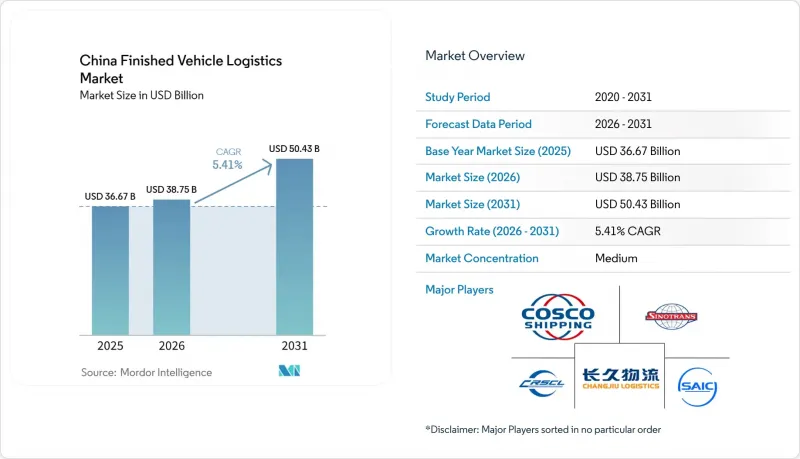
Mordor Intelligence에 의하면, 중국의 완성 차량 물류 시장 규모는 2025년 366억 7,000만 달러로 평가되었습니다. 2026년에는 387억 5,000만 달러로 확대되어 2031년까지 504억 3,000만 달러에 이를 것으로 예측되며, 2026년부터 2031년에 걸쳐 CAGR 5.41%로 성장할 전망입니다.
중국의 완성 차량 물류 시장은 수출 시장의 확대, 신에너지 차량에 대한 더욱 엄격한 취급 요건, 그리고 운송 1건당 부가가치 서비스 내용의 꾸준한 증가에 힘입어 성장하고 있습니다. 본 보고서는 물류 기능별(운송, 창고·배송, 부가가치 서비스), 목적지별(국내, 국제), 차량 유형별(승용차, 상용차, 오프로드 차량), 최종 사용자 산업별(OEM, 딜러, 기타), 지역별(북부, 북동부, 중부 등)로 분류되어 있습니다. 시장 전망은 금액(달러) 기준으로 제시되어 있습니다.
중국의 완성 차량 물류 시장 동향과 인사이트
신에너지차(NEV) 수출 확대와 성 간 차량 재배치
중국의 완성 차량 물류 시장은 신에너지차(NEV) 수출 활동의 확대와 내륙 생산 거점 및 국내·수출지 간에 완성차를 재배치해야 할 필요성에 의해 점차 형성되고 있습니다. 이에 따라 네트워크는 주로 유통 주도형 시스템에서 공장 클러스터, 집적 야드, 항만, 딜러 거점 간에 더 빈번한 장거리 균형 조정 운송을 관리해야 하는 시스템으로 변화하고 있습니다. 생산이 제한된 수의 주요 제조 지역에 집중되어 있는 반면, 수요는 내륙의 각 성 및 해외 시장으로 확산되고 있어 운영상의 과제는 더욱 심각해지고 있습니다. 이러한 추세로 인해 차량 취급의 복잡성, 계획 수립 요건, 그리고 여러 운송 경로에 걸친 전문적인 자산 배치의 필요성이 높아지고 있습니다. 그 결과, 운송 생산성이 향상되더라도 중국의 완성 차량 물류 시장에서는 운송 단위당 물류 가치가 높아지고 있습니다.
연안 수출 회랑에서의 항만·철도·RoRo 통합
중국의 완성 차량 물류 시장에서 가장 중요한 인프라 변화는 수출 회랑 전반에 걸친 철도, 항만, RoRo(롤온-롤오프) 운송 능력의 더욱 심화된 통합입니다. 2025년 4월, 중국은 북부만항에서 제벨 알리까지 첫 RoRo 항로를 개설했습니다. 이를 통해 기존 노선에 비해 운송 시간이 4-10일 단축되었으며, ‘신국제 육해 무역 회랑’ 내 물류 효율이 10%-15% 향상되었습니다. 2026년 1월에는 충칭에서 생산된 NEV를 실은 철도·해상 복합 운송 화물 열차가 난샤항으로 출발한 후, 중동행 선박으로 환적되었습니다. 이를 통해 내륙 지역의 공장도 중계 지점을 줄여 일반적인 수출 체인에 임베디드될 수 있게 되었음을 보여주었습니다. 신화통신은 2025년 6월, 중국-유럽 간 화물 열차가 완성차를 약 12일 만에 운송했으며, 물류 비용은 1대당 약 2,000달러인 반면, 육로로는 25-30일이 소요되고 1대당 약 2,500달러가 든다고 보도했습니다. 이는 우선순위가 높은 내륙 출발 수출 물량의 중요성을 뒷받침하는 것입니다. 이러한 복합 운송 경로가 시범적인 회랑에서 더 광범위한 내륙 및 연안 거점을 아우르는 재현 가능한 운영 모델로 전환됨에 따라, 중국의 완성 차량 물류 시장은 혜택을 누리게 될 것입니다.
수출 성수기 전용 자동차 운반선의 운송 능력 병목 현상
중국의 완성 차량 물류 시장은 2025년 및 2026년에 선박 증강이 진행된 후에도 수출 성수기에는 여전히 운송 능력 부족에 직면해 있습니다. 문제는 선단 규모뿐만이 아닙니다. 부두 접근성, 일정 신뢰성, 터미널 준비 상황도 얼마나 많은 차량을 제시간에 운송할 수 있는지를 좌우하기 때문입니다. 즉, 특히 대형 선박이 특정 부두 수심이나 하역 지원을 필요로 하는 경우, 2차 수출항이 가장 혼잡한 연안 관문에서 발생하는 잉여 물량을 항상 흡수할 수 있는 것은 아닙니다. 실제로 이러한 상황으로 인해 사업자 간 수출 운송 능력에 편차가 발생하며, 규모가 작거나 통합도가 낮은 화주일수록 분기말의 압박에 더 쉽게 노출됩니다. 따라서 중국의 완성 차량 물류 시장은 수출 증가세가 항만 및 해운 인프라 정비 상황을 앞지를 때마다 실행상의 병목 현상에 노출되기 쉬운 상태가 지속되고 있습니다.
부문 분석
2025년, 중국의 완성 차량 물류 시장에서 운송 부문은 시장 점유율의 64.87%를 차지하며 최대 기능 부문이 되었습니다. 한편, 부가가치 서비스 및 기타 부문은 2031년까지 연평균 성장률(CAGR) 7.16%를 나타낼 것으로 예측됩니다. 이러한 구성 비율은 수익원이 운송 과정을 중심으로 한 서비스로 이동하기 시작했음에도 불구하고, 물리적 운송이 여전히 시장의 기반을 이루고 있음을 보여줍니다. 도로 운송은 국내 딜러로의 보충 운송이나 단거리 도시 간·성내 운송에서 여전히 핵심적인 운송 수단입니다. 해상 및 내륙 수로는 대량의 수출 화물과 내륙 하천변의 제조 거점과 심해 터미널을 연결하는 데 있어 계속해서 중요한 역할을 수행하고 있습니다.
중국의 완성 차량 물류 시장에서는 검사, 손상 판정, 배터리 취급, 도착 예정 시간(ETA) 가시화, 통관 조정을 단일 서비스 패키지로 통합할 수 있는 제공업체가 점차 높은 평가를 받고 있습니다. 철도는 여전히 시장 점유율이 낮은 편이지만, 순수한 유연성보다는 비용과 시간 준수가 중시되는 장거리 내륙 노선에서 그 중요성이 커지고 있습니다. 창고 보관 및 유통의 역할도 변화하고 있습니다. 이는 각 OEM 업체들이 수동적인 차량 보관이 아닌, 보다 신속한 처리와 적절한 스테이징을 요구하게 되었기 때문입니다. 이러한 변화로 인해 복합 시설, 인도 전 검사, 항만 내 순서 배정, 그리고 디지털 야드 흐름이 단순한 운송량뿐만 아니라 기능적 차별화 측면에서도 더욱 중요한 요소로 부상하고 있습니다.
2025년 시점에서 중국 내 완성 차량 물류 시장 규모의 73.10%를 국내 물류가 차지했으나, 국제 물류는 2031년까지 연평균 성장률(CAGR) 6.76%를 나타낼 것으로 예측됩니다. 이를 통해 국내 물류가 시장의 기반이 되는 한편, 수출 지향형 물류가 더 빠른 속도로 중요성이 커지고 있음을 보여줍니다. 중국에서는 여전히 연안 및 내륙 소매 시장을 아우르는 방대한 국내 유통 네트워크가 구축되어 있어, 국내 부문의 규모는 여전히 큰 임베디드니다. 그러나 국제 부문은 틈새 수출 기능의 범위를 넘어, 수출 업무의 복잡성을 관리할 수 있는 사업자에게 핵심적인 성장 동력으로 변모하고 있습니다.
수출 물류는 운송 회랑의 정비, 항만 간 연계 강화, 그리고 내륙 생산 클러스터에서의 철도·해상 운송 연계가 널리 수용되고 있는 데서 혜택을 받고 있습니다. 수입 및 인바운드 물류 흐름은 복합적인 이용률을 뒷받침하고 일부 연안 터미널의 방향성 불균형을 완화하는 데 도움이 되므로 여전히 중요합니다. 그다지 눈에 띄지 않는 영향으로, 수출 체제의 강화로 인해 특수 차량이나 운송 능력이 고부가가치 해외 노선으로 재배치됨에 따라 국내 설비 가동률이 감소할 가능성이 있습니다. 수출 및 반품 흐름을 보다 효율적으로 관리하는 사업자는 중국의 완성 차량 물류 시장 전체에서 자산 활용률과 가격 책정 규율을 유지하는 데 있어 더 유리한 입장에 서게 될 것입니다.
기타 혜택 :
- 엑셀 형식 시장 예측(ME) 시트
- 3개월간의 애널리스트 지원
자주 묻는 질문
목차
제1장 서론
제2장 조사 방법
제3장 주요 요약
제4장 시장 구도
제5장 시장 규모 및 성장 예측
제6장 경쟁 구도
제7장 시장 기회 및 향후 전망
KTH 26.08.10According to Mordor Intelligence, the China finished vehicle logistics market size is projected to expand from USD 36.67 billion in 2025 to USD 38.75 billion in 2026, and reach USD 50.43 billion by 2031, growing at a CAGR of 5.41% from 2026 to 2031.
The China finished vehicle logistics market is being lifted by a wider export footprint, more demanding handling requirements for new energy vehicles, and a steady rise in value-added service content per shipment. This report is Segmented by Logistics Function (Transportation, Warehousing & Distribution, Value-Added Services), by Destination (Domestic, International), by Type of Vehicles (Passenger Vehicles, Commercial Vehicles, Off-Highway Vehicles), by End-User Industry (OEMs, Dealers, Others), and by Region (North, Northeast, Central, and More). The Market Forecasts are Provided in Terms of Value (USD).
China Finished Vehicle Logistics Market Trends and Insights
Rising NEV Exports and Inter-Provincial Vehicle Repositioning
The China finished vehicle logistics market is increasingly shaped by rising NEV export activity and by the need to reposition finished vehicles between inland production bases and both domestic and export destinations. This is changing the network from a mainly distribution-led system into one that must manage more frequent long-distance balancing moves between factory clusters, staging yards, ports, and dealer points. The operating challenge is stronger because production remains concentrated in a limited number of major manufacturing zones, while demand is spreading across interior provinces and overseas markets. That pattern lifts vehicle handling complexity, planning requirements, and the need for specialized asset deployment across multiple corridors. As a result, the China finished vehicle logistics market is seeing higher logistics value per unit moved, even when transport productivity improves.
Port-Rail-RoRo Integration Across Coastal Export Corridors
The most important infrastructure shift in the China finished vehicle logistics market is the deeper integration of rail, port, and RoRo capacity across export corridors. In April 2025, China opened its first RoRo route from Beibu Gulf Port to Jebel Ali, cutting transit time by 4 to 10 days against conventional routing and improving logistics efficiency by 10% to 15% within the New International Land-Sea Trade Corridor. In January 2026, a rail-sea intermodal freight train loaded with Chongqing-made NEVs departed for Nansha Port and then connected to a vessel bound for the Middle East, showing that inland factories can now plug into regular export chains with fewer breakpoints. Xinhua also reported in June 2025 that China-Europe freight trains were carrying finished vehicles in around 12 days at a logistics cost of around USD 2,000 per vehicle, against 25 to 30 days and around USD 2,500 per vehicle by road, which strengthens the case for high-priority and inland export batches. The China finished vehicle logistics market will benefit as these intermodal links move from pilot corridors into repeatable operating models across a wider set of inland and coastal nodes.
Specialized Car-Carrier Capacity Bottlenecks in Peak Export Seasons
The China finished vehicle logistics market still faces capacity pressure in peak export periods, even after a wave of vessel additions in 2025 and 2026. The problem is not only fleet size, because berth access, scheduling reliability, and terminal readiness also determine how much vehicle volume can move on time. That means secondary export ports cannot always absorb overflow from the busiest coastal gateways, especially when larger vessels need specific berth depth and handling support. In practice, this keeps export capacity uneven across operators and leaves smaller or less integrated shippers more exposed to quarter-end pressure. The China finished vehicle logistics market, therefore, remains vulnerable to execution bottlenecks whenever export growth outpaces the readiness of port and shipping infrastructure.
Other drivers and restraints analyzed in the detailed report include:
- OEM Demand for Damage-Reduction and Real-Time Vehicle Visibility
- Policy Support for Multimodal Freight and Logistics Network Upgrades
- High Vehicle Damage Exposure in Short-Haul and Yard-to-Yard Movements
For complete list of drivers and restraints, kindly check the Table Of Contents.
Segment Analysis
Transportation accounted for 64.87% of the China finished vehicle logistics market share in 2025, which made it the largest functional segment, while value-added services and others are projected to grow at a 7.16% CAGR through 2031. That mix shows that physical movement still anchors the market, even as profit pools start to shift toward services built around the transport leg. Road transport remains the core mode for domestic dealer replenishment and for shorter inter-city and intra-provincial moves. Sea and inland waterways continue to matter for bulk export batches and for linking inland river manufacturing zones with deep-sea terminals.
The China finished vehicle logistics market is gradually rewarding providers that can bundle inspection, damage certification, battery handling, ETA visibility, and customs coordination into a single service offer. Rail still represents a smaller share, but it is becoming more relevant on longer inland routes where cost and time discipline matter more than pure flexibility. Warehousing and distribution are also changing in role, because OEMs now want faster processing and better staging rather than passive vehicle storage. That shift means compounds, pre-delivery inspection, port-side sequencing, and digital yard flow are becoming more central to functional differentiation than simple transport volume alone.
Domestic logistics held 73.10% of the China finished vehicle logistics market size in 2025, while international logistics is forecast to grow at a 6.76% CAGR through 2031. This keeps domestic activity as the base of the market, but it also shows that export-oriented logistics is gaining weight at a faster pace. The domestic segment remained larger because China still supports a vast internal distribution network across coastal and inland retail markets. The international segment, however, is moving beyond a niche export function and into a core growth engine for operators that can manage outbound complexity.
Export logistics is benefiting from corridor upgrades, growing port integration, and wider acceptance of rail-sea handoffs for inland production clusters. Import and inbound flows still matter because they support compound utilization and help reduce directional imbalance at some coastal terminals. A less visible effect is that stronger export deployment can tighten domestic equipment availability when specialized rolling stock or carrier capacity gets pulled toward higher-value overseas routes. Providers that manage outbound and return flow more efficiently will be better placed to protect asset utilization and pricing discipline across the China finished vehicle logistics market.
Complete Report Scope:
- By Logistics Function
- Transportation
- Road
- Air
- Sea and Inland Waterways
- Rail
- Warehousing and Distribution
- Value-added Services and Others
- Transportation
- By Destination
- Domestic
- International
- Import/Inbound
- Export/Outbound
- By Type of Vehicles
- Passenger Vehicles (Including Two and Three-Wheelers)
- Commercial Vehicles
- Off-Highway Vehicles
- By End-user Industry
- OEMs
- Dealers
- Others (Rental Companies, Fleet leasing companies, Government and Defense Fleets, etc.)
- By Region
- North
- Northeast
- East
- Central
- South
- Southwest
- Northwest
List of Companies Covered in this Report:
- SAIC Motor Transportation and Logistics Co., Ltd.
- Changjiu Logistics Co., Ltd.
- China Railway Special Cargo Logistics Co., Ltd.
- Sinotrans Limited
- COSCO Shipping Logistics Co., Ltd.
- China Merchants Logistics Group Co., Ltd.
- FAW Logistics Co., Ltd.
- Dongfeng Logistics Group Co., Ltd.
- GAC Logistics Co., Ltd.
- Changan Minsheng APLL Logistics Co., Ltd.
- BAIC Logistics Co., Ltd.
- Geely Logistics Co., Ltd.
- BYD Logistics Co., Ltd.
- NYK Line (Including Yusen Logistics)
- Kuehne+Nagel
- DHL Group
- CMA CGM Group (Including CEVA Logistics)
- DSV A/S (Including DB Schenker)
- Nippon Express Holdings
- Wallenius Wilhelmsen
- Hoegh Autoliners
Additional Benefits:
- The market estimate (ME) sheet in Excel format
- 3 months of analyst support
TABLE OF CONTENTS
1 Introduction
- 1.1 Study Assumptions and Market Definition
- 1.2 Scope of the Study
2 Research Methodology
3 Executive Summary
4 Market Landscape
- 4.1 Market Overview and Role of Logistics in Finished Vehicle
- 4.2 Automotive Spending Trends
- 4.3 Market Drivers
- 4.3.1 Rising NEV Exports and Inter-Provincial Vehicle Repositioning
- 4.3.2 Port-Rail-RoRo Integration Across Coastal Export Corridors
- 4.3.3 OEM Demand for Damage-Reduction and Real-Time Vehicle Visibility
- 4.3.4 Dealer Network Consolidation and Direct-To-Dealer Delivery Optimization
- 4.3.5 Expansion of Digital Yard Management, Gate Automation, and ETA Control Towers
- 4.3.6 Policy Support for Multimodal Freight and Logistics Network Upgrades
- 4.4 Market Restraints
- 4.4.1 Specialized Car-Carrier Capacity Bottlenecks in Peak Export Seasons
- 4.4.2 High Vehicle Damage Exposure in Short-Haul and Yard-to-Yard Movements
- 4.4.3 Toll, Fuel, and Empty-Return Cost Pressure on Domestic Road Transport
- 4.4.4 Fragmented Regional Operating Standards and Loading Infrastructure Gaps
- 4.5 Regulatory Framework
- 4.6 Value Chain and Distribution Channel Architecture Analysis
- 4.7 Technology Innovations Outlook
- 4.8 Porter's Five Forces Analysis
- 4.8.1 Threat of New Entrants
- 4.8.2 Bargaining Power of Suppliers
- 4.8.3 Bargaining Power of Buyers
- 4.8.4 Threat of Substitutes
- 4.8.5 Rivalry Among Competitors
- 4.9 Evolution of Finished Vehicle Logistics Requirements
- 4.10 Impact of Geo-Political Events on Supply Chain Shifts
5 Market Size and Growth Forecasts
- 5.1 By Logistics Function
- 5.1.1 Transportation
- 5.1.1.1 Road
- 5.1.1.2 Air
- 5.1.1.3 Sea and Inland Waterways
- 5.1.1.4 Rail
- 5.1.2 Warehousing and Distribution
- 5.1.3 Value-added Services and Others
- 5.1.1 Transportation
- 5.2 By Destination
- 5.2.1 Domestic
- 5.2.2 International
- 5.2.2.1 Import/Inbound
- 5.2.2.2 Export/Outbound
- 5.3 By Type of Vehicles
- 5.3.1 Passenger Vehicles (Including Two and Three-Wheelers)
- 5.3.2 Commercial Vehicles
- 5.3.3 Off-Highway Vehicles
- 5.4 By End-user Industry
- 5.4.1 OEMs
- 5.4.2 Dealers
- 5.4.3 Others (Rental Companies, Fleet leasing companies, Government and Defense Fleets, etc.)
- 5.5 By Region
- 5.5.1 North
- 5.5.2 Northeast
- 5.5.3 East
- 5.5.4 Central
- 5.5.5 South
- 5.5.6 Southwest
- 5.5.7 Northwest
6 Competitive Landscape
- 6.1 Market Concentration
- 6.2 Key Strategic Moves
- 6.3 Market Share Analysis
- 6.4 Company Profiles (Includes Global Level Overview, Market Level Overview, Core Segments, Financials as Available, Strategic Information, Market Rank/Share for Key Companies, Products and Services, and Recent Developments)
- 6.4.1 SAIC Motor Transportation and Logistics Co., Ltd.
- 6.4.2 Changjiu Logistics Co., Ltd.
- 6.4.3 China Railway Special Cargo Logistics Co., Ltd.
- 6.4.4 Sinotrans Limited
- 6.4.5 COSCO Shipping Logistics Co., Ltd.
- 6.4.6 China Merchants Logistics Group Co., Ltd.
- 6.4.7 FAW Logistics Co., Ltd.
- 6.4.8 Dongfeng Logistics Group Co., Ltd.
- 6.4.9 GAC Logistics Co., Ltd.
- 6.4.10 Changan Minsheng APLL Logistics Co., Ltd.
- 6.4.11 BAIC Logistics Co., Ltd.
- 6.4.12 Geely Logistics Co., Ltd.
- 6.4.13 BYD Logistics Co., Ltd.
- 6.4.14 NYK Line (Including Yusen Logistics)
- 6.4.15 Kuehne+Nagel
- 6.4.16 DHL Group
- 6.4.17 CMA CGM Group (Including CEVA Logistics)
- 6.4.18 DSV A/S (Including DB Schenker)
- 6.4.19 Nippon Express Holdings
- 6.4.20 Wallenius Wilhelmsen
- 6.4.21 Hoegh Autoliners
7 Market Opportunities and Future Outlook
- 7.1 White-space and Unmet-Need Assessment


