
|
시장보고서
상품코드
2124442
북미의 자동차 물류 : 시장 점유율 분석, 업계 동향과 통계, 성장 예측(2026-2031년)North America Automotive Logistics - Market Share Analysis, Industry Trends & Statistics, Growth Forecasts (2026 - 2031) |
||||||
 Mordor Intelligence
Mordor Intelligence에 의하면, 북미의 자동차 물류 시장 규모는 2025년에 519억 3,000만 달러로 평가되었고, 2026년 538억 1,000만 달러에서 2031년까지 642억 3,000만 달러에 이를 것으로 예측되며, 예측 기간(2026-2031년) CAGR은 3.61%를 기록할 전망입니다.
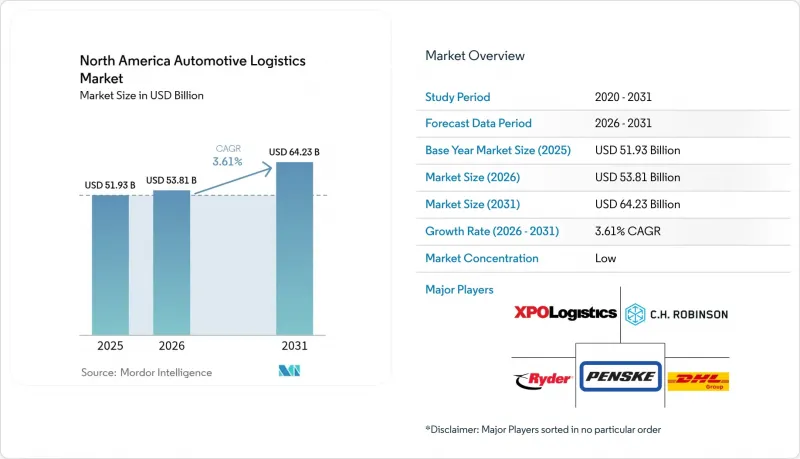
본 보고서는 서비스별(운송, 창고 보관, 유통·재고 관리, 부가가치 서비스), 유형별(OEM 및 애프터마켓), 화물 유형별(완성차, 자동차 부품, 전기차용 배터리·파워 일렉트로닉스, 기타 화물), 국가별(미국, 캐나다, 멕시코)로 분류되어 있습니다. 시장 예측은 금액(달러)으로 표시되어 있습니다.
북미의 자동차 물류 시장 동향 및 인사이트
환경 규제 강화(2025년-2030년)
2027년에 발효될 EPA의 3단계 온실가스 규제로 인해 물류 차량은 저공해 차량 및 제로 배출 트럭으로의 전환이 촉진되고 있으며, 자산 조달 및 배송 경로 전략이 변화하고 있습니다. 캘리포니아주의 ‘첨단 청정 차량 규정(Advanced Clean Fleets Rule)’을 채택한 각 주에서는 무공해 차량 구매를 의무화함으로써 이러한 전환을 가속화하고 있습니다. 사업자들은 전기 트랙터 도입에 막대한 설비 투자가 필요하지만, 그 비용은 전체 수명 주기 동안의 연료비 및 유지보수비 절감을 통해 상쇄될 것으로 전망하고 있습니다. 창고에서는 화주의 지속가능성 기준을 충족하기 위해 에너지 관리 시스템을 도입하고, ISO 14001 인증 취득을 추진하고 있습니다. 정량화 가능한 탄소 발자국 감축 실적을 입증할 수 있는 물류 파트너는 ESG 지표를 중시하는 자동차 제조업체로부터 장기 계약을 따내는 사례가 늘고 있습니다. 그 결과, 북미의 자동차 물류 시장에서 규제 준수를 위한 투자는 시장 진입의 승부수인 동시에 브랜드 구축의 수단이 되고 있습니다.
이커머스에 따른 부품 물류 확대
소비자 직접 판매(D2C)를 통한 부품 판매로 인해 출하 형태가 세분화되어, 팔레트 단위 운송에서 소포 크기의 화물 운송으로 전환되고 있습니다. 이에 따라 자동화된 피킹, 라벨링 및 당일 배송이 요구되고 있습니다. 도시 지역 수요 거점 근처에 설치된 크로스독 및 마이크로 풀필먼트 센터는 주문 접수부터 배송까지의 주기를 단축하고 있지만, SKU의 급증으로 인해 실시간 재고 가시화가 필수적입니다. 포장 엔지니어들은 소포 네트워크 내의 센서와 전자 기기를 보호하기 위해 변조 방지 기능 및 정전기 방지 기능을 갖춘 솔루션을 설계하고 있습니다. 소비자들이 번거롭지 않은 교환을 기대함에 따라 반품 처리의 복잡성이 증가하고 있으며, 이로 인해 3PL 업체들은 창고 내에 재생 및 재입고 라인을 추가하고 있습니다. 따라서 북미의 자동차 물류 시장은 순수하게 비용 중심의 운송에서 전자상거래의 변동성을 관리하는 통합형 기술 주도 서비스로 전환되고 있습니다.
운전기사 부족과 임금 상승
2025년에는 상업용 운전기사 부족 인원이 수만 명에 달하고, 운송 능력에 부담이 가중되고 있으며, 임금 중앙값이 상승하고 있습니다. 자동차 화물 운송은 위험물 운송 및 자동차 운송 자격 요건으로 인해 적격 인력 풀이 좁아지기 때문에 특히 큰 영향을 받고 있습니다. 운송 회사들은 입사 보너스와 학비 지원 프로그램을 확충하고 있지만, 그럼에도 퇴사자 보충에 어려움을 겪고 있습니다. 전용 자동차 운송 노선에서는 각 운송 회사가 가장 수익성이 높은 계약을 추구하기 때문에 분기마다 운임이 재검토되고 있습니다. 자율주행 트럭의 시범 운영은 허브 간 운송 분야에서 유망한 것으로 평가받고 있으나, 규제 및 사회적 수용이라는 장벽으로 인해 예측 기간 내 대규모 도입은 기대하기 어려우며, 인력 부족이 북미의 자동차 물류 시장의 중기적인 걸림돌로 남아 있을 것입니다.
부문 분석
2025년, 북미의 자동차 물류 시장 규모의 51.45%를 운송 부문이 차지했습니다. 이는 1차 공급업체와 조립 공장 간에 부품을 운송하는 도로 운송이 주를 이루고 있습니다. 인터모달 철도 노선은 멕시코 공장과 중서부 허브를 연결하며, 운행 속도를 향상시키는 기관차 차량의 현대화 혜택을 받고 있습니다. 항공 화물은 고부가가치 ECU 및 긴급 금형 운송과 같은 틈새 시장을 유지하고 있습니다. 부가가치 서비스(키팅, 시퀀싱, 간이 조립)는 자동차 제조업체가 비핵심 업무를 3PL에 위탁하고 전기차(EV) 생산 라인을 위한 바닥 공간을 확보함에 따라 연평균 성장률(CAGR) 2.95%(2026년-2031년)로 성장하고 있습니다.
각 공급업체는 공장 재고를 모델링하고, 칸반 방식에 따른 보충을 촉진하여 재공품 버퍼를 축소하는 디지털 트윈을 통해 타사와의 차별화를 꾀하고 있습니다. 창고 시설에는 반품 처리 및 배터리 건전성 진단을 수행하기 위한 메자닌이 추가되고 있습니다. 이 부문의 변화로 인해, 운송 업무와 공장 내 자재 운반 팀, 그리고 라인 사이드에서의 저스트-인-시퀀싱(JIS) 배송을 연계할 수 있는 통합업체들이 혜택을 보고 있습니다. 그 결과, 부가가치형 계약 기간이 5년 이상으로 장기화되면서 북미의 자동차 물류 시장 전체에서 교차 판매의 가능성이 확고해졌습니다.
기타 혜택:
- 엑셀 형식 시장 예측(ME) 시트
- 3개월간의 애널리스트 지원
자주 묻는 질문
목차
제1장 서론
제2장 조사 방법
제3장 주요 요약
제4장 시장 구도
제5장 시장 규모와 성장 예측
제6장 경쟁 구도
제7장 시장 기회와 향후 전망
제8장 부록
LSH 26.09.14According to Mordor Intelligence, the North America automotive logistics market size was valued at USD 51.93 billion in 2025 and estimated to grow from USD 53.81 billion in 2026 to reach USD 64.23 billion by 2031, at a CAGR of 3.61% during the forecast period (2026-2031).

This report is Segmented by Service (Transportation, Warehousing, Distribution & Inventory Management, and Value-Added Services), Type (OEM and Aftermarket), Cargo Type (Finished Vehicles, Auto Components, EV Batteries & Power-Electronics, and Other Cargo), Country (United States, Canada, and Mexico). The Market Forecasts are Provided in Terms of Value (USD).
North America Automotive Logistics Market Trends and Insights
Environmental Regulations Tightening (2025-2030)
The EPA's Phase 3 greenhouse-gas standards, effective 2027, push logistics fleets toward low- and zero-emission trucks, altering asset procurement and routing strategies. States adopting California's Advanced Clean Fleets Rule accelerate the transition by mandating zero-emission vehicle purchases. Operators face higher capital outlays for electric tractors yet expect lifetime fuel and maintenance savings to offset those costs. Warehouses install energy-management systems and secure ISO 14001 certification to meet shipper sustainability criteria. Logistics partners that can document quantifiable carbon-footprint reductions increasingly win long-term contracts from automakers focused on ESG metrics. Consequently, compliance investments become both a market entry ticket and a brand-building lever within the North America Automotive Logistics market.
Growth of E-commerce Parts Flows
Direct-to-consumer parts sales are fragmenting shipment profiles, shifting from pallet-level moves to parcel-size consignments that demand automated picking, labeling, and same-day fulfillment. Cross-docks and micro-fulfillment centers near urban demand nodes shrink order-to-delivery cycles, while SKU proliferation necessitates real-time inventory visibility. Packaging engineers design tamper-proof, static-free solutions to protect sensors and electronics in parcel networks. Returns complexity rises as consumers expect hassle-free exchanges, prompting 3PLs to add refurbishment and restocking lines inside warehouses. The North America Automotive Logistics market thus pivots from purely cost-focused transportation to integrated, tech-driven services that manage e-commerce volatility.
Driver Shortage & Wage Inflation
The commercial driver gap reached multi-tens-of-thousands of positions in 2025, straining capacity and lifting median pay. Automotive freight suffers disproportionately because hazmat and car-haul endorsements narrow the qualified labor pool. Carriers raise sign-on bonuses and tuition reimbursement programs, yet still struggle to backfill retirements. Dedicated auto lanes face re-pricing every quarter as fleets chase the most profitable contracts. Autonomous-truck pilots show promise for hub-to-hub moves, but regulatory and public-acceptance barriers keep widescale deployment beyond the forecast horizon, preserving labor scarcity as a medium-term drag on the North America Automotive Logistics market.
Other drivers and restraints analyzed in the detailed report include:
- OEM Near-shoring & USMCA Production Ramp-up
- AI-driven Dynamic Routing Slashes Empty-Mile Costs
- Battery-hazard Regulations Constrain EV Logistics Capacity
For complete list of drivers and restraints, kindly check the Table Of Contents.
Segment Analysis
Transportation generated 51.45% of the North America Automotive Logistics market size in 2025, anchored by road haulage that shuttles components between tier-1 suppliers and assembly plants. Intermodal rail corridors link Mexican factories with Midwest hubs, benefiting from locomotive fleet upgrades that raise velocity. Airfreight retains a niche for high-value ECUs and urgent tooling. Value-added services-kitting, sequencing, and light assembly-are growing at a 2.95% CAGR (2026-2031) as automakers offload non-core tasks to 3PLs, freeing floor space for EV production lines.
Providers differentiate through digital twins that model plant inventories and push kanban replenishment, shrinking work-in-process buffers. Warehousing footprints add mezzanines for returns processing and battery-state-of-health diagnostics. The segment shift rewards integrators that can couple transport with in-plant material-handling teams and line-side just-in-sequence delivery. Consequently, value-added contracts are lengthening to five-plus years, locking in cross-selling potential across the wider North America Automotive Logistics market.
Complete Report Scope:
- By Service
- Transportation
- Road
- Rail
- Air
- Sea / Ro-Ro / Short-Sea
- Warehousing, Distribution & Inventory Management
- Value-added Services
- Transportation
- By Type
- OEM
- Aftermarket
- By Cargo Type
- Finished Vehicles
- Auto Components
- EV Batteries and Power-Electronics
- Other Cargo
- By Country
- United States
- Canada
- Mexico
List of Companies Covered in this Report:
- DHL
- C.H. Robinson
- XPO Logistics
- Penske Logistics
- Ryder System Inc.
- CEVA Logistics
- DSV A/S
- Kuehne + Nagel
- GEODIS
- Nippon Express
- United Parcel Service (UPS)
- Jack Cooper Transport
- Wallenius Wilhelmsen
- SEKO Logistics
- Yusen Logistics
- Buske Logistics
- Grupo Traxion
- Schneider National
- Omni Logistics
- Crowley Logistics
Additional Benefits:
- The market estimate (ME) sheet in Excel format
- 3 months of analyst support
TABLE OF CONTENTS
1 Introduction
- 1.1 Study Assumptions & Market Definition
- 1.2 Scope of the Study
2 Research Methodology
3 Executive Summary
4 Market Landscape
- 4.1 Market Overview
- 4.2 Market Drivers
- 4.2.1 Environmental regulations tightening (2025-2030)
- 4.2.2 Growth of e-commerce parts flows
- 4.2.3 OEM near-shoring & USMCA production ramp-up
- 4.2.4 Technology-enabled supply-chain visibility
- 4.2.5 Mexico's Pacific port expansions unlock new Ro-Ro lanes
- 4.2.6 AI-driven dynamic routing slashes empty-mile costs
- 4.3 Market Restraints
- 4.3.1 Economic cyclicality of auto output
- 4.3.2 Driver shortage & wage inflation
- 4.3.3 Battery-hazard regulations constrain EV logistics capacity
- 4.3.4 Port-side dwell-time fines erode 3PL margins
- 4.4 Value / Supply-Chain Analysis
- 4.5 Regulatory Landscape
- 4.6 Technological Outlook
- 4.7 Spotlight - Effect of E-commerce on Automotive Logistics
- 4.8 Porter's Five Forces
- 4.8.1 Threat of New Entrants
- 4.8.2 Bargaining Power of Buyers
- 4.8.3 Bargaining Power of Suppliers
- 4.8.4 Threat of Substitutes
- 4.8.5 Intensity of Competitive Rivalry
5 Market Size & Growth Forecasts
- 5.1 By Service
- 5.1.1 Transportation
- 5.1.1.1 Road
- 5.1.1.2 Rail
- 5.1.1.3 Air
- 5.1.1.4 Sea / Ro-Ro / Short-Sea
- 5.1.2 Warehousing, Distribution & Inventory Management
- 5.1.3 Value-added Services
- 5.1.1 Transportation
- 5.2 By Type
- 5.2.1 OEM
- 5.2.2 Aftermarket
- 5.3 By Cargo Type
- 5.3.1 Finished Vehicles
- 5.3.2 Auto Components
- 5.3.3 EV Batteries and Power-Electronics
- 5.3.4 Other Cargo
- 5.4 By Country
- 5.4.1 United States
- 5.4.2 Canada
- 5.4.3 Mexico
6 Competitive Landscape
- 6.1 Market Concentration
- 6.2 Strategic Moves
- 6.3 Market Share Analysis
- 6.4 Company Profiles (includes Global level Overview, Market level overview, Core Segments, Financials as available, Strategic Information, Market Rank/Share for key companies, Products & Services, and Recent Developments)
- 6.4.1 DHL
- 6.4.2 C.H. Robinson
- 6.4.3 XPO Logistics
- 6.4.4 Penske Logistics
- 6.4.5 Ryder System Inc.
- 6.4.6 CEVA Logistics
- 6.4.7 DSV A/S
- 6.4.8 Kuehne + Nagel
- 6.4.9 GEODIS
- 6.4.10 Nippon Express
- 6.4.11 United Parcel Service (UPS)
- 6.4.12 Jack Cooper Transport
- 6.4.13 Wallenius Wilhelmsen
- 6.4.14 SEKO Logistics
- 6.4.15 Yusen Logistics
- 6.4.16 Buske Logistics
- 6.4.17 Grupo Traxion
- 6.4.18 Schneider National
- 6.4.19 Omni Logistics
- 6.4.20 Crowley Logistics
7 Market Opportunities & Future Outlook
- 7.1 White-space & Unmet-need Assessment
8 Appendix
- 8.1 GDP Distribution, by Activity
- 8.2 Insights into Capital Flows
- 8.3 Economic Statistics - Transport & Storage Sector Contribution