

|
시장보고서
상품코드
2099485
미국의 완성 차량 물류 : 시장 점유율 분석, 업계 동향 및 통계, 성장 예측(2026-2031년)United States Finished Vehicle Logistics - Market Share Analysis, Industry Trends & Statistics, Growth Forecasts (2026 - 2031) |
||||||
 Mordor Intelligence
Mordor Intelligence에 의하면, 미국의 완성 차량 물류 시장 규모는 2025년에 383억 3,000만 달러로 평가되었습니다. 2026년 402억 9,000만 달러에서 2031년까지 511억 1,000만 달러에 이를 것으로 예상되며, 예측 기간(2026-2031년) CAGR은 4.87%를 나타낼 전망입니다.
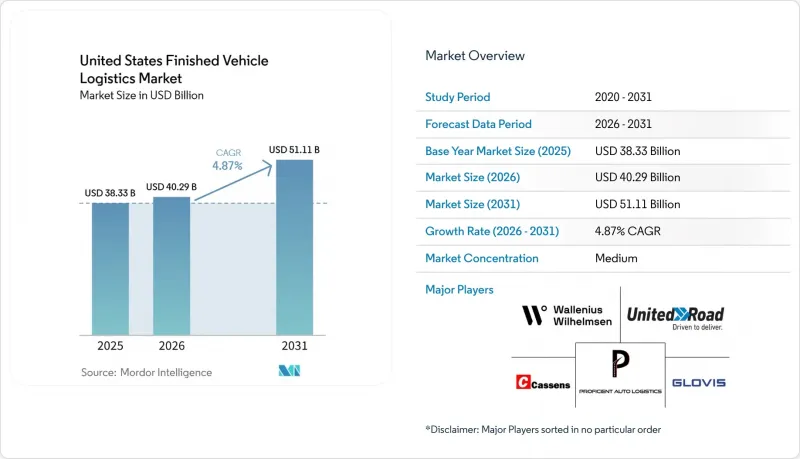
생산의 현지화로 인해 미국 완성 차량 물류 시장의 노선 설계가 재편되고 있습니다. 이는 국내 제조 거점이 확대됨에 따라 수입과 관련된 장거리 운송이 일부 감소하는 반면, 지역별 배송 주기와 딜러로의 차량 인도 빈도가 증가하고 있기 때문입니다. 본 보고서는 물류 기능(수송, 창고·유통, 부가가치 서비스), 목적지(국내, 국제), 차량 유형(승용차, 상용차, 오프로드 차량), 최종 사용자 산업(OEM, 딜러, 기타), 지역(북동부, 남동부, 중서부, 남서부, 서부)별로 분류되어 있습니다. 시장 전망은 금액(달러) 기준으로 제시되어 있습니다.
미국의 완성 차량 물류 시장 동향 및 인사이트
완성차 흐름의 리쇼어링 및 니어쇼어링이 국내 운송 경로의 밀도를 재구성하고 있습니다.
관세 위험 및 원산지 계획으로 인해 미국의 완성 차량 물류 시장 전체의 물류 흐름 설계가 변화하고 있습니다. 이는 조달 결정이 공장의 경제성뿐만 아니라 운송 경로의 밀도, 물류 거점의 이용 현황, 나아가 국내 및 국경을 넘는 차량 이동의 균형에도 영향을 미치게 되었기 때문입니다. 베이커 연구소는 2024년에 자동차 및 자동차 부품 부문이 북미 전체 무역의 4분의 1 가까이를 차지했다고 지적하며, 이는 미미한 생산 이동만으로도 여러 물류 거점에 걸친 차량 흐름이 어떻게 변화할 수 있는지를 보여줍니다. 국내 생산 비중이 높아지면 항만 관련 및 장거리 인바운드 운송은 일부 감소하지만, 그 대신 조립 공장, 철도 야드, 가공 센터, 딜러 간 단주기 배송 횟수가 증가합니다. 이러한 변화로 인해 정차 횟수가 잦아지고, 특히 새로운 제조 회랑에서 기존 자동차 산업 지역과 동등한 물류 인프라가 아직 구축되지 않은 지역에서는 일정 수립의 난이도가 높아집니다. 미국의 완성 차량 물류 시장에서 전국을 폭넓게 커버하고 유연한 차량 배치가 가능한 사업자는 서비스 품질을 희생하지 않고도 재분배된 국내 운송 물량을 확보하기 쉬운 입장에 있습니다. 반면, 고정된 국경 간 운송 패턴에 크게 의존하는 운송업체는 OEM의 조달 우선순위가 자산 배치 계획보다 빠르게 변화할 경우, 노선 수준에서 위험에 노출되기 쉽습니다.
전동화와 배터리 안전 취급 요건이 인프라의 복잡성을 가중
전동화는 미국의 완성 차량 물류 시장에 더욱 엄격한 규정 준수 및 시설 관련 요건을 추가하고 있습니다. 이는 배터리 구동 차량이 기존의 내연기관 플랫폼과 동일한 실용적인 취급 전제 하에서 운송되지 않기 때문입니다. 연방관보(Federal Register)는 2026년 2월, 리튬 이온 배터리 차량, 리튬금속 배터리 차량 및 나트륨이온 배터리 차량에 대해 개별적인 유엔(UN) 지정을 제안했으며, 이를 통해 배터리 구동 운송을 위한 보다 상세한 규제 체계가 공식적으로 확립되었습니다. 이 체계에 따라 차량이 출발지를 떠나기 전이나 복합 운송에 들어가기 전에 정확한 문서화, 표준화된 분류, 그리고 보다 엄격한 보관 절차가 요구되고 있습니다. 현재 차량 처리 센터에서는 충전 상태 확인, 체류 시간 관리, 그리고 취급 중이나 대기 중에 배터리 관련 문제가 발생했을 때의 대응 준비에 대해 더욱 견고한 절차가 요구되고 있습니다. AIAG의 완성 차량 물류 지침은 OEM, 도로 운송업체, 철도 회사, 해운 사업자 간에 검사 및 보고에 관한 공통 기준으로 계속해서 기능하고 있으며, 전기차(EV) 취급량이 증가함에 따라 프로세스 규정 준수는 더욱 중요해지고 있습니다. 따라서 이미 규정 준수 기준에 부합하는 취급 절차와 전기차 대응 시설에 투자한 공급업체는 이러한 차량 흐름에 수반되는 고부가가치 업무의 더 큰 점유율을 확보할 수 있는 위치에 있습니다.
운전기사 부족과 전문 운송업체의 운송 능력 제약이 공급을 압박하고 있습니다.
미국의 완성 차량 물류 시장에서는 전문적인 육상 운송 능력이 여전히 제약 요인으로 작용하고 있습니다. 이는 완성차 운송에는 일반 트럭 운송의 인력 풀보다 더 좁은 범위의 기술 세트가 요구되기 때문입니다. 자동차 운송 운전자의 업무에는 다단 적재에 대한 엄격한 절차, 적재 및 하역 시 손상 방지, 딜러로 향하는 배송 경로에 대한 숙지, 그리고 OEM 프로그램마다 다른 경우가 많은 운영 기준 등이 요구됩니다. 이 때문에 일반 화물 운송 분야의 채용 상황이 개선되는 것처럼 보여도, 신규 운전자가 수익성이 높은 자동차 운송 노선에 안전하게 배차되기 위해서는 현장 훈련이 필요하기 때문에 인력 보충 속도는 더딘 임베디드니다. 운송 능력이 부족해지면 운송업체는 수익성이 높은 운송을 우선시하는 경향이 있으며, 그 결과 우선순위가 낮은 노선에서는 화물 수주 거부, 대기 시간 장기화, 서비스 품질 변동과 같은 문제가 발생하기 쉽습니다. 이러한 영향은 생산량이 급증하거나, 지역 재고가 부족해지거나, 딜러에 대한 보충 일정에 여유가 없어질 때 특히 두드러집니다. 미국의 완성 차량 물류 시장에서 수요 증가가 교육 및 신규 운전기사 채용 주기를 초과할 경우, 도로 운송 능력이 얼마나 신속하게 대응할 수 있는지에 있어 이러한 요인들로 인해 상시적인 상한선이 발생하게 됩니다.
부문 분석
2025년, 운송 부문은 미국의 완성 차량 물류 시장 규모의 75.00%를 차지했으며, 철도 적재장이나 항구에서 딜러로 이어지는 최종 구간에서 도로 운송은 여전히 매우 중요한 역할을 수행하고 있습니다. 이는 바로 이 마지막 인도 단계가 일정 정확성과 손상 방지 대책이 가장 직접적으로 시험받는 순간이기 때문입니다. 철도는 대수 기준으로 여전히 신차의 큰 비중을 차지하고 있지만, 딜러로의 배송, 컴파운드(집적장)에서의 환적, 그리고 시간 지정이 중요한 운송은 장거리 간선 운송과는 별도로 가격이 책정되기 때문에 도로 운송과의 연계를 통해 트럭 운송은 수익 창출의 중심적인 역할을 계속하고 있습니다. 이러한 구조로 인해, 특히 항만 도착, 컴파운드에서의 처리, 그리고 딜러로의 인도 시점이 완벽하게 일치하지 않는 경우, 미국의 완성 차량 물류 시장은 단일한 주요 운송 수단이 아닌, 여전히 도로와 철도의 연계에 의존하고 있습니다. 철도 또는 트럭 운송 중 어느 한쪽에서 지연이 발생하면, 차량이 소매 채널이나 플릿 채널로 유입될 예정인 지점의 재고 배치가 차질을 빚을 가능성이 있으므로, 복합 운송 운영이 중요합니다. 철도와의 연계, 복합 시설에서의 스테이징, 딜러로의 납품 일정을 보다 긴밀하게 조정할 수 있는 공급업체는 운송 경로 패턴이 끊임없이 변화하는 상황에서도 가동률과 서비스의 일관성을 유지하는 데 유리한 입장에 있습니다.
창고·유통 분야는 2026년부터 2031년까지 연평균 성장률(CAGR) 6.62%를 나타낼 것으로 예측되며, 처리 및 스테이징 요건이 점점 더 엄격해지는 가운데, 미국의 완성 차량 물류 시장 규모에서 이 분야가 전반적인 가치 창출에 있어 더욱 중요한 역할을 수행하게 될 것으로 전망됩니다. 전기차(EV) 관련 준비 작업이 주요 촉진요인으로 작용하고 있습니다. 이는 차량이 다음 운송 단계로 넘어가기 전에, 컴파운드 내에서 충전 기능, 배터리 상태 확인, 관리된 체류 절차, 그리고 규정을 준수하는 출하 전 검사가 점점 더 필요해지고 있기 때문입니다. 켄코 그룹은 2026년 5월, 미국 내 134개 거점의 창고 면적이 전년 대비 24.7% 증가한 4,590만 제곱피트로 확대되었다고 발표했습니다. 이는 고품질 물류 공간에 대한 수요가 기존의 자동차 관련 시설이라는 제한된 범위를 훨씬 넘어 확산되고 있음을 보여줍니다. 부가가치 서비스도 주목받고 있습니다. 액세서리 장착, 프리미엄 취급, 검사 지원, 고가 차량의 전문 운송은 단순한 간선 운송 업무보다 높은 단위 수익성을 가져다주기 때문입니다. ACERTUS사는 2025년 3월 Bluestar Auto Movers사를 인수하여 이국적인 자동차 및 고급차 운송 사업에 진출했습니다. 이는 높은 이익률을 보이는 물류 틈새 시장에서 서비스의 폭이 경쟁 우위로 자리 잡고 있음을 보여줍니다.
2025년 미국의 완성 차량 물류 시장에서 목적지별 점유율의 76.11%를 국내 운송이 차지했으며, 이 부문은 국내 운송·유통 체계 내에서 운영되는 공장에서 보관 시설로, 그리고 보관 시설에서 딜러로 향하는 운송에 기반을 둔 상태를 유지했습니다. 이는 미국의 조립 활동, 딜러 네트워크 및 차량 인도 프로그램이 국내에 집중되어 있음을 반영하며, 국제 운송 노선에 비해 노선 설정은 단순하지만, 그럼에도 철도 적재장, 보관 시설 및 최종 인도 시간대 간의 시간 관리에는 여전히 높은 정밀도가 요구됩니다. 국내 운송은 국경을 넘는 운송이나 해상 운송에 비해 운영 면에서 관리가 용이하지만, 지역 간 운송량이 변동하거나 OEM 공장별 생산량이 변화하는 경우에는 여전히 치밀한 배차 계획이 필요합니다. 생산의 현지화가 진행됨에 따라 일부 국내 운송 노선은 거리가 짧아지고 운행 빈도도 높아지고 있습니다. 이로 인해 운송업체가 1회 운행 주기 동안 관리해야 하는 정차지 및 인계 횟수가 증가합니다. 유연한 배차 시스템과 광범위한 운송 노선망을 갖춘 사업자는 제한된 운송 회랑에 얽매여 있는 사업자보다 이러한 노선 변경에 효과적으로 대응할 수 있습니다.
국제 운송 회랑은 2026년부터 2031년까지 연평균 성장률(CAGR) 6.22%를 나타낼 것으로 예측되며, 규정 준수 요건의 강화와 서류 절차의 복잡화가 진행되고 있음에도 불구하고, 국경을 넘는 운송 및 해상 운송과 연계된 미국의 완성 차량 물류 시장 규모는 여전히 확대를 이어가고 있습니다. 이 부문은 수입, 수출 및 소량 전문 운송으로 나뉘며, 각각 서류 작성, 체류 관리, 운송 수단 선택에 있어 서로 다른 요건을 부과하고 있습니다. C.H. 로빈슨은 2026년 4월, 신차 수요 둔화로 인해 수출 압박이 일부 완화되고 있는 반면, 자동차 물류 전략이 부품, 애프터마켓 상품, 중고차 운송으로 이동하고 있다고 밝혔습니다. 이는 공급업체들이 단일 목적의 운송 체계가 아닌 유연한 처리 모델을 점점 더 필요로 하고 있음을 보여줍니다. 국제 물류 사업자는 엄격한 규정 준수 요건이 적용되는 운송을 지원하고, 항만 및 보관 시설에서의 체류를 더욱 엄격하게 관리하며, 고정된 서비스 패턴이 고객의 요구 사항에 충분히 부합하지 않을 경우 운송 수단의 유연성을 제공함으로써 더 큰 부가가치를 창출할 수 있습니다. 따라서 미국의 완성 차량 물류 시장의 국제 부문은 운영상의 복잡성이 높은 반면, 차별화된 서비스나 고부가가치 조정 업무를 수행할 여지도 크다고 할 수 있습니다.
기타 혜택 :
- 엑셀 형식 시장 예측(ME) 시트
- 3개월간의 애널리스트 지원
자주 묻는 질문
목차
제1장 서론
제2장 조사 방법
제3장 주요 요약
제4장 시장 구도
제5장 시장 규모 및 성장 예측
제6장 경쟁 구도
제7장 시장 기회 및 향후 전망
KTH 26.08.10According to Mordor Intelligence, the United States finished vehicle logistics market size was valued at USD 38.33 billion in 2025 and estimated to grow from USD 40.29 billion in 2026 to reach USD 51.11 billion by 2031, at a CAGR of 4.87% during the forecast period (2026-2031).
Production localization is reshaping route design in the United States finished vehicle logistics market, because a larger domestic manufacturing footprint is reducing some long-haul import-related moves while increasing the density of regional dispatch cycles and dealer drops. This report is Segmented by Logistics Function (Transportation, Warehousing and Distribution, Value-Added Services), by Destination (Domestic, International), by Type of Vehicles (Passenger, Commercial, Off-Highway), by End-User Industry (OEMs, Dealers, Others), and by Region (Northeast, Southeast, Midwest, Southwest, and West). The Market Forecasts are Provided in Terms of Value (USD).
United States Finished Vehicle Logistics Market Trends and Insights
Reshoring and Nearshoring of Finished Vehicle Flows Reshaping Domestic Lane Density
Tariff exposure and origin planning are changing flow design across the United States finished vehicle logistics market, because sourcing decisions now affect not only plant economics but also lane density, compound usage, and the balance between domestic and cross-border vehicle movement. The Baker Institute noted that the auto and auto parts sector accounted for nearly one-quarter of all North American trade in 2024, which shows how even a modest production shift can alter vehicle flows across multiple logistics nodes. A higher domestic production mix reduces some port-linked and long-haul inbound moves, but it also increases the number of shorter dispatch cycles between assembly plants, rail compounds, processing centers, and dealers. That change raises stop density and makes scheduling more demanding, especially where new manufacturing corridors do not yet have the same depth of logistics infrastructure as older automotive regions. In the United States finished vehicle logistics market, providers with wide national coverage and flexible equipment positioning are better placed to capture redistributed domestic volumes without sacrificing service quality. Carriers that depend heavily on fixed cross-border patterns face more route-level risk when OEM sourcing priorities shift faster than asset deployment plans.
Electrification and Battery-Safe Handling Requirements Adding Infrastructure Complexity
Electrification is adding a more demanding compliance and facility layer to the United States finished vehicle logistics market, because battery-powered vehicles do not move under the same practical handling assumptions as traditional internal combustion platforms. The Federal Register proposed distinct UN designations for lithium-ion battery vehicles, lithium-metal battery vehicles, and sodium-ion battery vehicles in February 2026, which formalized a more detailed regulatory structure for battery-powered transport. That framework increases the need for accurate documentation, standardized classification, and tighter custody procedures before a vehicle leaves the origin point or enters multimodal transit. Vehicle processing centers now need stronger routines for charge verification, controlled dwell management, and response readiness when battery-related issues arise during handling or staging. AIAG's finished vehicle logistics guideline remains the common language for inspection and reporting across OEMs, road carriers, railroads, and ocean operators, which makes process discipline even more important as EV volumes scale. Providers that already invested in compliant handling procedures and EV-ready compounds are therefore positioned to capture a larger portion of the higher-value work attached to these vehicle flows.
Driver Shortages and Specialized Carrier Capacity Constraints Tightening Supply
Specialized road capacity remains a limiting factor in the United States finished vehicle logistics market, because finished vehicle hauling requires a skill base that is narrower than the broader truckload labor pool. Car-hauler roles involve multi-level loading discipline, damage prevention during loading and unloading, route familiarity with dealer drops, and operating standards that often differ by OEM program. This makes replacement hiring slower, even when general freight hiring conditions appear to improve, because new drivers need hands-on training before they can be deployed safely on revenue-critical automotive lanes. When capacity tightens, carriers can favor better-yielding moves, which leaves lower-priority lanes exposed to tender rejection, longer wait times, and more variable service. The effect is especially visible when production surges, regional inventories tighten, or dealer replenishment schedules become less forgiving. In the United States finished vehicle logistics market, this creates a persistent ceiling on how quickly road capacity can respond when demand rises faster than training and onboarding cycles.
Other drivers and restraints analyzed in the detailed report include:
- OEM Demand for Just-In-Sequence Delivery Driving Software and Network Precision
- Real-Time Visibility and Exception Management Adoption Becoming a Contract Prerequisite
- Damage, Claims, and Rework Costs on High-Value Vehicles Raising Margin Pressure
For complete list of drivers and restraints, kindly check the Table Of Contents.
Segment Analysis
Transportation held 75.00% of the United States finished vehicle logistics market size in 2025, and road delivery remained critical on the final leg from rail ramp or port to dealer because that last handoff is where schedule precision and damage control are tested most directly. Rail still moved a large share of new vehicles by unit count, but the road connection kept trucking central to revenue formation because dealer delivery, compound transfer, and appointment-sensitive moves are priced separately from the longer line-haul leg. That structure means the United States finished vehicle logistics market still depends on road and rail coordination rather than on one dominant mode, especially when port arrivals, compound processing, and dealer release timing do not line up perfectly. Multimodal execution matters because delays on either the rail or trucking side can disrupt inventory positioning at the point where vehicles are expected to move into retail or fleet channels. Providers that can coordinate rail interfaces, compound staging, and dealer drop scheduling more tightly are better placed to protect utilization and service consistency as lane patterns continue to shift.
Warehousing and distribution is projected to grow at a 6.62% CAGR from 2026 to 2031, making this part of the United States finished vehicle logistics market size more important to overall value capture as processing and staging requirements become more demanding. EV-related preparation is a major driver, because compounds increasingly need charging capability, battery condition checks, controlled dwell routines, and compliant pre-shipment inspection before a vehicle can move into the next transport stage. Kenco Group said in May 2026 that its warehousing footprint expanded 24.7% year over year to 45.9 million square feet across 134 United States sites, which shows how demand for high-quality distribution space is extending well beyond a narrow set of legacy automotive locations. Value-added services are also drawing more attention because accessory fitting, premium handling, inspection support, and specialized movement of high-value vehicles deliver stronger unit economics than pure line-haul work. ACERTUS expanded into exotic and luxury vehicle transport through its March 2025 acquisition of Bluestar Auto Movers, which shows how service breadth is becoming a competitive lever in higher-margin logistics niches.
Domestic flows accounted for 76.11% of the United States finished vehicle logistics market share by destination in 2025, which kept the segment anchored in plant-to-compound and compound-to-dealer movements that operate within a national transport and distribution framework. This reflects the concentration of the United States assembly activity, dealership networks, and fleet delivery programs inside national borders, where routing is simpler than on international corridors but still highly dependent on timing discipline between rail ramps, compounds, and final delivery windows. Domestic movements are operationally more controllable than cross-border or ocean-linked flows, yet they still require dense dispatch planning when lane volumes shift between regions or when OEM output changes by plant. As production localization advances, some domestic lanes become shorter and more frequent, which increases the number of stops and handoffs that carriers must manage in a single operating cycle. Providers with flexible dispatch systems and wider lane coverage can capture these route changes more effectively than operators tied to a narrower set of corridors.
International corridors are projected to grow at a 6.22% CAGR from 2026 to 2031, so the United States finished vehicle logistics market size attached to cross-border and seaborne vehicle movement is still expanding despite tighter compliance needs and more complex paperwork expectations. The segment is split between imports, exports, and lower-volume specialized flows, each of which places different demands on documentation, dwell management, and mode selection. C.H. Robinson said in April 2026 that softer new-vehicle demand was easing some outbound pressure while automotive logistics strategies were shifting toward parts, aftermarket goods, and used vehicle flows, which shows how providers increasingly need flexible handling models instead of single-purpose transport setups. International operators can create more value when they support compliance-heavy movements, manage port or compound dwell more tightly, and offer mode flexibility where fixed service patterns do not fit customer requirements well. The international portion of the United States finished vehicle logistics market therefore carries greater operating complexity, but it also leaves more room for differentiated service and higher-value coordination work.
Complete Report Scope:
- By Logistics Function
- Transportation
- Road
- Air
- Sea and Inland Waterways
- Rail
- Warehousing and Distribution
- Value-added Services and Others
- Transportation
- By Destination
- Domestic
- International
- Import/Inbound
- Export/Outbound
- By Type of Vehicles
- Passenger Vehicles (Including Two and Three-Wheelers)
- Commercial Vehicles
- Off-Highway Vehicles
- By End-user Industry
- OEMs
- Dealers
- Others (Rental Companies, Fleet Leasing Companies, Government and Defense Fleets, etc.)
- By Region
- Northeast
- Southeast
- Midwest
- Southwest
- West
List of Companies Covered in this Report:
- United Road Services
- Wallenius Wilhelmsen
- Proficient Auto Logistics, Inc.
- Glovis America, Inc.
- Cassens Transport Company
- Hansen and Adkins Auto Transport
- Pasha Automotive Services
- ACERTUS
- Norfolk Southern Corporation
- CSX Corporation
- Union Pacific Corporation
- BNSF Railway Group
- Canadian National Railway Company (CN)
- Canadian Pacific Kansas City
- Ryder System, Inc.
- CMA CGM Group (Including CEVA Logistics)
- DHL Group
- Penske Corporation
- APL Logistics
- Auto Warehousing Company (AWC)
- Kenco Logistics
- AMPORTS Inc.
- ConGlobal
- RPM Logistics
- Ports America
- Schnellecke Logistics
Additional Benefits:
- The market estimate (ME) sheet in Excel format
- 3 months of analyst support
TABLE OF CONTENTS
1 Introduction
- 1.1 Study Assumptions and Market Definition
- 1.2 Scope of the Study
2 Research Methodology
3 Executive Summary
4 Market Landscape
- 4.1 Market Overview and Role of Logistics in Finished Vehicle
- 4.2 Automotive Spending Trends
- 4.3 Market Drivers
- 4.3.1 Reshoring and Nearshoring of Finished Vehicle Flows
- 4.3.2 Electrification and Battery-Safe Handling Requirements
- 4.3.3 OEM Demand for Just-in-Sequence Delivery
- 4.3.4 Real-Time Visibility and Exception Management Adoption
- 4.3.5 Cross-Border Compliance Complexity on the United States-Mexico Corridors
- 4.3.6 Autonomy in Yard and Damage-Reduction Workflows
- 4.4 Market Restraints
- 4.4.1 Driver Shortages and Specialized Carrier Capacity Constraints
- 4.4.2 Autorack and Ro-Ro Bottlenecks in Peak Lanes
- 4.4.3 Damage, Claims, and Rework Costs on High-Value Vehicles
- 4.4.4 Regulatory and Trade Friction Across Border Movements
- 4.5 Regulatory Framework
- 4.6 Value Chain and Distribution Channel Architecture Analysis
- 4.7 Technology Innovations Outlook
- 4.8 Porter's Five Forces Analysis
- 4.8.1 Threat of New Entrants
- 4.8.2 Bargaining Power of Suppliers
- 4.8.3 Bargaining Power of Buyers
- 4.8.4 Threat of Substitutes
- 4.8.5 Rivalry Among Competitors
- 4.9 Evolution of Finished Vehicle Logistics Requirements
- 4.10 Impact of Geo-Political Events on Supply Chain Shifts
5 Market Size and Growth Forecasts
- 5.1 By Logistics Function
- 5.1.1 Transportation
- 5.1.1.1 Road
- 5.1.1.2 Air
- 5.1.1.3 Sea and Inland Waterways
- 5.1.1.4 Rail
- 5.1.2 Warehousing and Distribution
- 5.1.3 Value-added Services and Others
- 5.1.1 Transportation
- 5.2 By Destination
- 5.2.1 Domestic
- 5.2.2 International
- 5.2.2.1 Import/Inbound
- 5.2.2.2 Export/Outbound
- 5.3 By Type of Vehicles
- 5.3.1 Passenger Vehicles (Including Two and Three-Wheelers)
- 5.3.2 Commercial Vehicles
- 5.3.3 Off-Highway Vehicles
- 5.4 By End-user Industry
- 5.4.1 OEMs
- 5.4.2 Dealers
- 5.4.3 Others (Rental Companies, Fleet Leasing Companies, Government and Defense Fleets, etc.)
- 5.5 By Region
- 5.5.1 Northeast
- 5.5.2 Southeast
- 5.5.3 Midwest
- 5.5.4 Southwest
- 5.5.5 West
6 Competitive Landscape
- 6.1 Market Concentration
- 6.2 Key Strategic Moves
- 6.3 Market Share Analysis
- 6.4 Company Profiles (Includes Global Level Overview, Market Level Overview, Core Segments, Financials as Available, Strategic Information, Market Rank/Share for Key Companies, Products and Services, and Recent Developments)
- 6.4.1 United Road Services
- 6.4.2 Wallenius Wilhelmsen
- 6.4.3 Proficient Auto Logistics, Inc.
- 6.4.4 Glovis America, Inc.
- 6.4.5 Cassens Transport Company
- 6.4.6 Hansen and Adkins Auto Transport
- 6.4.7 Pasha Automotive Services
- 6.4.8 ACERTUS
- 6.4.9 Norfolk Southern Corporation
- 6.4.10 CSX Corporation
- 6.4.11 Union Pacific Corporation
- 6.4.12 BNSF Railway Group
- 6.4.13 Canadian National Railway Company (CN)
- 6.4.14 Canadian Pacific Kansas City
- 6.4.15 Ryder System, Inc.
- 6.4.16 CMA CGM Group (Including CEVA Logistics)
- 6.4.17 DHL Group
- 6.4.18 Penske Corporation
- 6.4.19 APL Logistics
- 6.4.20 Auto Warehousing Company (AWC)
- 6.4.21 Kenco Logistics
- 6.4.22 AMPORTS Inc.
- 6.4.23 ConGlobal
- 6.4.24 RPM Logistics
- 6.4.25 Ports America
- 6.4.26 Schnellecke Logistics
7 Market Opportunities and Future Outlook
- 7.1 White-space and Unmet-Need Assessment


