
|
시장보고서
상품코드
2099848
유럽의 AI 코파일럿 시장 : 시장 점유율 분석, 업계 동향 및 통계, 성장 예측(2026-2031년)Europe AI Copilot - Market Share Analysis, Industry Trends & Statistics, Growth Forecasts (2026 - 2031) |
||||||
 Mordor Intelligence
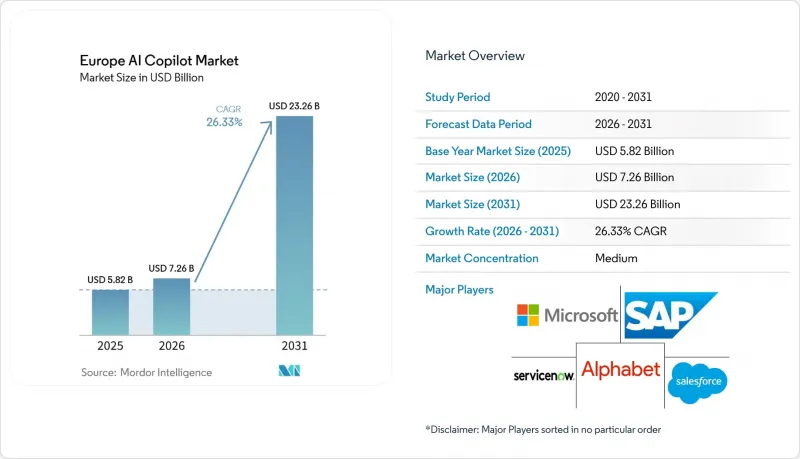
Mordor Intelligence에 의하면, 유럽의 AI 코파일럿 시장 규모는 2025년에 58억 2,000만 달러로 평가되었고, 2026년에 72억 6,000만 달러로 추정되고, 2031년까지 233억 6,000만 달러에 이를 것으로 예측되며, 2026-2031년 CAGR 26.33%로 성장할 전망입니다.
본 보고서는 코파일럿 유형별(범용 생산성 코파일럿 등), 도입 형태별(클라우드 기반, 하이브리드형, 온프레미스형), 조직 규모별(대기업, 중소기업), 용도별(지식 업무 및 생산성 지원 등), 최종 사용자 산업별(은행, 금융서비스 및 보험(BFSI), 소매 및 전자상거래 등), 그리고 지역별로 분류되어 있습니다. 시장 전망은 금액(달러) 기준으로 제시되어 있습니다.
유럽의 AI 코파일럿 시장 동향 및 인사이트
역할에 특화된 생산성 자동화에 대한 기업 수요 증가
유럽의 AI 코파일럿 시장은 특정 역할에서 반복적인 업무를 제거하는 도구로 기업의 구매 우선순위가 명확하게 이동하고 있는 점에 힘입어 성장하고 있습니다. 마이크로소프트는 2026년 4월, 액센츄어가 전 세계 직원 74만 3,000명에게 Microsoft 365 Copilot을 도입했다고 발표했으며, 이는 당시 공개된 기업용 AI 도입 사례 중 최대 규모였습니다. 잉글랜드 국민보건서비스(NHS England)는 2026년 6월, 90개 기관을 대상으로 한 시범 운영을 거쳐 2026년 10월까지 50만 5,000명의 임상 및 지원 직원에게 Microsoft 365 Copilot 접근 권한을 부여할 것이라고 확인했습니다. 이 시범 운영을 통해 하루 평균 43분의 사무 업무 시간 단축 효과가 확인되었으며, 대규모 고용주들에게 전 직원을 대상으로 한 확대 적용 사례를 평가할 수 있는 구체적인 벤치마크를 제공했습니다. 학술적 증거도 이러한 방향성을 뒷받침하고 있으며, 2025년 『The Quarterly Journal of Economics』에 게재된 연구에 따르면, 측정 대상 환경에서 AI 지원으로 근로자의 생산성이 평균 15% 향상된 것으로 밝혀졌습니다. 더 많은 대기업들이 특정 업무에서 시간 단축 및 생산성 향상을 입증함에 따라, 유럽의 AI 코파일럿 시장에서는 수요가 ‘임의적인 시범 도입’에서 ‘계획적인 운영 예산’으로 전환되고 있습니다.
전체 지식 워크플로우에 걸친 생성형 AI 도입 확대
유럽의 AI 코파일럿 시장은 기업의 일상 업무에 AI가 더욱 광범위하게 정착됨에 따라 더욱 탄력을 받고 있습니다. 유로스타트(Eurostat) 보고서에 따르면, 2025년에는 직원 10명 이상의 EU 기업 중 19.95%가 AI 기술을 활용하고 있으며, 이는 2024년 대비 6.47포인트 증가한 수치입니다. 대기업이 가장 큰 기여를 하고 있으며, 직원 250명 이상의 조직에서 AI 이용률은 55.03%에 달했습니다. 유럽중앙은행(ECB)은 2025년 4분기 시점에서 유로존 기업의 38%가 이미 AI 도입의 고도화된 단계에 있다고 발표했습니다. ECB의 조사에 따르면, AI를 대폭 활용하고 있다고 보고한 기업은 AI를 도입하지 않은 기업에 비해 향후 3개월간 매출이 21% 증가할 것으로 전망하고 있으며, 이것이 코파일럿이 단순한 기술적 업그레이드가 아닌 단기적인 비즈니스 도구로서 경영진 사이에서 논의되고 있는 이유 중 하나입니다. 이처럼 기업 내 AI에 대한 수용도가 확산됨에 따라, 유럽의 AI 코파일럿 시장에서는 AI를 활용한 워크플로우에 이미 익숙해져 있으며, 보다 체계적인 도입으로 전환해 가고 있는 구매자층이 확대되고 있습니다.
데이터 유출 및 프롬프트 공개에 대한 기업의 우려
유럽의 AI 코파일럿 시장에서는 여전히 주저하는 모습이 보이며, 사용자 및 규정 준수 담당 팀은 프롬프트, 출력 결과, 그리고 기업 컨텐츠가 어떻게 처리되는지에 대해 확신을 갖지 못하고 있습니다. 유로스타트(Eurostat) 보고서에 따르면, 2025년에 AI 도입을 검토했으나 도입에 이르지 못한 EU 기업의 48.83%가 데이터 보호 및 개인정보 보호에 대한 우려를 주요 장벽으로 꼽았습니다. 이는 내부 컨텐츠에 개인정보나 규제 대상 정보가 포함되는 경우가 많은 공공 서비스, 의료 및 기타 분야에서 특히 중요한 문제입니다. 잉글랜드 국민보건서비스(NHS)의 단계적 도입 사례도 대규모 공공 기관이 신중하게 움직이고 있음을 보여주며, 먼저 시범 사업을 시작한 뒤 수십만 명의 사용자로 접근을 확대되고 있습니다. 마이크로소프트가 국내 데이터 처리로 전환하고 있는 점도, 데이터 취급에 대한 우려가 이 지역의 제품 아키텍처에 영향을 미칠 만큼 중요하다는 사실을 더욱 잘 보여줍니다. 데이터 유출 위험이 충분히 관리되고 있다고 구매자가 완전히 확신하기 전까지는 유럽의 AI 코파일럿 시장에서 기밀성이 높은 환경에서는 심사 주기가 장기화되고 초기 도입 범위가 계속 좁아질 것입니다.
부문 분석
2025년, 범용 생산성 코파일럿은 유럽 AI 코파일럿 시장의 40.12%를 차지했습니다. 이는 일상적인 사무 업무에서 이미 널리 사용되고 있는 종합적인 엔터프라이즈 제품군이 가진 초기 우위를 반영한 것입니다. 유럽의 AI 코파일럿 시장은 당초 이러한 도구를 통해 성장했습니다. 이는 Microsoft 365나 Google Workspace를 이미 사용하고 있는 기업들에게 번들된 접근 권한 덕분에 도입 장벽이 낮아졌기 때문입니다. 일반적인 문서 작성, 요약, 검색, 업무 지원과 같은 기능은 워크플로우 재설계가 필요한 고도로 전문화된 이용 사례에 비해 도입이 용이했습니다. 이로 인해, 고도의 기술적 통합 없이도 가시적인 성과를 원했던 기업들에게 범용형 제품이 가장 실용적인 도입의 관문이 되었습니다. 또한, 조달 부서가 완전히 새로운 공급업체와의 거래 경로를 개척하는 대신 기존 소프트웨어 계약 관계를 확대할 수 있었기 때문에 플랫폼 공급업체에게도 판매 측면에서 선점 우위를 가져다주었습니다.
현재 이러한 성장 패턴은 변화하고 있으며, 산업 특화형 코파일럿 시장은 2031년까지 연평균 성장률(CAGR) 28.84%로 확대될 것으로 예측됩니다. 에어버스는 2026년 5월, 미스트랄 AI와 제휴하여 해당 기업의 제품군을 비행 안전 지원, 기술 문서 자동화, 설계 신속화 등의 항공우주 엔지니어링 업무에 활용할 것이라고 발표했습니다. 이 사례는 특히 정확도, 전문용어, 관리된 도입이 광범위한 범용 지원보다 더 중요시되는 분야에서 유럽의 AI 코파일럿 업계에서 전문 특화형 코파일럿이 주목받고 있는 이유를 보여줍니다. 기능별 워크플로우 코파일럿은 순수한 생산성 향상 도구보다 반복 가능한 업무와 밀접하게 관련되어 있기 때문에 인사, 재무, 공급망 프로세스에서 여전히 중요한 역할을 수행하고 있습니다. 기술·엔지니어링 코파일럿도 그 기능을 심화시키고 있으며, 지멘스는 2025년 11월 TIA Portal 버전 19 및 20 내에서 매니지드 서비스로 ‘Engineering Copilot TIA’를 출시함으로써 이러한 추세를 보여주었습니다.
2026년에는 클라우드 기반 도입이 시장의 71.24%를 차지할 것으로 추정되며, 여전히 많은 구매자가 신속한 설정, 쉬운 업데이트, 그리고 단순한 운영 모델을 선호하는 것으로 나타났습니다. 이러한 높은 점유율은 기업 사용자에게 이미 친숙한 ‘클라우드 퍼스트’ 환경을 통해 코파일럿을 제공하는 주요 소프트웨어 생태계의 영향도 반영하고 있습니다. 따라서 유럽의 AI 코파일럿 시장은 큰 호스팅 제약 없이 표준 상용 제품을 도입할 수 있는 조직에서 가장 빠르게 성장하고 있습니다. 클라우드는 기업이 예측 가능한 구독 구조를 원하고, AI 서비스를 위해 별도로 사내 인프라를 구축하기를 원하지 않는 경우 여전히 매력적인 선택지입니다. 또한, 규제가 엄격한 업무 기능에 비해 데이터 기밀성이 낮은 광범위한 사무 생산성 이용 사례에도 적합합니다.
반면, 하이브리드 배포는 2031년까지 연평균 성장률(CAGR) 29.16%를 나타낼 것으로 예측되며, 이는 이용 사례의 기밀성이 높아짐에 따라 수요가 어떤 방향으로 이동하고 있는지를 보여줍니다. 유럽 전역에서 마이크로소프트의 온프레미스 처리 확대는 대형 클라우드 벤더들조차도 로컬 제어에 대한 높아지는 기대에 적응하고 있음을 보여줍니다. Aleph Alpha와 STACKIT 역시 PhariaAI를 ‘주권형 AI-as-a-Service’로 포지셔닝하여, 규제 대상 기업 및 공공 기관을 대상으로 EU 내에서 완전히 호스팅되는 인프라를 통해 제공합니다. 온프레미스 배포는 유럽의 AI 코파일럿 시장에서 여전히 틈새 선택지이지만, 외부 처리가 승인되기 어려운 국방, 중요 인프라, 중앙 행정 분야에서는 중요한 역할을 하고 있습니다. 따라서 유럽의 AI 코파일럿 시장에서는 클라우드가 계속해서 주도적인 위치를 유지할 것이지만, 편의성과 엄격한 데이터 처리 규정의 균형을 맞추어야 하는 워크로드의 경우 하이브리드 방식이 선호되는 설계가 될 것입니다.
기타 혜택 :
- 엑셀 형식 시장 예측(ME) 시트
- 3개월간의 애널리스트 지원
자주 묻는 질문
목차
제1장 서론
제2장 조사 방법
제3장 주요 요약
제4장 시장 구도
제5장 시장 규모 및 성장 예측
제6장 경쟁 구도
제7장 시장 기회 및 향후 전망
AJYAccording to Mordor Intelligence, the Europe AI copilot market size was valued at USD 5.82 billion in 2025, USD 7.26 billion in 2026 and is projected to reach USD 23.36 billion by 2031, growing at a CAGR of 26.33% during 2026-2031.
This report is Segmented by Copilot Type (Horizontal Productivity Copilots, and More), Deployment (Cloud-Based, Hybrid, and On-Premises), Organization Size (Large Enterprises, and Small and Medium Enterprises), Application (Knowledge Work and Productivity Assistance, and More), End-User Industry (BFSI, Retail and E-Commerce, and More), and Geography. The Market Forecasts are Provided in Terms of Value (USD).
Europe AI Copilot Market Trends and Insights
Growing Enterprise Demand for Role-Specific Productivity Automation
The Europe AI copilot market is gaining from a clear shift in enterprise buying priorities toward tools that remove repetitive work in defined roles. Microsoft stated in April 2026 that Accenture had deployed Microsoft 365 Copilot to 743,000 employees globally, making it the largest publicly announced enterprise AI deployment at that time. NHS England confirmed in June 2026 that 505,000 clinical and support staff would receive access to Microsoft 365 Copilot by October 2026, following a pilot across 90 organizations. The same pilot showed average savings of 43 minutes per administrative task day, providing large employers with a concrete benchmark for evaluating workforce-wide rollout cases. Academic evidence also supports this direction, with a 2025 study in The Quarterly Journal of Economics finding that AI assistance raised worker productivity by 15% on average in the measured setting. As more large organizations validate time savings and output gains in defined tasks, the Europe AI copilot market is seeing demand move from optional testing into planned operating budgets.
Rising Adoption of Generative AI Across Knowledge Workflows
The Europe AI copilot market is also being lifted by a broader normalization of AI in day-to-day enterprise activity. Eurostat reported that 19.95% of EU enterprises with 10 or more employees used AI technologies in 2025, up by 6.47 percentage points from 2024. Large enterprises were the strongest contributors, with AI use reaching 55.03% among organizations with 250 or more employees. The European Central Bank stated that 38% of euro area firms were already at an advanced stage of AI adoption in Q4 2025. The same ECB study found that firms reporting significant AI use expected 21% higher turnover over the following 3 months than non-users, which helps explain why copilots are being discussed at the management level as a near-term business tool rather than solely as a technical upgrade. This wider base of enterprise AI familiarity is giving the Europe AI copilot market a larger pool of buyers that are already comfortable with AI-enabled workflows and are now moving toward more structured deployment.
Enterprise Concerns Over Data Leakage and Prompt Exposure
The Europe AI copilot market still faces hesitation, where users and compliance teams are unsure how prompts, outputs, and enterprise content are handled. Eurostat reported that 48.83% of EU enterprises that considered adopting AI but did not do so cited data protection and privacy concerns as a main barrier in 2025. This is especially important in public services, healthcare, and other settings where internal content often includes personal or regulated information. NHS England's staged rollout also shows that large public organizations are moving carefully, beginning with pilots before scaling access to hundreds of thousands of users. Microsoft's move toward in-country processing further indicates that data handling concerns are important enough to influence product architecture in the region. Until buyers are fully confident that data exposure risks are under control, the Europe AI copilot market will continue to see longer review cycles and narrower early-deployment scopes in sensitive environments.
Other drivers and restraints analyzed in the detailed report include:
- Expansion of Microsoft, Google, and Salesforce Ecosystems in Europe
- Regulatory Pressure on Data Governance and Traceability Driving Trusted Copilot Deployments
- Integration Complexity with Legacy Enterprise Applications
For complete list of drivers and restraints, kindly check the Table Of Contents.
Segment Analysis
Horizontal Productivity Copilots held 40.12% of the Europe AI copilot market in 2025, which reflects the early advantage of broad enterprise suites already used across daily office work. The Europe AI copilot market initially expanded through these tools because bundled access reduced deployment friction for companies already using Microsoft 365 or Google Workspace. General drafting, summarization, search, and task support were easier to launch than highly specialized use cases that needed workflow redesign. This made horizontal products the most practical entry point for enterprises that wanted visible gains without deep technical integration. It also gave platform vendors a head start in distribution because procurement teams could expand existing software relationships rather than open entirely new vendor tracks.
The growth pattern is now shifting, as Industry-Specific Copilots are projected to advance at a 28.84% CAGR through 2031. Airbus stated in May 2026 that it partnered with Mistral AI to use the company's product suite for aerospace engineering tasks such as flight safety support, technical documentation automation, and design acceleration. That example shows why specialized copilots are gaining attention in the Europe AI copilot industry, especially where accuracy, domain language, and controlled deployment matter more than broad generic assistance. Functional Workflow Copilots remain important in HR, finance, and supply chain processes because they sit closer to repeatable business work than pure productivity tools do. Technical and Engineering Copilots are also gaining depth, and Siemens showed this in November 2025 when it launched Engineering Copilot TIA as a managed service inside TIA Portal versions 19 and 20.
Cloud-based deployment accounted for 71.24% of the market in 2026, showing that most buyers still prefer faster setup, easier updates, and simpler operating models. This large share also reflects the influence of major software ecosystems that deliver copilots through cloud-first environments already familiar to enterprise users. The Europe AI copilot market has therefore grown fastest in organizations that can adopt standard commercial offerings without major hosting restrictions. Cloud remains attractive where companies want predictable subscription structures and do not want to build separate internal infrastructure for AI services. It also fits well with broad office productivity use cases where data sensitivity is lower than in tightly regulated operating functions.
At the same time, hybrid deployment is projected to grow at a 29.16% CAGR through 2031, which shows where demand is heading as use cases become more sensitive. Microsoft's in-country processing expansion across Europe indicates that even large cloud vendors are adapting to stronger expectations around local control. Aleph Alpha and STACKIT also positioned PhariaAI as a sovereign AI-as-a-service offering, delivered via fully EU-hosted infrastructure for regulated enterprises and public-sector bodies. On-premises deployment remains a narrower path within the Europe AI copilot market, but it matters in defense, critical infrastructure, and central administration where external processing can be hard to approve. This is why the Europe AI copilot market is likely to maintain its cloud leadership, while hybrid becomes the preferred design for workloads that balance convenience with strict data-handling rules.
Complete Report Scope:
- By Copilot Type
- Horizontal Productivity Copilots
- Functional Workflow Copilots
- Technical and Engineering Copilots
- Industry-Specific Copilots
- By Deployment
- Cloud-Based
- Hybrid
- On-Premises
- By Organization Size
- Large Enterprises
- Small and Medium Enterprises
- By Application
- Knowledge Work and Productivity Assistance
- Software Engineering and Technical Operations
- Customer and Employee Service Operations
- Sales, Marketing and Revenue Enablement
- Business Process and Enterprise Operations
- Regulated Industry Workflows
- By End-User Industry
- IT and Telecommunication
- BFSI
- Healthcare and Life Sciences
- Retail and E-Commerce
- Industrial Manufacturing
- Education and Research Institutions
- Media and Entertainment
- Government and administration
- Energy and Utilities
- Other end-user industries
- By Geography
- Germany
- United Kingdom
- France
- Russia
- Spain
- Rest of Europe
List of Companies Covered in this Report:
- Microsoft Corporation
- Alphabet Inc.
- Salesforce, Inc.
- SAP SE
- ServiceNow, Inc.
- Oracle Corporation
- Adobe Inc.
- Atlassian Corporation Plc
- Zoom Communications, Inc.
- Zendesk, Inc.
- HubSpot, Inc.
- UiPath, Inc.
- Writer, Inc.
- Glean Technologies, Inc.
- Cognigy GmbH
- Cohere
- Mistral AI SAS
- Aleph Alpha GmbH
- Intercom
- Aisera, Inc.
Additional Benefits:
- The market estimate (ME) sheet in Excel format
- 3 months of analyst support
TABLE OF CONTENTS
1 INTRODUCTION
- 1.1 Study Assumptions and Market Definition
- 1.2 Scope of the Study
2 RESEARCH METHODOLOGY
3 EXECUTIVE SUMMARY
4 MARKET LANDSCAPE
- 4.1 Market Overview
- 4.2 Market Drivers
- 4.2.1 Growing Enterprise Demand for Role-Specific Productivity Automation
- 4.2.2 Rising Adoption of Generative AI Across Knowledge Workflows
- 4.2.3 Expansion of Microsoft, Google, and Salesforce Ecosystems in Europe
- 4.2.4 Regulatory Pressure on Data Governance and Traceability, Driving Trusted Copilot Deployments
- 4.2.5 Shift Toward Multilingual Copilot Interfaces for European Workforces
- 4.2.6 Use of Domain-Tuned Copilots in High-Value Regulated Functions
- 4.3 Market Restraints
- 4.3.1 Enterprise Concerns Over Data Leakage and Prompt Exposure
- 4.3.2 Integration Complexity With Legacy Enterprise Applications
- 4.3.3 AI Governance Gaps Across Mid-Market Buyers
- 4.3.4 Budget Scrutiny on Recurring AI Software Subscriptions
- 4.4 Industry Value Chain Analysis
- 4.5 Technology Outlook
- 4.6 Regulatory Landscape
- 4.7 Porter's Five Forces Analysis
- 4.7.1 Threat of New Entrants
- 4.7.2 Bargaining Power of Suppliers
- 4.7.3 Bargaining Power of Buyers
- 4.7.4 Threat of Substitutes
- 4.7.5 Competitive Rivalry
5 MARKET SIZE AND GROWTH FORECASTS (VALUE)
- 5.1 By Copilot Type
- 5.1.1 Horizontal Productivity Copilots
- 5.1.2 Functional Workflow Copilots
- 5.1.3 Technical and Engineering Copilots
- 5.1.4 Industry-Specific Copilots
- 5.2 By Deployment
- 5.2.1 Cloud-Based
- 5.2.2 Hybrid
- 5.2.3 On-Premises
- 5.3 By Organization Size
- 5.3.1 Large Enterprises
- 5.3.2 Small and Medium Enterprises
- 5.4 By Application
- 5.4.1 Knowledge Work and Productivity Assistance
- 5.4.2 Software Engineering and Technical Operations
- 5.4.3 Customer and Employee Service Operations
- 5.4.4 Sales, Marketing and Revenue Enablement
- 5.4.5 Business Process and Enterprise Operations
- 5.4.6 Regulated Industry Workflows
- 5.5 By End-User Industry
- 5.5.1 IT and Telecommunication
- 5.5.2 BFSI
- 5.5.3 Healthcare and Life Sciences
- 5.5.4 Retail and E-Commerce
- 5.5.5 Industrial Manufacturing
- 5.5.6 Education and Research Institutions
- 5.5.7 Media and Entertainment
- 5.5.8 Government and administration
- 5.5.9 Energy and Utilities
- 5.5.10 Other end-user industries
- 5.6 By Geography
- 5.6.1 Germany
- 5.6.2 United Kingdom
- 5.6.3 France
- 5.6.4 Russia
- 5.6.5 Spain
- 5.6.6 Rest of Europe
6 COMPETITIVE LANDSCAPE
- 6.1 Market Concentration
- 6.2 Strategic Moves
- 6.3 Market Share Analysis
- 6.4 Company Profiles (includes Global Level Overview, Market Level Overview, Core Segments, Financials as available, Strategic Information, Market Rank/Share, Products and Services, Recent Developments)
- 6.4.1 Microsoft Corporation
- 6.4.2 Alphabet Inc.
- 6.4.3 Salesforce, Inc.
- 6.4.4 SAP SE
- 6.4.5 ServiceNow, Inc.
- 6.4.6 Oracle Corporation
- 6.4.7 Adobe Inc.
- 6.4.8 Atlassian Corporation Plc
- 6.4.9 Zoom Communications, Inc.
- 6.4.10 Zendesk, Inc.
- 6.4.11 HubSpot, Inc.
- 6.4.12 UiPath, Inc.
- 6.4.13 Writer, Inc.
- 6.4.14 Glean Technologies, Inc.
- 6.4.15 Cognigy GmbH
- 6.4.16 Cohere
- 6.4.17 Mistral AI SAS
- 6.4.18 Aleph Alpha GmbH
- 6.4.19 Intercom
- 6.4.20 Aisera, Inc.
7 MARKET OPPORTUNITIES AND FUTURE OUTLOOK
- 7.1 White-Space and Unmet-Need Assessment