
|
시장보고서
상품코드
2099865
북미의 AI 코파일럿 시장 : 시장 점유율 분석, 업계 동향 및 통계, 성장 예측(2026-2031년)North America AI Copilot - Market Share Analysis, Industry Trends & Statistics, Growth Forecasts (2026 - 2031) |
||||||
 Mordor Intelligence
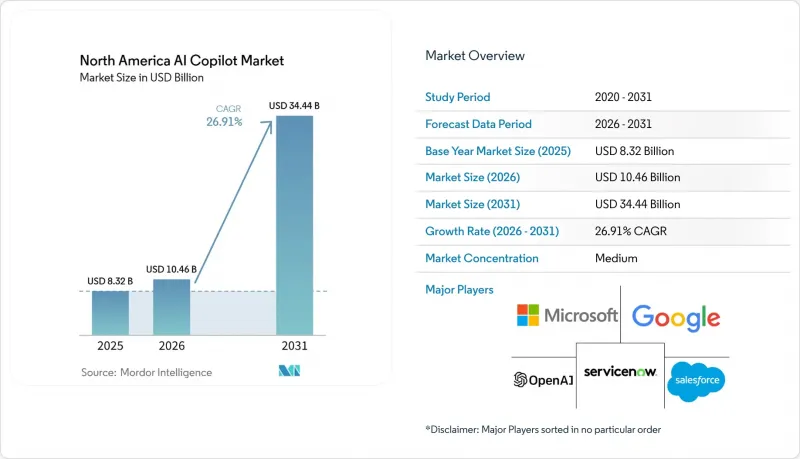
Mordor Intelligence에 의하면, 북미의 AI 코파일럿 시장 규모는 2025년 83억 2,000만 달러로 평가되었고, 2026년 104억 6,000만 달러에서 2031년까지 344억 4,000만 달러로 확대될 것으로 예측되며, 2026-2031년 연평균 복합 성장률(CAGR)은 26.91%를 나타낼 전망입니다.
본 보고서는 코파일럿 유형별(범용 생산성 코파일럿, 기능별 워크플로우 코파일럿 등), 도입 형태별(클라우드 기반 등), 조직 규모별(대기업, 중소기업), 용도별(지식 업무 및 생산성 지원 등), 최종 사용자 산업별(BFSI 등), 지역별로 분류되어 있습니다. 시장 전망은 금액(달러) 기준으로 제시되어 있습니다.
북미의 AI 코파일럿 시장 동향 및 인사이트
코파일럿 워크플로우를 통한 기업의 생산성 향상
코파일럿 주도 워크플로우를 통한 기업의 생산성 향상은 북미 AI 코파일럿 시장 수요를 견인하는 핵심 요인입니다. OpenAI는 2025년 12월, 조사 대상 직원의 75%가 작업 속도 및 결과물의 품질 향상을 체감했다고 보고했습니다. 또한 기업 사용자들은 AI의 지원으로 인해 실제 근무일 기준 40-60분의 시간 단축 효과를 보았다고 응답했으며, 데이터 사이언스자와 엔지니어들은 하루 최대 80분의 시간 단축을 보고했습니다. 이러한 시간 절약은 초안 작성, 요약, 검토, 검색이 업무 시간의 큰 비중을 차지하는 의사소통이 빈번한 직종에서 특히 중요합니다. 또한, 직원들이 코파일럿을 활용하여 상급 직원의 수동적인 지원을 기다리지 않고도 사내 지식을 활용할 수 있기 때문에 기업들은 온보딩 과정의 신속화에서도 가치를 발견하고 있습니다. 이러한 효과로 인해 복잡한 업무 환경에서의 교육 부담이 경감되어, 채용 후 팀이 더 빨리 안정적인 성과를 낼 수 있게 됩니다. 또한 이것이 재무 부서 리더가 코파일럿을 단순한 소프트웨어 실험이 아닌 업무 효율화 도구로 더욱 주목하고 있는 이유이기도 합니다.
지식 업무 전반에 걸친 Microsoft 365의 보급 범위
일상적인 지식 업무 분야에서 마이크로소프트가 차지하는 보급 우위는 북미 AI 코파일럿 시장을 지속적으로 형성하고 있습니다. 이 회사의 상용 Microsoft 365 사용자 기반은 일상 업무에서 Word, Excel, Outlook, Teams 및 관련 데이터 레이어를 이미 활용하고 있는 조직에 대한 직접적인 접근 경로가 되고 있습니다. Microsoft News는 2026년 6월, 인포시스(Infosys), TCS, 위프로(Wipro)가 6개월도 채 되지 않아 30만 명 이상의 직원에게 Microsoft 365 Copilot을 배포했다고 보도했습니다. 이는 도입 장벽이 낮아지면 대기업이 얼마나 신속하게 움직일 수 있는지를 보여줍니다. 이러한 전략적 우위는 기업에 새로운 습관이나 관리 체계를 수반하는 또 다른 ‘그린필드’ 도구의 도입을 설득하는 것이 아니라, 기존 테넌트에 대한 판매를 통해 창출됩니다. 기업 데이터는 이미 Microsoft와 연동된 시스템 내에 존재하기 때문에 이로 인해 평가 주기가 단축되고 전환 비용이 높아집니다. 더 많은 워크플로가 내부 데이터를 기반으로 구축됨에 따라, 경쟁사인 프로덕티비티 코파일럿은 개별 테스트에서 출력 품질이 높게 나타나더라도 시장 진입 여지가 좁아지게 됩니다.
기업 데이터의 저장 위치 및 프롬프트 유출에 대한 우려
기업 데이터의 저장 위치 및 프롬프트 유출에 대한 우려는 대규모 도입에 있어 여전히 큰 제약 요인으로 작용하고 있습니다. 법무, 금융, 의료, 공공 부문의 구매 담당자들은 기밀성이 높은 프롬프트, 기록 및 파생된 출력이 허용 가능한 통제 하에 있다는 증명을 요구하는 경우가 많습니다. 단일 워크플로우에 여러 클라우드 서비스, 타사 모델 및 내부 저장소가 관여하는 경우, 이러한 요구 사항을 충족하는 것은 더욱 어려워집니다. 이 문제를 완화하기 위해서는 전용 환경 구축, 데이터 보존 기간이 0인 계약 조건, 더욱 강력한 데이터 유출 방지 대책, 그리고 더 엄격한 정책 적용이 필요하지만, 이러한 조치는 대개 검토에 소요되는 시간과 비용을 증가시킵니다. 중견 기업은 대기업과 동등한 보호 조치를 요구하면서도 대기업만큼의 조달 능력을 갖추지 못한 경우가 많기 때문에 이러한 부담을 가장 크게 떠안고 있습니다. 이 때문에 비즈니스 사례가 탄탄해 보일지라도, 코파일럿에 대한 기대감에서 예상되는 것보다 도입 주기가 길어지게 됩니다.
부문 분석
2025년 북미 AI 코파일럿 시장에서 범용형 생산성 코파일럿은 42.18%를 차지했습니다. 이러한 우위는 일반적인 생산성 스위트 내에서 이메일 처리, 문서 작성, 회의 요약, 스프레드시트 작업, 일상적인 검색 작업 등 폭넓은 용도로 활용될 수 있기 때문입니다. 많은 기업에서는 코파일럿 도입 전부터 필요한 라이선스, ID 관리, 데이터 구조가 이미 갖춰져 있었기 때문에 도입 시 장벽이 낮아졌습니다. 기능별 워크플로우 코파일럿도 기세를 더하고 있습니다. 이는 인사, 재무, 영업 각 플랫폼에서 단순한 채팅 지원이 아닌, 프로세스 고유의 업무에 AI를 접목하는 능력이 향상되고 있기 때문입니다. 기술·엔지니어링용 코파일럿은 대상 사용자층이 제한적이지만, 코드, 테스트, 사고 대응 환경에서는 출력물의 품질을 판단하기 쉬우므로 여전히 중요한 위치를 차지하고 있습니다.
업종 특화형 코파일럿은 2026-2031년 연평균 성장률(CAGR) 29.24%를 나타낼 것으로 예측됩니다. 이러한 성장 속도는 규제가 엄격하거나 전문성이 높은 환경에서 범용적인 생산성 향상형 코파일럿보다 특정 분야에 적응된 도구가 더 명확한 성과를 낼 수 있다는 사실을 반영하고 있습니다. 의료 문서 작성, 법무 조사 지원, 독자적인 데이터를 기반으로 한 재무 분석은 모두 프리미엄 가격 책정과 고객 이탈률 감소를 정당화하는 강력한 근거가 되고 있습니다. SAP는 2026년 5월, Anthropic사의 ‘Claude’가 SAP Business AI Platform 내의 주요 에이전트형 추론 레이어로 기능하며, SAP의 전체 엔터프라이즈 인프라에서 ‘Joule’ 에이전트를 지원할 것이라고 발표했습니다. 이러한 움직임은 대형 소프트웨어 벤더들이 범용 모델을 엔터프라이즈 시스템과 연동된 비즈니스 특화형 인터페이스로 전환하고 있음을 보여줍니다. 북미 AI 코파일럿 시장에서 강력한 모델과 독자적인 수직 산업 데이터를 결합한 벤더는 도입이 확대됨에 따라 가장 견고한 입지를 확립할 가능성이 높을 것으로 보입니다.
2025년 북미 AI 코파일럿 시장 규모 중 클라우드 기반 도입이 75.41%를 차지했습니다. 이러한 선두 위상은 Microsoft 365, Salesforce, Google Workspace 및 관련 기업 소프트웨어를 통한 SaaS 제공의 우위를 반영한 것입니다. 클라우드 제공을 통해 벤더들은 기능을 신속하게 출시하고, 로컬 업그레이드가 필요 없는 모델 업데이트를 실현하며, 고객의 인프라 부담을 경감시킬 수 있었습니다. 온프레미스 배포는 에어갭 환경이나 엄격하게 격리된 환경이 여전히 필수적인 국방, 정보 기관, 중요 인프라 분야에서 여전히 중요한 역할을 수행했습니다. GitHub는 2026년 6월, AI 거버넌스를 위한 엔터프라이즈 관리 설정을 도입하여 조직이 Copilot 클라이언트 전반에 걸쳐 표준을 일원적으로 적용할 수 있는 수단을 제공함과 동시에, 클라우드 배포와 온프레미스 배포 간의 거버넌스 격차 일부를 해소했습니다.
하이브리드 배포는 2031년까지 연평균 성장률(CAGR) 28.83%로 확대될 것으로 예측됩니다. 이러한 성장을 주도하는 것은 클라우드 혁신의 속도와 기밀성이 높은 워크로드에 대한 보다 강력한 제어 기능을 모두 필요로 하는 기업들입니다. 금융 서비스, 의료, 정부 기관의 구매 담당자들은 규정 준수 문제를 야기하지 않으면서 모든 프롬프트나 문서를 퍼블릭 엔드포인트를 통해 라우팅할 수 없는 경우가 많습니다. 하이브리드 아키텍처는 위험이 낮은 작업에는 퍼블릭 클라우드의 용량을 활용하면서도, 특정 워크로드를 프라이빗 환경에 유지할 수 있는 방안을 제공합니다. AWS는 2026년 4월, 하이브리드 클라우드 서비스와 온프레미스 인프라를 아우르는 분산형 에이전트 AI 워크로드에 대한 논의를 통해 이러한 패턴을 강조했습니다. 이러한 분할 모델은 오케스트레이션의 복잡성을 증가시키지만, 순수한 클라우드 전용 또는 순수한 온프레미스 접근 방식보다 대기업의 실제 운영 환경에 더 잘 부합합니다.
기타 혜택 :
- 엑셀 형식 시장 예측(ME) 시트
- 3개월간의 애널리스트 지원
자주 묻는 질문
목차
제1장 서론
제2장 조사 방법
제3장 주요 요약
제4장 시장 구도
제5장 시장 규모 및 성장 예측
제6장 경쟁 구도
제7장 시장 기회 및 향후 전망
AJYAccording to Mordor Intelligence, the North America AI copilot market size is projected to expand from USD 8.32 billion in 2025 and USD 10.46 billion in 2026 to USD 34.44 billion by 2031, registering a CAGR of 26.91% between 2026 and 2031.
This report is Segmented by Copilot Type (Horizontal Productivity Copilots, Functional Workflow Copilots, and More), Deployment (Cloud-Based, and More), Organization Size (Large Enterprises, and Small and Medium Enterprises), Application (Knowledge Work and Productivity Assistance, and More), End-User Industry (BFSI, and More), and Geography. The Market Forecasts are Provided in Terms of Value (USD).
North America AI Copilot Market Trends and Insights
Enterprise Productivity Gains From Copilot Workflows
Enterprise productivity gains from copilot-led workflows are a central demand driver for the North America AI copilot market. OpenAI reported in December 2025 that 75% of surveyed workers saw better speed or output quality, while enterprise users linked AI support to 40 to 60 minutes saved in an active workday, and data scientists and engineers reported up to 80 minutes saved daily. Those time savings matter most in communications-heavy roles where drafting, summarizing, reviewing, and searching take a large share of the workday. Companies are also seeing value in faster onboarding because employees can use copilots to surface internal knowledge without waiting for manual support from senior staff. That effect reduces training friction in complex operating environments and helps teams reach stable output sooner after hiring. It also explains why finance leaders are paying closer attention to copilots as labor-efficiency tools rather than as isolated software experiments.
Microsoft 365 Distribution Reach Across Knowledge Work
Microsoft's distribution advantage across everyday knowledge work continues to shape the North America AI copilot market. The company's commercial Microsoft 365 base gives it a direct path into organizations that already rely on Word, Excel, Outlook, Teams, and related data layers for daily work. Microsoft News reported in June 2026 that Infosys, TCS, and Wipro scaled Microsoft 365 Copilot to more than 300,000 employees in under 6 months, which showed how quickly large organizations can move once deployment barriers are low. The strategic advantage comes from selling into existing tenancy, not from convincing enterprises to adopt a separate greenfield tool with new habits and new controls. This shortens evaluation cycles and increases switching costs because enterprise data already resides in Microsoft-connected systems. As more workflows are grounded in that internal data, competing productivity copilots have a narrower opening even when output quality appears strong in isolated tests.
Enterprise Data Residency and Prompt Leakage Concerns
Enterprise data residency and prompt leakage concerns remain significant constraints on adoption at scale. Buyers in legal, financial, healthcare, and public sector settings often need proof that sensitive prompts, records, and derived outputs remain under acceptable control. Those requirements become harder when multiple cloud services, third-party models, and internal repositories are involved in a single workflow. The mitigation path involves dedicated environments, zero-retention terms, stronger data loss prevention, and closer policy enforcement, but these steps usually add review time and cost. Mid-sized organizations bear this burden most, as they often seek the same protections as large enterprises but lack the same procurement capacity. This keeps rollout cycles longer than the excitement around copilots might suggest, even when the business case looks strong.
Other drivers and restraints analyzed in the detailed report include:
- Demand For Code, Content, and Knowledge Automation in Regulated Enterprises
- Secure Enterprise AI Stack Expansion on North America Cloud Infrastructure
- Hallucination Risk in High-Stakes Business Workflows
For complete list of drivers and restraints, kindly check the Table Of Contents.
Segment Analysis
Horizontal Productivity Copilots accounted for 42.18% of the North America AI copilot market in 2025. Their lead came from broad use across email handling, document drafting, meeting summaries, spreadsheet work, and everyday search tasks inside common productivity suites. Many enterprises already had the necessary licenses, identity controls, and data structures in place before Copilot activation, reducing friction at deployment time. Functional Workflow Copilots are also gaining ground because platforms in HR, finance, and sales are becoming better at embedding AI into process-specific tasks rather than simple chat assistance. Technical and Engineering Copilots serve a narrower user base, but they remain important because output quality is easier to judge in code, testing, and incident response environments.
Industry-Specific Copilots are projected to grow at a 29.24% CAGR from 2026 to 2031. That pace reflects the fact that domain-adapted tools can show clearer returns in regulated or specialized environments than broad productivity copilots usually can. Healthcare documentation, legal research support, and financial analysis grounded in proprietary data each create a strong case for premium pricing and lower churn. SAP announced in May 2026 that Anthropic's Claude would serve as the primary agentic reasoning layer within the SAP Business AI Platform and support Joule agents across SAP's enterprise base. This move showed how large software vendors are turning general-purpose models into business-specific interfaces tied to enterprise systems. In the North America AI copilot market, vendors that combine strong models with proprietary vertical data are likely to hold the most defensible positions as adoption deepens.
Cloud-based deployment accounted for 75.41% of the North America AI copilot market size in 2025. This lead reflected the dominance of SaaS delivery via Microsoft 365, Salesforce, Google Workspace, and related enterprise software. Cloud delivery helped vendors release features faster, update models without local upgrades, and lower the infrastructure burden placed on customers. On-premises deployment still mattered in defense, intelligence, and critical infrastructure settings where air-gapped or tightly isolated environments remained essential. GitHub introduced enterprise-managed settings for AI governance in June 2026, giving organizations a way to enforce standards centrally across Copilot clients and narrowing a part of the governance gap between cloud and local deployments.
Hybrid deployment is projected to expand at a 28.83% CAGR through 2031. Its growth is being driven by enterprises that need both cloud innovation speed and stronger control over highly sensitive workloads. Financial services, healthcare, and government buyers often cannot route every prompt and every document through public endpoints without raising compliance questions. Hybrid architectures give them a path to keep selected workloads in private environments while still using public cloud capacity for lower-risk tasks. AWS highlighted this pattern in April 2026 through its discussion of distributed agentic AI workloads across hybrid cloud services and localized infrastructure. This split model adds orchestration complexity, but it better aligns with the operational realities of large enterprises than a purely cloud-only or purely on-premises approach.
Complete Report Scope:
- By Copilot Type
- Horizontal Productivity Copilots
- Functional Workflow Copilots
- Technical and Engineering Copilots
- Industry-Specific Copilots
- By Deployment
- Cloud-Based
- Hybrid
- On-Premises
- By Organization Size
- Large Enterprises
- Small and Medium Enterprises
- By Application
- Knowledge Work and Productivity Assistance
- Software Engineering and Technical Operations
- Customer and Employee Service Operations
- Sales, Marketing and Revenue Enablement
- Business Process and Enterprise Operations
- Regulated Industry Workflows
- By End-User Industry
- IT and Telecommunication
- BFSI
- Healthcare and Life Sciences
- Retail and E-Commerce
- Industrial Manufacturing
- Education and Research Institutions
- Media and Entertainment
- Government and administration
- Energy and Utilities
- Other end-user industries
- By Geography
- United States
- Canada
- Mexico
List of Companies Covered in this Report:
- Microsoft Corporation
- Google LLC
- Salesforce, Inc.
- OpenAI, Inc.
- ServiceNow, Inc.
- Anthropic PBC
- Amazon Web Services, Inc.
- Adobe Inc.
- IBM Corporation
- Oracle Corporation
- SAP SE
- Workday, Inc.
- Atlassian Corporation Plc
- GitHub, Inc.
- Notion Labs, Inc.
- Replit, Inc.
- Tabnine Ltd.
- Sourcegraph, Inc.
- Glean Technologies, Inc.
- Cohere Inc.
Additional Benefits:
- The market estimate (ME) sheet in Excel format
- 3 months of analyst support
TABLE OF CONTENTS
1 INTRODUCTION
- 1.1 Study Assumptions and Market Definition
- 1.2 Scope of the Study
2 RESEARCH METHODOLOGY
3 EXECUTIVE SUMMARY
4 MARKET LANDSCAPE
- 4.1 Market Overview
- 4.2 Market Drivers
- 4.2.1 Enterprise-Wide Productivity Gains From Copilotized Workflows
- 4.2.2 Microsoft 365 Distribution Advantage Across Knowledge Work
- 4.2.3 Faster Internal Adoption Through Low-Friction SaaS Procurement
- 4.2.4 Expansion of Secure Enterprise AI Stack on North America Cloud Infrastructure
- 4.2.5 Rising Demand for Code, Content, and Knowledge Automation in Regulated Enterprises
- 4.2.6 Vendor Consolidation Around Native Copilot Bundles
- 4.3 Market Restraints
- 4.3.1 Enterprise Data Residency and Prompt Leakage Concerns
- 4.3.2 Model Hallucination Risk in High-Stakes Business Workflows
- 4.3.3 Copilot License Stacking and Budget Scrutiny
- 4.3.4 Fragmented Integration Across Legacy Applications and Data Silos
- 4.4 Impact of Macroeconomic Factors on the Market
- 4.5 Industry Value Chain Analysis
- 4.6 Technology Outlook
- 4.7 Regulatory Landscape
- 4.8 Porter's Five Forces Analysis
- 4.8.1 Threat of New Entrants
- 4.8.2 Bargaining Power of Suppliers
- 4.8.3 Bargaining Power of Buyers
- 4.8.4 Threat of Substitutes
- 4.8.5 Intensity of Competitive Rivalry
5 MARKET SIZE AND GROWTH FORECASTS (VALUE)
- 5.1 By Copilot Type
- 5.1.1 Horizontal Productivity Copilots
- 5.1.2 Functional Workflow Copilots
- 5.1.3 Technical and Engineering Copilots
- 5.1.4 Industry-Specific Copilots
- 5.2 By Deployment
- 5.2.1 Cloud-Based
- 5.2.2 Hybrid
- 5.2.3 On-Premises
- 5.3 By Organization Size
- 5.3.1 Large Enterprises
- 5.3.2 Small and Medium Enterprises
- 5.4 By Application
- 5.4.1 Knowledge Work and Productivity Assistance
- 5.4.2 Software Engineering and Technical Operations
- 5.4.3 Customer and Employee Service Operations
- 5.4.4 Sales, Marketing and Revenue Enablement
- 5.4.5 Business Process and Enterprise Operations
- 5.4.6 Regulated Industry Workflows
- 5.5 By End-User Industry
- 5.5.1 IT and Telecommunication
- 5.5.2 BFSI
- 5.5.3 Healthcare and Life Sciences
- 5.5.4 Retail and E-Commerce
- 5.5.5 Industrial Manufacturing
- 5.5.6 Education and Research Institutions
- 5.5.7 Media and Entertainment
- 5.5.8 Government and administration
- 5.5.9 Energy and Utilities
- 5.5.10 Other end-user industries
- 5.6 By Geography
- 5.6.1 United States
- 5.6.2 Canada
- 5.6.3 Mexico
6 COMPETITIVE LANDSCAPE
- 6.1 Market Concentration
- 6.2 Strategic Moves
- 6.3 Market Share Analysis
- 6.4 Company Profiles (includes Global Level Overview, Market Level Overview, Core Segments, Financials as available, Strategic Information, Market Rank/Share, Products and Services, Recent Developments)
- 6.4.1 Microsoft Corporation
- 6.4.2 Google LLC
- 6.4.3 Salesforce, Inc.
- 6.4.4 OpenAI, Inc.
- 6.4.5 ServiceNow, Inc.
- 6.4.6 Anthropic PBC
- 6.4.7 Amazon Web Services, Inc.
- 6.4.8 Adobe Inc.
- 6.4.9 IBM Corporation
- 6.4.10 Oracle Corporation
- 6.4.11 SAP SE
- 6.4.12 Workday, Inc.
- 6.4.13 Atlassian Corporation Plc
- 6.4.14 GitHub, Inc.
- 6.4.15 Notion Labs, Inc.
- 6.4.16 Replit, Inc.
- 6.4.17 Tabnine Ltd.
- 6.4.18 Sourcegraph, Inc.
- 6.4.19 Glean Technologies, Inc.
- 6.4.20 Cohere Inc.
7 MARKET OPPORTUNITIES AND FUTURE OUTLOOK
- 7.1 White-Space and Unmet-Need Assessment