

|
시장보고서
상품코드
2099967
공급망 최적화용 양자 소프트웨어 시장 : 시장 점유율 분석, 업계 동향 및 통계, 성장 예측(2026-2031년)Quantum Software For Supply Chain Optimization - Market Share Analysis, Industry Trends & Statistics, Growth Forecasts (2026 - 2031) |
||||||
 Mordor Intelligence
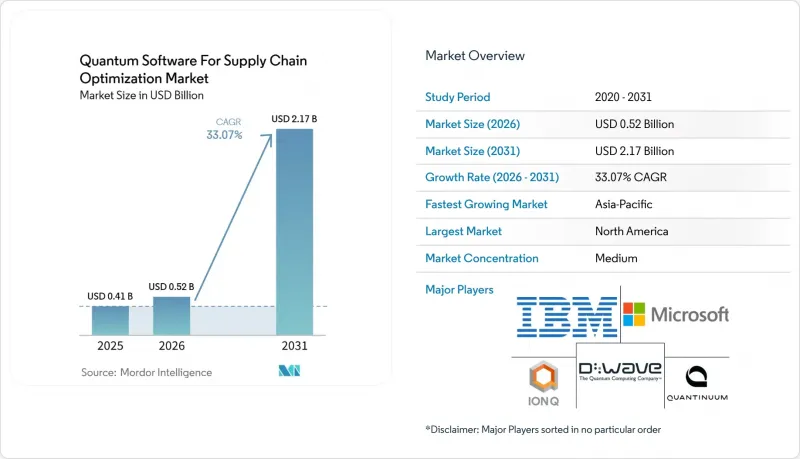
공급망 최적화용 양자 소프트웨어 시장 규모는 2025년에 4억 1,000만 달러로 평가되었고, 2026년 5억 2,000만 달러로 성장이 추정되고, 2026-2031년 CAGR 33.07%로 성장을 지속할 전망이며, 2031년에는 21억 7,000만 달러에 이를 것으로 예측됩니다.
본 보고서는 솔루션별(소프트웨어 및 서비스), 도입 형태별(클라우드 기반, 하이브리드형, 온프레미스형), 용도별(운송·경로 최적화, 재고 최적화, 생산 계획·스케줄링 등), 최종 사용자별(공업 제조, 소매 및 전자상거래 등), 지역별로 분류되어 있습니다. 시장 전망은 금액(달러)으로 표시되어 있습니다.
세계의 공급망 최적화용 양자 소프트웨어 시장 동향 및 인사이트
물류 분야의 복잡한 네트워크 최적화에 대한 수요 증가
공급망 최적화용 양자 소프트웨어 시장은 현대 물류 네트워크가 매우 대규모의 배송 지도, 다양한 차량 구성, 엄격한 시간 제한, 그리고 실시간 혼란 요인을 수반하게 되었습니다는 사실로부터 혜택을 받고 있습니다. 이러한 상황은 특히 기업이 변화하는 운영 조건 하에서 빈번한 재계산을 필요로 할 때, 기존 솔버를 실용적인 계획 기간의 범위를 벗어날 정도로 문제 규모를 키우고 있습니다. 2025년에 발표된 동료 심사 연구에 따르면, 양자 기술을 활용한 경로 최적화를 통해 연료 소비량이 12% 감소하고 배송 시간이 18% 단축된 것이 입증되어, 구매자에게 이론적인 약속이 아닌 명확한 운영상의 벤치마크를 제공합니다. 2026년에 발표된 연구에서도 제약 조건이 밀집된 차량 경로 계획 벤치마크에서 하이브리드 양자 타부 탐색 접근법이 동등한 고전적 휴리스틱 기법을 능가하는 성능을 보인 것으로 밝혀졌습니다. 실용적인 효과로 볼 때, 정차 패턴의 밀도가 높고 계획 기간이 촉박한 기업은 단순한 경로 구조만을 관리하는 사업자보다 더 빨리 그 가치를 실감할 수 있을 것입니다. 프라운호퍼 SCS는 또한 물류, 생산, 소매 분야의 NISQ 대응 스케줄링 및 예측에 관한 연구도 추진하고 있으며, 이를 통해 공급망 최적화용 양자 소프트웨어 시장에서 연구 프로그램에서 상용 도입으로 이어지는 단기적인 로드맵이 뒷받침되고 있습니다.
변동이 심한 계획에서 하이브리드 양자·고전 워크플로우를 통한 ROI의 조기 실현
밸류 체인 최적화를 위한 양자 소프트웨어 시장도 급속히 발전하고 있습니다. 이는 완벽한 내결함성을 갖춘 기계가 이용 가능해지기 전에, 하이브리드 양자·고전 워크플로가 가치를 창출하기 때문입니다. 이를 통해 그동안 양자 컴퓨팅을 ‘단기적인 비즈니스 활용이 제한적이고, 매우 장기적인 투자’로 인식해 온 재무팀의 경우, 투자 회수 기간에 대한 논의가 단축됩니다. BASF와 D-Wave는 2025년 11월, 하이브리드 용도를 통해 생산 스케줄링 시간을 10시간에서 5초로 단축하고, 스케줄링 지연을 14%, 설정 시간을 9%, 탱크 하역 시간을 최대 18% 줄였습니다고 보고했습니다. 2026년 2월 NTT 데이터 독일과 NTT 리서치가 실시한 조사에 따르면, IonQ 하드웨어에서 하이브리드 QUBO 모델을 활용함으로써 에어버스의 물류 제약 조건 하에서 비용, 배출량, 납기일을 동시에 최적화할 수 있는 것으로 나타났습니다. 이는 제조업체나 물류 사업자가 연중 동일한 계획 주기를 여러 번 재실행할 경우, 계획의 품질이 약간만 향상되어도 의미 있는 비용 절감으로 이어지기 때문에 중요한 의미를 지닙니다. 『Logistics』지에 게재된 조사에서는 2026년부터 2032년에 걸쳐 하이브리드 양자 최적화와 ERP 및 APS 시스템 간의 통합이 가속화될 것이라고 지적되었으며, 이를 통해 공급망 최적화용 양자 소프트웨어 시장의 중기적인 상업적 타당성이 강화될 것입니다.
많은 실제 공급망 문제의 규모에서 양자 우위는 제한적입니다.
공급망 최적화용 양자 소프트웨어 시장의 주요 제약 중 하나는 실제 기업 계획 문제의 상당수가 직접 인코딩될 경우, 가까운 미래의 하드웨어가 가진 실용적인 처리 능력을 여전히 초과한다는 점입니다. 공급망 네트워크는 대개 수백 개의 노드와 수천 개의 제약 조건을 포함하고 있으며, 현재의 NISQ 시스템에서는 이러한 문제를 처리 가능한 형태로 다루기 전에 여전히 분해 처리가 필요합니다. 2025년 리뷰에서는 직접 인코딩을 시도할 경우, 상용 시스템으로는 산업용 차량 경로 설정 및 관련 최적화 작업에서 그 규모에 여전히 한계가 있다는 점이 지적되었습니다. 플라운호퍼 SCS 역시 기업 규모공급망 문제에 대해 현재의 최첨단 하드웨어는 실험 단계에 있다고 밝히고 있으며, 그로 인해 많은 도입 사례가 본격적인 운영 단계에 이르지 못하고 시범 단계에 머물러 있습니다. 이로 인해 구매자들의 피로감이 발생하고 있습니다. 일부 기업은 즉각적인 운영 확대를 기대하며 파일럿 사업에 자금을 지원했으나, 실제로는 문제의 대대적인 분해 및 재설계가 여전히 필요하다는 사실이 드러나기 때문입니다. 그 결과, 공급망 최적화용 양자 소프트웨어 시장에서 개념 증명(PoC)에서 대규모 전개로의 전환이 지연되고 있습니다.
부문 분석
2025년에는 소프트웨어가 64.81%의 점유율을 차지했으나, 서비스 부문은 2031년까지 연평균 성장률(CAGR) 36.42%로 확대될 것으로 예측됩니다. 소프트웨어가 주도하고 있는 배경에는 알고리즘 라이브러리, QUBO 도구, 최적화 엔진, 기존 기업 계획 시스템과 긴밀하게 연동되는 커넥터 등 플랫폼 기반 솔루션의 도입이 활발해지고 있다는 점이 꼽힙니다. 구매자는 초기 단계에서 이러한 제품을 선호하는 경향이 있습니다. 라이선싱의 경우, 완전히 자유도가 높은 컨설팅 계약에 비해 명확한 운영 모델, 보다 명확한 조달 프로세스, 그리고 사내 책임 소재가 분명해지기 때문입니다. 이를 통해 기업이 광범위한 공급망으로의 확대가 아닌, 제한적인 파일럿 프로젝트나 단일 계획 워크플로우부터 시작하는 경우에도 플랫폼의 수익은 높은 수준을 유지됩니다. 한편, 공급망 최적화용 양자 소프트웨어 시장에서는 소프트웨어 수요만으로는 도입 지원의 필요성이 사라지지 않는다는 점이 밝혀졌습니다.
많은 기업이 여전히 이론상의 이용 사례를 실용적인 계획 도구로 전환하는 데 어려움을 겪고 있기 때문에 서비스 분야는 36.42%의 성장이 예상됩니다. 유력한 벤더들은 자체 개발한 소프트웨어와 통합, 튜닝, 워크플로우 지원을 결합하는 경향을 강화하고 있으며, 이를 통해 고객 예산의 더 큰 비중을 확보하는 동시에 맞춤형 문제 정의를 통해 전환 비용을 창출하고 있습니다. 이러한 추세로 인해, 특히 구매자가 ERP, TMS, APS 환경과의 직접적인 연동을 원할 경우, 전문 공급업체와 대규모 도입 기업 모두가 동일한 영업 활동에 참여하게 되고 있습니다. 2025년 조사에서는 보급의 장벽이 전문 인력 부족과 관련이 있는 것으로 나타났으며, 이는 소프트웨어 도구가 개선되더라도 서비스 수요는 계속해서 높은 수준을 유지할 것이라는 전망을 뒷받침합니다. 공급망 최적화용 양자 소프트웨어 업계에서 소프트웨어 분야의 주도권과 서비스 분야의 급속한 성장 간의 괴리는 시장이 상용화 단계에 있지만 여전히 실질적인 운영 지원이 필요함을 보여줍니다.
2025년에는 클라우드 기반 도입이 71.24%의 점유율을 차지했으나, 하이브리드 도입은 2031년까지 연평균 성장률(CAGR) 35.18%를 나타낼 것으로 예측됩니다. 클라우드가 주류를 이루는 이유는 기업이 전용 인프라에 비용을 들이지 않고도 양자 리소스를 활용할 수 있기 때문이며, 이는 연중 최적화 수요가 고르지 않은 경우에 특히 유용합니다. 또한, 이러한 구조는 파일럿 프로그램에도 적합합니다. 구매자는 테스트 단계에서는 접속 요금만 지불하고, 이용 사례가 유용하다고 판명된 후에 확장할 수 있기 때문입니다. 그 결과, 장기적인 아키텍처 결정을 내리기 전에 여러 워크플로를 평가하고자 하는 기업들에게 있어 공급망 최적화용 양자 소프트웨어 시장 진입이 더욱 신속해집니다. 또한 개발자용 도구, API, 관리형 환경을 통해 접근을 간소화할 수 있는 플랫폼 제공업체에게도 유리한 상황이 되고 있습니다.
하이브리드 배포가 급속히 확대되고 있는 배경에는 많은 기업이 양자 처리에 대해서는 외부에서 접근하되, 기존 워크로드나 기밀 데이터는 사내 시스템 근처에 보관해 두고 싶어 한다는 점이 여전히 존재하기 때문입니다. 이러한 조합은 규제가 엄격한 산업, 국방 관련 업무, 그리고 완전한 클라우드 오프로드가 어려운 주권 데이터 환경에서 중요합니다. 『Logistics』지에 게재된 조사에 따르면, ERP, WMS, APS 시스템에 연결된 하이브리드형 솔버가 중기적으로는 주류 도입 패턴이 될 것으로 예측됩니다. 온프레미스 도입은 공급망 최적화용 양자 소프트웨어 시장에서 여전히 극히 일부에 불과하지만, 보안, 기밀 분류 또는 주권상의 제약이 있는 조직에서는 여전히 그 역할을 하고 있습니다. 대략적인 방향성은 명확합니다. 현재는 클라우드가 시장 성장을 주도하고 있지만, 장기적으로는 하이브리드 설계가 기업 규모의 운영을 뒷받침하는 기반이 될 가능성이 높아지고 있습니다.
지역별 분석
2025년, 북미는 공급망 최적화용 양자 소프트웨어 시장의 34.82% 점유율을 차지했습니다. 이 지역이 주도적인 위치를 차지하고 있는 것은 기업의 구매 수요와 IBM, D-Wave, IonQ, Google, AWS, Microsoft와 같은 주요 플랫폼 벤더들의 지리적 집중이 맞물린 결과입니다. 2025년 조사에서는 미국이 2028년까지 연간 6억 7,500만 달러 규모의 양자 정보 과학 투자를 약속한 점도 지적되었으며, 이는 연구 심화와 생태계의 지속가능성 모두를 뒷받침하는 것입니다. 2026년 5월, IBM과 미국 상무부는 미국 최초의 전용 양자 웨이퍼 파운드리 ‘앤더슨(Anderon)’을 설립하기 위한 의향서에 서명했습니다. 이 프로젝트는 CHIPS법에 따른 10억 달러의 보조금과 IBM의 10억 달러 현금 투자로 지원될 예정입니다. 또한 캐나다에서는 2025년 11월에 시작된 IBM과 몬트리올 공과대학(Polytechnique Montreal)의 AI 및 양자 기술을 활용한 임업 공급망 의사결정 지원 이니셔티브를 통해 연구의 깊이가 더욱 깊어지고 있습니다. 한편, 멕시코는 니어쇼어링으로 인해 북미 전역의 물류 복잡성이 증가하는 가운데, 수요의 거점으로 부상하고 있습니다.
아시아태평양은 공급망 최적화용 양자 소프트웨어 시장에서 가장 빠른 성장세를 기록할 것으로 예상되며, 2031년까지 연평균 성장률(CAGR)은 36.93%에 달할 전망입니다. 이 지역은 중국의 국가 주도 프로그램, 자동차 및 반도체 공급망 분야의 일본 민관 협력 노력, 그리고 국산 기술 개발을 위해 6,000카롤 루피(7억 1,800만 달러)를 배정한 인도의 ‘국가 양자 미션’에 힘입어 성장하고 있습니다. 또한, 고밀도 전자 및 산업용 공급망 역시 한국과 동남아시아 지역의 전망을 뒷받침하고 있으며, 이들 지역에서는 이미 매우 높은 거래량 속에서 경로, 재고, 생산의 최적화가 중요시되고 있습니다. 2026년 4월, 싱가포르의 Horizon Quantum Holdings는 IonQ와 전략적 협약을 체결하고, IonQ가 최초로 개발한 6세대 칩 기반 256큐비트 트랩 이온 시스템 1대를 구매하기로 했습니다. 이는 이 지역의 소프트웨어 및 인프라 준비가 더욱 탄탄해지고 있음을 보여줍니다. 2025년 리뷰에서 주목받은 베이징-상하이 간 양자 키 배분 네트워크를 포함한 중국의 양자 통신 분야 노력 또한, 안전하고 고도화된 디지털 공급망 환경에 대한 부수적인 수요를 시사하고 있습니다.
유럽은 독일의 DLR 양자 컴퓨팅 이니셔티브와 EU의 'Quantum Flagship' 프로그램의 지원을 받아, 공급망 최적화용 양자 소프트웨어 시장에서 여전히 확고한 제3의 거점으로서의 지위를 유지하고 있습니다. 독일의 ‘QuTeNet’ 프로젝트는 그 대표적인 사례로, 베어링포인트, 멀티버스 컴퓨팅, 프라운호퍼 CML을 통해 해운 물류 분야의 텐서 네트워크 최적화를 지원하고 있습니다. 영국도 2026년, 케임브리지 대학교와 IonQ간의 제휴를 통해 그 역할을 강화했습니다. 이는 영국 최대 규모의 기업 간 양자 연구 협력으로 평가받고 있습니다. 남미, 중동 및 아프리카는 여전히 초기 단계에 있는 지역으로, 활동은 광범위한 상용화보다는 시범 사업, 연구 파트너십, 그리고 선별된 기업들의 탐색에 집중되어 있습니다.
기타 혜택 :
- 엑셀 형식 시장 예측(ME) 시트
- 3개월간의 애널리스트 지원
자주 묻는 질문
목차
제1장 서론
제2장 조사 방법
제3장 주요 요약
제4장 시장 구도
제5장 시장 규모 및 성장 예측
제6장 경쟁 구도
제7장 시장 기회 및 향후 전망
AJY 26.08.11According to Mordor Intelligence, the quantum software for supply chain optimization market size was USD 0.41 billion in 2025, USD 0.52 billion in 2026, and is forecast to reach USD 2.17 billion by 2031 at a CAGR of 33.07% over 2026-2031.
This report is Segmented by Solution (Software, and Services), Deployment (Cloud-Based, Hybrid, and On-Premises), Application (Transportation and Route Optimization, Inventory Optimization, Production Planning and Scheduling, and More), End User (Industrial Manufacturing, Retail and E-Commerce, and More), and Geography. The Market Forecasts are Provided in Terms of Value (USD).
Global Quantum Software For Supply Chain Optimization Market Trends and Insights
Rising Demand for Complex Network Optimization In Logistics
The quantum software for supply chain optimization market is gaining from the fact that modern logistics networks now involve very large delivery maps, mixed fleets, strict time windows, and real-time disruption triggers. These conditions create a problem scale that often pushes classical solvers outside practical planning windows, especially when enterprises need frequent reruns under changing operating conditions. A 2025 peer-reviewed study documented fuel consumption reductions of 12% and delivery time improvements of 18% from quantum-assisted route optimization, providing buyers a clear operational benchmark rather than a theoretical promise. Research published in 2026 also showed that a hybrid quantum tabu-search approach outperformed comparable classical heuristics across vehicle routing benchmarks with dense constraints. The practical effect is that companies with denser stop patterns and tighter planning windows can see value sooner than operators that only manage simple route structures. Fraunhofer SCS is also advancing NISQ-compatible scheduling and forecasting work for logistics, production, and retail, which supports a near-term path from research programs to commercial adoption in the quantum software for supply chain optimization market.
Faster ROI from Hybrid Quantum-Classical Workflows in High Variability Planning
The quantum software for supply chain optimization market is also advancing rapidly, as hybrid quantum-classical workflows deliver value before fully fault-tolerant machines are available. This shortens the payback discussion for finance teams that had previously viewed quantum computing as a very long-term commitment with limited near-term business use. BASF and D-Wave reported in November 2025 that a hybrid application reduced production scheduling time from 10 hours to 5 seconds, while cutting scheduling lateness by 14%, setup times by 9%, and tank unloading duration by up to 18%. A February 2026 study by NTT Data Germany and NTT Research showed that hybrid QUBO formulations could jointly optimize cost, emissions, and delivery time across Airbus logistics constraints on IonQ hardware. This matters because even modest gains in plan quality can yield meaningful savings when a manufacturer or logistics operator reruns the same planning cycle multiple times throughout the year. Research published in Logistics also pointed to faster integration of hybrid quantum optimization with ERP and APS systems between 2026 and 2032, which strengthens the medium-term commercial case for the quantum software market for supply chain optimization.
Limited Quantum Advantage for Many Real-World Supply Chain Problem Sizes
A core restraint on the quantum software for supply chain optimization market is that many real-world enterprise planning problems still exceed the practical capacity of near-term hardware when encoded directly. Supply chain networks often involve hundreds of nodes and thousands of constraints, and current NISQ systems still require decomposition before those problems can be handled in a workable form. A 2025 review noted that commercially available systems remain limited in scale for industrial vehicle routing and related optimization tasks when direct encoding is attempted. Fraunhofer SCS similarly describes current leading hardware as experimental for enterprise-scale supply chain problems, which keeps many deployments in the pilot stage rather than full production. This creates buyer fatigue because some companies fund pilots expecting immediate operational deployment, only to discover that substantial problem decomposition and redesign remain required. The result is a slower conversion from proof of concept to scaled rollout across the quantum software for supply chain optimization market.
Other drivers and restraints analyzed in the detailed report include:
- Cloud Delivery Lowers Trial Barriers for Enterprise Optimization Teams
- Growing Need for Scenario-Rich Resilience Planning After Supply Chain Shocks
- Scarcity of Quantum-Literate Optimization Talent And Implementation Partners
For complete list of drivers and restraints, kindly check the Table Of Contents.
Segment Analysis
Software held 64.81% share in 2025, while services are projected to expand at a 36.42% CAGR through 2031. The software lead reflects stronger adoption of platform-based offerings such as algorithm libraries, QUBO tools, optimization engines, and connectors that sit closer to existing enterprise planning systems. Buyers often prefer these products at the start because a software license gives them a defined operating model, a clearer procurement path, and easier internal ownership than a fully open-ended consulting engagement. This keeps platform revenue high even when enterprises begin with a narrow pilot or one planning workflow rather than a broad supply chain rollout. At the same time, the quantum software for supply chain optimization market shows that software demand alone does not eliminate the need for implementation support.
Services is projected to grow at 36.42% because many enterprises still struggle to turn theoretical use cases into deployable planning tools. The strongest vendors increasingly combine proprietary software with integration, tuning, and workflow support, helping them capture a larger share of the account budget and creating switching costs through custom problem formulations. This is drawing both specialist providers and larger implementation firms into the same sales motion, especially where a buyer wants direct links into ERP, TMS, and APS environments. A 2025 review tied wider adoption barriers to the shortage of specialized professionals, which supports the idea that service demand will remain elevated even as software tools improve. Within the quantum software for supply chain optimization industry, the split between software leadership and faster service growth indicates a market that is commercializing but still needs hands-on operational support.
Cloud-based deployment held 71.24% share in 2025, while hybrid deployment is projected to grow at a 35.18% CAGR through 2031. Cloud leads because enterprises can reach quantum resources without paying for dedicated infrastructure, which is especially useful when optimization demand is uneven across the year. This structure also supports pilot programs, because buyers can pay for access during a test phase and expand later if the use case proves useful. The result is a faster path into the quantum software for supply chain optimization market for companies that want to evaluate multiple workflows before making a long-term architecture decision. It also favors platform providers that can make access simple through developer tools, APIs, and managed environments.
Hybrid deployment is growing faster because many enterprises still want classical workloads and sensitive data to remain close to internal systems while quantum processing is accessed externally. That mix is important in regulated industries, defense-adjacent operations, and sovereign-data environments where full cloud offloading is difficult. Research published in Logistics stated that hybrid solvers connected to ERP, WMS, and APS systems are expected to be the dominant deployment pattern through the medium term. On-premises deployment remains a small part of the quantum software for supply chain optimization market, but it still has a place in organizations with security, classification, or sovereignty restrictions. The broader direction is clear: cloud drives access today, while hybrid design appears more likely to anchor enterprise-scale operations over time.
Complete Report Scope:
- By Solution
- Software
- Services
- By Deployment
- Cloud-Based
- Hybrid
- On-Premises
- By Application
- Transportation and Route Optimization
- Inventory Optimization
- Production Planning and Scheduling
- Supply Chain Network Design
- Supply Chain Risk and Resilience Planning
- By End User
- Industrial Manufacturing
- Retail and E-Commerce
- Transportation and Logistics
- Energy and Utilities
- Food and Beverage
- IT and Telecom
- Construction and Infrastructure
- Aerospace and Defense
- Other End-user Industries
- By Geography
- North America
- United States
- Canada
- Mexico
- South America
- Brazil
- Argentina
- Rest of South America
- Europe
- Germany
- United Kingdom
- France
- Russia
- Spain
- Rest of Europe
- Asia-Pacific
- China
- Japan
- India
- South Korea
- Southeast Asia
- Rest of Asia-Pacific
- Middle East and Africa
- Middle East
- Saudi Arabia
- United Arab Emirates
- Turkey
- Rest of Middle East
- Africa
- South Africa
- Nigeria
- Egypt
- Rest of Africa
- Middle East
- North America
Geography Analysis
North America held 34.82% of the quantum software for supply chain optimization market share in 2025. The region leads because it combines enterprise buyer demand with the geographic concentration of major platform vendors, including IBM, D-Wave, IonQ, Google, AWS, and Microsoft. A 2025 review also noted the United States commitment of USD 675 million in annual quantum information science investment through 2028, which supports both research depth and ecosystem continuity. In May 2026, IBM and the U.S. Department of Commerce signed a Letter of Intent to establish Anderon, America's first purpose-built quantum wafer foundry, backed by a proposed USD 1 billion CHIPS Act award and USD 1 billion in IBM cash investment. Canada also adds depth through the IBM and Polytechnique Montreal initiative launched in November 2025 for AI and quantum-enabled forestry supply chain decision support, while Mexico is emerging as a demand pocket as nearshoring raises the complexity of manufacturing logistics across North American corridors.
Asia-Pacific is projected to record the fastest growth in the quantum software for supply chain optimization market, with a 36.93% CAGR through 2031. The region is supported by China's state-backed programs, Japan's government-industry efforts in automotive and semiconductor supply chains, and India's National Quantum Mission, which has allocated INR 6,000 crore (USD 718 million) for indigenous capability development. Dense electronics and industrial supply chains also help the regional outlook in South Korea and Southeast Asia, where route, inventory, and production optimization already matter at very high transaction volumes. In April 2026, Horizon Quantum Holdings in Singapore signed a strategic agreement with IonQ to purchase one of IonQ's first 6th-generation, chip-based 256-qubit trapped-ion systems, indicating deeper regional software and infrastructure readiness. China's work in quantum communications, including the Beijing-Shanghai quantum key distribution network highlighted in the 2025 review, also signals adjacent demand for secure and advanced digital supply chain environments.
Europe remains a credible third center in the quantum software for supply chain optimization market, supported by Germany's DLR Quantum Computing Initiative and the EU Quantum Flagship program. Germany's QuTeNet project is one visible example, with support for tensor-network optimization in maritime logistics through BearingPoint, Multiverse Computing, and Fraunhofer CML. The United Kingdom also strengthened its role in 2026 through the University of Cambridge's partnership with IonQ, described as the country's largest corporate quantum research collaboration. South America, the Middle East, and Africa remain earlier-stage regions where activity is still concentrated in pilots, research partnerships, and selective enterprise exploration rather than broad commercial adoption.
- IBM Corporation
- Microsoft Corporation
- D-Wave Quantum Inc.
- Quantinuum Ltd.
- IonQ, Inc.
- Amazon Web Services, Inc.
- Google LLC
- SAP SE
- Oracle Corporation
- Accenture plc
- Atos SE
- Fujitsu Limited
- Classiq Technologies Ltd.
- QC Ware Corp.
- 1QBit
- Xanadu Quantum Technologies Inc.
- Rigetti Computing, Inc.
- Pasqal SAS
- Toshiba Digital Solutions Corporation
- Multiverse Computing
Additional Benefits:
- The market estimate (ME) sheet in Excel format
- 3 months of analyst support
TABLE OF CONTENTS
1 INTRODUCTION
- 1.1 Study Assumptions and Market Definition
- 1.2 Scope of the Study
2 RESEARCH METHODOLOGY
3 EXECUTIVE SUMMARY
4 MARKET LANDSCAPE
- 4.1 Market Overview
- 4.2 Market Drivers
- 4.2.1 Rising Demand For Complex Network Optimization In Logistics
- 4.2.2 Faster ROI From Hybrid Quantum-Classical Workflows in High Variability Planning
- 4.2.3 Cloud Delivery Lowers Trial Barriers for Enterprise Optimization Teams
- 4.2.4 Growing Need for Scenario-Rich Resilience Planning after Supply Chain Shocks
- 4.2.5 Integration with Existing ERP, TMS, and APS Stacks Accelerates Adoption
- 4.2.6 Early Compliance and Sustainability Use Cases Expand Budget Justification
- 4.3 Market Restraints
- 4.3.1 Limited Quantum Advantage for Many Real-World Supply Chain Problem Sizes
- 4.3.2 Scarcity of Quantum-Literate Optimization Talent and Implementation Partners
- 4.3.3 Data Quality and Model Formulation Gaps Weaken Production Deployment Outcomes
- 4.3.4 Vendor Lock-In Concerns Across Proprietary Quantum Toolchains and Cloud Stacks
- 4.4 Impact of Macroeconomic Factors on the Market
- 4.5 Industry Value Chain Analysis
- 4.6 Technology Outlook
- 4.7 Regulatory Landscape
- 4.8 Porter's Five Forces Analysis
- 4.8.1 Threat of New Entrants
- 4.8.2 Bargaining Power of Suppliers
- 4.8.3 Bargaining Power of Buyers
- 4.8.4 Threat of Substitutes
- 4.8.5 Intensity of Competitive Rivalry
5 MARKET SIZE AND GROWTH FORECASTS (VALUE)
- 5.1 By Solution
- 5.1.1 Software
- 5.1.2 Services
- 5.2 By Deployment
- 5.2.1 Cloud-Based
- 5.2.2 Hybrid
- 5.2.3 On-Premises
- 5.3 By Application
- 5.3.1 Transportation and Route Optimization
- 5.3.2 Inventory Optimization
- 5.3.3 Production Planning and Scheduling
- 5.3.4 Supply Chain Network Design
- 5.3.5 Supply Chain Risk and Resilience Planning
- 5.4 By End User
- 5.4.1 Industrial Manufacturing
- 5.4.2 Retail and E-Commerce
- 5.4.3 Transportation and Logistics
- 5.4.4 Energy and Utilities
- 5.4.5 Food and Beverage
- 5.4.6 IT and Telecom
- 5.4.7 Construction and Infrastructure
- 5.4.8 Aerospace and Defense
- 5.4.9 Other End-user Industries
- 5.5 By Geography
- 5.5.1 North America
- 5.5.1.1 United States
- 5.5.1.2 Canada
- 5.5.1.3 Mexico
- 5.5.2 South America
- 5.5.2.1 Brazil
- 5.5.2.2 Argentina
- 5.5.2.3 Rest of South America
- 5.5.3 Europe
- 5.5.3.1 Germany
- 5.5.3.2 United Kingdom
- 5.5.3.3 France
- 5.5.3.4 Russia
- 5.5.3.5 Spain
- 5.5.3.6 Rest of Europe
- 5.5.4 Asia-Pacific
- 5.5.4.1 China
- 5.5.4.2 Japan
- 5.5.4.3 India
- 5.5.4.4 South Korea
- 5.5.4.5 Southeast Asia
- 5.5.4.6 Rest of Asia-Pacific
- 5.5.5 Middle East and Africa
- 5.5.5.1 Middle East
- 5.5.5.1.1 Saudi Arabia
- 5.5.5.1.2 United Arab Emirates
- 5.5.5.1.3 Turkey
- 5.5.5.1.4 Rest of Middle East
- 5.5.5.2 Africa
- 5.5.5.2.1 South Africa
- 5.5.5.2.2 Nigeria
- 5.5.5.2.3 Egypt
- 5.5.5.2.4 Rest of Africa
- 5.5.5.1 Middle East
- 5.5.1 North America
6 COMPETITIVE LANDSCAPE
- 6.1 Market Concentration
- 6.2 Strategic Moves
- 6.3 Market Share Analysis
- 6.4 Company Profiles (includes Global Level Overview, Market Level Overview, Core Segments, Financials as available, Strategic Information, Market Rank/Share, Products and Services, Recent Developments)
- 6.4.1 IBM Corporation
- 6.4.2 Microsoft Corporation
- 6.4.3 D-Wave Quantum Inc.
- 6.4.4 Quantinuum Ltd.
- 6.4.5 IonQ, Inc.
- 6.4.6 Amazon Web Services, Inc.
- 6.4.7 Google LLC
- 6.4.8 SAP SE
- 6.4.9 Oracle Corporation
- 6.4.10 Accenture plc
- 6.4.11 Atos SE
- 6.4.12 Fujitsu Limited
- 6.4.13 Classiq Technologies Ltd.
- 6.4.14 QC Ware Corp.
- 6.4.15 1QBit
- 6.4.16 Xanadu Quantum Technologies Inc.
- 6.4.17 Rigetti Computing, Inc.
- 6.4.18 Pasqal SAS
- 6.4.19 Toshiba Digital Solutions Corporation
- 6.4.20 Multiverse Computing
7 MARKET OPPORTUNITIES AND FUTURE OUTLOOK
- 7.1 White-Space and Unmet-Need Assessment


