
|
시장보고서
상품코드
2122622
커넥티드 의료기기 시장 : 시장 점유율 분석, 업계 동향 및 통계, 성장 예측(2026-2031년)Connected Medical Device - Market Share Analysis, Industry Trends & Statistics, Growth Forecasts (2026 - 2031) |
||||||
 Mordor Intelligence
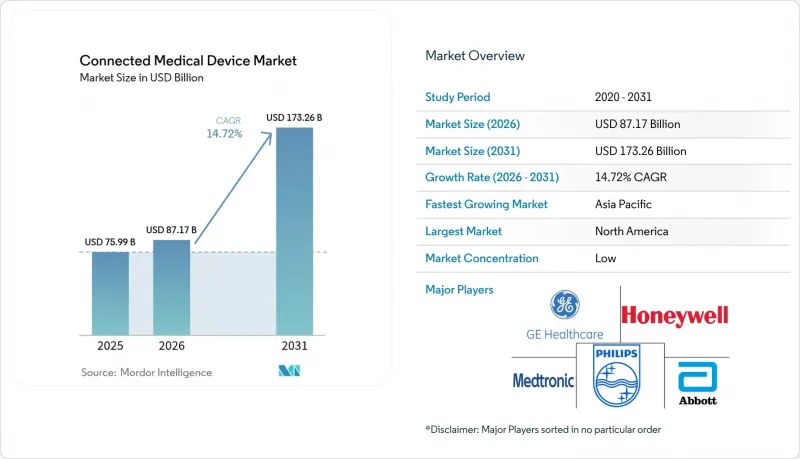
Mordor Intelligence에 의하면, 커넥티드 의료기기 시장 규모는 2025년에 759억 9,000만 달러로 평가되었고, 2026년 871억 7,000만 달러에서 2031년까지 1,732억 6,000만 달러에 이를 것으로 예측되며, 예측 기간(2026-2031년) CAGR은 14.72%를 나타낼 전망입니다.
본 보고서는 연결 기술별(Wi-Fi, BLE, NFC, Zigbee, 셀룰러, LPWAN, 위성 IoT), 기기 유형별(웨어러블, 임베디드형, 고정형, 일회용 센서, 휴대용 기기), 용도별(임상 업무, 영상 진단, 복약 관리 등), 최종 사용자별(병원, 재택 간호, 환자 등), 지역별로 분류되어 있습니다. 시장 전망은 금액(달러) 기준으로 제시되어 있습니다.
세계의 커넥티드 의료기기 시장 동향 및 인사이트
RPM(원격 환자 모니터링)의 보험 적용 확대로 인한 실시간 환자 모니터링의 보급
메디케어가 2024년에 청구 코드 99453-99458의 적용 범위를 확대하기로 결정함에 따라 확실한 수익원이 확립되었고, 이에 따라 의료 시스템은 고위험 만성 질환 환자 집단을 대상으로 한 지속적인 모니터링 프로그램을 확대하게 되었습니다. 재입원율 감소를 입증할 수 있는 의료기기 제조업체는 특히 치료 성과를 쉽게 정량화할 수 있는 당뇨병 및 심장 질환 분야에서 가치 분석에 기반한 승인 절차가 신속해지는 혜택을 누리고 있습니다. 성과 연동형 보상(Pay-for-performance) 인센티브는 민간 보험사에도 파급되고 있으며, 의료 제공업체들이 의료기기, 대시보드, 임상 서비스를 통합한 턴키 플랫폼을 요구함에 따라 단위 수요를 더욱 끌어올리고 있습니다. 그 결과, 커넥티드 의료기기 시장의 수주 증가는 절감된 비용에 대한 위험을 분담하는 통합 의료 네트워크(IDN)에서 가장 두드러지게 나타나고 있습니다.
센서 및 연결 비용의 하락이 기기의 소형화를 가능하게 함
MEMS 부품 가격은 2020년 이후 매년 약 15-20% 하락하고 있으며, 이에 따라 공급업체들은 우표 크기의 패키지에 여러 가지 감지 방식을 집적하면서도 이익률을 유지할 수 있게 되었습니다. 애보트(Abbott)사의 ‘FreeStyle Libre 3’ 센서는 현재 동급에서 가장 작은 양산 기기 중 하나이며, 공급업체가 비용 곡선을 어떻게 활용하여 배터리 수명 14일의 눈에 띄지 않는 웨어러블 기기를 실현하고 있는지를 보여줍니다. 부품 원가 하락으로 인해 비용 대비 효과 기준이 여전히 엄격한 아시아태평양의 공공 조달 입찰 참가 요건이 완화되고 있습니다. 또한 소형화를 통해 환자는 일상생활 속에서 눈에 띄지 않게 기기를 착용할 수 있어 치료 순응도가 향상되고, 구독형 모니터링 프로그램에 대한 장기적인 지속 이용이 촉진됩니다.
상호 운용성을 저해하는 기존의 독점 플랫폼
여전히 사일로화된 병상 모니터를 운영하고 있는 병원에서는 새로운 연결 모듈이 도입될 때마다 이중 입력 워크플로우와 고액의 통합 비용에 직면하고 있습니다. HL7 FHIR은 데이터의 유동성을 보장하지만, 공급업체별 도입 현황에 차이가 있어 의료 제공업체는 미들웨어에 의존할 수밖에 없으며, 그 결과 총 소유 비용이 상승하고 업데이트 주기가 지연되고 있습니다. 조달 팀은 자산의 노후화 위험을 우려하여, 검증된 오픈 API 로드맵을 보유한 공급업체로만 입찰을 제한하는 경우가 많으며, 그 결과 틈새 시장의 혁신 기업들 시장 진입이 제한되고, 커넥티드 의료기기 시장 전체의 성장이 둔화되고 있습니다.
부문 분석
2025년, Wi-Fi는 커넥티드 의료기기 시장 점유율의 42.78%를 차지했습니다. 이는 대부분의 급성기 의료시설이 이미 엔터프라이즈 WLAN 아키텍처를 보유하고 있기 때문입니다. 같은 해, 아시아태평양 전체에서 1,400억 달러에 달한 통신 사업자의 설비 투자의 뒷받침을 받아 5G는 급속한 성장 궤도에 오르기 시작했습니다. 초저지연 덕분에 전기생리학 검사실에서는 원격지 상담을 위해 고해상도 심장 매핑 데이터를 스트리밍할 수 있다는 확신을 갖게 되었습니다. 한편, LPWAN 모듈 덕분에 신생아 모니터의 배터리 팩이 소형화되어 웨어러블 포대기 안에 들어갈 수 있게 되었습니다. 위성 IoT는 재난 대응 임무 중 발생하는 통신 장애를 보완하고, 외상 센터의 서비스 수준 계약(SLA)에서 의무화하고 있는 99.999%의 가동률을 보장합니다.
5G 도입 가속화는 커넥티드 의료기기 시장에서 고정 스테이션에서 장소에 구애받지 않는 분석 플랫폼으로의 구조적 전환을 의미합니다. 주파수 대역 라이선스가 오픈 RAN 프레임워크로 전환됨에 따라, 기기 제조업체는 여러 관할 구역에서 자동으로 프로비저닝되는 통신사 독립형 SIM을 통합할 수 있는 유연성을 확보하여 전 세계적인 제품 출시를 효율화하고 있습니다. ITU 가이드라인에 따른 규제 조화를 통해 독자적인 무선 주파수 테스트가 줄어들고, 인증 리드타임이 최대 3개월 단축되어 가장 빠르게 성장하는 수출 시장으로의 진출이 가속화됩니다.
2025년에는 스마트 워치 인터페이스에 대한 소비자의 친숙도를 배경으로, 웨어러블 외부 기기가 커넥티드 의료기기 시장 점유율의 62.88%를 차지했습니다. 한편, 이식형 스마트팜프는 무선 충전 패드를 통해 교체 주기가 연장되고, 생체 흡수성 케이싱으로 인해 외과적 제거에 대한 불안이 완화됨에 따라 연평균 성장률(CAGR) 18.12%로 성장할 전망입니다. 일회용 경구 투여형 기기는 화학요법 주기 중 단기적인 감염 모니터링에서 전략적인 틈새 시장을 차지하고 있지만, 소비자용 사양의 파형 정확도를 뛰어넘는 정밀도가 요구되는 원격 모니터링 병동에서는 고정형 모니터가 여전히 필수적입니다.
이식형 기기는 지속적인 투여량 조정 알고리즘을 통해 약물 낭비를 두 자릿수 수준으로 줄일 수 있어 지불 기관에게 매력적입니다. 이를 통해 높은 초기 투자 비용을 정당화할 수 있는 정량화 가능한 비용 절감이 실현됩니다. 한편, 웨어러블 기기 제조업체들은 알고리즘 업데이트, 안전한 저장, 다국어 지침을 묶은 클라우드 구독 플랜을 확충하여 정기적인 수익원을 확보하려 하고 있습니다. 향후 소형화가 진전됨에 따라 카테고리 간의 경계가 모호해지며, 웨어러블 기기의 자가 관리 편의성과 완전 이식형 시스템의 복약 순응도상의 이점을 겸비한 반이식형 패치가 등장할 것으로 예측됩니다.
지역별 분석
북미는 메디케어 적용 범위 확대와 AI 탑재 기기의 승인 기간을 단축한 FDA의 패스트 트랙 제도 덕분에 2025년 매출의 40.42%를 차지했습니다. 전자건강기록(EHR) 보급률이 높고 민간 보험사의 후한 보상 제도가 마련되어 있어, 의료 제공업체는 복잡한 인터페이스를 재개발할 필요 없이 새로운 센서를 통합할 수 있어 이 지역의 도입 속도가 가속화되고 있습니다. 또한, 이 지역에는 5G를 지원하는 병원 캠퍼스가 가장 많이 설치되어 있어, 공급업체에게 로봇 기관지경 검사 안내 등 저지연 용도를 전개하기 위한 이상적인 거점이 되고 있습니다.
아시아태평양은 가장 빠르게 성장하는 시장으로, 1,400억 달러 규모의 의료 디지털화 프로그램과 국제 의료기기 규제 당국 포럼(IMDRF)에 의한 규제 조화를 배경으로, 2031년까지 연평균 성장률(CAGR)이 26.58%로 성장을 지속하고, 있습니다. 중국에서는 우선 심사 절차의 합리화를 통해 혁신적인 심장 의료기기의 승인 기간이 대폭 단축되어 국내 연구개발 투자가 촉진되는 한편, 다국적 기업의 합작 투자도 유치되고 있습니다. 인도에서는 민관 파트너십을 통해 2급 도시 전역에서 원격 중환자실(ICU) 시범 사업이 지원되고 있으며, 예산이 제한된 환경에서도 커넥티드 의료기기 시장의 경제성이 입증되고 있습니다.
유럽에서는 의료기기 규정(MDR)에 따라 단일 적합성 체계가 도입되어, 공급업체가 규정 준수 비용을 더 광범위한 대상 시장에 분산할 수 있게 됨에 따라 꾸준한 확장이 이루어지고 있습니다. 그러나 임상 증거 기준이 엄격해지면서 신청 서류 준비에 시간이 오래 걸리게 되었고, 많은 중소기업이 병목 현상을 피하기 위해 2년 전부터 인증 기관의 할당량을 확보하기 위해 움직이고 있습니다. 중동 및 아프리카 및 남미는 절대적인 지출 규모 면에서는 여전히 뒤처져 있지만, 특히 석유 수입에 힘입은 걸프 국가들과 브라질의 1차 의료 개혁에 힘입어 통신 인프라가 급속히 정비되면서, 원격 측정 솔루션에 있어 높은 성장이 기대되는 신흥 시장이 형성되고 있습니다.
기타 혜택 :
- 엑셀 형식 시장 예측(ME) 시트
- 3개월간의 애널리스트 지원
목차
제1장 서론
제2장 조사 방법
제3장 주요 요약
제4장 시장 구도
제5장 시장 규모 및 성장 예측
제6장 경쟁 구도
제7장 시장 기회 및 향후 전망
AJYAccording to Mordor Intelligence, the connected medical devices market size was valued at USD 75.99 billion in 2025 and estimated to grow from USD 87.17 billion in 2026 to reach USD 173.26 billion by 2031, at a CAGR of 14.72% during the forecast period (2026-2031).
This report is Segmented by Connectivity Technology (Wi-Fi, BLE, NFC, Zigbee, Cellular, LPWAN, Satellite IoT), Device Type (Wearable, Implantable, Stationary, Disposable Sensors, Portable Tools), Application (Clinical Operations, Imaging, Medication Management, and More), End User (Hospitals, Home-Care, Patients, and More), and Geography. The Market Forecasts are Provided in Terms of Value (USD).
Global Connected Medical Device Market Trends and Insights
Expansion of Real-Time Patient Monitoring via RPM Reimbursement
Medicare's 2024 decision to widen billing codes 99453-99458 created a dependable revenue path that convinced health systems to scale continuous monitoring programs for high-risk chronic cohorts.Device makers that can document reduced readmissions now enjoy accelerated value-analysis approvals, especially for diabetes and cardiac applications where outcomes are easily quantified. Pay-for-performance incentives are cascading to private payers, further boosting unit demand as providers seek turnkey platforms that integrate devices, dashboards, and clinical services. The resulting uptick in Connected Medical Devices market orders is strongest among integrated delivery networks that bear shared savings risk.
Falling Sensor and Connectivity Costs Enabling Device Miniaturization
MEMS component prices have declined roughly 15-20% a year since 2020, allowing suppliers to pack multiple sensing modalities into postage-stamp-sized packages and still protect margins. Abbott's FreeStyle Libre 3 sensor, currently one of the smallest mass-produced devices in its class, illustrates how suppliers are translating cost curves into discreet wearables with 14-day battery life. Lower bill-of-materials costs expand eligibility in public procurement tenders across Asia-Pacific, where cost-effectiveness benchmarks remain stringent. Smaller footprints also drive adherence gains because patients can wear devices unobtrusively during daily routines, reinforcing long-term retention in subscription monitoring programs.
Legacy Proprietary Platforms Hindering Interoperability
Hospitals that still run siloed bedside monitors face double-entry workflow and steep integration fees whenever a new connected module is introduced. Although HL7 FHIR promises data liquidity, uneven vendor adoption forces providers to rely on middleware that drives up total cost of ownership and slows refresh cycles. Procurement teams, wary of stranded-asset risk, often restrict tenders to suppliers with proven open-API roadmaps, limiting market access for niche innovators and tempering broader Connected Medical Devices market growth.
Other drivers and restraints analyzed in the detailed report include:
- 5G and LPWAN Deployment Unlocking Ultra-Low-Latency Clinical Use Cases
- AI-Powered Predictive Analytics Improving Device Value Proposition
- Rising Cybersecurity Breaches Targeting IoMT Endpoints
For complete list of drivers and restraints, kindly check the Table Of Contents.
Segment Analysis
In 2025, Wi-Fi accounted for 42.78% of the Connected Medical Devices market share because most acute-care facilities already possess enterprise WLAN architectures. The same year, 5G began its breakout trajectory, fueled by telecom capital spending that reached USD 140 billion across Asia-Pacific. Ultra-low latency gives electrophysiology labs confidence to stream HD cardiac mapping data for off-site consultation, while LPWAN modules shrink battery packs in neonatal monitors to fit inside wearable swaddles. Satellite IoT backfills outages during disaster-response missions, ensuring 99.999% uptime mandated in trauma-center service-level agreements.
Accelerated 5G adoption signals a structural pivot in the Connected Medical Devices market from fixed stations toward location-agnostic analytics platforms. As spectrum licenses migrate to open-RAN frameworks, device makers gain flexibility to embed carrier-agnostic SIMs that auto-provision in multiple jurisdictions, streamlining global product launches. Regulatory alignment under ITU guidelines curbs custom radio-frequency testing, trimming certification lead times by up to three months and expediting entry in the fastest-growing export markets.
Wearable external devices controlled 62.88% of the Connected Medical Devices market share in 2025, underpinned by consumer familiarity with smartwatch interfaces. Implantable smart pumps, however, are on track for an 18.12% CAGR as wireless charging pads lengthen replacement intervals and bioresorbable casings ease surgical removal anxiety. Disposable ingestibles occupy a tactical niche for short-horizon infection surveillance during chemotherapy cycles, whereas stationary monitors remain indispensable for telemetry wards that demand waveform fidelity exceeding consumer-grade specifications.
Implantables appeal to payers because continuous dose-adjusting algorithms can cut drug wastage by double digits, delivering quantifiable savings that justify higher upfront capital outlays. Wearable makers, meanwhile, are scaling cloud subscription tiers that bundle algorithm updates, secure storage, and multilingual coaching to lock in annuity revenue. Over time, miniaturization advances are expected to blur category boundaries, birthing semi-implantable patches that combine the self-administration ease of wearables with the adherence benefits of fully embedded systems.
Complete Report Scope:
- By Connectivity Technology
- Wi-Fi
- Bluetooth Low Energy (BLE)
- Near-Field Communication (NFC)
- Zigbee
- Cellular (3G/4G/5G and LPWAN)
- Other LPWAN
- Satellite IoT
- By Device Type
- Wearable External Devices
- Implantable Devices
- Stationary Devices
- Disposable / Ingestible Sensors
- Portable Diagnostic Tools
- By Application
- Remote Patient Monitoring
- Clinical Operations and Workflow Management
- Connected Imaging
- Medication Management
- Tele-ICU / Interactive Medicine
- Preventive and Wellness Programs
- By End User
- Hospitals and Health Systems
- Ambulatory Surgical Centers
- Home-Care Settings
- Patients/Consumers
- Research and Diagnostic Laboratories
- Payers/Insurance Providers
- Government and Defense Institutions
- Other End Users
- By Geography
- North America
- United States
- Canada
- South America
- Brazil
- Argentina
- Rest of South America
- Europe
- Germany
- United Kingdom
- France
- Italy
- Spain
- Russia
- Rest of Europe
- Asia Pacific
- China
- Japan
- India
- South Korea
- Australia and New Zealand
- Rest of Asia Pacific
- Middle East and Africa
- Middle East
- GCC
- Turkey
- Israel
- Rest of Middle East
- Africa
- South Africa
- Nigeria
- Kenya
- Rest of Africa
- Middle East
- North America
Geography Analysis
North America commanded 40.42% of 2025 revenue thanks to Medicare coverage expansion and FDA fast-track pathways that lowered approval times for AI-enabled devices. High EHR penetration and robust private-payer reimbursement let providers integrate new sensors without complex interface redevelopment, reinforcing regional adoption speed. The region also hosts the largest installed base of 5G-ready hospital campuses, giving suppliers an ideal launchpad for low-latency applications such as robotic bronchoscopy guidance.
Asia-Pacific is the fastest-growing territory, registering a 26.58% CAGR through 2031 on the back of USD 140 billion in healthcare digitization programs and regulatory harmonization under the International Medical Device Regulators Forum. China's streamlined priority-review channel has slashed approval timelines for innovative cardiology devices, stimulating domestic R and D investment and luring multinational joint ventures. In India, public-private partnerships are underwriting tele-ICU pilots across tier-2 cities, validating Connected Medical Devices market economics in value-constrained settings.
Europe shows steady expansion as the Medical Device Regulation enforces a single conformity framework, allowing vendors to amortize compliance costs over a larger addressable base. However, tougher clinical-evidence thresholds elongate dossier preparation, prompting many SMEs to seek notified-body slots two years in advance to avoid bottlenecks. Middle East and Africa and South America still trail on absolute spending but are fast upgrading telecom infrastructure, particularly in oil-funded Gulf states and Brazil's primary-care revamp, creating emerging pockets of high growth for telemetry solutions.
- Medtronic plc
- Koninklijke Philips N.V.
- Boston Scientific Corporation
- Abbott Laboratories
- Garmin Ltd.
- BIOTRONIK SE and Co. KG
- Honeywell International Inc.
- Stanley Black and Decker, Inc. (Stanley Healthcare)
- NXP Semiconductors N.V.
- GE HealthCare Technologies Inc.
- Siemens Healthineers AG
- DexCom, Inc.
- Omron Healthcare Co., Ltd.
- Masimo Corporation
- ResMed Inc.
- Teladoc Health, Inc.
- Cisco Systems, Inc.
- Hill-Rom Holdings, Inc.
- Capsule Technologies, Inc.
- Oracle Cerner Corporation
- Apple Inc.
- Fitbit LLC
- AliveCor, Inc.
Additional Benefits:
- The market estimate (ME) sheet in Excel format
- 3 months of analyst support
TABLE OF CONTENTS
1 INTRODUCTION
- 1.1 Study Assumptions and Market Definition
- 1.2 Scope of the Study
2 RESEARCH METHODOLOGY
3 EXECUTIVE SUMMARY
4 MARKET LANDSCAPE
- 4.1 Market Overview
- 4.2 Market Drivers
- 4.2.1 Expansion of real-time patient monitoring via RPM reimbursement
- 4.2.2 Falling sensor and connectivity costs enabling device miniaturization
- 4.2.3 5G and LPWAN deployment unlocking ultra-low-latency clinical use cases
- 4.2.4 AI-powered predictive analytics improving device value proposition
- 4.2.5 Shift to home-based chronic care amid hospital cAsia Pacificity constraints
- 4.2.6 Institutional demand for interoperable data to optimize workflows
- 4.3 Market Restraints
- 4.3.1 Legacy proprietary platforms hindering interoperability
- 4.3.2 Rising cybersecurity breaches targeting IoMT endpoints
- 4.3.3 Regulatory complexity and proof-of-safety costs for new device classes
- 4.3.4 Bandwidth and power limitations in rural/underserved regions
- 4.4 Value/Supply-Chain Analysis
- 4.5 Regulatory Landscape
- 4.6 Technological Outlook
- 4.7 Porter's Five Forces
- 4.7.1 Bargaining Power of Suppliers
- 4.7.2 Bargaining Power of Buyers/Consumers
- 4.7.3 Threat of New Entrants
- 4.7.4 Threat of Substitute Products
- 4.7.5 Intensity of Competitive Rivalry
- 4.8 Connectivity Technology Landscape
- 4.8.1 Wi-Fi
- 4.8.2 Bluetooth Low Energy (BLE)
- 4.8.3 Near-Field Communication (NFC)
- 4.8.4 Zigbee
- 4.8.5 Cellular (3G/4G/5G and LPWAN)
5 MARKET SIZE AND GROWTH FORECASTS (VALUE)
- 5.1 By Connectivity Technology
- 5.1.1 Wi-Fi
- 5.1.2 Bluetooth Low Energy (BLE)
- 5.1.3 Near-Field Communication (NFC)
- 5.1.4 Zigbee
- 5.1.5 Cellular (3G/4G/5G and LPWAN)
- 5.1.6 Other LPWAN
- 5.1.7 Satellite IoT
- 5.2 By Device Type
- 5.2.1 Wearable External Devices
- 5.2.2 Implantable Devices
- 5.2.3 Stationary Devices
- 5.2.4 Disposable / Ingestible Sensors
- 5.2.5 Portable Diagnostic Tools
- 5.3 By Application
- 5.3.1 Remote Patient Monitoring
- 5.3.2 Clinical Operations and Workflow Management
- 5.3.3 Connected Imaging
- 5.3.4 Medication Management
- 5.3.5 Tele-ICU / Interactive Medicine
- 5.3.6 Preventive and Wellness Programs
- 5.4 By End User
- 5.4.1 Hospitals and Health Systems
- 5.4.2 Ambulatory Surgical Centers
- 5.4.3 Home-Care Settings
- 5.4.4 Patients/Consumers
- 5.4.5 Research and Diagnostic Laboratories
- 5.4.6 Payers/Insurance Providers
- 5.4.7 Government and Defense Institutions
- 5.4.8 Other End Users
- 5.5 By Geography
- 5.5.1 North America
- 5.5.1.1 United States
- 5.5.1.2 Canada
- 5.5.2 South America
- 5.5.2.1 Brazil
- 5.5.2.2 Argentina
- 5.5.2.3 Rest of South America
- 5.5.3 Europe
- 5.5.3.1 Germany
- 5.5.3.2 United Kingdom
- 5.5.3.3 France
- 5.5.3.4 Italy
- 5.5.3.5 Spain
- 5.5.3.6 Russia
- 5.5.3.7 Rest of Europe
- 5.5.4 Asia Pacific
- 5.5.4.1 China
- 5.5.4.2 Japan
- 5.5.4.3 India
- 5.5.4.4 South Korea
- 5.5.4.5 Australia and New Zealand
- 5.5.4.6 Rest of Asia Pacific
- 5.5.5 Middle East and Africa
- 5.5.5.1 Middle East
- 5.5.5.1.1 GCC
- 5.5.5.1.2 Turkey
- 5.5.5.1.3 Israel
- 5.5.5.1.4 Rest of Middle East
- 5.5.5.2 Africa
- 5.5.5.2.1 South Africa
- 5.5.5.2.2 Nigeria
- 5.5.5.2.3 Kenya
- 5.5.5.2.4 Rest of Africa
- 5.5.5.1 Middle East
- 5.5.1 North America
6 COMPETITIVE LANDSCAPE
- 6.1 Market Concentration
- 6.2 Strategic Moves
- 6.3 Market Share Analysis
- 6.4 Company Profiles (includes Global level Overview, Market level overview, Core Segments, Financials as available, Strategic Information, Market Rank/Share for key companies, Products and Services, and Recent Developments)
- 6.4.1 Medtronic plc
- 6.4.2 Koninklijke Philips N.V.
- 6.4.3 Boston Scientific Corporation
- 6.4.4 Abbott Laboratories
- 6.4.5 Garmin Ltd.
- 6.4.6 BIOTRONIK SE and Co. KG
- 6.4.7 Honeywell International Inc.
- 6.4.8 Stanley Black and Decker, Inc. (Stanley Healthcare)
- 6.4.9 NXP Semiconductors N.V.
- 6.4.10 GE HealthCare Technologies Inc.
- 6.4.11 Siemens Healthineers AG
- 6.4.12 DexCom, Inc.
- 6.4.13 Omron Healthcare Co., Ltd.
- 6.4.14 Masimo Corporation
- 6.4.15 ResMed Inc.
- 6.4.16 Teladoc Health, Inc.
- 6.4.17 Cisco Systems, Inc.
- 6.4.18 Hill-Rom Holdings, Inc.
- 6.4.19 Capsule Technologies, Inc.
- 6.4.20 Oracle Cerner Corporation
- 6.4.21 Apple Inc.
- 6.4.22 Fitbit LLC
- 6.4.23 AliveCor, Inc.
7 MARKET OPPORTUNITIES AND FUTURE OUTLOOK
- 7.1 White-space and Unmet-Need Assessment