

|
시장보고서
상품코드
2100760
독일의 스마트 홈 시장 : 점유율 분석, 업계 동향 및 통계, 성장 예측(2026-2031년)Germany Smart Home - Market Share Analysis, Industry Trends & Statistics, Growth Forecasts (2026 - 2031) |
||||||
 Mordor Intelligence
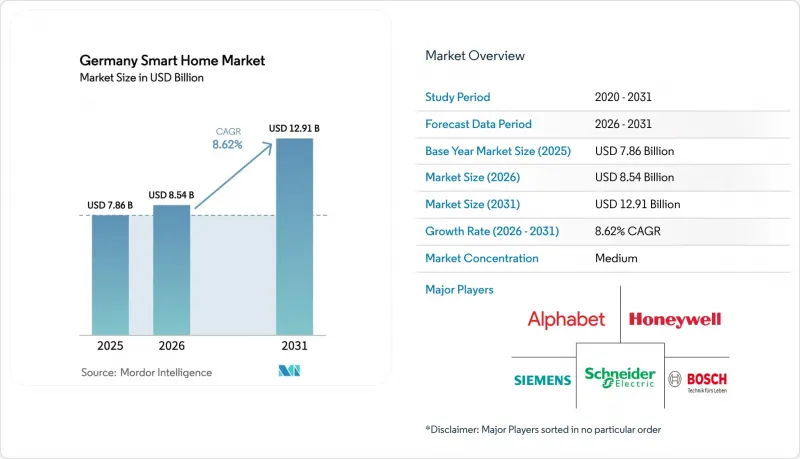
Mordor Intelligence에 의하면, 2026년 독일 스마트 홈 시장 규모는 85억 4,000만 달러로 추정되고 있어 2025년 78억 6,000만 달러에서 확대해, 2031년에는 129억 1,000만 달러에 이를 것으로 예측됩니다.
2026년부터 2031년까지 연평균 성장률(CAGR) 8.62%로 성장할 것으로 전망됩니다.
본 보고서는 제품별(편의성·조명, 제어·연결 등), 연결 기술별(Wi-Fi, Zigbee, Z-Wave 등), 최종 사용자별(단독 주택, 공동 주택 등), 판매 채널별(온라인 소매, 조직화된 소매 체인 등)로 분류되어 있습니다.
독일 스마트 홈 시장 동향과 인사이트
에너지 절약형 주택에 대한 정부의 보조금 제도가 시장 확대를 뒷받침
독일의 KfW 및 BAFA 프로그램은 에너지 관리 기기의 초기 비용을 절감하고, 스마트 리모델링에 대해 최대 1만 5,000유로의 보조금을 지급하고 있습니다. 2024년 건축 에너지법 개정에 따라 신축 주택에 스마트 대응 배선이 의무화되면서 스마트 계량기 도입이 가속화되었습니다. 스마트 계량기 설치 대수는 2022년 27만 2,024대에서 2024년 9월까지 100만 대 이상으로 급증했습니다. 아파트 개발업체들은 이러한 보조금을 활용하여 온도 조절기나 에너지 모니터를 세트로 판매함으로써, 최대 금액의 보조금을 확보할 수 있는 20-30%의 효율 향상을 실현하고 있습니다. 보조금 이용률은 1990년 이전에 건설된 주택 재고가 많아 리모델링 수요가 높은 지역에서 가장 높으며, 이는 독일 스마트 홈 시장의 성장을 뒷받침하고 있습니다.
에너지 절약에 대한 소비자의 인식 제고가 구매 결정에 변화를 주고 있습니다.
탄소세 인상으로 가정의 에너지 비용이 상승함에 따라, 네트워크 연결형 온도 조절기나 스마트 히트 펌프 컨트롤러의 경제적 매력이 높아지고 있습니다. 조사에 따르면, 2025년 기기 구매의 42%가 에너지 효율을 목적으로 하고 있으며, 이는 2022년의 28%에서 증가한 수치입니다. 서부 주에서는 각 가구가 옥상 태양광, 배터리 저장 장치, 적응형 난방을 연계하는 통합 솔루션에 연간 3,000-5,000유로를 투자하고 있습니다. 이러한 추세로 인해 실시간 절감 효과를 정량화하고, 소비자의 지속가능성 목표에 부합하는 분석 주도형 플랫폼에 대한 수요가 높아지고 있습니다.
높은 설치 및 개조 비용이 일반 시장에서의 보급을 저해하고 있습니다.
모든 기능을 갖춘 시스템의 설치 비용은 8,000-12,000유로가 소요되며, 오래된 건물의 경우 장비를 설치하기 전에 3,000-5,000유로의 배선 개보수가 필요한 경우가 많습니다. 가구의 54%가 임대 주택에 거주하고 있어 인센티브 불일치 문제가 여전히 남아 있습니다. 즉, 집주인이 하드웨어 비용을 부담하는 반면, 임대료 절감이라는 혜택을 누리는 것은 세입자라는 상황입니다. Homematic IP와 같은 브랜드가 제공하는 500유로 미만의 스타터 키트는 진입 장벽을 낮추고 있지만, 독일의 스마트 홈 시장은 여전히 보급 범위를 확대하기 위해 대출 및 보조금 제도에 의존하고 있습니다.
부문 분석
보안 플랫폼은 보험사가 침입 센서나 네트워크 연결 카메라를 도입한 고객에게 혜택을 제공함에 따라 2025년 매출의 26.65%를 차지했습니다. 이 부문에서는 문·창문용 센서, 인체 감지 센서, 클라우드 영상 기능을 결합하여 고객 유지율을 높이는 구독 수익원을 창출하고 있습니다. 에너지 관리 기기는 자동화된 부하 이동을 촉진하는 변동형 전기 요금 제도의 뒷받침을 받아, 2031년까지 연평균 성장률(CAGR) 13.78%로 현재 가장 빠른 성장세를 기록하고 있습니다. 스마트 온도 조절기, 히트 펌프 컨트롤러, 태양광 발전용 인버터는 ‘Matter’를 통해 통합되어 설치 시간 단축과 상호 운용성 향상을 실현하고 있습니다. 성장 추세는 가격대에 따라 다릅니다. 엔트리 레벨 센서 팩이 전자상거래 시장을 휩쓸고 있는 반면, 고급 별장에서는 주택 전체의 조명 시스템과 통합 오디오가 채택되고 있습니다. BSH가 CES 2025에서 최초의 ‘Matter’ 지원 냉장고를 출시함에 따라, 스마트 가전이 주류 제품 라인업에 합류하며 독일 스마트 홈 시장에서 백색 가전이 핵심 노드가 될 것임을 시사하고 있습니다.
가정용 라우터 덕분에 Wi-Fi가 표준이 되어, 기기 연결의 43.35%를 차지하고 있습니다. PLC 기술은 전력선을 이용하기 때문에 전력 회사는 2025년 동적 가격 책정 의무화 시행에 앞서 수요 반응(Demand Response) 시범 사업에 이를 도입하고 있습니다. 연평균 성장률(CAGR) 17.1%로 성장하는 PLC는 새로운 배선 공사 없이 엣지 미터의 지연 요건을 충족시키며, 에너지 대시보드에 할당된 독일 스마트 홈 시장 규모를 뒷받침하고 있습니다. Thread 및 Zigbee는 벤더들이 독자 규격의 허브에서 전환함에 따라 Matter를 통해 보급이 확대되고 있습니다. 도이치 텔레콤은 표준 라우터에 스마트 홈 제어 기능을 통합하여 소유 부담을 줄여주는 허브 없는 설치를 장려하고 있습니다. 블루투스 및 서브GHz 대역 RF는 저전력 소비와 긴 배터리 수명이 중요한 자물쇠나 누수 경보기 등 틈새 시장에서 역할을 담당하고 있습니다. Z-Wave는 여전히 맞춤형 통합 업체들 사이에서 사용되고 있지만, 라이선스 비용이 부품 원가를 상승시키기 때문에 신규 기기 도입의 모멘텀은 제한적입니다.
기타 혜택:
- 엑셀 형식 시장 예측(ME) 시트
- 3개월간의 애널리스트 지원
자주 묻는 질문
목차
제1장 서론
제2장 조사 방법
제3장 주요 요약
제4장 시장 구도
제5장 시장 규모와 성장 예측
제6장 경쟁 구도
제7장 시장 기회와 향후 전망
JHS 26.08.07According to Mordor Intelligence, Germany smart home market size in 2026 is estimated at USD 8.54 billion, growing from 2025 value of USD 7.86 billion with 2031 projections showing USD 12.91 billion, growing at 8.62% CAGR over 2026-2031.
This report is Segmented by Product (Comfort and Lighting, Control and Connectivity and More), Connectivity Technology (Wi-Fi, Zigbee, Z-Wave and More), by End User (Single-Family Homes, Multi-Family Homes and More), Sales Channel (Online Retail, Organised Retail Chains and More).
Germany Smart Home Market Trends and Insights
Government subsidies for energy-efficient homes drive market acceleration
Germany's KfW and BAFA programs cut the upfront cost of energy-management gear and reward smart-ready renovations with grants of up to EUR 15,000. The 2024 Building Energy Act amendments require smart-ready wiring in new builds and accelerate smart-meter deployment, which jumped from 272,024 units in 2022 to more than 1 million by September 2024. Multi-family developers tap these subsidies to bundle thermostats and energy monitors, achieving the 20-30% efficiency gains that secure maximum funding. Subsidy uptake is strongest in renovation-intensive regions where housing stock dates from before 1990, reinforcing the Germany smart home market growth.
Rising consumer awareness of energy savings transforms purchase decisions
Higher carbon levies lifted the cost of household energy, making connected thermostats and smart heat-pump controllers financially compelling. Surveys show that 42% of 2025 device purchases target energy efficiency, up from 28% in 2022. In western states, households invest EUR 3,000-5,000 each year in integrated solutions that link rooftop solar, battery storage, and adaptive heating. These patterns heighten demand for analytics-driven platforms that quantify real-time savings and align with consumers' sustainability goals.
High installation & retrofit costs constrain mass-market adoption
A full-featured system costs EUR 8,000-12,000 to install, and older buildings often need EUR 3,000-5,000 in wiring upgrades before devices go in. With 54% of households renting, split-incentive problems persist: landlords pay for hardware while tenants reap lower bills. Starter kits priced under EUR 500 from brands such as Homematic IP soften the barrier, yet the Germany smart home market still relies on financing and subsidy schemes to broaden reach.
Other drivers and restraints analyzed in the detailed report include:
- High smartphone & broadband penetration enables seamless integration
- Building Renovation Wave incentives accelerate smart integration
- Installer/technician talent shortage creates a market bottleneck
For complete list of drivers and restraints, kindly check the Table Of Contents.
Segment Analysis
Security platforms generated 26.65% of 2025 sales as insurers rewarded customers who deploy intrusion sensors and connected cameras. The segment bundles door-window contacts, motion detectors, and cloud video for subscription revenue streams that improve retention. Energy-management devices now register the fastest expansion at 13.78% CAGR through 2031, buoyed by dynamic utility tariffs that favor automated load shifting. Smart thermostats, heat-pump controllers, and PV inverters integrate through Matter, shrinking installation times and boosting interoperability. Growth dynamics vary across price tiers. Entry-level sensor packs dominate e-commerce, whereas premium villas specify whole-house lighting scenes and integrated audio. Smart appliances enter mainstream portfolios after BSH launched the first Matter-enabled refrigerator at CES 2025, signalling that white goods will become core nodes in the Germany smart home market.
Household routers make Wi-Fi the default, underpinning 43.35% of device links. PLC technology rides on power lines, so utilities adopt it for demand-response pilots that precede the 2025 dynamic-pricing mandate. With an 17.1% CAGR, PLC meets edge-meter latency requirements without new wiring, supporting the Germany smart home market size allocated to energy dashboards. Thread and Zigbee scale through Matter as vendors migrate from proprietary hubs. Deutsche Telekom embeds smart-home control in standard routers, fostering hub-less set-ups that simplify ownership. Bluetooth and sub-GHz RF fill niche roles such as locks and water leakage alarms where low power or long battery life matters. Z-Wave persists in custom-integrator circles but shows limited new-device momentum because license fees raise bill-of-materials cost.
Complete Report Scope:
- By Product
- Comfort and Lighting
- Control and Connectivity
- Energy Management
- Home Entertainment
- Security
- Smart Appliances
- By Connectivity Technology
- Wi-Fi
- Bluetooth and RF
- Zigbee
- Z-Wave
- Broadband PLC
- Other Protocols
- By End User
- Single-Family Homes
- Multi-Family Homes
- Apartments
- Luxury Villas
- By Sales Channel
- Online Retail
- Organised Retail Chains
- Specialty Stores
- Direct Installer Network
List of Companies Covered in this Report:
- Robert Bosch Smart Home GmbH
- ABB Ltd
- Schneider Electric SE
- Honeywell International Inc.
- Emerson Electric Co.
- Siemens AG
- Google LLC (Alphabet)
- LG Electronics Inc.
- Samsung Electronics Co.
- Telekom Deutschland GmbH (Magenta SmartHome)
- Amazon.com Inc.
- Eve Systems GmbH
- Homematic IP
- tado GmbH
- Nuki Home Solutions GmbH
- Devolo AG
- Gigaset AG
- Somfy SA
- Netatmo
- IKEA
- TP-Link Technologies Co.
Additional Benefits:
- The market estimate (ME) sheet in Excel format
- 3 months of analyst support
TABLE OF CONTENTS
1 INTRODUCTION
- 1.1 Study Assumptions and Market Definition
- 1.2 Scope of the Study
2 RESEARCH METHODOLOGY
3 EXECUTIVE SUMMARY
4 MARKET LANDSCAPE
- 4.1 Market Overview
- 4.2 Market Drivers
- 4.2.1 Government subsidies for energy?efficient homes
- 4.2.2 Rising consumer awareness of energy savings
- 4.2.3 High smartphone and broadband penetration
- 4.2.4 Germany's Building Renovation Wave incentives
- 4.2.5 Insurance premium discounts for smart security
- 4.2.6 Dynamic utility pricing pilots enabling demand response
- 4.3 Market Restraints
- 4.3.1 High installation and retrofit costs
- 4.3.2 Data-privacy and cybersecurity concerns
- 4.3.3 Interoperability and standards fragmentation
- 4.3.4 Installer/technician talent shortage
- 4.4 Value / Supply-Chain Analysis
- 4.5 Regulatory Landscape
- 4.6 Technological Outlook
- 4.7 Porter's Five Forces Analysis
- 4.7.1 Bargaining Power of Suppliers
- 4.7.2 Bargaining Power of Consumers
- 4.7.3 Threat of New Entrants
- 4.7.4 Threat of Substitute Products
- 4.7.5 Intensity of Competitive Rivalry
- 4.8 Investment Analysis
5 MARKET SIZE AND GROWTH FORECASTS
- 5.1 By Product
- 5.1.1 Comfort and Lighting
- 5.1.2 Control and Connectivity
- 5.1.3 Energy Management
- 5.1.4 Home Entertainment
- 5.1.5 Security
- 5.1.6 Smart Appliances
- 5.2 By Connectivity Technology
- 5.2.1 Wi-Fi
- 5.2.2 Bluetooth and RF
- 5.2.3 Zigbee
- 5.2.4 Z-Wave
- 5.2.5 Broadband PLC
- 5.2.6 Other Protocols
- 5.3 By End User
- 5.3.1 Single-Family Homes
- 5.3.2 Multi-Family Homes
- 5.3.3 Apartments
- 5.3.4 Luxury Villas
- 5.4 By Sales Channel
- 5.4.1 Online Retail
- 5.4.2 Organised Retail Chains
- 5.4.3 Specialty Stores
- 5.4.4 Direct Installer Network
6 COMPETITIVE LANDSCAPE
- 6.1 Market Concentration
- 6.2 Strategic Moves
- 6.3 Market Share Analysis
- 6.4 Company Profiles (includes Global level Overview, Market level overview, Core Segments, Financials as available, Strategic Information, Market Rank/Share for key companies, Products and Services, and Recent Developments)
- 6.4.1 Robert Bosch Smart Home GmbH
- 6.4.2 ABB Ltd
- 6.4.3 Schneider Electric SE
- 6.4.4 Honeywell International Inc.
- 6.4.5 Emerson Electric Co.
- 6.4.6 Siemens AG
- 6.4.7 Google LLC (Alphabet)
- 6.4.8 LG Electronics Inc.
- 6.4.9 Samsung Electronics Co.
- 6.4.10 Telekom Deutschland GmbH (Magenta SmartHome)
- 6.4.11 Amazon.com Inc.
- 6.4.12 Eve Systems GmbH
- 6.4.13 Homematic IP
- 6.4.14 tado GmbH
- 6.4.15 Nuki Home Solutions GmbH
- 6.4.16 Devolo AG
- 6.4.17 Gigaset AG
- 6.4.18 Somfy SA
- 6.4.19 Netatmo
- 6.4.20 IKEA
- 6.4.21 TP-Link Technologies Co.
7 MARKET OPPORTUNITIES AND FUTURE OUTLOOK
- 7.1 White-space and Unmet-Need Assessment


