

|
시장보고서
상품코드
2113196
태국의 전력 EPC : 시장 점유율 분석, 업계 동향과 통계, 성장 예측(2026-2031년)Thailand Power EPC - Market Share Analysis, Industry Trends & Statistics, Growth Forecasts (2026 - 2031) |
||||||
 Mordor Intelligence
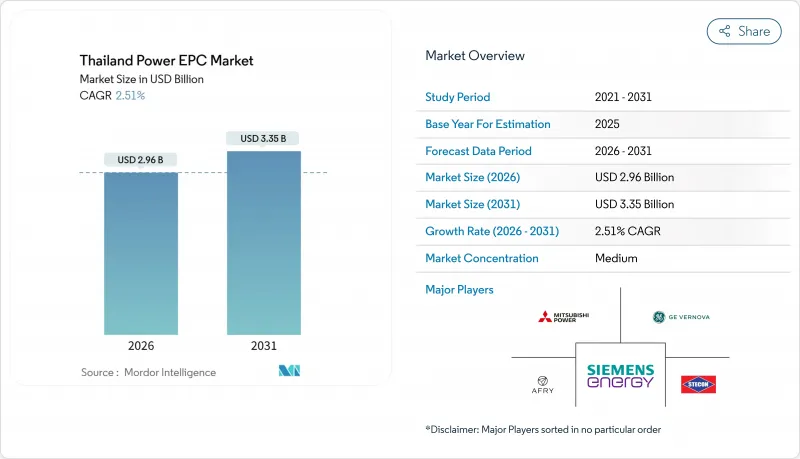
Mordor Intelligence에 따르면 태국의 전력 EPC 시장 규모는 2026년에 29억 6,000만 달러로 추정되고 있으며, 예측 기간(2026-2031년)에 CAGR 2.51%로 확대하며, 2031년에는 33억 5,000만 달러에 달할 것으로 전망되고 있습니다.
이 보고서는 발전 EPC[기술(화력, 원자력, 재생에너지), 용량대(100MW 이하, 100-499MW, 500MW 이상),및 최종사용자(규제 대상 유틸리티, 독립 발전 사업자, 산업용 자가 발전, 공공 부문 및 국영 기업)], 그리고 송배전(T&D) EPC로 분류되어 있습니다. 시장 규모 및 전망은 금액(달러) 기준으로 제시되어 있습니다.
태국의 전력 EPC 시장의 동향 및 인사이트
정부가 지원하는 PDP 2022-2037의 설비 투자 파이프라인
2조 9,000억 바트(850억 달러) 규모의 PDP는 2037년까지 재생 가능 에너지 도입률을 51%로 높이고, 아임계 석탄 화력 발전을 단계적으로 폐지하겠다고 약속하고 있으며, 발전, 송전, 배전 패키지에 대한 꾸준한 수요를 지원하고 있습니다. 2026년 5%, 2035년 20%라는 수소 혼소 목표에 따라 EPC 입찰자는 혼합 가스 공급에 대응할 수 있는 연소 설비의 사전 인증을 취득해야 합니다. 이는 2024년에 가동을 시작한 미쓰비시 파워(Mitsubishi Power)의 5,300MW 라용-촌부리 모듈형 복합 발전소에서 볼 수 있듯이입니다. EGAT의 219억 바트 규모의 주망 확장 계획에 따라 해상 풍력발전의 출력을 EEC의 부하 집중 지역으로 송전하는 500kV 송전선 및 디지털 변전소에 대한 투자 가치가 높아지고 있습니다. 이 장기 프로그램은 수주 변동을 완화하는 한편, 2030년까지 가스 발전이 설비 용량의 60% 이상을 계속 차지할 것으로 예상됨에 따라 연료 구성 리스크를 표면화시키고 있습니다.
산업 및 데이터센터의 전력 수요 급증
2024년에는 총액 1,680억 바트(49억 달러)에 달하는 46건의 데이터센터 계획이 신청되었으며, 그 중 90%가 EEC에 집중되어 있으며, 2026년 1월 이후 2,000MW의 직접 PPA 용량이 추가될 전망입니다. 아마존 웹 서비스(Amazon Web Services), 구글(Google), 틱톡(TikTok) 3개사만 해도 IT 부하가 400MW를 초과하는 하이퍼스케일 캠퍼스를 계획하고 있으며, 이에 따라 태양광발전 + BESS(배터리 에너지 저장 시스템) 및 500 kV 송전선 수주가 가속화되고 있습니다. Digital Edge와 B.Grimm은 100MW 규모의 캠퍼스를 건설 중이며, CtrlS는 2025년에 150억 바트를 투자해 150MW 규모의 설비를 가동했습니다. 이 회랑의 산업용 전력 소비량은 2024년에 전년 대비 4.2% 증가했으며(전국 평균은 2.1% 증가), 이에 따라 당초 2028년으로 예정되었던 변전소 업그레이드가 앞당겨졌습니다. 이러한 급증으로 인해 마이크로그리드 EPC 프로젝트가 증가하고 있으며, 반도체 및 전기자동차(EV) 배터리 공장을 대상으로 요금 안정화와 가동률 향상을 도모하기 위해 각 시설에서 5-20MW 규모의 자가 소비용 태양광발전 설비를 도입하고 있습니다.
환경영향 평가(EIA) 및 인허가 절차의 장기화
태국의 환경영향 평가(EIA) 제도에서는 국가환경보호청(ONEP), 각 주 사무소 및 공청회가 의무화되어 있으며, 대규모 태양광 및 풍력발전의 승인까지 12-24개월이 소요됩니다. 해상 풍력발전 구역의 경우, 허가 결정이 2026년 말까지 미뤄질 전망이며, 이로 인해 기초 공사 및 터빈 계약이 당초 일정보다 지연될 것입니다. 나콘라차시마 주의 태양광발전소의 경우, 토양에 미치는 영향을 우려한 농민들의 반대에 부딪혀 2024년에 예정되었던 200MW 규모의 계획이 지연되고 있습니다. 남부 지역의 풍력발전 개발 사업자들은 어업 관계자들을 달래기 위해 추가 해양 생물학적 조사를 지시받아 일정에 9개월의 지연이 발생했습니다. 2025년에는 50MW 미만의 프로젝트를 대상으로 한 신속 처리 절차가 마련되어 있지만, 이는 태국의 전력 EPC 시장의 극히 일부에만 적용됩니다.
부문별 분석
2025년 EPC의 63.8%를 화력 발전이 차지했으며, 국내 가스 공급과 LNG 수입이 이를 지원했습니다. 2025년 태국의 화력 발전소용 EPC 시장 규모는 20억 1,000만 달러에 달했습니다. 2025년 1월에 가동을 시작한 Mitsubishi Power의 1,400MW 힌콘 CCGT는 이미 5%의 수소를 혼소하고 있는 효율 61%의 차세대 터빈을 채택하고 있습니다. AEDP가 2030년까지 32GW 규모의 신규 태양광발전 설비 구축을 의무화하고 있으며, 재생에너지 설비 용량은 연평균 성장률(CAGR) 5.8%로 확대될 전망입니다. 태국의 발전 EPC 시장에서 재생에너지가 차지하는 비중은 해상 풍력발전 착공이 시작되면 꾸준히 상승할 전망이지만, 현지 기초 공사에 대한 전문 지식 부족과 공급망의 격차가 여전히 걸림돌로 작용하고 있습니다.
비용 동향은 기술별로 다릅니다. 환율 변동으로 인해 터빈 가격이 10-12% 상승하여 화력 발전의 EPC 마진을 압박하는 한편, 태양광 모듈의 공급 과잉으로 인해 2025년 패널 견적 가격이 15% 인하되어 태양광발전의 마진이 확대되고 있습니다. 해상 풍력발전 개발 사업자는 40%의 현지 조달률을 충족하기 위해 합작 투자를 구성해야 하며, 이로 인해 발전소 부대 설비(BOP) 비용이 상승할 가능성이 있지만, 국내 조선소에 유익한 기술 이전이 포함될 것입니다. EGAT가 2035년까지 20%의 수소 혼합을 목표로 하는 가운데, 수소 대응을 위한 기존 설비 개조는 틈새 시장이지만 성장세가 두드러지는 입찰 항목이 되고 있습니다.
기타 혜택:
- 엑셀 형식의 시장 예측(ME) 시트
- 3개월간의 애널리스트 지원
자주 묻는 질문
목차
제1장 서론
제2장 조사 방법
제3장 개요
제4장 시장 구도
제5장 시장 규모와 성장 예측
제6장 경쟁 구도
제7장 시장 기회와 향후 전망
KSA 26.08.25According to Mordor Intelligence, the Thailand power EPC market size is estimated at USD 2.96 billion in 2026, and is expected to reach USD 3.35 billion by 2031, at a CAGR of 2.51% during the forecast period (2026-2031).
This report is Segmented by Power Generation EPC [Technology (Thermal, Nuclear, and Renewables), Capacity Band (Up To 100 MW, 100 To 499 MW, and Above 500 MW), and End-User (Regulated Utilities, Independent Power Producers, Industrial Captive Power, and Public Sector and SOE)], and Power Transmission and Distribution (T&D) EPC. The Market Sizes and Forecasts are Provided in Terms of Value (USD).
Thailand Power EPC Market Trends and Insights
Government-Backed PDP 2022-2037 Capital-Expenditure Pipeline
The THB 2.9 trillion (USD 85 billion) PDP commits 51% renewable penetration by 2037 and phases out subcritical coal, anchoring steady demand for generation, transmission, and distribution packages. Hydrogen co-firing targets of 5% in 2026 and 20% in 2035 compel EPC bidders to pre-qualify combustors that can accept blended gas, as seen in Mitsubishi Power's 5,300 MW Rayong-Chonburi modular complex commissioned in 2024. EGAT's THB 21.9 billion backbone expansion shifts value toward 500 kV lines and digital substations that evacuate offshore-wind output to EEC load centers. The long-run program flattens order volatility yet crystallizes fuel-mix risk because gas stays above 60% of installed capacity through 2030.
Rapid Growth in Industrial and Data-Center Electricity Demand
Forty-six data-center filings worth THB 168 billion (USD 4.9 billion) in 2024 clustered 90% of requests in the EEC, adding 2,000 MW of direct PPA capacity from January 2026. Amazon Web Services, Google, and TikTok alone plan hyperscale campuses exceeding 400 MW IT load, accelerating solar-plus-BESS and 500 kV line awards. Digital Edge and B.Grimm are building a 100 MW campus, while CtrlS activated 150 MW in 2025 at THB 15 billion spend. Industrial electricity in the corridor grew 4.2% year-on-year in 2024 versus 2.1% nationwide, pulling forward substation upgrades originally slated for 2028. The surge lifts microgrid EPC volumes as estates deploy 5-20 MW captive solar arrays to stabilize tariffs and uptime for semiconductor and EV-battery plants.
Lengthy EIA and Permitting Timelines
Thailand's EIA regime requires ONEP, provincial offices, and public hearings, extending utility-scale solar and wind approvals to 12-24 months. Offshore-wind zones face permit decisions only by late 2026, pushing foundation and turbine contracts beyond initial schedules. Solar farms in Nakhon Ratchasima met farmer resistance over perceived soil impacts, stalling 200 MW in 2024. Southern wind developers ordered extra marine-biology studies to placate fisheries, adding nine months to timelines. A 2025 fast-track path for <50 MW projects exists but covers only a fraction of the Thailand power EPC market.
Other drivers and restraints analyzed in the detailed report include:
- Renewable-Energy Targets Under AEDP 2022 Steering EPC Uptake
- Grid-Modernization Incentives (Smart Substations, HVDC Links)
- High Project-Finance Costs Amid Rising Policy Rates
For complete list of drivers and restraints, kindly check the Table Of Contents.
Segment Analysis
Thermal generation accounted for 63.8% of the 2025 EPC value, anchored by domestic gas supply and LNG imports. The Thailand power EPC market size for thermal plants reached USD 2.01 billion in 2025. Mitsubishi Power's 1,400 MW Hin Kong CCGT, commissioned in January 2025, illustrates next-generation 61%-efficiency turbines that already co-fire 5% hydrogen. Renewable capacity is poised for a 5.8% CAGR as AEDP mandates 32 GW of new solar by 2030. The Thailand power generation EPC market share held by renewables should rise steadily once offshore wind breaks ground, yet local foundation expertise and supply-chain gaps remain barriers.
Cost dynamics diverge across technologies. Turbine prices rose 10-12% on currency moves, squeezing thermal EPC spreads, while photovoltaic module oversupply shaved 15% off 2025 panel quotes, widening solar margins. Offshore wind developers must joint-venture to satisfy 40% local content, potentially lifting balance-of-plant costs but embedding knowledge transfer that benefits domestic yards. Hydrogen-ready retrofits represent a niche yet growing bid line as EGAT seeks 20% blending by 2035.
Complete Report Scope:
- Power Generation EPC
- By Technology
- Thermal
- Nuclear
- Renewables
- By Capacity Band
- Up to 100 MW (DER, micro-grid)
- 100 to 499 MW
- Above 500 MW
- By End-User
- Regulated Utilities
- Independent Power Producers
- Industrial Captive Power
- Public Sector and SOE
- By Technology
- Power Transmission and Distribution (T&D) EPC
List of Companies Covered in this Report:
- Sino-Thai Engineering & Construction PCL
- Mitsubishi Power (Mitsubishi Heavy Industries Ltd.)
- Siemens Energy AG
- GE Vernova
- AFRY (Poyry PLC)
- Black & Veatch Corp.
- Marubeni Corp.
- Toshiba Energy Systems & Solutions Corp.
- B.Grimm Power PCL
- DP Cleantech Group
- Toyo-Thai Corp. PCL
- Ital-Thai Development PCL
- Ratch Group PCL
- CK Power PCL
- Chiyoda Corp.
- Doosan Enerbility
- Larsen & Toubro Ltd.
- Worley Ltd.
- Sumitomo Corp.
- Power Construction Corporation of China (PowerChina)
Additional Benefits:
- The market estimate (ME) sheet in Excel format
- 3 months of analyst support
TABLE OF CONTENTS
1 Introduction
- 1.1 Study Assumptions & Market Definition
- 1.2 Scope of the Study
2 Research Methodology
3 Executive Summary
4 Market Landscape
- 4.1 Market Overview
- 4.2 Market Drivers
- 4.2.1 Government-backed PDP 2022-2037 capital-expenditure pipeline
- 4.2.2 Rapid growth in industrial & data-centre electricity demand
- 4.2.3 Renewable-energy targets under AEDP 2022 steering EPC uptake
- 4.2.4 Grid-modernisation incentives (smart sub-stations, HVDC links)
- 4.2.5 Offshore-wind pilot zones unlocking multi-GW EPC contracts
- 4.2.6 ASEAN Power Grid cross-border trading catalysing transmission EPC
- 4.3 Market Restraints
- 4.3.1 Lengthy EIA & permitting timelines
- 4.3.2 High project-finance costs amid rising policy rates
- 4.3.3 Currency-exchange volatility on imported equipment
- 4.3.4 Local opposition to land acquisition for RE projects
- 4.4 Supply-Chain Analysis
- 4.5 Regulatory Landscape
- 4.6 Technological Outlook
- 4.7 Porter's Five Forces
- 4.7.1 Threat of New Entrants
- 4.7.2 Bargaining Power of Suppliers
- 4.7.3 Bargaining Power of Buyers
- 4.7.4 Threat of Substitutes
- 4.7.5 Competitive Rivalry
- 4.8 PESTLE Analysis
5 Market Size & Growth Forecasts
- 5.1 Power Generation EPC
- 5.1.1 By Technology
- 5.1.1.1 Thermal
- 5.1.1.2 Nuclear
- 5.1.1.3 Renewables
- 5.1.2 By Capacity Band
- 5.1.2.1 Up to 100 MW (DER, micro-grid)
- 5.1.2.2 100 to 499 MW
- 5.1.2.3 Above 500 MW
- 5.1.3 By End-User
- 5.1.3.1 Regulated Utilities
- 5.1.3.2 Independent Power Producers
- 5.1.3.3 Industrial Captive Power
- 5.1.3.4 Public Sector and SOE
- 5.1.1 By Technology
- 5.2 Power Transmission and Distribution (T&D) EPC
6 Competitive Landscape
- 6.1 Market Concentration
- 6.2 Strategic Moves (M&A, Partnerships, PPAs)
- 6.3 Market Share Analysis (Market Rank/Share for key companies)
- 6.4 Company Profiles (includes Global level Overview, Market level overview, Core Segments, Financials as available, Strategic Information, Products & Services, and Recent Developments)
- 6.4.1 Sino-Thai Engineering & Construction PCL
- 6.4.2 Mitsubishi Power (Mitsubishi Heavy Industries Ltd.)
- 6.4.3 Siemens Energy AG
- 6.4.4 GE Vernova
- 6.4.5 AFRY (Poyry PLC)
- 6.4.6 Black & Veatch Corp.
- 6.4.7 Marubeni Corp.
- 6.4.8 Toshiba Energy Systems & Solutions Corp.
- 6.4.9 B.Grimm Power PCL
- 6.4.10 DP Cleantech Group
- 6.4.11 Toyo-Thai Corp. PCL
- 6.4.12 Ital-Thai Development PCL
- 6.4.13 Ratch Group PCL
- 6.4.14 CK Power PCL
- 6.4.15 Chiyoda Corp.
- 6.4.16 Doosan Enerbility
- 6.4.17 Larsen & Toubro Ltd.
- 6.4.18 Worley Ltd.
- 6.4.19 Sumitomo Corp.
- 6.4.20 Power Construction Corporation of China (PowerChina)
7 Market Opportunities & Future Outlook
- 7.1 White-space & Unmet-need Assessment


