

|
시장보고서
상품코드
2120404
필리핀의 발전 EPC : 시장 점유율 분석, 업계 동향과 통계, 성장 예측(2026-2031년)Philippines Power Generation EPC - Market Share Analysis, Industry Trends & Statistics, Growth Forecasts (2026 - 2031) |
||||||
 Mordor Intelligence
Mordor Intelligence에 따르면 필리핀의 발전 EPC 시장 규모는 2025년 30억 3,000만 달러, 2026년 33억 4,000만 달러에서 2031년까지 53억 1,000만 달러로 확대할 것으로 예측되고 있으며, 2026-2031년까지 연평균 성장률(CAGR)은 9.72%에 달할 전망입니다.
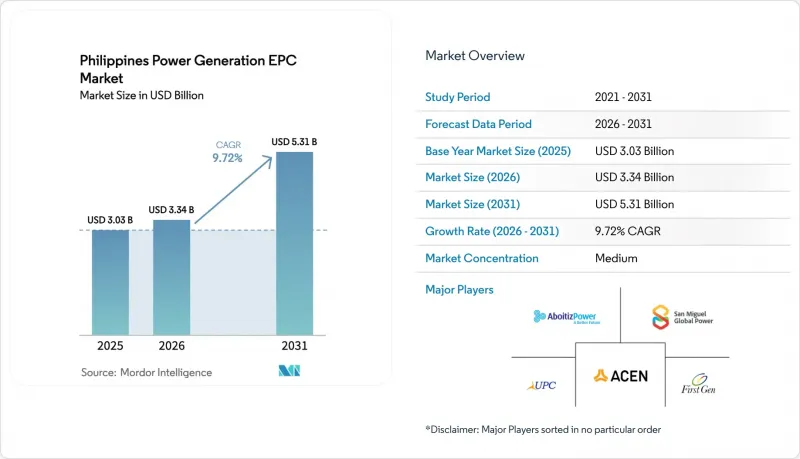
이 보고서는 기술별(화력, 원자력, 재생에너지), 발전 용량대별(100MW 이하, 100-499 MW, 500MW 이상), 그리고 최종사용자별(규제 대상 전력회사, 독립 발전 사업자, 산업용 자가 발전, 공공 부문 및 국영 기업)로 분류되어 있습니다. 시장 규모 및 전망은 금액(달러) 기준으로 제시되어 있습니다.
필리핀 발전 EPC 시장의 동향 및 인사이트
급속한 도시화와 디지털 경제 성장에 따른 전력 수요 증가
2024년, 메트로 마닐라가 인근 주로 확대되고 비즈니스 프로세스 아웃소싱(BPO) 거점에서 24시간 냉각 부하가 발생함에 따라 전력 소비량은 6.2% 증가하여 108 테라와트시에 달했습니다. 예비율은 하락하고 있으며, 2025년 4월 루손섬 송전망의 예비력은 불과 1,850메가와트에 그쳐 황색 경보 기준치에 근접한 수준입니다. 이러한 상황으로 인해 전력 회사는 새로운 발전 용량을 더 신속하게 확보해야 하는 압박을 받고 있습니다. 카비테주와 라구나주에 위치한 하이퍼스케일 데이터센터는 2025년에 이미 450메가와트가 필요하며, 2028년까지 그 두 배에 달할 가능성이 있습니다. 이로 인해 주간 부하 곡선이 변화하여, 오후 피크 수요에 맞춰 계획되는 태양광발전의 EPC(설계·조달·시공) 일정이 유리해집니다. 2024년에는 가정용 에어컨 보급률이 38%로 상승하면서, 배터리를 병용한 태양광발전으로 효율적으로 관리할 수 있는 주간 피크 수요가 더욱 증가했습니다. 전력 개발 계획에서는 2030년까지 15기가와트의 신규 발전 용량을 목표로 하고 있으며, 이는 연간 2.1기가와트에 해당하는 엔지니어링 업무량에 해당합니다. 이로 인해 현지 노동력에는 부담이 가해지는 한편, 지역을 넘나드는 동원 능력을 갖춘 시공업체에게는 이점이 주어집니다.
민다나오·비사야 회랑의 송전망 상호 연결이 새로운 EPC 수주의 계기가 되다
2024년에 송전을 시작한 450메가와트 규모의 민다나오·비사야 제도 해저 케이블 덕분에, 과거 민다나오 프로젝트가 어쩔 수 없이 감수해야 했던 할인 문제가 해소되어,프로젝트의 내부수익률이 1.8퍼센트 포인트 상승하여, 보류되었던 1.2기가와트 규모의 재생에너지 프로젝트가 재개되었습니다. 루손섬에 본사를 둔 독립발전사업자는 섬을 넘어 전력 판매 계약을 통합할 수 있게 되어, 거래 상대방 리스크를 줄이는 동시에 더 대규모이고 경제성이 높은 EPC 계약이 가능해졌습니다. 비사야 제도에서는 우기에 수력 발전으로 풍부한 전력을 수입할 수 있으며, 계절에 따른 가격 변동이 완화되고, 15년간의 전력 구매 계약에 대한 자금 조달 가능성이 향상됩니다. 2027년까지 1,000메가와트로 추가 확장하기 위해 350억 필리핀 페소의 예산이 편성되어 있으며, 이를 통해 군도 전체가 통합된 EPC 입찰 시장으로 더욱 통합될 것입니다. 여러 섬에 걸친 물류를 관리할 수 있는 시공사는 단일 현장에서 시공하는 데 익숙한 경쟁사 대비 비용 면에서 우위를 점할 수 있습니다.
송전망의 병목 현상이 신규 발전 설비의 출력 제한 위험을 초래하고 있습니다.
2024년, 송전망 운영 사업자는 루손섬 북부와 파나이·네그로스 간 주요 회선에서 송전 여력이 고갈됨에 따라 재생 가능 에너지 발전량 중 120기가와트시(총 발전량의 2.1%에 해당)를 억제했습니다. 독립 발전 사업자(IPP)는 손실된 전력에 대한 대금을 받을 수 없기 때문에 EPC의 시산서에서는 현재 3-5%의 출력 감축을 가정하고 있으며, 이로 인해 내부 수익률이 하락하고 있습니다. 당초 2024년에 예정되었던 170억 9,000만 필리핀 페소 규모의 500킬로볼트 간선 송전선 건설은 2026년으로 연기되었으며, 이로 인해 일로코스 노르테 주와 카가얀 주에서 1,200메가와트의 전력을 송전할 수 없게 되었습니다. 230킬로볼트 파나이-네그로스 간 연계선의 가동률이 95%에 달함에 따라 디젤 발전 가동은 불가피하게 되었으며, 이로 인해 신규 태양광발전 입찰의 수익성이 저하되고 있습니다. 2025년 에너지 규제 위원회(ERC)의 지침에서는 구속력 있는 이정표를 포함한 10년 확장 로드맵을 명시하고 있으나, 지방 자치 단체와의 토지 사용권 분쟁은 여전히 해결되지 않은 채로 남아 있으며, 프로젝트 비용을 최대 12%까지 계속 끌어올리고 있습니다.
부문별 분석
2025년 필리핀 발전 EPC 시장의 지출 중 재생 가능 에너지가 68.5%를 차지하며, 2031년까지 연평균 성장률(CAGR) 14.9%로 성장할 것으로 예측됩니다. 그 총액의 55%를 태양광발전이 차지하고 있으며, 40억 달러 규모의 3.5기가와트 "테라 솔라" 계약이 이를 주도하고 있습니다. 한편, 육상 풍력은 30%를 차지하고 있으며, 그 대부분은 일로코스 노르테 주와 기마라스 주에 집중되어 있습니다. 부유식 태양광발전은 15%를 차지하고 있으며, 부지 확보가 어려워지는 상황 속에서도 급속히 확대되고 있고, 설비 이용률은 지상 설치형에 비해 8% 더 높습니다.
화력 발전소는 2025년 투자액의 28%를 차지하며, 연간 3.2%라는 완만한 속도로 확대되고 있습니다. 420메가와트 규모의 ‘산 가브리엘’ 시설 등 액화천연가스(LNG) 프로젝트는 재기화 터미널과 복합 사이클 터빈을 통합함으로써 높은 수익률을 확보할 수 있음을 보여주고 있습니다. 석탄 화력 발전소의 신규 도입은 정부의 모라토리움으로 인해 동결되어 있으며, 원자력 발전은 여전히 검토 단계에 머물러 있습니다. 2024년 울트라 세이프 뉴클리어 코퍼레이션(Ultra Safe Nuclear Corporation)과 체결한 양해각서 덕분에 이 주제는 여전히 논의되고 있지만, 규제 측면의 기반이 부족합니다. 정책 측면에서 신속한 진전이 없다면, 향후 10년 동안 원자력 발전은 필리핀 발전 EPC 시장의 규모에 실질적인 영향을 미치지 못할 것입니다.
기타 혜택:
- 엑셀 형식의 시장 예측(ME) 시트
- 3개월간의 애널리스트 지원
자주 묻는 질문
목차
제1장 서론
제2장 조사 방법
제3장 개요
제4장 시장 구도
제5장 시장 규모와 성장 예측
제6장 경쟁 구도
제7장 시장 기회와 향후 전망
KSA 26.09.02According to Mordor Intelligence, the Philippines power generation EPC market size is projected to expand from USD 3.03 billion in 2025 and USD 3.34 billion in 2026 to USD 5.31 billion by 2031, registering a CAGR of 9.72% between 2026 to 2031.
This report is Segmented by Technology (Thermal, Nuclear, and Renewables), Capacity Band (Up To 100 MW, 100 To 499 MW, and Above 500 MW), and End-User (Regulated Utilities, Independent Power Producers, Industrial Captive Power, and Public Sector and SOE). The Market Sizes and Forecasts are Provided in Terms of Value (USD).
Philippines Power Generation EPC Market Trends and Insights
Rising Electricity Demand From Rapid Urbanization And Digital-Economy Growth
Electricity consumption jumped 6.2% in 2024 to 108 terawatt-hours as Metro Manila extended into neighboring provinces and business-process outsourcing hubs ran round-the-clock cooling loads. Reserve margins are thinning; the Luzon grid logged only 1,850 megawatts of reserves in April 2025, near the yellow-alert threshold, which is pushing utilities to lock in new capacity faster. Hyperscale data centers in Cavite and Laguna already required 450 megawatts in 2025 and could double that by 2028, converting daily load curves and favoring solar EPC timelines that align with peak afternoon demand. Household air-conditioning penetration rose to 38% in 2024, adding to daytime peaks that battery-backed solar can manage efficiently. The Power Development Plan targets 15 gigawatts of fresh capacity by 2030, translating into an annual engineering workload of 2.1 gigawatts that stretches local labor pools and benefits contractors with regional mobilization capability.
Grid Interconnection Of Mindanao-Visayas Corridors Unlocking New EPC Orders
The 450-megawatt Mindanao-Visayas submarine cable, energized in 2024, erased the discount that Mindanao projects once accepted, lifting project internal rates of return by 1.8 percentage points and resurrecting 1.2 gigawatts of shelved renewables. Luzon-based independent power producers can now aggregate offtake across islands, reducing counterparty risk and enabling bigger, more economical EPC scopes. Visayas can import hydro-rich power during rainy months, flattening seasonal price swings and improving the bankability of 15-year power-purchase agreements. A follow-on upgrade to 1,000 megawatts by 2027 is budgeted at PHP 35 billion and will further integrate the archipelago into a unified EPC bidding space. Contractors able to manage multi-island logistics gain a cost edge over rivals accustomed to single-site execution.
Transmission Bottlenecks Causing Curtailment Risk For New Builds
Grid operators curtailed 120 gigawatt-hours of renewable output in 2024, equal to 2.1% of total generation, because key corridors in Northern Luzon and the Panay-Negros link ran out of headroom. Independent power producers receive no payment for lost energy, so EPC pro formas now assume a 3-5% deration, trimming internal rates of return. A PHP 17.09 billion 500-kilovolt backbone originally slated for 2024 slipped to 2026, stranding 1,200 megawatts in Ilocos Norte and Cagayan. The 230-kilovolt Panay-Negros interconnection operates at 95% utilization, forcing diesel dispatch that erodes the economics of fresh solar bids. A 2025 Energy Regulatory Commission directive orders a 10-year expansion roadmap with binding milestones, yet right-of-way disputes with local governments remain unresolved and continue to inflate project costs by up to 12%.
Other drivers and restraints analyzed in the detailed report include:
- Corporate PPAs By Hyperscale Data-Center Entrants
- Modular Floating Solar Projects On Hydropower Reservoirs
- Peso Depreciation Inflating Imported EPC Equipment Costs
For complete list of drivers and restraints, kindly check the Table Of Contents.
Segment Analysis
Renewables commanded 68.5% of 2025 spending within the Philippines' power generation EPC market and are forecast to grow at a 14.9% CAGR through 2031. Solar comprised 55% of that total, led by the 3.5-gigawatt Terra Solar contract valued at USD 4 billion, while onshore wind held 30%, concentrated in Ilocos Norte and Guimaras. Floating solar captured 15% and is scaling rapidly as land access tightens, with capacity factors running 8% higher than ground-mount benchmarks.
Thermal plants accounted for 28% of the 2025 investment and are expanding modestly at 3.2% per year. Liquefied-natural-gas projects such as the 420-megawatt San Gabriel facility show how integrating regasification terminals with combined-cycle turbines secures premium margins. Coal additions are frozen under a government moratorium, and nuclear remains exploratory; a 2024 memorandum with Ultra Safe Nuclear Corporation keeps the topic alive but lacks a regulatory backbone. Absent swift policy progress, nuclear will not materially influence the Philippines' power generation EPC market size this decade.
Complete Report Scope:
- By Technology
- Thermal
- Nuclear
- Renewables
- By Capacity Band
- Up to 100 MW (DER, micro-grid)
- 100 to 499 MW
- Above 500 MW
- By End-User
- Regulated Utilities
- Independent Power Producers
- Industrial Captive Power
- Public Sector and SOE
List of Companies Covered in this Report:
- UPC Renewables
- Bronzeoak Philippines
- Black & Veatch Corporation
- JGC Philippines Inc.
- AECOM
- Fluor Corporation
- Aboitiz Power Corporation
- San Miguel Global Power Holdings
- First Gen Corporation
- ACEN Corporation
- DM Consunji Inc. (DMCI Power)
- Mitsubishi Power (MHI)
- Siemens Energy AG
- Sumitomo Corporation
- Hyundai Engineering Co., Ltd.
- POSCO E&C
- China Energy Engineering Corp. (CEEC)
- Power Construction Corp. of China (PowerChina)
- KEPCO Engineering & Construction
- Toyo Engineering Corporation
Additional Benefits:
- The market estimate (ME) sheet in Excel format
- 3 months of analyst support
TABLE OF CONTENTS
1 Introduction
- 1.1 Study Assumptions & Market Definition
- 1.2 Scope of the Study
2 Research Methodology
3 Executive Summary
4 Market Landscape
- 4.1 Market Overview
- 4.2 Installed Capacity Outlook
- 4.3 Primary-Energy Consumption Snapshot
- 4.4 Market Drivers
- 4.4.1 Rising electricity demand from rapid urbanisation & digital-economy growth
- 4.4.2 Fast-track approval of renewable-energy service contracts (2023-25)
- 4.4.3 Grid interconnection of Mindanao-Visayas corridors unlocking new EPC orders
- 4.4.4 Corporate PPAs by hyperscale data-center entrants (Google, Amazon, Meta)
- 4.4.5 Novel LNG-to-power hubs enabling hybrid EPC scopes
- 4.4.6 Modular floating solar projects on hydropower reservoirs
- 4.5 Market Restraints
- 4.5.1 Transmission bottlenecks causing curtailment risk for new builds
- 4.5.2 Peso depreciation inflating imported EPC equipment costs
- 4.5.3 Local content rule ambiguities delaying contract awards
- 4.5.4 Geothermal resource-rights disputes hindering brown-field repowering
- 4.6 Supply-Chain Analysis
- 4.7 Regulatory Landscape & Government Policies
- 4.8 Technological Outlook
- 4.9 Porter's Five Forces
- 4.9.1 Bargaining Power of Suppliers
- 4.9.2 Bargaining Power of Buyers
- 4.9.3 Threat of New Entrants
- 4.9.4 Threat of Substitutes
- 4.9.5 Competitive Rivalry
- 4.10 PESTLE Analysis
5 Market Size & Growth Forecasts
- 5.1 By Technology
- 5.1.1 Thermal
- 5.1.2 Nuclear
- 5.1.3 Renewables
- 5.2 By Capacity Band
- 5.2.1 Up to 100 MW (DER, micro-grid)
- 5.2.2 100 to 499 MW
- 5.2.3 Above 500 MW
- 5.3 By End-User
- 5.3.1 Regulated Utilities
- 5.3.2 Independent Power Producers
- 5.3.3 Industrial Captive Power
- 5.3.4 Public Sector and SOE
6 Competitive Landscape
- 6.1 Market Concentration
- 6.2 Strategic Moves (M&A, Partnerships, PPAs)
- 6.3 Market Share Analysis (Market Rank/Share for key companies)
- 6.4 Company Profiles (includes Global level Overview, Market level overview, Core Segments, Financials as available, Strategic Information, Products & Services, and Recent Developments)
- 6.4.1 UPC Renewables
- 6.4.2 Bronzeoak Philippines
- 6.4.3 Black & Veatch Corporation
- 6.4.4 JGC Philippines Inc.
- 6.4.5 AECOM
- 6.4.6 Fluor Corporation
- 6.4.7 Aboitiz Power Corporation
- 6.4.8 San Miguel Global Power Holdings
- 6.4.9 First Gen Corporation
- 6.4.10 ACEN Corporation
- 6.4.11 DM Consunji Inc. (DMCI Power)
- 6.4.12 Mitsubishi Power (MHI)
- 6.4.13 Siemens Energy AG
- 6.4.14 Sumitomo Corporation
- 6.4.15 Hyundai Engineering Co., Ltd.
- 6.4.16 POSCO E&C
- 6.4.17 China Energy Engineering Corp. (CEEC)
- 6.4.18 Power Construction Corp. of China (PowerChina)
- 6.4.19 KEPCO Engineering & Construction
- 6.4.20 Toyo Engineering Corporation
7 Market Opportunities & Future Outlook
- 7.1 White-space & Unmet-need Assessment


