

|
시장보고서
상품코드
2113235
미국의 농업용 트랙터 기계 : 시장 점유율 분석, 업계 동향과 통계, 성장 예측(2026-2031년)United States Agricultural Tractor Machinery - Market Share Analysis, Industry Trends & Statistics, Growth Forecasts (2026 - 2031) |
||||||
 Mordor Intelligence
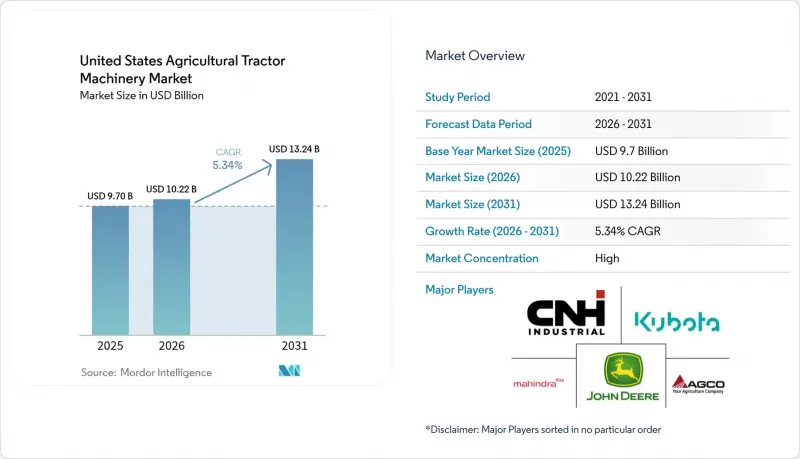
Mordor Intelligence에 따르면 미국의 농업용 트랙터 기계 시장 규모는 2025년에 97억 달러로 평가되며, 2026년 102억 2,000만 달러에서 2031년까지 132억 4,000만 달러에 달할 것으로 예측되고 있으며, 예측 기간(2026-2031년)에 CAGR은 5.34%에 달할 전망입니다.
이 보고서는 제품 유형(경운·경작 기계, 파종 기계, 분무기 등)별로 분류되어 있습니다. 시장 예측은 금액(달러) 기준으로 제시되어 있습니다.
미국 농업용 트랙터 시장 동향 및 인사이트
정밀농업의 도입 확대
전지구위치시스템(GPS)을 이용한 유도, 가변 시비율 컨트롤러 및 구획 제어 노즐은 1,500에이커가 넘는 농장에서 표준 관행으로 자리 잡았습니다. 2024년에는 중서부 지역의 옥수수 및 대두 재배 면적의 75%가 GPS 유도 기술을 사용하여 경작되었으며, 이는 2020년의 62%에서 증가한 수치입니다. 인력 부족으로 인해 밭에서 수작업으로 조정하는 것이 현실적으로 어려워짐에 따라 농가는 자동화에 의존하고 있습니다. 텔레매틱스를 통해 데이터가 클라우드 플랫폼으로 전송됨에 따라 전환 비용이 증가하고 있으며, 경쟁 우위는 마력이 아닌 소프트웨어의 상호 운용성에 좌우되고 있습니다. 구형 농기계가 수명을 다하면 업그레이드를 통해 센서나 연결 기능이 자동으로 탑재되게 되어, 미국 농업용 트랙터 시장에서 대당 기술적 부가가치가 높아지고 있습니다.
전동화에 대한 인센티브 확대
전기식 또는 하이브리드식 장비 구입 비용의 최대 30%를 지원하는 연방 세액 공제와 소형 디젤 엔진을 단계적으로 폐지하는 캘리포니아주의 규제가 저마력 배터리 구동형 트랙터에 대한 수요를 자극하고 있습니다. Monarch Tractor는 2024년 캘리포니아주 농가에게 작업 기구가 결합된 전기식 트랙터 200대 이상을 출하하며, 이 기술의 상업적 실현 가능성에 있으며, 중요한 이정표를 세웠습니다. 전기 구동 시스템은 고마력 줄 재배 농업 분야를 대체하는 것은 아니지만, 500에이커 미만의 특수 농장을 대상으로 병행 시장을 개발하고 있습니다. 이러한 양극화로 인해 미국 농업용 트랙터 기계 시장의 제품 라인업은 더욱 확대되고 있습니다.
첨단 기술 분야의 유지보수 기술 인력 부족
2024년에는 농업기계 판매점의 68%가 기술자 부족을 보고했으며, 첨단 기술을 다루는 직종의 평균 채용 기간은 120일을 초과하고 있습니다. 미국 농지의 약 30%에 영향을 미치는 농촌 지역의 광대역 격차가 여전히 존재하며, 이는 원격 진단의 유효성을 더욱 제한하고 정밀 트랙터용 작업기의 가동 시간으로 인한 이점을 저해하고 있습니다. 그 결과, 밀집되고 자원이 풍부한 서비스 네트워크를 갖춘 OEM은 뚜렷한 경쟁 우위를 확보하고 있는 반면, 소규모 기업이나 신규 진입 기업은 분산된 농업 지역 전체에 걸쳐 적절한 지원 체제를 유지하는 데 어려움을 겪고 있습니다.
부문 분석
2025년, 미국 농업용 트랙터 기계 시장 규모의 30.62%를 차지하는 파종 기계는 여전히 최대 부문로서의 위상을 유지했습니다. 1,500에이커 이상의 농장에서는 가변율 파종이 포화 상태에 가까워지고 있으며, 실시간 종자 간격 조정 및 다운포스 제어는 더 이상 프리미엄 기능이 아닌 표준 기능이 되어 가고 있습니다. 이러한 정밀 기술의 대중화로 하드웨어 간의 가격 차이는 줄어들고 있으며, 경쟁은 농업적 조언, 데이터 분석, 농장 관리 플랫폼과의 연동과 같은 부가가치 서비스로 이동하고 있습니다. 농가는 현재 파종 기기의 품질뿐만 아니라 소프트웨어 호환성, 딜러의 보정 지원, 그리고 수확량과 투입 자재의 효율을 최적화하는 실용적인 지식도 중요하게 여기고 있으며, 이로 인해 미국 농업용 트랙터 기계 시장에서 파종 기계의 전략적 중요성이 높아지고 있습니다.
분무기는 가장 빠르게 성장하는 부문으로, 2031년까지 연평균 성장률(CAGR)이 7.52%에 달할 것으로 예측됩니다. 섹션 제어 노즐 및 펄스 폭 변조(PWM) 시스템은 2,000에이커 이상의 농장에서 표준 사양으로 장착되고 있으며, 정밀 살포는 선택적 업그레이드에서 운영상의 필수 요건으로 변화하고 있습니다. 견인식 붐의 설계는 GPS와 가변 살포량 제어기가 통합된 자주식 살포기에 점차 대체되고 있습니다. 중서부 지역의 작물 재배 농가는 인력 절감, 농약 중복 살포 감소, 환경 규제 준수 강화를 이유로 30만-50만 달러의 추가 비용을 정당화하고 있습니다. 이러한 기계는 데이터를 농장 관리 소프트웨어에 직접 전송하므로 강력한 소프트웨어 생태계와 딜러의 보정 지원을 갖춘 제조업체는 큰 경쟁 우위를 점하고 있으며, 미국 농업용 트랙터 기계 시장에서 스마트 살포기 기술의 역할이 점점 더 중요해지고 있음이 부각되고 있습니다.
기타 혜택:
- 엑셀 형식의 시장 예측(ME) 시트
- 3개월간의 애널리스트 지원
자주 묻는 질문
목차
제1장 서론
제2장 조사 방법
제3장 개요
제4장 시장 구도
제5장 시장 규모와 성장 예측
제6장 경쟁 구도
제7장 시장 기회와 향후 전망
KSA 26.08.25According to Mordor Intelligence, the United States agricultural tractor machinery market size was valued at USD 9.7 billion in 2025 and estimated to grow from USD 10.22 billion in 2026 to reach USD 13.24 billion by 2031, at a CAGR of 5.34% during the forecast period (2026-2031).
This report is Segmented by Product Type (Plowing and Cultivating Machinery, Planting Machinery, Sprayers, and More). The Market Forecasts are Provided in Terms of Value (USD).
United States Agricultural Tractor Machinery Market Trends and Insights
Increase in Adoption of Precision Agriculture
Global Positioning System (GPS) guidance, variable-rate controllers, and section-control nozzles have become standard practices on farms exceeding 1,500 acres. In 2024, 75% of Midwest corn and soybean acres were planted using GPS-guided technology, up from 62% in 2020 . Farmers rely on automation because labor shortages make manual in-field adjustments unworkable. Telematics now feeds data to cloud platforms, which raises switching costs, so the competitive edge is tied to software interoperability rather than horsepower. As older implements reach the end of their life, upgrades automatically embed sensors and connectivity, increasing the technology content per unit in the United States agricultural tractor machinery market.
Rising in Electrification Incentives
Federal tax credits that cover up to 30% of electric or hybrid equipment cost and California rules that phase out small diesel engines are stimulating demand for lower-horsepower battery units . Monarch Tractor shipped more than 200 electric tractors with paired implements to California growers in 2024, marking a significant milestone in the commercial viability of the technology. Electric drives are not displacing the high-horsepower row-crop segment but are carving out a parallel lane for specialty farms under 500 acres. This bifurcation widens the product palette inside the United States agricultural tractor machinery market.
Advanced-Technology Maintenance Skill Gap
In 2024, 68% of equipment dealers reported technician shortages, with average hiring times exceeding 120 days for advanced-technology roles. Persistent rural broadband gaps affecting nearly 30% of the United States' farmland further limit the effectiveness of remote diagnostics, reducing the uptime benefits of precision tractor implements. As a result, OEMs (Original Equipment Manufacturers) with dense, well-resourced service networks gain a clear competitive edge, while smaller or newer market entrants struggle to maintain adequate support coverage across dispersed farming regions.
Other drivers and restraints analyzed in the detailed report include:
- Labor Cost Inflation on Large Farms
- High Adoption of Dealer-Led Subscription Models
- Steel and Aluminum Tariff Cost Pass-Through
For complete list of drivers and restraints, kindly check the Table Of Contents.
Segment Analysis
Planting machinery retained its position as the largest segment at 30.62% of the United States agricultural tractor machinery market size in 2025. Variable-rate seeding is nearing saturation on farms above 1,500 acres, making real-time seed spacing and downforce control standard rather than premium features. This normalization of precision technology has compressed hardware price spreads, pushing competition toward value-added services such as agronomic advice, data analytics, and integration with farm-management platforms. Farmers now prioritize not only the quality of seeding equipment but also software compatibility, dealer calibration support, and actionable insights that optimize yields and input efficiency, reinforcing the strategic importance of planting machinery in the United States agricultural tractor machinery market.
Sprayers are the fastest-growing segment with a projected 7.52% CAGR through 2031. Section-control nozzles and pulse-width-modulation systems have become standard for farms over 2,000 acres, turning precision application from an optional upgrade into an operational necessity. Pull-type boom designs are gradually giving way to self-propelled sprayers with integrated GPS and variable-rate controllers. Midwest row-crop growers justify the USD 300,000 to USD 500,000 premium through labor savings, reduced chemical overlap, and improved environmental compliance. Because these machines feed data directly into farm-management software, manufacturers with strong software ecosystems and dealer calibration support gain a significant competitive edge, highlighting the growing role of smart sprayer technologies in the United States agricultural tractor machinery market.
Complete Report Scope:
- By Product Type
- Plowing and Cultivating Machinery
- Plows
- Harrows
- Rotovators and Cultivators
- Other Plowing and Cultivating Machinery
- Planting Machinery
- Seed Drills
- Planters
- Spreaders
- Other Planting Machinery
- Sprayers
- Haying and Forage Machinery
- Mowers and Conditioners
- Balers
- Other Haying and Forage Machinery
- Other Types
- Plowing and Cultivating Machinery
List of Companies Covered in this Report:
- Deere & Company
- CNH Industrial N.V.
- AGCO Corporation
- Kubota Corporation
- Mahindra & Mahindra Ltd.
- Claas Group
- SDF Group
- Buhler Industries
- Yanmar Holdings
- JCB Group
- Trimble Inc.
- Monarch Tractor
- Autonomous Solutions Inc.
- Blue White Robotics
Additional Benefits:
- The market estimate (ME) sheet in Excel format
- 3 months of analyst support
TABLE OF CONTENTS
1 Introduction
- 1.1 Study Assumptions and Market Definition
- 1.2 Scope of the Study
2 Research Methodology
3 Executive Summary
4 Market Landscape
- 4.1 Market Overview
- 4.2 Market Drivers
- 4.2.1 Increase in Adoption of Precision Agriculture
- 4.2.2 Rising in Electrification Incentives
- 4.2.3 Labor Cost Inflation on Large Farms
- 4.2.4 High Adoption of Dealer-Led Subscription Models
- 4.2.5 Section 232 Tariff-Driven Localization
- 4.2.6 Carbon-Credit Revenue for Low-Emission Equipment
- 4.3 Market Restraints
- 4.3.1 High Equipment Capital Expenditure
- 4.3.2 Commodity-Price Volatility
- 4.3.3 Advanced-Technology Maintenance Skill Gap
- 4.3.4 Steel and Aluminum Tariff Cost Pass-Through
- 4.4 Regulatory Landscape
- 4.5 Technological Outlook
- 4.6 Porters Five Forces Analysis
- 4.6.1 Threat of New Entrants
- 4.6.2 Bargaining Power of Suppliers
- 4.6.3 Bargaining Power of Buyers
- 4.6.4 Threat of Substitutes
- 4.6.5 Intensity of Competitive Rivalry
5 Market Size and Growth Forecasts (Value)
- 5.1 By Product Type
- 5.1.1 Plowing and Cultivating Machinery
- 5.1.1.1 Plows
- 5.1.1.2 Harrows
- 5.1.1.3 Rotovators and Cultivators
- 5.1.1.4 Other Plowing and Cultivating Machinery
- 5.1.2 Planting Machinery
- 5.1.2.1 Seed Drills
- 5.1.2.2 Planters
- 5.1.2.3 Spreaders
- 5.1.2.4 Other Planting Machinery
- 5.1.3 Sprayers
- 5.1.4 Haying and Forage Machinery
- 5.1.4.1 Mowers and Conditioners
- 5.1.4.2 Balers
- 5.1.4.3 Other Haying and Forage Machinery
- 5.1.5 Other Types
- 5.1.1 Plowing and Cultivating Machinery
6 Competitive Landscape
- 6.1 Market Concentration
- 6.2 Strategic Moves
- 6.3 Market Share Analysis
- 6.4 Company Profiles (Includes Global Level Overview, Market Level Overview, Core Segments, Financials as Available, Strategic Information, Market Rank/Share, Products & Services, and Recent Developments)
- 6.4.1 Deere & Company
- 6.4.2 CNH Industrial N.V.
- 6.4.3 AGCO Corporation
- 6.4.4 Kubota Corporation
- 6.4.5 Mahindra & Mahindra Ltd.
- 6.4.6 Claas Group
- 6.4.7 SDF Group
- 6.4.8 Buhler Industries
- 6.4.9 Yanmar Holdings
- 6.4.10 JCB Group
- 6.4.11 Trimble Inc.
- 6.4.12 Monarch Tractor
- 6.4.13 Autonomous Solutions Inc.
- 6.4.14 Blue White Robotics


