

|
시장보고서
상품코드
2113531
아시아태평양의 농업용 트랙터 : 시장 점유율 분석, 업계 동향 및 통계, 성장 예측(2026-2031년)Asia-Pacific Agricultural Tractor Machinery - Market Share Analysis, Industry Trends & Statistics, Growth Forecasts (2026 - 2031) |
||||||
 Mordor Intelligence
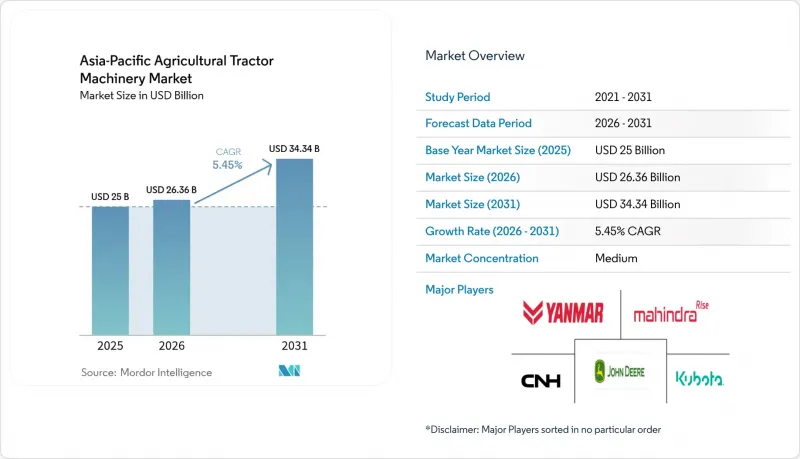
Mordor Intelligence에 의하면, 아시아태평양의 농업용 트랙터 시장 규모는 2025년 250억 달러에서 2026년에는 263억 6,000만 달러에 이르고, 2026-2031년 CAGR 5.45%로 성장을 지속하여 2031년에는 343억 4,000만 달러에 달할 것으로 예측됩니다.
본 보고서는 제품 유형별(경운 및 경작 기계, 파종 기계, 분무기, 건초 및 사료용 기계, 기타) 및 지역별(중국, 인도, 일본, 호주 등)로 분류되어 있습니다. 시장 예측은 금액(달러) 기준으로 이루어졌습니다.
아시아태평양의 농업용 트랙터 시장 동향 및 인사이트
정부의 기계화 보조금 및 융자 프로그램
2024년, 아시아태평양 전체의 직접 보조금 지출액은 42억 달러를 넘어, 구매 비용을 약 4분의 1 수준으로 절감했습니다. 인도에서는 Aadhaar(아다르)와 연동된 급여 제도를 통해 급여의 적시 지급이 보장되고 있습니다. 한편, 중국에서는 현재 지정된 현에서 100마력 미만 트랙터 가격의 최대 60%를 보조하고 있습니다. 태국과 베트남에서는 보조금에 더해 무이자 또는 금리 상한이 적용된 대출을 제공함으로써, 생산자들이 이용 데이터를 농업 보급 서비스에 전송하는 커넥티드 기기의 도입을 촉진하고 있습니다. 이러한 노력들이 맞물려 트랙터 교체 주기를 앞당기고, 중마력급 수요를 견인하며, OEM의 수주 파이프라인을 안정화하고 있습니다.
심각한 농촌 지역 인력 부족이 트랙터 수요를 견인
2020년부터 2024년에 걸쳐 아시아태평양에서는 이주 노동자들이 도시의 공장으로 이동함에 따라 830만 명의 농업 노동자가 감소했습니다. 펀자브 주에서는 일당이 600-700 루피(7.2-8.4 달러)로 상승했으며, 이로 인해 노동 집약적 작물의 이익률이 압박받으면서 농가들은 경작 및 모종 심기의 기계화를 추진하고 있습니다. 일본의 고령화되는 농가층과 중국의 호적 제도 개혁으로 인해 계절 노동력 공급이 더욱 감소하고 있으며, 협동조합을 통한 트랙터 공동 구매가 촉진되는 한편, 운전자의 훈련 기간을 단축하는 직관적인 사용자 인터페이스에 대한 수요가 높아지고 있습니다.
높은 초기 도입 비용과 자금 조달 비용
인도에서는 보급형 35마력 트랙터의 정가가 55만-65만 루피(6,600-7,800 달러)로, 이는 소규모 농가의 연간 순수입의 2배 이상에 해당합니다. 인도네시아의 대출 금리는 평균 11.5%이며, 베트남에서는 30%의 계약금 납부가 의무화되어 있어 운영 자금을 압박하고 있습니다. 필리핀에서는 담보 부족으로 인해 신청자들이 유지보수 위험이 높은 중고 시장으로 몰리고 있습니다. 이러한 자금적 장벽으로 인해, 특히 고사양 모델의 구매가 미뤄지고 있습니다.
부문 분석
2025년, 경운·중경용 기계는 부문 점유율의 39.95%를 차지하며, 아시아태평양의 다양한 작물 재배 체계에서 모종상 준비에 있어 그 지극히 중요한 역할을 부각시키고 있습니다. 여기에는 중국의 기계화된 밀 생산 지역과 인도의 세분화된 논이 포함되며, 이러한 지역에서는 습지에서의 진흙 교반 작업에 로터베이터가 널리 사용되고 있습니다. 이 카테고리가 지배적인 위치를 차지하고 있는 배경에는 모든 작물 유형에 걸쳐 경운이 보편적으로 필요하다는 점이 있습니다. 몰드보드식 쟁기는 호주의 광대한 밀 재배 지역에서 여전히 중요한 역할을 수행하고 있으며, 심층 반전 경운을 통해 잡초 씨앗을 땅속에 매몰시키고 석회 시비를 토양에 혼합하고 있습니다. 한편, 동남아시아의 이모작 시스템에서는 수확부터 파종까지 신속한 전환이 요구되기 때문에 디스크 할로우가 선호됩니다. 보전 경작법이 보급됨에 따라 이 부문의 성장은 둔화되고 있습니다. 로토베이터와 컬티베이터에는 타인의 깊이 조절 기능이나 유압식 사이드 시프트 기능 등의 기능이 추가되어, 파종용 토양을 정밀하게 평탄화할 수 있게 되었습니다. 이러한 기술 혁신은 15-20%의 가격 프리미엄을 수반하지만, 추가적인 해로우 작업을 줄임으로써 연료 소비를 현저히 절감하는 효과도 가져옵니다.
살포기는 2026년부터 2031년까지 연평균 성장률(CAGR) 9.12%를 나타낼 것으로 예측되며, 이는 다른 모든 제품 카테고리를 능가하는 속도입니다. 이러한 성장은 작물 보호 관행을 변화시키고 있는 정밀 살포 기술과 드론 탑재 시스템의 발전에 의해 주도되고 있습니다. 예를 들어, 2024년에 출시된 DJI의 드론 살포기 ‘Agras T50’은 시간당 16헥타르를 커버할 수 있으며, 수동식 등짐형 살포기에 비해 인건비를 10분의 1로 절감할 수 있습니다. 이러한 생산성의 대폭적인 향상으로 인해 인도 면화 재배 지역과 중국 과수원에서 도입이 가속화되고 있습니다. 파종기 및 정밀 파종기를 포함한 식재용 기계는 계약 농업이 집중된 지역에서 보급이 확대되고 있습니다. 이러한 기계를 통해 균일한 식재 간격이 실현되어 수확량이 8-12% 향상됩니다. 위성 이미지를 통해 생성된 토양 비옥도 지도를 바탕으로 파종 밀도를 조정하는 가변율 파종기도 점점 더 인기를 얻고 있습니다. 호주의 무경운 재배 밀 재배 지역에서는 해로우에 대한 관심이 다시 높아지고 있습니다. 체인 해로우는 토양 구조를 훼손하지 않으면서 수확 후 잔여물을 관리하는 데 사용되며, 발아라는 중요한 단계에서 수분 유지에 기여하고 있습니다. 입상 비료용 살포기에는 GPS 유도 방식의 구획 제어 기능이 탑재되어 있어, 끝부분에서의 중복 살포를 방지함으로써 대규모 농장에서 투입 비용을 6-9% 절감하고 있습니다.
기타 혜택:
- 엑셀 형식 시장 예측(ME) 시트
- 3개월간의 애널리스트 지원
자주 묻는 질문
목차
제1장 서론
제2장 조사 방법
제3장 주요 요약
제4장 시장 구도
제5장 시장 규모와 성장 예측
제6장 경쟁 구도
제7장 시장 기회와 향후 전망
LSH 26.08.25According to Mordor Intelligence, the Asia-Pacific agricultural tractor machinery market size is expected to grow from USD 25 billion in 2025 to USD 26.36 billion in 2026 and is forecast to reach USD 34.34 billion by 2031 at 5.45% CAGR over 2026-2031.
This report is Segmented by Product Type (Plowing and Cultivating Machinery, Planting Machinery, Sprayers, Haying and Forage Machinery, and Other Types) and by Geography (China, India, Japan, Australia, and More). The Market Forecasts in Terms of Value (USD).
Asia-Pacific Agricultural Tractor Machinery Market Trends and Insights
Government Mechanization Subsidies and Credit Programs
Direct subsidy outlays surpassed USD 4.2 billion in 2024 across Asia-Pacific, trimming acquisition costs by roughly one-quarter. India's Aadhaar-linked benefit transfers guarantee timely payments, while China now reimburses up to 60% of sub-100-horsepower tractor prices in designated counties. Thailand and Vietnam complement grants with zero-interest or capped-rate loans, nudging growers toward connected equipment that feeds usage data to extension services. These initiatives collectively accelerate fleet replacement, steer demand toward mid-range horsepower, and stabilize OEM order pipelines.
Acute Rural Labor Shortages Driving Tractor Demand
Asia-Pacific lost 8.3 million agricultural workers between 2020 and 2024 as migrants shifted to urban factories. Rising daily wages now INR 600-700 (USD 7.2-8.4) in Punjab compress margins for labor-intensive crops, pushing growers toward mechanized tillage and transplanting. Japan's aging farmer base and China's Hukou reforms further drain seasonal labor pools, boosting cooperative tractor purchases and spurring intuitive user interfaces that shorten operator training time.
High Upfront Acquisition and Financing Costs
Entry-level 35-horsepower units list at INR 550,000-650,000 (USD 6,600-7,800) in India, more than double a marginal farmer's annual net income. Indonesian loan rates average 11.5%, and Vietnam enforces 30% down-payments that sap working capital. Collateral gaps in the Philippines drive applicants toward second-hand markets with higher maintenance risks. These financial frictions postpone purchases, especially for higher-spec models.
Other drivers and restraints analyzed in the detailed report include:
- Rising Average Farm Size and Contract-Farming Models
- Surge in Precision-Farming Adoption
- Fragmented Land Holdings Curbing High-Horsepower Sales
For complete list of drivers and restraints, kindly check the Table Of Contents.
Segment Analysis
Plowing and cultivating machinery accounted for 39.95% of the segment share in 2025, underscoring its critical role in seedbed preparation across Asia-Pacific's diverse cropping systems. This includes China's mechanized wheat zones and India's fragmented rice paddies, where rotovators are widely used for wet-land puddling operations. The dominance of this category is driven by the universal need for tillage across all crop types. Moldboard plows remain significant in Australia's broadacre wheat regions, where deep inversion buries weed seeds and incorporates lime amendments. Meanwhile, disc harrows are preferred in Southeast Asia's double-cropping systems, which require a quick turnaround between harvest and planting. The segment's growth is slowing as conservation tillage practices gain momentum. Rotovators and cultivators are being upgraded with features such as adjustable tine depths and hydraulic side-shift capabilities, which enable precise seedbed leveling. These advancements, which command a 15-20% price premium, also deliver measurable fuel savings by reducing the need for additional harrowing passes.
Sprayers are projected to grow at a 9.12% CAGR from 2026 to 2031, outpacing all other product categories. This growth is driven by advancements in precision application technologies and drone-mounted systems, which are transforming crop protection practices. For instance, DJI's Agras T50 drone sprayer, launched in 2024, can cover 16 hectares per hour at one-tenth the labor cost of manual knapsack spraying. This significant productivity improvement is accelerating adoption in India's cotton belt and China's fruit orchards. Planting machinery, including seed drills and precision planters, is gaining traction in contract-farming clusters. These machines enable uniform plant spacing, resulting in 8-12% yield improvements. Variable-rate planters, which adjust seed populations based on soil fertility maps generated from satellite imagery, are becoming increasingly popular. Harrows are experiencing renewed interest in Australia's no-till wheat zones. Chain harrows are used to manage stubble residue without disturbing soil structure, helping to preserve moisture during the critical germination phase. Spreaders for granular fertilizers are incorporating GPS-guided section control, which prevents overlap in headlands and reduces input costs by 6-9% in large-scale operations.
Complete Report Scope:
- By Product Type
- Plowing and Cultivating Machinery
- Plows
- Harrows
- Rotovators and Cultivators
- Other Equipment
- Planting Machinery
- Seed Drills
- Planters
- Spreaders
- Other Planting Machinery
- Sprayers
- Haying and Forage Machinery
- Mowers and Conditioners
- Balers
- Other Haying and Forage Machinery
- Other Types
- Plowing and Cultivating Machinery
- By Geography
- China
- India
- Japan
- Australia
- South Korea
- Indonesia
- Thailand
- Vietnam
- Rest of Asia-Pacific
List of Companies Covered in this Report:
- Kubota Corporation
- Mahindra and Mahindra Ltd.
- Deere and Company
- Yanmar Co., Ltd.
- Iseki & Co., Ltd.
- Escorts Kubota Ltd. (Kubota Corporation)
- CNH Industrial N.V.
- Lovol Heavy Industry Co., Ltd.
- Daedong Corporation
- Zoomlion Heavy Industry Science and Technology Co., Ltd.
- Shandong Shifeng Group Co., Ltd.
- AGCO Corporation
- SDF Group
- CLAAS KGaA mbH
- TYM Corporation
Additional Benefits:
- The market estimate (ME) sheet in Excel format
- 3 months of analyst support
TABLE OF CONTENTS
1 Introduction
- 1.1 Study Assumptions and Market Definition
- 1.2 Scope of the Study
2 Research Methodology
3 Executive Summary
4 Market Landscape
- 4.1 Market Overview
- 4.2 Market Drivers
- 4.2.1 Government mechanization subsidies and credit programs
- 4.2.2 Acute rural labor shortages driving tractor demand
- 4.2.3 Rising average farm size and contract-farming models
- 4.2.4 Surge in precision-farming adoption
- 4.2.5 Telematics-enabled machinery-as-a-service business models
- 4.2.6 Climate-resilient equipment suited for erratic monsoon patterns
- 4.3 Market Restraints
- 4.3.1 High upfront acquisition and financing costs
- 4.3.2 Fragmented land holdings curbing high-horsepower sales
- 4.3.3 Expansion of custom-hiring centers reducing ownership need
- 4.3.4 Non-harmonized safety regulations delaying certifications
- 4.4 Regulatory Landscape
- 4.5 Technological Outlook
- 4.6 Porter's Five Forces Analysis
- 4.6.1 Threat of New Entrants
- 4.6.2 Bargaining Power of Suppliers
- 4.6.3 Bargaining Power of Buyers
- 4.6.4 Threat of Substitutes
- 4.6.5 Intensity of Competitive Rivalry
5 Market Size and Growth Forecasts (Value)
- 5.1 By Product Type
- 5.1.1 Plowing and Cultivating Machinery
- 5.1.1.1 Plows
- 5.1.1.2 Harrows
- 5.1.1.3 Rotovators and Cultivators
- 5.1.1.4 Other Equipment
- 5.1.2 Planting Machinery
- 5.1.2.1 Seed Drills
- 5.1.2.2 Planters
- 5.1.2.3 Spreaders
- 5.1.2.4 Other Planting Machinery
- 5.1.3 Sprayers
- 5.1.4 Haying and Forage Machinery
- 5.1.4.1 Mowers and Conditioners
- 5.1.4.2 Balers
- 5.1.4.3 Other Haying and Forage Machinery
- 5.1.5 Other Types
- 5.1.1 Plowing and Cultivating Machinery
- 5.2 By Geography
- 5.2.1 China
- 5.2.2 India
- 5.2.3 Japan
- 5.2.4 Australia
- 5.2.5 South Korea
- 5.2.6 Indonesia
- 5.2.7 Thailand
- 5.2.8 Vietnam
- 5.2.9 Rest of Asia-Pacific
6 Competitive Landscape
- 6.1 Market Concentration
- 6.2 Strategic Moves
- 6.3 Market Share Analysis
- 6.4 Company Profiles (Includes Global Level Overview, Market Level overview, Core Segments, Financials as available, Strategic Information, Market Rank/Share for key companies, Products and Services, and Recent Developments)
- 6.4.1 Kubota Corporation
- 6.4.2 Mahindra and Mahindra Ltd.
- 6.4.3 Deere and Company
- 6.4.4 Yanmar Co., Ltd.
- 6.4.5 Iseki & Co., Ltd.
- 6.4.6 Escorts Kubota Ltd. (Kubota Corporation)
- 6.4.7 CNH Industrial N.V.
- 6.4.8 Lovol Heavy Industry Co., Ltd.
- 6.4.9 Daedong Corporation
- 6.4.10 Zoomlion Heavy Industry Science and Technology Co., Ltd.
- 6.4.11 Shandong Shifeng Group Co., Ltd.
- 6.4.12 AGCO Corporation
- 6.4.13 SDF Group
- 6.4.14 CLAAS KGaA mbH
- 6.4.15 TYM Corporation


