

|
시장보고서
상품코드
2113563
북미의 농업용 트랙터 : 시장 점유율 분석, 업계 동향 및 통계, 성장 예측(2026-2031년)North America Agricultural Tractor Machinery - Market Share Analysis, Industry Trends & Statistics, Growth Forecasts (2026 - 2031) |
||||||
 Mordor Intelligence
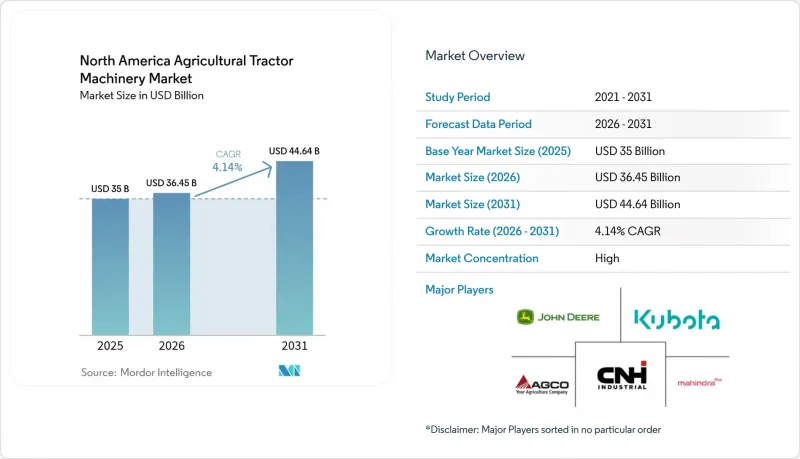
Mordor Intelligence에 의하면, 2026년 북미의 농업용 트랙터 시장 규모는 364억 5,000만 달러로 추정되고 있으며, 2025년 350억 달러에서 2031년에는 446억 4,000만 달러에 달할 것으로 예측됩니다.
또한 2026-2031년 연평균 성장률(CAGR) 4.14%를 기록할 전망입니다.
본 보고서는 제품 유형별(경운·중경 기계, 파종 기계, 분무기, 건초·사료용 기계, 기타) 및 지역별(미국, 캐나다, 멕시코, 기타 북미)로 분류되어 있습니다. 본 보고서에서는 시장 규모 및 전망을 금액(달러) 기준으로 제시하고 있습니다.
북미의 농업용 트랙터 시장 동향 및 인사이트
자율 주행 트랙터용 사후 장착 키트 수요 증가
애프터마켓 자율 주행 패키지를 통해 농가는 2015년식 등 비교적 새로운 트랙터의 수명을, 출고 시 자율 주행 기능이 탑재된 기종의 비용보다 훨씬 적은 비용으로 연장할 수 있게 되었습니다. 5만-15만 달러 가격대의 키트는 기존의 200-400마력 모델에 볼트온 방식으로 장착할 수 있으며, 경운, 파종, 살포 시 감독 하의 자율 주행을 실현합니다. 인건비 절감과 가동 기간 연장을 고려하면 투자 회수 기간은 3년 미만이 됩니다. 특히 미국 콘벨트 지역에서 주류를 이루는 2,000-5,000 에이커 규모의 농장에서는 그 효과가 두드러집니다. 2024년에 양산이 시작된 디어(Deere)사의 완전 자율 주행 트랙터 ‘8R’의 소매 가격이 50만 달러를 초과함에 따라, 사후 장착 키트의 매력이 더욱 두드러지고 있습니다. 키트의 급속한 보급으로 인해 OEM(주문자 상표 제조업체)은 소프트웨어를 하드웨어에서 분리하고, 자율 주행 기능을 구독 서비스 형태로 수익화해야 하는 상황에 직면해 있습니다. 이러한 변화는 북미의 농업용 트랙터 시장의 장기적인 수익 모델을 완전히 바꿀 가능성이 있습니다.
“정부의 ‘카본 스마트(Carbon Smart)’ 경운 장려책이 장비 업그레이드를 가속화하고 있다”
장비 구입 가격의 최대 75%를 지원하는 연방 및 주 정부의 비용 분담 프로그램 덕분에, 몰드보드식 쟁기에서 수직 경운 및 스트립 틸링용 장비로의 전환이 가속화되고 있습니다. 미국 농무부는 2024 회계연도에 환경 품질 장려 프로그램(EQIP)을 통해 31억 달러를 지출했으며, 그 대부분은 저침습 경작용 농기계에 지원되었습니다. ‘인플레이션 억제법’의 규정에 따라 전기 및 하이브리드 트랙터에 대한 추가 리베이트가 확대되고 있으며, 캘리포니아주의 ‘청정 오프로드 장비 바우처 프로그램’을 통해 대상 모델의 순 비용을 40%-50% 절감할 수 있습니다. 캐나다 프레리 주에서는 토양 탄소 크레딧 제도를 통해 유사한 인센티브를 제공하고 있으며, 멕시코에서는 ‘셈브랜드 비다(Sembrando Vida)’ 프로그램에 기계화 보조금을 포함하기 시작했습니다. 이러한 중복되는 보조금의 효과로 인해 교체 주기가 10-12년에서 최단 7년까지 단축되었으며, OEM(주문자 상표 제조업체) 입장에서는 북미의 농업용 트랙터 및 기계 시장의 단기 수주 전망이 명확해졌습니다.
Tier 4 Final/Stage V 준수 엔진의 높은 초기 비용
Tier 4 Final 규정을 준수함에 따라 75마력을 초과하는 신형 트랙터의 정가는 12%-15% 상승했으며, 200마력 모델의 가격은 2014년 18만 달러에서 2025년에는 21만-22만 달러로 급등할 전망입니다. 뷰러 인더스트리즈와 같이 연구 개발 비용을 대량 생산을 통해 분산시킬 수 없는 제조업체는 엔진 조달 비용이 높아져 이익률이 축소되고 있습니다. 멕시코 농가는 Stage V 규제가 시행되기 전부터 미국에서 중고 Tier 3 대응 기계를 수입하고 있으며, 이로 인해 신제품 수요가 위축되고 있습니다. 2027년 이후에는 공급업체의 규모 확대로 인해 후처리 비용이 억제될 전망이지만, 가격 프리미엄은 지속되어 북미의 농업용 트랙터 시장에서 가격에 민감한 부문의 성장을 제한할 것으로 보입니다.
부문 분석
2025년 북미의 농업용 트랙터 기계 시장에서 경운 및 중경 기계는 시장 점유율의 37.56%를 차지하며, 2억 에이커 이상에 달하는 줄기작물의 파종용 토양 준비에서 그 역할을 부각시켰습니다. 이 부문 내에서는 보전형 농업을 지향하는 수직 경운 및 스트립 틸링용 기구가 몰드보드식 쟁기를 대체하고 있으며, 주 및 연방 정부의 인센티브가 이러한 도입 추세를 뒷받침하고 있습니다. 북미의 농업용 트랙터 기계 시장에서 살포기 시장 규모는 연평균 성장률(CAGR) 6.78%로 확대될 것으로 예측됩니다. 이는 가변 살포율과 GPS 섹션 제어를 통해 제초제 드리프트를 최소화하고, 캘리포니아주 및 미네소타주의 완충지대 관련 규제 요건을 충족하기 때문입니다.
파종기는 시장 규모에서 2위를 차지하고 있으며, 다운포스 자동화 및 단립 선별 센서를 통해 발아 균일성이 향상되고 있습니다. 건초 및 사료용 기계는 육우 및 젖소 생산에 대응하고 있습니다. 북동부 지역의 젖소 사육 두수 감소는 태평양 연안 북서부 지역의 사료 수출 증가를 상쇄하고 있습니다. 드론으로 작성된 살포 계획도에 따라 고고도 분무기에 대한 수요가 증가하고 있으며, 이러한 추세로 인해 2031년까지 북미의 농업용 트랙터 기계 시장에서 농약 살포 장비가 가장 빠르게 성장하는 부문으로 남아 있을 것으로 예측됩니다.
기타 혜택:
- 엑셀 형식 시장 예측(ME) 시트
- 3개월간의 애널리스트 지원
자주 묻는 질문
목차
제1장 서론
제2장 조사 방법
제3장 주요 요약
제4장 시장 구도
제5장 시장 규모와 성장 예측
제6장 경쟁 구도
제7장 시장 기회와 향후 전망
LSH 26.08.25According to Mordor Intelligence, North America agricultural tractor machinery market size in 2026 is estimated at USD 36.45 billion, growing from 2025 value of USD 35 billion with 2031 projections showing USD 44.64 billion, growing at 4.14% CAGR over 2026-2031.
This report is Segmented by Product Type (Plowing and Cultivating Machinery, Planting Machinery, Sprayers, Haying and Forage Machinery, and Other Types) and by Geography (United States, Canada, Mexico, and Rest of North America). The Report Offers the Market Size and Forecasts in Terms of Value (USD).
North America Agricultural Tractor Machinery Market Trends and Insights
Rising Retrofit Demand for Autonomous Tractor Retrofit Kits
Aftermarket autonomy packages now allow growers to extend the useful life of tractors built as recently as 2015 for a fraction of the cost of factory-equipped autonomous units. Kits priced at USD 50,000-USD 150,000 bolt onto legacy 200- to 400-horsepower models and deliver supervised autonomy for tillage, planting, and spraying. Payback periods fall below three years when labor savings and longer operating windows are counted, especially in the 2,000- to 5,000-acre operations that dominate the United States Corn Belt . Deere's 8R fully autonomous tractor, launched in production in 2024, retails above USD 500,000, underscoring the appeal of retrofit paths. Rapid kit adoption pressures OEMs (Original Equipment Manufacturers) to unbundle software from hardware and monetize autonomy as a subscription, a shift that could reshape long-term revenue models across the North America agricultural tractor machinery market.
Government Carbon-Smart" Tillage Incentives Accelerating Equipment Upgrades"
Federal and state cost-share programs covering up to 75% of equipment purchase prices have accelerated the shift from moldboard plows to vertical-tillage and strip-till tools. The United States Department of Agriculture disbursed USD 3.1 billion through the Environmental Quality Incentives Program (EQIP) in fiscal 2024, a large share of which financed low-disturbance tillage implements . Inflation Reduction Act provisions extend additional rebates for electric and hybrid tractors, and California's Clean Off-Road Equipment Voucher Program can lower net costs by 40%-50% for qualifying models. Canada's prairie provinces mirror these incentives through soil carbon credit schemes, while Mexico has begun including mechanization grants in Sembrando Vida. These overlapping subsidies compress replacement cycles from 10-12 years to as little as seven, offering OEMs (Original Equipment Manufacturers) near-term order visibility in the North America agricultural tractor machinery market.
High Up-Front Cost of Tier 4 Final / Stage V Compliant Engines
Tier 4 Final compliance adds 12%-15% to sticker prices for new tractors above 75 horsepower, hiking a 200-horsepower model from USD 180,000 in 2014 to USD 210,000-USD 220,000 in 2025 . Manufacturers unable to spread R&D costs across high volumes, such as Buhler Industries, face higher engine sourcing expense, shrinking margins. Mexican growers import used Tier 3 units from the United States ahead of Stage V rules, undermining new-equipment demand. Although supplier scale should temper after-treatment costs after 2027, price premiums will persist, limiting growth for price-sensitive slices of the North America agricultural tractor machinery market.
Other drivers and restraints analyzed in the detailed report include:
- Ongoing Labor Shortages Boosting Tractor-Implement Packages
- Electrification Pilots by OEMs (Original Equipment Manufacturers) Lowering Lifetime Operating Cost
- Dealer Network Consolidation Limiting Service Accessibility in Rural Belts
For complete list of drivers and restraints, kindly check the Table Of Contents.
Segment Analysis
Plowing and cultivating machinery accounted for 37.56% of the North America agricultural tractor machinery market share in 2025, underscoring its role in seedbed preparation across more than 200 million acres of row crops. Within this segment, conservation-oriented vertical-tillage and strip-till tools are displacing moldboard plows, with state and federal incentives reinforcing adoption patterns. The North America agricultural tractor machinery market size for sprayers is projected to expand at a 6.78% CAGR as variable-rate application and the Global Positioning System (GPS) section control minimizes herbicide drift and meets buffer-zone mandates in California and Minnesota .
Planting equipment forms the second-largest slice, with down-force automation and singulation sensors raising germination uniformity. Haying and forage machinery caters to beef and dairy operations; declines in Northeastern dairy herds offset gains in Pacific Northwest forage exports. Drone-generated prescription maps are boosting demand for high-clearance sprayers, a trend projected to keep chemical application equipment the fastest-growing segment of the North America agricultural tractor machinery market through 2031.
Complete Report Scope:
- By Product Type
- Plowing and Cultivating Machinery
- Plows
- Harrows
- Rotovators and Cultivators
- Other Equipment
- Planting Machinery
- Seed Drills
- Planters
- Spreaders
- Other Planting Machinery
- Sprayers
- Haying and Forage Machinery
- Mowers and Conditioners
- Balers
- Other Haying and Forage Machinery
- Other Types
- Plowing and Cultivating Machinery
- By Geography
- United States
- Mexico
- Canada
- Rest of North America
List of Companies Covered in this Report:
- Deere & Company
- CNH Industrial N.V.
- AGCO Corporation
- Kubota Corporation
- Mahindra&Mahindra Ltd.
- CLAAS KGaA mbH
- Yanmar Holdings
- SDF Group
- LS Tractor (LS Mtron)
- Buhler Industries (Versatile)
- Kioti Tractor (Daedong Industrial Co.)
- JCB Agriculture
- Argo Tractors
- TAFE
- TYM Corporation
Additional Benefits:
- The market estimate (ME) sheet in Excel format
- 3 months of analyst support
TABLE OF CONTENTS
1 Introduction
- 1.1 Study Assumptions and Market Definition
- 1.2 Scope of the Study
2 Research Methodology
3 Executive Summary
4 Market Landscape
- 4.1 Market Overview
- 4.2 Market Drivers
- 4.2.1 Rising Retrofit Demand for Autonomous Tractor Retrofit Kits
- 4.2.2 Government Carbon-Smart" Tillage Incentives Accelerating Equipment Upgrades"
- 4.2.3 Ongoing Labor Shortages Boosting Tractor-Implement Packages
- 4.2.4 Electrification Pilots by OEMs (Original Equipment Manufacturer) Lowering Lifetime Operating Cost
- 4.2.5 Resilient Grain Price Outlook Sustaining Farmer Cash-Flow for Machinery
- 4.2.6 Shift Toward Strip-Tillage Favors Higher-Horsepower Articulated Tractors
- 4.3 Market Restraints
- 4.3.1 High Up-Front Cost of Tier 4 Final / Stage V Compliant Engines
- 4.3.2 Dealer Network Consolidation Limiting Service Accessibility in Rural Belts
- 4.3.3 Volatile Steel Prices Squeezing OEM (Original Equipment Manufacturer) Margins and Inflating Sticker Prices
- 4.3.4 Data-Ownership Concerns Slowing Adoption of Sensor-Integrated Implements
- 4.4 Regulatory Landscape
- 4.5 Technological Outlook
- 4.6 Porter's Five Forces Analysis
- 4.6.1 Threat of New Entrants
- 4.6.2 Bargaining Power of Suppliers
- 4.6.3 Bargaining Power of Buyers
- 4.6.4 Threat of Substitutes
- 4.6.5 Intensity of Competitive Rivalry
5 Market Size and Growth Forecasts (Value)
- 5.1 By Product Type
- 5.1.1 Plowing and Cultivating Machinery
- 5.1.1.1 Plows
- 5.1.1.2 Harrows
- 5.1.1.3 Rotovators and Cultivators
- 5.1.1.4 Other Equipment
- 5.1.2 Planting Machinery
- 5.1.2.1 Seed Drills
- 5.1.2.2 Planters
- 5.1.2.3 Spreaders
- 5.1.2.4 Other Planting Machinery
- 5.1.3 Sprayers
- 5.1.4 Haying and Forage Machinery
- 5.1.4.1 Mowers and Conditioners
- 5.1.4.2 Balers
- 5.1.4.3 Other Haying and Forage Machinery
- 5.1.5 Other Types
- 5.1.1 Plowing and Cultivating Machinery
- 5.2 By Geography
- 5.2.1 United States
- 5.2.2 Mexico
- 5.2.3 Canada
- 5.2.4 Rest of North America
6 Competitive Landscape
- 6.1 Market Concentration
- 6.2 Strategic Moves
- 6.3 Market Share Analysis
- 6.4 Company Profiles (Includes Global Level Overview, Market Level Overview, Core Segments, Financials as Available, Strategic Information, Market Rank/Share for Key Companies, Products and Services, and Recent Developments)
- 6.4.1 Deere & Company
- 6.4.2 CNH Industrial N.V.
- 6.4.3 AGCO Corporation
- 6.4.4 Kubota Corporation
- 6.4.5 Mahindra&Mahindra Ltd.
- 6.4.6 CLAAS KGaA mbH
- 6.4.7 Yanmar Holdings
- 6.4.8 SDF Group
- 6.4.9 LS Tractor (LS Mtron)
- 6.4.10 Buhler Industries (Versatile)
- 6.4.11 Kioti Tractor (Daedong Industrial Co.)
- 6.4.12 JCB Agriculture
- 6.4.13 Argo Tractors
- 6.4.14 TAFE
- 6.4.15 TYM Corporation


