

|
시장보고서
상품코드
2113510
남미의 농업용 트랙터 기계 : 시장 점유율 분석, 업계 동향과 통계, 성장 예측(2026-2031년)South America Agricultural Tractor Machinery - Market Share Analysis, Industry Trends & Statistics, Growth Forecasts (2026 - 2031) |
||||||
 Mordor Intelligence
Mordor Intelligence에 따르면 남미의 농업용 트랙터 기계 시장 규모는 2025년에 42억 달러로 평가되며, 2026년 45억 5,000만 달러에서 2031년까지 67억 9,000만 달러에 달할 것으로 예측되며, 예측 기간(2026-2031년) 동안 CAGR은 8.34%가 될 전망입니다.
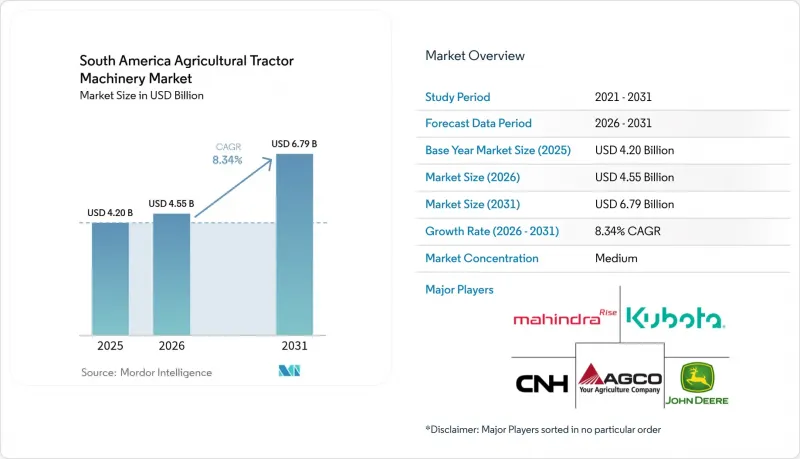
본 보고서는 기계 종류(경운·중경 기계, 파종 기계, 건초·사료용 기계, 살포기, 기타) 및 지역(브라질 등)별로 분류되어 있습니다. 시장 예측은 금액(달러) 기준으로 제시되어 있습니다.
남미 농업용 트랙터 기계 시장 동향 및 인사이트
기계화를 위한 정부의 넉넉한 대출 한도
브라질 개발은행(BNDES)이 운영하는 브라질의 ‘Moderfrota’ 프로그램은 2024/25년 작기를 위해 약 23억 달러를 금리 7%에서 10.5% 범위 내에서 배정했습니다. 이 배정액은 이전 주기보다 15% 증가하여, 상업은행 대출이 8% 감소함으로써 발생한 격차를 메웠습니다. 아르헨티나의 Banco de la Nacion Argentina는 12억 달러 규모의 농업기계 대출을 실행했으나, 페소화 약세로 인해 구매력이 하락하면서 생산자들의 구매 목록은 축소되었습니다. 파라과이의 Credito Agricola de Habilitacion은 2024년에 자금을 조달하여 그 중 4분의 1 가량을 농업기계에 할당했습니다. 이는 2030년까지 대두 수출량을 두 배로 늘리겠다는 해당국의 계획을 반영한 것입니다. CNH 인더스트리얼과 존 디어의 전속 금융 자회사들은 이러한 프로그램을 활용하여 시장 금리보다 낮은 금리의 대출과 서비스 플랜을 결합한 상품을 제공함으로써 브랜드 충성도를 공고히 하고 있습니다.
브라질과 아르헨티나의 상업용 대두 재배 면적 증가
브라질의 대두 재배 면적은 2024/25년도에 4,700만-4,820만 헥타르에 달해, 전년도 4,630만 헥타르에서 증가했습니다. 아르헨티나도 이에 뒤이어 재배 면적이 7% 증가한 4,400만 에이커를 기록했으며, 이 지역의 생산량은 2억 3,780만 메트르톤에 달했습니다. 이모작 시스템에서는 파종 기간이 단축되므로, 대용량 파종기, 자율주행식 살포기, 그리고 수확량 모니터를 탑재한 수확기가 유리합니다. MATOPIBA 지역의 농장은 보통 2,000-5,000헥타르에 달하며, 잦은 강우에도 대응할 수 있는 농업기계가 요구됩니다. 아르헨티나 국립농업 기술연구소(INTA)에 따르면, 정밀 파종으로 인해 수확량이 5-10% 향상되었으며, 종자 및 작물 보호 자재 모두에서 가변 시비 기술의 가치가 더욱 높아지고 있습니다. 견조한 압착 마진과 안정적인 중국 수요 덕분에 현금 흐름은 건전한 상태를 유지하고 있으며, 그 결과 다른 작물에 비해 30% 높은 기계 재투자율을 실현하고 있습니다.
환율 변동이 수입 부품 가격을 끌어올리고 있습니다.
2024년, 브라질 레알은 달러 대비 11% 하락하여 트랙터 부품 원가의 최대 절반을 차지하는 수입 엔진, 변속기, 유압 서브시스템의 수입 비용을 상승시켰습니다. 아르헨티나 페소의 하락률은 2024년 말까지월 25%로 가속화되어, OEM 각사는 6주마다 가격 조정을 할 수밖에 없게 되었고, 많은 농가가 구매를 연기하는 사태가 발생했습니다. 콜롬비아 페소는 8% 하락하여 수입된 파종기 및 살포기 가격에 3,000-5,000달러의 추가 비용이 발생했습니다. 현지 조립을 통해 그 영향의 일부는 완화되고 있지만, 전자 제어 장치와 정밀 안내 모듈은 여전히 해외 공급업체에 의존하고 있습니다. OEM 업체들은 현지 통화 표시 공급 계약을 시범적으로 도입하고, 지역 내 조달을 급속도로 추진하고 있지만, 실질적인 현지화를 실현하기까지는 적어도 2시즌은 걸릴 것입니다.
부문 분석
브라질의 세라두 지역과 아르헨티나의 팜파 지역에서는 여전히 전통적인 경작법이 주류를 이루고 있어, 남미 농업용 트랙터 기계 시장 규모에서 경운·경작 기기가 가장 큰 점유율을 차지하며 2025년 매출의 33.35%를 차지했습니다. 스트립 틸의 도입은 서서히 진행되고 있지만, 특히 이모작으로 인해 밭 준비 기간이 기상 조건에 따라 제한되는 지역에서는 아직 심경에 대한 수요를 대체하기에는 이르지 못했습니다. 각 제조사는 대두·옥수수 윤작에 특징적인 점토질 토양이나 다량의 잔여물에 대응하도록 설계된 리버시블 플로우와 헤비 듀티 컬티베이터를 제공함으로써 이러한 수요를 활용하고 있습니다. 노틸을 시범적으로 도입하고 있는 농장에서는 잔여물 처리 기능을 갖춘 얕게 갈아엎는용 경운기가 토양 구조를 유지하면서 파종상의 질을 향상시킨다는 틈새 수요를 발견하고 있습니다.
분무기는 가장 빠르게 성장하는 부문으로, 2031년까지 연평균 성장률(CAGR) 10.11%를 기록하며 남미 농업용 트랙터 기계 시장에서 꾸준히 점유율을 확대할 것으로 예상됩니다. Cromai사의 인공지능(AI)을 활용한 잡초 감지 시스템은 제초제 사용량을 최대 65%까지 줄여주어, 투입 비용 상승에 직면한 생산자들로부터 지지를 얻고 있습니다. 40미터 붐과 맞춤형 노즐 뱅크를 갖춘 자가 주행 플랫폼은 1,500헥타르가 넘는 농장에서의 구매를 주도하고 있습니다. 플러그 앤 플레이 방식의 개조 키트를 통해 중규모 농가들이 기존 섀시에 국소 살포 모듈을 장착하여, 교체 비용의 불과 몇 분의 일로 성능을 향상시킬 수 있기 때문에 경작 면적이 작은 농가층으로의 보급도 더욱 확대되고 있습니다. 폭넓은 텔레매틱스 호환성을 제공하는 제조사들은 데이터 기반 농업 서비스를 제공함으로써 고객 유지율을 높이고 있습니다.
기타 혜택:
- 엑셀 형식의 시장 예측(ME) 시트
- 3개월간의 애널리스트 지원
자주 묻는 질문
목차
제1장 소개
제2장 조사 방법
제3장 주요 요약
제4장 시장 구도
제5장 시장 규모와 성장 예측
제6장 경쟁 구도
제7장 시장 기회와 향후 전망
KSM 26.08.25According to Mordor Intelligence, the South America agricultural tractor machinery market size was valued at USD 4.20 billion in 2025 and estimated to grow from USD 4.55 billion in 2026 to reach USD 6.79 billion by 2031, at a CAGR of 8.34% during the forecast period (2026-2031).
This report is Segmented by Machinery Type (Plowing and Cultivating Machinery, Planting Machinery, Haying and Forage Machinery, Sprayers, and Other Types) and Geography (Brazil, and More). The Market Forecasts are Provided in Terms of Value (USD).
South America Agricultural Tractor Machinery Market Trends and Insights
Robust Government Credit Lines for Mechanization
Brazil's Moderfrota program, managed by the Brazilian Development Bank (BNDES), earmarked around USD 2.3 billion for the 2024/25 crop year at interest rates between 7% and 10.5%. The allocation rose 15% from the previous cycle and filled the gap left by an 8% drop in commercial bank lending. Argentina's Banco de la Nacion Argentina extended USD 1.2 billion in machinery loans, yet peso devaluation trimmed purchasing power and narrowed growers' shopping lists. Paraguay's Credito Agricola de Habilitacion disbursed funds in 2024 and channeled almost one-quarter into equipment, reflecting the nation's plan to double soybean exports by 2030. Captive finance subsidiaries of CNH Industrial and John Deere are leveraging these programs to package below-market loans with bundled service plans that lock in brand loyalty.
Rising Commercial Soybean Acreage in Brazil and Argentina
Brazil's soybean area reached 47-48.2 million hectares for the 2024/25 cycle, up from 46.3 million hectares in the prior year. Argentina followed with a 7% jump to 44 million acres, pushing regional output to 237.8 million metric tons. Double-cropping systems compress planting windows, which favors high-capacity planters, autonomous sprayers, and harvesters equipped with yield monitors. Farms in MATOPIBA routinely span 2,000-5,000 hectares and require machinery that can work around frequent rain events. Precision planting lifted yields 5-10% according to Argentina's National Institute of Agricultural Technology (INTA), reinforcing the value proposition of variable-rate technology for both seed and crop protection inputs. Robust crush margins and steady Chinese demand keep cash flow healthy, driving machinery reinvestment rates that are 30% greater than for other crops.
Currency-Exchange Volatility Inflating Imported Component Prices
The Brazilian real weakened 11% against the United States dollar during 2024, lifting the landed cost of imported engines, transmissions, and hydraulic subsystems that form up to half of a tractor's bill of materials. Argentina's peso depreciation accelerated to 25% per month by late 2024, forcing OEMs to reprice every six weeks and pushing many growers to delay purchases. Colombia's peso lost 8%, adding USD 3,000-5,000 to the price of imported planters and sprayers. Local assembly cushions part of the shock, yet electronic control units and precision guidance modules still rely on offshore suppliers. OEMs are testing local-currency supply contracts and fast-tracking regional sourcing, but meaningful localization takes at least two seasons to execute.
Other drivers and restraints analyzed in the detailed report include:
- Labor Scarcity Driving Demand for Self-Propelled Equipment
- OEM Financing Arms Lowering Total Cost of Ownership
- Fragmented Land-Holding Patterns Limiting Large-Equipment Penetration
For complete list of drivers and restraints, kindly check the Table Of Contents.
Segment Analysis
Plowing and cultivating equipment generated the largest slice of the South America agricultural tractor machinery market size, accounting for 33.35% of 2025 revenue, as conventional tillage remained prevalent across Brazil's Cerrado and Argentina's Pampas. Strip-till adoption softens but does not yet displace deep-plowing demand, especially where double-cropping squeezes field preparation into narrow weather windows. Manufacturers capitalize by offering reversible plows and heavy-duty cultivators engineered for clay soils and high residue loads that characterize soybean-corn rotations. On farms experimenting with no-till, shallow cultivators equipped with residue managers find niche demand that preserves soil structure while improving seedbed quality.
Sprayers are the fastest-growing category, projected to log a 10.11% CAGR through 2031 and steadily capture a larger share of the South America agricultural tractor machinery market. Artificial-intelligence weed-detection systems from Cromai cut herbicide use up to 65% and appeal to growers facing rising input costs. Self-propelled platforms with 40-meter booms and customizable nozzle banks dominate purchases on estates above 1,500 hectares. Plug-and-play retrofits push growth farther down the acreage ladder, as mid-sized farmers outfit existing chassis with spot-spray modules that upgrade performance for a fraction of the replacement cost. Manufacturers offering broad telematics compatibility unlock data-driven agronomy services that deepen client stickiness.
Complete Report Scope:
- By Machinery Type
- Plowing and Cultivating Machinery
- Plows
- Harrows
- Rotovators and Cultivators
- Other Plowing and Cultivating Machinery
- Planting Machinery
- Seed Drills
- Planters
- Spreaders
- Other Planting Machinery
- Haying and Forage Machinery
- Mowers and Conditioners
- Balers
- Other Haying and Forage Machinery
- Sprayers
- Other Types
- Plowing and Cultivating Machinery
List of Companies Covered in this Report:
- Deere & Company
- CNH Industrial N.V.
- AGCO Corporation
- Kubota Corporation
- Mahindra & Mahindra Ltd.
- Yanmar Holdings Co., Ltd.
- SDF Group
- Grupo Jacto
- Stara S/A Industria de Implementos Agricolas
- Grupo Agrale
- LS Mtron Tractors
- Claas KGaA mbH
- Kuhn Group (Bucher Industries)
Additional Benefits:
- The market estimate (ME) sheet in Excel format
- 3 months of analyst support
TABLE OF CONTENTS
1 Introduction
- 1.1 Study Assumptions and Market Definition
- 1.2 Scope of the Study
2 Research Methodology
3 Executive Summary
4 Market Landscape
- 4.1 Market Overview
- 4.2 Market Drivers
- 4.2.1 Robust government credit lines for mechanization
- 4.2.2 Rising commercial soybean acreage in Brazil and Argentina
- 4.2.3 Labor scarcity driving demand for self-propelled equipment
- 4.2.4 OEM financing arms lowering total cost of ownership
- 4.2.5 Precision-ag retrofit kits boosting attachment sales
- 4.2.6 Carbon-smart farming subsidies for low-HP machinery
- 4.3 Market Restraints
- 4.3.1 Currency-exchange volatility inflating imported component prices
- 4.3.2 Fragmented land-holding patterns limiting large equipment penetration
- 4.3.3 Slow roll-out of Tier III emission norms
- 4.3.4 Gray-market inflow of used tractors undermining new sales
- 4.4 Regulatory Landscape
- 4.5 Technological Outlook
- 4.6 Porter's Five Forces
- 4.6.1 Bargaining Power of Suppliers
- 4.6.2 Bargaining Power of Buyers
- 4.6.3 Threat of New Entrants
- 4.6.4 Threat of Substitutes
- 4.6.5 Intensity of Competitive Rivalry
5 Market Size and Growth Forecasts (Value)
- 5.1 By Machinery Type
- 5.1.1 Plowing and Cultivating Machinery
- 5.1.1.1 Plows
- 5.1.1.2 Harrows
- 5.1.1.3 Rotovators and Cultivators
- 5.1.1.4 Other Plowing and Cultivating Machinery
- 5.1.2 Planting Machinery
- 5.1.2.1 Seed Drills
- 5.1.2.2 Planters
- 5.1.2.3 Spreaders
- 5.1.2.4 Other Planting Machinery
- 5.1.3 Haying and Forage Machinery
- 5.1.3.1 Mowers and Conditioners
- 5.1.3.2 Balers
- 5.1.3.3 Other Haying and Forage Machinery
- 5.1.4 Sprayers
- 5.1.5 Other Types
- 5.1.1 Plowing and Cultivating Machinery
6 Competitive Landscape
- 6.1 Market Concentration
- 6.2 Strategic Moves
- 6.3 Market Share Analysis
- 6.4 Company Profiles (Includes Global Level Overview, Market Level overview, Core Segments, Financials as available, Strategic Information, Market Rank/Share for key companies, Products & Services, and Recent Developments)
- 6.4.1 Deere & Company
- 6.4.2 CNH Industrial N.V.
- 6.4.3 AGCO Corporation
- 6.4.4 Kubota Corporation
- 6.4.5 Mahindra & Mahindra Ltd.
- 6.4.6 Yanmar Holdings Co., Ltd.
- 6.4.7 SDF Group
- 6.4.8 Grupo Jacto
- 6.4.9 Stara S/A Industria de Implementos Agricolas
- 6.4.10 Grupo Agrale
- 6.4.11 LS Mtron Tractors
- 6.4.12 Claas KGaA mbH
- 6.4.13 Kuhn Group (Bucher Industries)


