
|
시장보고서
상품코드
2113339
이벤트 관리 소프트웨어 : 시장 점유율 분석, 업계 동향과 통계, 성장 예측(2026-2031년)Event Management Software - Market Share Analysis, Industry Trends & Statistics, Growth Forecasts (2026 - 2031) |
||||||
 Mordor Intelligence
Mordor Intelligence에 따르면 이벤트 관리 소프트웨어 시장 규모는 2026년에 152억 달러에 달하고, 2031년까지 241억 7,000만 달러에 달할 것으로 전망되는데, 이는 CAGR 9.73%를 반영한 수치입니다.
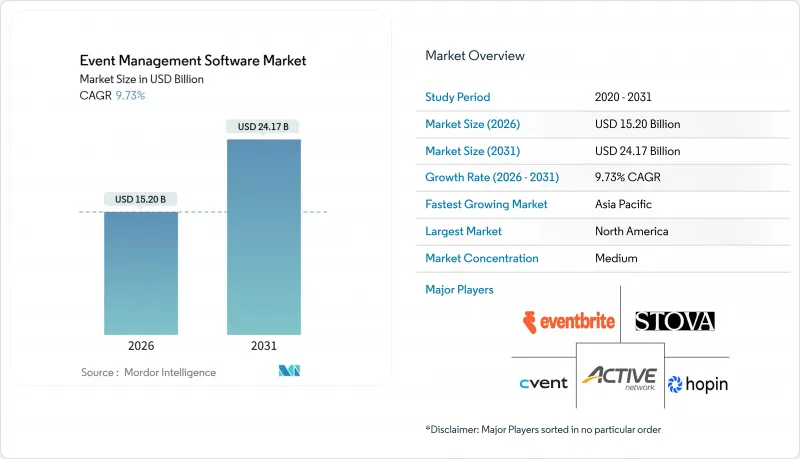
본 보고서는 소프트웨어 유형(이벤트 기획, 이벤트 마케팅, 행사장·티켓 관리, 분석·보고, 기타 소프트웨어 유형), 도입 형태(클라우드, 온프레미스), 조직 규모(중소기업, 대기업), 최종사용자 업종(기업, 정부, 교육 기관 등) 및 지역별로 분류되어 있습니다. 시장 예측은 금액(달러) 기준으로 제시되어 있습니다.
세계 이벤트 관리 소프트웨어 시장의 동향 및 인사이트
AI를 활용한 개인화 엔진
이벤트 소프트웨어는 단순한 등록 처리 도구에서 맞춤형 의제, 네트워킹 제안, 콘텐츠를 실시간으로 제공하는 예측형 참여 허브로 진화하고 있습니다. 2025년 6월, Cvent는 RFP(제안 요청서) 작성, 행사장 비교, 참가자 세분화를 자동화하는 생성형 AI 모듈 ‘CventIQ’를 출시하여 기획자의 업무 부담을 30% 줄였습니다. 2024년 11월에 도입된 Bizzabo의 ‘Event OS Copilot’은 대규모 언어 모델을 활용해 세션 요약을 작성하고, 그 자리에서 새로운 분과회 주제를 제안합니다. 아시아태평양이 도입을 주도하고 있으며, 2025년에는 기획자의 87%가 이미 AI 기능을 도입한 반면, 유럽에서는 54%에 그치고 있습니다. 이는 도입이 뒤처진 기업에 압박을 가하는 ‘양극화’ 상황을 보여줍니다. AI 기반 워크플로우를 통합하지 못하는 플랫폼은 구매자가 기본적인 실행 능력보다 참여 인텔리전스를 우선시하게 됨에 따라 상품화(commoditization)의 위험에 직면하게 됩니다.
중소기업용 셀프서비스형 티켓 판매
노코드 티켓 판매 포털을 통해 좌석 수 500석 미만의 행사장에서도 긴 판매 주기를 생략하고, 몇 시간 이내에 이벤트를 시작할 수 있게 됩니다. Ticket Tailor의 2024년 7월 업그레이드에서는 주최자가 공급업체의 지원 없이 설정할 수 있는 다단계 가격 책정 및 지정석 기능이 도입되어, 시장 출시까지 걸리는 시간을 몇 주에서 몇 시간으로 단축했습니다. 고객 행동 데이터에 따르면, 구매자의 81%는 고객 지원팀에 문의하기 전에 셀프서비스를 통해 문제를 해결하려고 시도합니다. 또한, 자동화된 추천 마케팅을 도입한 행사장의 경우 매출이 15-25% 증가한 것으로 보고되고 있습니다. 라틴아메리카와 아프리카는 행사장 시장이 세분화되어 있어 티켓 1장당 투명한 요금 체계가 선호되는, 새로운 주목 지역으로 부상하고 있습니다. 그 결과, 이벤트 관리 소프트웨어 시장은 기존에 대기업들이 간과했던 저예산 이벤트를 더 많이 포용하게 되었습니다.
SaaS 구독에 대한 피로감
2025년에 공급업체의 가격 인상이 평균 두 자릿수에 달함에 따라, 기업들은 소프트웨어 지출을 재검토하고 있습니다. 이벤트 플랫폼은 일상적으로 사용되지 않고 비정기적으로 이용되기 때문에 조달 팀은 다른 애플리케이션보다 먼저 연간 라이선스를 축소 대상에 포함시키고 있습니다. 구매자들은 현재 해지 조항이 포함된 종량제 계약을 선호하는 추세이며, 공급업체들은 해지 위험을 최소화하기 위해 등록, 동영상, 분석 기능을 단일 계약으로 통합하고 있습니다. 명확한 ROI를 제시하지 못하는 플랫폼은 판매 주기의 장기화나 가격 인하 압박에 직면하게 될 것입니다.
부문 분석
분석 및 보고서 작성 도구는 주최자가 ROI 증명을 요구하는 가운데, 2031년까지 연평균 성장률(CAGR)이 10.22%로 가장 빠르게 성장하는 카테고리입니다. Cvent가 Goldcast의 AI 동영상 분석 기능을 자사 플랫폼에 통합함에 따라, 마케터들은 시청자 이탈, 콘텐츠 재생 및 파이프라인 기여도를 추적할 수 있게 되었으며, 이러한 모듈에 할당되는 이벤트 관리 소프트웨어 시장 규모는 현저히 확대될 것으로 예상됩니다. 이벤트 기획 애플리케이션은 등록 및 의제 워크플로우를 지원하는 역할을 하며, 2025년 매출의 38.03%를 계속 차지하고 있습니다. 그러나 독립형 티켓 판매 플랫폼은 측정 가능한 수익률을 향상시키는 동적 가격 책정 및 부정 행위 탐지 기능을 통합하지 않는 한, 상품화(commoditization)의 위험에 노출될 것입니다. 기타 틈새 솔루션(모바일 앱, 매칭 스위트, 가상 스튜디오 등)은 학술 회의나 음악 페스티벌과 같은 수직 시장에서 전문 벤더가 기능의 심도 면에서 혁신성을 발휘할 수 있기 때문에 계속해서 세분화가 진행되고 있습니다.
이와 동시에, 기업의 구매 담당자들은 이벤트 전 프로모션부터 이벤트 후 어트리뷰션에 이르기까지 원활한 흐름을 점점 더 기대하고 있습니다. 이러한 기대에 따라, 제너럴리스트 기업들이 기능적 격차를 메우기 위해 틈새 분석 분야의 선도 기업을 인수하는 움직임이 가속화되며 업계 재편이 진행되고 있습니다. 그 결과, 이벤트 관리 소프트웨어 시장은 이벤트를 고립된 사건이 아닌 ‘상시 가동되는 콘텐츠 엔진’의 일부로 취급하는 통합형 참여 클라우드(engagement cloud)로 전환되고 있습니다.
클라우드 도입은 2025년 매출의 71.29%를 차지하며, 벤더들이 탄력적인 인프라와 자동 갱신을 활용함에 따라 연평균 10.91%의 속도로 성장하고 있습니다. 티켓마스터가 2025년 3월에 실시한 TM1 업데이트에서는 티켓 판매 개시 시 1분당 5,000건의 트랜잭션을 처리한 후, 몇 시간 이내에 규모를 축소함으로써 해당 모델의 효율성이 입증되었습니다. 온프레미스 도입에 따른 이벤트 관리 소프트웨어 시장 규모는 에어갭 네트워크가 필수로 요구되는 국방 및 정부 관련 분야에서 안정세를 보이고 있습니다. Digitevent는 오프라인 QR코드 스캔 기능을 제공하고, 나중에 참가자 데이터를 동기화함으로써 지방 시장의 연결성 문제를 완화하고 있습니다.
클라우드 대시보드와 현장 에지 디바이스를 결합한 하이브리드 아키텍처가 표준적인 절충안으로 부상하고 있으며, 벤더는 별도의 코드베이스를 유지하지 않고도 규제 대상 기관에 서비스를 제공할 수 있게 되었습니다. 예측 기간 동안 클라우드 보급률은 계속 확대될 전망이지만, 주권 및 연결성 우려가 지배적인 분야에서는 온프레미스의 내결함성이 계속 유지될 것입니다.
지역별 분석
북미는 성숙한 MICE 인프라와 포춘 500대 기업 본사가 밀집해 있다는 점을 배경으로 2025년 매출의 41.32%를 차지했습니다. 그러나 여행비 급등으로 인한 비용 압박으로 인해 2025년 4분기에는 기획자의 52%가 해외 참가자 수를 줄였습니다. 캐나다와 멕시코는 미국 기업들이 자국에 가까운 장소를 선택하는 ‘니어쇼어링(nearshoring)’의 혜택을 받고 있지만, USMCA(미국·멕시코·캐나다 협정)에 따른 국경 간 데이터 전송 관련 규정에 따라 공급업체는 거주지에 관한 보호 조치를 문서화해야 할 의무가 있습니다. 예산이 빠듯한 가운데, 이벤트 관리 소프트웨어 시장에서는 기업들이 공급업체 목록을 고도로 통합된 소수의 플랫폼으로 통합하는 경향이 나타나고 있습니다.
아시아태평양은 성장의 원동력이며, 2031년까지 연평균 성장률(CAGR) 11.01%를 기록할 것으로 예상됩니다. Cvent가 2025년에 실시한 ‘아시아 플래너 설문조사’에 따르면, 응답자의 74%가 이벤트 예산을 증액했으며, 88%가 지속가능성 목표를 설정하고 있는 것으로 나타났습니다. 걸프협력회의(GCC) 회원국들은 수십억 달러 규모의 컨벤션 센터와 간소화된 비자 프로그램을 통해 성장에 더욱 박차를 가하고 있습니다. 사우디아라비아는 1억 5,600만 달러의 인센티브에 힘입어 2024년 MICE 분야에서 44%의 성장률을 기록했습니다. 인도는 UPI 결제를 통합한 클라우드 SaaS에 의존하고 있는 반면, 중국은 ‘소버린 클라우드’ 도입을 의무화하고, 외국 벤더들에게 현지 호스팅을 위한 제휴를 의무화하고 있습니다.
유럽의 상황은 GDPR 의무와 강화되는 지속가능성 요건에 의해 형성되고 있습니다. Cvent의 2025년 4월판 ‘Europe Planner’ 보고서에 따르면, 비용이 20% 상승했음에도 불구하고 기획자의 67%가 예산을 증액한 것으로 나타났습니다. 독일, 영국, 프랑스가 지출의 대부분을 차지하고 있지만, 기획자들은 비용 절감을 위해 동유럽의 행사장을 점점 더 많이 활용하고 있습니다. 남미와 아프리카는 여전히 발전 단계에 있지만, 향후 전망은 밝다고 할 수 있습니다. 브라질의 ‘Even3’나 멕시코의 ‘Boletia’와 같은 현지 플랫폼은 Pix 및 Oxxo와의 결제 연동을 통해 성장을 거듭하고 있는 반면, 남아프리카의 제공업체들은 불안정한 통신 환경에 대응하기 위해 ‘오프라인 우선’ 체크인을 중시하고 있습니다.
기타 혜택:
- 엑셀 형식의 시장 예측(ME) 시트
- 3개월간 애널리스트의 지원
자주 묻는 질문
목차
제1장 소개
제2장 조사 방법
제3장 주요 요약
제4장 시장 구도
제5장 시장 규모와 성장 예측
제6장 경쟁 구도
제7장 시장 기회와 향후 전망
KSM 26.08.25According to Mordor Intelligence, the event management software market size stands at USD 15.2 billion in 2026 and is projected to reach USD 24.17 billion by 2031, reflecting a 9.73% CAGR.
This report is Segmented by Software Type (Event Planning, Event Marketing, Venue and Ticket Management, Analytics and Reporting, and Other Software Types), Deployment (Cloud, and On-Premise), Organization Size (Small and Medium Enterprises, and Large Enterprises), End-User Vertical (Corporate, Government, Education, and More), and Geography. The Market Forecasts are Provided in Terms of Value (USD).
Global Event Management Software Market Trends and Insights
AI-Driven Personalization Engines
Event software is evolving from transactional registration tools into predictive engagement hubs that serve tailored agendas, networking recommendations and content in real time. In June 2025 Cvent released CventIQ, a generative-AI module that automates RFP drafting, venue comparison and attendee segmentation, cutting planner workload by 30%. Bizzabo's Event OS Copilot, introduced in November 2024, applies large-language models to create session summaries and propose fresh breakout topics on the fly. Asia Pacific leads adoption, with 87% of planners already deploying AI features in 2025 compared with 54% in Europe, signalling a two-speed landscape that pressures late adopters. Platforms that fail to embed AI-driven workflows risk commoditization as buyers prioritize engagement intelligence over basic execution.
Self-Service Ticketing for SMEs
No-code ticketing portals let venues with fewer than 500 seats bypass lengthy sales cycles and launch events within hours. Ticket Tailor's July 2024 upgrade delivered multi-tier pricing and reserved seating that organizers configure without vendor support, shrinking time-to-market from weeks to hours. Customer behaviour data show 81% of buyers attempt self-service resolution before contacting support; venues using automated referral marketing report 15-25% sales uplift. Latin America and Africa are emerging hotspots where fragmented venue landscapes favour transparent pay-per-ticket pricing. As a result, the event management software market now captures a larger volume of low-budget events that incumbents once overlooked.
SaaS Subscription Fatigue
Enterprises are reassessing software spend after supplier price hikes averaged double digits in 2025. Because event platforms are used episodically rather than daily, procurement teams target annual licenses for cuts before other applications. Buyers now favour usage-based contracts with escape clauses, prompting vendors to bundle registration, video and analytics in a single contract to minimize churn risk. Platforms unable to articulate clear ROI face elongating sales cycles and discount pressure.
Other drivers and restraints analyzed in the detailed report include:
- 5G and Fiber Roll-out Empowering Live-Streams
- Mandatory Sustainability Reporting
- Data-Residency and Privacy Compliance
For complete list of drivers and restraints, kindly check the Table Of Contents.
Segment Analysis
Analytics and reporting tools are the fastest expanding category, clocking a 10.22% CAGR through 2031 as organizers demand proof of ROI. The event management software market size allocated to these modules is projected to widen notably as Cvent integrates Goldcast's AI-video analytics into its stack, allowing marketers to track viewer drop-offs, content replays and pipeline contribution. Event Planning applications still commanded 38.03% of 2025 revenue, anchoring registration and agenda workflows. However, standalone ticketing platforms risk commoditization unless they embed dynamic pricing and fraud detection that drive measurable yield. Other niche solutions - mobile apps, matchmaking suites and virtual studios - continue to fragment because specialist vendors can out-innovate on feature depth for verticals such as academic conferences or music festivals.
In parallel, enterprise buyers increasingly expect a seamless path from pre-event promotion to post-event attribution. This expectation accelerates consolidation as generalists buy niche analytics leaders to fill capability gaps. The event management software market is therefore transitioning toward unified engagement clouds that treat events as one part of an always-on content engine, rather than isolated occurrences.
Cloud deployments accounted for 71.29% of 2025 revenue and are growing at 10.91% annually as vendors capitalize on elastic infrastructure and automatic updates. Ticketmaster's March 2025 TM1 refresh showed the model's efficiency by handling 5,000 transactions per minute during on-sales before scaling down within hours. The event management software market size attached to on-premises installations remains stable in defense and government circles, where air-gapped networks are mandatory. Digitevent mitigates connectivity gaps in rural markets by offering offline QR scanning that later synchronizes attendee data.
Hybrid architectures combining cloud dashboards with on-site edge devices are emerging as the default compromise, enabling vendors to serve regulated agencies without maintaining separate codebases. Over the forecast period, cloud penetration will continue to expand, but on-premises resilience will persist where sovereignty or connectivity concerns dominate.
Complete Report Scope:
- By Software Type
- Event Planning
- Event Marketing
- Venue and Ticket Management
- Analytics and Reporting
- Other Software Types
- By Deployment
- Cloud
- On-Premise
- By Organization Size
- Small and Medium Enterprises
- Large Enterprises
- By End-User Vertical
- Corporate
- Government
- Education
- Media and Entertainment
- Other End-User Verticals
- By Geography
- North America
- United States
- Canada
- Mexico
- South America
- Brazil
- Argentina
- Rest of South America
- Europe
- Germany
- United Kingdom
- France
- Italy
- Spain
- Rest of Europe
- Asia Pacific
- China
- Japan
- South Korea
- India
- Australia
- New Zealand
- Rest of Asia Pacific
- Middle East
- United Arab Emirates
- Saudi Arabia
- Turkey
- Rest of Middle East
- Africa
- South Africa
- Nigeria
- Kenya
- Rest of Africa
- North America
Geography Analysis
North America held 41.32% of 2025 revenue, underpinned by mature MICE infrastructure and a dense base of Fortune 500 headquarters. Yet cost pressures triggered by travel inflation led 52% of planners to cut international attendance in Q4 2025. Canada and Mexico benefit from near-shoring as U.S. companies pick venues closer to home, but cross-border data-transfer rules under USMCA oblige providers to document residency safeguards. As budgets tighten, the event management software market sees enterprises consolidating vendor lists to a few deeply integrated platforms.
Asia Pacific is the growth engine, expected to post an 11.01% CAGR through 2031. Cvent's 2025 Asia Planner survey found 74% of respondents upping event budgets and 88% setting sustainability targets. Gulf Cooperation Council nations add momentum via multi-billion-dollar convention centers and streamlined visa programs. Saudi Arabia recorded 44% MICE growth in 2024, backed by USD 156 million in incentives. India leans on cloud SaaS that integrates UPI payments, whereas China enforces sovereign-cloud deployment, obliging foreign vendors to partner for local hosting.
Europe's landscape is shaped by GDPR obligations and rising sustainability mandates. Cvent's April 2025 Europe Planner report noted that 67% of planners raised budgets despite 20% cost inflation. Germany, the United Kingdom and France dominate spend, yet planners increasingly source Eastern European venues for cost relief. South America and Africa remain nascent but promising: local platforms such as Even3 in Brazil and Boletia in Mexico thrive through Pix and Oxxo payment integrations, while South African providers stress offline-first check-in to accommodate patchy connectivity.
- Cvent, Inc.
- Stova, Inc.
- Eventbrite, Inc.
- Tripleseat, Inc.
- ACTIVE Network, LLC
- Momentus Technologies, Inc.
- Certain, Inc.
- SignUpGenius, Inc.
- EMS Software, LLC
- Hopin Ltd.
- Bizzabo Ltd.
- Whova, Inc.
- vFairs LLC
- Splash That, Inc.
- Eventzilla LLC
- Brown Paper Tickets, LLC
- idloom S.A.S.
- TryBooking Pty Ltd
- Hubb, Inc.
- MeetApp, Inc.
Additional Benefits:
- The market estimate (ME) sheet in Excel format
- 3 months of analyst support
TABLE OF CONTENTS
1 INTRODUCTION
- 1.1 Study Assumptions and Market Definition
- 1.2 Scope of the Study
2 RESEARCH METHODOLOGY
3 EXECUTIVE SUMMARY
4 MARKET LANDSCAPE
- 4.1 Market Overview
- 4.2 Market Drivers
- 4.2.1 Proliferation of AI-Driven Personalisation Across Virtual, Hybrid and On-site Events
- 4.2.2 Rapid Adoption of Self-Service Ticketing Systems by Small and Mid-Sized Venues
- 4.2.3 Large-Scale Roll-out of 5G and FTTX Enabling Real-Time Interactive Live-Streams
- 4.2.4 Mandatory Sustainability Reporting Boosting Demand for Carbon-Analytics Modules
- 4.2.5 Expansion of Government-Backed MICE Infrastructure in GCC Economies
- 4.2.6 Growing Uptake of Campus-Wide Event Suites in Higher-Education Consortia
- 4.3 Market Restraints
- 4.3.1 Legacy PMS Integration Friction in Developing Regions
- 4.3.2 Rising SaaS Subscription Fatigue Among Enterprise Clients
- 4.3.3 Event Oversaturation and Budget Scrutiny by Corporates
- 4.3.4 Data-Residency and Privacy Compliance Complexities
- 4.4 Impact of Macroeconomic Factors on the Market
- 4.5 Industry Value/Supply-Chain Analysis
- 4.6 Regulatory Outlook
- 4.7 Technological Outlook
- 4.8 Porter's Five Forces Analysis
- 4.8.1 Bargaining Power of Suppliers
- 4.8.2 Bargaining Power of Buyers
- 4.8.3 Threat of New Entrants
- 4.8.4 Threat of Substitutes
- 4.8.5 Intensity of Rivalry
5 MARKET SIZE AND GROWTH FORECASTS (VALUE)
- 5.1 By Software Type
- 5.1.1 Event Planning
- 5.1.2 Event Marketing
- 5.1.3 Venue and Ticket Management
- 5.1.4 Analytics and Reporting
- 5.1.5 Other Software Types
- 5.2 By Deployment
- 5.2.1 Cloud
- 5.2.2 On-Premise
- 5.3 By Organization Size
- 5.3.1 Small and Medium Enterprises
- 5.3.2 Large Enterprises
- 5.4 By End-User Vertical
- 5.4.1 Corporate
- 5.4.2 Government
- 5.4.3 Education
- 5.4.4 Media and Entertainment
- 5.4.5 Other End-User Verticals
- 5.5 By Geography
- 5.5.1 North America
- 5.5.1.1 United States
- 5.5.1.2 Canada
- 5.5.1.3 Mexico
- 5.5.2 South America
- 5.5.2.1 Brazil
- 5.5.2.2 Argentina
- 5.5.2.3 Rest of South America
- 5.5.3 Europe
- 5.5.3.1 Germany
- 5.5.3.2 United Kingdom
- 5.5.3.3 France
- 5.5.3.4 Italy
- 5.5.3.5 Spain
- 5.5.3.6 Rest of Europe
- 5.5.4 Asia Pacific
- 5.5.4.1 China
- 5.5.4.2 Japan
- 5.5.4.3 South Korea
- 5.5.4.4 India
- 5.5.4.5 Australia
- 5.5.4.6 New Zealand
- 5.5.4.7 Rest of Asia Pacific
- 5.5.5 Middle East
- 5.5.5.1 United Arab Emirates
- 5.5.5.2 Saudi Arabia
- 5.5.5.3 Turkey
- 5.5.5.4 Rest of Middle East
- 5.5.6 Africa
- 5.5.6.1 South Africa
- 5.5.6.2 Nigeria
- 5.5.6.3 Kenya
- 5.5.6.4 Rest of Africa
- 5.5.1 North America
6 COMPETITIVE LANDSCAPE
- 6.1 Market Concentration
- 6.2 Strategic Developments
- 6.3 Vendor Positioning Analysis
- 6.4 Company Profiles (includes Global Level Overview, Market Level Overview, Core Segments, Financials as Available, Strategic Information, Market Rank/Share for Key Companies, Products & Services, and Recent Developments)
- 6.4.1 Cvent, Inc.
- 6.4.2 Stova, Inc.
- 6.4.3 Eventbrite, Inc.
- 6.4.4 Tripleseat, Inc.
- 6.4.5 ACTIVE Network, LLC
- 6.4.6 Momentus Technologies, Inc.
- 6.4.7 Certain, Inc.
- 6.4.8 SignUpGenius, Inc.
- 6.4.9 EMS Software, LLC
- 6.4.10 Hopin Ltd.
- 6.4.11 Bizzabo Ltd.
- 6.4.12 Whova, Inc.
- 6.4.13 vFairs LLC
- 6.4.14 Splash That, Inc.
- 6.4.15 Eventzilla LLC
- 6.4.16 Brown Paper Tickets, LLC
- 6.4.17 idloom S.A.S.
- 6.4.18 TryBooking Pty Ltd
- 6.4.19 Hubb, Inc.
- 6.4.20 MeetApp, Inc.
7 MARKET OPPORTUNITIES AND FUTURE OUTLOOK
- 7.1 White-Space and Unmet-Need Assessment