
|
시장보고서
상품코드
2119002
하이브리드 이벤트 마케팅 서비스 : 시장 점유율 분석, 업계 동향 및 통계, 성장 예측(2026-2031년)Hybrid Event Marketing Services - Market Share Analysis, Industry Trends & Statistics, Growth Forecasts (2026 - 2031) |
||||||
 Mordor Intelligence
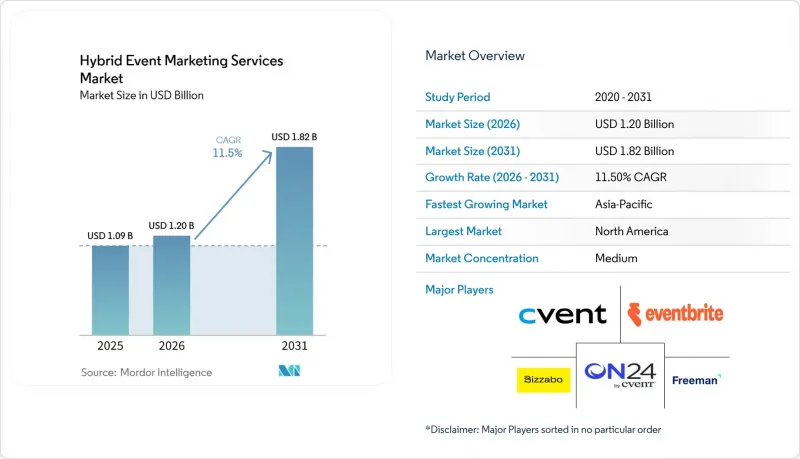
Mordor Intelligence에 의하면, 하이브리드 이벤트 마케팅 서비스 시장 규모는 2025년에 10억 9,000만 달러로 평가되었습니다. 2026년 12억 달러에서 2031년까지 18억 2,000만 달러에 이를 것으로 예상되며, 예측 기간(2026-2031년) CAGR은 11.50%를 나타낼 전망입니다.
본 보고서는 서비스 유형(기획·운영, 이벤트 홍보·공보, 콘텐츠 제작·재활용, 가상 이벤트 기술·스트리밍 등), 이벤트 유형(회의·세미나, 박람회·전시회 등), 고객 유형(B2B 기업, B2C 브랜드 등), 지역별로 분류되어 있습니다. 시장 전망은 금액(달러) 기준으로 제시되어 있습니다.
세계의 하이브리드 이벤트 마케팅 서비스 시장 동향 및 인사이트
청중 도달 범위를 확대하는 하이브리드 형식에 대한 선호도 증가
하이브리드 이벤트 마케팅 서비스 시장은 주최자가 행사장의 수용 인원을 늘리지 않고도 참가자를 확대할 수 있을 때 혜택을 보게 됩니다. 가상 참여를 통해 이벤트는 개최 도시 외부의 사람들에게도 라이브 세션, 아카이브 영상, 스폰서 노출을 제공할 수 있게 됩니다. Bizzabo의 보고서에 따르면, 주최사의 67%가 하이브리드 형식을 이벤트 마케팅의 미래로 인식하고 있으며, 63%는 대상 고객 도달 범위를 넓히기 위해 더 많은 하이브리드 이벤트를 개최할 계획이라고 응답했습니다. 이 형식을 통해 녹화 콘텐츠 및 후속 활동을 통해 행사 종료 후에도 지속적으로 리드를 창출할 수 있습니다. ON24에 따르면, 하이브리드 행사는 기존의 대면 행사에 비해 2배 이상의 행동 데이터를 생성할 수 있다고 합니다. 이러한 확장된 데이터 세트는 매니지드 애널리틱스 서비스를 뒷받침할 뿐만 아니라, 제공업체로서는 이벤트 운영에 그치지 않고 리드 적격성 평가, 스폰서용 보고서, 이벤트 종료 후 콘텐츠 성과 분석, 차기 이벤트 주기를 위한 참가자 분석 등을 포함하는 계약 범위를 확대할 수 있는 근거가 됩니다. 또한 주최자에게는 최종 참가자 총수에만 의존하지 않고, 세션, 개최지, 형식, 참가자 그룹별 참여 현황을 비교하는 데 도움이 됩니다.
측정 가능한 이벤트 ROI와 퍼스트파티 데이터에 대한 수요 증가
하이브리드 이벤트 마케팅 서비스 시장은 이벤트의 투자 수익률(ROI)에 대한 보다 명확한 증거를 요구하는 구매자 수요에 힘입어 성장하고 있습니다. 등록 데이터, 배지 스캔, 세션 시청 및 다시 보기 활동은 고객 관계 관리(CRM) 시스템과 연동할 수 있습니다. Cvent의 보고서에 따르면, 주최자의 71%가 ROI 측정을 가장 중요한 업무 우선순위로 꼽았습니다. 이러한 우선순위는 이벤트 예산에 대한 심사가 엄격해지고 있으며, 수익 귀속(attribution)에 대한 기대가 높아지고 있음을 반영합니다. 대면 및 가상 활동을 단일 리드 레코드로 통합할 수 있는 제공업체는 수동 데이터 내보내기의 필요성을 줄일 수 있습니다. 이 기능은 마케팅 자동화와의 연동 기능을 기본으로 갖춘 플랫폼에 유리하게 작용하며, 보다 광범위한 서비스 제품군으로의 전환을 촉진하고 있습니다. 이를 통해 조달 팀과 스폰서는 등록 수, 세션 참여도, 미팅 요청, 다시보기 이용 현황, 이벤트에서 판매로 이어지는 후속 조치, 그리고 투자를 통해 도달한 잠재 고객을 평가할 수 있게 됩니다.
행사장, 인건비, 제작비의 인플레이션
제작 비용의 상승은 프로젝트의 이익률을 압박하여 하이브리드 이벤트에 대한 투자를 지연시킬 가능성이 있습니다. 『The Exhibitor Advocate』가 미국 23개 도시에서 개최된 224개의 무역 박람회를 대상으로 실시한 2025년 조사에 따르면, 전시 설치 인건비(정규 근무)의 시간당 임금은 평균 157.48달러였습니다. 또한, 같은 조사에서 이 시급이 6.4% 상승한 것으로 기록되었으며, 전기 공사 초과 근무 수당은 2022년 이후 41.2% 상승했습니다. 하이브리드 형식의 이벤트 개최 시에는 행사장 비용과 제작비 외에도 스트리밍, 인코딩, 플랫폼 라이선스 비용이 발생합니다. 따라서 인건비나 기술 비용이 클라이언트의 예산을 초과하는 속도로 상승하면 고정 가격 계약은 위험에 노출될 수 있습니다. 서비스 제공업체는 표준화된 기술 스택을 채택하고, 스트리밍, 등록, 이벤트 앱, 음향·영상 운영에 있어 행사 직전 작업을 최소화하는 재사용 가능한 기술 설계를 도입하는 한편, 클라이언트에게 명확하고 조기에 비용 보고를 함으로써 이러한 압박을 완화할 수 있습니다.
부문별 분석
2025년, 하이브리드 이벤트 마케팅 서비스 시장에서 기획 및 관리가 27.81%의 점유율을 차지했습니다. 이 서비스에는 제안 요청서 조정, 행사장 선정, 등록, 그리고 대면 및 디지털 채널을 아우르는 보고가 포함됩니다. 대규모 조직은 여러 이벤트 일정에 걸쳐 발생하는 분산 현상을 완화하기 위해 이러한 서비스를 활용하고 있습니다. 프로그램 관리를 일원화함으로써 일관된 프로세스와 데이터 정의를 유지하는 데에도 도움이 됩니다. 분석 및 리드 관리 분야의 하이브리드 이벤트 마케팅 서비스 시장 규모는 구매자들이 CRM과 연동된 파이프라인 측정을 요구함에 따라 2031년까지 연평균 성장률(CAGR) 12.54%로 확대될 것으로 예측됩니다.
이벤트 홍보 및 대외 홍보는 특히 행사장 수용 인원을 초과하는 디지털 접근을 제공하는 프로그램의 경우, 실제 행사장과 가상 채널을 아우르는 참가자 유치를 지원합니다. 녹화된 세션은 추가 캠페인 자료로 활용될 수 있으므로, 콘텐츠 제작과 재사용은 점점 더 중요해지고 있습니다. 주최자는 클라우드를 통해 전송되는 콘텐츠와 행사장 내 음향·영상 시스템 간의 동기화된 연동이 필요하기 때문에 가상 이벤트 기술과 스트리밍은 필수적입니다. 참가자의 참여, 네트워킹, 스폰서십, 파트너 활성화는 고객 유지를 촉진할 뿐만 아니라, 행사장 공간이나 세션 명명권을 넘어선 디지털 광고 공간 창출로 이어집니다. 프리먼(Freeman)사는 2026년 7월 보고서에서 참가자가 학습 시간의 54%를 기존 세션 행사장 밖에서 보내는 것이 이상적이며, 무역 박람회에서는 그 비율이 64%로 상승한다고 지적했는데, 이는 실제 행사장과 디지털 양쪽의 접점에서 작동하는 서비스를 뒷받침하는 요소입니다.
지역별 분석
2025년, 북미는 하이브리드 이벤트 마케팅 서비스 시장의 36.72%를 차지했습니다. 이 지역에는 대규모 기업 구매자층, 컨벤션 인프라, 그리고 확고한 입지를 갖춘 이벤트 기술 제공업체들이 모여 있습니다. Cvent, Freeman, Bizzabo, RainFocus 등은 제품 개발 및 서비스 경쟁에 기여하고 있는 벤더 중 일부입니다. 미국은 여전히 주요 지역 시장인 반면, 캐나다와 멕시코에서는 제약, 에너지, 금융 서비스 분야의 프로그램에서 하이브리드형 이벤트 활동이 확대되고 있습니다. 캘리포니아주의 규제 및 캐나다의 PIPEDA(개인정보보호법)를 포함한 개인정보 보호 요건이 지역 플랫폼의 동의 관리 의사 결정에 영향을 미치고 있습니다.
유럽은 두 번째로 큰 지역이며, 독일, 영국, 프랑스에서는 이벤트 개최 빈도가 높고 하이브리드 형식의 활용이 정착되어 있습니다. 독일에서는 2025년에 3억 9,510만 명의 대면 이벤트 참가자가 기록되어, 2024년의 3억 7,760만 명 대비 4.6% 증가했습니다. 또한, 독일 컨벤션 뷰로(German Convention Bureau)의 조사에 따르면, 참가자 수 1,000명 이상의 여러 행사 규모 카테고리에서도 성장이 나타났습니다. 2025년 6월 28일부터 ‘유럽 접근성 법’이 시행됨에 따라 다국어 자막 및 종합적인 디지털 참여에 대한 관심이 높아지고 있습니다. 한편, 남미에서는 브라질이 기업 대상 컨퍼런스 수요를 주도하고 있으며, 아르헨티나와 칠레에서는 금융 서비스 및 기술 분야에서의 도입이 앞서고 있습니다.
아시아태평양은 2031년까지 연평균 성장률(CAGR) 13.01%를 나타낼 것으로 예측되며, 이는 하이브리드 이벤트 마케팅 서비스 시장에서 가장 높은 지역별 성장률입니다. 인도, 한국, 일본, 호주에서는 기업 행사 운영이 점차 체계화되고 있으며, 하이브리드 형식의 도입을 통해 해당 지역 내 장거리 이동에 따른 이동 및 조정 부담을 줄일 수 있습니다. EventHub의 조사에 따르면, 일본 이벤트 마케팅 조직의 60% 이상이 여전히 수작업 관리와 자원 부족에 직면해 있는 반면, 25%는 고도의 데이터 통합을 실현하고 있습니다. 중동에서는 UAE와 사우디아라비아에서 정부 주도의 회의 이니셔티브와 ‘사우지 비전 2030’의 MICE 프로그램을 통해 시장이 확대되고 있습니다. 아프리카는 여전히 초기 단계에 있지만, 남아프리카공화국, 이집트, 나이지리아에서는 모바일 우선 참여와 온라인 연결을 동반한 회의 활동이 기반을 다지고 있습니다.
기타 혜택 :
- 엑셀 형식 시장 예측(ME) 시트
- 3개월간의 애널리스트 지원
자주 묻는 질문
목차
제1장 서론
제2장 조사 방법
제3장 개요
제4장 시장 구도
제5장 시장 규모 및 성장 예측
제6장 경쟁 구도
제7장 시장 기회 및 향후 전망
KTH 26.09.02According to Mordor Intelligence, the hybrid event marketing services market size was valued at USD 1.09 billion in 2025 and estimated to grow from USD 1.20 billion in 2026 to reach USD 1.82 billion by 2031, at a CAGR of 11.50% during the forecast period (2026-2031).
This report is Segmented by Service Type (Planning and Management, Event Promotion and Publicity, Content Production and Repurposing, Virtual Event Technology and Streaming, and More), Event Type (Conferences and Seminars, Trade Shows and Exhibitions, and More), Client Type (B2B Enterprises, B2C Brands, and More), and Geography. The Market Forecasts are Provided in Terms of Value (USD).
Global Hybrid Event Marketing Services Market Trends and Insights
Rising Preference for Hybrid Formats That Extend Audience Reach
The hybrid event marketing services market benefits when organizers can increase attendance without expanding venue capacity. Virtual access lets an event offer live sessions, replay libraries, and sponsor exposure to people outside the host city. Bizzabo reported that 67% of organizers viewed hybrid as the future of event marketing, and 63% planned to hold more hybrid events to broaden audience reach. The same format can keep generating leads after the event through recorded content and follow-up activity. ON24 states that hybrid events can generate more than twice as much behavioral data as traditional in-person events. This expanded data set supports managed analytics services and gives providers a reason to extend contracts beyond event delivery, including lead qualification, sponsor reporting, post-event content performance, and audience analysis for the next event cycle, while helping organizers compare participation across sessions, locations, formats, and audience groups without relying only on final attendance totals.
Stronger Demand for Measurable Event ROI and First-Party Data
The hybrid event marketing services market is also supported by buyer demand for clearer evidence of event returns. Registration data, badge scans, session viewing, and replay activity can be connected to customer relationship management systems. Cvent reported that 71% of organizers ranked measuring ROI as their leading operational priority. This priority reflects closer review of event budgets and stronger expectations for revenue attribution. Providers that unite in-person and virtual activity in a single lead record can reduce the need for manual data exports. That capability favors platforms with built-in marketing automation connections and helps explain the shift toward broader service suites, allowing procurement teams and sponsors to assess registration volume, session engagement, meeting requests, replay use, event-to-sales follow-up, and the audiences reached through their investment.
Venue, Labor, and Production Cost Inflation
Rising production costs can limit project margins and delay hybrid event investments. The Exhibitor Advocate found that display labor straight-time rates averaged USD 157.48 per hour in its 2025 survey of 224 trade shows across 23 US cities. The survey also recorded a 6.4% increase in that rate, while electrical overtime labor had risen 41.2% since 2022. Hybrid delivery adds streaming, encoding, and platform licensing costs to venue and production budgets. Fixed-price contracts are therefore exposed when labor or technical costs move faster than client budgets. Providers can reduce this pressure by adopting standardized technology stacks, reusable technical designs that limit last-minute work across streaming, registration, event applications, and audiovisual operations, and by providing clear, early cost reporting to clients.
Other drivers and restraints analyzed in the detailed report include:
- Expanding B2B Experiential Marketing and Field Events Budgets
- AI-Powered Personalization, Matchmaking, and Content Repurposing
- Privacy, Consent, and Cross-Border Attendee Data Compliance
For complete list of drivers and restraints, kindly check the Table Of Contents.
Segment Analysis
Planning and management held 27.81% of the hybrid event marketing services market share in 2025. The service covers coordinated requests for proposals, venue sourcing, registration, and reporting across in-person and digital channels. Large organizations use these services to reduce fragmentation across multi-event calendars. Centralizing program management also helps maintain consistent processes and data definitions. The hybrid event marketing services market size for analytics and lead management is projected to grow at a 12.54% CAGR through 2031, as buyers seek CRM-linked pipeline measurement.
Event Promotion and Publicity supports audience acquisition across physical and virtual channels, particularly when a program offers digital access beyond venue capacity. Content production and repurposing are becoming more important because recorded sessions can be converted into additional campaign materials. Virtual event technology and streaming are essential because organizers need synchronized links between cloud-delivered content and in-room audiovisual systems. Audience engagement, networking, sponsorship, and partner activation support retention and create digital inventory beyond floor space and session naming rights. Freeman reported in July 2026 that attendees ideally spend 54% of learning time outside traditional session rooms, rising to 64% at trade shows, which supports services that work across physical and digital touchpoints.
Complete Report Scope:
- By Service Type
- Planning and Management
- Event Promotion and Publicity
- Content Production and Repurposing
- Virtual Event Technology and Streaming
- Audience Engagement and Networking
- Analytics and Lead Management
- Sponsorship and Partner Activation
- By Event Type
- Conferences and Seminars
- Trade Shows and Exhibitions
- Product Launches
- Company Meetings and Sales Kickoffs
- Webinars and Digital Summits
- Association and User Conferences
- Partner and Community Events
- By Client Type
- B2B Enterprises
- B2C Brands
- Trade Associations and Professional Bodies
- Educational Institutions
- Government and Public Sector
- Nonprofit Organizations
- By Geography
- North America
- United States
- Canada
- Mexico
- South America
- Brazil
- Argentina
- Chile
- Rest of South America
- Europe
- Germany
- United Kingdom
- France
- Italy
- Spain
- Rest of Europe
- Asia-Pacific
- China
- Japan
- India
- South Korea
- Australia
- Rest of Asia-Pacific
- Middle East
- United Arab Emirates
- Saudi Arabia
- Qatar
- Rest of Middle East
- Africa
- South Africa
- Egypt
- Nigeria
- Rest of Africa
- North America
Geography Analysis
North America held 36.72% of the hybrid event marketing services market share in 2025. The region combines a large base of enterprise buyers, convention infrastructure, and established event technology providers. Cvent, Freeman, Bizzabo, and RainFocus are among the vendors that contribute to product development and service competition. The United States remains the principal regional market, while Canada and Mexico are extending hybrid activity across pharmaceutical, energy, and financial services programs. Privacy requirements, including California rules and Canada's PIPEDA, shape consent-management decisions for regional platforms.
Europe is the second-largest regional area, with Germany, the United Kingdom, and France showing high event density and established hybrid use. Germany recorded 395.1 million on-site event attendees in 2025, up 4.6% from 377.6 million in 2024, while the German Convention Bureau also found growth across several event-size categories above 1,000 attendees. The European Accessibility Act has been applied since June 28, 2025, increasing attention to multilingual captioning and inclusive digital participation, while South America is emerging, with Brazil leading corporate conference demand and Argentina and Chile showing earlier adoption in financial services and technology.
Asia-Pacific is projected to grow at a 13.01% CAGR through 2031, the fastest regional rate in the Hybrid Event Marketing Services Market. Corporate event programs are becoming more formal across India, South Korea, Japan, and Australia, and hybrid delivery can reduce the travel and coordination burden created by long distances across the region. EventHub found that more than 60% of Japanese event marketing organizations still faced manual management and resource gaps, while 25% had reached advanced data integration. The Middle East is expanding in the UAE and Saudi Arabia through government-backed conference initiatives and Saudi Vision 2030 MICE programs. Africa remains at an earlier stage, with South Africa, Egypt, and Nigeria providing a base for mobile-first participation and connected conference activity.
- Cvent, Inc.
- Freeman Company
- Eventbrite, Inc.
- ON24, Inc.
- Bizzabo Ltd.
- Goldcast, Inc.
- EventMobi Inc.
- Kaltura, Inc.
- 6Connex, Inc.
- vFairs LLC
- Whova Inc.
- Airmeet, Inc.
- Stova Group, LLC
- RainFocus, LLC
- Encore Global Group, LLC
- Maritz Holdings Inc.
- MCI Group Holding SA
- GL events SA
- Jack Morton Worldwide, Inc.
- Informa PLC
Additional Benefits:
- The market estimate (ME) sheet in Excel format
- 3 months of analyst support
TABLE OF CONTENTS
1 INTRODUCTION
- 1.1 Study Assumptions and Market Definition
- 1.2 Scope of the Study
2 RESEARCH METHODOLOGY
3 EXECUTIVE SUMMARY
4 MARKET LANDSCAPE
- 4.1 Market Overview
- 4.2 Market Drivers
- 4.2.1 Rising Preference for Hybrid Formats That Extend Audience Reach
- 4.2.2 Stronger Demand for Measurable Event ROI and First-Party Data
- 4.2.3 Expanding B2B Experiential Marketing and Field Events Budgets
- 4.2.4 AI-Powered Personalization, Matchmaking, and Content Repurposing
- 4.2.5 Accessibility Compliance Expanding Captioning and Multilingual Event Demand
- 4.2.6 Scope 3 Travel and ESG Pressures Supporting Hybrid-First Event Mix
- 4.3 Market Restraints
- 4.3.1 Venue, Labor, and Production Cost Inflation
- 4.3.2 Privacy, Consent, and Cross-Border Attendee Data Compliance
- 4.3.3 Deepfake, Identity, and Cybersecurity Exposure in Digital Sessions
- 4.3.4 Uneven Venue Bandwidth and AV Integration Readiness
- 4.4 Industry Value Chain Analysis
- 4.5 Impact of Macroeconomic Factors on the Market
- 4.6 Regulatory Landscape
- 4.7 Technological Outlook
- 4.8 Porter's Five Forces Analysis
- 4.8.1 Threat of New Entrants
- 4.8.2 Bargaining Power of Suppliers
- 4.8.3 Bargaining Power of Buyers
- 4.8.4 Threat of Substitutes
- 4.8.5 Intensity of Competitive Rivalry
5 MARKET SIZE AND GROWTH FORECASTS (VALUE)
- 5.1 By Service Type
- 5.1.1 Planning and Management
- 5.1.2 Event Promotion and Publicity
- 5.1.3 Content Production and Repurposing
- 5.1.4 Virtual Event Technology and Streaming
- 5.1.5 Audience Engagement and Networking
- 5.1.6 Analytics and Lead Management
- 5.1.7 Sponsorship and Partner Activation
- 5.2 By Event Type
- 5.2.1 Conferences and Seminars
- 5.2.2 Trade Shows and Exhibitions
- 5.2.3 Product Launches
- 5.2.4 Company Meetings and Sales Kickoffs
- 5.2.5 Webinars and Digital Summits
- 5.2.6 Association and User Conferences
- 5.2.7 Partner and Community Events
- 5.3 By Client Type
- 5.3.1 B2B Enterprises
- 5.3.2 B2C Brands
- 5.3.3 Trade Associations and Professional Bodies
- 5.3.4 Educational Institutions
- 5.3.5 Government and Public Sector
- 5.3.6 Nonprofit Organizations
- 5.4 By Geography
- 5.4.1 North America
- 5.4.1.1 United States
- 5.4.1.2 Canada
- 5.4.1.3 Mexico
- 5.4.2 South America
- 5.4.2.1 Brazil
- 5.4.2.2 Argentina
- 5.4.2.3 Chile
- 5.4.2.4 Rest of South America
- 5.4.3 Europe
- 5.4.3.1 Germany
- 5.4.3.2 United Kingdom
- 5.4.3.3 France
- 5.4.3.4 Italy
- 5.4.3.5 Spain
- 5.4.3.6 Rest of Europe
- 5.4.4 Asia-Pacific
- 5.4.4.1 China
- 5.4.4.2 Japan
- 5.4.4.3 India
- 5.4.4.4 South Korea
- 5.4.4.5 Australia
- 5.4.4.6 Rest of Asia-Pacific
- 5.4.5 Middle East
- 5.4.5.1 United Arab Emirates
- 5.4.5.2 Saudi Arabia
- 5.4.5.3 Qatar
- 5.4.5.4 Rest of Middle East
- 5.4.6 Africa
- 5.4.6.1 South Africa
- 5.4.6.2 Egypt
- 5.4.6.3 Nigeria
- 5.4.6.4 Rest of Africa
- 5.4.1 North America
6 COMPETITIVE LANDSCAPE
- 6.1 Market Concentration
- 6.2 Strategic Moves
- 6.3 Market Share Analysis
- 6.4 Company Profiles (includes Global Level Overview, Market Level Overview, Core Segments, Financials as available, Strategic Information, Market Rank/Share, Products and Services, Recent Developments)
- 6.4.1 Cvent, Inc.
- 6.4.2 Freeman Company
- 6.4.3 Eventbrite, Inc.
- 6.4.4 ON24, Inc.
- 6.4.5 Bizzabo Ltd.
- 6.4.6 Goldcast, Inc.
- 6.4.7 EventMobi Inc.
- 6.4.8 Kaltura, Inc.
- 6.4.9 6Connex, Inc.
- 6.4.10 vFairs LLC
- 6.4.11 Whova Inc.
- 6.4.12 Airmeet, Inc.
- 6.4.13 Stova Group, LLC
- 6.4.14 RainFocus, LLC
- 6.4.15 Encore Global Group, LLC
- 6.4.16 Maritz Holdings Inc.
- 6.4.17 MCI Group Holding SA
- 6.4.18 GL events SA
- 6.4.19 Jack Morton Worldwide, Inc.
- 6.4.20 Informa PLC
7 MARKET OPPORTUNITIES AND FUTURE OUTLOOK
- 7.1 White-space and unmet-need assessment