

|
시장보고서
상품코드
2113993
농업용 드론 : 시장 점유율 분석, 업계 동향과 통계, 성장 예측(2026-2031년)Agriculture Drones - Market Share Analysis, Industry Trends & Statistics, Growth Forecasts (2026 - 2031) |
||||||
 Mordor Intelligence
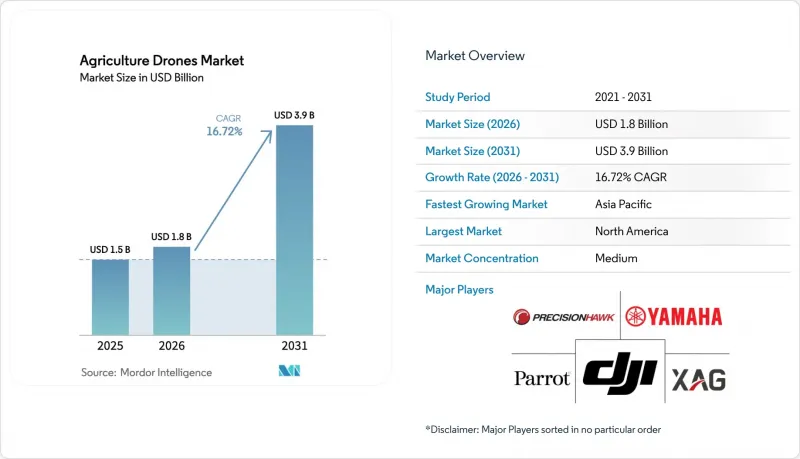
Mordor Intelligence에 따르면 농업용 드론 시장 규모는 2025년에 15억 달러로 평가되며, 2026년 18억 달러에서 2031년까지 39억 달러에 달할 것으로 예측되고 있으며, 예측 기간(2026-2031년)에 CAGR은 16.72%에 달할 전망입니다.
이 보고서는 제품별(고정익 드론, 회전익 드론 등), 구성 요소별(하드웨어, 소프트웨어, 서비스),용도별(농지 매핑 및 측량, 농약 살포 등), 농장 규모별(대규모 상업 농장 및 중소규모 농장), 지역별(북미, 남미, 유럽 등)로 분류되어 있습니다. 시장 예측은 금액(달러) 기준으로 제시되어 있습니다.
전 세계 농업용 드론 시장의 동향 및 인사이트
드론 하드웨어 가격의 급격한 하락
엔트리 레벨 농업용 드론의 소매 가격은 2016년 1만 4,500달러에서 2,000-4,000달러로 하락하여, 소규모 농가 협동조합에서도 도입이 현실화되고 있습니다. 8,000-1만 5,000달러 가격대의 중급 기종에는 과거 2만 달러를 초과하던 기업 모델에만 탑재되었던 장애물 회피 기능과 자동 임무 계획 기능이 갖춰져 있습니다. 모듈식 기체 구조 덕분에 페이로드 교체가 가능해져 내구 연수가 연장되고 투자 수익률(ROI)이 향상되고 있습니다. 인도와 호주의 보조금 제도를 통해 구매 비용의 최대 80.0%가 지원되므로 기체 교체 속도가 가속화되고 있습니다. 단가가 하락하고 있음에도 불구하고 하드웨어의 이익률은 안정적이며, 이는 공급망이 점차 성숙해지고 있음을 보여줍니다.
5G와 엣지 AI의 확산으로 실시간 분석 가능
5세대 네트워크는 지연 시간을 20밀리초 미만으로 줄여, 드론이 한 번의 비행 중에 이미지를 전송하고 비료 살포 지도를 수신할 수 있게 합니다. 미국 옥수수 농장에서 실시된 시험에서 탑재된 컨볼루션 신경망이 94.0%의 정확도로 스트레스 상태를 분류할 수 있음이 입증되었으며, 이를 통해 클라우드 업로드에 따른 병목 현상이 해소되었습니다. 광활한 농지에 프라이빗 5G를 도입함으로써 10대 이상의 드론 군이 연계되어 하루에 1,000에이커 이상의 면적을 커버할 수 있게 됩니다. 또한 원본 영상이 농지 밖으로 유출되는 일이 절대 없기 때문에 엣지 처리는 개인정보 보호에 대한 우려도 해소합니다. 2027년까지 모듈 가격이 500달러 미만으로 떨어질 것으로 예상되며, 이에 따라 중규모 농가에도 이 기술이 보급될 전망입니다.
항공 교통 통합의 장벽
농업용 드론을 관제 공역에 통합하기 위한 무인 항공기 교통 관리 시스템은 현재 개발 중이며, 대규모 농장에 필수적인 ‘시야 밖(BVLOS)’ 운용이 지연되고 있습니다. 연방항공청(FAA)이 2024년에 발표한 ‘시야 외(BVLOS)’ 관련 규정 제정안 통지는 여전히 해결되지 않은 상태이며, 운영자들은 여전히 특례 조치에 의존할 수밖에 없는 상황입니다. 유럽연합(EU)의 U-space 규정에 따르면 2027년까지 U-space 공역 도입이 의무화되어 있으나, 도입 시기는 지역에 따라 다릅니다. 원격 식별(RI) 요건으로 인해 하드웨어 비용이 대당 100-300달러 증가합니다. 인프라가 정비될 때까지는 드론 운용이 가시거리 내(VLOS) 비행으로 제한되며, 한 번의 비행으로 커버할 수 있는 면적은 50-100에이커에 그칩니다.
부문 분석
2025년, 농업용 드론 시장에서 회전익 드론은 62.0%의 시장 점유율을 차지했습니다. 비행 지속 시간의 제한은 있지만, 호버링 능력과 기동성을 활용하여 농약 살포 및 가축 모니터링 분야에서 압도적인 입지를 구축하고 있습니다. 하이브리드 드론은 수직 이륙과 고정익의 순항 효율을 겸비한 플랫폼에 대한 수요에 힘입어 2031년까지 연평균 성장률(CAGR) 18.9%로 성장할 것으로 예측됩니다. AeroVironment사의 ‘Quantix Recon’은 1회 출동당 45분의 비행 시간과 400에이커의 커버리지를 실현하여 광활한 농지의 생산성 문제를 해결합니다. 비행 지속 시간이 45-90분인 고정익 드론은 매핑이나 측량에 일반적으로 사용되지만, 가변율 살포에 필요한 정밀도는 부족합니다. 시야 외(BVLOS) 운용에 대한 규제 승인은 장거리 비행이라는 특징 덕분에 하이브리드형 및 고정익 드론에 혜택을 가져다줄 것입니다.
1만 달러 미만의 부문에서는 SZ DJI Technology나 XAG 등의 제조사가 기능이 풍부한 모델을 제공하고 있으며, 회전익형 플랫폼이 주류를 이루고 있습니다. 하이브리드형 플랫폼은 살포, 정찰, 관개 관리에 있으며, 높은 범용성을 갖추고 있으며, 특히 소규모 농가가 여러 작물을 재배하는 인도나 동남아시아 등의 지역에서 주목을 받고 있습니다.
2025년, 농업용 드론 시장 규모의 55.0%를 기체, 센서, 배터리, 지상 관제소를 포함한 하드웨어가 차지했습니다. 그러나 서비스 분야는 2031년까지 연평균 성장률(CAGR) 17.8%로 성장할 것으로 예측됩니다. ‘Drone-as-a-Service(DaaS)’ 모델은 초기 투자를 줄이고 운영 위험을 전문 제공업체로 이전합니다. DroneDeploy, Inc.나 PrecisionHawk, Inc. 등의 기업은 비행 운영,데이터 처리, 농업학적 인사이트를 묶은 구독형 분석 플랫폼을 시즌당 1에이커당 5-15달러에 제공하고 있으며, 하드웨어에 1만-3만 달러를 투자할 여력이 없는 농장에서도 정밀농업을 활용할 수 있게 되었습니다.
비행 계획, 이미지 스티칭, 기계학습을 통한 추론과 같은 소프트웨어 구성 요소는 클라우드 플랫폼을 통해 제공되는 사례가 늘어나고 있으며, 이를 통해 지속적인 수입원이 창출되고 벤더의 이익률도 향상되고 있습니다. 파일럿 교육, 유지보수 계약, 규제 준수 지원과 같은 서비스는 기술적 전문 지식이 제한적인 인도나 아프리카 등의 지역에서 특히 높은 가치를 지닙니다.
지역별 분석
아시아태평양은 중국의 광범위한 제조 능력과 정부가 지원하는 농업 현대화 구상에 힘입어 2026-2031년까지 연평균 성장률(CAGR) 18.5%로 성장할 것으로 예측됩니다. 이러한 프로그램을 통해 드론은 식량안보를 강화하기 위한 필수적인 툴로서의 입지를 확고히 하고 있습니다. 이 지역은 노동력 부족과 임금 상승에 직면해 있으며, 자동화가 유망한 투자 분야로 떠오르고 있습니다. SZ DJI Technology사는 민용 드론 분야의 전문성을 활용하여 소규모 농가 및 상업 농업 두 부문을 대상으로, 5,000-27,000달러 가격대의 ‘Agras T50’‘T40’, ‘T25’, ‘T10’ 시리즈를 제공하고 있습니다.
북미는 확립된 정밀농업 인프라에 힘입어 2025년에는 36.0%의 시장 점유율을 차지하며 최대 시장이 되었습니다. 미국 농무부(USDA)의 3억 달러 규모 ‘직접 보전 대출 프로그램(Direct Conservation Loan Program)’은 항공 플랫폼과 센서 네트워크를 우선적으로 지원하고 있습니다. 연방항공청(FAA)의 파트 107 규정에 더해, 시야 외 비행(BVLOS)에 대한 단계적 면제 조치로 인해 대규모 상업 농장에서 다중 드론 군집의 도입이 촉진되고 있습니다.
유럽의 성장은 유럽항공안전청(EASA)의 ‘U-space’ 공역 통합 일정과 일반 데이터 보호 규정(GDPR)의 데이터 개인정보 보호 요건에 제약을 받고 있으며, 이로 인해 드론 서비스 도입이 지연되고 있습니다. 독일, 프랑스, 영국이 이 지역에서의 도입 노력을 주도하고 있습니다. 남미에서는 브라질의 대규모 사탕수수, 대두, 옥수수 재배에서 가변율 살포의 혜택을 보고 있습니다. 한편, 아르헨티나의 곡물 및 축산 부문에서는 작물 모니터링과 목초지 관리에 드론이 도입되고 있습니다. 아프리카 및 중동에서는 4G/5G 통신 범위가 제한적이고 조종사 양성 프로그램이 미흡한 등 인프라 격차에 직면해 있으며, 선진 지역에 비해 도입 속도가 더딘 실정입니다.
기타 혜택:
- 엑셀 형식의 시장 예측(ME) 시트
- 3개월간의 애널리스트 지원
자주 묻는 질문
목차
제1장 서론
제2장 조사 방법
제3장 개요
제4장 시장 구도
제5장 시장 규모와 성장 예측
제6장 경쟁 구도
제7장 시장 기회와 향후 전망
KSA 26.08.25According to Mordor Intelligence, the agriculture drones market size was valued at USD 1.5 billion in 2025 and estimated to grow from USD 1.8 billion in 2026 to reach USD 3.9 billion by 2031, at a CAGR of 16.72% during the forecast period (2026-2031).
This report is Segmented by Product (Fixed-Wing Drones, Rotary-Wing Drones, and More), by Component (Hardware, Software, and Services), by Application (Field Mapping and Surveying, Crop Spraying, and More), by Farm Size (Large-Scale Commercial Farms and Small and Medium Farms), and by Geography (North America, South America, Europe, and More). The Market Forecasts are Provided in Terms of Value (USD).
Global Agriculture Drones Market Trends and Insights
Rapid Decline in Drone Hardware Prices
Entry-level agricultural drones now retail for USD 2,000-4,000, down from USD 14,500 in 2016, allowing smallholder cooperatives to justify ownership. Mid-range platforms, priced at USD 8,000-15,000, include obstacle avoidance and automated mission planning features, which were once reserved for enterprise models topping USD 20,000. Modular airframes support payload swaps, extending the useful life and improving the return on investment. Subsidies in India and Australia eliminate up to 80.0% of the purchase cost, accelerating fleet turnover. Hardware margins are stabilizing even as unit prices fall, signaling a maturing supply chain.
Expansion of 5G and Edge-AI Enabling Real-Time Analytics
Fifth-generation networks reduce latency to below twenty milliseconds, allowing drones to transmit imagery and receive prescription maps during a single flight. Trials on United States corn farms demonstrate that onboard convolutional networks can classify stress with 94.0% accuracy, thereby removing cloud-upload bottlenecks. Private 5G installations on large estates coordinate swarms of ten or more drones, providing daily coverage of over 1,000 acres. Edge processing also addresses privacy worries because raw images never leave the farm. Module prices under USD 500 are anticipated by 2027, opening the technology to mid-size growers.
Air-Traffic Integration Hurdles
Unmanned Traffic Management systems for integrating agricultural drones into controlled airspace are under development, delaying Beyond Visual Line of Sight operations essential for large farms. The Federal Aviation Administration's 2024 Notice of Proposed Rulemaking for Beyond Visual Line of Sight remains unresolved, leaving operators reliant on waivers. The European Union's U-space regulation mandates the implementation of U-space airspace by 2027, but the timing of implementation varies. Remote identification requirements add USD 100-300 per unit in hardware costs. Until the infrastructure matures, drones remain limited to visual line-of-sight operations, covering 50-100 acres per flight.
Other drivers and restraints analyzed in the detailed report include:
- Government Subsidies for Precision Agriculture
- Rising Agro-Chemical Cost Pushing Variable-Rate Spraying Demand
- Short Battery Endurance for Large Acreage
For complete list of drivers and restraints, kindly check the Table Of Contents.
Segment Analysis
Rotary-wing drones held a 62.0% market share in the agricultural drones market in 2025, dominating crop spraying and livestock monitoring due to their hovering capability and maneuverability, despite having endurance limitations. Hybrid drones are projected to grow at a 18.9% CAGR through 2031, driven by demand for platforms that combine vertical takeoff with fixed-wing cruise efficiency. AeroVironment's Quantix Recon offers 45-minute flight times and 400-acre coverage per sortie, addressing productivity gaps in broad-acre estates. Fixed-wing drones, with an endurance of 45-90 minutes, are commonly used in mapping and surveying, but they lack the precision required for variable-rate spraying. Regulatory approvals for Beyond Visual Line of Sight (BVLOS) operations will benefit hybrid and fixed-wing drones due to their extended range.
Rotary-wing platforms dominate the sub-USD 10,000 segment, with manufacturers such as SZ DJI Technology Co., Ltd. and XAG Co., Ltd. offering feature-rich models. Hybrid platforms are gaining traction due to their versatility in spraying, scouting, and irrigation management, particularly in regions such as India and Southeast Asia, where smallholder farmers cultivate multiple crops.
In 2025, hardware accounted for 55.0% of the agricultural drones market size, including airframes, sensors, batteries, and ground control stations. However, the services segment is projected to grow at a CAGR of 17.8% through 2031. Drone-as-a-Service (DaaS) models reduce upfront capital requirements and transfer operational risks to specialized providers. Companies such as DroneDeploy, Inc. and PrecisionHawk, Inc. offer subscription-based analytics platforms that bundle flight operations, data processing, and agronomic insights for USD 5-15 per acre per season, making precision agriculture accessible to farms that cannot justify investments of USD 10,000-30,000 in hardware.
Software components, such as flight planning, image stitching, and machine learning inference, are increasingly delivered via cloud platforms, creating recurring revenue streams and improving vendor margins. Services such as pilot training, maintenance contracts, and regulatory compliance support are particularly valuable in regions like India and Africa, where technical expertise is limited.
Complete Report Scope:
- By Product
- Fixed-wing Drones
- Rotary-wing Drones
- Hybrid Drones
- By Component
- Hardware
- Software
- Services
- By Application
- Field Mapping and Surveying
- Crop Spraying
- Crop Monitoring/Field Surveillance
- Livestock Monitoring
- Irrigation Management
- Soil and Field Analysis
- By Farm Size
- Large-scale Commercial Farms
- Small and Medium Farms
- By Geography
- North America
- United States
- Canada
- Rest of North America
- South America
- Brazil
- Argentina
- Rest of South America
- Europe
- Germany
- United Kingdom
- France
- Russia
- Rest of Europe
- Asia-Pacific
- China
- India
- Japan
- Australia
- Rest of Asia-Pacific
- Middle East
- Saudi Arabia
- United Arab Emirates
- Rest of Middle East
- Africa
- South Africa
- Kenya
- Rest of Africa
- North America
Geography Analysis
The Asia-Pacific region is projected to grow at an 18.5% CAGR during 2026-2031, driven by China's extensive manufacturing capabilities and government-supported agricultural modernization initiatives. These programs position drones as essential tools for enhancing food security. The region faces labor shortages and rising wages, making automation a viable investment. SZ DJI Technology Co., Ltd. leverages its expertise in consumer drones to offer the Agras T50, T40, T25, and T10 series, priced between USD 5,000 and USD 27,000, targeting both smallholder and commercial farming segments.
North America accounted for the largest market share, holding 36.0% in 2025, supported by a well-established precision agriculture infrastructure. The United States Department of Agriculture's (USDA) USD 300 million Direct Conservation Loan Program prioritizes aerial platforms and sensor networks. The Federal Aviation Administration's (FAA) Part 107 regulation, along with incremental beyond visual line of sight (BVLOS) waivers, facilitates the deployment of multi-drone fleets on large-scale commercial farms.
Europe's growth is constrained by the European Union Aviation Safety Agency's (EASA) U-space airspace integration timelines and the General Data Protection Regulation (GDPR) 's data privacy requirements, which slow the adoption of drone services. Germany, France, and the United Kingdom lead the region's deployment efforts. In South America, Brazil's large-scale sugarcane, soybean, and corn operations benefit from variable-rate spraying, while Argentina's grain and cattle sectors adopt drones for crop monitoring and pasture management. Africa and the Middle East face infrastructure gaps, including limited 4G/5G coverage and inadequate pilot training programs, which slow adoption compared to developed regions.
- SZ DJI Technology Co., Ltd.
- Yamaha Motor Co., Ltd.
- Parrot S.A.
- AeroVironment, Inc.
- PrecisionHawk, Inc.
- AgEagle Aerial Systems Inc.
- Trimble Inc.
- DELair SAS
- DroneDeploy, Inc.
- XAG Co., Ltd.
- Kray Technologies LLC
- Hylio, Inc.
- ShenZhen AEE Technology company
- AgEagle Aerial Systems
- Drone Volt S.A.
Additional Benefits:
- The market estimate (ME) sheet in Excel format
- 3 months of analyst support
TABLE OF CONTENTS
1 Introduction
- 1.1 Study Assumptions and Market Definition
- 1.2 Scope of the Study
2 Research Methodology
3 Executive Summary
4 Market Landscape
- 4.1 Market Overview
- 4.2 Market Drivers
- 4.2.1 Rapid decline in drone hardware prices
- 4.2.2 Expansion of 5G and edge-AI enabling real-time analytics
- 4.2.3 Government subsidies for precision agriculture
- 4.2.4 Rising agro-chem cost pushing variable-rate spraying demand
- 4.2.5 Climate-change driven need for crop stress monitoring
- 4.2.6 Carbon-credit markets rewarding low-input farming
- 4.3 Market Restraints
- 4.3.1 Air-traffic integration hurdles
- 4.3.2 Data-privacy concerns among farmers
- 4.3.3 Short battery endurance for large acreage
- 4.3.4 Fragmented regulatory standards across countries
- 4.4 Regulatory Landscape
- 4.5 Technological Outlook
- 4.6 Porter's Five Forces
- 4.6.1 Threat of New Entrants
- 4.6.2 Bargaining Power of Suppliers
- 4.6.3 Bargaining Power of Buyers
- 4.6.4 Threat of Substitutes
- 4.6.5 Intensity of Competitive Rivalry
5 Market Size and Growth Forecasts (Value)
- 5.1 By Product
- 5.1.1 Fixed-wing Drones
- 5.1.2 Rotary-wing Drones
- 5.1.3 Hybrid Drones
- 5.2 By Component
- 5.2.1 Hardware
- 5.2.2 Software
- 5.2.3 Services
- 5.3 By Application
- 5.3.1 Field Mapping and Surveying
- 5.3.2 Crop Spraying
- 5.3.3 Crop Monitoring/Field Surveillance
- 5.3.4 Livestock Monitoring
- 5.3.5 Irrigation Management
- 5.3.6 Soil and Field Analysis
- 5.4 By Farm Size
- 5.4.1 Large-scale Commercial Farms
- 5.4.2 Small and Medium Farms
- 5.5 By Geography
- 5.5.1 North America
- 5.5.1.1 United States
- 5.5.1.2 Canada
- 5.5.1.3 Rest of North America
- 5.5.2 South America
- 5.5.2.1 Brazil
- 5.5.2.2 Argentina
- 5.5.2.3 Rest of South America
- 5.5.3 Europe
- 5.5.3.1 Germany
- 5.5.3.2 United Kingdom
- 5.5.3.3 France
- 5.5.3.4 Russia
- 5.5.3.5 Rest of Europe
- 5.5.4 Asia-Pacific
- 5.5.4.1 China
- 5.5.4.2 India
- 5.5.4.3 Japan
- 5.5.4.4 Australia
- 5.5.4.5 Rest of Asia-Pacific
- 5.5.5 Middle East
- 5.5.5.1 Saudi Arabia
- 5.5.5.2 United Arab Emirates
- 5.5.5.3 Rest of Middle East
- 5.5.6 Africa
- 5.5.6.1 South Africa
- 5.5.6.2 Kenya
- 5.5.6.3 Rest of Africa
- 5.5.1 North America
6 Competitive Landscape
- 6.1 Market Concentration
- 6.2 Strategic Moves
- 6.3 Market Share Analysis
- 6.4 Company Profiles (Includes Global-Level Overview, Market-Level Overview, Core Segments, Financials as Available, Strategic Information, Market Rank/Share for Key Companies, Products and Services, and Recent Developments)
- 6.4.1 SZ DJI Technology Co., Ltd.
- 6.4.2 Yamaha Motor Co., Ltd.
- 6.4.3 Parrot S.A.
- 6.4.4 AeroVironment, Inc.
- 6.4.5 PrecisionHawk, Inc.
- 6.4.6 AgEagle Aerial Systems Inc.
- 6.4.7 Trimble Inc.
- 6.4.8 DELair SAS
- 6.4.9 DroneDeploy, Inc.
- 6.4.10 XAG Co., Ltd.
- 6.4.11 Kray Technologies LLC
- 6.4.12 Hylio, Inc.
- 6.4.13 ShenZhen AEE Technology company
- 6.4.14 AgEagle Aerial Systems
- 6.4.15 Drone Volt S.A.


