|
시장보고서
상품코드
2114131
글루카곤 유사 펩티드-1(GLP-1) 아고니스트 : 시장 점유율 분석, 산업 동향 및 통계 데이터, 성장 예측(2026-2031년)Glucagon-like Peptide-1 Agonists - Market Share Analysis, Industry Trends & Statistics, Growth Forecasts (2026 - 2031) |
||||||
 Mordor Intelligence
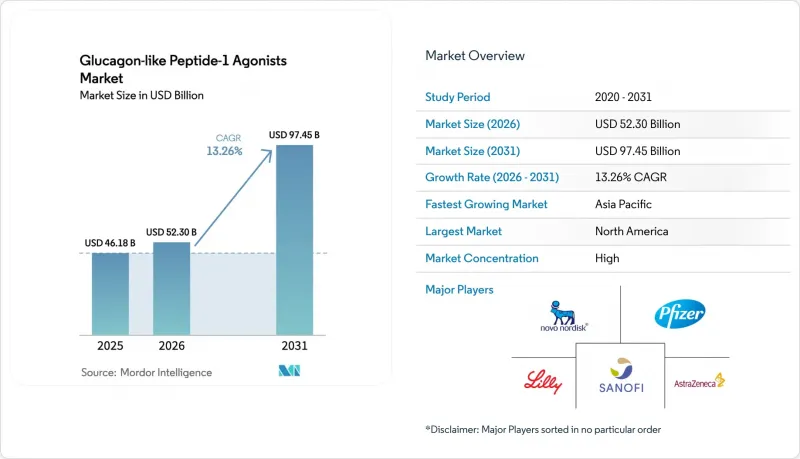
Mordor Intelligence에 따르면 글루카곤 유사 펩티드-1(GLP-1) 아고니스트 시장 규모는 2025년 461억 8,000만 달러에서 2026년에는 523억 달러로 확대하며, 2026-2031년에 CAGR 13.26%로 추이하며, 2031년까지 974억 5,000만 달러에 달할 것으로 예측됩니다.
이 보고서는 분자별(듀라구티드, 엑세나티드, 릴라구티드, 릭시세나티드 등), 투여 경로별(매일 주사제, 주 1회 주사제 등), 적응증별(제2형 당뇨병, 심혈관 위험 감소 등) 및 지역별(북미, 유럽,아시아태평양 등)으로 분류되어 있습니다. 시장 예측은 금액(달러) 기준으로 제시되어 있습니다.
전 세계 글루카곤 유사 펩티드-1(GLP-1) 작용제 시장의 동향 및 인사이트
제2형 당뇨병 유병률의 급증
국제당뇨병연맹(IDF)의 예측에 따르면 당뇨병 환자 수는 2021년 5억 3,700만 명에서 2045년까지 7억 8,300만 명으로 증가할 것이며, 그 중 90%가 제2형 당뇨병으로 분류될 것으로 예상됩니다. 발병률은 생활 방식의 변화와 인구 고령화가 겹치는 도시화가 진행되고 있는 아시아태평양의 경제권에서 가장 빠르게 가속화되고 있습니다. 중국만 해도 2024년 성인 유병률은 12.4%로 보고되고 있으며, 이는 1억 4,000만 명 이상에 해당하지만, 그 중 대다수는 여전히 적절한 치료를 받지 못하고 있는 상황입니다. 미국당뇨병협회(ADA)는 2024년 ‘치료 지침(Standards of Care)’에서 심혈관계 동반 질환이 있는 환자에 대한 GLP-1 작용제를 ‘권장되는 2차 선택 약물’로 격상시켰으며,많은 임상 시나리오에서 이 약제 클래스을 설포닐우레아계 약물이나 DPP-4 억제제보다 우선시하는 입장으로 정했습니다. 보험 지급 기관이 가치 기반 모델로 전환하는 가운데,GLP-1 작용제가 미세혈관 및 대혈관 합병증을 완화하는 능력은 보험 적용 리스트 등재를 지원하고 있으며, 글루카곤 유사 펩티드-1(GLP-1) 작용제 시장은 향후 10년 동안에도 견고한 성장을 이어갈 전망입니다.
심화되는 비만 확산과 체중 감량제 승인
세계보건기구(WHO)의 데이터에 따르면 1975-2024년 사이에 전 세계 비만 유병률은 거의 3배로 증가하여 8억 9,000만 명 이상의 성인이 영향을 받고 있습니다. 규제 당국의 움직임은 이러한 역학적 긴급성에 부응하고 있습니다. 일라이 릴리(Eli Lilly)사의 틸제파티드는 2023년 말 만성 체중 관리 약물로 FDA 승인을 획득했으며, 2024년 초 유럽에서도 승인되어 웨고비(Wegovy)의 초기 독점 상태를 깨뜨렸습니다. 주요 SURMOUNT-1 임상시험 데이터에 따르면 틸제파티드는 평균 20.9%의 체중 감소를 가져왔으며, 세마글루티드의 STEP-1 임상시험 결과인 14.9%를 상회하는 성과를 보였습니다. 2025년 FDA가 폐쇄성 수면무호흡증에 대한 세마글루티드를 승인함에 따라 적응증 대상이 더욱 확대되었고, 메디케어 어드밴티지 플랜이 기존의 적용 제외 조항을 철회하는 움직임이 가속화되었습니다. 이러한 승인들이 맞물리면서 비만 치료제 처방 건수가 급증했으며, 현재 글루카곤 유사 펩티드-1(GLP-1) 작용제 시장에서 가장 빠르게 성장하는 단일 수입원이 되었습니다.
고액의 치료비와 제한된 비만 치료 보험 적용
미국내 연간 도매 구입 비용은 13,000-16,000달러 범위이며, 무보험자나 당뇨병이 없는 메디케어 수급자는 정가 전액을 부담할 수밖에 없는 상황입니다. 2024년 현재, 항비만제를 보장 대상으로 하는 고용주의 건강 보험 플랜은 고작 38%에 불과하며, 그 경우에도 사전 승인이나 지출 상한선이 여전히 일반적입니다. 노보 노르디스크사의 할인 카드를 이용하면 웨고비의 본인 부담금을 500달러로 낮출 수 있지만, 법령에 따라 적용 대상에서 제외된 65세 이상 인구는 이 혜택을 받을 수 없습니다. 인도 전역의 가구 소득 중앙값이 2,400달러인 만큼, 브랜드 GLP-1 치료제는 접근하기 어려운 수준이며, 수요는 향후 출시될 바이오시밀러로 이동하고 있습니다. 따라서 가격 책정 및 보험 적용 범위의 장벽이, 특히 비만만을 적응증으로 하는 분야에서 GLP-1 작용제 시장 전체의 성장을 저해하고 있습니다.
부문 분석
세마글루티드는 2025년 매출의 42.56%를 차지하며, 당뇨병과 비만의 이중 적응증 및 풍부한 치료 성과 데이터를 통해 글루카곤 유사 펩티드-1(GLP-1) 작용제 시장의 핵심을 이루고 있습니다. 틸제파티드의 2031년까지의 연평균 성장률(CAGR)(연평균 성장률) 25.25%는 GIP/GLP-1 이중 작용제 효과로 인한 HbA1c 수치 및 체중의 대폭적인 감소를 반영하며, 웰고비(Wegovy)의 정가보다 낮은 릴리(Lilly)사의 할인 전략에 힘입고 있습니다. 현재의 임상 시험 데이터가 계속해서 양호하고, 생산 능력 확대가 예정대로 진행된다면, 2031년까지 틸제파티드의 GLP-1 작용제 시장 규모는 380억 달러에 달할 가능성이 있습니다. 둘라글루티드와 릴라글루티드는 보험 적용 약품 리스트이 더 효능이 높은 주 1회 투여 약물로 전환됨에 따라 그 역할을 다하고 있습니다. 한편, 레타토르티드의 초기 단계 데이터는 더 큰 체중 감량 효과의 가능성을 시사하며, GLP-1 작용제 시장에서 분자 수준의 순위를 재편할 가능성이 있는 파이프라인의 존재를 보여줍니다.
2세대 약물인 엑세나티드와 리키세나티드는 현재 가격에 민감한 지역 및 더 강력한 화합물을 견디지 못하는 환자를 대상으로 제공되고 있습니다. 중국과 인도에서의 릴라글루티드 바이오시밀러 신청은 가치 부문의 가격에 압박을 가할 가능성은 있지만, 입증된 유효성 데이터가 요구되는 프리미엄 시장에서 브랜드 제품을 몰아낼 가능성은 낮다고 여겨집니다. 그 결과, GLP-1 작용제 업계는 분자 수준에서 여전히 두 회사 간의 경쟁이 지속되고 있으며, 세마글루타이드와 틸제파티드가 설정한 효능 기준을 신규 진입 제품들이 달성하거나 능가해야만 합니다.
지역별 분석
북미는 조기 승인, 높은 비만 유병률, 그리고 프리미엄 가격 책정에 힘입어 2025년 매출의 41.13%를 계속 차지했습니다. 현재 처방은 전문의에서 일차 진료 현장으로 이동하고 있지만, 보험 적용 범위 확대와 경쟁 심화에 따라 판매량 증가세는 정체되고 있습니다. 2027년에 발효될 ‘인플레이션 억제법(Inflation Reduction Act)’에 따른 가격 협상으로 인해 평균 판매 가격은 하락하겠지만 판매량은 증가할 것이며, 이로 인해 해당 지역의 글루카곤 유사 펩티드-1(GLP-1)작용제 시장에서 순수한 매출 안정화가 이루어질 것으로 전망됩니다.
2025년, 유럽은 전 세계 매출의 28%를 차지했습니다. 중앙 승인 제도에 따라 다국적 기업의 제품 출시가 가속화되고 있지만, 각국의 비용 대비 효과 심사로 인해 환자 1인당 매출은 억제되고 있습니다. 독일에서는 틸제파티드에 대해 긍정적인 유효성 평가가 내려짐에 따라 더 높은 가격으로 협상할 수 있게 되었으나, 반면 영국에서는 BMI 기준에 따른 적격 범위가 좁아 잠재적 대상 환자 수가 제한되고 있습니다. 심혈관 및 신장 예후와 연계된 보험 적용 범위의 지속적인 확대로 인해 판매량은 한 자릿수 중반대의 성장이 예상되며, 유럽은 성숙기에 접어들었음에도 불구하고 견실한 수입원으로서의 위상을 유지할 것입니다.
아시아태평양은 18.81%라는 가장 높은 연평균 성장률(CAGR)을 기록하고 있으며, 중국, 일본, 인도가 방대한 환자층을 개발함에 따라 전 세계 매출 구성비에 변화를 가져올 전망입니다. 2024년 말 중국의 틸제파티드 승인 및 이에 따른 10억 달러 규모의 현지 생산 약속은, 판매량의 급속한 확대를 지원할 국내 생산 능력에 대한 전략적 중점을 부각시키고 있습니다. 2024년 초 일본에서 승인된 퍼스트-인-클래스(First-in-Class) 비만 치료제는 출시 초기부터 높은 채택률을 보였습니다. 현재 국내 각 보험사가 보상 상한액 재평가를 진행 중이며, 이는 지속적인 성장을 지원할 것으로 전망됩니다. 각 지역 정부가 심혈관 및 대사 질환의 의료비 급증을 겪고 있는 가운데, 보조금 확대가 기대되고 있으며, 이에 따라 글루카곤 유사 펩티드-1(GLP-1) 작용제 시장은 2030년대 초까지 아시아태평양에서 주도적인 위치를 확립할 것으로 전망됩니다.
기타 혜택:
- Excel 형식의 시장 예측(ME) 시트
- 3개월간의 애널리스트 지원
자주 묻는 질문
목차
제1장 서론
제2장 분석 방법
제3장 개요
제4장 시장 구도
제5장 시장 규모·성장률 예측
제6장 경쟁 구도
제7장 시장 기회와 향후 전망
KSA 26.08.26According to Mordor Intelligence, the glucagon-like peptide-1 agonists market size is expected to grow from USD 46.18 billion in 2025 to USD 52.30 billion in 2026 and is forecast to reach USD 97.45 billion by 2031 at 13.26% CAGR over 2026-2031.
This report is Segmented by Molecule (Dulaglutide, Exenatide, Liraglutide, Lixisenatide, and More), Route of Administration (Daily Injectable, Weekly Injectable, and More), Indication (Type-2 Diabetes, Cardiovascular Risk Reduction, and More), and Geography (North America, Europe, Asia-Pacific, and More). The Market Forecasts are Provided in Terms of Value (USD).
Global Glucagon-like Peptide-1 Agonists Market Trends and Insights
Rising Prevalence of Type-2 Diabetes
International Diabetes Federation projections show diabetes cases climbing from 537 million in 2021 to 783 million by 2045, with 90% classified as type-2. Incidence is accelerating fastest across urbanizing Asia-Pacific economies, where lifestyle changes and aging populations converge. China alone documented a 12.4% adult prevalence in 2024, translating into more than 140 million individuals who often remain undertreated. The American Diabetes Association upgraded GLP-1 agonists to preferred second-line agents for patients with cardiovascular comorbidities in its 2024 Standards of Care, elevating the drug class above sulfonylureas and DPP-4 inhibitors for many clinical scenarios. As payers shift toward value-based models, the capacity of GLP-1 agonists to reduce microvascular and macrovascular complications strengthens formulary support, boosting the glucagon-like peptide-1 (GLP-1) agonists market well into the next decade.
Escalating Obesity Epidemic and Weight-Loss Approvals
World Health Organization data confirm that worldwide obesity prevalence nearly tripled between 1975 and 2024, affecting more than 890 million adults. Regulatory momentum is matching the epidemiologic urgency. Eli Lilly's tirzepatide gained FDA clearance for chronic weight management in late 2023, followed by European approval in early 2024, breaking Wegovy's early monopoly. In pivotal SURMOUNT-1 data, tirzepatide produced a 20.9% mean weight reduction, outperforming semaglutide's 14.9% STEP-1 result. The FDA endorsement of semaglutide for obstructive sleep apnea in 2025 further widened the eligible population, encouraging Medicare Advantage plans to drop previous exclusions. Collectively these approvals have catalyzed a surge of obesity prescriptions that now form the single fastest-growing revenue stream inside the glucagon-like peptide-1 (GLP-1) agonists market.
High Therapy Cost and Limited Obesity Coverage
Annual U.S. wholesale acquisition costs range from USD 13,000 to USD 16,000, leaving uninsured and Medicare beneficiaries without diabetes exposed to full list prices. Only 38% of employer plans covered anti-obesity drugs in 2024; even then, prior authorizations and spending caps remain common. Novo Nordisk's savings card caps Wegovy copays at USD 500 but does not address the 65-plus population excluded by statute. Across India, median household income of USD 2,400 renders branded GLP-1 therapy out of reach, steering demand toward forthcoming biosimilars. Thus pricing and coverage barriers temper overall GLP-1 agonists market expansion, particularly in obesity-only indications.
Other drivers and restraints analyzed in the detailed report include:
- Physician Shift to Once-Weekly GLP-1s
- Reimbursement and Guideline Expansion
- Gastro-Intestinal Side Effects and Discontinuation
For complete list of drivers and restraints, kindly check the Table Of Contents.
Segment Analysis
Semaglutide generated 42.56% of 2025 revenue, anchoring the glucagon-like peptide-1 agonists market through its dual diabetes-obesity branding and extensive outcomes data. Tirzepatide's 25.25% CAGR to 2031 reflects dual GIP/GLP-1 agonism that delivers larger HbA1c and weight reductions, bolstered by Lilly's discounting strategy that undercuts Wegovy list prices. The GLP-1 agonists market size for tirzepatide could reach USD 38 billion by 2031 if current trial data readouts remain positive and capacity expansions stay on schedule. Dulaglutide and liraglutide are sliding into twilight phases as payer formularies migrate toward higher-efficacy weekly drugs. Meanwhile, retatrutide's early-stage data suggest even greater weight-loss potential, indicating a pipeline that could further reshape molecule-level rankings within the GLP-1 agonists market.
Second-generation agents exenatide and lixisenatide now serve price-sensitive geographies or patients intolerant to stronger compounds. Biosimilar liraglutide filings in China and India may pressure pricing in value segments, but are unlikely to displace branded products in premium markets that demand proven outcomes data. As a result, the GLP-1 agonists industry remains a two-player race at the molecule level, with semaglutide and tirzepatide setting efficacy benchmarks that newer entrants must match or exceed.
Complete Report Scope:
- By Molecule
- Exenatide
- Liraglutide
- Dulaglutide
- Lixisenatide
- Semaglutide
- Tirzepatide
- Others
- By Route of Administration
- Daily Injectable
- Weekly Injectable
- Oral Small-Molecule
- Long-acting Monthly (Pipeline)
- By Indication
- Type-2 Diabetes
- Obesity / Weight Management
- Cardiovascular Risk Reduction
- Other Emerging Indications
- By Geography
- North America
- United States
- Canada
- Mexico
- Europe
- Germany
- United Kingdom
- France
- Italy
- Spain
- Rest of Europe
- Asia-Pacific
- China
- Japan
- India
- South Korea
- Australia
- Rest of Asia-Pacific
- Middle East & Africa
- GCC
- South Africa
- Rest of Middle East & Africa
- South America
- Brazil
- Argentina
- Rest of South America
- North America
Geography Analysis
North America maintained 41.13% of 2025 revenue, supported by early approvals, high prevalence of obesity, and premium pricing. Adoption has now moved from specialist to primary-care settings, yet unit growth is plateauing as coverage widens and competition intensifies. Inflation Reduction Act price negotiations, effective 2027, will reduce average selling price but boost volume, providing net positive revenue stability for the glucagon-like peptide-1 (GLP-1) agonists market in the region.
Europe accounted for 28% of global sales in 2025. Centralized approvals speed multinational launches, but national cost-effectiveness reviews temper revenue per patient. Germany's positive benefit rating for tirzepatide enabled higher negotiated pricing, whereas the United Kingdom's narrower BMI eligibility dampens total addressable population. Continued reimbursement expansion tied to cardiovascular and renal outcomes is likely to drive mid-single-digit volume growth, preserving Europe as a solid, though mature, profit pool.
Asia-Pacific, recording the fastest 18.81% CAGR, is set to shift the global revenue mix as China, Japan, and India unlock large patient cohorts. China's late-2024 tirzepatide approval and accompanying USD 1 billion local manufacturing commitment highlight strategic focus on domestic capacity that supports rapid volume ramp-up. Japan's first-in-class obesity approval in early 2024 delivered strong initial uptake; local insurers are now reevaluating reimbursement ceilings, which should foster sustained growth. As regional governments confront soaring cardiometabolic disease costs, broader subsidization is expected, advancing the glucagon-like peptide-1 (GLP-1) agonists market toward leadership status in Asia-Pacific by the early 2030s.
- Amgen
- Amylink Bio
- Ascletis Pharma
- AstraZeneca
- Boehringer Ingelheim
- Eli Lilly and Company
- Gan & Lee Pharma
- Hanmi Pharmaceutical
- Hengrui Pharma
- Innovent Biologics
- Novo Nordisk
- Pfizer
- Roche
- Sanofi
- Structure Therapeutics
- Terns Pharmaceuticals
- Viking Therapeutics
- Zealand Pharma
Additional Benefits:
- The market estimate (ME) sheet in Excel format
- 3 months of analyst support
TABLE OF CONTENTS
1 Introduction
- 1.1 Study Assumptions & Market Definition
- 1.2 Scope of the Study
2 Research Methodology
3 Executive Summary
4 Market Landscape
- 4.1 Market Overview
- 4.2 Market Drivers
- 4.2.1 Rising prevalence of type-2 diabetes
- 4.2.2 Escalating obesity epidemic & weight-loss approvals
- 4.2.3 Physician shift to once-weekly GLP-1s
- 4.2.4 Reimbursement & guideline expansion
- 4.2.5 Cardiometabolic-outcomes data broadening access
- 4.2.6 Peptide manufacturing scale-up lowering COGS
- 4.3 Market Restraints
- 4.3.1 High therapy cost & limited obesity coverage
- 4.3.2 Gastro-intestinal side-effects & discontinuation
- 4.3.3 Supply shortages & grey-market compounded products
- 4.3.4 Incoming biosimilars after 2027 pressuring prices
- 4.4 Supply-Chain Analysis
- 4.5 Regulatory Landscape
- 4.6 Technological Outlook
- 4.7 Porter's Five Forces
- 4.7.1 Bargaining Power of Suppliers
- 4.7.2 Bargaining Power of Buyers
- 4.7.3 Threat of New Entrants
- 4.7.4 Threat of Substitutes
- 4.7.5 Intensity of Rivalry
5 Market Size & Growth Forecasts (Value, USD)
- 5.1 By Molecule
- 5.1.1 Exenatide
- 5.1.2 Liraglutide
- 5.1.3 Dulaglutide
- 5.1.4 Lixisenatide
- 5.1.5 Semaglutide
- 5.1.6 Tirzepatide
- 5.1.7 Others
- 5.2 By Route of Administration
- 5.2.1 Daily Injectable
- 5.2.2 Weekly Injectable
- 5.2.3 Oral Small-Molecule
- 5.2.4 Long-acting Monthly (Pipeline)
- 5.3 By Indication
- 5.3.1 Type-2 Diabetes
- 5.3.2 Obesity / Weight Management
- 5.3.3 Cardiovascular Risk Reduction
- 5.3.4 Other Emerging Indications
- 5.4 By Geography
- 5.4.1 North America
- 5.4.1.1 United States
- 5.4.1.2 Canada
- 5.4.1.3 Mexico
- 5.4.2 Europe
- 5.4.2.1 Germany
- 5.4.2.2 United Kingdom
- 5.4.2.3 France
- 5.4.2.4 Italy
- 5.4.2.5 Spain
- 5.4.2.6 Rest of Europe
- 5.4.3 Asia-Pacific
- 5.4.3.1 China
- 5.4.3.2 Japan
- 5.4.3.3 India
- 5.4.3.4 South Korea
- 5.4.3.5 Australia
- 5.4.3.6 Rest of Asia-Pacific
- 5.4.4 Middle East & Africa
- 5.4.4.1 GCC
- 5.4.4.2 South Africa
- 5.4.4.3 Rest of Middle East & Africa
- 5.4.5 South America
- 5.4.5.1 Brazil
- 5.4.5.2 Argentina
- 5.4.5.3 Rest of South America
- 5.4.1 North America
6 Competitive Landscape
- 6.1 Market Concentration
- 6.2 Market Share Analysis
- 6.3 Company Profiles (includes Global level Overview, Market level overview, Core Segments, Financials as available, Strategic Information, Market Rank/Share for key companies, Products & Services, and Recent Developments)
- 6.3.1 Amgen
- 6.3.2 Amylink Bio
- 6.3.3 Ascletis Pharma
- 6.3.4 AstraZeneca
- 6.3.5 Boehringer Ingelheim
- 6.3.6 Eli Lilly
- 6.3.7 Gan & Lee Pharma
- 6.3.8 Hanmi Pharmaceutical
- 6.3.9 Hengrui Pharma
- 6.3.10 Innovent Biologics
- 6.3.11 Novo Nordisk
- 6.3.12 Pfizer
- 6.3.13 Roche
- 6.3.14 Sanofi
- 6.3.15 Structure Therapeutics
- 6.3.16 Terns Pharmaceuticals
- 6.3.17 Viking Therapeutics
- 6.3.18 Zealand Pharma
7 Market Opportunities & Future Outlook
- 7.1 White-space & Unmet-Need Assessment