|
시장보고서
상품코드
2119286
석고보드 라이너지 : 시장 점유율 분석, 업계 동향 및 통계, 성장 예측(2026-2031년)Plasterboard Liner Paper - Market Share Analysis, Industry Trends & Statistics, Growth Forecasts (2026 - 2031) |
||||||
 Mordor Intelligence
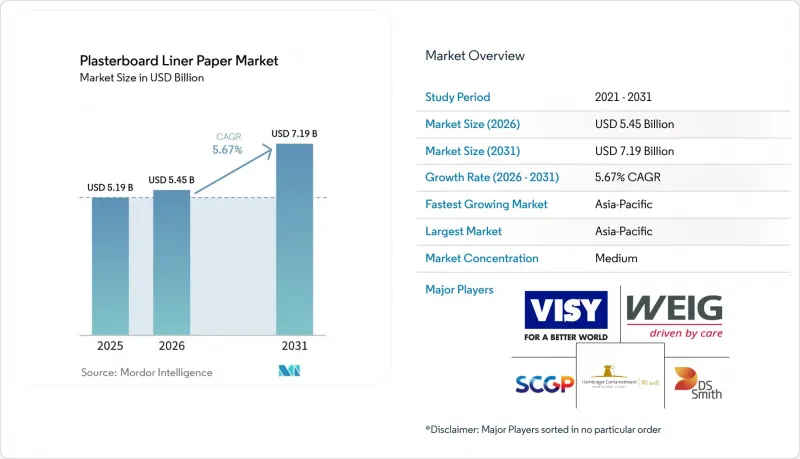
Mordor Intelligence에 의하면, 석고보드 라이너지 시장 규모는 2025년에 51억 9,000만 달러로 평가되었습니다. 예측 기간(2026-2031년) CAGR 5.67%로 확대되어 2026년 54억 5,000만 달러에서 2031년에는 71억 9,000만 달러에 이를 전망입니다.
본 보고서는 제품 유형(표면 라이너지 등), 섬유 유형(재생 섬유지 등), 석고보드 유형(표준 석고보드 등), 용도(벽 시스템 등) 및 지역(아시아태평양, 북미, 유럽, 남미, 중동 및 아프리카)별로 분류되어 있습니다. 시장 전망은 금액(달러)으로 표시되어 있습니다.
세계의 석고보드 라이너지 시장 동향 및 인사이트
주거용 및 상업용 석고보드 수요
아시아태평양의 주택 건설 확대에 따라, 대량 생산 라인을 통한 석고보드 생산을 배경으로 석고보드 라이너지 수요가 증가하고 있습니다. 중국의 ‘친환경 건축물 평가 기준’에 따르면, 2025년 이후 신규 상업 프로젝트에 대해 최소 1성급 인증 취득이 의무화되어 있으며, 이에 따라 보드 제조업체들은 재생 섬유 함량이 검증된 라이너 배합재의 사용을 촉진하고 있습니다. 또한, 인도의 ‘국가 건축 기준 2025’에서는 내화 성능을 갖춘 벽체 구조의 사용이 강화되어, 고성능 등급의 라이너지에 대한 수요가 높아지고 있습니다. 분당 120미터를 넘는 속도로 가동되는 고속 석고보드 생산 라인에서는 더욱 균일한 종이 성형이 요구되며, 이에 따라 저규격 등급의 사용이 제한됩니다. 그 결과, 석고보드 라이너지 시장에서는 계속 확대되고 있는 아시아의 석고보드 공장에서 채택된 생산 속도에서도 품질을 유지할 수 있는 공급업체가 우위를 점하고 있습니다.
내화·방습·방음 보드의 사양
내화성, 내습성 및 방음성 요건으로 인해 석고보드 시공에서 종이의 기술적 역할은 점점 더 중요해지고 있습니다. 2024년에 발생한 고층 빌딩 화재 사고를 계기로 홍콩과 싱가포르의 구획화 규제가 더욱 엄격해졌으며, 유형 X 보드는 공동 주택 및 상업 프로젝트의 기본 사양으로 자리 잡고 있습니다. 내화성 보드에는 석고 슬러리의 이동을 제어하고 화재 시 접착력을 유지하기 위해, 더 높은 평량과 안정적인 표면 사이징을 갖춘 표면 라이너가 요구됩니다. 또한, EN 520 분류에서는 라이너의 접착 요건 차이에 따라 석고 보드의 유형가 구분됩니다. 단일 라이너 화학 성분으로 여러 기능을 지원할 수 있는 공급업체는 가공업체가 조달해야 하는 용지 등급 수를 줄이는 데 도움이 됩니다. 이를 통해 기술적으로 우수한 공급업체는 특히 보드 제조업체가 여러 규제 대상 용도를 다루고 있는 경우, 석고보드 라이너 용지 시장에서 더욱 확고한 입지를 다질 수 있습니다.
건설 주기의 영향
석고보드 라이너지 수요는 주택 착공 건수 및 상업용 건축 허가 건수와 밀접한 관련이 있으며, 이 시장은 건설 경기 변동에 민감합니다. 2024년과 2025년의 엄격한 금리 환경으로 인해 미국에서는 주택 착공 건수가 감소했으며, 캐나다와 유럽의 일부 시장에서는 이와 관련된 신용 경색이 발생했습니다. 건설 활동이 부진할 경우, 보드 제조업체는 일반적으로 라이너 주문을 줄이기 전에 기존 안전 재고를 활용합니다. 이로 인해 2-3분기 동안 라이너 수요가 기반이 되는 건설 시장보다 급격히 감소할 가능성이 있습니다. 또한, 회복은 건설 시장의 회복보다 6-9개월 늦어질 수 있으며, 제조업체는 이 기간 동안 운전자금을 적절히 관리해야 합니다. 독립 제지 공장은 최종 시장의 선택지가 좁고 공급망의 완충 여력도 적기 때문에 통합형 제지 그룹에 비해 위험에 더 쉽게 노출되는 경향이 있습니다.
부문 분석
2025년, 석고보드 라이너지 시장에서 표면 라이너지는 52.37%의 점유율을 차지했으며, 2031년까지 연평균 성장률(CAGR) 5.87%를 나타낼 것으로 예측됩니다. 이 종이는 석고 슬러리가 시트를 고르지 않게 통과하지 않고 기계적인 상호 결합을 실현할 수 있도록 다공성을 제어해야 합니다. 또한, 도장, 벽지 시공, 접착제를 이용한 접착을 위해서는 매끄러운 표면도 요구됩니다. 프리데코레이션 보드나 내화 패널은 표면 라이너에 대한 사양 요건을 더욱 엄격하게 하고 있습니다. 이러한 제품에는 목적하는 보드의 성능에 맞추어 표면 처리가 된 라이너지가 필요하기 때문입니다. 이 부문의 규모가 크기 때문에 페이스 라이너는 석고보드 라이너지 시장 전체 수요에서 중심적인 위치를 차지하고 있습니다.
뒷면 라이너지는 제품 수요의 나머지 부분을 차지하며, 서로 다른 성능 요건을 충족하는 역할을 합니다. 이 등급에서는 표면의 외관보다 세로 및 가로 방향 모두에서의 인장 강도가 더 중요하게 여겨집니다. 따라서 보드 제조업체들이 강도를 희생하지 않으면서 재료 사용량을 줄이려고 노력하는 가운데, 뒷면 라이너는 평량 감축 노력의 주요 초점이 되고 있습니다. 필요한 물리적 특성을 유지할 수 있다면, 뒷면 라이너를 경량화함으로써 섬유 소비량을 줄이고 가공의 경제성을 향상시킬 수 있습니다. 두 등급 모두에서 고객이 공급받는 톤수뿐만 아니라 석고보드 1제곱미터당 종이의 성능을 비교하게 되었기 때문에 공급업체들은 성형성과 밀도 제어 향상에 주력하고 있습니다.
2025년, 재생 섬유지는 석고보드 라이너지 시장의 58.15%를 차지했으며, 2031년까지 연평균 성장률(CAGR) 6.73%를 나타낼 것으로 예측됩니다. 비용은 여전히 중요한 고려 사항이지만, 인증된 재생 섬유 함유율은 또 다른 상업적 요건으로 자리 잡고 있습니다. SCG Packaging사는 태국에서 석고보드 라이너지 생산 시설을 운영하고 있으며, 이 시설에서는 100% 재생 펄프를 사용하여 ‘탄소 발자국 저감 라벨’을 획득했습니다. 이러한 인증은 재생 섬유 함유율을 자격 기준에 포함하는 건설 업계의 구매자에게 제지 공급업체가 적절히 대응하는 데 도움이 됩니다. 따라서 순환형 조달 체제가 확립된 석고보드 라이너지 시장에서 재생 섬유의 역할은 점점 더 중요해지고 있습니다.
인장 강도의 균일성이나 내습성이 필수적인 용도에서는 버진 펄프지가 여전히 중요한 역할을 하고 있습니다. 이러한 요건은 내화성 및 내습성 보드에서 가장 엄격하며, 재생 섬유의 편차가 접착력에 위험을 초래할 가능성이 있습니다. 혼합 섬유지는 까다로운 보드 용도의 인증 기준을 충족하면서 재생 섬유 함유율을 높이고자 하는 제조업체에게 중간적인 선택지가 됩니다. 이러한 접근 방식을 통해 가공 및 세정 기술의 발전에 따라 섬유 구성을 단계적으로 변경할 수 있게 됩니다.
지역별 분석
아시아태평양은 2025년 석고보드 라이너지 시장 점유율의 38.14%를 차지했으며, 2031년까지 연평균 성장률(CAGR) 6.09%를 나타낼 것으로 예측됩니다. 중국은 277억 달러 규모의 인프라 투자와 신규 상업 프로젝트에 대한 그린 빌딩 인증 요건에 힘입어 이 지역에서 가장 큰 소비국으로 자리매김하고 있습니다. 인도의 ‘2025년 국가 건축 기준’은 내화 성능을 갖춘 벽 구조 및 고성능 라이너지에 대한 수요를 촉진할 것으로 예측됩니다. 베트남, 인도네시아, 태국에서는 도시 지역의 건설이 기존의 벽돌·콘크리트 구조에서 전환됨에 따라 건식 벽체의 사용이 증가하고 있습니다. 이러한 지역적 성장 동향에 힘입어 아시아태평양은 석고보드 라이너지 시장의 주요 성장 지역으로서의 입지를 확고히 하고 있습니다.
북미는 주택 건설, 상업시설 리모델링, 산업 및 물류 개발에 힘입어 지역 시장 중 2위의 규모를 자랑합니다. 크나우프 그룹은 캐나다 앨버타주 휘트랜드 카운티에 1억 3,000만 유로(1억 4,300만 달러)를 투자해 석고보드 공장을 설립했습니다. 이러한 생산 능력 확충으로 캐나다 서부 지역의 계약된 라이너 수요가 확대되고 있습니다. CGC사는 2025년 2월, ‘Sheetrock UltraLight PRO 패널’을 출시했습니다. 이 제품은 동급의 하프인치 패널에 비해 최대 8.9% 가벼우며, 업계 평균과 비교하여 1,000제곱피트(MSF)당 최대 37%의 수명 주기 온실가스 배출량을 감축합니다. 멕시코 역시 2024년 이후 증가하고 있는 니어쇼어링 관련 산업 건설 및 상업시설의 인테리어 공사를 통해 시장에 기여하고 있습니다.
유럽의 라이너 수요는 리모델링 수요와 확립된 재생 섬유 시스템에 의해 형성되고 있습니다. 지침 2024/1275/EU는 2026년 5월까지 각국이 리모델링 계획을 수립할 것을 의무화해, 유럽 주요 시장에서 건식벽체의 장기적인 활용을 뒷받침하고 있습니다. 남미는 여전히 소규모 시장이지만, 브라질과 아르헨티나가 주요 수요원으로 지목되고 있습니다. 중동 및 아프리카에서는 사우디아라비아의 ‘비전 2030’ 프로그램과 남아프리카공화국 도시 지역의 주택 부족을 배경으로 장기적인 성장 가능성이 예상됩니다.
기타 혜택 :
- 엑셀 형식 시장 예측(ME) 시트
- 3개월간의 애널리스트 지원
자주 묻는 질문
목차
제1장 서론
제2장 조사 방법
제3장 주요 요약
제4장 시장 구도
제5장 시장 규모 및 성장 예측
제6장 경쟁 구도
제7장 시장 기회 및 향후 전망
KTH 26.09.10According to Mordor Intelligence, the plasterboard liner paper market size was estimated at USD 5.19 billion in 2025 and is estimated to grow from USD 5.45 billion in 2026 to USD 7.19 billion by 2031, at a CAGR of 5.67% during the forecast period (2026-2031).

This report is Segmented by Product Type (Face Liner Paper and More), Fiber Type (Recycled Fiber Paper and More), Plasterboard Type (Standard Plasterboard and More), Application (Wall Systems and More), and Geography (Asia-Pacific, North America, Europe, South America, and Middle-East and Africa). The Market Forecasts are Provided in Terms of Value (USD).
Global Plasterboard Liner Paper Market Trends and Insights
Residential and Commercial Drywall Demand
Residential construction in Asia-Pacific is increasing demand for plasterboard liner paper across high-volume gypsum board production lines. China's Evaluation Standard for Green Buildings requires new commercial projects to achieve at least one certification star from 2025, encouraging board manufacturers to use liner formulations with verified recycled content. India's National Building Code 2025 strengthened the use of fire-rated wall assemblies and increased demand for performance-grade liner. High-speed board lines operating above 120 meters per minute require more consistent paper formation, which limits the use of lower-specification grades. As a result, the plasterboard liner paper market favors suppliers that can maintain quality at the production speeds used in expanding Asian board plants.
Fire, Moisture, and Acoustic Board Specifications
Fire, moisture, and acoustic requirements are increasing the technical role of paper in gypsum board construction. Compartmentation rules in Hong Kong and Singapore became stricter following high-rise fire incidents in 2024, and Type X board is becoming a baseline specification in multi-family and commercial projects. Fire-rated board requires face liners with higher grammage and stable surface sizing to control gypsum slurry movement and maintain adhesion during fire exposure. EN 520 classifications also distinguish gypsum board types based on different liner-bonding requirements. Suppliers that support multiple functions with a single liner chemistry can help converters reduce the number of paper grades they must source. This gives technically qualified suppliers a stronger position in the plasterboard liner paper market, particularly where board makers serve multiple regulated applications.
Construction-Cycle Sensitivity
Demand for plasterboard liner paper is closely linked to housing starts and commercial construction permits, making the market sensitive to construction cycles. Restrictive interest-rate conditions during 2024 and 2025 reduced housing starts in the United States and created related credit pressure in Canada and several European markets. When construction activity declines, board producers typically draw on existing safety stocks before reducing liner orders, which can cause liner demand to decline more sharply than the underlying construction market for 2 to 3 quarters. Recovery can also lag a construction rebound by 6 to 9 months, requiring producers to manage working capital during this period. Independent mills tend to be more exposed than integrated paper groups due to narrower end-market options and smaller supply-chain buffers.
Other drivers and restraints analyzed in the detailed report include:
- Recycled-Content and Circular Construction Procurement
- Renovation and Energy-Efficiency Upgrades
- Recovered Fiber Quality and Availability Constraints
For complete list of drivers and restraints, kindly check the Table Of Contents.
Segment Analysis
Face liner paper held 52.37% of the plasterboard liner paper market share in 2025 and is projected to grow at a CAGR of 5.87% through 2031. It requires controlled porosity so that the gypsum slurry can achieve mechanical interlock without passing unevenly through the sheet. It also requires a smooth external surface for painting, wallpapering, and adhesive bonding. Pre-decorated boards and fire-rated panels add to the specification requirements for face liner, as these products require paper with surface chemistry tailored to the intended board performance. The segment's scale makes face liner central to demand across the plasterboard liner paper market.
Back liner paper accounts for the balance of product demand and serves different performance requirements. Tensile strength in both the machine and cross directions is more important than surface appearance for this grade. This makes back liner a major focus for grammage-reduction efforts, as board producers seek to reduce material use without sacrificing strength. A lighter back liner can reduce fiber consumption and improve conversion economics if it maintains the required physical properties. Across both grades, suppliers are moving toward better formation and density control as customers compare paper performance by square meters of board covered rather than by tons supplied alone.
Recycled fiber paper held 58.15% of the plasterboard liner paper market share in 2025 and is forecast to grow at a CAGR of 6.73% through 2031. Cost remains a key consideration, but certified recycled content is becoming an additional commercial requirement. SCG Packaging operates a plasterboard liner production facility in Thailand that uses 100% recycled pulp and holds the Carbon Footprint Reduction Label. This type of documentation helps paper suppliers respond to construction buyers who include recycled content in their qualification criteria. Recycled fiber is therefore gaining a stronger role in the plasterboard liner paper market, where circular procurement is established.
Virgin fiber paper remains important in applications where tensile uniformity and moisture resistance are essential. These requirements are most stringent for fire-rated and moisture-resistant boards, where variability in recovered fiber can pose an adhesion risk. Blended fiber paper offers an intermediate option for producers seeking to increase recycled content without losing qualification for demanding board applications. This approach allows gradual changes in fiber composition as processing and cleaning methods improve.
Complete Report Scope:
- By Product Type
- Face Liner Paper
- Back Liner Paper
- By Fiber Type
- Recycled Fiber Paper
- Virgin Fiber Paper
- Others (Blended Fiber Paper)
- By Plasterboard Type
- Standard Plasterboard
- Moisture-Resistant Plasterboard
- Fire-Resistant Plasterboard
- Others (Acoustic, Impact-Resistant and Specialty Plasterboard)
- By Application
- Wall Systems
- Ceiling Systems
- Others (Partition Systems, Floor and Underlayment Systems)
- By Geography
- Asia-Pacific
- China
- India
- Japan
- South Korea
- ASEAN Countries
- Rest of Asia-Pacific
- North America
- United States
- Canada
- Mexico
- Europe
- Germany
- United Kingdom
- France
- Italy
- NORDIC Countries
- Rest of Europe
- South America
- Brazil
- Argentina
- Rest of South America
- Middle-East and Africa
- Saudi Arabia
- South Africa
- Rest of Middle-East and Africa
- Asia-Pacific
Geography Analysis
Asia-Pacific held 38.14% of the plasterboard liner paper market share in 2025 and is forecast to grow at a CAGR of 6.09% through 2031. China remains the largest national consumer in the region, supported by a USD 27.7 billion infrastructure allocation and green-building certification requirements for new commercial projects. India's National Building Code 2025 is expected to support fire-rated wall assemblies and demand for higher-performance liners. Vietnam, Indonesia, and Thailand are increasing drywall use as urban construction shifts from traditional masonry systems. This regional growth profile positions Asia-Pacific as the primary region of expansion for the plasterboard liner paper market.
North America is the second-largest regional market, supported by residential construction, commercial retrofits, and industrial and logistics development. Knauf Group opened a EUR 130 million (USD 143 million) wallboard plant in Wheatland County, Alberta, Canada. The added board capacity extends contracted liner demand in Western Canada. CGC Inc. launched Sheetrock UltraLight PRO Panels in February 2025, which are up to 8.9% lighter than comparable half-inch panels and reduce lifecycle greenhouse gas emissions by up to 37% per thousand square feet (MSF) versus the industry average. Mexico also contributes through nearshoring-related industrial construction and commercial interior fit-outs that have increased since 2024.
Europe's liner demand is shaped by renovation requirements and established recovered-fiber systems. Directive 2024/1275/EU requires national renovation trajectories by May 2026 and supports the long-term use of drywall across major European markets. South America remains a smaller market, with Brazil and Argentina identified as the main sources of demand. The Middle-East and Africa present longer-term potential through Saudi Arabia's Vision 2030 program and South Africa's urban housing shortfall.
- Alier S.A.
- American Gypsum Company, LLC
- ASIA PAPER MFG.CO.,LTD
- DS Smith
- Georgia-Pacific Gypsum LLC
- International Paper
- Knauf Gips KG
- PAPCEL, a.s.
- Republic Paperboard Company, LLC
- SCG PACKAGING
- Sure Paper Co., Ltd.
- Visy
- W. Hamburger GmbH
- WEIG Group
- Yoshino Gypsum Co., Ltd.
Additional Benefits:
- The market estimate (ME) sheet in Excel format
- 3 months of analyst support
TABLE OF CONTENTS
1 Introduction
- 1.1 Study Assumptions and Market Definition
- 1.2 Scope of the Study
2 Research Methodology
3 Executive Summary
4 Market Landscape
- 4.1 Market Overview
- 4.2 Market Drivers
- 4.2.1 Residential and Commercial Drywall Demand
- 4.2.2 Fire, Moisture and Acoustic Board Specifications
- 4.2.3 Recycled-Content and Circular Construction Procurement
- 4.2.4 Renovation and Energy-Efficiency Upgrades
- 4.2.5 Lightweighting of Gypsum Boards and Liner Grammage
- 4.2.6 Closed-Loop Recovery of Gypsum Board Paper
- 4.3 Market Restraints
- 4.3.1 Construction-Cycle Sensitivity
- 4.3.2 Recovered Fibre Quality and Availability Constraints
- 4.3.3 Contaminant Carryover in Closed-Loop Board Recycling
- 4.3.4 Drying-Energy and Water-Quality Exposure
- 4.4 Value Chain Analysis
- 4.5 Porter's Five Forces Analysis
- 4.5.1 Bargaining Power of Suppliers
- 4.5.2 Bargaining Power of Buyers
- 4.5.3 Threat of New Entrants
- 4.5.4 Threat of Substitutes
- 4.5.5 Competitive Rivalry
5 Market Size and Growth Forecasts (Value)
- 5.1 By Product Type
- 5.1.1 Face Liner Paper
- 5.1.2 Back Liner Paper
- 5.2 By Fiber Type
- 5.2.1 Recycled Fiber Paper
- 5.2.2 Virgin Fiber Paper
- 5.2.3 Others (Blended Fiber Paper)
- 5.3 By Plasterboard Type
- 5.3.1 Standard Plasterboard
- 5.3.2 Moisture-Resistant Plasterboard
- 5.3.3 Fire-Resistant Plasterboard
- 5.3.4 Others (Acoustic, Impact-Resistant and Specialty Plasterboard)
- 5.4 By Application
- 5.4.1 Wall Systems
- 5.4.2 Ceiling Systems
- 5.4.3 Others (Partition Systems, Floor and Underlayment Systems)
- 5.5 By Geography
- 5.5.1 Asia-Pacific
- 5.5.1.1 China
- 5.5.1.2 India
- 5.5.1.3 Japan
- 5.5.1.4 South Korea
- 5.5.1.5 ASEAN Countries
- 5.5.1.6 Rest of Asia-Pacific
- 5.5.2 North America
- 5.5.2.1 United States
- 5.5.2.2 Canada
- 5.5.2.3 Mexico
- 5.5.3 Europe
- 5.5.3.1 Germany
- 5.5.3.2 United Kingdom
- 5.5.3.3 France
- 5.5.3.4 Italy
- 5.5.3.5 NORDIC Countries
- 5.5.3.6 Rest of Europe
- 5.5.4 South America
- 5.5.4.1 Brazil
- 5.5.4.2 Argentina
- 5.5.4.3 Rest of South America
- 5.5.5 Middle-East and Africa
- 5.5.5.1 Saudi Arabia
- 5.5.5.2 South Africa
- 5.5.5.3 Rest of Middle-East and Africa
- 5.5.1 Asia-Pacific
6 Competitive Landscape
- 6.1 Market Concentration
- 6.2 Strategic Moves
- 6.3 Market Share (%)/Ranking Analysis
- 6.4 Company Profiles (includes Global Overview, Market Overview, Core Segments, Financials as available, Strategic Information, Products and Services, and Recent Developments)
- 6.4.1 Alier S.A.
- 6.4.2 American Gypsum Company, LLC
- 6.4.3 ASIA PAPER MFG.CO.,LTD
- 6.4.4 DS Smith
- 6.4.5 Georgia-Pacific Gypsum LLC
- 6.4.6 International Paper
- 6.4.7 Knauf Gips KG
- 6.4.8 PAPCEL, a.s.
- 6.4.9 Republic Paperboard Company, LLC
- 6.4.10 SCG PACKAGING
- 6.4.11 Sure Paper Co., Ltd.
- 6.4.12 Visy
- 6.4.13 W. Hamburger GmbH
- 6.4.14 WEIG Group
- 6.4.15 Yoshino Gypsum Co., Ltd.
7 Market Opportunities and Future Outlook
- 7.1 White-Space and Unmet-Need Assessment