

|
시장보고서
상품코드
2114841
독일의 계약 물류 시장 : 점유율 분석, 업계 동향과 통계, 성장 예측(2026-2031년)Germany Contract Logistics - Market Share Analysis, Industry Trends & Statistics, Growth Forecasts (2026 - 2031) |
||||||
 Mordor Intelligence
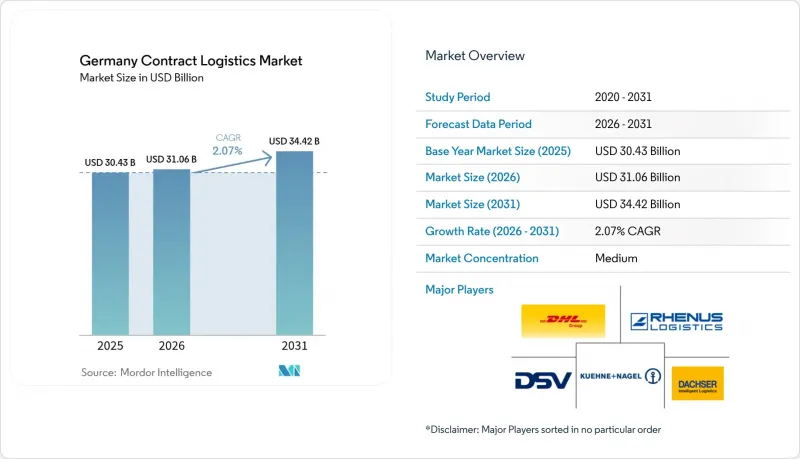
Mordor Intelligence에 의하면, 2026년 독일 계약 물류 시장 규모는 310억 6,000만 달러로 추정되고 있어 2025년 304억 3,000만 달러에서 확대해, 2031년에는 344억 2,000만 달러에 이를 것으로 예측됩니다.
2026년부터 2031년까지의 연평균 성장률(CAGR)은 2.07%를 나타낼 전망입니다.
본 보고서는 서비스별(운송 관리, 창고 및 물류, 기타), 최종 사용자 산업별(소비재 및 소매, 헬스케어, 기타),계약 기간별(단기·장기), 지역별(노르트라인-베스트팔렌주, 함부르크·슐레스비히-홀슈타인주, 기타)로 분류되어 있습니다. 본 보고서에서는 상기 모든 부문에 대해 시장 규모 및 예측치(미 달러)를 제시하고 있습니다.
독일 계약 물류 시장 동향 및 인사이트
전자상거래의 가속화로 소포 처리량이 확대되고 있습니다.
B2C 전자상거래는 현재 독일 소비자의 74%에게 보급되어 있으며, 풀필먼트 및 라스트 마일 운송량을 사상 최고 수준으로 끌어올리고, 자동화 및 옴니채널 기능을 확장할 수 있는 3PL로의 아웃소싱 매력을 높이고 있습니다. 특히 루르 지역과 베를린 대도시권에서 소포 집적도가 높아 노선 최적화가 가능하고 단위당 배송 비용을 절감할 수 있기 때문에 소매업체들은 독일 계약 물류 시장에서 수년에 걸친 풀필먼트 계약을 체결하고 있습니다. 로봇과 ‘상품에서 사람으로(Goods-to-Person)’ 시스템은 주문에서 출하까지의 주기를 단축하여, 패션 및 가전제품 판매업체에게 차별화 요소가 되고 있는 ‘당일 배송’ 약속을 뒷받침하고 있습니다.
전기차로의 전환이 인바운드 흐름을 재편하고 있다.
독일은 여전히 유럽 최대의 자동차 생산국이지만, 플랫폼의 전동화에 따라 고부가가치 배터리 모듈 및 위험물 취급이 인바운드 JIT(Just-in-Time) 및 JIS(Just-in-Sequence) 물류에 추가되고 있습니다. 바이에른주와 바덴뷔르템베르크주의 조립 공장 근처에 위치한 전용 시퀀싱 센터가 확대되고 있으며, ISO 45001 및 ADR 준수를 보장할 수 있는 공급업체들이 여러 공장에 걸친 계약을 수주하고 있습니다. 각 OEM 업체들이 창고 부지 면적보다 배터리 셀 생산 라인에 자본을 집중하는 가운데, 이러한 복잡성으로 인해 독일 계약 물류 시장의 아웃소싱 비중이 높아지고 있습니다.
인력 부족이 운영 비용을 끌어올리고 있다.
2024년에는 운전기사와 창고 작업원의 구인 건수가 약 50만 건에 달했고, 운전기사의 평균 연령이 47.2세로 상승함에 따라 법정 임금이 3.42% 인상되었습니다. 독일 계약 물류 시장의 각 제공업체들은 교육 기관에 대한 투자나 유연한 근무표 도입에 힘쓰고 있지만, 인력 부족은 비용 구조에 변동을 초래하며, 성수기에는 처리 능력을 제한하는 요인이 되고 있습니다.
부문 분석
2025년, 독일 계약 물류 시장 매출의 43.60%는 라인-룰 축을 따라 구축된 대규모 크로스 도킹 시설 및 지역 풀필먼트 센터를 배경으로 창고·유통 부문이 차지했습니다. 이 부문은 서유럽 소비자 시장으로의 리드 타임을 단축하는 도로, 철도, 내륙 수로의 촘촘한 네트워크의 혜택을 받고 있지만, 토지 부족과 인력 부족으로 인한 비용 압박으로 인해 자동화 도입이 급격히 증가하고 있습니다. 자율 주행 로봇이 소량 화물의 피킹과 배치를 수행하는 한편, 자동 창고 시스템(AS/RS)을 통해 팔레트 밀도가 향상되어 처리 능력이 25% 증가함과 동시에, 제한된 바닥 면적의 효율적 활용이 촉진되고 있습니다.
키팅에서 포장, 최종 공정의 간이 조립에 이르는 부가가치 서비스는 연평균 성장률(CAGR) 3.92%로 확대될 것으로 예측되며, 독일 계약 물류 시장 전체를 웃도는 속도로 성장하고 있습니다. 고객들은 특히 가전제품 및 산업기계 분야에서 재고 리스크를 줄이고 제품 출시를 가속화하기 위해 시장과 가까운 곳에서의 조립을 점점 더 요구하고 있습니다. 이러한 전문적인 업무는 기본적인 창고 업무보다 200-300 베이시스 포인트 높은 이익률을 가져오며, 공급업체들은 디지털 트윈을 활용하여 물리적 자산을 투입하기 전에 프로세스 흐름을 모델링하고 있습니다. 그 결과, 소규모 사업자들은 기술 및 역량에 대한 투자나 대형 3PL 업체와의 제휴를 모색해야 하는 압박이 커지고 있습니다.
기타 혜택:
- 엑셀 형식 시장 예측(ME) 시트
- 3개월간의 애널리스트 지원
자주 묻는 질문
목차
제1장 서론
제2장 조사 방법
제3장 주요 요약
제4장 시장 구도
제5장 시장 규모와 성장 예측
제6장 경쟁 구도
제7장 시장 기회와 향후 전망
JHS 26.08.26According to Mordor Intelligence, Germany contract logistics market size in 2026 is estimated at USD 31.06 billion, growing from 2025 value of USD 30.43 billion with 2031 projections showing USD 34.42 billion, growing at 2.07% CAGR over 2026-2031.
This report is Segmented by Service (Transportation Management, Warehouse and Distribution, and More), by End-User Industry (Consumer Goods and Retail, Healthcare and More), by Contract Duration (Short-Term and Long Term), and by Geography (North Rhine-Westphalia, Hamburg and Schleswig-Holstein, and More). The Report Offers Market Size and Forecasts in Value (USD) for all the Above Segments.
Germany Contract Logistics Market Trends and Insights
Accelerating e-commerce amplifies parcel volumes
B2C e-commerce now reaches 74% of German consumers and pushes fulfilment and last-mile traffic to record highs, raising the attractiveness of outsourcing to 3PLs that can scale automation and omnichannel capabilities. Parcel density, especially inside the Ruhr and Berlin metropolitan areas, enables route optimization that lowers per-unit delivery costs, incentivizing retailers to award multi-year fulfilment mandates within the Germany contract logistics market. Robots and goods-to-person systems shorten order-to-ship cycles, supporting same-day delivery commitments that have become a differentiator for fashion and consumer electronics sellers.
Electric-vehicle transition reshapes inbound flows
Germany remains Europe's largest vehicle producer, yet platform electrification adds high-value battery modules and hazardous materials handling to inbound JIT and JIS logistics. Dedicated sequencing centers close to assembly plants in Bavaria and Baden-Wurttemberg are expanding, and providers able to guarantee ISO 45001 and ADR compliance are securing multi-plant contracts. This complexity lifts outsourcing intensity within the Germany contract logistics market as OEMs focus capital on cell production lines rather than warehouse footprints.
Labor scarcity inflates operating costs
Vacancies for drivers and warehouse operatives reached about 500,000 in 2024, with the average driver age climbing to 47.2 years, prompting 3.42% statutory wage hikes. Providers in the Germany contract logistics market are investing in academies and flexible rosters, but labor adds volatility to cost bases and limits capacity during peak seasons.
Other drivers and restraints analyzed in the detailed report include:
- Supply Chain Due Diligence Act stimulates compliance-focused outsourcing
- Domestic pharma expansion escalates cold-chain demand
- Emission standards trigger fleet spending
For complete list of drivers and restraints, kindly check the Table Of Contents.
Segment Analysis
Warehousing and distribution generated 43.60% of Germany contract logistics market revenue in 2025 on the back of extensive cross-docking and regional fulfilment centers aligned along the Rhine-Ruhr axis. The segment benefits from dense road, rail, and inland waterway links that shorten lead times to West European consumer markets, yet cost pressures from land scarcity and labor mean automation adoption is climbing steeply. Autonomous mobile robots pick and place small parcels, while automated storage and retrieval systems enhance pallet density, raising throughput by 25% and supporting higher utilization of scarce floor space.
Value-added services ranging from kitting to packaging and end-of-line light assembly are forecast to expand at 3.92% CAGR, outpacing the overall Germany contract logistics market. Clients increasingly require configuration near market to cut inventory risk and accelerate product launches, particularly for consumer electronics and industrial machinery. These specialized tasks command margins of 200-300 basis points above basic warehousing, and providers leverage digital twins to model process flows before committing physical assets. As a result, pressure mounts on smaller operators to invest in skills and technology or partner with larger 3PLs.
Complete Report Scope:
- By Service
- Transportation Management
- Road
- Rail
- Air
- Sea
- Warehousing and Distribution
- Cold Chain/Temperature-Controlled
- Non-Cold Chain/Non-Temperature-Controlled
- Value-Added Services (Kitting, Packaging, Assembly, etc.)
- Transportation Management
- By End-User Industry
- Manufacturing and Automotive
- Consumer Goods and Retail (incl. E-commerce)
- High-Tech and Electronics
- Healthcare and Pharmaceuticals
- Oil, Gas and Chemicals
- Other End Users
- By Contract Duration
- Short-Term (Less Than 1 Year)
- Long-Term (Greater than or equal to 1 Year)
- By Geography
- North Rhine-Westphalia
- Hamburg and Schleswig-Holstein
- Lower Saxony and Bremen
- Hesse / Rhine-Main
- Bavaria
- Baden-Wurttemberg
- Rhineland-Palatinate and Saarland
- Eastern Germany (Berlin, Brandenburg, Saxony, Saxony-Anhalt, Thuringia)
List of Companies Covered in this Report:
- DHL Supply Chain and Global Forwarding
- Dachser SE
- Kuehne + Nagel
- Rhenus Logistics
- DSV Solutions
- Hellmann Worldwide Logistics
- BLG Logistics Group
- Yusen Logistics
- CEVA Logistics
- APL Logistics
- GXO Logistics
- Fiege Logistik
- GEODIS
- UPS Supply Chain Solutions
- FedEx Supply Chain
- DPD Group (GeoPost)
- Arvato Supply Chain Solutions
- Loxxess AG
- Pfenning Logistics
- Simon Hegele Logistics
- Hermes Fulfilment GmbH
Additional Benefits:
- The market estimate (ME) sheet in Excel format
- 3 months of analyst support
TABLE OF CONTENTS
1 Introduction
- 1.1 Study Assumptions and Market Definition
- 1.2 Scope of the Study
2 Research Methodology
3 Executive Summary
4 Market Landscape
- 4.1 Market Overview
- 4.2 Market Drivers
- 4.2.1 Accelerating B2C e-commerce penetration elevating parcel and fulfilment volumes nationwide
- 4.2.2 OEM pivot to electric-vehicle and battery production intensifying inbound JIT/JIS logistics complexity across Germany
- 4.2.3 Supply-Chain Due-Diligence Act requiring auditable end-to-end visibility, pushing manufacturers to outsource to compliant 3PLs
- 4.2.4 Expanding domestic pharma and biotech manufacturing base demanding GDP-compliant cold-chain logistics solutions
- 4.2.5 Rapid adoption of warehouse robotics/AI boosting productivity and lowering per-unit costs, encouraging long-term 3PL contracts
- 4.2.6 Corporate decarbonisation targets driving demand for 3PL-managed green logistics (battery-electric trucks, multimodal shifts)
- 4.3 Market Restraints
- 4.3.1 Persistent shortage of truck drivers and warehouse labour inflating wages and constraining capacity country-wide
- 4.3.2 Escalating prime logistics real-estate rents and land scarcity raising operating costs for contract-logistics providers
- 4.3.3 Stricter emission regulations (Euro VII, urban low-emission zones) elevating fleet compliance and retrofit expenditure
- 4.3.4 Inflation-linked cost increases amid tepid industrial output and consumer-confidence swings, compressing logistics margins
- 4.4 Value / Supply-Chain Analysis
- 4.5 Key Government Regulations and Initiatives
- 4.6 Technology Snapshot (IoT, AI, etc.)
- 4.7 Porter's Five Forces
- 4.7.1 Threat of New Entrants
- 4.7.2 Bargaining Power of Buyers
- 4.7.3 Bargaining Power of Suppliers
- 4.7.4 Threat of Substitutes
- 4.7.5 Industry Rivalry
- 4.8 Insights on E-commerce Contract Logistics
- 4.9 Reverse Logistics / After-Sales Services
- 4.10 Impact Analysis of Geopolitical Events on the Market
5 Market Size and Growth Forecasts (Value)
- 5.1 By Service
- 5.1.1 Transportation Management
- 5.1.1.1 Road
- 5.1.1.2 Rail
- 5.1.1.3 Air
- 5.1.1.4 Sea
- 5.1.2 Warehousing and Distribution
- 5.1.2.1 Cold Chain/Temperature-Controlled
- 5.1.2.2 Non-Cold Chain/Non-Temperature-Controlled
- 5.1.3 Value-Added Services (Kitting, Packaging, Assembly, etc.)
- 5.1.1 Transportation Management
- 5.2 By End-User Industry
- 5.2.1 Manufacturing and Automotive
- 5.2.2 Consumer Goods and Retail (incl. E-commerce)
- 5.2.3 High-Tech and Electronics
- 5.2.4 Healthcare and Pharmaceuticals
- 5.2.5 Oil, Gas and Chemicals
- 5.2.6 Other End Users
- 5.3 By Contract Duration
- 5.3.1 Short-Term (Less Than 1 Year)
- 5.3.2 Long-Term (Greater than or equal to 1 Year)
- 5.4 By Geography
- 5.4.1 North Rhine-Westphalia
- 5.4.2 Hamburg and Schleswig-Holstein
- 5.4.3 Lower Saxony and Bremen
- 5.4.4 Hesse / Rhine-Main
- 5.4.5 Bavaria
- 5.4.6 Baden-Wurttemberg
- 5.4.7 Rhineland-Palatinate and Saarland
- 5.4.8 Eastern Germany (Berlin, Brandenburg, Saxony, Saxony-Anhalt, Thuringia)
6 Competitive Landscape
- 6.1 Market Concentration
- 6.2 Strategic Moves
- 6.3 Market Share Analysis
- 6.4 Company Profiles {(includes Global level Overview, Market level overview, Core Segments, Financials as available, Strategic Information, Market Rank/Share for key companies, Products and Services, and Recent Developments)}
- 6.4.1 DHL Supply Chain and Global Forwarding
- 6.4.2 Dachser SE
- 6.4.3 Kuehne + Nagel
- 6.4.4 Rhenus Logistics
- 6.4.5 DSV Solutions
- 6.4.6 Hellmann Worldwide Logistics
- 6.4.7 BLG Logistics Group
- 6.4.8 Yusen Logistics
- 6.4.9 CEVA Logistics
- 6.4.10 APL Logistics
- 6.4.11 GXO Logistics
- 6.4.12 Fiege Logistik
- 6.4.13 GEODIS
- 6.4.14 UPS Supply Chain Solutions
- 6.4.15 FedEx Supply Chain
- 6.4.16 DPD Group (GeoPost)
- 6.4.17 Arvato Supply Chain Solutions
- 6.4.18 Loxxess AG
- 6.4.19 Pfenning Logistics
- 6.4.20 Simon Hegele Logistics
- 6.4.21 Hermes Fulfilment GmbH
7 Market Opportunities and Future Outlook
- 7.1 White-Space and Unmet-Need Assessment


