

|
시장보고서
상품코드
2115081
자동차용 리튬 이온 배터리 시장 : 시장 점유율 분석, 업계 동향 및 통계, 성장 예측(2026-2031년)Automotive Lithium Ion Battery - Market Share Analysis, Industry Trends & Statistics, Growth Forecasts (2026 - 2031) |
||||||
 Mordor Intelligence
Mordor Intelligence에 의하면, 2026년 자동차용 리튬 이온 배터리 시장 규모는 750억 5,000만 달러로 추정되고, 2025년 641억 7,000만 달러에서 확대해, 2031년에는 1,642억 1,000만 달러에 이를 것으로 예측됩니다.
2026-2031년 연평균 성장률(CAGR)은 16.95%를 나타낼 전망입니다.
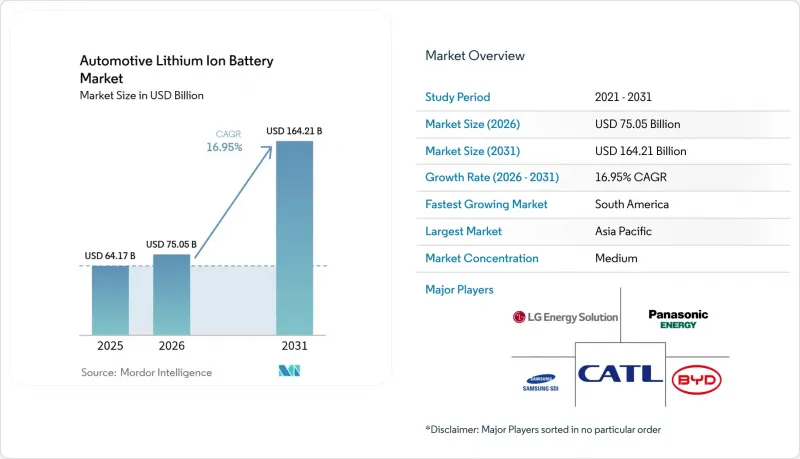
본 보고서는 차량 유형별(배터리식 전기차, 플러그인 하이브리드차, 하이브리드차), 판매 채널별(OEM 및 애프터마켓), 배터리 화학 조성별(NMC 등),셀 형태별(원통형 등), 용량 범위별(30kWh 미만, 30-60kWh, 기타), 지역별로 분류되어 있습니다. 시장 전망은 금액(달러) 단위로 제시되어 있습니다.
세계의 자동차용 리튬 이온 배터리 시장 동향 및 인사이트
2030년까지 전 세계적으로 강화되는 전기차 생산 의무
규제에는 2035년까지 판매 대수의 100%를 제로 에미션 차량으로 만들겠다는 EU의 목표와 2030년까지 신규 판매되는 소형 승용차의 68%를 제로 에미션 차량으로 만들겠다는 캘리포니아주의 요건 등이 포함되어 있어, 경기 순환과 관계없이 배터리 수요가 확고해지고 있습니다. 2024년에는 전 세계적으로 약 1,700만 대의 전기차가 판매될 것으로 예상되며, 이 중 중국이 1,100만 대를 차지할 전망입니다. 각 자동차 제조업체들은 2030년까지 1조 2,000억 달러 규모의 전동화 투자를 단행하겠다고 발표했으며, 이로 인해 장기적인 수요 전망이 확고해졌습니다. 그 결과 발생하는 판매 대수는 규모의 경제를 가져와 자동차용 리튬 이온 배터리 시장 전체의 추가적인 비용 절감을 가속화할 것입니다.
고니켈계 및 LMFP계 화학 조성에 따른 배터리 셀 비용의 급격한 하락
2024년 배터리 팩의 평균 가격은 전년 대비 14% 하락하여 1kWh당 약 152달러를 기록했습니다. 중국 제조업체들은 최적화된 LFP(인산철리튬) 생산 라인에서 이미 1kWh당 100달러 미만의 가격을 제시하고 있으며, 이를 통해 자동차 제조업체들은 중형 모델의 차량 정가를 최대 6,000달러까지 낮출 수 있게 되었습니다. 고니켈 양극재는 에너지 밀도를 10% 향상시키는 반면, LMFP 블렌드는 기존 NMC에 비해 재료비를 20-30% 절감합니다. 비용의 양극화로 인해 현재는 2단계 구조의 제품 라인업이 형성되어 있습니다. 고급 차량에서는 주행 거리를 극대화하기 위해 고니켈 양극재가 채택되는 반면, 대중형 모델에서는 합리적인 가격을 실현하기 위해 LFP나 LMFP가 선택되고 있습니다. 500 Wh/kg의 고체 배터리 프로토타입 발표는 에너지 밀도 주도형 가격 전환을 예고하고 있으며, 2027년까지 배터리 화학 조성에 대한 선호도에 변화를 가져올 가능성이 있습니다.
리튬 탄산염 현물 가격의 변동
호주와 칠레의 신규 광산에서 발생한 공급 과잉을 배경으로, 2024년에는 가격이 최고치인 톤당 8만 달러에서 약 1만 3,000달러로 90% 급락했습니다. 이러한 가격 변동은 수직 통합형이 아닌 배터리 제조업체의 예산 계획을 어렵게 만들고, 확장 결정을 미루게 할 가능성이 있습니다. 공급 과잉은 지속되고 있지만, 인허가 지연이나 지정학적 리스크로 인해 2025년 시장이 다시 타이트해졌습니다. 업스트림 자산을 보유한 BYD와 같은 수직 통합형 기업은 이러한 가격 변동의 영향을 덜 받는 상황입니다. 반면, 헤지 능력이 없는 중소규모 생산자들은 이익률 위험과 업계 재편 압력에 직면할 가능성이 있습니다.
부문 분석
2025년 매출에서 BEV가 63.12%를 차지했으며, 자동차용 리튬 이온 배터리 시장의 핵심 부문으로서의 입지를 공고히 하고 있습니다. BEV 경상용차(LCV)의 상용 차량 함대 도입은 주행 거리가 많은 노선에서 일반 소비자 대상 부문보다 빠르게 연료비 절감을 통한 투자 회수가 가능하기 때문에 연평균 성장률(CAGR) 34.20%로 확대되고 있습니다. 플러그인 하이브리드 차량은 충전 인프라 구축이 뒤처진 지방이나 개발도상 지역에서 점유율을 유지하고 있는 반면, 기존 하이브리드 차량은 과도기적인 기술로 자리 잡고 있습니다. 아마존의 리비안사에 대한 10만 대 발주와 페덱스의 차량 교체 사례는 기업의 지속가능성 목표가 대량 조달을 어떻게 촉진하는지를 보여줍니다. 테슬라 세미(Tesla Semi)의 대형 트럭 분야 진출과 파나소닉 에너지(Panasonic Energy)와 하빈저 모터스(Harbinger Motors)의 제휴는 대용량 배터리 팩과 견고한 열 관리 시스템에 대한 수요가 증가하고 있음을 시사합니다. 차량의 전동화로 인해 교체 주기가 단축되고, 향후 애프터마켓 수요가 증가함에 따라 자동차용 리튬 이온 배터리 시장 점유율이 더욱 확대될 전망입니다.
장거리 상용차의 보급으로 인해 메가와트급 충전 및 내구성이 뛰어난 배터리 화학 계열에 대한 관심이 더욱 높아지고 있습니다. 급속 충전 시 내구성을 고려하여 각형 셀이나 대형 원통형 셀을 맞춤 제작하는 공급업체는 이러한 요구 사항에 대해 가장 유리한 입장에 있습니다. 정부는 디젤 밴과 트럭을 배제하는 도시 배출 규제 구역 도입을 통해 추진력을 얻고 있으며, 전기차로의 전환은 경제적으로 불가피한 상황이 되었습니다. 이러한 규제의 추진으로 잔존 가치에 대한 불확실성이 완화되어, 금융 기관은 차량 함대의 전환에 대한 자금 조달을 자신 있게 지원할 수 있게 될 것입니다. 고속 물류 분야는 배터리 팩의 상태를 모니터링하고 예방적 교체를 계획하는 예측 유지보수 플랫폼을 더욱 촉진하여, 자동차용 리튬 이온 배터리 시장의 서비스 기반 수익원을 확대할 것입니다.
신차 출시가 수요를 견인함에 따라, 2025년 배터리 매출의 80.94%는 OEM이 차지했습니다. 그러나 1세대 배터리 팩의 수명이 다함에 따라, 기존 전기차 차량군이 현저한 변화를 일으키게 될 것입니다. 초기 차량 운영 사업자들이 용량 감소를 겪게 됨에 따라 애프터마켓 매출은 연평균 31.75%의 성장률을 보이고 있습니다. 독립 서비스 네트워크 및 재활용 업체들은 추진용으로는 부적합하지만 고정형 에너지 저장용으로는 여전히 사용 가능한 모듈에서 가치를 창출하기 위해 진단 및 재생 라인 구축을 추진하고 있습니다. EU와 캘리포니아주의 ‘수리권’에 관한 법규에 따라 자동차 제조업체는 진단 데이터 공유를 강요받고 있으며, 이로 인해 교체 및 재이용 분야에서의 경쟁이 활성화되고 있습니다. NIO와 CATL이 제공하는 ‘Battery-as-a-Service(BaaS)’ 플랫폼은 배터리 팩의 소유권과 차량의 소유권을 분리함으로써 경계를 모호하게 만들고, 구독형 수익원을 개척하고 있습니다.
독자적인 사양의 배터리 관리 소프트웨어는 여전히 제3자 수리 업체에게 가장 큰 장벽으로 남아 있습니다. 보안이 강화된 데이터 게이트웨이 및 텔레매틱스와의 통합은 경쟁상의 차별화 요소로 부상하고 있습니다. 순환 경제의 이점을 검토하고 있는 정책 입안자들은 특히 배터리 수입량이나 국내 재활용 능력이 여전히 낮은 지역에서 접근성을 더욱 확대할 가능성이 있습니다. 모듈 치수 및 통신 프로토콜을 다루는 표준화 컨소시엄은 애프터마켓으로의 전환을 가속화할 가능성이 있습니다. 이러한 동향이 결합되어, 교체 및 세컨드 라이프 이용 사례와 관련된 자동차용 리튬 이온 배터리 시장 규모는 향후 10년 동안 급속히 확대될 전망입니다.
지역별 분석
아시아태평양은 2025년에도 48.10%의 점유율을 유지한 것으로 평가되었으며, 그 배경에는 셀 생산, 전구체 처리 및 음극 활물질 공급 분야에서 중국이 압도적인 우위를 점하고 있다는 점이 있습니다. 정책 주도형 내수 수요와 수출 지향적인 기가팩토리 전략이 맞물리면서, CATL이나 BYD와 같은 지역 제조업체들은 무역 리스크를 헤지하면서도 적극적으로 사업 규모를 확대할 수 있게 되었습니다. 일본은 파나소닉 에너지가 스바루 및 마쓰다와 설립한 합작 사업을 통해 사업 재편을 추진하고 있으며, 기술적 리더십을 유지하면서 중국 수입에 대한 의존도를 낮추는 것을 목표로 하고 있습니다. 한국의 LG 에너지솔루션, 삼성SDI, SK온 등 3개사는 중국의 비용 경쟁력과 유럽 및 미국 국가들의 현지 생산 수요를 연결하는 가교 역할을 하며, 세계 시장 점유율의 18.4%를 차지했습니다.
남미는 연평균 성장률(CAGR) 28.75%를 기록하며 가장 빠른 성장세를 보였습니다. 브라질에서는 2024년 전기차 판매량이 17만 7,358대를 기록했으며, BYD가 인도 대수 부문에서 1위를 차지했습니다. 이는 비용 경쟁력이 뛰어난 중국 기업들이 가격을 중시하는 시장에 얼마나 깊이 침투하고 있는지를 여실히 보여줍니다. 칠레는 세계 2위의 리튬 생산국일 뿐만 아니라, 유리한 로열티 제도까지 더해져 현지 양극재 및 배터리 프로젝트에 대한 투자를 유치하고 있습니다. 이 지역의 전기 버스(BYD가 시장 점유율의 대부분을 차지하고 있음)는 충전 인프라 기반을 구축하고 소비자들이 배터리 구동에 익숙해지도록 함으로써 승용차로의 도입을 촉진하고 있습니다. 브라질의 ‘Mover’ 이니셔티브와 같은 정부 프로그램은 더욱 엄격한 배기가스 규제를 시행하며, 2030년까지 안정적인 정책 환경을 제공합니다.
북미와 유럽은 중국에 대한 의존도를 낮추면서 자국 내 공장 확장에 주력하고 있습니다. 미국의 ‘인플레이션 억제법(Inflation Reduction Act)’은 2030년까지 자동차용 리튬 이온 배터리 시장 규모를 확대하여, 해당 지역을 잠재적인 수출국으로 자리매김하고 있습니다. 유럽에서는 총액 1,800억 유로 규모의 기가팩토리 계획이 2026년까지 자급자족을 목표로 하고 있지만, 높은 에너지 관세와 복잡한 인허가 절차가 생산 확대 속도를 늦추고 있습니다. 모로코나 아랍에미리트(UAE)와 같은 신흥 거점들은 재생에너지의 우위를 내세워 양극재 및 배터리 팩 투자를 유치하고 있으며, 이는 자동차용 리튬 이온 배터리 시장이 점점 더 다극화될 것임을 시사합니다.
기타 혜택 :
- 엑셀 형식 시장 예측(ME) 시트
- 3개월간의 애널리스트 지원
자주 묻는 질문
목차
제1장 서론
제2장 조사 방법
제3장 주요 요약
제4장 시장 구도
제5장 시장 규모 및 성장 예측
제6장 경쟁 구도
제7장 시장 기회 및 향후 전망
AJY 26.08.28According to Mordor Intelligence, the automotive lithium-Ion battery market size in 2026 is estimated at USD 75.05 billion, growing from 2025 value of USD 64.17 billion with 2031 projections showing USD 164.21 billion, growing at 16.95% CAGR over 2026-2031.
This report is Segmented by Vehicle Type (Battery Electric Vehicle, Plug-In Hybrid Electric Vehicle and Hybrid Electric Vehicle), Channel Sales Type (OEMs and Aftermarket), Battery Chemistry (NMC, and More), Cell Format (Cylindrical, and More), Capacity Range (Less Than 30 KWh, 30-60 KWh, and More) and Geography. The Market Forecasts are Provided in Terms of Value (USD).
Global Automotive Lithium Ion Battery Market Trends and Insights
Soaring Global EV Production Mandates by 2030
Regulations include the EU target of 100% zero-emission sales by 2035 and California's requirement that 68% of new light-duty sales be zero-emission by 2030, locking in battery demand irrespective of economic cycles. Nearly 17 million EVs are expected to be sold worldwide in 2024, with China contributing 11 million units. Automakers have announced USD 1.2 trillion in electrification spending through 2030, anchoring long-term demand visibility. The resulting volume unlocks scale economies that accelerate further cost declines across the automotive lithium-ion battery market.
Sharp Cell-Cost Decline from High-Nickel & LMFP Chemistries
Average pack prices fell 14% year-on-year to about USD 152 per kWh in 2024. Chinese producers already quote sub-USD 100 per kWh for optimised LFP lines, enabling automakers to trim vehicle list prices by up to USD 6,000 on mid-range models. High-nickel cathodes deliver 10% higher energy density, while LMFP blends cut material expense 20-30% against legacy NMC. Cost segmentation now creates a two-tier product stack: premium vehicles chase range with nickel-rich cathodes, whereas mass models choose LFP or LMFP for affordability. Announcements of 500 Wh/kg solid-state prototypes foreshadow a density-led pricing pivot that could reshape chemistry preferences by 2027.
Lithium Carbonate Spot-Price Volatility
Prices collapsed 90% from highs of USD 80,000 per tonne to around USD 13,000 in 2024 amid oversupply from new Australian and Chilean mines. Volatility complicates budget planning for non-integrated cell makers and may defer expansion decisions. While oversupply persists, permitting delays and geopolitical risks could tighten the market again by 2025. Vertically integrated firms like BYD, which hold upstream assets, remain insulated from these swings. Smaller producers without hedging capacity face margin risk and potential consolidation pressures.
Other drivers and restraints analyzed in the detailed report include:
- Gigafactory Over-Supply Securing Pack Availability
- IRA & EU Battery Regulation Localisation Incentives
- Fire-Safety Recall Costs Hitting Residual Values
For complete list of drivers and restraints, kindly check the Table Of Contents.
Segment Analysis
BEVs contributed 63.12% of 2025 revenue, confirming their status as the anchor segment of the automotive lithium-ion battery market. Commercial fleet adoption of BEV LCVs grows at 34.20% CAGR because mileage-intensive routes unlock fuel-savings payback sooner than consumer segments. Plug-in hybrids maintain a share in rural and developing regions where charging access lags, while conventional hybrids are a bridging technology. Amazon's 100,000-unit Rivian order and FedEx fleet upgrades illustrate how corporate sustainability targets catalyse bulk procurement. Heavy-duty cycles from Tesla Semi and partnerships between Panasonic Energy and Harbinger Motors point to escalating demand for higher-capacity packs and robust thermal systems. Fleet electrification shortens replacement cycles, increasing future aftermarket volumes and deepening the automotive lithium-ion battery market footprint.
The long-haul commercial wave intensifies interest in megawatt-class charging and rugged cell chemistries. Suppliers that tailor prismatic or large-format cylindrical cells for rapid-charge durability position best for these requirements. Governments add momentum through urban emission zones that exclude diesel vans and trucks, making electric alternatives economically inevitable. This regulatory push reduces residual-value uncertainty, giving financiers confidence to underwrite fleet conversions. High-throughput logistics further drive predictive maintenance platforms that monitor pack health and schedule pre-emptive replacements, expanding service-based revenue pools within the automotive lithium-ion battery market.
OEMs generated 80.94% of 2025 battery revenue as new vehicle roll-outs dominated demand. The installed EV park, however, will trigger a pronounced shift once first-generation packs reach end-of-life. Aftermarket sales are growing 31.75% annually as early fleet operators face capacity fade. Independent service networks and recyclers are preparing diagnostic and refurbishment lines to capture value from modules deemed unfit for propulsion but still viable for stationary storage. Right-to-repair statutes in the EU and California force automakers to share diagnostic data, boosting competition in replacement and repurposing. Battery-as-a-Service platforms from NIO and CATL blur boundaries by decoupling pack ownership from vehicle ownership, opening subscription-based revenue streams.
Proprietary battery management software remains the largest barrier for third-party repairers. Secure data gateways and telematics integration are becoming competitive differentiators. Policy makers weighing circular-economy benefits may further open access, especially where battery imports and domestic recycling capacity remain low. Standardisation consortia working on module dimensions and communication protocols could accelerate the aftermarket shift. As these developments converge, the automotive lithium-ion battery market size linked to replacement and second-life use cases is set to expand rapidly through the next decade.
Complete Report Scope:
- By Vehicle Type
- Battery Electric Vehicle (BEV)
- Plug-in Hybrid Electric Vehicle (PHEV)
- Hybrid Electric Vehicle (HEV)
- Fuel-Cell Electric Vehicle (FCEV)
- By Channel Sales Type
- OEMs
- Aftermarket
- By Battery Chemistry
- NMC
- LFP
- NCA
- LMFP / LFMP
- LTO
- By Cell Format
- Cylindrical
- Prismatic
- Pouch
- By Capacity Range
- Less than 30 kWh
- 30-60 kWh
- 60-90 kWh
- More than 90 kWh
- By Geography
- North America
- United States
- Canada
- Rest of North America
- South America
- Brazil
- Chile
- Rest of South America
- Europe
- Germany
- France
- United Kingdom
- Norway
- Netherlands
- Rest of Europe
- Asia-Pacific
- China
- Japan
- South Korea
- India
- Rest of Asia-Pacific
- Middle East & Africa
- UAE
- Saudi Arabia
- South Africa
- Rest of Middle East & Africa
- North America
Geography Analysis
Asia-Pacific retained a 48.10% share in 2025, anchored by China's dominance across cell production, precursor processing, and anode active material supply. Policy-driven domestic demand combines export-oriented gigafactory strategies, allowing regional producers like CATL and BYD to scale aggressively while hedging trade risks. Japan is repositioning through Panasonic Energy joint ventures with Subaru and Mazda, aiming to cut reliance on Chinese imports while preserving technology leadership. South Korea's trio of LG Energy Solution, Samsung SDI, and SK On held 18.4% global share, bridging Chinese cost leadership and Western localisation needs.
South America registers the fastest expansion at 28.75% CAGR. Brazil recorded 177,358 electrified sales in 2024, with BYD leading deliveries, highlighting how cost-competitive Chinese players penetrate value-conscious markets. Chile's status as the second-largest lithium producer, coupled with favourable royalty frameworks, draws investment in local cathode and cell projects. The region's electric bus fleets-BYD holds majority of the share-seed charging infrastructure and familiarise consumers with battery propulsion, reinforcing passenger-car adoption. Government programs like Brazil's Mover initiative enforce stricter emission norms, providing a stable policy backdrop through 2030.
North America and Europe focus on cutting Chinese exposure while scaling home-grown factories. The United States' Inflation Reduction Act fosters an automotive lithium-ion battery market size surplus by 2030, positioning the region as a potential exporter. Europe's EUR 180 billion gigafactory roster targets self-sufficiency by 2026, though high energy tariffs and complex permitting slow ramp-ups. Emerging hubs in Morocco and the United Arab Emirates market renewable power advantages to attract cathode and pack investment, signalling that the automotive lithium-ion battery market will become increasingly multipolar.
- Contemporary Amperex Technology (CATL)
- LG Energy Solution
- Panasonic Energy
- BYD Co. Ltd.
- Samsung SDI
- SK On
- CALB Group
- EVE Energy
- Farasis Energy
- Gotion High-Tech
- Envision AESC
- SVOLT Energy
- Tianjin Lishen
- GS Yuasa
- Toshiba Corp.
- Hitachi Astemo
- Optimum Nano
- Microvast
- StoreDot
- QuantumScape
Additional Benefits:
- The market estimate (ME) sheet in Excel format
- 3 months of analyst support
TABLE OF CONTENTS
1 Introduction
- 1.1 Study Assumptions & Market Definition
- 1.2 Scope of the Study
2 Research Methodology
3 Executive Summary
4 Market Landscape
- 4.1 Market Overview
- 4.2 Market Drivers
- 4.2.1 Soaring global EV production mandates by 2030
- 4.2.2 Sharp cell-cost decline from high-nickel & LMFP chemistries
- 4.2.3 Gigafactory over-supply securing pack availability
- 4.2.4 IRA & EU Battery Regulation localisation incentives
- 4.2.5 OEM-led closed-loop recycling partnerships
- 4.2.6 Vehicle-to-grid monetisation models for fleets
- 4.3 Market Restraints
- 4.3.1 Lithium carbonate spot-price volatility
- 4.3.2 Fire-safety recall costs hitting residual values
- 4.3.3 Slow-moving permitting for new raw-material mines
- 4.3.4 Consumer concern over ethical cobalt sourcing
- 4.4 Value / Supply-Chain Analysis
- 4.5 Regulatory Landscape
- 4.6 Technological Outlook
- 4.7 Porter's Five Forces
- 4.7.1 Threat of New Entrants
- 4.7.2 Bargaining Power of Buyers
- 4.7.3 Bargaining Power of Suppliers
- 4.7.4 Threat of Substitutes
- 4.7.5 Competitive Rivalry
5 Market Size & Growth Forecasts (Value (USD))
- 5.1 By Vehicle Type
- 5.1.1 Battery Electric Vehicle (BEV)
- 5.1.2 Plug-in Hybrid Electric Vehicle (PHEV)
- 5.1.3 Hybrid Electric Vehicle (HEV)
- 5.1.4 Fuel-Cell Electric Vehicle (FCEV)
- 5.2 By Channel Sales Type
- 5.2.1 OEMs
- 5.2.2 Aftermarket
- 5.3 By Battery Chemistry
- 5.3.1 NMC
- 5.3.2 LFP
- 5.3.3 NCA
- 5.3.4 LMFP / LFMP
- 5.3.5 LTO
- 5.4 By Cell Format
- 5.4.1 Cylindrical
- 5.4.2 Prismatic
- 5.4.3 Pouch
- 5.5 By Capacity Range
- 5.5.1 Less than 30 kWh
- 5.5.2 30-60 kWh
- 5.5.3 60-90 kWh
- 5.5.4 More than 90 kWh
- 5.6 By Geography
- 5.6.1 North America
- 5.6.1.1 United States
- 5.6.1.2 Canada
- 5.6.1.3 Rest of North America
- 5.6.2 South America
- 5.6.2.1 Brazil
- 5.6.2.2 Chile
- 5.6.2.3 Rest of South America
- 5.6.3 Europe
- 5.6.3.1 Germany
- 5.6.3.2 France
- 5.6.3.3 United Kingdom
- 5.6.3.4 Norway
- 5.6.3.5 Netherlands
- 5.6.3.6 Rest of Europe
- 5.6.4 Asia-Pacific
- 5.6.4.1 China
- 5.6.4.2 Japan
- 5.6.4.3 South Korea
- 5.6.4.4 India
- 5.6.4.5 Rest of Asia-Pacific
- 5.6.5 Middle East & Africa
- 5.6.5.1 UAE
- 5.6.5.2 Saudi Arabia
- 5.6.5.3 South Africa
- 5.6.5.4 Rest of Middle East & Africa
- 5.6.1 North America
6 Competitive Landscape
- 6.1 Market Concentration
- 6.2 Strategic Moves
- 6.3 Market Share Analysis
- 6.4 Company Profiles (includes Global Overview, Market Overview, Core Segments, Financials, Strategic Information, Market Rank/Share, Products & Services, Recent Developments)
- 6.4.1 Contemporary Amperex Technology (CATL)
- 6.4.2 LG Energy Solution
- 6.4.3 Panasonic Energy
- 6.4.4 BYD Co. Ltd.
- 6.4.5 Samsung SDI
- 6.4.6 SK On
- 6.4.7 CALB Group
- 6.4.8 EVE Energy
- 6.4.9 Farasis Energy
- 6.4.10 Gotion High-Tech
- 6.4.11 Envision AESC
- 6.4.12 SVOLT Energy
- 6.4.13 Tianjin Lishen
- 6.4.14 GS Yuasa
- 6.4.15 Toshiba Corp.
- 6.4.16 Hitachi Astemo
- 6.4.17 Optimum Nano
- 6.4.18 Microvast
- 6.4.19 StoreDot
- 6.4.20 QuantumScape
7 Market Opportunities & Future Outlook
- 7.1 White-space & Unmet-Need Assessment


