

|
시장보고서
상품코드
2116294
유럽의 핀테크 시장 : 점유율 분석, 업계 동향과 통계, 성장 예측(2026-2031년)Europe Fintech - Market Share Analysis, Industry Trends & Statistics, Growth Forecasts (2026 - 2031) |
||||||
 Mordor Intelligence
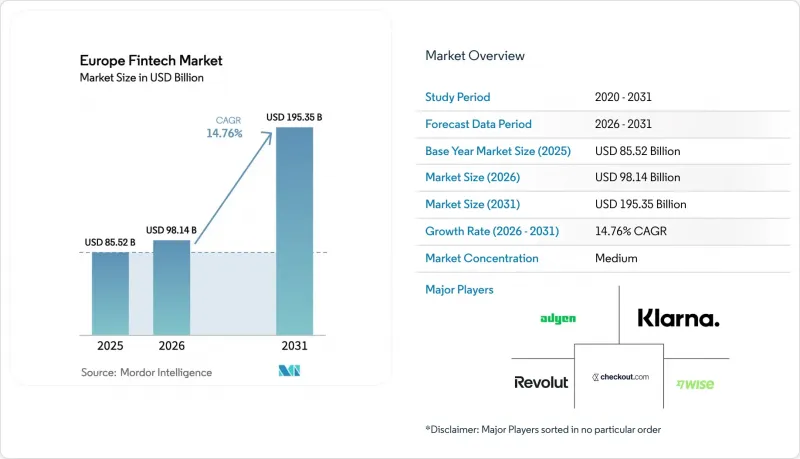
Mordor Intelligence에 의하면, 유럽 핀테크 시장 규모는 2025년 855억 2,000만 달러, 2026년 981억 4,000만 달러에서 2031년까지 1,953억 5,000만 달러로 확대한다고 예측되고 있어 2026년부터 2031년까지 연평균 복합 성장률(CAGR)은 14.76%를 나타낼 전망입니다.
본 보고서는 서비스 분야(디지털 결제, 디지털 대출·자금 조달, 디지털 투자, 인슈어테크, 네오뱅킹), 최종 사용자(개인, 기업), 사용자 인터페이스(모바일 앱, 웹/브라우저, POS/IoT 기기), 지역(영국, 독일, 프랑스,스페인, 이탈리아, 베네룩스, 북유럽 국가, 기타 유럽)별로 분류되어 있습니다. 시장 전망은 금액(달러) 기준으로 제시되어 있습니다.
유럽 핀테크 시장 동향 및 인사이트
PSD2 및 SEPA 인프라를 통해 가능해진 계좌 간 즉시 결제의 확대
2024년 EU가 채택한 즉시 결제 규정(IPR)은 기존 유로화 송금 서비스 제공업체에 해당 서비스의 즉시 버전도 제공하도록 의무화함으로써, 유럽 전역에서 유로화 계좌 간 즉시 송금의 도입과 보급을 급속히 가속화하고 있습니다. 이 규정에 따라 즉시 결제는 연중무휴 24시간 이용 가능하며, 몇 초 이내에 결제가 완료되어야 합니다. 이를 통해 지불 지시부터 자금이 최종적으로 이용 가능해질 때까지의 시간이 단축되어, 은행과 핀테크 기업 간의 실시간 거래 기능이 촉진됩니다. PSP(결제 서비스 제공업체)는 즉시 결제가 일반 송금과 동등하거나 그 이하의 비용으로 제공되도록 보장해야 하며, 이는 지금까지 도입을 가로막았던 가격 측면의 장벽을 제거하는 데 기여하고 있습니다. 또한, 본 규정에서는 ‘수취인 확인(VoP)’ 요건도 도입되어, 실행 전에 계좌 식별자와 수취인 명의가 일치하지 않을 경우 지급인에게 경고함으로써 부정 위험을 줄이고, 실시간 계좌 간 송금에 대한 신뢰를 강화합니다. 더 나아가, 이 규정은 비은행 결제 기관 및 전자화폐 기관에 핵심 결제 시스템에 대한 접근을 허용함으로써, 더 폭넓은 시장 진출기업을 지원하고, 즉시 결제 서비스를 제공할 수 있는 공급자 생태계를 확대합니다. 단일 유로 결제권(SEPA) 전체에서 접근, 가격 책정, 보안 기준을 통일함으로써, IPR은 계좌 간 즉시 결제의 신뢰성, 보급 범위, 매력을 대폭 향상시켜, 진화를 거듭하는 유럽 핀테크 산업에 있어 실시간 거래를 필수적이고 확장 가능한 기반으로 자리매김하고 있습니다.
유럽 중소기업 및 중견 기업의 임베디드 결제 도입 가속화
유럽 중소기업 및 중견 기업에서의 내장형 결제 도입 가속화는 유럽 핀테크 시장의 성장을 견인하는 주요 요인이며, 이는 Adyen의 2025년 상반기 실적에도 반영되어 있습니다. 이 회사는 결제 기능을 자사의 소프트웨어 및 상거래 생태계에 직접 통합하는 플랫폼 사업과 중규모 가맹점의 거래량 증가에 힘입어 두 자릿수의 견실한 매출 성장을 기록했습니다. Adyen의 플랫폼 및 카드 발급 부문의 성장은 단일 확장 가능한 인프라를 통해 제공되는 통합 결제 수락, 결제 처리 및 카드 발급 기능에 대한 수요가 증가하고 있음을 보여줍니다. 유럽의 중소기업 및 중견 기업들은 업무의 복잡성을 줄이고, 여러 공급업체와의 관계를 해소하며, 시장 출시 속도를 높이기 위해 임베디드 결제 방식을 점점 더 우선시하고 있습니다. 결제 기능을 ERP(전사적 자원 관리) 시스템, 마켓플레이스, SaaS 플랫폼에 기본적으로 통합함으로써, 이러한 기업들은 채널 전반에 걸친 원활한 결제 절차, 신속한 결제 처리 및 통합된 보고 기능을 제공할 수 있게 됩니다. 또한, 임베디드 결제 모델은 옴니채널 전략을 지원하여 가맹점이 단일 백엔드를 통해 오프라인 매장, 온라인, 모바일 거래를 관리할 수 있게 해줍니다. 거래량이 확대됨에 따라 결제 인프라 제공업체는 운영 레버리지의 혜택을 누리며, 첨단 핀테크 기능에 대한 투자를 강화할 수 있습니다. 이러한 변화는 시장의 세분화와 국경을 초월한 거래가 통합된 결제 오케스트레이션에 대한 수요를 창출하고 있는 유럽에서 특히 중요한 의미를 지닙니다.
벤처 캐피털의 침체가 장기화되면서 스케일업 기업에 자금 조달 격차가 발생하고 있다.
벤처 캐피털을 통한 자금 조달 부진이 장기화되고 있는 것은 유럽 핀테크 시장, 특히 스케일업 기업과 초기 단계 기업에게 여전히 주요 제약 요인으로 작용하고 있습니다. 2025년에는 투자자들의 안목이 더욱 까다로워지면서, 실적이 입증된 후기 단계의 비즈니스 모델이나 수익 전망이 더 명확한 프로젝트에 자본이 집중되었습니다. 이러한 변화로 인해 자금 조달 기간이 장기화되었으며, 수익성, 단위 경제성 및 경영 규율에 대한 기대가 높아지고 있습니다. 핀테크 투자의 회복세는 유럽 전역에서 고르지 않게 나타나고 있으며, 주요 허브 지역은 계속해서 자금을 유치하는 반면, 소규모 시장이나 신흥 시장에서는 거래 건수가 감소하는 추세를 보이고 있습니다. 금리 상승과 세계 정책의 불확실성으로 인해 투자자들은 낮은 번레이트와 지속 가능한 성장 전략을 더욱 중시하게 되었습니다. 그 결과, 수익원이 다각화되지 않았거나 명확한 현금 창출 경로가 없는 핀테크 기업들은 사업 확장을 위한 자금 조달에 제약을 받고 있습니다.
부문별 분석
2025년, 유럽 핀테크 시장에서 디지털 결제가 52.67%를 차지했습니다. 이러한 성장은 즉시 결제 의무화, 수취인 확인 요건, 그리고 가맹점의 계좌 간 결제 및 카드 결제 채택 확대에 의해 주도되고 있습니다. Adyen과 같은 인프라 제공업체들은 옴니채널 및 실시간 결제로의 전환을 반영하여 견실한 수익과 거래량을 보고하고 있습니다. 수취인 확인 의무화와 같은 규제 조치는 거래 보안을 강화하고 신뢰를 구축함으로써, 전자상거래 및 POS 환경 모두에서 더 광범위한 도입을 촉진하고 있습니다. 실시간 결제 인프라, 오프라인 결제 보안 조치, 통합된 리스크 관리가 결합되어 유럽 전역의 소비자와 가맹점에게 결제는 더욱 신속하고, 안전하며, 신뢰할 수 있는 서비스가 되고 있습니다.
인슈어테크는 유럽에서 가장 빠르게 성장하는 분야로, 데이터 기반의 인수 심사, 임베디드 판매, 규정 준수 상품 설계에 힘입어 2031년까지 연평균 성장률(CAGR) 16.58%로 확대될 것으로 전망됩니다. 네오뱅킹은 계속 진화하고 있으며, 수익성이 높은 대기업들은 상품 라인 확충, 영업 레버리지 향상, AI를 활용한 서비스 흐름 활용에 주력하는 반면, 중소규모의 제공업체들은 비용 효율성 향상에 중점을 두고 있습니다. 실시간 결제 인프라와 오픈 API의 성장은 데이터, 유통, 개인화를 위한 새로운 채널을 제공하며, 보험사와 은행이 보험 보상 및 금융 서비스를 디지털 경험에 원활하게 통합할 수 있게 해줍니다. 유럽의 규제 수립 및 스킴 거버넌스에 대한 참여를 통해 핀테크 기업들은 업계에 보다 직접적으로 통합되고 있으며, 결제 및 표준화가 강화되고 있습니다. 전반적으로 이러한 혁신을 통해 여러 핀테크 분야가 동시에 확장되고 있으며, 디지털 결제는 실시간 인프라를 기반으로 발전하고 있고, 인슈어테크는 AI 및 파트너 주도형 유통을 통해 성장하고 있습니다.
기타 혜택:
- 엑셀 형식 시장 예측(ME) 시트
- 3개월간의 애널리스트 지원
자주 묻는 질문
목차
제1장 서론
제2장 조사 방법
제3장 주요 요약
제4장 시장 구도
제5장 시장 규모와 성장 예측
제6장 경쟁 구도
제7장 시장 기회와 향후 전망
JHS 26.08.28According to Mordor Intelligence, the Europe fintech market size is projected to expand from USD 85.52 billion in 2025 and USD 98.14 billion in 2026 to USD 195.35 billion by 2031, registering a CAGR of 14.76% between 2026 to 2031.
This report is Segmented by Service Proposition (Digital Payments, Digital Lending and Financing, Digital Investments, Insurtech, Neobanking), End-User (Retail, Businesses), User Interface (Mobile Applications, Web/Browser, POS/IoT Devices), and Geography (United Kingdom, Germany, France, Spain, Italy, Benelux, Nordics, Rest of Europe). The Market Forecasts are Provided in Terms of Value (USD).
Europe Fintech Market Trends and Insights
Expansion of Account-to-Account Instant Payments Enabled by PSD2 and SEPA Infrastructure
The Instant Payments Regulation (IPR) adopted by the EU in 2024 is rapidly accelerating the deployment and uptake of instant account-to-account credit transfers in euros across Europe by mandating that providers of traditional euro credit transfers must also offer instant versions of those services. Under the regulation, instant payments must be available 24/7/365 and settled within seconds, narrowing the gap between payment initiation and final funds availability and fostering real-time transaction capabilities across banks and fintechs. PSPs (payment service providers) are required to ensure that instant payments are offered at no greater cost than standard credit transfers, helping to remove pricing barriers that previously discouraged adoption. The regulation also introduces a verification-of-payee (VoP) requirement, which alerts payers to mismatches between account identifiers and beneficiary names before execution, reducing fraud risk and strengthening trust in real-time account-to-account transfers. In addition, the regulation supports broader market participation by granting non-bank payment and e-money institutions access to core payment systems, widening the ecosystem of providers that can deliver instant payment services. By harmonizing access, pricing, and security standards across the Single Euro Payments Area (SEPA), the IPR significantly enhances the reliability, reach, and appeal of instant account-to-account payments, making real-time transactions an essential, scalable foundation for Europe's evolving fintech landscape.
Acceleration of Embedded Payments Adoption Among European SMEs and Mid-Market Enterprises
The acceleration of embedded payments adoption among European SMEs and mid-market enterprises is a major driver of growth in the European fintech market, as reflected in Adyen's H1 2025 performance. The company reported strong double-digit revenue growth, supported by increasing transaction volumes from platform businesses and mid-sized merchants that are embedding payments directly into their software and commerce ecosystems. Growth in Adyen's platforms and issuing segments indicates rising demand for integrated payment acceptance, payouts, and card issuing capabilities that are delivered through a single, scalable infrastructure. European SMEs and mid-market enterprises are increasingly prioritizing embedded payments to reduce operational complexity, eliminate multiple vendor relationships, and improve speed to market. By integrating payments natively into enterprise resource planning systems, marketplaces, and SaaS platforms, these businesses can offer seamless checkout, faster settlement, and unified reporting across channels. Embedded payment models also support omnichannel strategies, allowing merchants to manage in-store, online, and mobile transactions through a single backend. As transaction volumes scale, payment infrastructure providers benefit from operating leverage, reinforcing investment in advanced fintech capabilities. This shift is particularly relevant in Europe, where fragmented markets and cross-border activity create demand for unified payment orchestration.
Prolonged Venture Capital Slowdown Creating Funding Gaps for Scale-Ups
Prolonged weakness in venture capital funding remains a key restraint for the European fintech market, particularly for scale-ups and early-stage firms. In 2025, investor appetite became increasingly selective, with capital concentrated on proven, later-stage business models and stronger revenue visibility. This shift has extended fundraising timelines and raised expectations around profitability, unit economics, and operating discipline. Recovery in fintech investment is uneven across Europe, as major hubs continue to attract funding while smaller or emerging markets face reduced deal activity. Elevated interest rates and global policy uncertainty have further reinforced investor preference for lower burn rates and sustainable growth strategies. As a result, fintechs without diversified revenue streams or clear paths to cash generation face constrained access to expansion capital.
Other drivers and restraints analyzed in the detailed report include:
- Maturation of Open-Banking API Ecosystems Unlocking Data-Driven Revenue Streams
- Rapid Uptake of Buy-Now-Pay-Later Solutions Across Regional E-Commerce Channels
- Fragmented National Licensing Regimes Hindering Cross-Border Expansion
For complete list of drivers and restraints, kindly check the Table Of Contents.
Segment Analysis
Digital payments accounted for 52.67% of the European fintech market in 2025. Growth is driven by instant payment mandates, verification-of-payee requirements, and increasing merchant adoption of account-to-account and card-based flows. Infrastructure providers, such as Adyen, report strong revenue and transaction volume, reflecting the shift toward omnichannel, real-time payment acceptance. Regulatory measures like mandatory verification-of-payee enhance transaction security and build trust, encouraging broader adoption in both e-commerce and point-of-sale environments. Together, real-time rails, offline acceptance safeguards, and unified risk controls are making payments faster, safer, and more reliable for consumers and merchants across Europe.
Insurtech is the fastest-growing segment in Europe, projected to expand at a 16.58% CAGR through 2031, supported by data-driven underwriting, embedded distribution, and compliance-ready product design. Neobanking is evolving, with profitable leaders expanding product lines, improving operating leverage, and leveraging AI-enabled service flows, while smaller providers focus on cost efficiency. The growth of real-time payment rails and open APIs provides new channels for data, distribution, and personalization, enabling insurers and banks to embed coverage and financial services seamlessly into digital journeys. European rulemaking and participation in scheme governance are integrating fintechs more directly into the industry, strengthening settlement and standardization. Overall, these innovations allow multiple fintech segments to scale concurrently, with digital payments advancing on real-time infrastructure and Insurtech expanding via AI and partner-led distribution.
Complete Report Scope:
- By Service Proposition
- Digital Payments
- Digital Lending and Financing
- Digital Investments
- Insurtech
- Neobanking
- By End-User
- Retail
- Businesses
- By User Interface
- Mobile Applications
- Web/Browser
- POS/IoT Devices
- By Country
- United Kingdom
- Germany
- France
- Spain
- Italy
- Benelux (Belgium, Netherlands, and Luxembourg)
- Nordics (Sweden, Norway, Denmark, Finland, and Iceland)
- Rest of Europe
List of Companies Covered in this Report:
- Adyen N.V.
- Klarna Bank AB
- Revolut Ltd
- Checkout.com Group
- Wise plc
- Stripe Inc.
- N26 GmbH
- Starling Bank Ltd
- OakNorth Bank plc
- Solaris SE
- Mambu GmbH
- Tink AB (Visa)
- Onfido Ltd
- WorldRemit Group
- Rapyd Financial Network
- Pleo Technologies ApS
- Qonto SAS
- Tide Platform Ltd
- LendInvest plc
- Funding Circle Holdings plc
Additional Benefits:
- The market estimate (ME) sheet in Excel format
- 3 months of analyst support
TABLE OF CONTENTS
1 Introduction
- 1.1 Study Assumptions & Market Definition
- 1.2 Scope of the Study
2 Research Methodology
3 Executive Summary
4 Market Landscape
- 4.1 Market Overview
- 4.2 Market Drivers
- 4.2.1 Expansion of Account-to-Account Instant Payments Enabled by PSD2 and SEPA Infrastructure
- 4.2.2 Acceleration of Embedded Payments Adoption Among European SMEs and Mid-Market Enterprises
- 4.2.3 Maturation of Open-Banking API Ecosystems Unlocking Data-Driven Revenue Streams
- 4.2.4 Rapid Uptake of Buy-Now-Pay-Later Solutions Across Regional E-commerce Channels
- 4.2.5 European Central Bank Digital-Euro Pilots Catalysing Wallet and Digital Identity Investments
- 4.2.6 Growth in Climate-Aligned Fintech Innovation Driven by EU Sustainable Finance Regulations
- 4.3 Market Restraints
- 4.3.1 Prolonged Venture Capital Slowdown Creating Funding Gaps for Scale-Ups
- 4.3.2 Fragmented National Licensing Regimes Hindering Cross-Border Expansion
- 4.3.3 Escalating Cloud-Sovereignty Compliance Costs Under Emerging EU Standards
- 4.3.4 Stricter Bank Capital Rules Reducing Appetite for Fintech Partnership Lending
- 4.4 Value Chain Analysis
- 4.5 Regulatory Outlook
- 4.6 Technological Outlook
- 4.7 Porter's Five Forces
- 4.7.1 Threat of New Entrants
- 4.7.2 Bargaining Power of Suppliers
- 4.7.3 Bargaining Power of Buyers
- 4.7.4 Threat of Substitutes
- 4.7.5 Industry Rivalry
- 4.8 Investment & Funding Trend Analysis
5 Market Size & Growth Forecasts (Value)
- 5.1 By Service Proposition
- 5.1.1 Digital Payments
- 5.1.2 Digital Lending and Financing
- 5.1.3 Digital Investments
- 5.1.4 Insurtech
- 5.1.5 Neobanking
- 5.2 By End-User
- 5.2.1 Retail
- 5.2.2 Businesses
- 5.3 By User Interface
- 5.3.1 Mobile Applications
- 5.3.2 Web/Browser
- 5.3.3 POS/IoT Devices
- 5.4 By Country
- 5.4.1 United Kingdom
- 5.4.2 Germany
- 5.4.3 France
- 5.4.4 Spain
- 5.4.5 Italy
- 5.4.6 Benelux (Belgium, Netherlands, and Luxembourg)
- 5.4.7 Nordics (Sweden, Norway, Denmark, Finland, and Iceland)
- 5.4.8 Rest of Europe
6 Competitive Landscape
- 6.1 Market Concentration
- 6.2 Strategic Moves
- 6.3 Market Share Analysis
- 6.4 Company Profiles (includes Global Level Overview, Market Level Overview, Core Segments, Financials as available, Strategic Information, Market Rank/Share for Key Companies, Products & Services, and Recent Developments)
- 6.4.1 Adyen N.V.
- 6.4.2 Klarna Bank AB
- 6.4.3 Revolut Ltd
- 6.4.4 Checkout.com Group
- 6.4.5 Wise plc
- 6.4.6 Stripe Inc.
- 6.4.7 N26 GmbH
- 6.4.8 Starling Bank Ltd
- 6.4.9 OakNorth Bank plc
- 6.4.10 Solaris SE
- 6.4.11 Mambu GmbH
- 6.4.12 Tink AB (Visa)
- 6.4.13 Onfido Ltd
- 6.4.14 WorldRemit Group
- 6.4.15 Rapyd Financial Network
- 6.4.16 Pleo Technologies ApS
- 6.4.17 Qonto SAS
- 6.4.18 Tide Platform Ltd
- 6.4.19 LendInvest plc
- 6.4.20 Funding Circle Holdings plc
7 Market Opportunities & Future Outlook
- 7.1 Digital Payments & Instant Account-to-Account Rails
- 7.2 Stablecoins & Digital Asset Payment Infrastructure


