
|
시장보고서
상품코드
2116659
프랑스의 중고차 시장 : 점유율 분석, 업계 동향과 통계, 성장 예측(2026-2031년)France Used Car - Market Share Analysis, Industry Trends & Statistics, Growth Forecasts (2026 - 2031) |
||||||
 Mordor Intelligence
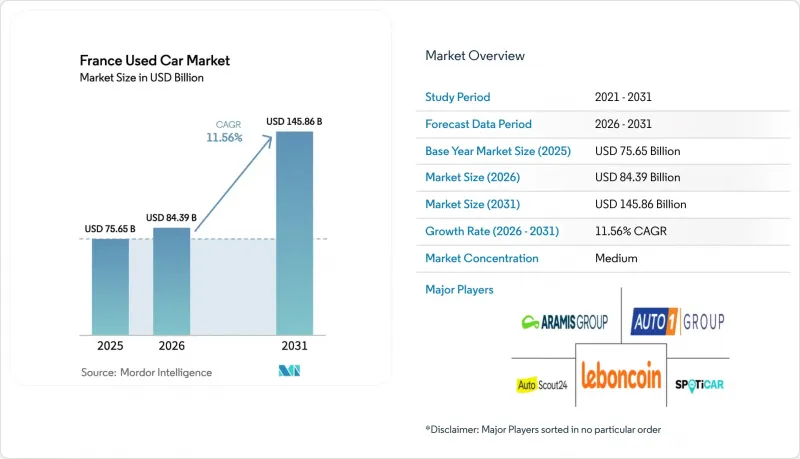
Mordor Intelligence에 의하면, 2026년 프랑스 중고차 시장 규모는 843억 9,000만 달러로 추정되고 있어 2025년 756억 5,000만 달러에서 확대해, 2031년에는 1,458억 6,000만 달러에 이를 것으로 예측됩니다.
2026년부터 2031년까지의 연평균 성장률(CAGR)은 11.56%를 나타낼 전망입니다.
본 보고서는 판매자 유형(조직화·비조직화), 차종(해치백 등), 연료 유형(가솔린, 디젤 등), 차량 연식(0-2년, 3-5년 등),가격대(5,000달러 미만, 5,000-9,999달러, 그 이상), 판매 채널(온라인(디지털 분류 포털 등) 및 오프라인)에 따라 분류되어 있습니다. 시장 전망은 금액(달러) 및 수량(대수)의 관점에서 제시되어 있습니다.
프랑스 중고차 시장 동향 및 인사이트
신차 가격 상승으로 인해 중고차와의 가격 격차 확대
2025년 4월까지의 신차 등록 대수는 전년 동기 대비 7% 감소한 반면, 중고차 거래 건수는 3.1% 증가하여 프랑스 중고차 시장으로의 구조적 전환이 두드러지게 나타나고 있습니다. 동급의 3년 된 모델과 비교한 신차의 평균 가격 프리미엄은 2024년 45%에서 2025년 12월까지 52%로 성장할 전망입니다. 임베디드 및 재생 파이프라인을 확대하고 있는 딜러들은 이러한 차익을 누리고 있습니다. 특히, 보증이 적용되는 CPO(인증 중고차) 재고의 경우, 여전히 신차 구매 비용보다 약 30% 낮은 수준이므로 그 이점이 두드러집니다.
온라인 중고차 플랫폼 및 디지털 쇼룸의 확대
AI 검사 키오스크와 엔드투엔드 금융 통합에 힘입은 온라인 채널은 현재 매출에서 ‘클릭 투 바이(Click-to-Buy)’가 차지하는 비중이 13.11%에 불과함에도 불구하고, 2030년까지 연평균 17.75%의 성장세를 이어가고 있습니다. ProovStation의 자동 스캔 시스템을 도입한 사업자들은 감정 시간을 몇 초로 단축하고 즉시 구속력 있는 제안을 발행함으로써, 프랑스 중고차 시장에서 거래를 점점 더 주도하고 있는 도시 지역 밀레니얼 세대의 진입 장벽을 낮추고 있습니다.
고도로 세분화된 딜러 환경이 이익률을 압박
전국적으로 15,000개 이상의 소규모 딜러가 영업하고 있어, 이로 인해 임베디드 시 협상력이 제한되고 규모의 경제도 저해되고 있습니다. 비조직화된 판매업체가 여전히 57.08%의 점유율을 차지하고 있어, 가격 경쟁이 매출 총이익률을 잠식하고 있으며, 프랑스 중고차 시장의 다음 성장 단계에 필수적인 기술 업그레이드를 지연시키고 있습니다.
부문 분석
2025년 기준, SUV는 프랑스 중고차 시장 점유율의 38.10%를 차지하고 있으며, 높은 시트 위치를 선호하는 소비자 경향과리스 제도를 통한 소형 전기 크로스오버 차량의 유입에 힘입어, 2031년까지 연평균 성장률(CAGR) 12.05%로 이 차종의 중고차 시장 규모가 확대되고 있습니다. 이 부문의 다양성 덕분에 조직화된 소매업체는 재고 계획을 최적화할 수 있습니다. 한편, 해치백은 도심 지역에서 여전히 인기를 유지하고 있으나, 경량 플랫폼을 유리하게 만드는 무게세 정책의 역풍을 맞고 있습니다. 지방에서는 다용도성을 중시하여 대형 SUV가 선호되는 경향이 있는 반면, 파리의 각 지역에서는 좁은 주차 공간에 적합한 서브컴팩트 모델이 인기를 끌고 있습니다.
SUV 거래 빈도 증가는 동적 가격 책정을 위한 데이터 활용 가능성을 높여, 재고 회전율을 최적화하는 AI 지원형 분석을 뒷받침하고 있습니다. 반면, 세단과 MPV는 시장 점유율을 내주고 있으며, 구매자들이 다목적 차량으로 눈을 돌리면서 세단의 재판매 가치는 하락하고 있습니다. MPV는 여전히 가족의 이동 수단으로서 수요를 충족시키고 있지만, 동등한 적재 용량과 더 높은 잔존 가치를 제공하는 SUV 대체 차종과의 경쟁에 직면해 있습니다. 라이프스타일 계열 카테고리인 컨버터블과 쿠페는 판매 대수가 여전히 적음에도 불구하고 애호가들 수요에 힘입어 견실한 이익률을 유지하고 있습니다.
2025년, 프랑스 중고차 시장 규모 중 비조직화 판매점이 56.40%를 차지했으나, 조직화된 판매 네트워크는 연평균 13.35%의 성장률을 기록하며 시장 구도의 점진적인 재균형이 시사되고 있습니다. 규모의 경제를 활용하여 전국 체인점은 정비의 표준화, 보증 기간 연장, 디지털 판매 플랫폼의 통합을 실현하고 있습니다. 프랜차이즈 그룹은 일원화된 재판매 거점을 활용하여 정비 주기를 두 자릿수 비율로 단축하고, 이익률 격차를 확대되고 있습니다.
소규모 독립 업체들은 지역과의 긴밀한 관계와 낮은 운영 비용을 통해 기동력을 유지하고 있지만, 프랑스 중고차 시장에서 비교 사이트가 보급됨에 따라 불투명한 가격 책정은 꾸준히 불리한 요인으로 작용하고 있습니다. 자금 면의 제약으로 인해 옴니채널 기술이나 전기차 재고용 배터리 진단에 대한 투자가 제한되면서 역량 격차가 확대되고 있습니다. 공존의 균형 상태가 예상되지만, 전반적인 흐름은 CPO(인증 중고차)의 신뢰성을 활용하는 브랜드 네트워크에 유리하게 작용하고 있습니다.
기타 혜택:
- 엑셀 형식 시장 예측(ME) 시트
- 3개월간의 애널리스트 지원
자주 묻는 질문
목차
제1장 서론
제2장 조사 방법
제3장 주요 요약
제4장 시장 구도
제5장 시장 규모 및 성장 예측(금액 및 수량, 2020-2030년)
제6장 경쟁 구도
제7장 시장 기회와 향후 전망
JHS 26.08.28According to Mordor Intelligence, France used car market size in 2026 is estimated at USD 84.39 billion, growing from 2025 value of USD 75.65 billion with 2031 projections showing USD 145.86 billion, growing at 11.56% CAGR over 2026-2031.
This report is Segmented by Vendor Type (Organized and Unorganized), Vehicle Type (Hatchbacks and More), Fuel Type (Petrol, Diesel, and More), Vehicle Age (0 -2 Years, 3 -5 Years, and More), Price Segment (Under USD 5, 000, USD 5, 000 - 9, 999, and More), Sales Channel (Online [Digital Classifieds Portals and More] and Offline). The Market Forecasts are Provided in Terms of Value (USD) and Volume (Units).
France Used Car Market Trends and Insights
Rising New-Car Prices Widen the Value Gap to Used Cars
New-car registrations fell 7% year-on-year through April 2025, while pre-owned transactions climbed 3.1%, underscoring a structural shift toward the France used car market. The average price premium for a new vehicle over a comparable three-year-old model widened from 45% in 2024 to 52% by December 2025. Dealers that scale sourcing and refurbishing pipelines capture this arbitrage, especially within warranty-backed CPO stock that still undercuts new-car outlays by roughly 30%.
Expansion of Online Used-Car Platforms & Digital Showrooms
Online channels, fuelled by AI inspection kiosks and end-to-end finance integration, are compounding at 17.75% through 2030 even though click-to-buy makes up only 13.11% of current turnover. Players deploying ProovStation's automated scanning cut appraisal time to seconds and issue instant binding offers, lowering friction for urban millennials increasingly steering activity within the France used car market.
Highly Fragmented Dealer Landscape Compresses Margins
More than 15,000 small-scale dealerships operate nationwide, limiting purchasing leverage and curtailing economies of scale. With unorganised vendors still commanding 57.08% share, pricing wars erode gross margins and delay technology upgrades critical for the next phase of growth in the France used car market.
Other drivers and restraints analyzed in the detailed report include:
- Short-Term Subscription & Lease Fleet Returns Surge From 2026
- Growth of Certified-Pre-Owned (CPO) Programmes
- Falling BEV Residual Values Create Stock-Value Risk
For complete list of drivers and restraints, kindly check the Table Of Contents.
Segment Analysis
SUVs held 38.10% of the French used car market share in 2025 and are expanding the French used car market size for this body style at a 12.05% CAGR to 2031, fuelled by consumer preference for elevated seating and the influx of compact electric crossovers from leasing schemes. The segment's depth lets organised retailers optimise stocking plans, while hatchbacks retain inner-city loyalty but face weight-tax headwinds favouring lighter platforms. Rural territories lean toward larger SUVs for versatility, whereas Parisian districts gravitate to sub-compact variants apt for tight parking zones.
Higher transaction velocity in SUVs boosts data availability for dynamic pricing, supporting AI-assisted analytics that refine inventory turns. Conversely, sedans and MPVs cede mindshare, with sedan resale values dipping as buyers gravitate to multi-purpose silhouettes. MPVs still address family mobility but battle SUV substitutes offering comparable boot volume and better residuals. Lifestyle categories, convertibles, and coupes remain low in volume yet enjoy resilient margins driven by enthusiast appetite.
Unorganised outlets retained 56.40% of France used car market size in 2025, but organised networks are compounding at 13.35%, signalling a gradual re-balancing. Scale advantages allow nationwide chains to standardise refurbishment, extend warranties, and unify digital storefronts. Franchise groups employ centralised remarketing hubs to shave reconditioning cycles by double-digit percentages, reinforcing margin differential.
Small independents maintain agility through local rapport and lower overhead; yet opaque pricing is steadily penalised as comparison engines proliferate across the French used car market. Capital constraints limit their investment in omnichannel tech and battery diagnostics for EV stock, widening the capability gap. A coexistence equilibrium is likely, but shared drift favours branded networks leveraging CPO credibility.
Complete Report Scope:
- By Vehicle Type
- Hatchbacks
- Sedans
- SUVs
- MPVs
- Others (convertibles, coupes, crossovers, sports cars)
- By Vendor Type
- Organized
- Unorganized
- By Fuel Type
- Petrol
- Diesel
- Hybrid
- Electric
- LPG / CNG / Others
- By Vehicle Age
- 0 - 2 Years
- 3 - 5 Years
- 6 - 8 Years
- 9 - 12 Years
- Above 12 Years
- By Price Segment
- Under USD 5,000
- USD 5,000 - 9,999
- USD 10,000 - 14,999
- USD 15,000 - 19,999
- USD 20,000 - 29,999
- USD 30,000 and Above
- By Sales Channel
- Online
- Digital Classifieds Portals
- Pure-play e-Retailers
- OEM-Certified Online Stores
- Offline
- OEM-Franchised Dealers
- Multi-brand Independent Dealers
- Physical Auction Houses
- Online
List of Companies Covered in this Report:
- AutoScout24 (SMG Swiss Marketplace Group)
- Leboncoin
- Aramis Group (Aramisauto)
- La Centrale
- Reezocar
- Heycar
- BYmyCAR Group
- Stellantis N.V. (Spoticar)
- BNP Paribas (Arval AutoSelect)
- Autosphere
- ParuVendu
- Auto1 Group (Autohero)
- Cazoo Group
- Hiflow
- CAR Avenue
- Speedy France
- Feu Vert
- Emil Frey France
- GPA Motors
- Edenauto
Additional Benefits:
- The market estimate (ME) sheet in Excel format
- 3 months of analyst support
TABLE OF CONTENTS
1 Introduction
- 1.1 Study Assumptions & Market Definition
- 1.2 Scope of the Study
2 Research Methodology
3 Executive Summary
4 Market Landscape
- 4.1 Market Overview
- 4.2 Market Drivers
- 4.2.1 Rising new-car prices widen the value gap to used cars
- 4.2.2 Expansion of online used-car platforms & digital showrooms
- 4.2.3 Short-term subscription & lease fleet returns surge from 2026
- 4.2.4 Growth of certified-pre-owned (CPO) programmes
- 4.2.5 2025 French CO?/weight tax pushes buyers to lighter used models
- 4.2.6 AI-driven reconditioning cuts refurb costs & speeds turnover
- 4.3 Market Restraints
- 4.3.1 Highly fragmented dealer landscape compresses margins
- 4.3.2 Falling BEV residual values create stock-value risk
- 4.3.3 Extended 3-year statutory warranty (2027) raises dealer liability
- 4.3.4 EU battery end-of-life rules add compliance cost for used-EV trade
- 4.4 Value / Supply-Chain Analysis
- 4.5 Regulatory Landscape
- 4.6 Technological Outlook
- 4.7 Porter's Five Forces
- 4.7.1 Threat of New Entrants
- 4.7.2 Bargaining Power of Buyers
- 4.7.3 Bargaining Power of Suppliers
- 4.7.4 Threat of Substitute Products
- 4.7.5 Intensity of Competitive Rivalry
5 Market Size & Growth Forecasts (Value & Volume, 2020-2030)
- 5.1 By Vehicle Type
- 5.1.1 Hatchbacks
- 5.1.2 Sedans
- 5.1.3 SUVs
- 5.1.4 MPVs
- 5.1.5 Others (convertibles, coupes, crossovers, sports cars)
- 5.2 By Vendor Type
- 5.2.1 Organized
- 5.2.2 Unorganized
- 5.3 By Fuel Type
- 5.3.1 Petrol
- 5.3.2 Diesel
- 5.3.3 Hybrid
- 5.3.4 Electric
- 5.3.5 LPG / CNG / Others
- 5.4 By Vehicle Age
- 5.4.1 0 - 2 Years
- 5.4.2 3 - 5 Years
- 5.4.3 6 - 8 Years
- 5.4.4 9 - 12 Years
- 5.4.5 Above 12 Years
- 5.5 By Price Segment
- 5.5.1 Under USD 5,000
- 5.5.2 USD 5,000 - 9,999
- 5.5.3 USD 10,000 - 14,999
- 5.5.4 USD 15,000 - 19,999
- 5.5.5 USD 20,000 - 29,999
- 5.5.6 USD 30,000 and Above
- 5.6 By Sales Channel
- 5.6.1 Online
- 5.6.1.1 Digital Classifieds Portals
- 5.6.1.2 Pure-play e-Retailers
- 5.6.1.3 OEM-Certified Online Stores
- 5.6.2 Offline
- 5.6.2.1 OEM-Franchised Dealers
- 5.6.2.2 Multi-brand Independent Dealers
- 5.6.2.3 Physical Auction Houses
- 5.6.1 Online
6 Competitive Landscape
- 6.1 Market Concentration
- 6.2 Strategic Moves
- 6.3 Market Share Analysis
- 6.4 Company Profiles (includes Global level Overview, Market level overview, Core Segments, Financials as available, Strategic Information, Market Rank/Share for key companies, Products & Services, and Recent Developments)
- 6.4.1 AutoScout24 (SMG Swiss Marketplace Group)
- 6.4.2 Leboncoin
- 6.4.3 Aramis Group (Aramisauto)
- 6.4.4 La Centrale
- 6.4.5 Reezocar
- 6.4.6 Heycar
- 6.4.7 BYmyCAR Group
- 6.4.8 Stellantis N.V. (Spoticar)
- 6.4.9 BNP Paribas (Arval AutoSelect)
- 6.4.10 Autosphere
- 6.4.11 ParuVendu
- 6.4.12 Auto1 Group (Autohero)
- 6.4.13 Cazoo Group
- 6.4.14 Hiflow
- 6.4.15 CAR Avenue
- 6.4.16 Speedy France
- 6.4.17 Feu Vert
- 6.4.18 Emil Frey France
- 6.4.19 GPA Motors
- 6.4.20 Edenauto