

|
시장보고서
상품코드
2117214
중국의 중고차 시장 : 시장 점유율 분석, 업계 동향 및 통계, 성장 예측(2026-2031년)China Used Car - Market Share Analysis, Industry Trends & Statistics, Growth Forecasts (2026 - 2031) |
||||||
 Mordor Intelligence
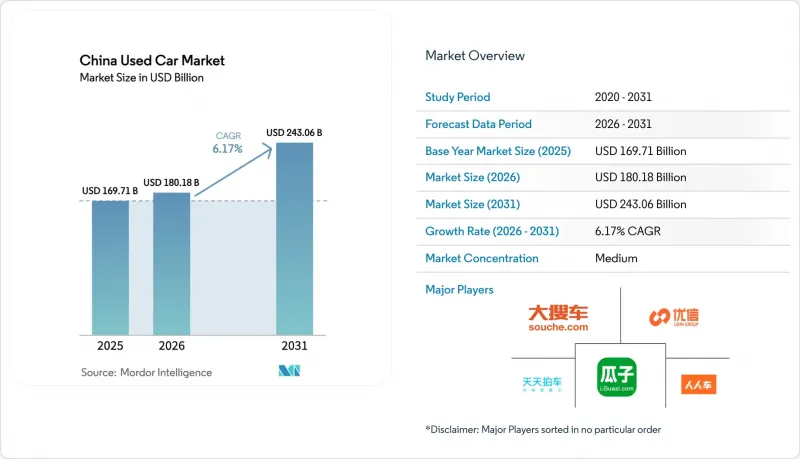
Mordor Intelligence에 의하면, 중국의 중고차 시장 규모는 2025년 1,697억 1,000만 달러로 평가되었고, 2026년에는 1,801억 8,000만 달러로 추정되고, 2026-2031년 CAGR 6.17%로 성장을 지속할 전망이며, 2031년에는 2,430억 6,000만 달러에 이를 것으로 예측됩니다.
본 보고서는 차량 유형별(해치백 등), 판매 채널별(온라인 포털 등), 판매업체 유형별(조직화된 판매업체와 비조직화된 판매업체), 거래 형태별(일시불과 할부), 연료 유형별(가솔린 등), 차량 연식별(0-2년 등), 가격대별(5,000달러 미만 등), 지역별로 분류되어 있습니다. 시장 예측은 금액(달러) 및 수량(대)으로 제시되어 있습니다.
중국의 중고차 시장 동향 및 인사이트
가처분 소득 증가와 교체 주기 단축
2024년 도시 지역의 가처분 소득은 평균 5만 4,188위안(약 7,748달러)에 달했으며, 이로 인해 이전의 6-8년에서 5-6년으로 단축된 더 빠른 교체 주기가 촉진되고 있습니다(1). 부유층 소유주들은 새로운 ADAS 기능과 장거리 주행이 가능한 배터리를 이용하기 위해 조기에 차량을 교체함에 따라, 중국 중고차 시장에는 신차와 다름없는 차량이 급증하고 있습니다. 구매 후 0-2년 된 중고차의 두드러진 연평균 성장률(CAGR)은 이러한 행동 변화를 반영하고 있으며, 한편 금융 기관은 신용도 향상을 확인하고 있어 채무 불이행 위험이 낮아지고 있습니다. 동시에 소득 증가가 가치 하락에 따른 손실을 완화하고 있어, 판매자들은 더 빠른 매각을 수용하기 쉬워지고 있습니다. 이러한 경향은 가구 소득이 전국 평균을 상회하는 상하이, 베이징, 선전에서 가장 두드러집니다.
도시 간 이전 규제 완화
상무부는 2026년까지 차량 이전 규정의 통일을 단계적으로 추진하고 있으며, 과거 재고를 원산지에서 묶어두던 지역 보호주의를 철폐하고 있습니다. 서류 절차 간소화와 배기가스 기준의 통일로 인해 딜러들은 잉여 재고를 안고 있는 내륙 판매 거점에서 수요가 집중되는 연안 허브로 재고를 이동시킬 수 있게 되었습니다. 중국 동부에서 가장 먼저 이 조치를 도입한 기업들은 이미 평균 판매 소요 시간을 단축하고, 운전자금을 유동화하며, 이익률을 향상시키고 있습니다. 물류 네트워크가 확대됨에 따라 지역 간 차익 거래를 통해 잔존 가치가 안정화되고 유동성이 향상될 전망입니다. 디지털 판매 플랫폼이 실시간 운송 상황 정보를 통합하여 딜러의 임베디드 효율을 높임에 따라, 중기적인 이익은 더욱 확대될 것으로 예측됩니다.
신차의 과감한 할인에 따른 가격 변동
2024-2025년 가격 경쟁에서 자동차 제조업체들은 정가를 대폭 인하하여 신차와 거의 신차에 가까운 차량의 재고 가격 차이를 좁혔습니다. BYD가 사내에서 의무화한 지급 조건 개혁은 해당사의 판매 목표에 대한 현저한 조정을 초래했으며, 수익성 문제를 부각시켰습니다. 중고차 시장의 판매업자에게는 제조업체로부터 리베이트가 적용될 때마다 희망 가격을 재설정해야 하므로, 이익률이 하락하는 경우가 많습니다. 판매가 부진한 세단을 재고로 보유한 딜러는 막대한 손실에 직면하고 있습니다. 규제 당국은 부당한 가격 경쟁을 억제하기 위해 감시를 강화하고 있지만, 이러한 감독 조치는 구매자의 의사결정을 방해하는 가격 변동을 억제하기에는 미치지 못하고 있습니다.
부문 분석
2025년 시점에서 세단의 점유율은 44.21%를 유지했으나, 중국 중고차 시장의 SUV 시장은 2026-2031년 연평균 성장률(CAGR) 16.21%라는 견실한 속도로 확대되고 있습니다. 높은 운전석 위치, 안전성에 대한 신뢰, 그리고 지위 향상과 같은 요인으로 인해 SUV는 도시 지역 가구에게 ‘표준적인 교체 대상’이 되고 있습니다. BMW, 메르세데스-벤츠, NIO의 프리미엄 모델은 구매 후 3년이 지나도 잔존 가치에서 현저한 점수 차이로 인한 프리미엄을 유지하고 있어, 신차의 치열한 가격 인하 영향에 덜 노출된 상황입니다. 이에 대응하여 딜러들은 SUV 재고에 넓은 판매 공간을 할당하고, 구매자의 고액 구매에 부응하는 금융 패키지에 투자하고 있습니다. 세단은 여전히 판매 대수의 주력을 이루고 있지만, 가격 경쟁의 영향을 받기 쉬운 엔트리 모델과 ADAS(첨단 운전자 보조 시스템)를 탑재한 하이엔드 등급 사이에서 잔존 가치에 현저한 격차가 발생하고 있습니다. 이러한 추세로 볼 때, 2031년까지 SUV가 거래 건수의 상당 부분을 차지하게 되어 딜러의 재고 전략을 전면적으로 재편하고 세단의 재판매 가격 곡선을 압축할 가능성이 있다고 볼 수 있습니다.
SUV로의 구조적 전환은 화물 적재의 유연성과 가족 중심의 편의성을 중시하는 보다 광범위한 도시화 추세와 일치합니다. 크로스오버, 쿠페, 컨버터블은 시장 점유율이 미미하지만, 가처분 소득이 라이프스타일 지향적 구매를 뒷받침하는 해안 도시에서는 열성적인 지지층을 유지하고 있습니다. 해치백과 MPV는 각각 첫 차를 구매하는 계층이나 다자녀 가구와 같은 틈새 시장을 점유하고 있지만, 자동차 제조업체들이 연구개발 예산을 대량 생산형 SUV 플랫폼에 할당하고 있기 때문에 성장은 둔화되고 있습니다. 따라서 중국 중고차 시장에서는 SUV와 고급 세단에 공급이 집중될 것이며, 이에 따라 경매 회사는 기존에 세단 기준을 중시하던 감정 알고리즘을 재조정해야할 것입니다.
2025년에는 오프라인 판매 채널이 32.18%의 점유율을 차지했으나, 온라인 소매업체는 2026-2031년 연평균 성장률(CAGR) 20.34%를 나타낼 것으로 예측되어, 자동차 제조업체 직영점의 점유율을 크게 앞지를 전망입니다. AI를 활용한 감정 평가와 전국 규모의 재고 집약화를 통해 온라인 플랫폼은 판매까지 걸리는 기간을 몇 주에서 며칠로 단축할 수 있게 되었으며, 이를 통해 딜러의 자금을 유휴 상태에서 해방시키고 있습니다. Uxin의 옴니채널 슈퍼스토어는 폭넓은 차종을 전시하여 2025년 2분기에는 거래 건수가 대폭 증가했습니다. Autohome과 같은 분류 광고 포털은 핀테크의 관문으로 진화하여, 대출 소개나 보증 서비스의 업셀링을 통해 수익화를 도모하고 있습니다. 한편, 오프라인 쇼룸은 체험형 접점에서는 뛰어나지만, 높은 임대료와 인건비를 부담하고 있어 디지털 예약 시스템이나 원격 영상 검사의 도입을 피할 수 없게 되었습니다.
온라인 조회와 매장에서의 최종 계약을 결합한 하이브리드 모델이 소매 업계의 주류로 부상하고 있습니다. 독립 딜러나 오프라인 경매 업체는 전국 규모의 플랫폼이 가진 방대한 데이터와 마케팅 도달 범위에 맞설 수 없어 이익률이 축소되고 있습니다. 공안성의 전자 면허 도입으로 실시간 검사 데이터가 온라인 게시 정보에 직접 반영되게 되면서, 실차 검사를 통한 정보상의 우위는 점차 약화되고 있습니다. 그 결과, 조직화되지 않은 딜러들은 주변 시장으로 이전하거나, 디지털 검증 수요가 비교적 낮은 5,000달러 미만의 재고로 사업을 전환하고 있습니다. 조직화된 플랫폼은 로열티 프로그램, 연장 보증, 환매 보증 등을 중첩하여 우위를 강화하고, 고객 생애 가치를 높이며, 재구매를 정착시키고 있습니다.
조직화된 벤더는 2025년에 63.11%의 시장 점유율을 차지한 것으로 평가되었으며, 2031년까지 연평균 성장률(CAGR) 10.36%로 성장하여 비조직화된 벤더에 대한 우위를 더욱 확대해 나갈 전망입니다. 규모가 확대됨에 따라 재고 자금 조달 비용을 절감하고 일괄 정비가 가능해져 단위당 비용이 낮아집니다. Uxin이 우한에서 설립한 100만 규모의 합작 사업과 같은 민관 파트너십은 소규모 사업자가 확보할 수 없는 세제 혜택이나 토지 이용권을 제공합니다. 주행 거리 0에 대한 정부의 단속은 규정 준수 체계가 갖춰지지 않은 비조직화된 딜러에게 과도한 부담을 안겨주어, 시장 철수나 강제 합병을 가속화하고 있습니다. 조직화된 사업자들이 블록체인을 통한 주행거리 기록과 특허를 취득한 AI 감정 시스템을 통합함에 따라, 신규 시장 진출기업을 배제하는 신뢰의 ‘해자’를 구축하고 있습니다.
그렇지만 중국 중고차 업계에는 여전히 정보 격차가 뿌리 깊은 3선 도시에 수천 개의 가족 경영 딜러가 존재합니다. 이러한 사업자들은 가격에 민감한 구매자를 타겟으로 삼고, 지역과의 유대 관계를 활용하여 생존하고 있습니다. 하지만 플랫폼을 통해 판매자가 전국의 제안을 즉시 비교할 수 있게 되면서, 이들의 협상력은 약화되고 있습니다. 예측 기간 동안 시장 집중도는 높아지겠지만, 독점적 행위에 대한 규제 당국의 감시로 인해 단일 사업자가 시장을 독점하는 것은 제한될 것입니다.
기타 혜택 :
- 엑셀 형식 시장 예측(ME) 시트
- 3개월간의 애널리스트 지원
자주 묻는 질문
목차
제1장 서론
제2장 조사 방법
제3장 개요
제4장 시장 구도
제5장 시장 규모 및 성장 예측
제6장 경쟁 구도
제7장 시장 기회 및 향후 전망
AJY 26.09.01According to Mordor Intelligence, the China used car market size is expected to grow from USD 169.71 billion in 2025 to USD 180.18 billion in 2026 and is forecasted to reach USD 243.06 billion by 2031 at a 6.17% CAGR over 2026-2031.
This report is Segmented by Vehicle Type (Hatchbacks and More), Sales Channel (Online Portals and More), Vendor Type (Organized and Unorganized), Transaction Type (Full Payment and Finance), Fuel Type (Petrol, and More), Vehicle Age (0 To 2 Years and More), Price Segment (Less Than USD 5, 000 and More), and Geography. The Market Forecasts are Provided in Terms of Value (USD) and Volume (Units).
China Used Car Market Trends and Insights
Rising Disposable Income and Upgrade Cycles
Urban disposable income averaged CNY 54,188 (~USD 7,748) in 2024, fueling faster replacement cycles that now run 5-6 years instead of the previous 6-8 years [1]. Affluent owners trade up earlier to access new ADAS features and longer-range batteries, feeding a surge of nearly-new units into the Chinese used car market. The 0-to-2-year bracket's notable CAGR mirrors this behavioral shift, while lenders observe higher creditworthiness, lowering default risk. Concurrently, rising incomes cushion depreciation losses, encouraging sellers to accept quicker turnarounds. The effect is most pronounced in Shanghai, Beijing, and Shenzhen, where household earnings exceed the national average.e.
Deregulation of Inter-City Transfer Restrictions
The Ministry of Commerce is phasing in harmonized vehicle-transfer rules by 2026, eliminating local protectionism that once trapped inventory at its origin. Relaxed documentation and emissions alignment allow dealers to relocate stock from surplus inland lots to coastal hubs with denser demand. Early adopters in East China are already reducing average time-to-sale, freeing up working capital, and increasing margins. As logistics networks scale, cross-regional arbitrage should stabilize residual values and boost liquidity. Medium-term gains are forecast to compound as digital listing platforms integrate real-time transport availability, improving dealer sourcing efficiency.
Price Volatility from Aggressive New-Car Discounting
During the 2024-2025 price war, OEMs significantly reduced sticker prices, narrowing the divide between new and nearly-new inventories. BYD's reforms to payment terms, mandated by the company, led to a notable adjustment in its sales target, underscoring profitability challenges. For sellers in the used-car market, each factory rebate requires recalibrating asking prices, often diminishing profit margins. Dealers with a stock of slower-moving sedans are facing outsized losses. While regulatory bodies are intensifying scrutiny to mitigate predatory pricing, this oversight hasn't quelled the volatility that hampers buyer decisions.
Other drivers and restraints analyzed in the detailed report include:
- OEM-Led Certified Pre-Owned Programs Expand Trust
- Battery-Health Certification for Used NEVs
- Mileage Fraud and Information Asymmetry
For complete list of drivers and restraints, kindly check the Table Of Contents.
Segment Analysis
Sedans retained a 44.21% share in 2025, whereas the Chinese used-car market for SUVs is expanding at a robust 16.21% CAGR from 2026 to 2031. Higher seating positions, perceived safety, and elevated status make SUVs the default upgrade for urban households. Premium models from BMW, Mercedes-Benz, and NIO sustain a notable percentage-point residual-value premium three years post-purchase, insulating them from aggressive new-car discounts. In response, dealers allocate larger floor space to SUV inventory and invest in financing bundles that cater to buyers' higher ticket sizes. Sedans continue to anchor volumes, yet residual values diverge sharply between entry-level models, those susceptible to price wars, and high-end trims that incorporate advanced driver-assistance systems. The trajectory suggests that SUVs could account for a notable share of transaction counts by 2031, reshaping dealer stocking strategies and compressing the resale curves of sedans.
The structural pivot toward SUVs aligns with broader urbanization trends that prioritize cargo flexibility and family utility. Crossovers, coupes, and convertibles command a marginal share but maintain loyal followings in coastal cities, where discretionary income supports lifestyle purchases. Hatchbacks and MPVs occupy niche spaces, first-time buyers and multi-child families respectively, but encounter slower growth as OEMs allocate R&D budgets to high-volume SUV platforms. The China used car market will therefore see supply concentration in SUVs and premium sedans, prompting auction houses to recalibrate appraisal algorithms that formerly weighted sedan benchmarks more heavily.
Offline sales channels captured a 32.18% share in 2025, while online e-retailers are forecasted to post a 20.34% CAGR from 2026 to 2031, dwarfing the share of OEM-franchised outlets. AI-enabled valuations and nationwide inventory aggregation enable online platforms to shorten time-to-sale from weeks to days, thereby freeing up dealer capital. Uxin's omnichannel superstores showcased a wide range of vehicles and recorded significant transaction growth in the second quarter of 2025. Classified portals like Autohome evolve into fintech gateways, monetizing financing referrals and warranty up-sells. While offline showrooms excel at experiential touchpoints, they shoulder higher rent and labor costs, compelling them to integrate digital appointment systems and remote video inspections.
Hybrid models, online browsing with in-store finalization, are emerging as the dominant retail template. Independent dealers and physical auction houses face shrinking margins because they cannot match the depth of data or marketing reach of national platforms. The Ministry of Public Security's electronic license rollout feeds real-time inspection data directly into online listings, eroding the information edge of physical inspections. Consequently, unorganized dealers migrate to peripheral markets or pivot to sub-USD 5,000 inventory, where digital verification is less in demand. Organized platforms reinforce their advantage by layering loyalty programs, extended warranties, and buy-back guarantees that boost customer lifetime value and lock in repeat transactions.
Organized vendors held 63.11% market share in 2025 and are projected to grow at a 10.36% CAGR through 2031, widening their lead over unorganized vendors. Scale unlocks cheaper inventory financing and bulk reconditioning, reducing per-unit costs. Public-private partnerships, such as Uxin's million joint venture in Wuhan, grant tax incentives and land access that small operators cannot secure. Government crackdowns on zero-mileage fraud disproportionately burden unorganized dealers lacking compliance infrastructure, accelerating exits or forced mergers. As organized players integrate blockchain odometer logs and patented AI appraisals, they build trust moats that fend off new entrants.
Nevertheless, the Chinese used-car industry still hosts thousands of family-run dealerships in tier-three cities, where information asymmetry persists. These operators survive by targeting price-sensitive buyers and leveraging local relationships. Yet their bargaining power declines as platforms enable sellers to compare instant offers nationwide. Over the forecast horizon, market concentration will increase, but regulatory vigilance against monopolistic behavior will limit any single player's dominance.
Complete Report Scope:
- By Vehicle Type
- Hatchbacks
- Sedans
- Sport Utility Vehicles (SUVs)
- Multi-Utility Vehicles (MPVs)
- Others (Convertibles, Coupes, Crossovers, Sports Cars)
- By Sales Channel
- Online Digital Classified Portals
- Pure-play e-Retailers
- OEM-Certified Online Stores
- Offline OEM-Franchised Dealers
- Multi-brand Independent Dealers
- Physical Auction Houses
- By Vendor Type
- Organized
- Unorganized
- By Transaction Type
- Full Payment
- Finance
- By Fuel Type
- Petrol
- Diesel
- Hybrid
- Electric
- LPG / CNG / Others
- By Vehicle Age
- 0 to 2 Years
- 3 to 5 Years
- 6 to 8 Years
- 9 to 12 Years
- More Than 12 Years
- By Price Segment
- Less Than USD 5,000
- USD 5,000 to 9,999
- USD 10,000 to 14,999
- USD 15,000 to 19,999
- USD 20,000 to 29,999
- More Than USD 30,000
- By Geography
- East China
- North China
- South China
- Central China
- West China
List of Companies Covered in this Report:
- Guazi Used Cars (Chehaoduo Group)
- Uxin Limited
- Renrenche
- Souche
- CAR Inc.
- Autohome Inc.
- Yixin Used Car Co., Ltd.
- Tiantian Paiche
- Foshan Guangcai International Trade Co., Ltd.
- Chongqing Senkai Automobile Sales & Service Co., Ltd.
- PLC Auction
- Dongdong Automobile
Additional Benefits:
- The market estimate (ME) sheet in Excel format
- 3 months of analyst support
TABLE OF CONTENTS
1 Introduction
- 1.1 Study Assumptions and Market Definition
- 1.2 Scope of the Study
2 Research Methodology
3 Executive Summary
4 Market Landscape
- 4.1 Market Overview
- 4.2 Market Drivers
- 4.2.1 Rising Disposable Income and Upgrade Cycles
- 4.2.2 Deregulation of Inter-City Transfer Restrictions
- 4.2.3 Carbon-Credit Incentives for Scrapping Old ICE Cars
- 4.2.4 OEM-Led Certified-Pre-Owned Programs Expand Trust
- 4.2.5 Battery-Health Certification for Used NEVs
- 4.2.6 AI-Driven Residual-Value Prediction Platforms
- 4.3 Market Restraints
- 4.3.1 Price Volatility from Aggressive New-Car Discounting
- 4.3.2 Mileage Fraud and Information Asymmetry
- 4.3.3 Limited EV Financing Due to Battery-Lease Complexity
- 4.3.4 City License-Plate Quota Tightening on Older ICE Cars
- 4.4 Value / Supply-Chain Analysis
- 4.5 Regulatory Landscape
- 4.6 Technological Outlook
- 4.7 Porter's Five Forces Analysis
- 4.7.1 Threat of New Entrants
- 4.7.2 Bargaining Power of Buyers/Consumers
- 4.7.3 Bargaining Power of Suppliers
- 4.7.4 Threat of Substitute Products
- 4.7.5 Intensity of Competitive Rivalry
5 Market Size and Growth Forecasts (Value (USD) and Volume (Units))
- 5.1 By Vehicle Type
- 5.1.1 Hatchbacks
- 5.1.2 Sedans
- 5.1.3 Sport Utility Vehicles (SUVs)
- 5.1.4 Multi-Utility Vehicles (MPVs)
- 5.1.5 Others (Convertibles, Coupes, Crossovers, Sports Cars)
- 5.2 By Sales Channel
- 5.2.1 Online Digital Classified Portals
- 5.2.2 Pure-play e-Retailers
- 5.2.3 OEM-Certified Online Stores
- 5.2.4 Offline OEM-Franchised Dealers
- 5.2.5 Multi-brand Independent Dealers
- 5.2.6 Physical Auction Houses
- 5.3 By Vendor Type
- 5.3.1 Organized
- 5.3.2 Unorganized
- 5.4 By Transaction Type
- 5.4.1 Full Payment
- 5.4.2 Finance
- 5.5 By Fuel Type
- 5.5.1 Petrol
- 5.5.2 Diesel
- 5.5.3 Hybrid
- 5.5.4 Electric
- 5.5.5 LPG / CNG / Others
- 5.6 By Vehicle Age
- 5.6.1 0 to 2 Years
- 5.6.2 3 to 5 Years
- 5.6.3 6 to 8 Years
- 5.6.4 9 to 12 Years
- 5.6.5 More Than 12 Years
- 5.7 By Price Segment
- 5.7.1 Less Than USD 5,000
- 5.7.2 USD 5,000 to 9,999
- 5.7.3 USD 10,000 to 14,999
- 5.7.4 USD 15,000 to 19,999
- 5.7.5 USD 20,000 to 29,999
- 5.7.6 More Than USD 30,000
- 5.8 By Geography
- 5.8.1 East China
- 5.8.2 North China
- 5.8.3 South China
- 5.8.4 Central China
- 5.8.5 West China
6 Competitive Landscape
- 6.1 Market Concentration
- 6.2 Strategic Moves
- 6.3 Market Share Analysis
- 6.4 Company Profiles (includes Global Level Overview, Market Level Overview, Core Segments, Financials as Available, Strategic Information, Market Rank/Share for Key Companies, Products and Services, SWOT Analysis, and Recent Developments)
- 6.4.1 Guazi Used Cars (Chehaoduo Group)
- 6.4.2 Uxin Limited
- 6.4.3 Renrenche
- 6.4.4 Souche
- 6.4.5 CAR Inc.
- 6.4.6 Autohome Inc.
- 6.4.7 Yixin Used Car Co., Ltd.
- 6.4.8 Tiantian Paiche
- 6.4.9 Foshan Guangcai International Trade Co., Ltd.
- 6.4.10 Chongqing Senkai Automobile Sales & Service Co., Ltd.
- 6.4.11 PLC Auction
- 6.4.12 Dongdong Automobile
7 Market Opportunities and Future Outlook
- 7.1 White-space and Unmet-Need Assessment


