

|
시장보고서
상품코드
2116742
태국의 용기용 유리 시장 : 점유율 분석, 업계 동향과 통계, 성장 예측(2026-2031년)Thailand Container Glass - Market Share Analysis, Industry Trends & Statistics, Growth Forecasts (2026 - 2031) |
||||||
 Mordor Intelligence
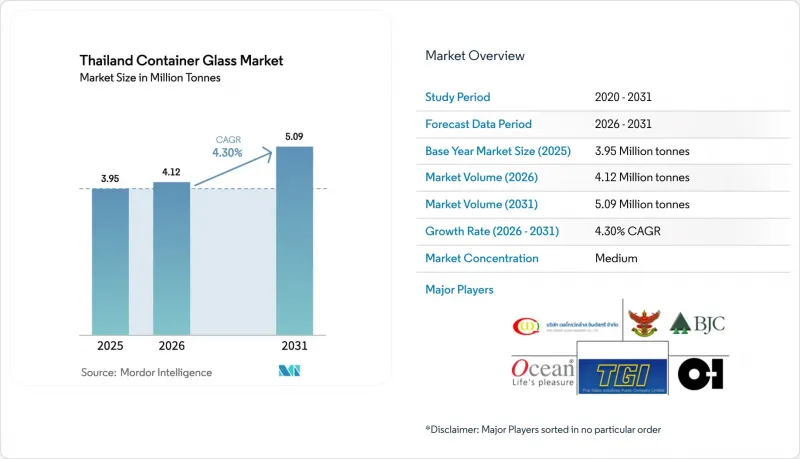
Mordor Intelligence에 의하면, 태국 용기용 유리 시장 규모는 2025년에 395만 톤으로 평가되어 2026년 412만 톤에서 2031년까지 509만 톤에 이를 것으로 예측되며, 예측 기간(2026-2031년) CAGR은 4.30%를 나타낼 전망입니다.
본 보고서는 최종 사용자별(음료(주류(맥주, 와인, 증류주 등) 및 무알코올 음료(주스, 탄산음료, 유제품 베이스 음료 등)), 식품(잼, 젤리, 마멀레이드, 오일, 피클 등), 화장품 및 퍼스널케어, 의약품, 향수), 색상(그린, 앰버, 플린트, 기타 색상)별로 분류되어 있습니다. 시장 예측은 수량(톤) 기준으로 제시되어 있습니다.
태국 용기용 유리 시장 동향 및 인사이트
지속 가능하고 재활용 가능한 포장에 대한 규제적 추진
태국의 플라스틱 폐기물 대책 로드맵에서는 2025년까지 일회용 스티로폼 식품 용기 및 얇은 플라스틱 컵을 폐지하고, 유리 용기로의 구조적인 대체를 촉진하고 있습니다. 규제 적용 범위는 2020년 이후 화장품 내 마이크로비즈 사용 금지 및 소매업체 주도의 비닐봉지 사용 단계적 감축까지 미치며, 유리가 저탄소 기본 선택지라는 소비자 인식을 정착시키고 있습니다. 전체 수명 주기의 탄소 발자국을 고려할 때, 탄소세는 플라스틱과 유리의 비용 격차를 더욱 확대시켜 브랜드 소유자가 재생 유리를 지정하도록 유도하고 있습니다. 대형 에너지 복합 기업인 PTT는 이미 순환형 폐기물 관리 목표를 제시하고 있으며, 재활용 가능한 포장재를 둘러싼 공급망 협력을 강화하고 있습니다. 정책적 전환점이 다가옴에 따라, 높은 칼렛 비율과 낮은 배출량을 보장할 수 있는 제조업체에 대한 수요 전망이 밝아지고 있습니다. 따라서 이러한 규제 환경의 시너지 효과로 인해 태국 용기용 유리 시장의 예상 연평균 성장률(CAGR)은 1.2포인트 상승했습니다.
음료 및 화장품 패키지의 프리미엄화
각 브랜드는 수제 맥주, 기능성 음료, 고급 화장품 라인에서 유리의 아름다움을 활용하여 고가 전략을 정당화하고 있습니다. 이러한 분야에서는 포장이 진정성과 지속가능성을 전달하는 역할을 하고 있습니다. 2001년 1,000만 달러였던 시장 규모가 2004년에는 1억 5,000만 달러로 확대된 즉석 음용 녹차의 초기 성공 사례는 포장이 소비자가 인식하는 품질과 일치할 경우 소비자가 더 고가의 상품을 선택할 의향이 있음을 입증하고 있습니다. 소셜 미디어상의 이미지에서는 투명하고 광택 있는 유리 표면이 더욱 매력적으로 비쳐 진열 시 호소력을 높이고, 환경 의식이 높은 밀레니얼 세대의 재구매를 촉진하고 있습니다. 국내 화장품 제조업체들은 이러한 추세를 반영하여 두꺼운 플린트 병이나 드롭퍼를 채택한 신제품을 출시하고 있으며, 시장 성장률을 0.8포인트 끌어올리는 프리미엄화의 선순환을 유지하고 있습니다.
PET 및 알루미늄 캔의 급속한 보급
경량인 PET와 알루미늄은 이익률이 낮은 음료 분야에서 비용 및 물류 측면의 이점을 제공하여, 편의점 채널에서의 유리 용기 판매량을 압박하고 있습니다. Indorama Ventures사의 PET 하류 통합은 공급 측면의 경제성을 향상시켜 대중 시장 청량음료 시장에서 적극적인 가격 책정을 가능하게 하고 있습니다. 편의점 운영자들은 진열대 보충을 최적화하기 위해 경량 포장을 선호하기 때문에 가격에 민감한 카테고리에서 유리 용기 수요가 둔화되어 시장의 연평균 성장률(CAGR)을 1.1포인트 끌어내리고 있습니다.
부문 분석
2025년, 음료는 태국 용기용 유리 시장 점유율의 53.78%를 차지하며, 관광 산업의 회복과 프리미엄 수제 음료로의 전환을 배경으로 다른 모든 용도를 앞질렀습니다. 이 시장에서 맥주는 판매량 면에서 1위를 유지하고 있지만, 차별화된 병 모양, 엠보싱 가공 및 위조 방지 캡에 힘입어 프리미엄 증류주와 기능성 음료가 현재 가장 높은 가치 성장을 기록하고 있습니다. 호스피탈리티 업계의 방문객 수가 팬데믹 이전 수준으로 회복됨에 따라, 음료와 관련된 태국의 용기용 유리 시장 규모는 꾸준히 확대될 것으로 예측됩니다.
지속가능성에 대한 브랜드의 관심이 높아짐에 따라, 병에는 30-65%의 재활용 유리 파편이 혼합되어 있어 순환 경제에서의 입지를 강화하는 동시에 용해로의 에너지 집약도를 낮추고 있습니다. 이와 동시에, 콤부차나 콜드브루 커피와 같은 무알코올 분야에서도 진정성을 중시하는 소비 트렌드와 클린 라벨의 신뢰성을 강조하기 위해 유리 용기로의 전환이 진행되고 있습니다. 화장품 및 퍼스널케어 카테고리는 현재 규모는 작지만, 2031년까지 연평균 성장률(CAGR) 5.01%를 나타낼 것으로 전망됩니다. 이는 효과와 환경 의식을 전달하는 프리미엄 유리병, 드롭퍼, 롤러를 소비자가 선호하는 경향을 반영한 것입니다. 고급 스킨케어 브랜드들은 이미 자사 병이 100% 재활용 가능하다는 점을 홍보하고 있으며, 책임감 있는 럭셔리를 추구하는 국내 소비자들 사이에서 이러한 제품의 채택이 가속화되고 있습니다.
기타 혜택:
- 엑셀 형식 시장 예측(ME) 시트
- 3개월간의 애널리스트 지원
자주 묻는 질문
목차
제1장 서론
제2장 조사 방법
제3장 주요 요약
제4장 시장 구도
제5장 시장 규모와 성장 예측
제6장 경쟁 구도
제7장 시장 기회와 향후 전망
JHS 26.08.28According to Mordor Intelligence, the Thailand container glass market size was valued at 3.95 million tonnes in 2025 and estimated to grow from 4.12 million tonnes in 2026 to reach 5.09 million tonnes by 2031, at a CAGR of 4.30% during the forecast period (2026-2031).
This report is Segmented by End-User(Beverages [Alcoholic {Beer, Wine, Spirits, and More}, and Non-Alcoholic {Juices, Csds, Dairy Product Based Drinks, and More}], Food [Jam, Jelly, Marmalades, Oil, Pickles, and More], Cosmetics and Personal Care, Pharmaceuticals, and Perfumery), Color (Green, Amber, Flint, and Other Colors). The Market Forecasts are Provided in Terms of Volume (Tonnes).
Thailand Container Glass Market Trends and Insights
Regulatory Push for Sustainable and Recyclable Packaging
Thailand's plastic-waste roadmap eliminates single-use foam food boxes and thin plastic cups by 2025, creating structural substitution toward glass containers. Enforcement extends to microbead bans in cosmetics since 2020 and retailer-led plastic-bag phase-downs, anchoring consumer perception of glass as the low-carbon default. The carbon tax amplifies cost differentials between plastics and glass when lifecycle footprints are considered, encouraging brand owners to specify recycled-content glass. Leading energy conglomerate PTT has already committed to circular waste management targets, reinforcing supply-chain alignment around recyclable packaging. As policy milestones approach, demand visibility rises for producers able to guarantee high-cullet, low-emission output. The combined regulatory environment therefore adds 1.2 percentage points to the forecast CAGR of the Thailand container glass market.
Premiumization in Beverage and Cosmetics Packaging
Brands leverage glass aesthetics to justify higher price points in craft beer, functional drinks, and prestige beauty lines, where packaging communicates authenticity and sustainability. Early success stories in ready-to-drink green tea, whose value expanded from USD 10 million in 2001 to USD 150 million by 2004, underscore consumers' willingness to trade up when packaging aligns with perceived quality. Social-media imagery further rewards clear, glossy glass surfaces, elevating shelf appeal and driving repeat purchases among eco-conscious millennials. Domestic cosmetic companies translate these cues into product launches that feature thick-wall flint jars and droppers, sustaining a premiumization flywheel that adds 0.8 percentage points to market growth.
Rapid Penetration of PET and Aluminum Cans
Lightweight PET and aluminum offer cost and logistics advantages in low-margin beverage segments, squeezing glass volumes in convenience channels. Indorama Ventures' downstream PET integration improves supply economics, enabling aggressive pricing into mass-market soft drinks. C-store operators favor lighter packs to optimize shelf replenishment, dulling glass demand in price-sensitive categories and shaving 1.1 percentage points off market CAGR.
Other drivers and restraints analyzed in the detailed report include:
- Domestic Craft-Beer and Alcoholic Consumption Uptrend
- Cannabis Beverages Driving Demand for UV-Protective Glass
- High Furnace Energy Costs and Fuel-Switching CAPEX
For complete list of drivers and restraints, kindly check the Table Of Contents.
Segment Analysis
Beverages accounted for 53.78% of Thailand container glass market share in 2025, outpacing all other uses by leveraging the tourism rebound and a shift toward premium craft formulations. Within this base, beer maintains volume leadership, but premium spirits and functional drinks now contribute the highest value growth, supported by differentiated bottle shapes, embossing, and tamper-evident closures. The Thailand container glass market size attached to beverages is projected to expand steadily as hospitality footfall returns to pre-pandemic norms.
Growing brand focus on sustainability integrates 30-65% recycled cullet into bottles, reinforcing circular economy positioning while reducing furnace energy intensity. In parallel, non-alcoholic segments such as kombucha and cold-brew coffee migrate to glass to emphasize authenticity and clean-label credentials. The cosmetics and personal care category though smaller today will post a 5.01% CAGR to 2031, reflecting consumer preference for premium glass jars, droppers, and rollers that convey efficacy and eco-consciousness. High-end skincare brands already advertise their bottles as 100% recyclable, reinforcing adoption momentum among domestic shoppers seeking responsible luxury.
Complete Report Scope:
- By End-user
- Beverages
- Alcoholic
- Beer
- Wine
- Spirits
- Other Alcoholic Beverages (Cider and Other Fermented Drinks)
- Non-Alcoholic
- Juices
- Carbonated Drinks (CSDs)
- Dairy Product Based Drinks
- Other Non-Alcoholic Beverages
- Alcoholic
- Food (Jam, Jelly, Marmalades, Honey, Sausages and Condiments, Oil, Pickles)
- Cosmetics and Personal Care
- Pharmaceuticals (excluding Vials and Ampoules)
- Perfumery
- Beverages
- By Color
- Green
- Amber
- Flint
- Other Colors
List of Companies Covered in this Report:
- Thai Glass Industries Public Company Limited
- Wellgrow Glass Industry Co., Ltd.
- Berli Jucker Public Company Limited (BJC Packaging)
- Ocean Glass Public Company Limited
- O-I Glass, Inc.
- Ardagh Group S.A.
- Verallia S.A.
- Nihon Yamamura Glass Co., Ltd.
- Saverglass SAS
- Heinz-Glas GmbH & Co. KGaA
- Gerresheimer AG
- Vetropack Holding AG
- Asahi Glass Public Company Limited (AGC)
- Sisecam Group
- AGI Glaspac (HSIL Ltd.)
- PT Culletprima Setia (Indonesia)
- Union Glass Public Company Limited
Additional Benefits:
- The market estimate (ME) sheet in Excel format
- 3 months of analyst support
TABLE OF CONTENTS
1 INTRODUCTION
- 1.1 Study Assumptions and Market Definition
- 1.2 Scope of the Study
2 RESEARCH METHODOLOGY
3 EXECUTIVE SUMMARY
4 MARKET LANDSCAPE
- 4.1 Market Overview
- 4.2 Market Drivers
- 4.2.1 Regulatory push for sustainable and recyclable packaging
- 4.2.2 Premiumization in beverage and cosmetics packaging
- 4.2.3 Domestic craft-beer and alcoholic consumption uptrend
- 4.2.4 Mandatory recycled-content targets in government procurement
- 4.2.5 Cannabis beverages driving demand for UV-protective glass
- 4.2.6 Scrap-surcharge rebates for 60 % cullet usage
- 4.3 Market Restraints
- 4.3.1 Rapid penetration of PET and aluminum cans
- 4.3.2 High furnace energy costs and fuel-switching CAPEX
- 4.3.3 Stricter 2023 NOx caps delaying furnace rebuilds
- 4.3.4 Fragmented rural cullet-collection logistics
- 4.4 PESTEL Analysis
- 4.5 Industry Value Chain Analysis
- 4.6 Container Glass Furnace Capacity and Locations in Thailand
- 4.6.1 Plant Locations and Year of Commencement
- 4.6.2 Production Capacities
- 4.6.3 Types of Furnaces
- 4.6.4 Color of Glass Produced
- 4.7 Export-Import Data of Container Glass - Covering Key Import and Export Destinations
- 4.7.1 Import Volume and Value, 2021-2024
- 4.7.2 Export Volume and Value, 2021-2024
- 4.8 Porter's Five Forces Analysis
- 4.8.1 Threat of New Entrants
- 4.8.2 Bargaining Power of Suppliers
- 4.8.3 Bargaining Power of Buyers
- 4.8.4 Threat of Substitutes
- 4.8.5 Competitive Rivalry
- 4.9 Raw Material Analysis
- 4.10 Recycling Trends for Glass Packaging
- 4.11 Demand vs Supply Analysis for Glass Packaging
5 MARKET SIZE AND GROWTH FORECASTS (VOLUME)
- 5.1 By End-user
- 5.1.1 Beverages
- 5.1.1.1 Alcoholic
- 5.1.1.1.1 Beer
- 5.1.1.1.2 Wine
- 5.1.1.1.3 Spirits
- 5.1.1.1.4 Other Alcoholic Beverages (Cider and Other Fermented Drinks)
- 5.1.1.2 Non-Alcoholic
- 5.1.1.2.1 Juices
- 5.1.1.2.2 Carbonated Drinks (CSDs)
- 5.1.1.2.3 Dairy Product Based Drinks
- 5.1.1.2.4 Other Non-Alcoholic Beverages
- 5.1.1.1 Alcoholic
- 5.1.2 Food (Jam, Jelly, Marmalades, Honey, Sausages and Condiments, Oil, Pickles)
- 5.1.3 Cosmetics and Personal Care
- 5.1.4 Pharmaceuticals (excluding Vials and Ampoules)
- 5.1.5 Perfumery
- 5.1.1 Beverages
- 5.2 By Color
- 5.2.1 Green
- 5.2.2 Amber
- 5.2.3 Flint
- 5.2.4 Other Colors
6 COMPETITIVE LANDSCAPE
- 6.1 Market Concentration
- 6.2 Strategic Moves and Developments
- 6.3 Company Market Share Analysis, (Based on Latest Production Capacity)
- 6.4 Company Profiles (includes Global level Overview, Market level overview, Core Segments, Financials as available, Strategic Information, Market Rank/Share for key companies, Products and Services, and Recent Developments)
- 6.4.1 Thai Glass Industries Public Company Limited
- 6.4.2 Wellgrow Glass Industry Co., Ltd.
- 6.4.3 Berli Jucker Public Company Limited (BJC Packaging)
- 6.4.4 Ocean Glass Public Company Limited
- 6.4.5 O-I Glass, Inc.
- 6.4.6 Ardagh Group S.A.
- 6.4.7 Verallia S.A.
- 6.4.8 Nihon Yamamura Glass Co., Ltd.
- 6.4.9 Saverglass SAS
- 6.4.10 Heinz-Glas GmbH & Co. KGaA
- 6.4.11 Gerresheimer AG
- 6.4.12 Vetropack Holding AG
- 6.4.13 Asahi Glass Public Company Limited (AGC)
- 6.4.14 Sisecam Group
- 6.4.15 AGI Glaspac (HSIL Ltd.)
- 6.4.16 PT Culletprima Setia (Indonesia)
- 6.4.17 Union Glass Public Company Limited
7 MARKET OPPORTUNITIES AND FUTURE OUTLOOK
- 7.1 White-space and Unmet-Need Assessment


