

|
시장보고서
상품코드
2125466
이탈리아의 용기용 유리 시장 : 시장 점유율 분석, 업계 동향 및 통계, 성장 예측(2026-2031년)Italy Container Glass - Market Share Analysis, Industry Trends & Statistics, Growth Forecasts (2026 - 2031) |
||||||
 Mordor Intelligence
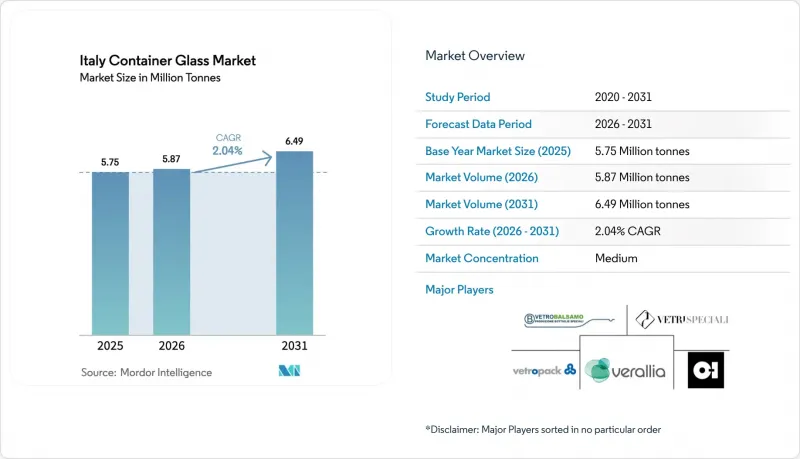
Mordor Intelligence에 의하면, 이탈리아의 용기용 유리 시장 규모는 2025년 575만 톤으로 평가되었고, 2026년에는 587만 톤으로 추정되고, 2026-2031년 CAGR 2.04%로 성장을 지속할 전망이며, 2031년에는 649만 톤에 이를 것으로 예측됩니다.
본 보고서는 최종 사용자별(음료(주류(맥주, 와인, 증류주, 기타 주류) 및 무알코올 음료(탄산음료(CSD), 유제품 베이스 음료, 기타)), 식품(잼·젤리, 조미료·소스 등), 화장품 및 퍼스널케어, 의약품, 향수) 및 색상별(그린, 앰버, 플린트, 기타 색상)로 분류되어 있습니다. 시장 예측은 수량(톤) 기준으로 제시되어 있습니다.
이탈리아의 용기용 유리 시장 동향 및 인사이트
친환경적이고 지속 가능한 포장 솔루션에 대한 수요 증가
이탈리아 소비자들은 무한히 재활용 가능한 유리를 포장 폐기물 문제에 대한 구체적인 해결책으로 인식하고 있습니다. 현재 슈퍼마켓에서는 반환 가능한 병이나 재활용률이 높은 병에 담긴 제품에 진열 공간을 우선적으로 할당하고 있으며, 이로 인해 브랜드 소유주들은 유리 용기로의 전환을 서두르고 있습니다. 2030년까지 회수율 90%를 달성하겠다는 PPWR의 목표가 이러한 전환을 가속화하고 있으며, CONAI의 역물류 네트워크가 안정적인 유리 파편 흐름을 실현함으로써 이탈리아 유리 용기 시장은 구조적인 뒷받침을 받고 있습니다. 환경 친화성에 대한 프리미엄을 기꺼이 지불하려는 브랜드들이 수요를 확대하고, 플라스틱 대체재가 과세 및 평판 위험에 직면하는 반면, 이탈리아의 유리 용기 시장은 이미지가 좋은 제품에 있어 여전히 표준적인 선택지로 남아 있습니다.
순환형 경제를 지원하는 정부 시책과 EU 규제
2024년에 도입된 1kg당 0.45유로(0.48달러)의 이탈리아 플라스틱세로 인해 PET와 유리의 비용 격차는 즉시 축소되었습니다. 확대 생산자 책임 제도에 따른 수수료는 현재 재활용 가능성 점수에 따라 변동하고 있으며, 회수율이 높은 유리에 대해서는 사실상 보조금이 지급되고 있습니다. CoReVe 산하에서 운영되는 국내 유리 재활용 공장은 연간 200만 톤 이상의 유리 파편을 처리하며, 생산자에 대한 안정적인 공급을 보장하고 있습니다. 이러한 정책 수단들이 결합되어 이탈리아의 용기용 유리 시장 기준을 높였으며, 프리미엄 부문에서 대체재의 도입을 억제하고 있습니다.
가볍고 비용 효율이 뛰어난 대체품에 의한 치열한 경쟁
알루미늄 캔은 같은 부피의 유리에 비해 무게가 약 60% 가벼워 장거리 운송 시 운임을 최대 25% 절감할 수 있습니다. PET 병은 디자인 자유도가 높고 내충격성을 겸비하고 있어 외출 시 소비하는 소비자들에게 매력적입니다. 신속한 비용 절감을 목표로 하는 대형 음료 기업들은 용기 형태를 빠르게 전환할 수 있어, 엔트리 가격대 부문에서 이탈리아 유리 용기 시장 점유율을 빼앗고 있습니다. 이에 대응하여 유리 제조업체들은 포장이 단순한 상품 원가가 아니라 브랜드 전통의 핵심을 이루는 프리미엄 라인에 초점을 맞추었습니다.
부문 분석
2025년, 음료 부문은 이탈리아 유리 용기 시장의 57.74%를 차지했으며, 용해로의 처리량 대부분을 차지하고 다교대 체제의 운영을 뒷받침하고 있습니다. 주류, 특히 와인은 전체의 35%를 차지하며, 여전히 지방의 포도 재배 클러스터와 밀접하게 연결되어 있습니다. 연평균 4.2%의 성장률을 기록하고 있는 수제 맥주는 소규모 유리 제조업체가 매력적인 이익률로 공급할 수 있는 개성 있는 병 금형에 대한 수요를 활성화시키고 있습니다. 무알코올 프리미엄 주스와 보타니컬 소다도 이러한 성장세에 합류하여 이탈리아 유리 용기 시장 규모 확대를 뒷받침하고 있습니다.
화장품 및 퍼스널케어 부문은 연평균 성장률(CAGR) 3.9%로 가장 빠른 성장세를 보이고 있으며, 이는 리필 가능한 유리병과 고급 향수에 대한 소비자 수요를 반영합니다. 럭셔리 브랜드들은 유리의 촉감과 시각적 매력을 활용하여 높은 가격 책정을 정당화하고, 톤당 매출을 끌어올리고 있습니다. 식품 용도는 안정적이고 변동이 적은 기반을 형성하고 있는 반면, 의약품용 바이알과 앰플은 이탈리아의 수출 지향적인 의약품 부문의 혜택을 받고 있습니다. 이러한 동향들이 맞물리면서 용해로의 가동률은 90% 이상을 유지하고 있으며, 소량 생산에 높은 수익률을 내는 생산 라인의 도입을 촉진하고 있습니다.
기타 혜택
- 엑셀 형식 시장 예측(ME) 시트
- 3개월간의 애널리스트 지원
자주 묻는 질문
목차
제1장 서론
제2장 조사 방법
제3장 주요 요약
제4장 시장 구도
제5장 시장 규모 및 성장 예측
제6장 경쟁 구도
제7장 시장 기회 및 향후 전망
AJY 26.09.15According to Mordor Intelligence, the Italy container glass market size is expected to grow from 5.75 million tonnes in 2025 to 5.87 million tonnes in 2026 and is forecast to reach 6.49 million tonnes by 2031 at 2.04% CAGR over 2026-2031.
This report is Segmented by End-User (Beverages [Alcoholic {Beer, Wine, Spirits, Other Alcoholic Beverages}, and Non-Alcoholic {CSDs, Dairy Product Based Drinks, and More}], Food [Jam and Jelly, Condiments and Sauces, and More], Cosmetics and Personal Care, Pharmaceuticals, and Perfumery) and Color (Green, Amber, Flint, and Other Colors). The Market Forecasts are Provided in Terms of Volume (Tonnes).
Italy Container Glass Market Trends and Insights
Rising Demand for Eco-Friendly and Sustainable Packaging Solutions
Italian shoppers view endlessly recyclable glass as a tangible response to packaging waste concerns. Supermarkets now prioritize shelf space for products in returnable or high-recycled-content bottles, pushing brand owners toward glass. The PPWR target of 90% collection by 2030 accelerates this shift, and the Italy container glass market gains structural support as CONAI's reverse-logistics network achieves consistent cullet flows. Brands willing to pay a green premium amplify demand, ensuring that the Italy container glass market remains the default for high-image goods while plastic alternatives face levies and reputational risks.
Government Policies and EU Regulations Supporting Circular Economy
Italy's plastic tax of EUR 0.45 (USD 0.48) per kg, introduced in 2024, immediately narrowed the cost gap between PET and glass. Extended producer-responsibility fees now scale with recyclability scores, effectively subsidizing glass because of its high recovery rate. National glass-recycling plants operating under CoReVe process more than 2 million tons of cullet annually, guaranteeing supply stability for producers. These policy levers collectively raise the baseline for the Italy container glass market and discourage substitution in premium segments.
Intense Competition from Lightweight and Cost-Effective Alternatives
Aluminum cans weigh roughly 60% less than equal-volume glass, trimming freight outlays by as much as 25% for long hauls. PET bottles add design freedom and shatter resistance that appeal to on-the-go consumers. Beverage giants seeking quick cost wins can pivot formats rapidly, siphoning shared volume from the Italy container glass market in entry-price segments. Glass producers respond by targeting premium lines where packaging is central to brand heritage rather than a commodity cost.
Other drivers and restraints analyzed in the detailed report include:
- Booming Beverage Industry, Especially Wine, Spirits, and Craft Beer
- Technological Innovations in Glass Manufacturing
- Higher Transportation and Storage Costs Due to Weight
For complete list of drivers and restraints, kindly check the Table Of Contents.
Segment Analysis
The beverage segment commanded 57.74% of the Italy container glass market in 2025, generating the bulk of furnace throughput and sustaining multi-shift operations. Alcoholic drinks especially wine account for 35% of total volume and remain closely tied to rural viticulture clusters. Craft beer, posting 4.2% annual growth, energizes demand for distinctive bottle molds that smaller glassmakers can supply at attractive margins. Non-alcoholic premium juices and botanical sodas join this momentum, reinforcing the Italy container glass market size uplift.
Cosmetics and personal care exhibits the fastest expansion at a 3.9% CAGR, reflecting consumers' appetite for refillable glass jars and prestige fragrances. Luxury brands leverage glass's tactile and visual cues to justify higher price points, lifting revenue density per ton. Food applications form a stable, low-volatility base, while pharmaceutical vials and ampoules gain from Italy's export-oriented drug sector. Together, these trends keep furnace utilization above 90% and encourage lines dedicated to smaller-batch, higher-margin runs.
Complete Report Scope:
- By End-user
- Beverages
- Alcoholic
- Beer
- Wine
- Spirits
- Other Alcoholic Beverages (Cider and Other Fermented Drinks)
- Non-Alcoholic
- Juices
- Carbonated Drinks (CSDs)
- Dairy Product Based Drinks
- Other Non-Alcoholic Beverages
- Alcoholic
- Food (Jam, Jelly, Marmalades, Honey, Sausages and Condiments, Oil, Pickles)
- Cosmetics and Personal Care
- Pharmaceuticals (excluding Vials and Ampoules)
- Perfumery
- Beverages
- By Color
- Green
- Amber
- Flint
- Other Colors
List of Companies Covered in this Report:
- Verallia Italia S.p.A.
- Vetropack Italia S.r.l.
- Vetri Speciali S.p.A.
- Vetrobalsamo S.p.A.
- O-I Glass Italy S.r.l. (Owens-Illinois)
- Bormioli Luigi S.p.A.
- Ardagh Glass S.A.
- Zignago Vetro S.p.A.
- Vetreria Etrusca S.p.A.
- Vetrerie Riunite S.p.A.
- Vidrala Italia S.r.l.
- Stolzle Glass Group (Italy Division)
- Gerresheimer Italia S.p.A.
- Saverglass Italia S.r.l.
- Vetreria di Borgonovo S.p.A.
- Vetreria Palomar S.r.l.
- Vetreria Artistica Rosa S.r.l.
- Vetreria Empolese S.p.A.
Additional Benefits:
- The market estimate (ME) sheet in Excel format
- 3 months of analyst support
TABLE OF CONTENTS
1 INTRODUCTION
- 1.1 Study Assumptions and Market Definition
- 1.2 Scope of the Study
2 RESEARCH METHODOLOGY
3 EXECUTIVE SUMMARY
4 MARKET LANDSCAPE
- 4.1 Market Overview
- 4.2 Market Drivers
- 4.2.1 Rising Demand for Eco-Friendly and Sustainable Packaging Solutions
- 4.2.2 Government Policies and EU Regulations Supporting Circular Economy
- 4.2.3 Booming Beverage Industry, Especially Wine, Spirits, and Craft Beer
- 4.2.4 Health and Safety Awareness Among Consumers
- 4.2.5 Technological Innovations in Glass Manufacturing
- 4.2.6 Premium Branding and Shelf Appeal of Glass Packaging
- 4.3 Market Restraints
- 4.3.1 Intense Competition from Lightweight and Cost-Effective Alternatives
- 4.3.2 Fragility and Risk of Breakage During Handling and Transport
- 4.3.3 Higher Transportation and Storage Costs Due to Weight
- 4.3.4 Limited Design Flexibility Compared to Malleable Materials
- 4.4 PESTEL Analysis
- 4.5 Industry Value Chain Analysis
- 4.6 Container Glass Furnace Capacity and Locations in Italy
- 4.6.1 Plant Locations and Year of Commencement
- 4.6.2 Production Capacities
- 4.6.3 Types of Furnaces
- 4.6.4 Color of Glass Produced
- 4.7 Export-Import Data of Container Glass - Covering Key Import and Export Destinations
- 4.7.1 Import Volume and Value, 2021-2024
- 4.7.2 Export Volume and Value, 2021-2024
- 4.8 Porter's Five Forces Analysis
- 4.8.1 Threat of New Entrants
- 4.8.2 Bargaining Power of Suppliers
- 4.8.3 Bargaining Power of Buyers
- 4.8.4 Threat of Substitutes
- 4.8.5 Competitive Rivalry
- 4.9 Raw Material Analysis
- 4.10 Recycling Trends for Glass Packaging
- 4.11 Demand vs Supply Analysis for Glass Packaging
5 MARKET SIZE AND GROWTH FORECASTS (VOLUME)
- 5.1 By End-user
- 5.1.1 Beverages
- 5.1.1.1 Alcoholic
- 5.1.1.1.1 Beer
- 5.1.1.1.2 Wine
- 5.1.1.1.3 Spirits
- 5.1.1.1.4 Other Alcoholic Beverages (Cider and Other Fermented Drinks)
- 5.1.1.2 Non-Alcoholic
- 5.1.1.2.1 Juices
- 5.1.1.2.2 Carbonated Drinks (CSDs)
- 5.1.1.2.3 Dairy Product Based Drinks
- 5.1.1.2.4 Other Non-Alcoholic Beverages
- 5.1.1.1 Alcoholic
- 5.1.2 Food (Jam, Jelly, Marmalades, Honey, Sausages and Condiments, Oil, Pickles)
- 5.1.3 Cosmetics and Personal Care
- 5.1.4 Pharmaceuticals (excluding Vials and Ampoules)
- 5.1.5 Perfumery
- 5.1.1 Beverages
- 5.2 By Color
- 5.2.1 Green
- 5.2.2 Amber
- 5.2.3 Flint
- 5.2.4 Other Colors
6 COMPETITIVE LANDSCAPE
- 6.1 Market Concentration
- 6.2 Strategic Moves and Developments
- 6.3 Company Market Share Analysis, (Based on Latest Production Capacity)
- 6.4 Company Profiles (includes Global level Overview, Market level overview, Core Segments, Financials as available, Strategic Information, Market Rank/Share for key companies, Products and Services, and Recent Developments)
- 6.4.1 Verallia Italia S.p.A.
- 6.4.2 Vetropack Italia S.r.l.
- 6.4.3 Vetri Speciali S.p.A.
- 6.4.4 Vetrobalsamo S.p.A.
- 6.4.5 O-I Glass Italy S.r.l. (Owens-Illinois)
- 6.4.6 Bormioli Luigi S.p.A.
- 6.4.7 Ardagh Glass S.A.
- 6.4.8 Zignago Vetro S.p.A.
- 6.4.9 Vetreria Etrusca S.p.A.
- 6.4.10 Vetrerie Riunite S.p.A.
- 6.4.11 Vidrala Italia S.r.l.
- 6.4.12 Stolzle Glass Group (Italy Division)
- 6.4.13 Gerresheimer Italia S.p.A.
- 6.4.14 Saverglass Italia S.r.l.
- 6.4.15 Vetreria di Borgonovo S.p.A.
- 6.4.16 Vetreria Palomar S.r.l.
- 6.4.17 Vetreria Artistica Rosa S.r.l.
- 6.4.18 Vetreria Empolese S.p.A.
7 MARKET OPPORTUNITIES AND FUTURE OUTLOOK
- 7.1 White-space and Unmet-Need Assessment


