

|
시장보고서
상품코드
2125452
프랑스의 용기용 유리 시장 : 시장 점유율 분석, 업계 동향 및 통계, 성장 예측(2026-2031년)France Container Glass - Market Share Analysis, Industry Trends & Statistics, Growth Forecasts (2026 - 2031) |
||||||
 Mordor Intelligence
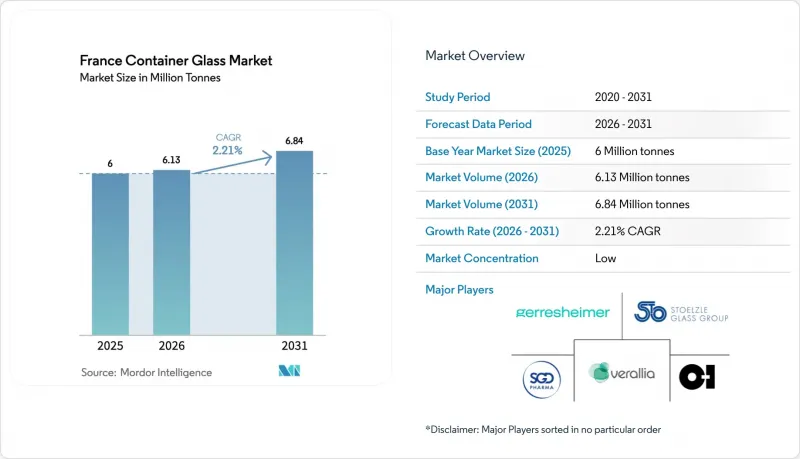
Mordor Intelligence에 의하면, 프랑스의 용기용 유리 시장 규모는 2025년에 600만 톤으로 평가되었고, 2026년 613만 톤에서 2031년까지 684만 톤에 이를 것으로 예측되며, 예측 기간(2026-2031년) CAGR은 2.21%를 나타낼 전망입니다.
본 보고서는 최종 사용자별(음료 (주류(맥주, 와인, 증류주, 기타 주류), 무알코올 음료(탄산음료(CSD), 유제품 베이스 음료 등)), 식품(잼·젤리, 조미료·소스 등), 화장품 및 퍼스널케어, 향수, 기타), 색상별(플린트, 앰버, 그린, 기타)로 분류되어 있습니다. 시장 예측은 수량(톤) 기준으로 제시되어 있습니다.
프랑스의 용기용 유리 시장 동향 및 인사이트
프리미엄 주류 시장의 성장
샴페인과 코냑 제조업체들은 브랜드의 전통을 강화하기 위해 두꺼운 플린트 유리나 특수한 호박색 병을 계속해서 지정하고 있으며, 다른 음료 틈새 시장에서 가격에 대한 민감성에도 불구하고 유리는 사실상 대체 불가능한 소재가 되었습니다. 2024년에는 출하량이 보합세를 보였음에도 불구하고, 와인 수출 수입은 95억 8,000만 유로(108억 3,000만 달러)로 증가했습니다. 이는 정교한 바닥 오목 처리나 엠보싱 가공을 통해 더 높은 단가가 정당화되는 프리미엄 SKU로의 가치 이동을 보여줍니다. 디아지오(Diageo)가 내세운 ‘2030년까지 프랑스 증류주 매출의 12%를 점유하겠다’는 목표는 유리를 기반으로 한 고수익 포맷에 대한 외부 수요가 높음을 여실히 보여줍니다. AOC(원산지 명칭 통제)에 기반한 보호 지정 규정은 진위성 검증에서 유리의 역할을 더욱 공고히 하여 구조적인 수요를 확고히 하고 있습니다.
화장품 및 고급 향수 부문의 확대
그라스나 파리의 고급 향수 제조업체들은 금속 가공된 목 부분이나 산 에칭 로고가 있는 정교하게 성형된 병을 선호하지만, 이러한 디자인은 용기용 유리로만 대규모로 구현할 수 있습니다. 이 부문은 2030년까지 연평균 성장률(CAGR) 2.83%로 성장하고 있으며, 특정 플라스틱 부품에 대한 규제와 재활용 가능한 고급 포장을 원하는 소비자 수요에 힘입어 프랑스 용기용 유리 시장 전체를 능가하는 속도로 확대되고 있습니다. SGD Pharma는 2024년에 화장품용 포맷에 대응하기 위해 국내에 있는 2기의 용융로를 현대화하기 위해 3,100만 유로(3,500만 달러)를 투자하며, 수요가 확고하게 자리 잡고 있음을 보여주고 있습니다. SEALIAN과 같은 내부 실리콘화 처리는 휘발성이 높은 향료 기반 물질과의 상호 작용을 억제하는 동시에, 추가적인 경량화를 가능하게 합니다.
유리 제조의 높은 에너지 소비
1,600°C에 달하는 용융 온도로 인해 에너지 집약도는 여전히 높은 수준을 유지하고 있으며, 2024년 프랑스 산업계에서 거의 두 배로 상승한 전력 가격의 영향을 더욱 가중시켰습니다. EU 배출권 거래 제도(EU ETS)의 제4단계에서는 무상 할당량이 감축되어, 표준 엔드파이어식 용광로의 경우 CO2 배출 1톤당 80-90유로(90-102달러)의 탄소 규정 준수 비용이 증가하게 됩니다. 2024년 베랄리아(Veralia)사의 매출이 8.7% 감소한 것은 가격 인상으로만 에너지 추가 비용을 완전히 충당할 수 없는 경우 이익률이 즉시 압박을 받게 됨을 보여줍니다.
부문별 분석
음료 부문은 2025년 출하량의 59.62%를 차지했으며, 이는 프랑스 용기용 유리 시장 규모 3,577.2킬로톤에 해당합니다. 샴페인,코냑, 프리미엄 스틸 와인의 성장에 힘입어, 경량 PET 병이 보급형 사이다나 주스용 병의 점유율을 잠식하고 있음에도 불구하고 기본 수량 수준은 유지되고 있습니다. 프리미엄 주류 브랜드들은 뛰어난 산소 침투 방지 성능과 높은 매장 가격을 정당화할 수 있는 촉각적 특징을 이유로 유리병을 고수하고 있습니다. 국내 소규모 양조장들은 크래프트 맥주로서의 기원을 강조하기 위해 엠보싱 처리된 재사용 가능한 유리병을 채택하고 있으며, 이는 대중 시장 라거 맥주에서 알루미늄 용기의 급증세를 소폭 상쇄하고 있습니다.
식품, 화장품, 의약품은 프랑스 용기용 유리 시장 규모의 나머지 40.38%를 합쳐 차지하고 있지만, 화장품 및 퍼스널케어 분야는 고급 제품 수출이 호조를 보임에 따라 연평균 성장률(CAGR) 2.69%로 확대되고 있습니다. 까르띠에, 디올, 에르메스는 조각이 새겨진 병에 담긴 한정판 향수를 출시하며, 색상이 변하는 전로가 장착된 특수 용기에 대한 수요를 촉진하고 있습니다. 제약 기업들은 바이오의약품을 위해 제1형 붕규산 바이알을 지속적으로 채택하고 있으며, 음료 시장의 경기 변동기에도 기준 생산량을 유지하고 있습니다.
기타 혜택 :
- 엑셀 형식 시장 예측(ME) 시트
- 3개월간의 애널리스트 지원
자주 묻는 질문
목차
제1장 서론
제2장 조사 방법
제3장 주요 요약
제4장 시장 구도
제5장 시장 규모 및 성장 예측
제6장 경쟁 구도
제7장 시장 기회 및 향후 전망
AJY 26.09.15According to Mordor Intelligence, the France container glass market size was valued at 6 million tonnes in 2025 and estimated to grow from 6.13 million tonnes in 2026 to reach 6.84 million tonnes by 2031, at a CAGR of 2.21% during the forecast period (2026-2031).
This report is Segmented by End-User (Beverages [Alcoholic {Beer, Wine, Spirits, Other Alcoholic Beverages}, and Non-Alcoholic {Carbonated Drinks (CSDs), Dairy Product Based Drinks, and More}], Food [Jam and Jelly, Condiments and Sauces, and More], Cosmetics and Personal Care, Perfumery, and More), Color (Flint, Amber, Green, and More). The Market Forecasts are Provided in Terms of Volume (Tonnes).
France Container Glass Market Trends and Insights
Growth in Premium Alcoholic Beverages
Champagne and cognac houses continue to specify thick-wall flint and specialty amber flasks to reinforce brand heritage, making glass effectively non-substitutable despite price sensitivity in other beverage niches. Wine export earnings rose to EUR 9.58 billion (USD 10.83 billion) in 2024, even as volumes plateaued, illustrating value migration to premium SKUs where elaborate punted bottles and embossing justify higher unit economics. Diageo's stated goal of seizing 12% of French spirits sales by 2030 underscores external appetite for high-margin formats anchored in glass. Protected-designation rules under AOC further cement glass's role in authenticity verification, locking in structural demand.
Expansion of Cosmetics and Luxury Perfumes Sector
Luxury perfume houses in Grasse and Paris favor intricately molded flacons with metallized necks and acid-etched logos that only container glass can deliver at scale. The segment is growing at 2.83% CAGR through 2030, outpacing the broader France container glass market, helped by regulatory curbs on certain plastic components and consumer pursuit of recyclable prestige packaging. SGD Pharma invested EUR 31 million (USD 35 million) in 2024 to modernize two domestic furnaces geared toward cosmetic formats, signaling entrenched demand. Internal siliconization treatments such as SEALIAN mitigate interaction with volatile fragrance bases while enabling further lightweighting.
High Energy Consumption in Glass Production
Melting temperatures of 1,600°C keep energy intensity elevated, amplifying exposure to electricity prices that nearly doubled for French industry in 2024. Phase IV of the EU ETS slices free allocations, lifting carbon compliance costs by EUR 80-90 (USD 90-102) per ton of CO2 emitted for a standard end-fired furnace. Verallia's 8.7% revenue drop in 2024 shows immediate margin erosion when price hikes cannot fully cover energy surcharges.
Other drivers and restraints analyzed in the detailed report include:
- Consumer Preference for Non-Toxic Packaging
- Technological Advancements in Lightweight Glass Manufacturing
- Competition from Lightweight Alternatives
For complete list of drivers and restraints, kindly check the Table Of Contents.
Segment Analysis
The beverages channel generated 59.62% of 2025 shipments, equal to 3,577.2 kilotons of the France container glass market size. Growth in Champagne, cognac, and premium still wines secures baseline volume even as lighter PET erodes entry-level cider and juice bottles. Premium alcoholic labels retain glass for superior oxygen ingress protection and tactile cues that rationalize higher shelf prices. Domestic microbreweries lean into embossed, returnable glass to emphasize craft provenance, slightly offsetting aluminum's surge among mass-market lagers.
Food, cosmetics, and pharmaceuticals collectively account for the remaining 40.38% of France's container glass market volume, yet cosmetics and personal care are expanding at a 2.69% CAGR on strong luxury exports.Cartier, Dior, and Hermes launch limited-edition scents in sculptural flacons, stimulating demand for specialty furnaces with color-changing forehearths. Pharmaceutical firms adhere to type-I borosilicate vials for biologics, reinforcing baseline throughput during beverage cyclicality.
Complete Report Scope:
- By End-user
- Beverages
- Alcoholic
- Beer
- Wine
- Spirits
- Other Alcoholic Beverages (Cider and Other Fermented Drinks)
- Non-Alcoholic
- Juices
- Carbonated Drinks (CSDs)
- Dairy Product Based Drinks
- Other Non-Alcoholic Beverages
- Alcoholic
- Food (Jam, Jelly, Marmalades, Honey, Sausages and Condiments, Oil, Pickles)
- Cosmetics and Personal Care
- Pharmaceuticals (excluding Vials and Ampoules)
- Perfumery
- Beverages
- By Color
- Green
- Amber
- Flint
- Other Colors
List of Companies Covered in this Report:
- O-I Glass, Inc.
- Verallia Packaging SAS
- Verescence S.A.
- Saverglass Group
- SGD S.A.
- Stoelzle Glass Group
- Pochet Group
- Gerresheimer AG
- Zignago Vetro SpA
- Ardagh Glass S.A.
- Vidrala, S.A
- Coverpla S.A.S.
- Id Labo
Additional Benefits:
- The market estimate (ME) sheet in Excel format
- 3 months of analyst support
TABLE OF CONTENTS
1 INTRODUCTION
- 1.1 Study Assumptions and Market Definition
- 1.2 Scope of the Study
2 RESEARCH METHODOLOGY
3 EXECUTIVE SUMMARY
4 MARKET LANDSCAPE
- 4.1 Market Overview
- 4.2 Market Drivers
- 4.2.1 Growth in Premium Alcoholic Beverages (Champagne, Cognac, Wine)
- 4.2.2 Expansion of Cosmetics and Luxury Perfumes Sector
- 4.2.3 Consumer Preference for Non-Toxic Packaging
- 4.2.4 Technological Advancements in Lightweight Glass Manufacturing
- 4.2.5 Rise in Eco-Conscious Consumer Behavior
- 4.2.6 Export Demand for French Packaged Goods
- 4.3 Market Restraints
- 4.3.1 High Energy Consumption in Glass Production
- 4.3.2 Competition from Lightweight Alternatives
- 4.3.3 Fragility and Higher Transportation Costs
- 4.3.4 Volatility in Raw Material Prices
- 4.4 PESTEL Analysis
- 4.5 Industry Supply-Chain Analysis
- 4.6 Container Glass Furnace Capacity and Locations in France
- 4.6.1 Plant Locations and Year of Commencement
- 4.6.2 Production Capacities
- 4.6.3 Types of Furnaces
- 4.6.4 Color of Glass Produced
- 4.7 Export-Import Data of Container Glass - Covering Key Import and Export Destinations
- 4.7.1 Import Volume and Value, 2021-2024
- 4.7.2 Export Volume and Value, 2021-2024
- 4.8 Porter's Five Forces Analysis
- 4.8.1 Threat of New Entrants
- 4.8.2 Bargaining Power of Suppliers
- 4.8.3 Bargaining Power of Buyers
- 4.8.4 Threat of Substitutes
- 4.8.5 Competitive Rivalry
- 4.9 Raw Material Analysis
- 4.10 Recycling Trends for Glass Packaging
- 4.11 Demand vs Supply Analysis for Glass Packaging
5 MARKET SIZE AND GROWTH FORECASTS (VOLUME)
- 5.1 By End-user
- 5.1.1 Beverages
- 5.1.1.1 Alcoholic
- 5.1.1.1.1 Beer
- 5.1.1.1.2 Wine
- 5.1.1.1.3 Spirits
- 5.1.1.1.4 Other Alcoholic Beverages (Cider and Other Fermented Drinks)
- 5.1.1.2 Non-Alcoholic
- 5.1.1.2.1 Juices
- 5.1.1.2.2 Carbonated Drinks (CSDs)
- 5.1.1.2.3 Dairy Product Based Drinks
- 5.1.1.2.4 Other Non-Alcoholic Beverages
- 5.1.1.1 Alcoholic
- 5.1.2 Food (Jam, Jelly, Marmalades, Honey, Sausages and Condiments, Oil, Pickles)
- 5.1.3 Cosmetics and Personal Care
- 5.1.4 Pharmaceuticals (excluding Vials and Ampoules)
- 5.1.5 Perfumery
- 5.1.1 Beverages
- 5.2 By Color
- 5.2.1 Green
- 5.2.2 Amber
- 5.2.3 Flint
- 5.2.4 Other Colors
6 COMPETITIVE LANDSCAPE
- 6.1 Market Concentration
- 6.2 Strategic Moves and Developments
- 6.3 Company Market Share Analysis, (Based on Latest Production Capacity)
- 6.4 Company Profiles (includes Global level Overview, Market level overview, Core Segments, Financials as available, Strategic Information, Market Rank/Share for key companies, Products and Services, and Recent Developments)
- 6.4.1 O-I Glass, Inc.
- 6.4.2 Verallia Packaging SAS
- 6.4.3 Verescence S.A.
- 6.4.4 Saverglass Group
- 6.4.5 SGD S.A.
- 6.4.6 Stoelzle Glass Group
- 6.4.7 Pochet Group
- 6.4.8 Gerresheimer AG
- 6.4.9 Zignago Vetro SpA
- 6.4.10 Ardagh Glass S.A.
- 6.4.11 Vidrala, S.A
- 6.4.12 Coverpla S.A.S.
- 6.4.13 Id Labo
7 MARKET OPPORTUNITIES AND FUTURE OUTLOOK
- 7.1 White-space and Unmet-Need Assessment


