

|
시장보고서
상품코드
2117536
클라우드 제조 시장 : 점유율 분석, 업계 동향과 통계, 성장 예측(2026-2031년)Cloud Manufacturing - Market Share Analysis, Industry Trends & Statistics, Growth Forecasts (2026 - 2031) |
||||||
 Mordor Intelligence
Mordor Intelligence에 의하면, 클라우드 제조 시장 규모는 2025년에 366억 8,000만 달러가 되고, 2026년부터 2031년까지 CAGR 14.76%로 확대되어 2031년에는 831억 7,000만 달러에 이를 것으로 예측됩니다.
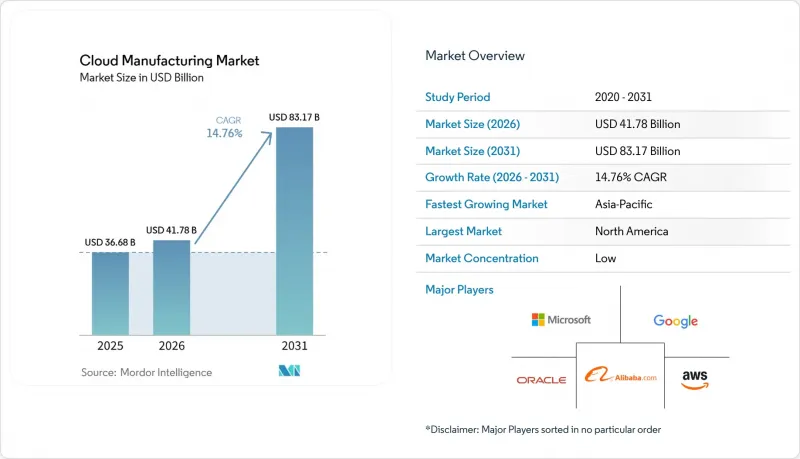
본 보고서는 구성 요소(소프트웨어 및 서비스), 도입 모델(퍼블릭 클라우드, 프라이빗 클라우드 등), 기업 규모(대기업, 중소기업), 최종 사용자 산업(자동차, 항공우주 및 방위, 일렉트로믹스 및 반도체, 의료기기·생명과학 등) 및 지역별로 분류되어 있습니다. 시장 전망은 금액(달러) 기준으로 제시되어 있습니다.
세계 클라우드 제조 시장 동향 및 인사이트
스마트 팩토리와 인더스트리 4.0을 통한 현대화
스마트 팩토리 프로그램은 클라우드 제조 시장에서 가장 명확한 수요 기반 중 하나를 형성하고 있습니다. 이는 에지에서 데이터를 수집하는 것만으로는 공장 간 계획, 품질 또는 협업의 격차를 해소할 수 없기 때문입니다. 딜로이트는 2025년에 미국 제조업체의 88%가 향후 2년 동안 스마트 제조에 대한 투자를 지속하거나 늘릴 것으로 예상하며, 고급 생산 스케줄링과 품질 관리가 주요 업그레이드 우선순위 상위에 랭크되어 있다고 보고했습니다. Bitkom은 2025년 9월, 독일 산업 기업의 71%가 이미 구체적인 인더스트리 4.0 용도를 활용하고 있음을 밝혔습니다. 또한 96%가 이 기술을 국제 경쟁력을 위해 필수적이라고 인식하고 있으며, 80%는 2025년까지 지출 계획을 유지하거나 증액했습니다. 제조업체가 생산 데이터 모델, 품질 스키마, 공급업체의 워크플로우를 클라우드 네이티브 플랫폼에 통합하면, 그 결정을 번복하는 데 드는 비용이 높아지기 때문에 클라우드 제조 시장에서의 장기적인 정착이 강화됩니다. 일본 또한 NEDO가 2025년 5월과 2026년 2월에 ‘스마트 제조 구축 가이드라인’을 개정하여 제조업체가 업무 혁신을 위해 클라우드 기반 디지털 솔루션을 선택할 수 있도록 지원함으로써 이러한 방향성을 더욱 강화했습니다.
산업용 IoT 데이터의 급증과 확장 가능한 분석의 필요성
클라우드 제조 시장은 연결된 산업용 자산의 급속한 증가로부터도 혜택을 받고 있습니다. 이는 장치 수 증가에 따라 개별 플랜트 시스템으로는 경제적으로 처리하기 어려운 데이터 부하가 발생하기 때문입니다. KPMG는 2025년 3월, IoT 연결 기기 수가 2024년 1,800만 대에서 2026년에는 2,240만 대에 달할 것으로 예측했는데, 이는 기계의 연결성과 데이터 생성량의 지속적인 증가를 반영한 것입니다. 중국 공업정보화부(MIIT)의 보고서에 따르면, 2025년 말 기준으로 주요 산업용 인터넷 플랫폼에는 8,900만 대 이상의 기기와 설비가 연결되어 있으며,2026년 1월에 발표된 행동 계획에서는 2028년까지 1억 2,000만 대 이상의 산업용 연결 기기를 목표로 하고 있습니다. 이러한 규모 확대에 따라 공유 데이터 모델, 컨텍스트 분석 및 중앙 집중식 처리의 필요성이 높아지고 있습니다. 이는 구조화되지 않은 원시 기계 신호가 클라우드 제조 시장에서 스토리지 비용을 증가시키고 의사결정 주기를 지연시키기 때문입니다. 일본은 2025년 6월, 26개 주요 제조업 경제권 내 공장 운영 파트너십의 60% 이상을 시스템 통합사업자와 클라우드 플랫폼 공급업체가 차지하고 있다고 덧붙이며, 데이터의 맥락화가 데이터 수집 그 자체만큼이나 중요해지고 있음을 보여주었습니다.
사이버 보안 및 산업용 데이터의 개인정보 보호 위험
사이버 보안은 여전히 클라우드 제조 시장의 주요 구조적 제약 요인으로 남아 있습니다. 이는 OT 관련 사고가 데이터 유출뿐만 아니라 생산 중단까지 초래할 수 있기 때문입니다. 버라이즌은 2025년에 조사 대상인 제조 업계의 보안 침해 사례 중 47%에서 랜섬웨어가 확인되었으며, 도난당한 인증 정보가 공격 벡터의 34%를 차지했고, 해당 부문에서 침해의 동기로 간첩 활동이 급증했다고 보고했습니다. 구글 클라우드(Google Cloud)의 CISO 사무국은 2025년 7월,제조업은 국가가 지원하는 고도화된 지속적 위협(APT)의 표적이 되기 쉬운 분야 중 하나라고 밝히며, 자산 인벤토리나 네트워크 세분화이 불충분할 경우 OT와 클라우드의 하이브리드 환경이 새로운 취약점을 야기할 수 있다고 경고했습니다. 또한 KPMG는 2025년 3월, 조직의 77%가 OT 환경에서 가장 큰 우려 사항으로 랜섬웨어를 꼽고 있음을 밝혔습니다. 이는 제조업계의 클라우드 시장에서 클라우드 전환 결정에 긴 검토 기간과 막대한 보안 비용이 수반되는 경우가 많은 이유를 설명하는 요인 중 하나입니다. 이로 인해 도입이 완전히 차단되는 것은 아니지만, 도입 장벽은 높아지며 클라우드 기능과 산업용 보안 대책을 결합할 수 있는 벤더가 유리해집니다.
부문 분석
2025년 클라우드 제조 시장 규모 중 소프트웨어가 37.68%를 차지하여 매출 기준 최대 구성 요소가 되었습니다. 제조 실행 및 운영 관리 용도는 노후화된 플랜트 수준의 MES 시스템을 대체하고, 현장 활동을 보다 광범위한 계획 및 규정 준수 워크플로우와 연계하기 때문에 주요 도입 동인이 되고 있습니다. 또한, 제조업체들이 재무 계획 주기와 생산 실행 데이터를 보다 직접적으로 연계하려는 가운데, 클라우드 ERP 및 생산 계획 도구도 탄력을 받고 있습니다. SAP는 2026년 초, SAP S/4HANA Cloud Public Edition의 ‘Joule’을 통해 AI 지원형 생산 주문 발행 기능을 출시하며 이러한 방향성을 보여주었습니다. 이를 통해 AI가 일상적인 제조 워크플로우에 더욱 깊이 통합될 것입니다. 제품 수명 주기 및 엔지니어링 협업 도구에 더해, 품질, 추적성, 분석, AI, 디지털 트윈 용도 등이 클라우드 제조 업계, 특히 엄격한 버전 관리와 감사 가능성이 요구되는 분야에서 소프트웨어의 기능적 역할을 확대되고 있습니다.
서비스 시장은 2026년부터 2031년까지 연평균 성장률(CAGR) 16.62%로 확대될 것으로 예측되며, 클라우드 제조 시장에서 가장 두드러진 성장을 보일 분야가 될 전망입니다. 이러한 성장은 긴 업데이트 주기를 거쳐 구축되었으며, 공통 데이터 표준이 부재한 경우가 많은 다양한 OT 환경과 클라우드 플랫폼을 통합하는 데 따르는 어려움을 반영합니다. 많은 제조업체는 플랫폼 선정을 확정하기 전에 운영 모델에 대한 결정을 내려야 하므로, 일반적으로 컨설팅이나 프로세스 재설계 작업부터 프로젝트가 시작됩니다. 그 후, 구현 및 통합 서비스가 프로젝트의 주요 가치를 차지하게 됩니다. 특히, 데이터 마이그레이션이나 상호 연결이 여러 레거시 시스템에 걸쳐 있는 다중 공장 환경에서의 구축에서는 이러한 경향이 두드러집니다. 매니지드 서비스도 성장세를 보이고 있습니다. 딜로이트가 2025년에 실시한 조사에 따르면, 인력 확보 어려움을 이유로 미국 제조업체의 65-70%가 IT, OT, 데이터 사이언스 업무를 외부에 위탁하고 있으며, 이로 인해 서비스 제공 범위가 넓은 벤더는 장기적으로 고객을 유지하기 위한 강력한 수단을 확보하게 됩니다.
2025년 시점에서 퍼블릭 클라우드는 클라우드 제조 시장의 41.99%를 차지하며, 여전히 가장 큰 도입 모델로서의 지위를 유지하고 있습니다. 그 매력은 제조업체가 새로운 사내 인프라를 구축하지 않고도 신속한 도입, 예측 가능한 구독 비용, 정기적인 소프트웨어 업데이트를 필요로 하는 워크로드에서 가장 강력하게 발휘됩니다. 이는 실시간 공정 제어에 비해 지연 요구 사항이 낮은 품질 분석, 조달 계획, 공급업체와의 협업과 같은 이용 사례에서 특히 중요한 요소로 작용합니다. 프라이빗 클라우드는 국방, 항공우주, 규제가 엄격한 생명과학 등의 분야에서 여전히 중요한 위치를 차지하고 있습니다. 이러한 분야에서는 데이터의 소재지나 지적 재산권 보호가 공유 환경의 비용적 이점보다 우선시되는 경우가 많기 때문입니다. 이러한 도입 옵션은 제조업체들이 획일적인 전환 경로를 따르기보다는 워크로드의 기밀성에 따라 아키텍처를 조정하고 있음을 보여주며, 클라우드 제조 시장이 한 방향으로만 움직이고 있는 것은 아님을 시사합니다.
하이브리드 클라우드는 2026년부터 2031년까지 연평균 성장률(CAGR) 17.34%로 확대될 것으로 예측되며, 클라우드 제조 시장에서 가장 빠르게 성장하는 도입 모델이 될 전망입니다. 이 모델은 실제 공장의 요구 사항에 더 밀접하게 부합합니다. 프로그래머블 로직 컨트롤러(PLC), SCADA, 분산 제어 환경에서는 저지연 운영을 위해 여전히 로컬 또는 프라이빗 컴퓨팅 리소스가 필요한 반면, 분석 및 AI 훈련은 확장 가능한 클라우드 리소스의 이점을 누릴 수 있기 때문입니다. 아우디는 2026년 1월, 이 모델을 산업 규모로 실증했습니다. 이 회사의 ‘Edge Cloud 4 Production’ 플랫폼은 독일 공장에 있는 1,000대 이상의 산업용 PC를 가상화된 로컬 클라우드 아키텍처로 대체하면서도, 분석 데이터를 중앙 관리 시스템에 계속 제공했습니다. 또한, 롤랜드 베르거와 알레프 알파가 2025년 9월에 발표한 분석에서도 클라우드 기반 모델 학습과 엣지 기반 실시간 제어를 결합하는 것이 유럽 제조업체에게 가장 신뢰할 수 있는 AI 주권을 구축하는 방법으로 알려져 있습니다. 이를 통해 생산에 필수적인 환경의 로컬 제어를 포기하지 않으면서도 클라우드 수준의 지능을 추구하는 제조업체에게 하이브리드 방식이 현실적인 타협점이 됩니다.
지역별 분석
2025년, 북미는 클라우드 제조 시장의 35.77% 점유율을 차지하며 여전히 가장 규모가 큰 지역 기여자로서의 지위를 유지했습니다. 미국이 이 지역을 주도한 이유는 주요 제조업체들이 이미 시설 및 네트워크 수준에서 클라우드를 충분히 도입했기 때문이며, 딜로이트는 2025년 보고서에서 미국 제조업체의 57%가 이러한 환경에서 클라우드 컴퓨팅을 이용하고 있다고 보고했습니다. 또한, 이 지역에는 복잡한 제조 네트워크 전반에 걸친 대규모 도입을 지원할 수 있는 산업용 소프트웨어, 자동화, 클라우드 공급업체가 밀집해 있다는 점도 강점으로 작용하고 있습니다. 클라우드 제조 시장에서 북미의 성장은 단순한 초기 전환에 그치지 않고, AI 통합, 디지털 트윈, 관리형 서비스 등 플랫폼의 심층적인 활용과 점점 더 밀접하게 연결되어 있습니다.
아시아태평양은 2026년부터 2031년까지 연평균 성장률(CAGR) 16.28%로 확대될 것으로 예측되며, 클라우드 제조 시장에서 가장 빠르게 성장하는 지역 부문이 될 전망입니다. 중국은 시장 규모 확대의 주요 원동력이 되고 있습니다. 중국 공업정보화부(MIIT) 보고서에 따르면, 주요 산업용 인터넷 플랫폼은 2025년 말까지 8,900만 대 이상의 기기를 연결할 것으로 예상되며, 2026년 1월의 행동 계획에서는 2028년까지 1억 2,000만 대 이상의 연결 기기를 목표로 하고 있습니다. 이러한 정책 방향은 클라우드의 보다 광범위한 도입을 뒷받침하고 있습니다. 규모, 연결성, 플랫폼 보급은 더 이상 개별 기업의 판단에 맡겨지는 것이 아니라 국가 차원의 산업 프로그램을 통해 추진되고 있기 때문입니다. 한편, 일본은 또 다른 성장 요인으로 부상하고 있습니다. NEDO가 2025년과 2026년에 ‘스마트 제조 구축 가이드라인’을 개정하여, 제조업체가 업무 혁신을 위해 클라우드 기반 솔루션을 선택할 수 있도록 지원하고 있기 때문입니다. 따라서 아시아태평양 전체에서 클라우드 제조 시장은 국가 주도의 산업 정책과 전자, 반도체, 수출 주도형 생산 시스템의 업무상 요구 사항 모두에 의해 형성되고 있습니다.
유럽은 클라우드 제조 시장에서 여전히 2위의 규모를 자랑하는 지역이며, 독일이 그 활동의 중심지로 두각을 나타내고 있습니다. Bitkom은 2025년 9월, 독일 제조 기업의 71%가 이미 구체적인 ‘인더스트리 4.0’ 용도를 활용하고 있으며, 96%가 이러한 기술을 국제 경쟁력에 필수적인 요소로 인식하고, 80%가 2025년까지 관련 지출 계획을 유지하거나 확대하고 있다고 보고했습니다. 데이터 주권은 다른 많은 지역에 비해 유럽에서 수요에 더 큰 영향을 미치고 있으며, T-Systems는 2026년 2월, 규정 준수를 충족하는 플랫폼 상의 도입 문제가 해결되지 않아 AI를 활용한 제조 이니셔티브의 70% 가까이가 여전히 시범 단계에 머물러 있다고 밝혔습니다. 남미, 중동 및 아프리카는 클라우드 제조 시장에서 여전히 규모는 작지만, 광범위한 산업 디지털화 프로그램과 클라우드 인프라 확장을 통해 점차 혜택을 보고 있습니다.
기타 혜택:
- 엑셀 형식 시장 예측(ME) 시트
- 3개월간의 애널리스트 지원
자주 묻는 질문
목차
제1장 서론
제2장 조사 방법
제3장 개요
제4장 시장 구도
제5장 시장 규모와 성장 예측
제6장 경쟁 구도
제7장 시장 기회와 향후 전망
JHS 26.09.01According to Mordor Intelligence, the cloud manufacturing market size stood at USD 36.68 billion in 2025 and is forecast to reach USD 83.17 billion by 2031, at a CAGR of 14.76% from 2026 to 2031.
This report is Segmented by Component (Software, and Services), Deployment Model (Public Cloud, Private Cloud, and More), Enterprise Size (Large Enterprises, and Small and Medium-Sized Enterprises), End-User Industry (Automotive, Aerospace and Defense, Electronics and Semiconductor, Medical Devices and Life Sciences, and More), and Geography. The Market Forecasts are Provided in Terms of Value (USD).
Global Cloud Manufacturing Market Trends and Insights
Smart Factory And Industry 4.0 Modernization
Smart factory programs are creating one of the clearest demand foundations for the cloud manufacturing market because edge data collection alone does not solve planning, quality, or coordination gaps across plants. Deloitte reported in 2025 that 88% of U.S. manufacturers expected smart manufacturing investment to continue or increase over the following 2 years, with advanced production scheduling and quality management ranking among the main upgrade priorities. Bitkom found in September 2025 that 71% of German industrial companies already used concrete Industry 4.0 applications, while 96% viewed the technology as essential for international competitiveness, and 80% maintained or increased spending plans through 2025. Once manufacturers embed production data models, quality schemas, and supplier workflows into a cloud-native platform, the cost of reversing that decision becomes high, which strengthens long-term retention in the cloud manufacturing market. Japan also reinforced this direction when NEDO updated its Smart Manufacturing Construction Guidelines in May 2025 and again in February 2026 to help manufacturers choose cloud-based digital solutions for operational transformation.
Industrial IoT Data Proliferation And Need For Scalable Analytics
The cloud manufacturing market is also gaining from the rapid increase in connected industrial assets, because growing device volumes create data loads that are difficult to process economically in isolated plant systems. KPMG stated in March 2025 that IoT-connected devices were projected to reach 22.4 million units in 2026, up from 18 million in 2024, which reflects a sustained rise in machine connectivity and data generation. China's MIIT reported that key industrial internet platforms had connected more than 89 million devices and equipment sets by the end of 2025, and its January 2026 action plan targeted more than 120 million connected industrial devices by 2028. That scale increases the need for shared data models, contextual analytics, and centralized processing, because raw machine signals without structure raise storage costs and slow decision cycles in the cloud manufacturing market Japan added in June 2025 that system integrators and cloud platform vendors accounted for more than 60% of factory operations partnerships across 26 major manufacturing economies, showing that data contextualization has become as important as data collection itself.
Cybersecurity and Industrial Data Privacy Risks
Cybersecurity remains the main structural drag on the cloud manufacturing market because OT-linked incidents can interrupt production as well as compromise data. Verizon reported in 2025 that ransomware appeared in 47% of manufacturing breaches reviewed, while stolen credentials accounted for 34% of attack vectors, and espionage rose sharply as a breach motive in the sector. Google Cloud's Office of the CISO stated in July 2025 that manufacturing is among the sectors most targeted by state-sponsored advanced persistent threats, and it warned that hybrid OT-cloud environments create new exposure if asset inventories and network segmentation are weak. KPMG also found in March 2025 that 77% of organizations viewed ransomware as the biggest concern in the OT environment, which helps explain why cloud migration decisions in the cloud manufacturing market often involve longer reviews and higher security spending. This does not stop adoption, but it raises the threshold for deployment and favors vendors that can combine cloud capability with industrial security controls.
Other drivers and restraints analyzed in the detailed report include:
- Multi-Site Supply Chain Visibility And Production Orchestration Needs
- Small And Medium-Sized Enterprise Adoption Through Lower Upfront SaaS Costs
- Legacy OT-IT Integration Complexity
For complete list of drivers and restraints, kindly check the Table Of Contents.
Segment Analysis
Software accounted for 37.68% of the cloud manufacturing market size in 2025, which made it the largest component by revenue. Manufacturing execution and operations management applications formed the main entry point because they replace aging plant-level MES installations and connect shop-floor activity with broader planning and compliance workflows. Cloud ERP and production planning tools are also gaining ground as manufacturers try to link financial planning cycles more directly with production execution data. SAP showed this direction in early 2026 when it launched AI-assisted production order release capabilities through Joule in SAP S/4HANA Cloud Public Edition, which brings AI deeper into routine manufacturing workflows. Product lifecycle and engineering collaboration tools, along with quality, traceability, analytics, AI, and digital twin applications, are broadening the functional role of software in the cloud manufacturing industry, especially in sectors that need stricter version control and auditability.
Services are projected to grow at a 16.62% CAGR from 2026 to 2031, making them the fastest-growing component in the cloud manufacturing market. The growth reflects how difficult it is to align cloud platforms with diverse OT estates that were built over long replacement cycles and often lack common data standards. Consulting and process redesign work usually starts the engagement because many manufacturers need operating-model decisions before they can finalize platform selection. Implementation and integration services then capture large project value, especially in multi-plant rollouts where data migration and interconnection span several legacy systems. Managed services are also gaining traction because Deloitte found in 2025 that 65-70% of U.S. manufacturers outsource roles in IT, OT, and data science due to hiring challenges, which gives vendors with service depth a stronger way to retain customers over time.
Public cloud held 41.99% of the cloud manufacturing market size in 2025, which kept it as the largest deployment model. Its appeal remains strongest in workloads where manufacturers want quick deployment, predictable subscription costs, and regular software updates without new internal infrastructure. That has been especially relevant for quality analytics, procurement planning, and supplier collaboration use cases where latency demands are lower than in real-time process control. Private cloud remains important in sectors such as defense, aerospace, and regulated life sciences, where data residency and intellectual property protection often outweigh the cost advantages of shared environments. These deployment choices show that the cloud manufacturing market is not moving in a single direction, because manufacturers are matching architecture to workload sensitivity rather than following a uniform migration path.
Hybrid cloud is projected to expand at a 17.34% CAGR from 2026 to 2031, making it the fastest-growing deployment model in the cloud manufacturing market. The model fits actual factory needs more closely because programmable logic controllers, SCADA, and distributed control environments still require local or private compute for low-latency operations, while analytics and AI training benefit from scalable cloud resources. Audi illustrated this model at industrial scale in January 2026 when its Edge Cloud 4 Production platform replaced more than 1,000 industrial PCs in German plants with a virtualized local cloud architecture that still fed analytics into centralized systems. A September 2025 analysis by Roland Berger and Aleph Alpha also argued that cloud-based model training combined with edge-based real-time control offered the most credible AI sovereignty setup for European manufacturers. That makes hybrid the practical middle ground for manufacturers that want cloud-level intelligence without giving up local control of production-critical environments.
Complete Report Scope:
- By Component
- Software
- Manufacturing Execution and Operations Management Software
- Cloud ERP and Production Planning Software
- Product Lifecycle and Engineering Collaboration Software
- Quality, Traceability and Compliance Software
- Analytics, AI and Digital Twin Software
- Services
- Consulting and Process Redesign Services
- Implementation and Integration Services
- Managed Services
- Support and Maintenance Services
- Training and Change Management Services
- Software
- By Deployment model
- Public cloud
- Private cloud
- Hybrid cloud
- By Enterprise Size
- Large enterprises
- Small and medium-sized enterprises
- By End-User Industry
- Automotive
- Aerospace and Defense
- Electronics and Semiconductor
- Industrial Machinery and Equipment
- Medical Devices and Life Sciences
- Consumer Goods and Food and Beverage
- Chemicals and Materials
- Energy and Utilities
- Other End-User Industries
- By Geography
- North America
- United States
- Canada
- Mexico
- South America
- Brazil
- Argentina
- Rest of South America
- Europe
- Germany
- United Kingdom
- France
- Italy
- Rest of Europe
- Asia-Pacific
- China
- Japan
- India
- South Korea
- Rest of Asia-Pacific
- Middle East and Africa
- Saudi Arabia
- United Arab Emirates
- Turkey
- South Africa
- Egypt
- Rest of Middle East and Africa
- North America
Geography Analysis
North America held 35.77% of the cloud manufacturing market share in 2025, which kept it as the largest regional contributor. The United States led the region because large manufacturers had already built meaningful cloud adoption at the facility and network level, and Deloitte reported in 2025 that 57% of U.S. manufacturers used cloud computing in those settings. The region also benefits from a dense base of industrial software, automation, and cloud vendors that can support large-scale deployments across complex manufacturing networks. In the cloud manufacturing market, North American growth is increasingly tied to deeper platform use, including AI integration, digital twins, and managed services, rather than first-time migration alone.
Asia-Pacific is projected to expand at a 16.28% CAGR from 2026 to 2031, making it the fastest-growing regional segment in the cloud manufacturing market. China is the main volume engine because MIIT reported that key industrial internet platforms had connected more than 89 million devices by the end of 2025, and the January 2026 action plan targeted more than 120 million connected devices by 2028. That policy direction supports broader cloud adoption because scale, connectivity, and platform penetration are now being pushed through national industrial programs rather than left to isolated enterprise decisions. Japan adds a different layer of growth because NEDO updated its Smart Manufacturing Construction Guidelines in 2025 and 2026 to help manufacturers choose cloud-based solutions for operational transformation. Across Asia-Pacific, the cloud manufacturing market is therefore being shaped by both state-backed industrial policy and the operational demands of electronics, semiconductor, and export-led production systems.
Europe remained the second-largest region in the cloud manufacturing market, with Germany as the clearest center of activity. Bitkom reported in September 2025 that 71% of German industrial firms already used concrete Industry 4.0 applications, 96% saw these technologies as essential for international competitiveness, and 80% maintained or increased related spending plans through 2025. Data sovereignty is shaping demand more strongly in Europe than in many other regions, and T-Systems said in February 2026 that nearly 70% of AI manufacturing initiatives had remained in pilot stages because deployment on compliant platforms was unresolved. South America, the Middle East and Africa remain smaller in the cloud manufacturing market, but they are gradually benefiting from wider industrial digitalization programs and the expansion of cloud infrastructure footprints.
- Microsoft Corporation
- SAP SE
- Oracle Corporation
- Siemens Aktiengesellschaft
- Amazon.com, Inc.
- Google LLC
- International Business Machines Corporation
- PTC Inc.
- Dassault Systemes SE
- Rockwell Automation, Inc.
- Autodesk, Inc.
- ABB Ltd
- Cisco Systems, Inc.
- Hewlett Packard Enterprise Company
- Epicor Software Corporation
- Infor Inc.
- IFS AB
- Tata Consultancy Services Limited
- Hitachi, Ltd.
- Fujitsu Limited
- Tulip Interfaces, Inc.
Additional Benefits:
- The market estimate (ME) sheet in Excel format
- 3 months of analyst support
TABLE OF CONTENTS
1 INTRODUCTION
- 1.1 Study Assumptions and Market Definition
- 1.2 Scope of the Study
2 RESEARCH METHODOLOGY
3 EXECUTIVE SUMMARY
4 MARKET LANDSCAPE
- 4.1 Market Overview
- 4.2 Market Drivers
- 4.2.1 Smart Factory and Industry 4.0 Modernization
- 4.2.2 Industrial IoT Data Proliferation and Need for Scalable Analytics
- 4.2.3 Multi-Site Supply Chain Visibility and Production Orchestration Needs
- 4.2.4 Small and Medium-Sized Enterprise Adoption Through Lower Upfront SaaS Costs
- 4.2.5 Sovereign and Edge-Cloud Architectures Expanding Cloud Use in Regulated Plants
- 4.2.6 Product Passport and Carbon Traceability Demands Strengthening Digital Thread Adoption
- 4.3 Market Restraints
- 4.3.1 Cybersecurity and Industrial Data Privacy Risks
- 4.3.2 Legacy OT-IT Integration Complexity
- 4.3.3 Data Sovereignty Rules Fragmenting Cross-Border Cloud Manufacturing Rollouts
- 4.3.4 AI Workload Cost Inflation and Poor Data Pipeline Governance Eroding ROI
- 4.4 Industry Value Chain Analysis
- 4.5 Impact of Macroeconomic Factors on the Market
- 4.6 Regulatory Landscape
- 4.7 Technological Outlook
- 4.8 Porter's Five Forces Analysis
- 4.8.1 Threat of New Entrants
- 4.8.2 Bargaining Power of Suppliers
- 4.8.3 Bargaining Power of Buyers
- 4.8.4 Threat of Substitutes
- 4.8.5 Competitive Rivalry
5 MARKET SIZE AND GROWTH FORECASTS (VALUE)
- 5.1 By Component
- 5.1.1 Software
- 5.1.1.1 Manufacturing Execution and Operations Management Software
- 5.1.1.2 Cloud ERP and Production Planning Software
- 5.1.1.3 Product Lifecycle and Engineering Collaboration Software
- 5.1.1.4 Quality, Traceability and Compliance Software
- 5.1.1.5 Analytics, AI and Digital Twin Software
- 5.1.2 Services
- 5.1.2.1 Consulting and Process Redesign Services
- 5.1.2.2 Implementation and Integration Services
- 5.1.2.3 Managed Services
- 5.1.2.4 Support and Maintenance Services
- 5.1.2.5 Training and Change Management Services
- 5.1.1 Software
- 5.2 By Deployment model
- 5.2.1 Public cloud
- 5.2.2 Private cloud
- 5.2.3 Hybrid cloud
- 5.3 By Enterprise Size
- 5.3.1 Large enterprises
- 5.3.2 Small and medium-sized enterprises
- 5.4 By End-User Industry
- 5.4.1 Automotive
- 5.4.2 Aerospace and Defense
- 5.4.3 Electronics and Semiconductor
- 5.4.4 Industrial Machinery and Equipment
- 5.4.5 Medical Devices and Life Sciences
- 5.4.6 Consumer Goods and Food and Beverage
- 5.4.7 Chemicals and Materials
- 5.4.8 Energy and Utilities
- 5.4.9 Other End-User Industries
- 5.5 By Geography
- 5.5.1 North America
- 5.5.1.1 United States
- 5.5.1.2 Canada
- 5.5.1.3 Mexico
- 5.5.2 South America
- 5.5.2.1 Brazil
- 5.5.2.2 Argentina
- 5.5.2.3 Rest of South America
- 5.5.3 Europe
- 5.5.3.1 Germany
- 5.5.3.2 United Kingdom
- 5.5.3.3 France
- 5.5.3.4 Italy
- 5.5.3.5 Rest of Europe
- 5.5.4 Asia-Pacific
- 5.5.4.1 China
- 5.5.4.2 Japan
- 5.5.4.3 India
- 5.5.4.4 South Korea
- 5.5.4.5 Rest of Asia-Pacific
- 5.5.5 Middle East and Africa
- 5.5.5.1 Saudi Arabia
- 5.5.5.2 United Arab Emirates
- 5.5.5.3 Turkey
- 5.5.5.4 South Africa
- 5.5.5.5 Egypt
- 5.5.5.6 Rest of Middle East and Africa
- 5.5.1 North America
6 COMPETITIVE LANDSCAPE
- 6.1 Market Concentration
- 6.2 Strategic Moves
- 6.3 Market Share Analysis
- 6.4 Company Profiles (includes Global Level Overview, Market Level Overview, Core Segments, Financials as available, Strategic Information, Market Rank/Share, Products and Services, Recent Developments)
- 6.4.1 Microsoft Corporation
- 6.4.2 SAP SE
- 6.4.3 Oracle Corporation
- 6.4.4 Siemens Aktiengesellschaft
- 6.4.5 Amazon.com, Inc.
- 6.4.6 Google LLC
- 6.4.7 International Business Machines Corporation
- 6.4.8 PTC Inc.
- 6.4.9 Dassault Systemes SE
- 6.4.10 Rockwell Automation, Inc.
- 6.4.11 Autodesk, Inc.
- 6.4.12 ABB Ltd
- 6.4.13 Cisco Systems, Inc.
- 6.4.14 Hewlett Packard Enterprise Company
- 6.4.15 Epicor Software Corporation
- 6.4.16 Infor Inc.
- 6.4.17 IFS AB
- 6.4.18 Tata Consultancy Services Limited
- 6.4.19 Hitachi, Ltd.
- 6.4.20 Fujitsu Limited
- 6.4.21 Tulip Interfaces, Inc.
7 MARKET OPPORTUNITIES AND FUTURE OUTLOOK
- 7.1 White-Space and Unmet-Need Assessment


