

|
시장보고서
상품코드
2121329
스마트 제조 : 시장 점유율 분석, 업계 동향과 통계, 성장 예측(2026-2031년)Smart Manufacturing - Market Share Analysis, Industry Trends & Statistics, Growth Forecasts (2026 - 2031) |
||||||
 Mordor Intelligence
Mordor Intelligence에 의하면, 스마트 제조 시장 규모는 2026년에 3,871억 4,000만 달러에 이르고, 2031년까지 7,300억 4,000만 달러에 이를 것으로 예측되며, CAGR은 13.53%를 기록할 전망입니다.
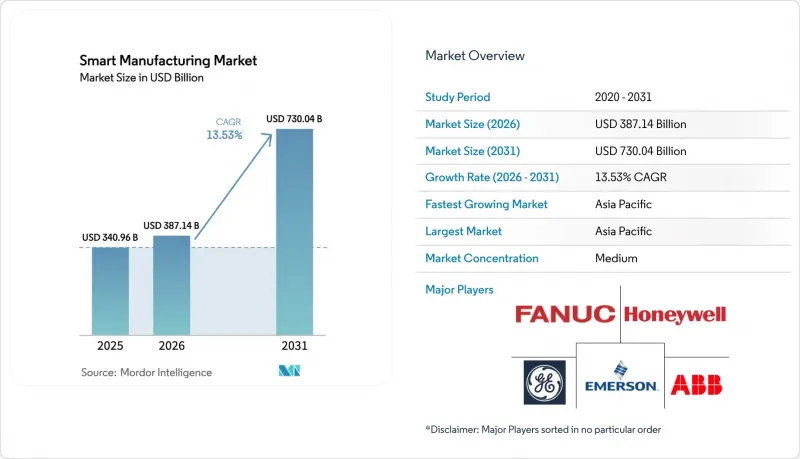
본 보고서는 기술별(프로그래머블 로직 컨트롤러(PLC), 감시 제어 및 데이터 수집 시스템(SCADA), 기타), 구성 요소별(하드웨어, 소프트웨어, 기타),도입 형태별(On-Premise, 클라우드, 하이브리드), 최종 사용자 산업별(자동차, 반도체 및 전자, 화학제품 및 석유화학제품, 기타), 지역별로 분류되어 있습니다. 시장 예측은 금액(달러) 기준으로 제시되어 있습니다.
세계 스마트 제조 시장 동향 및 인사이트
효율화를 위한 인더스트리 4.0 및 IIoT 도입 확대
공장에서는 파일럿 프로젝트에서 본격적인 IIoT 도입으로의 전환이 진행되고 있으며, 기존 설비에 저비용 엣지 센서를 추가함으로써 예기치 못한 가동 중단 시간을 최대 20%까지 줄이고 있습니다. 감시 제어 및 데이터 수집(SCADA) 인프라를 통해 신규 노드의 한계 비용이 절감되어, 자동차 및 반도체 생산 라인에서는 수백만 달러 규모의 가동 중단을 미연에 방지할 수 있는 예측 경보를 생성할 수 있게 되었습니다. 제약 공장에서는 클린룸까지 아키텍처를 확장하여 미립자 수를 실시간으로 모니터링함으로써 배치 부적합률을 낮추고, 매출 총이익률을 향상시키고 있습니다. 인증 프레임워크에서는 현재 디지털 감사 추적이 참조 대상으로 삼고 있으며, 품질 관리 업데이트를 위해서는 IIoT 도입이 필수 조건이 되고 있습니다. 운영 기술과 정보 기술의 융합이 진행되는 가운데, 각 공장에서는 제로 트러스트를 통한 세분화 및 트래픽 이상 분석을 도입하여 횡방향 사이버 위협을 억제하고 있습니다.
디지털 팩토리에 대한 정부의 인센티브 및 정책적 의무
미국의 ‘CHIPS and Science Act’에 따르면, 2027년까지 첨단 제조 실행 시스템을 도입하는 반도체 제조 공장에 390억 달러의 보조금이 지급됩니다. 독일의 ‘인더스트리 4.0’ 보조금 제도에서는 클라우드 연결형 컨트롤러나 인간-기계 인터페이스를 도입하는 중소규모 공장에 대해 개조 비용의 최대 40%가 지원됩니다. 인도의 ‘생산 연계형 인센티브’ 제도에서는 전자기기 및 의약품 분야의 실시간 생산 이력 추적을 조건으로 지원금이 지급됩니다. 중국의 ‘제14차 5개년 계획’에서는 철강, 화학,에너지 분야의 국영 기업에 대해 2025년까지 ‘스마트 제조’ 목표를 달성할 것을 의무화하고 있으며, 이에 따라 분산 제어 및 엣지 분석 플랫폼에 대한 국내 수주가 확대되고 있습니다. 업그레이드를 미루는 기업은 보조금을 통한 자금 조달 기회를 놓치거나, 디지털 추적성을 요구하는 수출 시장으로의 접근권을 상실할 위험이 있습니다.
고액의 설비 투자와 불투명한 중소기업의 투자 수익률
중소기업은 제조업 전체 고용의 60%를 차지하고 있지만, 스마트 제조에 대한 설비 투자액은 고작 28%에 그치고 있습니다. 이는 엔트리 레벨 실행 시스템의 도입 비용이 20만-80만 달러로, 일반적인 IT 예산을 훨씬 상회하기 때문입니다. 기존 컨트롤러에는 이더넷 포트가 없는 경우가 많아, 게이트웨이 장비 구입이나 맞춤형 프로토콜 변환이 불가피합니다. 2025년 조사에 따르면, 유럽 중소기업의 절반 이상이 18개월 이내에 생산성 향상을 수치화하지 못해, 그 결과 예산이 동결되는 사태에 이르렀습니다. 구독 방식은 초기 비용을 절감하는 반면, 지속적인 비용이 발생합니다. 또한 신흥 시장의 은행들은 자동화 대출을 이용할 때 막대한 자기자본 출자를 요구하고 있습니다.
부문 분석
디지털 트윈 플랫폼은 공장이 물리적 설비를 갱신하기 전에 생산 라인 전체를 시뮬레이션할 수 있게 해주기 때문에 그 어떤 기술보다도 더 많은 부가가치를 창출할 것입니다. 프로그래머블 로직 컨트롤러(PLC)는 여전히 필수적이지만, 2025년 매출 점유율이 31.23%에 그치고 있다는 점은 성장기라기보다는 성숙기에 접어들었음을 나타냅니다. 가상 복제본에 대한 수요는 특히 항공우주 및 자동차 산업에서 증가하고 있으며, 이러한 산업에서는 1분의 물리적 가동 중단 시간당 6자리 수의 비용이 발생합니다. 디지털 트윈 도구는 제품 수명 주기 관리(PLM)와 연동되어, 가동 중인 라인을 중단하지 않고도 엔지니어가 수백 가지의 ‘만약 -라면’ 시나리오를 테스트할 수 있도록 지원합니다. 이산 전자기기 분야에서는 레이아웃 변경이 현장이 아닌 가상 공간에서 드러나기 때문에 디지털 트윈을 통해 신제품 도입 기간이 단축됩니다.
분산 제어 시스템은 안전성이 결정론적인 응답 시간을 요구하는 화학, 석유 및 가스 산업에서 여전히 확고하게 자리 잡고 있습니다. 엣지 분석은 감시 제어 및 데이터 수집(SCADA)과 융합되어, 머신러닝 모델을 컨트롤러 펌웨어에 통합함으로써 진동이 임계값을 훨씬 초과하기 전에 펌프가 베어링 마모를 직원에게 경고할 수 있게 됩니다. 고정식 패널 대신 모바일형 인간-기계 인터페이스가 도입되어, 건당 평균 수리 시간이 약 15분 단축되었습니다. 국제전기표준회의(IEC)의 IEC 61499 규격은 대규모 재프로그래밍 없이 소량 생산 전환이 요구되는 모듈식 생산 라인에서 보급이 확대되고 있습니다. 이러한 융합 추세는 스마트 제조 시장이 하드웨어 기반 위에 구축된 소프트웨어 주도형 오케스트레이션에 의존해 나갈 것임을 시사합니다.
2025년에도 지출의 44.13%는 여전히 하드웨어가 차지했지만, 센서와 로봇의 가격 하락으로 인해 향후 성장은 소프트웨어와 통합 쪽으로 이동할 것입니다. 온도나 진동을 측정하는 센서는 현재 개당 10달러 미만으로, 공장에서는 모든 모터에 센서를 장착할 수 있게 되었습니다. 초당 수백만 개의 데이터 포인트를 수집하고 정리하는 것은 레거시 시스템에 부하를 주기 때문에 스마트 제조 시장은 수평적으로 확장 가능한 고성능 시계열 데이터베이스로 전환되고 있습니다. 영구 라이선스에서 클라우드 구독으로 전환됨에 따라 소프트웨어 수익은 꾸준히 증가하고 있으며, 장기적인 소유 비용은 상승하고 있지만 벤더의 현금 흐름은 안정적입니다.
다중 벤더 스택으로 인해 도입이 복잡한 엔지니어링 프로젝트가 되기 때문에 서비스 분야는 연평균 성장률(CAGR) 16.89%로 확대되고 있습니다. 통합 업체들은 한 벤더의 프로그래머블 로직 컨트롤러(PLC)를 다른 벤더의 모니터링 시스템이나 또 다른 벤더의 전사적 자원 관리(ERP) 시스템과 통합하고 있습니다. 전문 업체들은 제약 배치 처리 및 자동차 혼합 모델 조립을 위한 사전 설정된 템플릿을 묶어 제공함으로써 가동 시작까지의 기간을 절반으로 단축하고 있습니다. 매니지드 서비스는 자동화 엔지니어를 보유하지 않은 소규모 공장에서 선호되고 있으며, 월정액 계약을 기반으로 원격 모니터링, 소프트웨어 패치 적용, 사이버 보안을 제공합니다. 통합이 조달을 능가함에 따라, 서비스는 스마트 제조 시장 규모 지표에서 다음 성장 물결의 기반이 될 것입니다.
지역별 분석
아시아태평양은 2025년에 스마트 제조 매출의 36.53%를 차지할 것이며, 2031년까지 연평균 14.54%의 성장률을 유지하여 다른 모든 지역을 능가할 전망입니다. 중국에서만 400개 이상의 민간 5G 공장 네트워크가 도입되어 있으며, 5개년 계획에 따라 2025년까지 스마트 제조 목표 달성이 의무화되어 있습니다. 인도의 보조금 제도를 통해 전자기기 및 의약품의 디지털 추적성에 65억 달러가 투입되어, 평균 회수 기간이 2년 미만으로 단축되었습니다. 일본에서는 노동력의 고령화에 따라 협동 로봇 도입이 가속화되고 있는 반면, 한국에서는 3나노미터 이하 노드에서의 수율을 확보하기 위해 반도체 제조 장비의 전극에 이르기까지 계측 기기가 도입되고 있습니다.
북미에서는 미국의 ‘CHIPS법’에 따른 390억 달러의 보조금이 활용되고 있으며, 이를 위해서는 첨단 실행 시스템의 도입이 요구됩니다. 또한, 에너지 모니터링 시스템을 도입한 기업에는 세액 공제가 적용됩니다. 멕시코에서는 니어쇼어링 붐에 힘입어 디지털 트윈과 프라이빗 5G를 기반으로 한 최첨단 생산 라인으로 국경을 넘어 자본이 유입되고 있습니다. 캐나다의 항공우주 클러스터에서는 복합재 조립 공정에 머신 비전을 활용한 검사가 도입되고 있습니다. 유럽은 ‘탄소 국경 조정 메커니즘’에 따라 향후 관세를 피하기 위해 수출업체를 대상으로 에너지 모니터링 장치의 개조를 즉시 추진하고 있습니다. 독일은 소규모 공장을 대상으로 40%의 개조 보조금을 확대하고 있으며, 영국은 전기차를 위한 자동차 생산 라인을 재구축하고 있습니다.
중동 및 아프리카에서는 각국이 독자적인 산업 정책을 추진하고 있습니다. 사우디아라비아는 ‘비전 2030’에 따라 석유화학, 금속, 식품 관련 프로젝트에 자금을 지원하고 있으며, 모든 신규 생산 라인에 프로그래머블 로직 컨트롤러(PLC)와 엣지 분석 도입을 의무화하고 있습니다. 아랍에미리트(UAE)는 해수 담수화 및 알루미늄 제련 분야의 디지털 팩토리 시범 사업에 AI 보조금을 연계하고 있습니다. 남아프리카공화국에서는 정전 시 공장이 디젤 발전기에 의존하고 있어 클라우드 도입이 지연되고 있습니다. 그럼에도 불구하고 케냐의 섬유 산업에서는 수출 계약을 통해 비용 대비 효과가 있을 경우 기본적인 스마트 팩토리 시스템이 도입되고 있습니다.
기타 혜택:
- 엑셀 형식 시장 예측(ME) 시트
- 3개월간의 애널리스트 지원
자주 묻는 질문
목차
제1장 서론
제2장 조사 방법
제3장 주요 요약
제4장 시장 구도
제5장 시장 규모와 성장 예측
제6장 경쟁 구도
제7장 시장 기회와 향후 전망
LSH 26.09.08According to Mordor Intelligence, the smart manufacturing market size is USD 387.14 billion in 2026 and is projected to reach USD 730.04 billion by 2031, reflecting a 13.53% CAGR.
This report is Segmented by Technology (Programmable Logic Controller (PLC), Supervisory Controller and Data Acquisition (SCADA), and More), Component (Hardware, Software, and More), Deployment Mode (On-Premise, Cloud, and Hybrid), End-User Industry (Automotive, Semiconductors and Electronics, Chemical and Petrochemical, and More), and Geography. The Market Forecasts are Provided in Terms of Value (USD).
Global Smart Manufacturing Market Trends and Insights
Rising Adoption of Industry 4.0 and IIoT for Efficiency
Factories move from pilot projects to full-scale IIoT rollouts, cutting unplanned downtime by as much as 20% after adding low-cost edge sensors to legacy equipment. Supervisory control and data acquisition backbones lower the marginal cost of new nodes, helping automotive and semiconductor lines generate predictive alerts that avert million-dollar stoppages. Pharmaceutical plants extend the architecture into cleanrooms to monitor particulate counts in real time, trimming batch rejection rates and raising gross margins. Certification frameworks now reference digital audit trails, making IIoT adoption a prerequisite for quality-management renewals. As operational and information technology converge, plants deploy zero-trust segmentation and traffic anomaly analytics to curb lateral cyber threats.
Government Incentives and Policy Mandates for Digital Factories
The United States CHIPS and Science Act directs USD 39 billion in subsidies toward fabs that install advanced manufacturing execution systems by 2027. Germany's Industry 4.0 grants reimburse up to 40% of retrofit costs for small and medium plants that add cloud-connected controllers and human-machine interfaces. India's Production-Linked Incentive schemes tie payouts to real-time genealogy tracking in electronics and pharmaceuticals. China's 14th Five-Year Plan obliges state-owned enterprises in steel, chemicals, and energy to reach "intelligent manufacturing" targets by 2025, inflating domestic orders for distributed control and edge-analytics platforms. Companies delaying upgrades risk losing access to subsidized capital and export markets that demand digital traceability.
High CAPEX and Uncertain SME ROI
Small and medium enterprises cover 60% of manufacturing employment but just 28% of smart-manufacturing capex, because entry-level execution systems run USD 200,000-USD 800,000, well above typical IT budgets. Legacy controllers often lack Ethernet ports, forcing purchases of gateway devices and custom protocol translation. A 2025 survey found that more than half of European SMEs could not quantify productivity gains within 18 months, leading to budget freezes. Subscription pricing lowers upfront costs but adds recurring fees, and banks in emerging markets demand high equity contributions for automation loans.
Other drivers and restraints analyzed in the detailed report include:
- Skilled-Labor Shortages Accelerating Automation Uptake
- Carbon-Border Adjustment Mechanism Driving Factory-level Energy Transparency
- Cyber-Security and Data-Sovereignty Concerns
For complete list of drivers and restraints, kindly check the Table Of Contents.
Segment Analysis
Digital-twin platforms will capture more incremental value than any other technology as factories simulate entire lines before physical retooling. Programmable logic controllers remain vital, yet their 31.23% revenue share in 2025 signals maturity rather than growth. Demand for virtual replicas rises especially in aerospace and automotive, where every minute of physical downtime carries six-figure costs. Digital-twin tools link with product lifecycle management to help engineers test hundreds of "what-if" scenarios without stopping a running line. In discrete electronics, twins shorten new-product introductions because layout changes surface virtually, not on shop floors.
Distributed control systems stay entrenched in chemicals and oil and gas, where safety demands deterministic response times. Edge analytics blends with supervisory control and data acquisition, embedding machine-learning models inside controller firmware so pumps alert staff to bearing wear well before vibration exceeds thresholds. Mobile human-machine interfaces replace fixed panels, shaving average repair time by nearly 15 minutes per incident. The International Electrotechnical Commission's IEC 61499 standard gains traction in modular lines that must switch between short batches without extensive reprogramming. This convergence suggests the smart manufacturing market will rely on software-driven orchestration layered over a hardware foundation.
Hardware still accounted for 44.13% of expenditure in 2025, yet falling sensor and robot prices mean future growth will shift to software and integration. Sensors for temperature or vibration now cost under USD 10 each, allowing plants to instrument every motor. Collating millions of data points per second strains legacy systems, pushing the smart manufacturing market toward high-performance time-series databases that scale horizontally. Software revenue grows steadily as perpetual licenses give way to cloud subscriptions, driving up long-run ownership cost but smoothing cash flow for vendors.
Services expand at a 16.89% CAGR because multi-vendor stacks turn deployment into a complex engineering project. Integrators blend programmable logic controllers from one vendor with supervision from another and enterprise resource planning from a third. Specialists bundle pre-configured templates for pharmaceutical batch execution or automotive mixed-model assembly, halving go-live timelines. Managed services appeal to smaller plants that lack automation engineers, offering remote monitoring, software patching, and cybersecurity under monthly contracts. As integration eclipses procurement, services will anchor the next growth wave within the smart manufacturing market size metrics.
Complete Report Scope:
- By Technology
- Programmable Logic Controller (PLC)
- Supervisory Control and Data Acquisition (SCADA)
- Enterprise Resource Planning (ERP)
- Distributed Control System (DCS)
- Human-Machine Interface (HMI)
- Product Lifecycle Management (PLM)
- Manufacturing Execution System (MES)
- Other Technologies
- By Component
- Hardware
- Robotics
- Sensors
- Machine-Vision Systems
- Control Devices
- Software
- MES
- PLM
- SCADA / ERP Suites
- Digital-Twin / AI and Analytics
- Services
- Integration and Implementation
- Consulting and Training
- Managed Services
- Communication Segment
- Hardware
- By Deployment Mode
- On-Premise
- Cloud
- Hybrid
- By End-User Industry
- Automotive
- Semiconductors and Electronics
- Oil and Gas
- Chemical and Petrochemical
- Pharmaceuticals and Life Sciences
- Food and Beverage
- Energy and Utilities
- Logistics and Warehousing
- Other End-User Industries
- By Geography
- North America
- United States
- Canada
- Mexico
- Europe
- Germany
- United Kingdom
- France
- Italy
- Spain
- Russia
- Rest of Europe
- Asia Pacific
- China
- Japan
- India
- South Korea
- ASEAN
- Australia and New Zealand
- Rest of Asia Pacific
- South America
- Brazil
- Argentina
- Rest of South America
- Middle East
- Saudi Arabia
- United Arab Emirates
- Turkey
- Rest of Middle East
- Africa
- South Africa
- Nigeria
- Rest of Africa
- North America
Geography Analysis
Asia-Pacific held 36.53% of smart manufacturing revenue in 2025 and will deliver a 14.54% compound growth pace through 2031, outstripping every other region. China alone deployed more than 400 private 5G factory networks, and its five-year plan mandates intelligent-manufacturing milestones by 2025. India's subsidies channel USD 6.5 billion into digital traceability for electronics and pharmaceuticals, cutting average payback to under two years. Japan's aging workforce accelerates collaborative-robot rollouts, while South Korea instruments every semiconductor tool down to electrodes to safeguard yields at sub-3-nanometer nodes.
North America benefits from USD 39 billion in U.S. CHIPS Act grants, which require advanced execution systems, and tax credits that reward energy-monitoring layers. Mexico's nearshoring boom pulls capital south of the border to brand-new lines designed around digital twins and private 5G. Canada's aerospace cluster adds machine-vision inspection on composite assemblies. Europe leans on its Carbon Border Adjustment Mechanism, pushing exporters to retrofit energy-monitoring devices now to avoid future tariffs. Germany extends 40% retrofit grants for small plants, and the United Kingdom rebuilds automotive lines for electric vehicles.
Middle East and Africa pursue national industrial agendas. Saudi Arabia funds petrochemical, metals, and food projects under Vision 2030, with every new line stipulating programmable logic controllers and edge analytics. The United Arab Emirates ties AI grants to digital-factory pilots in desalination and aluminum smelting. South Africa's cloud adoption lags because plants rely on diesel generators during power outages. Still, Kenya's textiles adopt basic smart-factory layers where export contracts justify the cost.
- ABB Ltd.
- Emerson Electric Co.
- FANUC Corporation
- General Electric Co.
- Honeywell International Inc.
- Mitsubishi Electric Corp.
- Robert Bosch GmbH
- Rockwell Automation Inc.
- Schneider Electric SE
- Siemens AG
- Texas Instruments Inc.
- Yokogawa Electric Corp.
- Cisco Systems Inc.
- IBM Corporation
- Oracle Corporation
- SAP SE
- Johnson Controls Intl. plc
- PTC Inc.
- Dassault Systemes SE
- 3D Systems Corp.
- Stratasys Ltd.
- Delta Electronics Inc.
- Capgemini SE
- Renishaw plc
Additional Benefits:
- The market estimate (ME) sheet in Excel format
- 3 months of analyst support
TABLE OF CONTENTS
1 INTRODUCTION
- 1.1 Study Assumptions and Market Definition
- 1.2 Scope of the Study
2 RESEARCH METHODOLOGY
3 EXECUTIVE SUMMARY
4 MARKET LANDSCAPE
- 4.1 Market Overview
- 4.2 Market Drivers
- 4.2.1 Rising Adoption of Industry 4.0 / IIoT for Efficiency
- 4.2.2 Government Incentives and Policy Mandates for Digital Factories
- 4.2.3 Skilled-Labour Shortages Accelerating Automation Uptake
- 4.2.4 Carbon-Border Adjustment Mechanism Driving Factory-level Energy Transparency
- 4.2.5 Digital-Twin-based Predictive-Maintenance Revenue Streams
- 4.2.6 Roll-out of Private 5G Networks Enabling Ultra-Low-Latency Control
- 4.3 Market Restraints
- 4.3.1 High CAPEX and Uncertain SME ROI
- 4.3.2 Cyber-Security and Data-Sovereignty Concerns
- 4.3.3 Legacy Analogue Equipment Limiting Interoperability
- 4.3.4 Semiconductor Supply-Chain Volatility Delaying Control Hardware
- 4.4 Impact of Macroeconomic Factors on the Market
- 4.5 Industry Value Chain Analysis
- 4.6 Regulatory Landscape
- 4.7 Technological Outlook
- 4.8 Porter's Five Forces Analysis
- 4.8.1 Bargaining Power of Suppliers
- 4.8.2 Bargaining Power of Buyers
- 4.8.3 Threat of New Entrants
- 4.8.4 Threat of Substitutes
- 4.8.5 Intensity of Competitive Rivalry
5 MARKET SIZE AND GROWTH FORECASTS (VALUE)
- 5.1 By Technology
- 5.1.1 Programmable Logic Controller (PLC)
- 5.1.2 Supervisory Control and Data Acquisition (SCADA)
- 5.1.3 Enterprise Resource Planning (ERP)
- 5.1.4 Distributed Control System (DCS)
- 5.1.5 Human-Machine Interface (HMI)
- 5.1.6 Product Lifecycle Management (PLM)
- 5.1.7 Manufacturing Execution System (MES)
- 5.1.8 Other Technologies
- 5.2 By Component
- 5.2.1 Hardware
- 5.2.1.1 Robotics
- 5.2.1.2 Sensors
- 5.2.1.3 Machine-Vision Systems
- 5.2.1.4 Control Devices
- 5.2.2 Software
- 5.2.2.1 MES
- 5.2.2.2 PLM
- 5.2.2.3 SCADA / ERP Suites
- 5.2.2.4 Digital-Twin / AI and Analytics
- 5.2.3 Services
- 5.2.3.1 Integration and Implementation
- 5.2.3.2 Consulting and Training
- 5.2.3.3 Managed Services
- 5.2.4 Communication Segment
- 5.2.1 Hardware
- 5.3 By Deployment Mode
- 5.3.1 On-Premise
- 5.3.2 Cloud
- 5.3.3 Hybrid
- 5.4 By End-User Industry
- 5.4.1 Automotive
- 5.4.2 Semiconductors and Electronics
- 5.4.3 Oil and Gas
- 5.4.4 Chemical and Petrochemical
- 5.4.5 Pharmaceuticals and Life Sciences
- 5.4.6 Food and Beverage
- 5.4.7 Energy and Utilities
- 5.4.8 Logistics and Warehousing
- 5.4.9 Other End-User Industries
- 5.5 By Geography
- 5.5.1 North America
- 5.5.1.1 United States
- 5.5.1.2 Canada
- 5.5.1.3 Mexico
- 5.5.2 Europe
- 5.5.2.1 Germany
- 5.5.2.2 United Kingdom
- 5.5.2.3 France
- 5.5.2.4 Italy
- 5.5.2.5 Spain
- 5.5.2.6 Russia
- 5.5.2.7 Rest of Europe
- 5.5.3 Asia Pacific
- 5.5.3.1 China
- 5.5.3.2 Japan
- 5.5.3.3 India
- 5.5.3.4 South Korea
- 5.5.3.5 ASEAN
- 5.5.3.6 Australia and New Zealand
- 5.5.3.7 Rest of Asia Pacific
- 5.5.4 South America
- 5.5.4.1 Brazil
- 5.5.4.2 Argentina
- 5.5.4.3 Rest of South America
- 5.5.5 Middle East
- 5.5.5.1 Saudi Arabia
- 5.5.5.2 United Arab Emirates
- 5.5.5.3 Turkey
- 5.5.5.4 Rest of Middle East
- 5.5.6 Africa
- 5.5.6.1 South Africa
- 5.5.6.2 Nigeria
- 5.5.6.3 Rest of Africa
- 5.5.1 North America
6 COMPETITIVE LANDSCAPE
- 6.1 Market Concentration
- 6.2 Strategic Moves
- 6.3 Market Share Analysis
- 6.4 Company Profiles (includes Global Level Overview, Market Level Overview, Core Segments, Financials as Available, Strategic Information, Market Rank/Share for Key Companies, Products and Services, and Recent Developments)
- 6.4.1 ABB Ltd.
- 6.4.2 Emerson Electric Co.
- 6.4.3 FANUC Corporation
- 6.4.4 General Electric Co.
- 6.4.5 Honeywell International Inc.
- 6.4.6 Mitsubishi Electric Corp.
- 6.4.7 Robert Bosch GmbH
- 6.4.8 Rockwell Automation Inc.
- 6.4.9 Schneider Electric SE
- 6.4.10 Siemens AG
- 6.4.11 Texas Instruments Inc.
- 6.4.12 Yokogawa Electric Corp.
- 6.4.13 Cisco Systems Inc.
- 6.4.14 IBM Corporation
- 6.4.15 Oracle Corporation
- 6.4.16 SAP SE
- 6.4.17 Johnson Controls Intl. plc
- 6.4.18 PTC Inc.
- 6.4.19 Dassault Systemes SE
- 6.4.20 3D Systems Corp.
- 6.4.21 Stratasys Ltd.
- 6.4.22 Delta Electronics Inc.
- 6.4.23 Capgemini SE
- 6.4.24 Renishaw plc
7 MARKET OPPORTUNITIES AND FUTURE OUTLOOK
- 7.1 White-Space and Unmet-Need Assessment


