|
시장보고서
상품코드
2117559
당뇨병 치료제 및 기기 : 시장 점유율 분석, 업계 동향 및 통계, 성장 예측(2026-2031년)Diabetes Care Drugs and Devices - Market Share Analysis, Industry Trends & Statistics, Growth Forecasts (2026 - 2031) |
||||||
 Mordor Intelligence
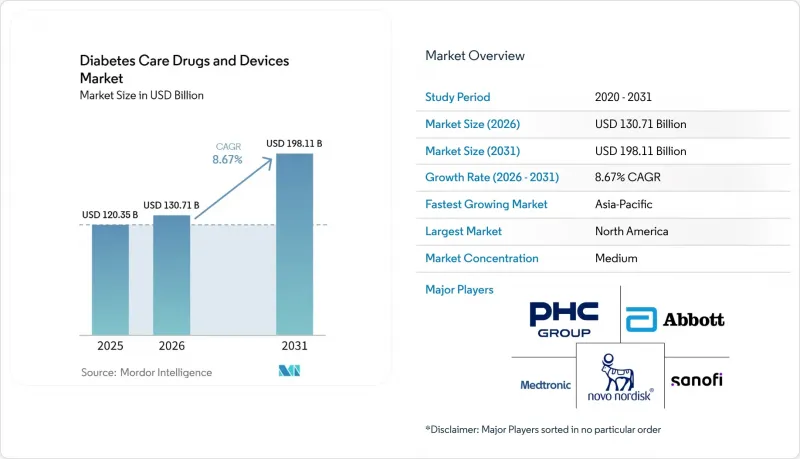
Mordor Intelligence에 의하면, 당뇨병 치료제 및 기기 시장 규모는 2025년에 1,203억 5,000만 달러로 평가되었습니다. 2026년에는 1,307억 1,000만 달러에 달할 것으로 예상됩니다.
본 보고서는 약물 유형(인슐린, GLP-1 수용체 작용제 등), 기기 유형(모니터링 기기, 관리 기기),환자 유형(1형 당뇨병 등), 최종 사용자(병원 및 진료소 등), 유통 채널(병원 약국, 소매 약국 등), 지역(북미, 유럽 등)별로 분류되어 있습니다. 시장 전망은 금액(미 달러) 기준으로 제시되어 있습니다.
세계의 당뇨병 치료제 및 기기 시장 동향 및 인사이트
연속 혈당 모니터링에 대한 보험 적용 범위의 급속한 확대
당뇨병 치료제 및 기기 시장은 지속적 모니터링에 대한 관심을 일상적인 관리에서의 실제 이용으로 전환시키는 정책 변경의 혜택을 받고 있습니다. 미국에서는 메디케어가 2025년 1월부터 적용을 시작하는 제도 개정에 따라, 기존에 필요했던 하루에 여러 번의 손가락 채혈 검사 요건이 철폐되어, 더 광범위한 인슐린 사용자와 문제가 되는 저혈당이 확인된 환자가 대상이 되었습니다. 이는 중요한 의미를 지닙니다. 특히 기기 비용의 지속적인 부담이 도입을 지연시킬 가능성이 있는 고령층의 경우, 보험 적용 여부가 환자가 센서 기반 모니터링을 시도할지 여부를 결정하는 주요 요인이 되는 경우가 많기 때문입니다. 2025년과 2026년에 CGM 접근성이 개선됨에 따라, 환자는 혈당 변동을 더 명확하게 파악하고 집에서 치료법 변경에 신속하게 대응할 수 있게 되어 치료 지속률도 향상될 것입니다. 당뇨병 치료제 및 기기 시장에서 이는 의료기기의 보험 급여와 치료법의 보다 광범위한 이용 사이에 연관성을 만들어 냅니다. 모니터링 도구는 주사제나 인슐린 기반 치료법에서 치료 지속률을 높이는 데 도움을 줄 수 있기 때문입니다. 따라서 현재 보험 급여 정책은 의료기기에 대한 수요뿐만 아니라, 당뇨병 치료제 및 기기 시장의 더 광범위한 치료 경로 전반에 걸친 치료 강화 속도까지 좌우하고 있습니다.
전 세계 당뇨병 유병률 증가와 치료 강화
당뇨병 치료제 및 기기 시장은 환자 기반이 여전히 매우 크고, 충족되지 않은 의료 수요가 여전히 많기 때문에 계속 확대되고 있습니다. 국제당뇨병연맹(IDF)은 2025년에 2024년 기준으로 당뇨병을 앓고 있는 성인의 43%가 미진단 상태로 남아 있을 것이라고 보고했습니다. 이는 현재의 치료 대상자 수만으로는 장기적인 수요를 과소평가하고 있음을 의미합니다. 또한, 해당 보고서는 2025년에 미진단 환자의 90% 가까이가 저·중소득 국가에 거주할 것이라고 지적했으며, 이는 진단율 향상과 함께 기초 치료와 고도화된 모니터링 양쪽 모두에서 향후 수요가 증가할 것으로 예상을 시사합니다. 동시에, 이미 진단을 받은 환자들은 새로운 약물군별 모니터링과 데이터 기반 모니터링을 결합한 보다 집중적인 치료 계획으로 전환되고 있어, 단순히 환자 수가 증가할 뿐만 아니라 환자 1인당 수익도 증가하고 있습니다. 2026년 2월, 노보노르디스크는 2025년도 결산을 발표하며, 비만 치료 제품의 성장이 가속화되는 가운데도 GLP-1 계열 당뇨병 치료제의 매출이 계속해서 큰 기여를 하고 있음을 확인했습니다. 진단 범위의 확대와 치료의 심화가 맞물리면서, 당뇨병 치료제 및 기기 시장은 의약품과 의료기기 두 부문 모두에서 더욱 견고한 성장 기반을 다지고 있습니다.
첨단 의료기기 및 브랜드 의약품에 대한 고액의 본인 부담 비용
당뇨병 치료제 및 기기 시장은 여전히 첨단 제품 카테고리에서 뚜렷한 경제적 부담 문제에 직면해 있습니다. 2025년, FDA 승인을 받은 CGM 시스템의 경우, 자료에 따르면 보험 적용 전월비용이 100-400달러로 기재되어 있으며, 보험이 적용되는 경우에도 환자의 본인 부담금은 여전히 상당한 금액에 달했습니다. 2025년과 2026년, 저소득층이나 가격에 민감한 시장에서는 이 문제가 더욱 심각해져, 많은 환자가 연속 모니터링이나 고가의 약물 요법으로의 전환을 피하고 기존의 모니터링 방식을 계속 사용하는 결과를 낳았습니다. 높은 비용은 유통 경로의 양상에도 변화를 가져올 가능성이 있습니다. 표준 브랜드 제품을 구매할 여유가 없는 환자들은 일관성이 낮고 관리가 어려운 저비용 공급 경로를 찾게 될 것이기 때문입니다. 당뇨병 치료제 및 기기 시장에서 이러한 상황은 충분한 보험 가입자층 이외의 지역에서의 보급을 지연시키고, 혁신이 광범위한 일상적 이용으로 확대되는 속도를 제한하고 있습니다. 또한, 환자가 매월 지속적으로 접근할 수 없다면, 뛰어난 임상적 가치만으로는 불충분하다는 것을 의미합니다.
부문별 분석
2025년, 인슐린은 의약품 부문 매출의 38.8%를 차지하며 당뇨병 치료제 및 기기 시장의 전체 치료 카테고리에서 1위 자리를 유지했습니다. 이러한 위상은 1형 당뇨병 관리에서 인슐린이 수행하는 필수적인 역할과, 2형 당뇨병 관리의 상당 부분, 특히 비용이 여전히 처방 선택에 영향을 미치는 시장에서 인슐린이 계속해서 차지하는 중요성을 반영합니다. 그럼에도 불구하고, 성장의 모멘텀은 더 광범위한 임상적 가치 제안과 더 강력한 상업적 확장 가능성을 지닌 약물 군으로 이동하고 있습니다. 2026년에는 임상 지침과 상업 활동 모두 심혈관 및 대사 분야에서 더 광범위한 관련성을 지닌 새로운 치료군을 지속적으로 뒷받침했습니다. 이러한 변화로 인해 인슐린의 중요성이 낮아지는 것은 아니지만, 당뇨병 치료제 및 기기 시장에서 향후 제품 구성이 개선될 가능성이 높은 분야에는 변화가 나타나고 있습니다.
GLP-1 수용체 작용제는 2026년부터 2031년까지 연평균 성장률(CAGR) 16.5%를 나타낼 것으로 예측되며, 당뇨병 치료제 및 기기 시장에서 가장 빠르게 성장하는 약물 군이 될 전망입니다. 이러한 성장은 심혈관 및 대사 질환 관리 분야의 사용 범위 확대와, 혈당 조절에 그치지 않는 장기적인 치료 결과에 대한 의료진의 신뢰 증대에 힘입은 것입니다. 2026년 1월, IRA(인플레이션 억제법)에 따른 협상을 통해 결정된 메디케어 가격이 특정 의약품에 대해 발효되면서, 브랜드 당뇨병 치료제에 있어 가격 책정 및 접근성과 관련된 새로운 변동 요인이 추가되었습니다. 또한, 2026년에는 진료 지침에 따라 일상 진료에서 당뇨병 치료가 심부전 및 신장 질환 관리와 밀접하게 연계됨에 따라 SGLT2 억제제의 중요성이 높아지고 있습니다. 경구용 GLP-1 제제는 여전히 주사 요법 시작을 주저하는 환자들의 접근성을 확대하는 데 기여할 수 있으므로, 예측 기간 동안 전략적으로 중요한 위치를 계속 차지할 것입니다.
2025년에는 모니터링 기기가 의료기기 부문 매출의 65.4%를 차지하며, 의료기기 카테고리 내에서 당뇨병 치료제 및 기기 시장에서 가장 큰 점유율을 기록했습니다. 이러한 선두 위상은 인슐린 사용자에게 연속 모니터링이 얼마나 빠르게 주류로 자리 잡았으며, 2형 당뇨병 관리의 더 넓은 영역으로 꾸준히 확산되었는지를 반영합니다. 이 카테고리를 주도하고 있는 것은 일상적인 추적을 용이하게 하고, 착용 시간을 연장하며, 환자의 일상생활에 더욱 자연스럽게 녹아드는 센서 생태계입니다. 2025년 4월, Dexcom은 G7 15일 CGM에 대해 FDA 승인을 획득했으며, 이는 더 장기적인 착용 형태로의 전환이 계속되고 있음을 보여줍니다. 또한 이는 관리 시스템이 개선되고 있음에도 불구하고, 당뇨병 치료제 및 기기 시장에서 기기의 구성 비율이 여전히 모니터링에 치우쳐 있는 이유를 설명해 줍니다.
관리용 기기는 2031년까지 연평균 성장률(CAGR) 10.7%를 나타낼 것으로 예측되며, 이로 인해 당뇨병 치료제 및 기기 시장에서 가장 빠르게 확대되고 있는 기기 부문이 되었습니다. 2026년 1월, 메드트로닉(Medtronic)은 ‘MiniMed Go Smart MDI’ 시스템에 대한 FDA 승인을 획득했으며, 2026년 6월에는 MiniMed가 애보트(Abbott)와의 제휴를 혈당·케톤체 듀얼 센서 분야로 확대했습니다. 또한, 2026년 5월 애보트(Abbott)사는 ‘Libre Duo’의 CE 마크를 획득하여 인슐린 관리 분야에서 임상적으로 진보된 센싱 기술로의 전환이 더욱 강화되었습니다. 이러한 움직임은 관리용 기기의 성장이 단순한 투여 하드웨어가 아닌, 연결된 설계와 점점 더 밀접하게 연관되어 있음을 보여줍니다. 실용적인 관점에서 볼 때, 센서 데이터, 의사결정 지원, 투여 도구를 가장 효과적으로 결합할 수 있는 기업이 당뇨병 치료제 및 기기 시장의 이 분야에서 장기적으로 가장 견고한 입지를 구축할 가능성이 높다고 볼 수 있습니다.
지역별 분석
2025년, 북미는 전 세계 매출의 39.6%를 차지하며 당뇨병 치료제 및 기기 시장에서 가장 규모가 큰 지역 점유율을 기록했습니다. 이 지역의 우위는 환자 1인당 치료비 수준이 높고, 광범위한 보험 인프라를 갖추고 있으며, 고품질 CGM 및 자동 인슐린 투여 시스템이 조기에 도입된 점을 반영합니다. 미국에서는 2025년 1월부터 시행된 메디케어 급여 범위 변경에 따라, 인슐린을 사용하는 환자나 심각한 저혈당 문제를 겪는 사람들의 CGM 접근성이 더욱 개선되었습니다. 캐나다에서는 주(州)별 환급 제도를 통해 보다 안정적인 기반이 구축되고 있는 반면, 멕시코에서는 여전히 보급률이 낮아 민간 의료시설에서의 이용이 집중되고 있습니다. 이 광대한 지역 블록에서도 2025년 및 2026년의 사전 승인 여부와 경제적 부담의 유무가 첨단 솔루션이 일상적인 사용으로 얼마나 신속하게 확산될지를 계속해서 좌우하고 있습니다.
아시아태평양은 2026년부터 2031년까지 연평균 성장률(CAGR) 10.7%를 나타낼 것으로 예측되며, 당뇨병 치료제 및 기기 시장에서 가장 빠르게 성장하는 지역이 될 전망입니다. 이 지역은 당뇨병 유병률이 높은 데다, 몇몇 주요 시장에서 진단, 기초 치료 및 기기에 대한 보험 급여 접근성이 개선되고 있습니다. 2025년 3분기, 일본의 틸제파티드 매출은 전년 동기 대비 251% 증가를 기록하며, 성숙 시장에서 프리미엄 치료법의 채택이 견조함을 보여주었습니다. 2026년 2월, 애보트 인디아와 노보노르디스크는 인도에서 공동 판촉 계약을 체결했습니다. 이는 수요가 큰 시장에서 접근성을 확대하기 위해 합리적인 가격에 중점을 둔 파트너십이 활용되고 있음을 보여줍니다. 이러한 동향들이 합쳐져 아시아태평양은 당뇨병 치료제 및 기기 시장의 주요 장기 성장 지역이 되었습니다.
유럽은 주요 국가들의 확립된 보험 환급 제도와 전문 의료 네트워크에 힘입어 당뇨병 치료제 및 기기 시장에서 여전히 중요한 위치를 차지하고 있습니다. 2025년, MedTech Europe은 MDR 재인증에 따른 업무상의 부담을 계속해서 지적했으며, 이러한 압박은 2026년부터 2027년에 걸친 갱신 주기에도 직접적인 영향을 미치고 있습니다. 2026년 7월, Diabeloop사의 DBLG2 폐쇄 루프 시스템이 독일 내 초기 출시를 위해 CE 마크를 획득했습니다. 이는 규제상의 부담에도 불구하고 자동 투여 기술 분야의 혁신이 여전히 진전되고 있음을 보여줍니다. 남미에서는 여전히 가격 측면이 중시되고 있는 반면, 중동 및 아프리카에서는 부유한 걸프 국가들에서 프리미엄 제품의 채택이 활발한 반면, 조달 및 물류 제약이 있는 저소득 지역에서는 진전이 더딘 양극화가 나타나고 있습니다. 이로 인해 지역 전체의 상황은 고르지 않지만, 이미 확립된 주요 시장을 넘어선 장기적인 확장 측면에서는 여전히 중요한 시장으로 남아 있습니다.
기타 혜택 :
- 엑셀 형식 시장 예측(ME) 시트
- 3개월간 애널리스트 지원
목차
제1장 서론
제2장 조사 방법
제3장 개요
제4장 시장 구도
제5장 시장 규모 및 성장 예측
제6장 경쟁 구도
제7장 시장 기회 및 향후 전망
KTHAccording to Mordor Intelligence, the diabetes care drugs and devices market size was at USD 120.35 billion in 2025 and stands at USD 130.71 billion in 2026. This report is Segmented by Drug Type (Insulin, GLP-1 Receptor Agonists, and More), Device Type (Monitoring Devices, Management Devices), Patient Type (Type 1, and More), End User (Hospitals and Clinics, and More), Distribution Channel (Hospital Pharmacies, Retail Pharmacies, and More), and Geography (North America, Europe, and More). Market Forecasts are Provided in Terms of Value (USD).
Global Diabetes Care Drugs and Devices Market Trends and Insights
Rapid Reimbursement Expansion for Continuous Glucose Monitoring
The diabetes care drugs and devices market is gaining from policy changes that are turning interest in continuous monitoring into actual use in daily care. In the United States, Medicare expanded access effective January 2025 by removing the earlier requirement for repeated daily fingerstick testing, which opened eligibility to a wider group of insulin users and people with documented problematic hypoglycemia.That matters because reimbursement often decides whether a patient tries sensor-based monitoring at all, especially in older populations where recurring device cost can delay adoption. Better access to CGM in 2025 and 2026 also improves treatment follow-through because patients can see glucose response more clearly and respond faster to therapy changes at home. In the diabetes care drugs and devices market, this creates a link between device reimbursement and broader therapy use, since monitoring tools can support stronger persistence with injectable and insulin-based regimens. This is why reimbursement policy now shapes not only device demand, but also the pace of treatment intensification across the wider care pathway in the diabetes care drugs and devices market.
Rising Global Diabetes Prevalence and Treatment Intensification
The diabetes care drugs and devices market continues to expand because the underlying patient base remains very large and still has significant unmet treatment need. The International Diabetes Federation reported in 2025 that 43% of adults living with diabetes in 2024 remained undiagnosed, which means the current treatment pool still understates long-term demand. The report also noted in 2025 that nearly 90% of the undiagnosed population lived in low- and middle-income countries, which points to future demand growth across both basic therapies and advanced monitoring as diagnosis rates improve. At the same time, diagnosed patients are moving toward more intensive treatment plans that combine newer drug classes with data-driven monitoring, raising revenue per patient rather than only increasing patient numbers. In February 2026, Novo Nordisk reported its fiscal 2025 results, confirming that GLP-1-based diabetes sales continued to contribute meaningfully even as obesity products grew faster. That combination of wider diagnosis and deeper treatment use is giving the diabetes care drugs and devices market a stronger growth base across both its drug and device segments.
High Out-of-Pocket Cost for Advanced Devices and Branded Therapeutics
The diabetes care drugs and devices market still faces a clear affordability problem in advanced product categories. In 2025, FDA-approved CGM systems were described in the source material as costing USD 100 to USD 400 per month before insurance, and that still left meaningful patient exposure even where coverage existed. In lower-income and price-sensitive markets during 2025 and 2026, that challenge became more severe and kept many patients on older monitoring formats instead of shifting them into continuous sensing or premium drug therapy. High cost can also reshape channel behavior, because patients who cannot afford standard branded access may search for lower-cost supply routes that are less consistent and harder to supervise. In the diabetes care drugs and devices market, this slows adoption beyond well-insured groups and limits how fast innovation can scale into broad routine use. It also means that strong clinical value alone is not enough if the patient still cannot maintain access month after month.
Other drivers and restraints analyzed in the detailed report include:
- Faster Adoption of Connected Insulin Delivery and Smart Monitoring
- EU MDR and Other Re-certification Bottlenecks for Legacy Devices
For complete list of drivers and restraints, kindly check the Table Of Contents.
Segment Analysis
Insulin held 38.8% of the drug segment by value in 2025, which kept it in the leading position across treatment categories in the diabetes care drugs and devices market. That position reflects its essential role in type 1 care and its continued importance in large parts of type 2 management, especially in markets where cost still shapes prescribing choices. Even so, growth momentum is moving toward drug classes that offer a wider clinical value proposition and stronger commercial expansion potential. In 2026, clinical guidance and commercial activity both continued to support newer treatment classes with broader cardiometabolic relevance. The shift does not reduce insulin's relevance, but it does change where future mix improvement is likely to come from in the diabetes care drugs and devices market.
GLP-1 receptor agonists are forecasted to grow at a 16.5% CAGR from 2026 to 2031, making them the fastest-growing drug class in the diabetes care drugs and devices market. Their expansion is being supported by broader use in cardiometabolic care and by stronger physician confidence in long-term outcomes beyond glucose control alone. In January 2026, IRA-negotiated Medicare prices took effect for selected drugs, which added another pricing and access variable for branded diabetes therapies. SGLT2 inhibitors are also gaining importance in 2026 because guidelines are bringing diabetes therapy closer to heart failure and kidney disease management in routine practice. Oral GLP-1 formats remain strategically important through the forecasted period because they can help expand access among patients who still hesitate to begin injectable therapy.
Monitoring devices held 65.4% of device segment revenue in 2025, giving them the largest diabetes care drugs and devices market share within the device category. This lead reflects how quickly continuous monitoring moved into the mainstream for insulin users and how steadily it spread into broader type 2 care. The category is being led by sensor ecosystems that make daily tracking easier, extend wear time, and fit more naturally into patient routines. In April 2025, Dexcom received FDA clearance for its G7 15-Day CGM, which showed continued movement toward longer wear formats. It also explains why the device mix in the diabetes care drugs and devices market is staying weighted toward monitoring even as management systems improve.
Management devices are projected to grow at a 10.7% CAGR through 2031, which makes them the fastest-expanding device segment in the diabetes care drugs and devices market. In January 2026, Medtronic received FDA clearance for the MiniMed Go Smart MDI system, and in June 2026, MiniMed expanded its Abbott partnership around dual glucose-ketone sensors. In May 2026, Abbott also secured CE Mark for Libre Duo, which reinforced the move toward more clinically advanced sensing within insulin management. These steps show that growth in management devices is increasingly tied to connected design rather than stand-alone delivery hardware. In practical terms, the companies that can combine sensor data, decision support, and dosing tools most effectively are likely to hold the strongest long-term position in this part of the diabetes care drugs and devices market.
Complete Report Scope:
- By Drug Type
- Insulin
- GLP-1 Receptor Agonists
- SGLT2 Inhibitors
- DPP-4 Inhibitors
- Other Diabetes Drugs
- By Device Type
- Monitoring Devices
- Self-Monitoring Blood Glucose Devices
- Glucometer Devices
- Test Strips
- Lancets
- Continuous Glucose Monitoring Devices
- Sensors
- Durables
- Self-Monitoring Blood Glucose Devices
- Management Devices
- Insulin Pumps
- Insulin Pump Device
- Insulin Pump Reservoir
- Infusion Set
- Insulin Delivery Consumables
- Insulin Syringes
- Insulin Pens
- Jet Injectors
- Insulin Pumps
- Monitoring Devices
- By Patient Type
- Type 1 Diabetes
- Type 2 Diabetes
- Gestational and Other Diabetes Types
- By End User
- Hospitals and Clinics
- Home Care Settings
- Ambulatory Surgical Centres
- By Distribution Channel
- Hospital Pharmacies
- Retail Pharmacies
- E-Commerce and Direct-to-Consumer Channels
- Diabetes Specialty Clinics and Institutional Supply
- By Geography
- North America
- United States
- Canada
- Mexico
- South America
- Brazil
- Argentina
- Rest of South America
- Europe
- Germany
- France
- United Kingdom
- Italy
- Spain
- Russia
- Rest of Europe
- Asia-Pacific
- China
- Japan
- India
- South Korea
- Australia
- Rest of Asia-Pacific
- Middle East and Africa
- Middle East
- GCC
- South Africa
- Rest of Middle East and Africa
- Middle East
- North America
Geography Analysis
North America held 39.6% of global revenue in 2025, which gave it the largest regional position in the diabetes care drugs and devices market share. The region's lead reflects high per-patient treatment spending, broad insurance infrastructure, and early use of premium CGM and automated insulin delivery systems. In the United States, Medicare coverage changes effective from January 2025 further improved access to CGM for insulin-using patients and people with problematic hypoglycemia. Canada adds a steadier base through provincial reimbursement, while Mexico remains more underpenetrated and more concentrated in private care settings. Even in this large regional block, prior authorization and affordability in 2025 and 2026 still shape how quickly advanced solutions spread across everyday use.
Asia-Pacific is forecasted to grow at a 10.7% CAGR from 2026 to 2031, making it the fastest-growing regional component of the diabetes care drugs and devices market. The region combines a large diabetes burden with improving access to diagnosis, basic therapy, and device reimbursement in several major markets. In Q3 2025, tirzepatide posted 251% year-on-year sales growth in Japan, which signaled strong premium therapy adoption in a mature market. In February 2026, Abbott India and Novo Nordisk entered a co-promotion agreement in India, showing how affordability-focused partnerships are being used to widen access in high-volume markets. Together, these developments make Asia-Pacific the main long-term expansion zone for the diabetes care drugs and devices market.
Europe remains a substantial part of the diabetes care drugs and devices market, supported by established reimbursement structures and specialist care networks in major countries. In 2025, MedTech Europe continued to highlight the operational strain tied to MDR recertification, and that pressure is carrying directly into the 2026 to 2027 renewal cycle. In July 2026, Diabeloop's DBLG2 closed-loop system received CE Mark for initial launch in Germany, which showed that innovation in automated delivery was still moving forward despite the regulatory burden. South America remains more sensitive to affordability, while the Middle East and Africa show a split between stronger premium uptake in wealthier Gulf countries and slower progress in lower-income settings with procurement and logistics limits. This leaves the wider regional picture uneven, but still relevant for long-term expansion beyond the largest established markets.
- Abbott Laboratories
- A. Menarini Diagnostics srl
- Arkray
- Ascensia Diabetes Care Holdings AG (PHC Holdings Corporation)
- AstraZeneca
- Bayer
- Beckton Dickinson
- Bionime
- Dexcom
- Eli Lilly and Company
- Embecta Corp.
- Roche
- Insulet
- LifeScan Enterprises LLC
- Medtronic
- Nipro
- Novo Nordisk
- Sanofi
- Senseonics
- Tandem Diabetes Care
- Terumo
- Trividia Health, Inc.
- Ypsomed
Additional Benefits:
- The market estimate (ME) sheet in Excel format
- 3 months of analyst support
TABLE OF CONTENTS
1 INTRODUCTION
- 1.1 Study Assumptions and Market Definition
- 1.2 Scope of the Study
2 RESEARCH METHODOLOGY
3 EXECUTIVE SUMMARY
4 MARKET LANDSCAPE
- 4.1 Market Overview
- 4.2 Market Drivers
- 4.2.1 Rapid Reimbursement Expansion for Continuous Glucose Monitoring
- 4.2.2 Rising Global Diabetes Prevalence and Treatment Intensification
- 4.2.3 Faster Adoption of Connected Insulin Delivery and Smart Monitoring
- 4.2.4 Expanded Public and Private Funding for Diabetes Screening and Care Pathways
- 4.2.5 GLP-1 Driven Demand Spillover into Home Glucose Testing and Care Devices
- 4.2.6 Pediatric Hybrid Closed-Loop Adoption in Europe and High-Income Asia-Pacific
- 4.3 Market Restraints
- 4.3.1 High Out-of-Pocket Cost for Advanced Devices and Branded Therapeutics
- 4.3.2 Low Awareness and Weak Follow-Through in Rural and Underserved Care Settings
- 4.3.3 EU MDR and Other Re-certification Bottlenecks for Legacy Devices
- 4.3.4 Insurance Prior Authorization Friction for Newer Diabetes Therapies
- 4.4 Value Chain and Supply Chain Analysis
- 4.5 Regulatory Landscape
- 4.6 Technological Outlook
- 4.7 Porter's Five Forces Analysis
- 4.7.1 Threat of New Entrants
- 4.7.2 Bargaining Power of Buyers
- 4.7.3 Bargaining Power of Suppliers
- 4.7.4 Threat of Substitutes
- 4.7.5 Competitive Rivalry
- 4.8 Analysis
5 MARKET SIZE AND GROWTH FORECASTS
- 5.1 By Drug Type
- 5.1.1 Insulin
- 5.1.2 GLP-1 Receptor Agonists
- 5.1.3 SGLT2 Inhibitors
- 5.1.4 DPP-4 Inhibitors
- 5.1.5 Other Diabetes Drugs
- 5.2 By Device Type
- 5.2.1 Monitoring Devices
- 5.2.1.1 Self-Monitoring Blood Glucose Devices
- 5.2.1.1.1 Glucometer Devices
- 5.2.1.1.2 Test Strips
- 5.2.1.1.3 Lancets
- 5.2.1.2 Continuous Glucose Monitoring Devices
- 5.2.1.2.1 Sensors
- 5.2.1.2.2 Durables
- 5.2.1.1 Self-Monitoring Blood Glucose Devices
- 5.2.2 Management Devices
- 5.2.2.1 Insulin Pumps
- 5.2.2.1.1 Insulin Pump Device
- 5.2.2.1.2 Insulin Pump Reservoir
- 5.2.2.1.3 Infusion Set
- 5.2.2.2 Insulin Delivery Consumables
- 5.2.2.2.1 Insulin Syringes
- 5.2.2.2.2 Insulin Pens
- 5.2.2.2.3 Jet Injectors
- 5.2.2.1 Insulin Pumps
- 5.2.1 Monitoring Devices
- 5.3 By Patient Type
- 5.3.1 Type 1 Diabetes
- 5.3.2 Type 2 Diabetes
- 5.3.3 Gestational and Other Diabetes Types
- 5.4 By End User
- 5.4.1 Hospitals and Clinics
- 5.4.2 Home Care Settings
- 5.4.3 Ambulatory Surgical Centres
- 5.5 By Distribution Channel
- 5.5.1 Hospital Pharmacies
- 5.5.2 Retail Pharmacies
- 5.5.3 E-Commerce and Direct-to-Consumer Channels
- 5.5.4 Diabetes Specialty Clinics and Institutional Supply
- 5.6 By Geography
- 5.6.1 North America
- 5.6.1.1 United States
- 5.6.1.2 Canada
- 5.6.1.3 Mexico
- 5.6.2 South America
- 5.6.2.1 Brazil
- 5.6.2.2 Argentina
- 5.6.2.3 Rest of South America
- 5.6.3 Europe
- 5.6.3.1 Germany
- 5.6.3.2 France
- 5.6.3.3 United Kingdom
- 5.6.3.4 Italy
- 5.6.3.5 Spain
- 5.6.3.6 Russia
- 5.6.3.7 Rest of Europe
- 5.6.4 Asia-Pacific
- 5.6.4.1 China
- 5.6.4.2 Japan
- 5.6.4.3 India
- 5.6.4.4 South Korea
- 5.6.4.5 Australia
- 5.6.4.6 Rest of Asia-Pacific
- 5.6.5 Middle East and Africa
- 5.6.5.1 Middle East
- 5.6.5.1.1 GCC
- 5.6.5.1.2 South Africa
- 5.6.5.1.3 Rest of Middle East and Africa
- 5.6.5.1 Middle East
- 5.6.1 North America
6 COMPETITIVE LANDSCAPE
- 6.1 Market Concentration
- 6.2 Strategic Moves
- 6.3 Market Share Analysis
- 6.4 Company Profiles (includes Global Level Overview, Market Level Overview, Core Segments, Financials as available, Strategic Information, Market Rank/Share, Products and Services, Recent Developments)
- 6.4.1 Abbott Laboratories
- 6.4.2 A. Menarini Diagnostics srl
- 6.4.3 ARKRAY, Inc.
- 6.4.4 Ascensia Diabetes Care Holdings AG (PHC Holdings Corporation)
- 6.4.5 AstraZeneca
- 6.4.6 Bayer AG
- 6.4.7 Becton, Dickinson and Company
- 6.4.8 Bionime Corporation
- 6.4.9 Dexcom, Inc.
- 6.4.10 Eli Lilly and Company
- 6.4.11 Embecta Corp.
- 6.4.12 F. Hoffmann-La Roche Ltd.
- 6.4.13 Insulet Corporation
- 6.4.14 LifeScan Enterprises LLC
- 6.4.15 Medtronic plc
- 6.4.16 Nipro Corporation
- 6.4.17 Novo Nordisk A/S
- 6.4.18 Sanofi
- 6.4.19 Senseonics Holdings, Inc.
- 6.4.20 Tandem Diabetes Care, Inc.
- 6.4.21 Terumo Corporation
- 6.4.22 Trividia Health, Inc.
- 6.4.23 Ypsomed AG
7 MARKET OPPORTUNITIES AND FUTURE OUTLOOK
- 7.1 White-Space and Unmet-Need Assessment