

|
시장보고서
상품코드
2117330
인도의 경구 항당뇨병약 시장 : 시장 점유율 분석, 업계 동향 및 통계, 성장 예측(2026-2031년)India Oral Anti-Diabetic Drug - Market Share Analysis, Industry Trends & Statistics, Growth Forecasts (2026 - 2031) |
||||||
 Mordor Intelligence
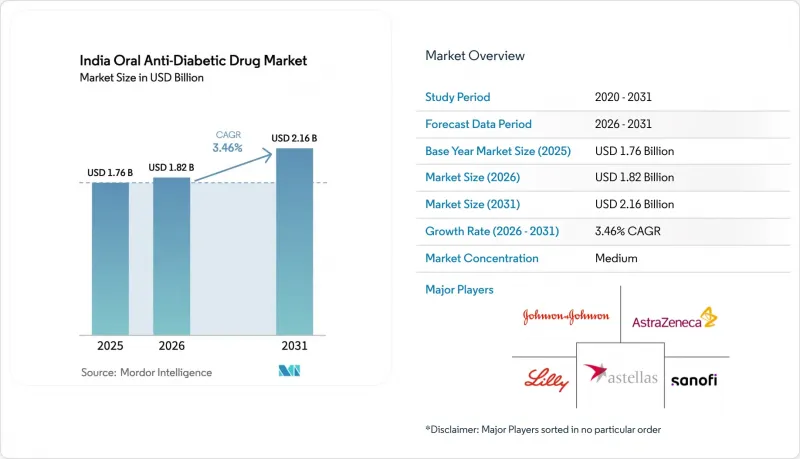
Mordor Intelligence에 의하면, 인도의 경구 항당뇨병약 시장 규모는 2025년에 17억 6,000만 달러로 평가되었고, 2026년 18억 2,000만 달러에서 2031년까지 21억 6,000만 달러에 이를 것으로 예측되며, 예측 기간(2026-2031년) CAGR은 3.46%를 나타낼 전망입니다.
본 보고서는 약물 분류별(비구아나이드계 약물, 설포닐우레아계 약물, 메글리티니드계 약물, 기타), 연령대별(성인, 소아, 고령자), 당뇨병 유형별(1형 당뇨병, 2형 당뇨병), 유통 채널별(병원 약국, 소매 약국, 온라인 약국)로 분류되어 있습니다. 시장 규모 및 전망은 금액(달러) 기준으로 제시되어 있습니다.
인도의 경구 항당뇨병약 시장 동향 및 인사이트
2형 당뇨병(T2DM) 및 당뇨병 전단계 유병률 증가
인도에는 7,700만 명의 당뇨병 환자가 있으며, 2045년까지 1억 3,400만 명에 달할 것으로 예측됩니다. 도시 지역의 혈당 선별 검사 조사에 따르면, 검사를 받은 성인의 49.43%가 비정상 수치를 보였으며, 27.18%는 이미 당뇨병 기준치에 도달한 것으로 나타났습니다. 라크나우의 유병률 데이터에 따르면, 도시 지역은 15.8%, 농촌 지역은 11.7%로 나타나 대도시권 이외의 지역에서도 시장 기회가 있음을 여실히 보여주고 있습니다. 당뇨병과 관련된 연간 의료비는 50억 달러를 초과하며, 저소득 가구는 소득의 최대 23.7%를 질병 관리에 지출하고 있습니다. 이러한 역학적 현실이 치료에 대한 지속적인 수요를 견인하고 있지만, 제네릭 의약품의 보급률 상승과 가격 상한선 설정으로 인해 인도의 경구 항당뇨병약 시장의 성장 속도는 완만해지고 있습니다.
특허 만료로 인한 제네릭 의약품 시장 진입 가속화
2025년 3월 엠파글리플로진의 특허 만료를 계기로 147개의 제네릭 브랜드가 시장에 유입되었으며, 한 달 만에 시장 진출기업이 2배로 증가했습니다. 제네릭 정제의 소매 가격은 5.49 루피인 반면, 오리지널 의약품은 59 루피로, 이로 인해 80-90%의 가격 하락이 발생했습니다. 향후 예정된 특허 만료-세마글루티드(2026년 1월)와 시타글립틴/메트포르민 복합제(2029년 7월)-는 국내 제제 제조업체들에게 지속적인 시장 진입 기회를 제공할 전망입니다. 이에 대해 다국적 기업들은 심혈관 및 신장 관련 효능을 결합하거나 기기를 동봉하는 등의 방식으로 프리미엄 가격 책정을 정당화하려고 하고 있습니다. 급속한 제네릭화는 일반 대중에게 접근 기회를 널리 열어주는 동시에, 인도의 경구 항당뇨병약 시장 전체경쟁 구도를 재편하고 있습니다.
신규 GLP-1 경구용 약물의 높은 가격
경구용 세마글루티드의 1개월 치료비는 1만 루피에 달하며, 제네릭 메트포르민이 100 루피 미만으로 구입 가능한 시장에서 이 약의 보급을 저해하고 있습니다. 환자의 80%가 종합적인 보험에 가입되어 있지 않아 본인 부담이 주를 이루고 있습니다. 임상시험에서는 HbA1c가 1.56% 감소하고 체중이 5kg 줄어드는 것으로 나타났으나, 대부분의 가구에게 비용 대비 효과는 여전히 부정적입니다. 따라서 2026년 이후 특허 만료에 따라 제네릭 의약품이 등장할 때까지는 판매가 도시 지역의 부유층으로만 제한될 것으로 보입니다. 이처럼 인도의 경구 항당뇨병약 시장에서는 임상적 유효성의 향상과 합리적인 가격이라는 한계 사이에서 균형이 잡혀 있습니다.
부문 분석
2025년, 메트포르민을 주력 제품으로 하는 비구아나이드 계열 약물은 인도 경구 항당뇨병약 시장 점유율의 36.85%를 차지했습니다. 그러나 엠파글리플로진의 특허 만료와 급격한 가격 하락으로 인해 처방 의사의 관심은 SGLT-2 억제제로 이동했습니다. SGLT-2 억제제는 가장 빠르게 성장하는 약물군으로, 2031년 연평균 성장률(CAGR)은 3.79%로 예상됩니다. 설포닐우레아 계열 약물은 저혈당에 대한 우려로 감소 추세를 보이는 반면, DPP-4 억제제는 안전성이라는 장점 덕분에 채택이 확대되고 있습니다. α-글루코시다제 억제제와 메글리티니드 계열 약물은 여전히 틈새 시장으로 남아 있습니다. 약리유전학 연구에 따르면, 인도 환자들에서 메트포르민에 대한 반응이 미미한 것과 관련된 대립유전자의 유병률이 높은 것으로 나타났으며, 이를 통해 맞춤형 투여의 가능성이 열리고 있습니다. 인도의 경구 항당뇨병약 시장에서 SGLT-2 억제제 시장 규모는 새로운 치료 경향을 반영하여 2031년까지 6억 1,180만 달러에 달할 것으로 예측됩니다. 개발 파이프라인에 있는 새로운 SGLT-1/2 이중 복합제 및 GLP-1 병용제는 가격에 민감한 고정용량복합제(FDC) 시장이 성숙해짐에 따라 시장 점유율 재편을 더욱 촉진할 가능성이 있습니다.
심혈관 및 신장 관련 데이터와 초기 가격 하락이 맞물리면서 SGLT-2 분자 시장 입지가 강화되고 있습니다. 수직 통합형 API 생산 능력을 갖춘 국내 기업들은 PLI(의약품 목록)의 우대 조치를 활용하여 품질 기준을 준수하면서도 수입품보다 저렴한 가격으로 공급하고 있습니다. 선발 기업들은 결과 중심의 실세계 연구를 통해 차별화를 꾀하고 있지만, 제네릭 의약품은 이미 처방량의 대부분을 차지하고 있습니다. 전반적으로, 각 약물 군별 경쟁 심화가 인도 경구 항당뇨병약 시장의 가치 창출 방식을 재정의하고 있습니다.
2025년 처방전의 67.05%는 성인이 차지했으나, 치료법의 성숙과 중년층의 발병률 증가 둔화로 인해 그 연평균 성장률(CAGR)은 2.98%에 그치고 있습니다. 반면, 고령층에서는 평균 수명의 연장과 더 안전한 약물을 필요로 하는 다중 질환 동반율의 상승에 힘입어 3.94%의 연평균 성장률(CAGR)을 보이고 있습니다. 2025년 인도의 고령자용 경구 항당뇨병약 시장 규모는 4억 2,760만 달러로 추정되며, 고령 연금 수급자들이 월 비용을 70% 절감할 수 있는 저렴한 ‘Jan Aushadhi’ 제네릭 의약품으로 전환함에 따라 시장은 확대되고 있습니다. 농촌 지역의 고령 환자들은 의료 접근성 격차에 직면해 있지만, 타밀나두주 등 일부 주에서 시행되고 있는 원격 진료 시범 사업을 통해 후속 관리의 격차가 점차 해소되고 있습니다.
다약제 병용으로 인한 과제가 체중에 미치는 영향이 적고 저혈당 위험이 낮은 제제에 대한 수요를 가속화하고 있습니다. 대문자 표기를 지원하는 디지털 복약 순응도 관리 도구는 고령 사용자 사이에서 18% 더 높은 이용률을 기록하고 있으며, 이것이 매출 증가의 기반이 되고 있습니다. 한편, 소아용 처방량은 여전히 적지만, 1형 당뇨병 청소년의 인슐린 저항성을 완화하기 위한 메트포르민 병용 요법에 관한 연구는 향후 틈새 시장의 확대를 시사하고 있습니다. 전반적으로 인구 동태의 변화로 인해 인도 경구 항당뇨병약 시장에서 안정적인 환자층이 확보되고 있습니다.
기타 혜택
- 엑셀 형식 시장 예측(ME) 시트
- 3개월간의 애널리스트 지원
자주 묻는 질문
목차
제1장 서론
제2장 조사 방법
제3장 개요
제4장 시장 구도
제5장 시장 규모 및 성장 예측
제6장 경쟁 구도
제7장 시장 기회 및 향후 전망
AJY 26.09.01According to Mordor Intelligence, the India oral anti-diabetic drug market size was valued at USD 1.76 billion in 2025 and estimated to grow from USD 1.82 billion in 2026 to reach USD 2.16 billion by 2031, at a CAGR of 3.46% during the forecast period (2026-2031).
This report is Segmented by Drug Class (Biguanides, Sulfonylureas, Meglitinides, and More), Age Group (Adults, Pediatric, and Geriatric), Diabetes Type (Type 1 Diabetes and Type 2 Diabetes), Distribution Channel (Hospital Pharmacies, Retail Pharmacies, and Online Pharmacies). The Market and Forecasts are Provided in Terms of Value (USD).
India Oral Anti-Diabetic Drug Market Trends and Insights
Rising Prevalence of T2DM & Pre-Diabetes
India hosts 77 million individuals with diabetes and projections indicate 134 million cases by 2045. Urban blood-glucose screening campaigns reveal that 49.43% of tested adults show abnormal values and 27.18% already meet diabetic thresholds. Lucknow prevalence data record 15.8% urban versus 11.7% rural incidence, underscoring market opportunities beyond metros. Annual diabetes-linked healthcare costs exceed USD 5 billion, and poorer households devote up to 23.7% of income to disease management. These epidemiological realities drive consistent therapy demand, though the India oral anti-diabetic drug market grows at a measured pace given rising generic penetration and price caps.
Patent Expiries Accelerating Generic Launches
Empagliflozin's March 2025 patent cliff spurred an influx of 147 generic brands, doubling market participants within a month. Generic tablets retail at INR 5.49 compared with the innovator's INR 59, unleashing 80-90% price erosion. Upcoming expiries-Semaglutide (Jan 2026) and Sitagliptin/Metformin FDCs (Jul 2029)-promise sustained openings for domestic formulators. Multinationals respond by bundling cardiovascular-renal claims and co-packaged devices to justify premium positioning. Rapid genericisation democratises access while rewiring competitive dynamics across the India oral anti-diabetic drug market.
High Price of Novel GLP-1 Oral Agents
Monthly therapy with oral Semaglutide costs INR 10,000, deterring widespread uptake in a market where generic Metformin costs under INR 100. Out-of-pocket spending dominates, as 80% of patients lack comprehensive insurance coverage. Clinical trials show 1.56% HbA1c reductions and 5 kg weight loss, yet cost-effectiveness remains negative for most households. Sales therefore remain confined to affluent urban cohorts until patent expiry-led generics emerge post-2026. The India oral anti-diabetic drug market thus balances clinical efficacy gains against affordability ceilings.
Other drivers and restraints analyzed in the detailed report include:
- PLI Scheme Boosting Diabetes API Output
- Surge in FDCs & Once-Daily Novel Classes
- National Price-Control & Trade-Generic Squeeze
For complete list of drivers and restraints, kindly check the Table Of Contents.
Segment Analysis
Biguanides anchored by Metformin held 36.85% of India oral anti-diabetic drug market share in 2025. Empagliflozin's patent expiry and rapid price erosion, however, redirected prescribers toward SGLT-2 inhibitors, the fastest-growing class with a 3.79% CAGR to 2031. Sulfonylureas are declining due to hypoglycaemia fears, while DPP-4 inhibitors widened adoption on safety merits. Alpha-glucosidase inhibitors and Meglitinides remain niche. Pharmacogenomic studies show higher prevalence of alleles linked to poor Metformin response among Indian patients, opening avenues for personalised dosing . The India oral anti-diabetic drug market size for SGLT-2 inhibitors is projected to reach USD 611.8 million by 2031, reflecting emerging therapeutic preferences. Novel dual SGLT-1/2 compounds and GLP-1 combinations in the development pipeline may further recalibrate shares as price-sensitive FDCs mature.
A confluence of cardiovascular-renal data and initial price drops is strengthening SGLT-2 molecule positioning. Domestic players with vertically integrated API capacity leverage PLI incentives to undercut imports while ensuring quality compliance. Innovator firms seek differentiation through outcome-based real-world studies, but generics already capture volume prescribing. Net-net, competitive intensity within drug classes is redefining value capture along the India oral anti-diabetic drug market.
Adults generated 67.05% of 2025 prescriptions, yet their CAGR trails at 2.98% because of therapeutic maturity and slowing incidence growth in mid-life cohorts. The geriatric cohort shows a 3.94% CAGR driven by longevity gains and higher multi-morbidities requiring safer agents. India oral anti-diabetic drug market size for geriatrics is estimated at USD 427.6 million in 2025, growing as elderly pensioners turn to affordable Jan Aushadhi generics that cut monthly spend by 70%. Rural elderly patients face access gaps, but teleconsultation pilots in states such as Tamil Nadu are bridging follow-up care.
Polypharmacy challenges accelerate demand for weight-neutral, low-hypoglycaemia formulations. Digital adherence tools customised for large-font interfaces record 18% higher engagement among older users, underpinning incremental sales gains. Meanwhile, paediatric prescriptions remain low volume, yet research into Metformin add-on therapy to mitigate insulin resistance in type 1 adolescents highlights future niche expansion. Overall, demographic evolution ensures a steady patient pipeline within the India oral anti-diabetic drug market.
Complete Report Scope:
- By Drug Class
- Biguanides
- Sulfonylureas
- Meglitinides
- Thiazolidinediones
- Alpha-Glucosidase Inhibitors
- DPP-4 Inhibitors
- SGLT-2 Inhibitors
- Others
- By Age Group
- Adults
- Pediatric
- Geriatric
- By Diabetes Type
- Type 1 Diabetes
- Type 2 Diabetes
- By Distribution Channel
- Hospital Pharmacies
- Retail Pharmacies
- Online Pharmacies
List of Companies Covered in this Report:
- Sun Pharmaceuticals Industries
- USV Private Ltd.
- Dr Reddy's Laboratories
- Cipla
- Abbott India Ltd.
- Lupin
- Glenmark Pharmaceuticals
- Torrent Pharmaceuticals
- Zydus Lifesciences
- Mankind Pharma
- Alkem Laboratories
- Takeda Pharma
- Novo Nordisk
- Boehringer Ingelheim
- Eli Lilly and Company
- AstraZeneca
- Merck
- Johnson & Johnson
- Astellas Pharma
- Bristol-Myers Squibb
- Novartis
Additional Benefits:
- The market estimate (ME) sheet in Excel format
- 3 months of analyst support
TABLE OF CONTENTS
1 Introduction
- 1.1 Study Assumptions & Market Definition
- 1.2 Scope of the Study
2 Research Methodology
3 Executive Summary
4 Market Landscape
- 4.1 Market Overview
- 4.2 Market Drivers
- 4.2.1 Rising prevalence of T2DM & pre-diabetes
- 4.2.2 Patent expiries driving rapid generic penetration
- 4.2.3 Production-Linked Incentive (PLI) scheme for diabetes APIs/formulations
- 4.2.4 Surge in FDCs & once-daily novel classes (SGLT-2, DPP-4)
- 4.2.5 Digital-first pharmacy expansion in Tier-2-4 cities
- 4.2.6 Pharmacogenomic-guided dosing pilots in tertiary centres
- 4.3 Market Restraints
- 4.3.1 High price of novel GLP-1 oral agents
- 4.3.2 National price-control & trade-generic proliferation squeezing margins
- 4.3.3 Patient drift to long-acting injectables/implants
- 4.3.4 Extreme inter-brand price dispersion eroding prescriber confidence
- 4.4 Regulatory Landscape
- 4.5 Technological Outlook
- 4.6 Porters Five Forces Analysis
- 4.6.1 Bargaining Power of Suppliers
- 4.6.2 Bargaining Power of Buyers
- 4.6.3 Threat of New Entrants
- 4.6.4 Threat of Substitutes
- 4.6.5 Competitive Rivalry
5 Market Size & Growth Forecasts
- 5.1 By Drug Class
- 5.1.1 Biguanides
- 5.1.2 Sulfonylureas
- 5.1.3 Meglitinides
- 5.1.4 Thiazolidinediones
- 5.1.5 Alpha-Glucosidase Inhibitors
- 5.1.6 DPP-4 Inhibitors
- 5.1.7 SGLT-2 Inhibitors
- 5.1.8 Others
- 5.2 By Age Group
- 5.2.1 Adults
- 5.2.2 Pediatric
- 5.2.3 Geriatric
- 5.3 By Diabetes Type
- 5.3.1 Type 1 Diabetes
- 5.3.2 Type 2 Diabetes
- 5.4 By Distribution Channel
- 5.4.1 Hospital Pharmacies
- 5.4.2 Retail Pharmacies
- 5.4.3 Online Pharmacies
6 Competitive Landscape
- 6.1 Market Concentration
- 6.2 Market Share Analysis
- 6.3 Company Profiles (includes Global level Overview, Market level overview, Core Segments, Financials, Strategic Info, Market Rank/Share, Products & Services, Recent Developments)
- 6.3.1 Sun Pharmaceutical Industries Ltd.
- 6.3.2 USV Private Ltd.
- 6.3.3 Dr Reddy's Laboratories
- 6.3.4 Cipla Ltd.
- 6.3.5 Abbott India Ltd.
- 6.3.6 Lupin Ltd.
- 6.3.7 Glenmark Pharmaceuticals
- 6.3.8 Torrent Pharma
- 6.3.9 Zydus Lifesciences
- 6.3.10 Mankind Pharma
- 6.3.11 Alkem Labs
- 6.3.12 Takeda Pharma
- 6.3.13 Novo Nordisk
- 6.3.14 Boehringer Ingelheim
- 6.3.15 Eli Lilly
- 6.3.16 AstraZeneca
- 6.3.17 Merck & Co.
- 6.3.18 Johnson & Johnson
- 6.3.19 Astellas Pharma
- 6.3.20 Bristol Myers Squibb
- 6.3.21 Novartis
7 Market Opportunities & Future Outlook
- 7.1 White-space & Unmet-Need Assessment


