

|
시장보고서
상품코드
2117594
맞춤형 마케팅 콘텐츠 및 캠페인 자동화 분야 생성형 AI : 시장 점유율 분석, 업계 동향 및 통계, 성장 예측(2026-2031년)Generative AI In Personalized Marketing Content and Campaign Automation - Market Share Analysis, Industry Trends & Statistics, Growth Forecasts (2026 - 2031) |
||||||
 Mordor Intelligence
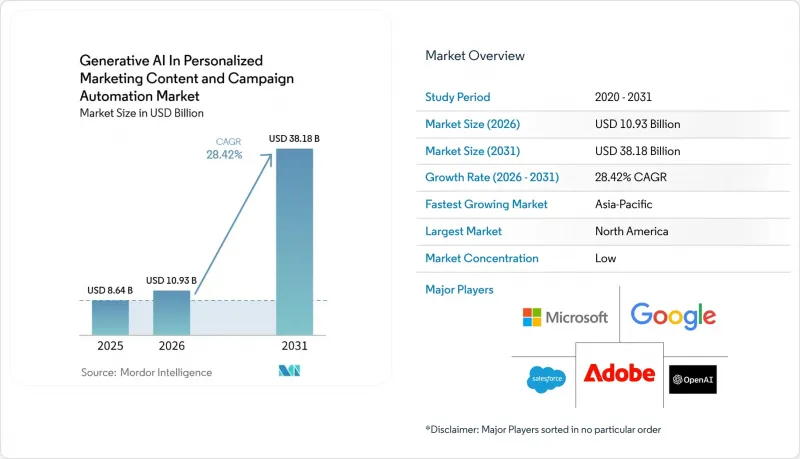
Mordor Intelligence에 의하면, 맞춤형 마케팅 콘텐츠 및 캠페인 자동화 분야 생성형 AI 시장 규모는 2025년 86억 4,000만 달러로 평가되었습니다. 2026년에는 109억 3,000만 달러로 확대되어 2031년까지 381억 8,000만 달러에 이를 것으로 예상되고 2026-2031년에 걸쳐 CAGR 28.42%로 성장할 전망입니다.
본 보고서는 제공 서비스(소프트웨어 및 서비스), 배포 방식(클라우드, On-Premise, 하이브리드), 용도(개인화된 콘텐츠 및 크리에이티브 생성, 캠페인 기획·제작, 기타),최종 사용자(전자상거래·소매, 은행, 금융서비스 및 보험(BFSI), IT 및 통신, 기타), 지역별로 분류되어 있습니다. 시장 예측은 금액(미 달러) 기준으로 제시되어 있습니다.
세계의 맞춤형 마케팅 콘텐츠 및 캠페인 자동화 분야 생성형 AI 시장 동향 및 인사이트
AI 기반 에이전트형 개인화 서비스에 대한 수요 증가
맞춤형 마케팅 콘텐츠 및 캠페인 자동화 분야 생성형 AI 시장은 고립된 도구에서 일상적인 고객 업무에 대한 에이전트 기반 실행으로 명확하게 전환되고 있는 추세에 힘입어 성장하고 있습니다. 2026년 제품 출시를 통해 볼 때, 벤더들은 더 이상 AI를 단순한 글쓰기 지원 도구로 제시하지 않고, 전체 고객 워크플로우에 걸쳐 계획, 추천, 실행을 수행하는 시스템으로 포지셔닝하고 있음을 알 수 있습니다. Salesforce는 2025년 10월 OpenAI와의 제휴를 확대하여 추론, 음성, 멀티모달 기능을 ‘Agentforce 360’에 통합했습니다. 이는 주요 플랫폼 벤더들이 에이전트형 개인화를 보다 광범위한 엔터프라이즈 스택에 통합하고 있음을 보여줍니다. 또한 Insider One은 2026년 6월 Google과의 제휴를 발표했습니다. 이를 통해 브랜드는 웹, 모바일, 이메일, SMS, RCS, WhatsApp에 걸친 AI로 조정된 고객 여정 내에서 BigQuery의 실시간 데이터를 활용할 수 있게 됩니다. 이는 실시간 오케스트레이션이 핵심 프로덕션 환경에 점점 더 가까워지고 있음을 시사합니다. 타겟 고객에 대한 인사이트, 콘텐츠 제작, 캠페인 실행 간의 이관 과정을 최소화하려는 기업이 늘어남에 따라, 이러한 기능을 단일 운영 계층 내에서 조정할 수 있는 플랫폼에 대한 수요가 높아지고 있습니다. 이로 인해 통합형 제품군에 대한 수요가 강화되고 있으며, 오케스트레이션, 데이터 액세스, 거버넌스를 단일 솔루션으로 통합할 수 있는 벤더의 가치가 높아지고 있습니다.
생성형 AI가 콘텐츠 제작 비용을 대폭 절감
맞춤형 마케팅 콘텐츠 및 캠페인 자동화 분야 생성형 AI의 활용도 확대되고 있습니다. 이는 브랜드가 기존 워크플로우에서 필요했던 수준의 수작업에 의존하지 않고도 더욱 세밀한 콘텐츠를 제작할 수 있게 되었기 때문입니다. 이에 따라 개인화의 경제성이 변화하고 있습니다. 왜냐하면 동일한 운영 주기 내에서 캠페인이 더 다양한 대상층, 더 많은 형태, 더 빈번한 업데이트에 대응할 수 있게 되었기 때문입니다. Google Cloud와 OTB Group은 2026년 5월, 가상 피팅을 활용한 AI 기반의 초개인화된 쇼핑 경험을 발표했습니다. 이는 개인화된 크리에이티브 출력이 정적인 텍스트의 범위를 넘어, 더욱 풍부한 비주얼 커머스 경험으로 확대되고 있음을 보여줍니다. Visa는 2026년 7월, 카드 회원의 행동, 거래 인텔리전스, 기관 데이터를 결합하여 은행 브랜드 이름으로 개인화된 안내를 제공하는 서비스인 ‘AI 금융 어시스턴트’를 도입했습니다. 이는 반복적인 고객 접점 전반에 걸쳐 개인화가 고도화되고 있다는 동일한 추세를 반영합니다. 콘텐츠 제작 및 의사 결정 지원의 규모 확장이 용이해짐에 따라, 브랜드는 대상층을 프리미엄 계층으로 한정하지 않고 도달 범위를 확대하는 경향을 보이고 있습니다. 이는 맞춤형 마케팅 콘텐츠와 캠페인 자동화 분야 생성형 AI의 도입 확대를 촉진하는 요인입니다. 왜냐하면 가치는 단위당 노력의 감소뿐만 아니라 캠페인의 도달 범위 확대에서도 비롯되기 때문입니다.
브랜드 안전성 위험, AI에 의한 ‘환각’, 출력 품질에 대한 우려
맞춤형 마케팅 콘텐츠 및 캠페인 자동화 분야 생성형 AI 시장은 여전히 신뢰성이 낮은 출력 결과라는 형태로 큰 제약에 직면해 있습니다. 메시지가 부정확하거나 편견을 포함하거나 브랜드 이미지와 어긋날 경우, 개인화의 가치는 급속도로 상실되기 때문입니다. 이 문제는 결코 이론적인 것에 그치지 않습니다. IAB 보고서에 따르면, 마케터의 70%가 캠페인에서 AI에 의한 ‘환각’ 출력, 편향된 크리에이티브, 또는 규정 위반과 관련된 사고를 적어도 한 번은 경험한 것으로 나타났습니다. 콘텐츠, 의사 결정, 배포가 자동화된 워크플로우에서 연계되어 있을 경우, 이 위험은 더욱 심각해집니다. 왜냐하면 단 하나의 결함이 있는 결과물이 검토되기 전에 여러 채널로 확산될 가능성이 있기 때문입니다. 2026년에 발표된 학술 연구에서는 AI에 의한 ‘환각’이 단순한 크리에이티브 검토를 넘어, 감사 추적, 설명 책임, 적극적인 모니터링이 필요한 기업 거버넌스상의 문제로 규정되었습니다. 이는 개인화 마케팅 콘텐츠 및 캠페인 자동화 분야 생성형 AI 공급업체가 콘텐츠의 신속성뿐만 아니라 브랜드 안전성 및 사실의 일관성에 대한 측정 가능한 관리 능력도 입증해야 함을 의미합니다. 배포 전에 출력물의 품질을 검증할 수 없는 기업은 대응이 늦어지기 쉬우며, 그 결과 조달 및 도입 주기가 장기화될 가능성이 있습니다.
부문별 분석
2025년, 개인화 마케팅 콘텐츠 및 캠페인 자동화 분야 생성형 AI 시장에서 소프트웨어는 71.28%의 점유율을 차지했습니다. 이는 현재 엔터프라이즈 플랫폼에 통합된 개인화 기능의 충실도를 반영합니다. 구매자는 오디언스 데이터, 콘텐츠 생성, 고객 여정 오케스트레이션, 분석을 단일 환경에서 통합할 수 있기 때문에 소프트웨어 주도형 도입을 선호하는 경향이 있습니다. 이러한 광범위한 기능은 높은 전환 비용을 뒷받침할 뿐만 아니라, 기업이 단일 용도의 도입에서 더 광범위한 고객 참여 프로그램으로 확장하려고 할 때 기존 벤더에게 우위를 제공합니다. 2025년 10월 Salesforce가 OpenAI와의 제휴를 확대한 것은 확립된 플랫폼이 추론, 음성, 멀티모달 기능을 별도의 도구에 맡기지 않고 고객 대응 워크플로우에 직접 통합하고 있음을 보여줍니다.
서비스 시장은 2031년까지 연평균 성장률(CAGR) 29.24%로 확대될 것으로 예측되며, 맞춤형 마케팅 콘텐츠 및 캠페인 자동화 분야 생성형 AI 시장 중에서 가장 빠르게 성장하는 서비스가 되고 있습니다. 이러한 추세는 도입이 여전히 초기 구매 후의 구현 작업, 통합 지원, 모델 튜닝, 운영 지침에 크게 의존하고 있음을 보여줍니다. 맞춤형 마케팅 콘텐츠 및 캠페인 자동화 분야 생성형 AI 시장은 여전히 많은 기업이 도입 단계에서 운영 단계로 전환하고 있는 단계에 있으며, 이에 따라 데이터 아키텍처 및 워크플로우 설계와 관련된 도입 지원에 대한 안정적인 수요가 발생하고 있습니다. 또한, 기업이 개인화 도구를 CRM 시스템, 거버넌스 프로세스, 고객 경험 목표와 연계하는 과정에서 서비스 파트너가 여전히 중요한 역할을 하고 있음을 시사하고 있습니다.
2025년, 맞춤형 마케팅 콘텐츠 및 캠페인 자동화 분야 생성형 AI 시장의 77.34%를 클라우드가 차지했으며, 이는 관리형 인프라의 매력, 신속한 업데이트, 기업 소프트웨어와의 손쉬운 통합을 반영하고 있습니다. 또한, 클라우드 도입을 통해 고객은 사내 인프라에 부담을 주지 않으면서도 새로운 모델의 기능에 신속하게 접근할 수 있게 됩니다. 이 모델은 개인화 프로그램을 여러 채널이나 사업 지역에 걸쳐 확장해야 할 때 특히 적합합니다. Google Cloud, Salesforce, Insider One 등 각 기업이 최근 개인화 기능을 클라우드 연결 데이터 및 오케스트레이션 환경과 연계하고 있는 점을 고려할 때, 벤더들의 신제품 및 서비스 출시 동향도 이러한 추세를 뒷받침하고 있습니다.
하이브리드 배포는 2031년까지 연평균 성장률(CAGR) 29.88%로 확대될 것으로 예측되며, 맞춤형 마케팅 콘텐츠 및 캠페인 자동화 분야 생성형 AI 시장에서 가장 빠르게 성장하는 배포 방식이 될 것입니다. 주요 성장 촉진요인은 규정 준수입니다. 많은 기업이 기밀성이 높은 고객 데이터와 감사 기록을 더욱 엄격하게 관리하면서 클라우드 기반 AI 기능을 활용하고자 하기 때문입니다. 이는 데이터의 보관 장소와 감독이 벤더 선정과 시스템 설계 모두에 영향을 미치는 은행 및 의료 등 규제가 엄격한 산업에서 특히 중요합니다. 유럽의 규제 상황도 이러한 추세를 뒷받침하고 있으며, 규정 준수 의무로 인해 기업들은 추론의 편의성과 데이터 관리를 분리된 배포 모델로 전환하고 있습니다.
지역별 분석
2025년, 북미는 맞춤형 마케팅 콘텐츠 및 캠페인 자동화 분야 생성형 AI 시장에서 40.18%의 점유율을 차지하며 지역으로서의 선도적 지위를 유지했습니다. 이 지역은 성숙한 클라우드 인프라, 기업용 소프트웨어의 높은 보급률, 플랫폼 벤더 및 대규모 구매자의 높은 집중도라는 이점을 누리고 있습니다. 맞춤형 마케팅 콘텐츠 및 캠페인 자동화 분야 생성형 AI 시장이 북미에서 특히 활발한 이유는 많은 기업이 이미 대규모 도입을 지원할 수 있는 자사 데이터 시스템과 고객 참여 스택을 보유하고 있기 때문이기도 합니다. Visa는 2026년 7월, 금융 기관용 ‘AI 금융 어시스턴트’를 발표했으며, 2026년 8월 미국 은행을 대상으로 한 시범 운영을 계획하고 있습니다. 이러한 움직임은 주류 금융 서비스 분야에서 생산 환경 수준의 개인화에 대한 적극적인 투자가 이루어지고 있음을 반영합니다. 남미는 여전히 도입 주기의 초기 단계에 있지만, 브라질은 지역 전체의 성장을 이끄는 주요 단기 진입점으로 두각을 나타내고 있습니다.
아시아태평양은 2031년까지 연평균 성장률(CAGR) 30.94%로 확대될 것으로 예상되며, 맞춤형 마케팅 콘텐츠 및 캠페인 자동화 분야 생성형 AI 시장에서 가장 빠르게 성장하는 지역이 될 것입니다. 이러한 성장은 디지털 커머스의 확대, 주요 소비 경제권 내 기업들의 적극적인 도입, 여러 시장에서 AI 개발에 대한 정부 지원에 의해 주도되고 있습니다. 싱가포르의 역할은 OCBC WoW를 통해 드러나고 있습니다. 이 회사는 2026년 7월, 모바일 뱅킹에 AI 아바타를 활용한 자산 운용 참여 기능을 도입하여, 고객 맞춤형 서비스가 일상적인 금융 이용에 어떻게 스며들고 있는지를 보여주었습니다. 일본에도 잠재적인 성장 여지가 있습니다. 2025년 ‘정보통신 백서’에 따르면, 일본 기업의 55.2%가 업무에 생성형 AI를 활용하고 있으며, 이 비율은 중국, 미국, 독일보다 낮은 수준이기 때문입니다.
유럽은 맞춤형 마케팅 콘텐츠 및 캠페인 자동화 분야 생성형 AI 시장에서 여전히 중요한 위치를 차지하고 있지만, 규정 준수 요건이 다른 여러 지역에 비해 발전 속도와 아키텍처에 큰 영향을 미치고 있습니다. EU AI 법 및 더 광범위한 유럽의 규제 환경으로 인해, 공급업체와 구매자는 도입을 확대하기 전에 문서화, 감독, 데이터 처리에 더욱 집중해야 하는 상황에 놓여 있습니다. 이러한 영향은 이미 기업의 행동에도 나타나고 있으며, SAP Emarsys가 2025년에 보고한 바에 따르면 독일 마케팅 책임자의 48%가 EU AI법 제정에 따라 AI를 활용한 개인화 접근 방식을 근본적으로 변경했다고 합니다. 중동에서는 사우디아라비아와 아랍에미리트의 디지털 전환(DX) 프로그램을 통해 시장이 확대되고 있지만, 아프리카는 여전히 초기 단계에 있으며, 남아프리카공화국과 이집트가 주요 초기 도입 시장으로 부상하고 있습니다.
기타 혜택
- 엑셀 형식 시장 예측(ME) 시트
- 3개월간의 애널리스트 지원
자주 묻는 질문
목차
제1장 서론
제2장 조사 방법
제3장 개요
제4장 시장 구도
제5장 시장 규모 및 성장 예측
제6장 경쟁 구도
제7장 시장 기회 및 향후 전망
KTH 26.09.02According to Mordor Intelligence, the generative AI in Personalized Marketing Content and Campaign Automation Market size is expected to increase from USD 8.64 billion in 2025 to USD 10.93 billion in 2026 and reach USD 38.18 billion by 2031, growing at a CAGR of 28.42% over 2026-2031.
This report is Segmented by Offering (Software, and Services), Deployment Mode (Cloud, On-Premise, and Hybrid), Application (Personalized Content and Creative Generation, Campaign Planning and Creation, and More), End User (E-Commerce and Retail, BFSI, IT and Telecom, and More), and Geography. The Market Forecasts are Provided in Terms of Value (USD).
Global Generative AI In Personalized Marketing Content and Campaign Automation Market Trends and Insights
Growing Demand for AI-Driven, Agentic Personalization at Scale
The generative AI in personalized marketing content and campaign automation market is being pushed forward by a clear move from isolated tools toward agent-based execution inside daily customer operations. Product launches in 2026 show that vendors are no longer presenting AI solely as a writing aid, but are positioning it as a system that can plan, recommend, and act across customer workflows. Salesforce expanded its partnership with OpenAI in October 2025 and embedded reasoning, voice, and multimodal capabilities into Agentforce 360, which shows how major platform vendors are bringing agentic personalization into broader enterprise stacks. Insider One also announced a June 2026 partnership with Google that lets brands activate live BigQuery data within AI-orchestrated journeys across web, mobile, email, SMS, RCS, and WhatsApp, signaling that real-time orchestration is moving closer to core production environments. As more enterprises seek fewer handoffs between audience insight, content creation, and campaign action, the preference is shifting toward platforms that can coordinate those functions within a single operating layer. This is strengthening demand for integrated suites and raising the value of vendors that can combine orchestration, data access, and governance in a single solution.
GenAI Significantly Reduces Content Production Costs
The generative AI in personalized marketing content and campaign automation market is also expanding because brands can now create more tailored content without relying on the same level of manual effort that older workflows required. This changes the economics of personalization because a campaign can now support more audience variants, more formats, and more frequent updates inside the same operating cycle. Google Cloud and OTB Group launched an AI-powered, hyper-personalized shopping experience in May 2026 using virtual try-on, demonstrating that personalized creative output is scaling beyond static text into richer visual commerce experiences. Visa introduced an AI Financial Assistant in July 2026 as a service that combines cardholder behavior, transaction intelligence, and institutional data to deliver personalized guidance under bank branding, reflecting the same pattern of higher personalization across recurring customer interactions. When content creation and decision support are easier to scale, brands tend to expand coverage rather than limit it to premium audiences. This supports stronger adoption in the generative AI in personalized marketing content and campaign automation market, because value comes from broader campaign reach as much as from lower unit effort.
Brand Safety Risks, AI Hallucinations, and Output Quality Concerns
The generative AI in personalized marketing content and campaign automation market still faces a major restraint in the form of unreliable output, because personalization loses value quickly when the message is inaccurate, biased, or off-brand. The issue is not theoretical, as IAB reported that 70% of marketers had experienced at least 1 AI incident involving hallucinated outputs, biased creative, or compliance failures in campaigns. The risk becomes more serious when content, decisioning, and delivery are linked together in automated workflows, because one flawed output can spread across several channels before review. Academic work published in 2026 framed AI hallucinations as an enterprise governance problem that calls for audit trails, accountability, and active monitoring rather than simple creative review. This means vendors in the generative AI in personalized marketing content and campaign automation market need to show not only content speed, but also measurable control over brand safety and factual consistency. Enterprises that cannot validate output quality before deployment are likely to move more slowly, which lengthens procurement and implementation cycles.
Other drivers and restraints analyzed in the detailed report include:
- Rapid Shift Toward Real-Time Customer Personalization
- Expanding Multimodal AI Capabilities Broaden Application Range
- Consumer Data Privacy Concerns and Regulatory Compliance Complexity
For complete list of drivers and restraints, kindly check the Table Of Contents.
Segment Analysis
Software held a 71.28% share of the generative AI in personalized marketing content and campaign automation market in 2025, which reflects the depth of personalization functions now built into enterprise platforms. Buyers often prefer software-led deployments because they can combine audience data, content generation, journey orchestration, and analytics in one environment. That breadth supports higher switching costs and gives incumbent vendors an advantage when enterprises want to expand from single-use deployments into broader customer engagement programs. Salesforce's October 2025 partnership expansion with OpenAI showed how established platforms are embedding more reasoning, voice, and multimodal capability directly into customer-facing workflows instead of leaving those functions to separate tools.
Services are projected to expand at a 29.24% CAGR through 2031, which makes them the faster-growing offering in the generative AI in personalized marketing content and campaign automation market. This pattern shows that adoption still depends heavily on implementation work, integration support, model tuning, and operating guidance after the initial purchase. The generative AI in personalized marketing content and campaign automation market is still in a phase where many enterprises are moving from acquisition to production, and that creates a steady need for deployment support around data architecture and workflow design. It also suggests that service partners remain important in helping enterprises connect personalization tools to CRM systems, governance processes, and customer experience targets.
Cloud accounted for 77.34% of the generative AI in personalized marketing content and campaign automation market in 2025, which reflects the appeal of managed infrastructure, faster updates, and easier integration with enterprise software. Cloud deployment also gives customers quicker access to new model capabilities without the same internal infrastructure burden. This model fits especially well where personalization programs need to scale across multiple channels and operating regions. The direction of vendor launches supports this pattern, because Google Cloud, Salesforce, and Insider One each tied recent personalization capabilities to cloud-connected data and orchestration environments.
Hybrid deployment is projected to expand at a 29.88% CAGR through 2031, which makes it the fastest-growing deployment mode in the generative AI in personalized marketing content and campaign automation market. The main driver is compliance, because many enterprises want cloud-based AI capability while keeping sensitive customer data and audit records under tighter control. This is especially important in regulated sectors such as banking and healthcare, where data residency and oversight affect both vendor selection and system design. The European regulatory landscape reinforces this trend, as compliance obligations push enterprises toward deployment models that separate inference convenience from data control.
Complete Report Scope:
- By Offering
- Software
- Services
- By Deployment Mode
- Cloud
- On-Premise
- Hybrid
- By Application
- Personalized Content and Creative Generation
- Campaign Planning and Creation
- Campaign Automation and Journey Orchestration
- Dynamic Creative Optimization and Personalization
- Marketing Copilots and AI Agents
- Campaign Analytics, Insights, and Optimization
- By End User
- E-Commerce and Retail
- BFSI
- Media and Entertainment
- Travel and Hospitality
- Healthcare
- IT and Telecom
- By Geography
- North America
- United States
- Canada
- Mexico
- South America
- Brazil
- Argentina
- Rest of South America
- Europe
- Germany
- United Kingdom
- France
- Italy
- Spain
- Russia
- Rest of Europe
- Asia-Pacific
- China
- Japan
- India
- South Korea
- Australia
- Rest of Asia-Pacific
- Middle East
- Saudi Arabia
- United Arab Emirates
- Turkey
- Rest of Middle East
- Africa
- South Africa
- Egypt
- Rest of Africa
- North America
Geography Analysis
North America held a 40.18% share of the generative AI in personalized marketing content and campaign automation market in 2025, maintaining its leading regional position. The region benefits from mature cloud infrastructure, strong enterprise software penetration, and a high concentration of platform vendors and large buyers. The generative AI in personalized marketing content and campaign automation market is also stronger in North America because many enterprises already have first-party data systems and customer engagement stacks that can support deployment at scale. Visa introduced an AI Financial Assistant in July 2026 for financial institutions, with a pilot rollout to U.S. banks planned for August 2026, a move that reflects active investment in production-grade personalization within mainstream financial services. South America remains earlier in the adoption cycle, with Brazil standing out as the main near-term entry point for broader regional growth.
Asia-Pacific is projected to expand at a 30.94% CAGR through 2031, which makes it the fastest-growing geography in the generative AI in personalized marketing content and campaign automation market. Growth is being driven by expanding digital commerce, strong enterprise adoption in large consumer economies, and public support for AI development across several markets. Singapore's role is visible through OCBC WoW, which brought AI-avatar wealth engagement into mobile banking in July 2026 and showed how customer-facing personalization is moving into daily financial use. Japan also presents latent headroom, because the 2025 White Paper on Information and Communications reported that 55.2% of Japanese businesses used generative AI for work, a lower level than China, the United States, and Germany.
Europe remains a meaningful part of the generative AI in personalized marketing content and campaign automation market, although compliance demands are shaping its pace and architecture more heavily than in some other regions. The EU AI Act and the wider European regulatory setting are pushing vendors and buyers to focus more closely on documentation, oversight, and data handling before scaling deployments. This influence is already visible in enterprise behavior, because SAP Emarsys reported in 2025 that 48% of German marketing leaders had fundamentally changed their AI personalization approach after the EU AI Act's passage. The Middle East is expanding through digital transformation programs in Saudi Arabia and the UAE, while Africa remains at an early stage with South Africa and Egypt as the main initial deployment markets.
- OpenAI
- Adobe Inc.
- Salesforce, Inc.
- Microsoft Corporation
- Google LLC
- Anthropic
- Klaviyo
- Oracle Corporation
- Braze
- HubSpot, Inc.
- Jasper AI, Inc.
- Writer, Inc.
- Copy.ai, Inc.
- Anyword Inc.
- Persado, Inc.
- Blueshift, Inc.
- Zeta Global Holdings Corp.
- Dynamic Yield by Mastercard
- Optimove Inc.
Additional Benefits:
- The market estimate (ME) sheet in Excel format
- 3 months of analyst support
TABLE OF CONTENTS
1 INTRODUCTION
- 1.1 Study Assumptions and Market Definition
- 1.2 Scope of the Study
2 RESEARCH METHODOLOGY
3 EXECUTIVE SUMMARY
4 MARKET LANDSCAPE
- 4.1 Market Overview
- 4.2 Market Drivers
- 4.2.1 Rapid Shift Toward Real-Time Personalization at Scale
- 4.2.2 GenAI Reduces Content Production Cycles Across Channels
- 4.2.3 Growing Demand for Automated Cross-Channel Campaign Orchestration and Optimization
- 4.2.4 Increasing Integration of Generative AI with CRM, CDP, and Marketing Automation Platforms
- 4.2.5 Expansion of Multimodal Creative Generation for Ads, Email, and Social
- 4.2.6 Growing Pressure to Improve Marketing Productivity and Content ROI
- 4.3 Market Restraints
- 4.3.1 Brand Safety, Hallucination, and Content Accuracy Risks
- 4.3.2 Consumer Data Privacy, Consent, and AI Governance Challenges
- 4.3.3 Integration Complexity Across Fragmented CRM, CDP, and Martech Ecosystems
- 4.3.4 Copyright, IP, and Content Ownership Concerns
- 4.4 Value Chain Analysis
- 4.5 Market Ecosystem Analysis
- 4.6 Regulatory, Data Privacy, and AI Governance Landscape
- 4.7 Technological Outlook
- 4.7.1 Large Language Models and Foundation Models
- 4.7.2 Multimodal Generative AI
- 4.7.3 Retrieval-Augmented Generation and Brand Grounding
- 4.7.4 Agentic AI and Autonomous Marketing Agents
- 4.7.5 Synthetic Media Generation
- 4.8 Porter's Five Forces Analysis
- 4.8.1 Bargaining Power of Suppliers
- 4.8.2 Bargaining Power of Buyers
- 4.8.3 Threat of New Entrants
- 4.8.4 Threat of Substitutes
- 4.8.5 Competitive Rivalry
5 MARKET SIZE AND GROWTH FORECASTS (VALUE)
- 5.1 By Offering
- 5.1.1 Software
- 5.1.2 Services
- 5.2 By Deployment Mode
- 5.2.1 Cloud
- 5.2.2 On-Premise
- 5.2.3 Hybrid
- 5.3 By Application
- 5.3.1 Personalized Content and Creative Generation
- 5.3.2 Campaign Planning and Creation
- 5.3.3 Campaign Automation and Journey Orchestration
- 5.3.4 Dynamic Creative Optimization and Personalization
- 5.3.5 Marketing Copilots and AI Agents
- 5.3.6 Campaign Analytics, Insights, and Optimization
- 5.4 By End User
- 5.4.1 E-Commerce and Retail
- 5.4.2 BFSI
- 5.4.3 Media and Entertainment
- 5.4.4 Travel and Hospitality
- 5.4.5 Healthcare
- 5.4.6 IT and Telecom
- 5.5 By Geography
- 5.5.1 North America
- 5.5.1.1 United States
- 5.5.1.2 Canada
- 5.5.1.3 Mexico
- 5.5.2 South America
- 5.5.2.1 Brazil
- 5.5.2.2 Argentina
- 5.5.2.3 Rest of South America
- 5.5.3 Europe
- 5.5.3.1 Germany
- 5.5.3.2 United Kingdom
- 5.5.3.3 France
- 5.5.3.4 Italy
- 5.5.3.5 Spain
- 5.5.3.6 Russia
- 5.5.3.7 Rest of Europe
- 5.5.4 Asia-Pacific
- 5.5.4.1 China
- 5.5.4.2 Japan
- 5.5.4.3 India
- 5.5.4.4 South Korea
- 5.5.4.5 Australia
- 5.5.4.6 Rest of Asia-Pacific
- 5.5.5 Middle East
- 5.5.5.1 Saudi Arabia
- 5.5.5.2 United Arab Emirates
- 5.5.5.3 Turkey
- 5.5.5.4 Rest of Middle East
- 5.5.6 Africa
- 5.5.6.1 South Africa
- 5.5.6.2 Egypt
- 5.5.6.3 Rest of Africa
- 5.5.1 North America
6 COMPETITIVE LANDSCAPE
- 6.1 Market Concentration
- 6.2 Strategic Moves
- 6.3 Market Share Analysis
- 6.4 Company Profiles (includes Global Level Overview, Market Level Overview, Core Segments, Financials as available, Strategic Information, Market Rank/Share, Products and Services, Recent Developments)
- 6.4.1 OpenAI
- 6.4.2 Adobe Inc.
- 6.4.3 Salesforce, Inc.
- 6.4.4 Microsoft Corporation
- 6.4.5 Google LLC
- 6.4.6 Anthropic
- 6.4.7 Klaviyo
- 6.4.8 Oracle Corporation
- 6.4.9 Braze
- 6.4.10 HubSpot, Inc.
- 6.4.11 Jasper AI, Inc.
- 6.4.12 Writer, Inc.
- 6.4.13 Copy.ai, Inc.
- 6.4.14 Anyword Inc.
- 6.4.15 Persado, Inc.
- 6.4.16 Blueshift, Inc.
- 6.4.17 Zeta Global Holdings Corp.
- 6.4.18 Dynamic Yield by Mastercard
- 6.4.19 Optimove Inc.
7 MARKET OPPORTUNITIES AND FUTURE OUTLOOK
- 7.1 White-Space and Unmet-Need Assessment


