
|
시장보고서
상품코드
2117971
중부 및 동유럽의 ITSM : 시장 점유율 분석, 업계 동향 및 통계, 성장 예측(2026-2035년)Central and Eastern Europe ITSM - Market Share Analysis, Industry Trends & Statistics, Growth Forecasts (2026 - 2035) |
||||||
 Mordor Intelligence
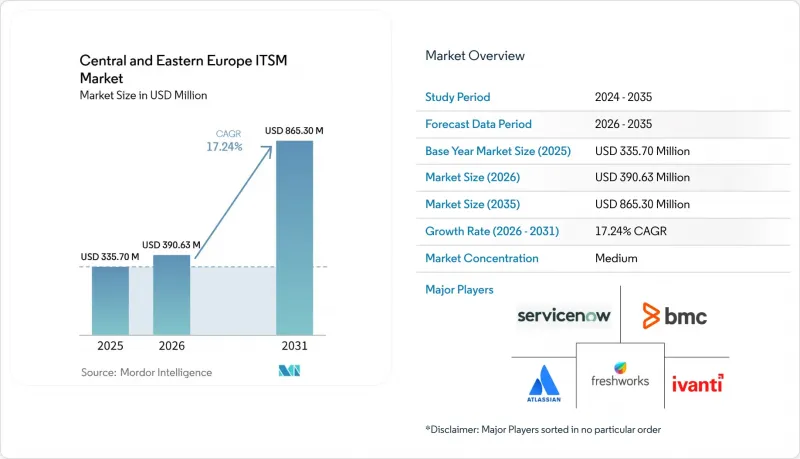
Mordor Intelligence에 의하면, 중부 및 동유럽의 ITSM 시장 규모는 2025년 3억 3,570만 달러로 평가되었습니다. 2026년에는 3억 9,063만 달러로 확대되어 2026-2035년에 걸쳐 CAGR 17.24%로 성장을 지속하여, 2035년까지 8억 6,530만 달러에 이를 것으로 예측됩니다.
본 보고서는 구성 요소(솔루션, 서비스), 배포 방식(클라우드, On-Premise, 하이브리드), 용도(서비스 데스크, 자산 및 구성 관리, 기타), 최종 사용자 산업(은행, 금융서비스 및 보험(BFSI), 제조업, 기타), 기업 규모(대기업, 중소기업)별로 분류되어 있습니다. 시장 전망은 금액(달러) 기준으로 제시되어 있습니다.
중부 및 동유럽의 ITSM 시장 동향 및 인사이트
중견 기업에서의 클라우드 기반 ITSM 플랫폼 도입 확대
클라우드를 통한 제공으로 On-Premise 인프라의 필요성이 감소하고 도입 주기가 단축됨에 따라, 중견 기업은 중부 및 동유럽의 ITSM 시장에서 새로운 수요의 주요 원천이 되고 있습니다. 폴란드에서는 비즈니스 서비스 업무에 이미 견고한 클라우드 기반이 구축되어 있으며, 2025년 ABSL 부문 보고서에 따르면 IT 전문센터의 93.8%가 Microsoft Azure를, 81.3%가 AWS를 이용하고 있습니다. 이러한 하이퍼스케일러 도입 기반이 갖춰져 있어, 많은 기업이 별도의 인프라를 구축하지 않고도 서비스 관리 소프트웨어를 추가할 수 있으므로 SaaS형 ITSM 도입이 용이해지고 있습니다. 동일한 ABSL 보고서에 따르면, 폴란드 IT 전문센터의 75%가 이미 엔터프라이즈용 ITSM 플랫폼을 이용하고 있으며, 이는 클라우드 주도형 운영 모델이 이제 이 지역의 주류 제공 형태 중 하나가 되었음을 보여줍니다. 도입 비용이 낮고 온보딩이 신속한 벤더는 미드마켓에서 가장 큰 혜택을 보고 있습니다. 이는 구매자들이 대규모 엔터프라이즈 배포에 따르는 비용이나 지연 없이 최신 워크플로우 도구를 원하기 때문입니다. 이러한 추세로 인해 중부 및 동유럽 ITSM 시장의 타겟 고객층은 대기업을 넘어 확대되고 있으며, 지역 전체의 신규 고객 확보 흐름도 개선되고 있습니다.
워크플로우 자동화 및 서비스 표준화에 대한 수요 증가
중부 및 동유럽의 ITSM 시장이 확대되고 있는 배경에는 공유 서비스 센터가 국가, 팀, 사내 시스템을 넘나들며 일관된 워크플로우를 필요로 하고 있다는 점도 있습니다. ABSL 보고서에 따르면, 폴란드 공유 서비스 센터의 74.1%가 2024년에 지능형 프로세스 자동화(IPA)를 도입했으며, 이는 전년도의 65.2%에서 증가한 수치입니다. 또한, 업무의 평균 자동화율은 22.4%에 달했습니다. 자동화가 확산됨에 따라 ITSM 플랫폼은 이벤트를 기록하고, 예외를 라우팅하며, 전체 비즈니스 프로세스에서 승인 현황을 가시화하는 제어 계층으로 자리 잡고 있습니다. Freshworks는 2026년 1분기, Freshservice가 인프라 감지를 위한 Device42와 사고 대응을 위한 FireHydrant를 통합하여 통합된 서비스 운영 환경을 구축했다고 보고하며, 이러한 방향성을 더욱 강화했습니다. 이러한 통합이 중요시되는 이유는 구매자들이 더 이상 ITSM을 단순한 티켓 처리의 관점에서만 평가하지 않기 때문입니다. 그들은 ITSM을 활용하여 자산, 인시던트, 서비스 프로세스에 걸쳐 더 광범위한 워크플로우 자동화를 통제하려고 하고 있습니다. 그 결과, 중부 및 동유럽의 ITSM 시장에서는 자동화 거버넌스와 연계된 플랫폼 교체가 어려워짐에 따라 계약 갱신 수요가 더욱 높아지고 있습니다.
레거시 인프라와 도구의 난립으로 인한 플랫폼 통합 지연
많은 기업이 여전히 중복되는 여러 서비스, 모니터링, 자산 관리 도구를 동시에 운영하고 있기 때문에 레거시 환경은 중부 및 동유럽의 ITSM 시장에 여전히 큰 걸림돌이 되고 있습니다. 이는 특히 여러 기술 주기에 걸쳐 구식 시스템이 유지되어 온 제조업, 유틸리티, 정부 기관에서 두드러집니다. 제조업만 해도 2025년 매출의 19%를 차지했는데, 이는 OT(운영 기술) 환경이 표준 ITSM 설계 범위를 벗어나는 경우가 많아 별도의 통합 작업이 필요하기 때문에 중요한 의미를 지닙니다. 또한 CMDB 기록이 불완전하거나 부정확할 경우, 마이그레이션 프로젝트 진행도 지연됩니다. 새로운 플랫폼이 구매자가 기대하는 가시성을 제공하려면 자산 데이터를 정리해야 하는 경우가 많기 때문입니다. 각 벤더는 디스커버리 및 마이그레이션 도구를 제공하여 이에 대응하고 있지만, 이러한 추가 도구는 이미 예산 압박에 직면해 있는 구매자에게 총 소유 비용을 상승시키는 요인이 됩니다. 이러한 제약으로 인해, 장기적인 비즈니스 타당성이 명확하더라도 중부 및 동유럽 ITSM 시장의 일부 수요는 당분간 계약 체결로 이어지지 않는 상황이 지속되고 있습니다.
부문별 분석
2025년, 솔루션은 중부 및 동유럽 ITSM 시장 점유율의 62%를 차지했으며, 이는 구매자가 여전히 소프트웨어 플랫폼을 서비스 관리 지출의 핵심으로 삼고 있음을 보여줍니다. 이 수요의 대부분은 서비스 데스크 도구, CMDB 기능, 지식 모듈,셀프 서비스 계층에서 비롯되며, 조직은 이를 매니지드 딜리버리 계약을 통해 외부에 위탁하기보다는 자체 운영 모델 내에서 보유하고자 합니다. 실무적인 관점에서 볼 때, 이러한 경향은 사내 IT 역량이 더 잘 갖춰진 국가, 특히 공유 서비스 센터가 이미 광범위한 업무 부하를 관리하고 있는 지역에서 가장 두드러집니다. 이 점에서 폴란드는 두드러지는데, 2025년 시점에서 IT 전문 비즈니스 서비스 센터의 75%가 이미 엔터프라이즈 ITSM 플랫폼을 도입한 상태였습니다.
중부 및 동유럽의 ITSM 시장에서는 여전히 서비스 분야의 성장세가 강하며, 이 분야는 2031년까지 연평균 성장률(CAGR) 18.65%로 확대될 것으로 예측됩니다. 이러한 성장은 전담 ITSM 팀을 보유하지 않은 구매자들의 도입, 워크플로우 설계, AI 설정 및 지속적인 지원에 대한 수요 증가를 반영합니다. Freshworks는 2026년 1분기, Freshservice, Device42, FireHydrant를 통해 티켓 관리, 자산 관리, 인시던트 관리, 서비스 관리, 워크플로우를 통합한 플랫폼을 소개하며 이러한 서비스 기회를 명확히 보여주었습니다. 루마니아, 슬로바키아, 헝가리의 중견 기업들은 규정 준수를 충족하는 워크플로우가 필요하면서도, 업무를 원활하게 운영하기 위해 공급업체나 파트너의 지원을 선호하는 경향이 강하기 때문에 이 점에서 특히 중요한 존재입니다. 그 결과, 솔루션이 여전히 수익의 주축으로 남아 있는 한편, 도입이 더욱 복잡해지고 규정 준수 및 자동화와 밀접하게 연계됨에 따라 서비스 부문이 더욱 빠른 성장을 이루는 분야로 부상하고 있습니다.
2025년, 중부 및 동유럽의 ITSM 시장에서 클라우드는 64%를 차지하며 압도적인 차이로 주요 배포 모델이 되었습니다. 그 매력은 명백합니다. SaaS 플랫폼은 현지 인프라에 대한 수요를 줄이고, 지속적인 기능 업데이트를 지원하며, 단일 테넌트로 여러 국가를 동시에 커버할 수 있기 때문입니다. 이 모델은 폴란드, 체코, 루마니아, 슬로바키아의 공유 서비스 센터 운영 실태와 부합합니다. 이 국가들에서는 지원 팀이 국경을 넘어 업무를 수행하는 경우가 많아 공통된 서비스 계층이 필요하기 때문입니다. 클라우드 기반의 강점은 폴란드에서 두드러지는데, 2025년에는 IT 전문센터의 93.8%가 Microsoft Azure를, 81.3%가 AWS를 이용하고 있었습니다.
또한, 클라우드 시장은 2031년까지 연평균 성장률(CAGR) 19.30%로 확대될 것으로 예측되며, 도입 기반과 확대 속도 양면에서 중부 및 동유럽의 ITSM 시장을 주도하고 있습니다. 이러한 이중적 우위는 전환이 아직 완료되기까지 한참 남았으며, 많은 조직이 On-Premise나 하이브리드 환경에서 전환 과정에 있음을 시사합니다. 데이터 관리나 조달 주기의 사정상 퍼블릭 클라우드로의 전환이 지연되고 있는 정부 기관이나 국방 관련 분야에서는 여전히 On-Premise에 대한 수요가 존재합니다. 한편, 기밀성이 높은 워크로드를 프라이빗 인프라에 계속 유지하는 제조업체나 금융 기관의 경우, 하이브리드 모델이 계속해서 활용되고 있습니다. 이러한 혼합 환경은 데이터 보관에 관한 프레임워크가 표준화되고, 벤더의 AI 기능이 클라우드 제공을 통해 계속해서 선제적으로 제공됨에 따라 시간이 지남에 따라 축소될 가능성이 높다고 볼 수 있습니다. 그 결과, 레거시 형태나 전환 단계의 형태가 여전히 포함된 상태와 함께, 클라우드가 중부 및 동유럽의 ITSM 시장의 운영 기준을 확립해 가고 있는 상황이 전개되고 있습니다.
기타 혜택
- 엑셀 형식 시장 예측(ME) 시트
- 3개월간의 애널리스트 지원
자주 묻는 질문
목차
제1장 서론
제2장 조사 방법
제3장 개요
제4장 시장 구도
제5장 시장 규모 및 성장 예측
제6장 경쟁 구도
제7장 시장 기회 및 향후 전망
KTH 26.09.02According to Mordor Intelligence, the central and Eastern Europe ITSM market size is expected to grow from USD 335.70 million in 2025 to USD 390.63 million in 2026 and is forecast to reach USD 865.30 million by 2035 at 17.24% CAGR over 2026-2035.
This report is Segmented by Component (Solutions, Services), Deployment (Cloud, On-Premises, Hybrid), Application (Service Desk and Incident Management, Asset and Configuration Management, and More), End-User Industry (BFSI, Manufacturing, and More), and Enterprise Size (Large Enterprises, Small and Medium Enterprises). The Market Forecasts are Provided in Terms of Value (USD).
Central and Eastern Europe ITSM Market Trends and Insights
Rising Adoption Of Cloud-Based ITSM Platforms Across Midmarket Enterprises
Midmarket organizations are becoming a major source of new demand in the Central and Eastern Europe ITSM market because cloud delivery has lowered the need for local infrastructure and shortened deployment cycles. Poland already has a strong cloud foundation inside business services operations, with 93.8% of IT-focused centers using Microsoft Azure and 81.3% using AWS as of the 2025 ABSL sector report. This installed hyperscaler base makes SaaS ITSM procurement easier because many firms can add service management software without a separate infrastructure build. The same ABSL report also showed that 75% of IT-focused centers in Poland were already using enterprise ITSM platforms, which signals that cloud-led operating models are now part of mainstream regional delivery practice. Vendors with lower entry pricing and faster onboarding are benefiting most in the midmarket because buyers want modern workflow tools without the cost and delay tied to larger enterprise rollouts. That pattern is widening the addressable base of the Central and Eastern Europe ITSM market beyond large accounts and is improving new logo flow across the region.
Increasing Need For Workflow Automation And Service Standardization
The Central and Eastern Europe ITSM market is also moving forward because shared service centers need consistent workflows across countries, teams, and internal systems. ABSL reported that 74.1% of centers in Poland implemented Intelligent Process Automation in 2024, up from 65.2% a year earlier, and the average automation rate reached 22.4% of tasks. As automation spreads, ITSM platforms are becoming the control layer that records events, routes exceptions, and keeps approvals visible across business processes. Freshworks reinforced this direction in Q1 2026 when it reported that Freshservice had integrated Device42 for infrastructure discovery and FireHydrant for incident response into a unified service operations environment. That kind of integration matters because buyers are no longer judging ITSM only by ticket handling; they are using it to govern broader workflow automation across asset, incident, and service processes. In turn, the Central and Eastern Europe ITSM market is seeing stronger renewal logic because platforms tied to automation governance become harder to replace.
Legacy Infrastructure And Tool Sprawl Slowing Platform Consolidation
Legacy environments remain a real brake on the Central and Eastern Europe ITSM market because many enterprises still operate several overlapping service, monitoring, and asset tools at once. This is especially visible in manufacturing, utilities, and government settings where older systems have been kept in place across multiple technology cycles. Manufacturing alone held 19% of 2025 revenue, and that matters because OT environments often sit outside standard ITSM designs and require separate integration work. Migration projects also slow down when CMDB records are incomplete or inaccurate, since asset data often needs cleanup before a new platform can deliver the visibility buyers expect. Vendors are responding with discovery and migration tooling, but those add-ons raise total ownership cost for buyers that already face budget pressure. This restraint keeps some demand in the Central and Eastern Europe ITSM market from converting quickly, even when the long-term business case is clear.
Other drivers and restraints analyzed in the detailed report include:
- Greater Demand For Hybrid Work Enablement And Self-Service Support
- Regulatory Pressure For Auditability, Access Control, And Service Traceability
- Budget Sensitivity Among Small And Medium Enterprises
For complete list of drivers and restraints, kindly check the Table Of Contents.
Segment Analysis
Solutions held 62% of the Central and Eastern Europe ITSM market share in 2025, which shows that buyers still place software platforms at the center of service management spending. The largest part of this demand comes from service desk tools, CMDB functions, knowledge modules, and self-service layers that organizations want to own inside their operating model rather than outsource through managed delivery contracts. In practical terms, that preference is strongest in countries with deeper in-house IT capability, especially where shared service centers already manage large regional workloads. Poland stands out in this regard because 75% of IT-focused business service centers were already using enterprise ITSM platforms in 2025.
The Central and Eastern Europe ITSM market is still seeing stronger momentum in services, with that component projected to expand at an 18.65% CAGR through 2031. That growth reflects rising need for implementation, workflow design, AI configuration, and ongoing support for buyers that do not have dedicated ITSM teams. Freshworks showed this service opportunity clearly in Q1 2026 when it described a unified platform that brought together ticketing, assets, incidents, services, and workflows through Freshservice, Device42, and FireHydrant. Midmarket firms in Romania, Slovakia, and Hungary are especially relevant here because they may need compliant workflows but often prefer vendor or partner assistance to keep operations running smoothly. As a result, solutions remain the revenue anchor, while services are becoming the faster layer of growth as deployments become more complex and more closely tied to compliance and automation.
Cloud accounted for 64% of the Central and Eastern Europe ITSM market in 2025, which made it the dominant deployment model by a clear margin. The appeal is straightforward because SaaS platforms reduce local infrastructure needs, support continuous feature updates, and allow a single tenant to serve multiple countries at once. That model fits the operating reality of shared service centers in Poland, the Czech Republic, Romania, and Slovakia, where support teams often work across borders and need a common service layer. The strength of the underlying cloud base is visible in Poland, where 93.8% of IT-focused centers used Microsoft Azure and 81.3% used AWS in 2025.
Cloud is also projected to grow at a 19.30% CAGR through 2031, so it leads the Central and Eastern Europe ITSM market on both installed base and expansion speed. This dual position suggests that migration is still far from complete and that many organizations remain in transition from on-premise or hybrid environments. On-premise demand remains present in government and defense-related settings where data control and procurement cycles slow movement to public cloud, while hybrid models continue to serve manufacturers and financial institutions that keep sensitive workloads on private infrastructure. Those mixed environments are likely to narrow over time as residency frameworks become more standardized and as vendor AI features continue to arrive first through cloud delivery. The result is a deployment mix that still includes legacy and transitional forms, but one in which cloud is setting the operating standard for the Central and Eastern Europe ITSM market.
Complete Report Scope:
- By Component
- Solutions
- Services
- By Deployment
- Cloud
- On-Premise
- Hybrid
- By Application
- Service Desk
- Asset And Configuration Management
- Change And Release Management
- Service Request Management
- Knowledge Management
- Other Applications
- By End-User Industry
- BFSI
- Manufacturing
- Government
- IT And Telecom
- Retail And E-Commerce
- Healthcare
- Travel And Hospitality
- Other Industries
- By Enterprise Size
- Large Enterprises
- Small And Medium Enterprises
- By Geography
- Poland
- Czech Republic
- Hungary
- Romania
- Slovakia
- Rest Of Central And Eastern Europe
List of Companies Covered in this Report:
- ServiceNow, Inc.
- BMC Software, Inc.
- Ivanti, Inc.
- Atlassian Corporation Plc
- Freshworks Inc.
- ManageEngine, a division of Zoho Corporation Pvt. Ltd.
- Microsoft Corporation
- Broadcom Inc.
- OpenText Corporation
- SolarWinds Corporation
- IBM Corporation
- DXC Technology Company
- Accenture plc
- Atos SE
- Tietoevry Oyj
- Asseco Poland S.A.
- Comarch S.A.
- Efecte Oyj
- TOPdesk Holding B.V.
Additional Benefits:
- The market estimate (ME) sheet in Excel format
- 3 months of analyst support
TABLE OF CONTENTS
1 INTRODUCTION
- 1.1 Study Assumptions and Market Definition
- 1.2 Scope of the Study
2 RESEARCH METHODOLOGY
3 EXECUTIVE SUMMARY
4 MARKET LANDSCAPE
- 4.1 Market Overview
- 4.2 Market Drivers
- 4.2.1 Rising Adoption Of Cloud-Based ITSM Platforms Across Midmarket Enterprises
- 4.2.2 Increasing Need For Workflow Automation And Service Standardization
- 4.2.3 Greater Demand For Hybrid Work Enablement And Self-Service Support
- 4.2.4 Regulatory Pressure For Auditability, Access Control, And Service Traceability
- 4.2.5 AI-Assisted Ticket Triage And Knowledge Discovery Improving Resolution Efficiency
- 4.2.6 Cross-Border Shared Service Center Expansion Across Central and Eastern Europe
- 4.3 Market Restraints
- 4.3.1 Legacy Infrastructure And Tool Sprawl Slowing Platform Consolidation
- 4.3.2 Budget Sensitivity Among Small And Medium Enterprises
- 4.3.3 Integration Complexity With ERP, Identity, And Monitoring Stacks
- 4.3.4 Data Residency And Procurement Constraints In Public Sector And Regulated Verticals
- 4.4 Industry Value Chain Analysis
- 4.5 Regulatory Landscape
- 4.6 Technological Outlook
- 4.7 Porter's Five Forces Analysis
- 4.7.1 Bargaining Power Of Suppliers
- 4.7.2 Bargaining Power Of Buyers
- 4.7.3 Threat Of New Entrants
- 4.7.4 Threat Of Substitutes
- 4.7.5 Competitive Rivalry
5 MARKET SIZE AND GROWTH FORECASTS (VALUE)
- 5.1 By Component
- 5.1.1 Solutions
- 5.1.2 Services
- 5.2 By Deployment
- 5.2.1 Cloud
- 5.2.2 On-Premise
- 5.2.3 Hybrid
- 5.3 By Application
- 5.3.1 Service Desk
- 5.3.2 Asset And Configuration Management
- 5.3.3 Change And Release Management
- 5.3.4 Service Request Management
- 5.3.5 Knowledge Management
- 5.3.6 Other Applications
- 5.4 By End-User Industry
- 5.4.1 BFSI
- 5.4.2 Manufacturing
- 5.4.3 Government
- 5.4.4 IT And Telecom
- 5.4.5 Retail And E-Commerce
- 5.4.6 Healthcare
- 5.4.7 Travel And Hospitality
- 5.4.8 Other Industries
- 5.5 By Enterprise Size
- 5.5.1 Large Enterprises
- 5.5.2 Small And Medium Enterprises
- 5.6 By Geography
- 5.6.1 Poland
- 5.6.2 Czech Republic
- 5.6.3 Hungary
- 5.6.4 Romania
- 5.6.5 Slovakia
- 5.6.6 Rest Of Central And Eastern Europe
6 COMPETITIVE LANDSCAPE
- 6.1 Market Concentration
- 6.2 Strategic Moves
- 6.3 Market Share Analysis
- 6.4 Company Profiles (includes Global Level Overview, Market Level Overview, Core Segments, Financials as available, Strategic Information, Market Rank/Share, Products and Services, Recent Developments)
- 6.4.1 ServiceNow, Inc.
- 6.4.2 BMC Software, Inc.
- 6.4.3 Ivanti, Inc.
- 6.4.4 Atlassian Corporation Plc
- 6.4.5 Freshworks Inc.
- 6.4.6 ManageEngine, a division of Zoho Corporation Pvt. Ltd.
- 6.4.7 Microsoft Corporation
- 6.4.8 Broadcom Inc.
- 6.4.9 OpenText Corporation
- 6.4.10 SolarWinds Corporation
- 6.4.11 IBM Corporation
- 6.4.12 DXC Technology Company
- 6.4.13 Accenture plc
- 6.4.14 Atos SE
- 6.4.15 Tietoevry Oyj
- 6.4.16 Asseco Poland S.A.
- 6.4.17 Comarch S.A.
- 6.4.18 Efecte Oyj
- 6.4.19 TOPdesk Holding B.V.
7 MARKET OPPORTUNITIES AND FUTURE OUTLOOK
- 7.1 White-Space and Unmet-Need Assessment