

|
시장보고서
상품코드
2118154
AI 기반 보행 및 이동 분석 시장 : 시장 점유율 분석, 업계 동향 및 통계, 성장 예측(2026-2031년)AI-Powered Gait and Mobility Analytics - Market Share Analysis, Industry Trends & Statistics, Growth Forecasts (2026 - 2031) |
||||||
 Mordor Intelligence
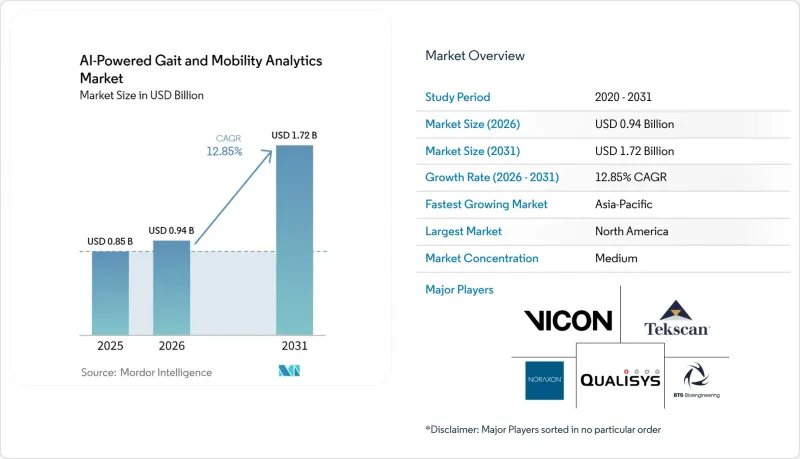
Mordor Intelligence에 의하면, AI 기반 보행 및 이동 분석 시장은 2025년 8억 5,000만 달러로 평가되었고, 2026년에는 9억 4,000만 달러로 추정되고, 2026-2031년 CAGR 12.85%로 성장을 지속할 전망이며, 2031년에는 17억 2,000만 달러에 이를 것으로 예측됩니다.
본 보고서는 구성 요소별(소프트웨어, 하드웨어, 서비스), 배포 방식별(클라우드 기반, 온프레미스, 하이브리드), 기술별(컴퓨터 비전 기반 분석, 기타), 이동성 평가 유형별(보행 분석, 기타), 용도별(신경 장애, 기타), 최종 사용자별(병원, 기타), 지역별(북미, 유럽, 아시아태평양, 기타)로 분류되어 있습니다. 시장 예측은 금액(달러)으로 표시되어 있습니다.
세계의 AI 기반 보행 및 이동 분석 시장 동향 및 인사이트
AI 기반 생체역학적 진단의 보급 확대
AI 기반 보행 및 이동 분석 시장은 생체역학적 평가가 전문 검사실에서 일반 임상 현장으로 전환되고 있는 데 따른 혜택을 받고 있습니다. AI를 통해 유용한 보행 매개변수를 추출하는 데 필요한 전문 지식의 부담이 줄어들고 있으며, 이로 인해 병원 및 외래 진료 현장에서 고도의 평가가 더욱 실용적으로 이루어지고 있습니다. Qualisys는 2026년 1월, 훈련을 중단하지 않고 30분 만에 20명의 운동선수를 평가할 수 있는 마커리스 기능 평가 기능을 갖춘 ‘OnTraq’를 출시했습니다. 이 제품의 사례는 정확도뿐만 아니라 처리 능력이 어떻게 상업적 우위를 점하고 있는지를 보여줍니다. 이러한 마커 없는 접근 방식은 그동안 본격적인 모션 캡처 시스템 도입을 정당화할 수 없었던 클리닉의 진입 장벽을 낮추고, AI 기반 보행 및 이동 분석 시장의 잠재 고객 기반을 확대되고 있습니다. 포스 플레이트 기반 시스템과의 임상적 동등성을 입증할 수 있는 공급업체는 의료 제공업체들이 수동 관찰 도구에서 점차 전환함에 따라 병원 측 수요를 더 많이 확보할 가능성이 높습니다.
원격 재활 및 재택 모니터링 워크플로우의 확대
AI 기반 보행 및 이동 분석 시장은 원격 재활 모델의 급속한 보급에 힘입어 더욱 성장하고 있습니다. 의료 제공업체는 지속적인 운동 데이터를 기반으로 치료를 구성하고 있으며, 이를 통해 공식적인 실험실이나 클리닉 환경 밖에서도 환자를 추적할 수 있는 소프트웨어가 뒷받침되고 있습니다. Net Health는 2026년 2월, 재활 서비스 제공업체를 위한 원격 치료 모니터링 플랫폼으로 Limber Health를 확장했는데, 이는 디지털 재활 채널이 일시적인 시범 운영 추세가 아니라 안정적인 수요 채널로 자리 잡고 있음을 보여줍니다. 이러한 변화가 중요한 이유는 재택 모니터링의 보급에 따라 AI 기반 보행 및 이동 분석 시장 전반에서 표준화된 점수, 경과 시간별 보고서, 워크플로우에 부합하는 대시보드에 대한 수요가 증가하고 있기 때문입니다. 이동 능력 지표를 보험사 및 의료 제공업체의 문서화 요구와 연계하는 플랫폼은 디지털 재활 모델이 성숙해짐에 따라 구조적인 우위를 유지할 가능성이 높다고 볼 수 있습니다.
고액의 하드웨어 투자 및 교정 부담
AI 기반 보행 및 이동 분석 시장은 여전히 임상 등급 기기의 비용이라는 실용적 장벽에 직면해 있습니다. 힘판(force plate), 멀티 카메라 시스템, 고밀도 IMU 설비는 2차 의료 수준 이하의 의료 제공업체에게는 여전히 고가이며, 자금력이 있는 병원이나 전문센터 외에서의 도입을 제한하고 있습니다. 2024년 카탈루냐에서 실시된 기술경제 조사에 따르면, 보행에 특화된 웨어러블 의료용 IoT 시스템의 총 자본 비용에는 ±20%에서 ±30%의 불확실성이 존재하며, 이는 예산이 제한된 의료시설의 경우 총 소유 비용에 대한 위험을 높이는 것으로 밝혀졌습니다. 부담이 되는 것은 구매 가격뿐만이 아닙니다. 임상적 정확도를 유지하기 위해서는 정기적인 재보정 및 유지보수도 필요하며, 이는 소규모 시설이 AI 기반 보행 및 이동 분석 시장에 진입하는 데 장애물이 되고 있습니다. 웨어러블 기기의 대체품은 지속적으로 개선되고 있지만, 많은 구매자들은 여전히 정교한 관절 운동학 및 진단 용도 측면에서 이러한 기기를 실험실용 시스템과 완전히 동등한 수준으로 간주하지 않고 있습니다.
부문 분석
2025년에는 소프트웨어가 매출의 49.37%를 차지했으며, AI 기반 보행 및 이동 능력 분석 시장에서 여전히 가장 큰 구성 요소로 자리매김했습니다. 이러한 위상은 가치가 어디에서 창출되는지를 반영합니다. 임상적 유용성은 원시 신호 획득 자체보다 데이터 처리, 점수 산정, 보고서 작성에 크게 의존하기 때문입니다. 또한, 구독형 소프트웨어 모델은 하드웨어만 판매하는 것에 비해 지속적인 수익과 더 견고한 고객 유지를 가능하게 합니다. 따라서 AI 기반 보행 및 이동 능력 분석 시장은 단순히 기기 판매만 하는 경우보다 임상 해석 영역을 더 효과적으로 수익화하고 있습니다.
하드웨어는 2031년까지 연평균 성장률(CAGR) 12.94%를 기록하며 가장 빠르게 성장하는 부문이 될 것으로 예상되며, 이러한 성장세는 AI 기반 보행 및 이동 분석 시장 내에서 새로운 자본이 어디로 유입되고 있는지를 보여줍니다. 수요를 견인하는 요인으로는 센서의 소형화, 설치 부담 경감, 웨어러블 기기를 통한 데이터 수집이 필요한 지역 밀착형 모니터링 워크플로우의 보급을 들 수 있습니다. 소프트웨어가 주요 수익원인 경우에도 많은 도입 현장에서는 배포, 보정, 직원 교육이 여전히 필요하기 때문에 서비스는 계속해서 중간적인 역할을 담당하고 있습니다.
2025년에는 클라우드 도입이 수익의 51.27%를 차지했으며, AI 기반 보행 및 이동 분석 시장 전체에서 1위를 차지했습니다. 이러한 우위는 확장 용이성, 온프레미스 IT 부담 경감, SaaS(Software-as-a-Service)형 운영 모델과의 높은 친화성에 기인합니다. 또한, 클라우드 시스템은 반복되는 세션에 걸쳐 환자의 경과 추적을 지원하며, 임상의가 진료 현장과 재택 이용 데이터 모두에 쉽게 접근해야 할 때 중요해집니다.
하이브리드 배포는 2031년까지 연평균 성장률(CAGR) 13.12%로 가장 빠르게 성장하는 모델이 될 것으로 예상되며, 이는 AI 기반 보행 및 이동 분석 시장에서 순수 클라우드 제공만으로는 반드시 해결할 수 없는 운영상의 제약을 반영한 것입니다. 실시간 바이오 피드백, 저지연 처리, 국가별 고유한 데이터 상주 규정은 모두 로컬 엣지 처리와 선택적 클라우드 집약을 결합한 접근 방식을 뒷받침하고 있습니다. 온프레미스 환경은 높은 수준의 보안이 요구되는 학술 의료 센터나 전문 프로그램에서 여전히 일정한 위치를 차지하고 있지만, 호스팅형 플랫폼의 거버넌스 기준이 향상됨에 따라 그 전반적인 역할은 축소되고 있습니다.
지역별 분석
북미는 2025년에 43.42%의 점유율을 차지하며, AI를 활용한 보행 및 이동 능력 분석 시장에서 가장 규모가 큰 지역 블록으로서의 위상을 유지했습니다. 이 지역은 충분한 자금을 확보한 병원 인프라, 확립된 원격 치료 모니터링 채널, 디지털 임상 워크플로우에 대한 보다 탄탄한 준비 태세 등의 혜택을 누리고 있습니다. 또한, 2026년 1월 FDA가 발표한 임상 의사 결정 지원에 관한 지침에 따라, 임상의가 독자적으로 검증할 수 있고 더 신속한 상용화 주기를 지원하는 ‘설명 가능한 AI’ 소프트웨어에 대한 규제상의 불확실성이 일부 해소되었습니다. 캐나다와 멕시코는 지역 전체에서 여전히 규모는 작지만, 공공 및 민간 의료 채널을 통해 북미 전체 수요 기반을 확대되고 있습니다.
유럽은 고령화와 재활 수요 증가로 인해 공공 의료 제도가 끊임없이 압박을 받고 있기 때문에 AI 기반 보행 및 이동 분석 시장에서 여전히 중요한 위치를 차지하고 있습니다. 보험 환급 제도는 북미에 비해 국가별 특성이 강하며, 이로 인해 공급업체의 계약 및 진출 전략도 달라집니다. 영국, 독일, 프랑스, 이탈리아, 스페인은 여전히 주요 수익원이 되고 있지만, 재활 채널에서의 정량적 이동 능력 평가 제도화에 대해서는 국가마다 진행 속도가 다릅니다. 따라서 유럽 내 비즈니스 기회는 단일 시설의 구매보다는 근거, 워크플로우와의 적합성, 조달 기준이 마련된 후의 시스템 차원에서의 도입에 크게 의존하고 있습니다.
아시아태평양은 2031년까지 연평균 성장률(CAGR) 16.13%로 확대될 것으로 예측되며, AI 기반 보행 및 이동 분석 시장에서 가장 빠르게 성장하는 지역입니다. 일본은 고령화가 진행되고 있어 낙상 위험 및 장기적인 이동 능력 추적에 대한 수요가 견조한 반면, 한국과 중국에서는 디지털 헬스에 대한 광범위한 투자와 현지 혁신 활동을 통해 시장의 성장세를 뒷받침하고 있습니다. 인도 역시 중요한 시장입니다. 인도에서는 낙상으로 인한 부담이 크기 때문에 장기적으로 볼 때 성장 잠재력이 높은 선별 검사 및 재활 도구의 도입이 점점 더 중요해지고 있기 때문입니다. 이 지역의 성장은 단일한 패턴에 의한 것이 아닙니다. 성숙한 의료 시스템, 급속히 확장되는 외래 환자 네트워크, 비용에 민감한 구매자들이 모두 그 배경에 있는 요인이기 때문입니다. 남미, 중동 및 아프리카는 여전히 규모가 작고 도입 초기 단계에 있으며, 도입은 사립 병원 시스템이나 프리미엄 케어 네트워크에 집중되어 있습니다.
기타 혜택
- 엑셀 형식 시장 예측(ME) 시트
- 3개월간의 애널리스트 지원
자주 묻는 질문
목차
제1장 서론
제2장 조사 방법
제3장 주요 요약
제4장 시장 구도
제5장 시장 규모 및 성장 예측
제6장 경쟁 구도
제7장 시장 기회 및 향후 전망
AJY 26.09.03According to Mordor Intelligence, the AI-powered gait and mobility analytics market is expected to grow from USD 0.85 billion in 2025 to USD 0.94 billion in 2026 and is forecasted to reach USD 1.72 billion by 2031 at 12.85% CAGR over 2026-2031.
This report is Segmented by Component (Software, Hardware, Services), Deployment (Cloud-Based, Hybrid, On-Premises), Technology (Computer Vision-Based Analytics, and More), Assessment (Gait Analysis, and More), Application (Neurological Disorders, and More), End-User (Hospitals, and More), Geography (North America, Europe, Asia-Pacific, and More). The Market Forecasts are Provided in Value (USD).
Global AI-Powered Gait and Mobility Analytics Market Trends and Insights
Rising Adoption of AI-Assisted Biomechanical Diagnostics
The AI-powered gait and mobility analytics market is benefiting from a shift in biomechanical assessment from specialist labs into normal clinical use. AI is lowering the skill burden required to extract useful gait parameters, which makes advanced assessment more practical for hospitals and outpatient settings. Qualisys launched OnTraq in January 2026 with a markerless functional assessment that can evaluate 20 athletes in 30 minutes without interrupting training, and that product example shows how throughput has become a commercial advantage alongside accuracy. The same markerless approach also lowers the entry barrier for clinics that could not previously justify a full motion capture installation, which broadens the addressable base for the AI-powered gait and mobility analytics market. Vendors that can prove clinical equivalence against force-plate-based systems are likely to win more hospital demand as providers move away from manual observational tools.
Expansion of Remote Rehabilitation and Home Monitoring Workflows
The AI-powered gait and mobility analytics market is also being lifted by the fast buildout of remote rehabilitation models. Providers are structuring care around continuous movement data, and that supports software that can follow patients outside formal lab or clinic settings. Net Health expanded Limber Health in February 2026 as a remote therapeutic monitoring platform for rehabilitation providers, and this shows that digital rehab pathways are becoming a stable demand channel rather than a temporary pilot trend. This shift matters because home-based monitoring increases the need for standard scores, longitudinal reporting, and workflow-ready dashboards across the AI-powered gait and mobility analytics market. Platforms that align mobility metrics with payer and provider documentation needs are likely to hold a structural advantage as digital rehab models mature.
High Hardware Capex and Calibration Burden
The AI-powered gait and mobility analytics market still faces a practical barrier in the cost of clinical-grade equipment. Force plates, multi-camera systems, and dense IMU setups remain expensive for providers below the secondary-care level, which limits adoption outside well-funded hospitals and specialty centers. A 2024 technoeconomic study in Catalonia found that full gait-oriented wearable medical IoT systems carried capital cost uncertainty of +-20% to +-30%, and that raised total ownership risk for care facilities working with tight budgets. The burden is not only the purchase price because recurring recalibration and maintenance are also required to preserve clinical accuracy, and that adds friction for the AI-powered gait and mobility analytics market in smaller sites. Wearable alternatives are improving, but many buyers still view them as not fully equivalent to lab systems for advanced joint kinematics and diagnostic use.
Other drivers and restraints analyzed in the detailed report include:
- Growth in Fall-Risk Screening Across Aging Care Pathways
- Clinical Preference for Explainable Mobility Scoring and Audit Trails
- Limited Diverse Annotated Gait Datasets for Model Training
For complete list of drivers and restraints, kindly check the Table Of Contents.
Segment Analysis
Software held 49.37% of revenue in 2025, which kept it as the largest component in the AI-powered gait and mobility analytics market. That position reflects where value is created, since clinical usefulness depends more on data processing, scoring, and reporting than on raw signal capture alone. Subscription-based software models also support recurring revenue and tighter customer retention than hardware-only sales. The AI-powered gait and mobility analytics industry is therefore monetizing clinical interpretation layers more effectively than device sales alone.
Hardware is expected to be the fastest-growing component at a 12.94% CAGR through 2031, and that rise shows where fresh capital is moving inside the AI-powered gait and mobility analytics market. Demand is being lifted by smaller sensors, lower setup burden, and the spread of community-based monitoring workflows that need wearable capture. Services continue to fill the middle ground because deployment, calibration, and staff training remain necessary in many installations, even when software remains the main revenue anchor.
Cloud deployment accounted for 51.27% of revenue in 2025, which gave it the lead across the AI-powered gait and mobility analytics market. Its advantage comes from easier scaling, lower local IT burden, and better fit with software-as-a-service operating models. Cloud systems also support longitudinal patient tracking across repeated sessions, which matters when clinicians need easy access to data from both clinical and home-based use.
Hybrid deployment is anticipated to be the fastest-growing model at a 13.12% CAGR through 2031, and that reflects operational limits that pure cloud delivery cannot always solve in the AI-powered gait and mobility analytics market. Real-time biofeedback, low-latency processing, and country-specific data residency rules all support a mix of local edge processing with selective cloud aggregation. On-premises setups still hold a place in high-security academic medical centers and specialized programs, but their overall role is narrowing as hosted platforms improve their governance standards.
Complete Report Scope:
- By Component
- Software
- Hardware
- Services
- By Deployment Mode
- Cloud-Based
- On-Premises
- Hybrid
- By Technology
- Computer Vision-Based Analytics
- Wearable Sensor Analytics
- Machine Learning-Based Predictive Analytics
- Deep Learning
- Other Technologies
- By Mobility Assessment Type
- Gait Analysis
- Balance Assessment
- Fall Risk Assessment
- Posture Analysis
- Joint Movement Analysis
- Functional Mobility Assessment
- Other Mobility Assessment Types
- By Application
- Neurological Disorders
- Orthopedic Rehabilitation
- Geriatric Care
- Sports Medicine & Performance
- Parkinson's Disease Management
- Other Applications
- By End-User
- Hospitals
- Rehabilitation Centers
- Long-Term Care Facilities
- Sports Performance Centers
- Other End-Users
- By Geography
- North America
- United States
- Canada
- Mexico
- Europe
- Germany
- United Kingdom
- France
- Italy
- Spain
- Rest of Europe
- Asia-Pacific
- China
- Japan
- India
- Australia
- South Korea
- Rest of Asia-Pacific
- Middle East and Africa
- GCC
- South Africa
- Rest of Middle East and Africa
- South America
- Brazil
- Argentina
- Rest of South America
- North America
Geography Analysis
North America held 43.42% share in 2025, which kept it as the largest regional block in the AI-powered gait and mobility analytics market. The region benefits from well-funded hospital infrastructure, established remote therapeutic monitoring pathways, and stronger readiness for digital clinical workflows. The FDA's January 2026 clinical decision support guidance also reduced some regulatory uncertainty for explainable AI software that clinicians can independently review and that supports faster commercialization cycles. Canada and Mexico remain smaller within the regional total, but they add to the broader North American demand base through public and private care channels.
Europe remains an important part of the AI-powered gait and mobility analytics market because public health systems are under steady pressure from aging populations and rising rehabilitation needs. Reimbursement structures are more national in character than in North America, which changes how vendors approach contracting and rollout. The United Kingdom, Germany, France, Italy, and Spain remain the main revenue contributors, though they are moving at different speeds in formalizing quantitative mobility assessment in rehabilitation pathways. Europe's opportunity is therefore tied less to single-facility purchasing and more to system-level adoption once evidence, workflow fit, and procurement standards align.
Asia-Pacific is projected to expand at 16.13% CAGR through 2031, which makes it the fastest-growing region in the AI-powered gait and mobility analytics market. Japan's aging population supports strong demand for fall-risk and longitudinal mobility tracking, while South Korea and China add momentum through broader digital health investment and local innovation activity. India also matters because the country's fall burden is high, which strengthens the case for scalable screening and rehabilitation tools over time. The region's growth is not coming from a single pattern, since mature health systems, rapidly scaling outpatient networks, and cost-sensitive buyers are all part of the story. South America, the Middle East, and Africa remain smaller and earlier-stage, with adoption concentrated in private hospital systems and premium care networks.
- Bertec Corporation
- BioSensics LLC
- BTS Bioengineering Corp.
- Delsys Inc.
- Gait Up SA
- Hocoma
- Kistler Group
- Moticon GmbH
- Motion Analysis Corporation
- NaturalPoint Inc.
- Noraxon Inc.
- ProtoKinetics LLC
- Qualisys AB
- ReWalk Robotics
- Sensoria Health Inc.
- Simi Reality Motion Systems GmbH
- Tekscan Inc.
- Vicon Motion Systems Ltd
- Xsens Technologies B.V.
- Zebris Medical GmbH
Additional Benefits:
- The market estimate (ME) sheet in Excel format
- 3 months of analyst support
TABLE OF CONTENTS
1 Introduction
- 1.1 Study Assumptions and Market Definition
- 1.2 Scope of the Study
2 Research Methodology
3 Executive Summary
4 Market Landscape
- 4.1 Market Overview
- 4.2 Market Drivers
- 4.2.1 Rising Adoption of AI-Assisted Biomechanical Diagnostics
- 4.2.2 Expansion of Remote Rehabilitation and Home Monitoring Workflows
- 4.2.3 Increasing Demand for Wearable IMU and Insole-Based Gait Assessment
- 4.2.4 Growth in Fall-Risk Screening Across Aging Care Pathways
- 4.2.5 Need for Longitudinal Mobility Tracking in Post-Acute Care
- 4.2.6 Clinical Preference for Explainable Mobility Scoring and Audit Trails
- 4.3 Market Restraints
- 4.3.1 High Hardware Capex and Calibration Burden
- 4.3.2 Stringent Clinical Validation and Data Privacy Requirements
- 4.3.3 Interoperability Gaps with EHR and Rehab Software
- 4.3.4 Limited Diverse Annotated Gait Datasets for Model Training
- 4.4 Supply/Value Chain Analysis
- 4.5 Regulatory Landscape
- 4.6 Technological Outlook
- 4.7 Porter's Five Forces Analysis
- 4.7.1 Threat of New Entrants
- 4.7.2 Bargaining Power of Suppliers
- 4.7.3 Bargaining Power of Buyers
- 4.7.4 Threat of Substitutes
- 4.7.5 Competitive Rivalry
5 Market Size & Growth Forecasts (Value, USD)
- 5.1 By Component
- 5.1.1 Software
- 5.1.2 Hardware
- 5.1.3 Services
- 5.2 By Deployment Mode
- 5.2.1 Cloud-Based
- 5.2.2 On-Premises
- 5.2.3 Hybrid
- 5.3 By Technology
- 5.3.1 Computer Vision-Based Analytics
- 5.3.2 Wearable Sensor Analytics
- 5.3.3 Machine Learning-Based Predictive Analytics
- 5.3.4 Deep Learning
- 5.3.5 Other Technologies
- 5.4 By Mobility Assessment Type
- 5.4.1 Gait Analysis
- 5.4.2 Balance Assessment
- 5.4.3 Fall Risk Assessment
- 5.4.4 Posture Analysis
- 5.4.5 Joint Movement Analysis
- 5.4.6 Functional Mobility Assessment
- 5.4.7 Other Mobility Assessment Types
- 5.5 By Application
- 5.5.1 Neurological Disorders
- 5.5.2 Orthopedic Rehabilitation
- 5.5.3 Geriatric Care
- 5.5.4 Sports Medicine & Performance
- 5.5.5 Parkinson's Disease Management
- 5.5.6 Other Applications
- 5.6 By End-User
- 5.6.1 Hospitals
- 5.6.2 Rehabilitation Centers
- 5.6.3 Long-Term Care Facilities
- 5.6.4 Sports Performance Centers
- 5.6.5 Other End-Users
- 5.7 By Geography
- 5.7.1 North America
- 5.7.1.1 United States
- 5.7.1.2 Canada
- 5.7.1.3 Mexico
- 5.7.2 Europe
- 5.7.2.1 Germany
- 5.7.2.2 United Kingdom
- 5.7.2.3 France
- 5.7.2.4 Italy
- 5.7.2.5 Spain
- 5.7.2.6 Rest of Europe
- 5.7.3 Asia-Pacific
- 5.7.3.1 China
- 5.7.3.2 Japan
- 5.7.3.3 India
- 5.7.3.4 Australia
- 5.7.3.5 South Korea
- 5.7.3.6 Rest of Asia-Pacific
- 5.7.4 Middle East and Africa
- 5.7.4.1 GCC
- 5.7.4.2 South Africa
- 5.7.4.3 Rest of Middle East and Africa
- 5.7.5 South America
- 5.7.5.1 Brazil
- 5.7.5.2 Argentina
- 5.7.5.3 Rest of South America
- 5.7.1 North America
6 Competitive Landscape
- 6.1 Market Concentration
- 6.2 Market Share Analysis
- 6.3 Company Profiles (includes Global level Overview, Market level overview, Core Segments, Financials as available, Strategic Information, Market Rank/Share for key companies, Products & Services, Recent Developments)
- 6.3.1 Bertec Corporation
- 6.3.2 BioSensics LLC
- 6.3.3 BTS Bioengineering Corp.
- 6.3.4 Delsys Inc.
- 6.3.5 Gait Up SA
- 6.3.6 Hocoma AG
- 6.3.7 Kistler Group
- 6.3.8 Moticon GmbH
- 6.3.9 Motion Analysis Corporation
- 6.3.10 NaturalPoint Inc.
- 6.3.11 Noraxon Inc.
- 6.3.12 ProtoKinetics LLC
- 6.3.13 Qualisys AB
- 6.3.14 ReWalk Robotics Ltd.
- 6.3.15 Sensoria Health Inc.
- 6.3.16 Simi Reality Motion Systems GmbH
- 6.3.17 Tekscan Inc.
- 6.3.18 Vicon Motion Systems Ltd
- 6.3.19 Xsens Technologies B.V.
- 6.3.20 Zebris Medical GmbH
7 Market Opportunities & Future Outlook
- 7.1 White-space & Unmet-need Assessment


